

Tortoise beetles are small, dome-shaped insects that often look like living jewels. Some shine like gold, while others wear patterns of spots, stripes, or even a fuzzy coat. These beetles are part of the leaf beetle family and are named “tortoise” beetles because of their rounded, shield-like shells that cover their wings and bodies—just like a tortoise shell.
In this guide, I’ll walk you through 10 different types of tortoise beetles, each with its own look, habitat, and behavior. You’ll learn how to identify them, where they live, what they eat, and a few fun facts that make them special. Whether you’re a gardener, nature lover, or just curious about bugs, this article is for you.
Let’s start exploring these tiny beetles, one by one.
1. Golden Tortoise Beetle

The Golden Tortoise Beetle (Charidotella sexpunctata) is one of the most beautiful and shiny beetles found in nature. It is known for its bright, golden color that looks like a tiny piece of gold on leaves. But what’s even more interesting is that this beetle can change its color!
It is often called the “gold bug” and is loved by many gardeners and insect lovers because of its unique look.
Golden Tortoise Beetle Habitat
Golden tortoise beetles are commonly found in gardens, farms, and places where sweet potato and morning glory plants grow. These beetles like warm weather and are often seen on the underside of leaves.
They live in areas with a lot of greenery and feed on soft leaves. You may spot them in home gardens, parks, or natural fields where their host plants grow.
Golden Tortoise Beetle Facts
- This beetle can change color when scared or disturbed.
- Its gold color fades to reddish-brown when it feels threatened.
- The beetle’s shiny color comes from light reflection, not real pigment.
- Both adult beetles and their larvae feed on leaves.
- The larvae carry their waste on their backs to protect themselves.
Golden Tortoise Beetle Range
Golden tortoise beetles are mostly found in North America, especially in the United States and parts of Mexico. They are also seen in Central America and some areas of South America. These beetles prefer warm and humid climates and are most active during spring and summer when their host plants are growing.
How to Identify a Golden Tortoise Beetle
- Bright, metallic gold color (like shiny foil)
- Dome-shaped, flat body like a tortoise shell
- Small in size (about 5–7 mm long)
- Transparent outer edge around the body
- Turns reddish or brown when handled
2. Argus Tortoise Beetle

The Argus Tortoise Beetle (Chelymorpha cassidea) is a unique-looking beetle covered with black spots, similar to the eye spots on a peacock’s feathers. This beetle is named after “Argus,” a giant from Greek mythology who had many eyes. Its shell has a reddish or orange color with bold black dots that make it stand out.
It feeds mostly on plants from the morning glory family and can often be seen resting on the leaves.
Argus Tortoise Beetle Habitat
These beetles are found in open areas like gardens, fields, and meadows. They prefer areas where wild morning glory and bindweed grow. Argus tortoise beetles usually live on the underside of leaves, where they are protected and can feed quietly.
They like warm, sunny climates and are active during the growing season of their host plants.
Argus Tortoise Beetle Facts
- Named after a many-eyed figure in mythology.
- Their spots help them blend in or scare predators.
- They feed on the leaves of morning glory and related plants.
- The beetle’s color doesn’t change like the golden tortoise beetle.
- Larvae are spiny and carry a shield of waste for protection.
Argus Tortoise Beetle Range
The Argus tortoise beetle is mostly found across North America. It’s seen from Canada down through the United States and even into Central America. You’re more likely to see them during summer and early fall when their favorite plants are growing.
How to Identify an Argus Tortoise Beetle
- Oval-shaped body with a smooth, domed shell
- Reddish or orange background with bold black spots
- Black spots are often round and evenly spaced
- Around 6–9 mm long
- Flat edges with a transparent or light border
3. Mottled Tortoise Beetle

The Mottled Tortoise Beetle (Deloyala guttata) is a colorful beetle with a mixed pattern of gold, brown, and black on its back. “Mottled” means uneven coloring, and that’s what makes this beetle look like a little piece of abstract art. It can look different in every light and is often mistaken for other types of beetles.
These beetles love feeding on morning glory leaves and are often found in home gardens.
Mottled Tortoise Beetle Habitat
They live in gardens, fields, and anywhere their favorite host plants—morning glories and sweet potatoes—grow. Mottled tortoise beetles prefer warm areas and often hide under leaves to stay safe from predators.
They are more active in the daytime and are commonly seen during the warmer seasons.
Mottled Tortoise Beetle Facts
- The shell has a mix of colors like gold, brown, and black.
- They feed on the leaves, creating small holes or bite marks.
- Like other tortoise beetles, they have a protective shell.
- The larvae use their waste as a shield.
- Their shiny look comes from the way light reflects off their shell.
Mottled Tortoise Beetle Range
This beetle is mostly found in the United States, especially in the southeast and central regions. They also appear in Mexico and some parts of Central America. Their range follows the growth of their host plants, especially in gardens and farms.
How to Identify a Mottled Tortoise Beetle
- Shiny and dome-shaped shell
- Mixed golden, brown, and black patches on the back
- Size around 5–8 mm
- Flattened outer edge with a transparent border
- Often found sitting quietly on green leaves
4. Clavate Tortoise Beetle

The Clavate Tortoise Beetle (Plagiometriona clavata) has a unique, dark-colored shell with a shape that looks a bit like a small shield. Its name “clavate” means club-shaped, referring to its rounded, wide body. Unlike the shiny golden beetle, this one has a more muted color—often dark brown, black, or reddish.
It blends in easily with leaves and is not as flashy, but it’s still an interesting species to spot in the wild.
Clavate Tortoise Beetle Habitat
This beetle is usually found in places where wild nightshade plants grow. That includes fields, forests, roadsides, and sometimes gardens. They are also seen on horsenettle, a weedy plant with small purple flowers.
Clavate tortoise beetles like warm areas and are mostly active during the spring and summer months.
Clavate Tortoise Beetle Facts
- Named for its club-like body shape
- Often dark in color, helping it hide on leaves
- Feeds on nightshade plants like horsenettle and groundcherry
- The larvae look like tiny spiky bugs with waste shields
- Moves slowly and hides under leaves when disturbed
Clavate Tortoise Beetle Range
The clavate tortoise beetle is native to North America. It is found mainly in the eastern and southeastern United States. States like Georgia, Florida, and Texas are common spots. They are also found in some central regions, wherever host plants are available.
How to Identify a Clavate Tortoise Beetle
- Flat, shield-shaped beetle with a rounded body
- Color is usually dark brown, black, or reddish
- Transparent edge around the shell
- Grows about 6–8 mm in size
- Often found on nightshade leaves or stems
5. Blue Tortoise Beetle

The Blue Tortoise Beetle (Chelymorpha alternans) is a rare and striking beetle with a shiny blue or greenish shell. The color can sometimes look metallic and may shift slightly in the light. Unlike the golden beetle, the blue tortoise beetle is not commonly seen in home gardens. It is more often found in tropical regions.
Its beautiful color makes it a favorite among insect collectors and nature photographers.
Blue Tortoise Beetle Habitat
Blue tortoise beetles prefer warm, tropical climates. They are usually found in rainforests, jungle edges, and areas where vines and creeping plants grow. Their favorite food plants belong to the morning glory family.
These beetles stay close to plants where they can hide under leaves and feed without being disturbed.
Blue Tortoise Beetle Facts
- Known for its rare metallic blue or green color
- Found mostly in tropical forests
- Feeds on leaves from vine-type plants
- Not common in home gardens
- Larvae use waste shields for protection
Blue Tortoise Beetle Range
This beetle is found mostly in South and Central America. It may also appear in parts of the southern United States but is rare there. Countries like Brazil, Colombia, and Costa Rica are known to have populations of this beetle.
How to Identify a Blue Tortoise Beetle
- Bright blue or green metallic shell
- Small and round with a dome-shaped body
- Transparent edge around the body
- Usually 6–8 mm in length
- Often found on tropical vines and large leafy plants
6. Striped Tortoise Beetle

The Striped Tortoise Beetle (Chelymorpha phytophagica) is easy to recognize because of the stripes running along its back. It usually has a light yellow or orange body with two dark stripes. The beetle’s body shape is still round and domed like other tortoise beetles, but the pattern is what makes it stand out.
It blends well with certain plants and is sometimes mistaken for a small leaf spot.
Striped Tortoise Beetle Habitat
These beetles like to live in gardens, fields, and places where morning glories and sweet potato vines grow. They prefer warm weather and are often found resting quietly under leaves.
They are most active in late spring and summer when their host plants are full and green.
Striped Tortoise Beetle Facts
- Has two long, dark stripes on its shell
- Feeds on sweet potato and morning glory leaves
- Body color can range from pale yellow to orange
- Larvae are dark and spiny with waste shields
- Tends to move slowly and hide when disturbed
Striped Tortoise Beetle Range
This beetle is mostly found in the southern United States, especially in areas with warm weather and lots of vines. It may also be found in Mexico and other parts of Central America.
How to Identify a Striped Tortoise Beetle
- Dome-shaped body with yellow or orange color
- Two clear dark stripes running from head to tail
- 5–7 mm in size
- Transparent border around the body
- Often seen on vines or leaf edges
7. Spotted Tortoise Beetle
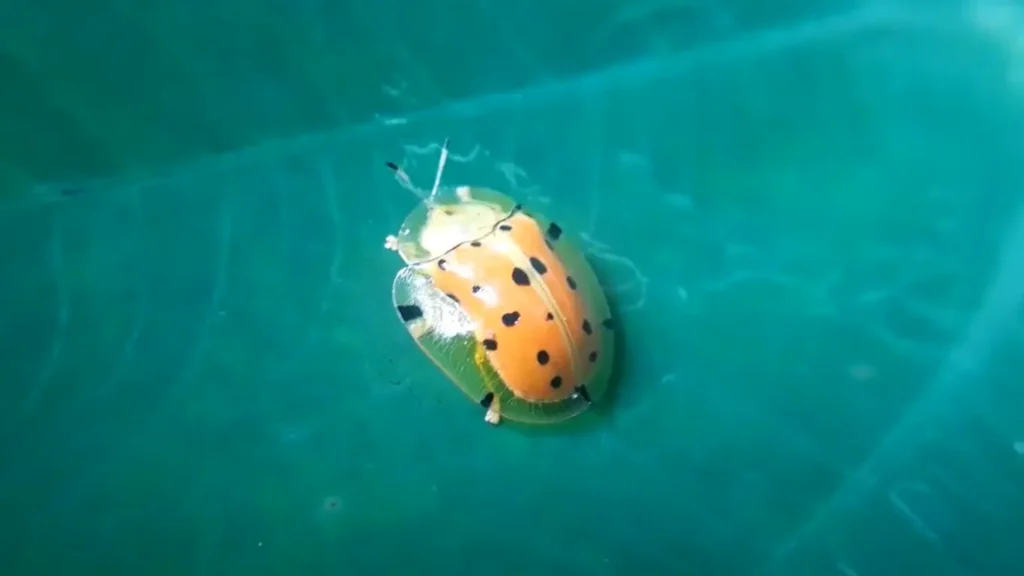
The Spotted Tortoise Beetle (Charidotella bicolor) is another eye-catching beetle with a clear or gold background and dark spots on its back. The pattern can change slightly from one beetle to another, making each look a little unique.
This beetle looks somewhat similar to the Argus tortoise beetle but has fewer and sometimes larger spots.
Spotted Tortoise Beetle Habitat
These beetles are found in gardens and fields with plenty of vine-like plants. They especially like to live on morning glories and related species. They are usually spotted on the underside of leaves.
They stay hidden during the day and are more active during the early morning or evening.
Spotted Tortoise Beetle Facts
- Has dark spots on a gold or light-colored shell
- May change shades depending on mood or light
- Feeds on morning glory leaves
- Larvae carry shields made of waste and shed skin
- Adults are more active during warm weather
Spotted Tortoise Beetle Range
This species is seen in Central and South America and has been reported in some parts of the southern U.S. They prefer warm, moist environments and tend to follow the growth of their host plants.
How to Identify a Spotted Tortoise Beetle
- Dome-shaped body with shiny appearance
- Light gold or clear background with black spots
- Body length around 5–7 mm
- Slightly transparent edge on the shell
- Often found alone or in small groups on leaves
8. Lantana Tortoise Beetle

The Lantana Tortoise Beetle (Octotoma championi) is a small beetle that feeds mostly on the lantana plant, a common ornamental plant with colorful flowers. Unlike shiny tortoise beetles, this one has a dull and flat appearance. It may not be as beautiful, but it plays a role in controlling lantana, which is considered a weed in many places.
This beetle is often used in some countries as a biological control agent to reduce wild lantana growth.
Lantana Tortoise Beetle Habitat
These beetles live wherever lantana grows—gardens, roadsides, forest edges, and even wild fields. They stay close to lantana plants because both the larvae and adults feed on its leaves.
They are more common in warmer regions and can survive in both wet and dry climates.
Lantana Tortoise Beetle Facts
- Specializes in feeding on lantana leaves
- Used in biological control programs
- Shell is dull brown or black, not shiny
- Larvae create tunnels in the leaves
- Adults chew holes and leaf edges
Lantana Tortoise Beetle Range
Originally from Central and South America, this beetle has also been introduced in Asia, Africa, and Australia to help manage invasive lantana plants. It can now be found in both tropical and subtropical regions.
How to Identify a Lantana Tortoise Beetle
- Small and oval-shaped
- Dull, dark shell (not metallic)
- Usually brown or black
- Around 4–6 mm long
- Always found on or near lantana plants
9. Fuzzy Tortoise Beetle

The Fuzzy Tortoise Beetle (Eurypepla calochroma) is a soft-looking beetle with fine hair-like textures on its shell. It may appear slightly fuzzy or velvety rather than shiny. The color can range from green to bronze or even brown, depending on the light.
Though it’s not flashy, this beetle is interesting because of its soft appearance and smooth movements.
Fuzzy Tortoise Beetle Habitat
This beetle prefers to live on plants from the nightshade family. It is found in gardens, fields, and sometimes forests. You might see it on leaves of tomato plants, eggplant, or wild nightshades.
They usually hide under leaves and come out more often in the early morning or late afternoon.
Fuzzy Tortoise Beetle Facts
- Covered in tiny hairs that give a soft look
- Color can look bronze, green, or brown
- Lives on nightshade family plants
- Moves slowly and hides from light
- Larvae use shields like other tortoise beetles
Fuzzy Tortoise Beetle Range
This beetle is found in parts of the southern United States, especially in areas with rich vegetation and nightshade plants. It may also appear in parts of Central America.
How to Identify a Fuzzy Tortoise Beetle
- Oval and slightly domed body
- Fine hair-like texture on the shell
- Green, brown, or bronze coloring
- Size about 5–8 mm
- Often blends in with leaves
10. Squash Tortoise Beetle

The Squash Tortoise Beetle (Metriona elatior) is a lesser-known beetle that feeds on plants in the cucumber and squash family. It has a soft-colored body and looks more like a traditional leaf beetle than the shiny tortoise types.
While not as common as other tortoise beetles, it still plays a role in garden ecosystems.
Squash Tortoise Beetle Habitat
This beetle lives in areas where squash, pumpkin, cucumber, and gourd plants grow. You might find it in vegetable gardens or small farms. It stays close to its food plants and feeds mainly on leaf surfaces.
They are active during warm months and hide under leaves during midday heat.
Squash Tortoise Beetle Facts
- Feeds on squash and cucumber plants
- Pale yellow or greenish in color
- Creates holes in the leaves
- Larvae live on the same plants as adults
- Moves slowly and hides when disturbed
Squash Tortoise Beetle Range
This species is mostly found in Central and South America, and has been recorded in southern parts of the U.S. where squash plants are grown. Its range is limited to areas with these crops.
How to Identify a Squash Tortoise Beetle
- Pale yellow or green oval body
- Flat shell with slightly rounded edges
- Around 6–9 mm in size
- Found only on squash or related plants
- Lacks bright shine like golden beetles
