
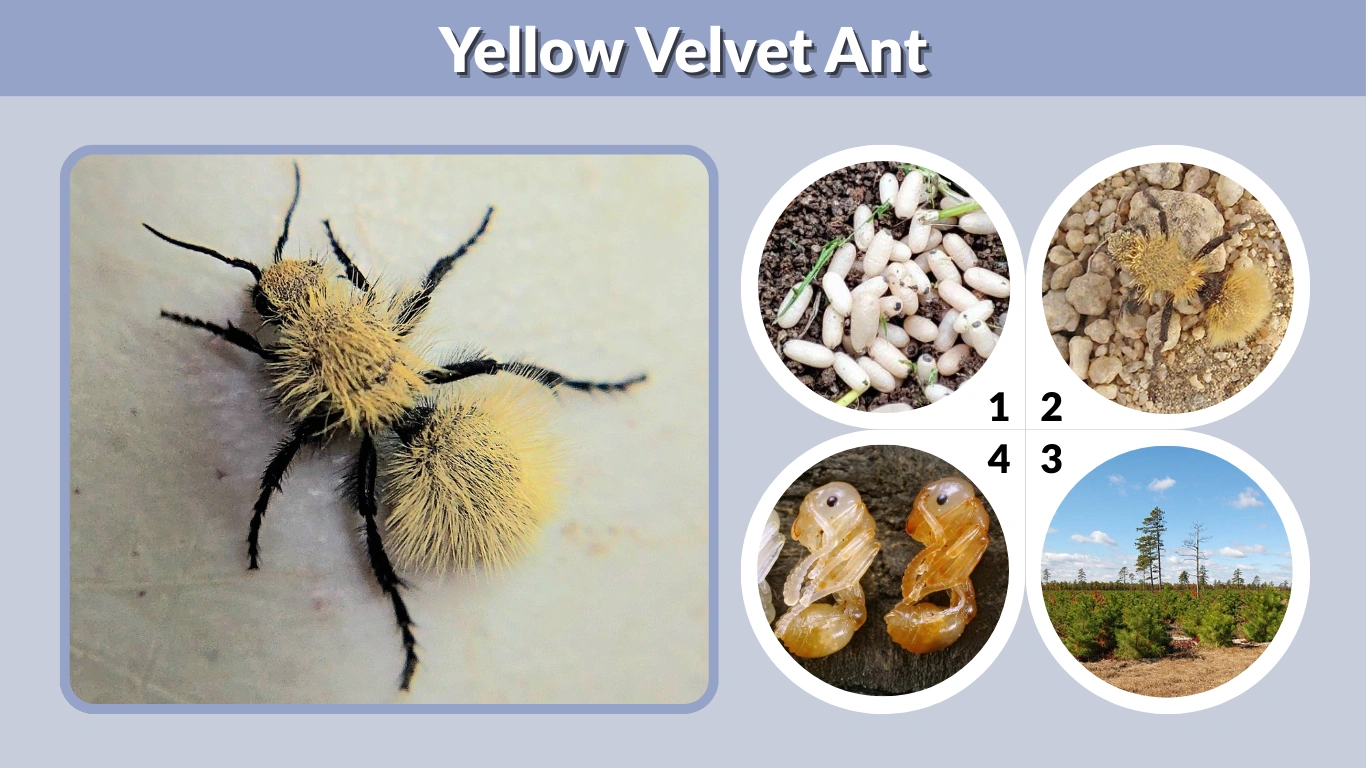
Yellow velvet ants are striking and unusual insects native to the southern and eastern United States. Despite their name, they are not true ants but wingless female wasps belonging to the family Mutillidae. They are famous for their bright yellow or yellow-orange velvety hair, hard exoskeleton, and extremely painful sting, earning some species nicknames like “cow killer.” These insects are solitary, ground-dwelling, and parasitic, laying their eggs in the nests of ground-nesting bees and wasps. While intimidating in appearance, they are important for controlling populations of other insects in their habitats.
What Are Yellow Velvet Ants?
Yellow velvet ants are wasps in the genus Dasymutilla. Only the females are wingless and crawl across the ground, while males have wings and can fly. Their bright coloration and velvety body serve as a warning to predators, signaling that they are capable of delivering a powerful sting.
Unlike social ants or bees, yellow velvet ants do not form colonies. Females roam alone in search of host insect nests to lay eggs. This solitary behavior, combined with their potent sting, helps them survive in open fields, sandy soils, and dry habitats where they are most commonly found.
Yellow Velvet Ant Identification
Physical Appearance
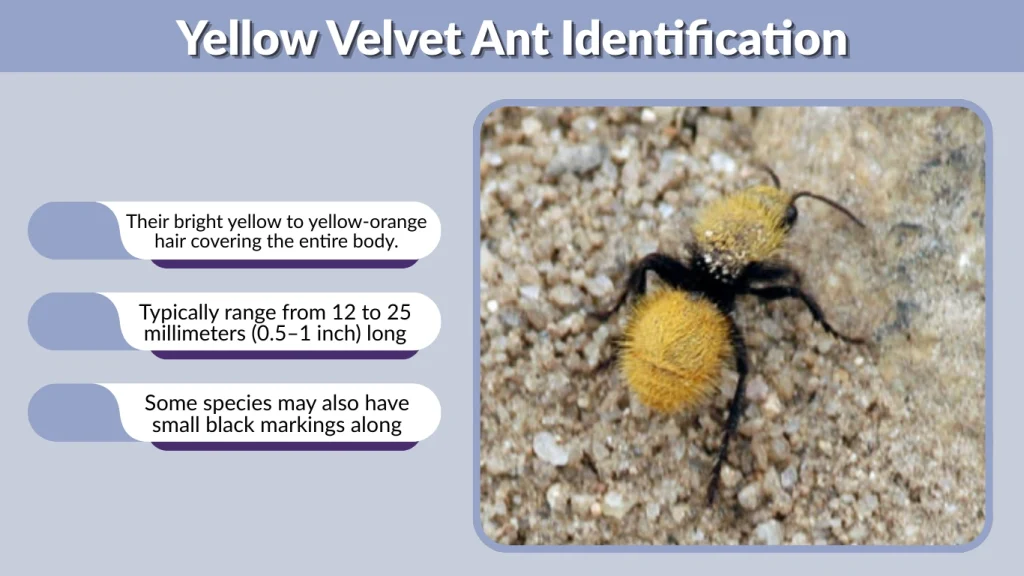
Yellow velvet ants are easily identifiable due to their bright yellow to yellow-orange hair covering the entire body. Their bodies are elongated with a narrow waist connecting the thorax and abdomen, giving them a wasp-like silhouette. The hairs are dense and ruffled, creating a soft, velvety texture that contrasts with the tough, hard exoskeleton beneath.
Some species may also have small black markings along the thorax or abdomen. The bright coloration not only makes them visually striking but also acts as a warning to predators that the insect is capable of delivering a painful sting.
Size
Females typically range from 12 to 25 millimeters (0.5–1 inch) long, making them relatively large for solitary insects. Males are usually slightly smaller and more slender, with wings that allow them to fly. Size varies between species but the velvety hair and bold coloration remain consistent.
Male vs Female Yellow Velvet Ants
Yellow velvet ants show pronounced sexual dimorphism:
- Females: Wingless, robust, brightly colored, and capable of stinging. These are the ones most often encountered by humans.
- Males: Winged, smaller, less vividly colored, and not capable of stinging. Males primarily fly to locate females for mating.
Recognizing these differences is essential for identification and for assessing sting risk.
Yellow Velvet Ant Species Overview
Several species of yellow velvet ants are found in North America, each varying slightly in coloration, size, and habitat preference. Some of the more common species include:
- Bright yellow Eastern species: Found in open fields and forests along the eastern U.S.
- Desert-adapted species: Found in southern plains and arid regions, often slightly smaller but still brightly colored.
- Parasitic variants: Specialize in parasitizing certain species of ground-nesting bees and wasps.
All yellow velvet ant species share the same key characteristics: velvety hair, bright warning coloration, solitary behavior, and a parasitic reproductive lifestyle.
Habitat and Distribution
Typical Habitat
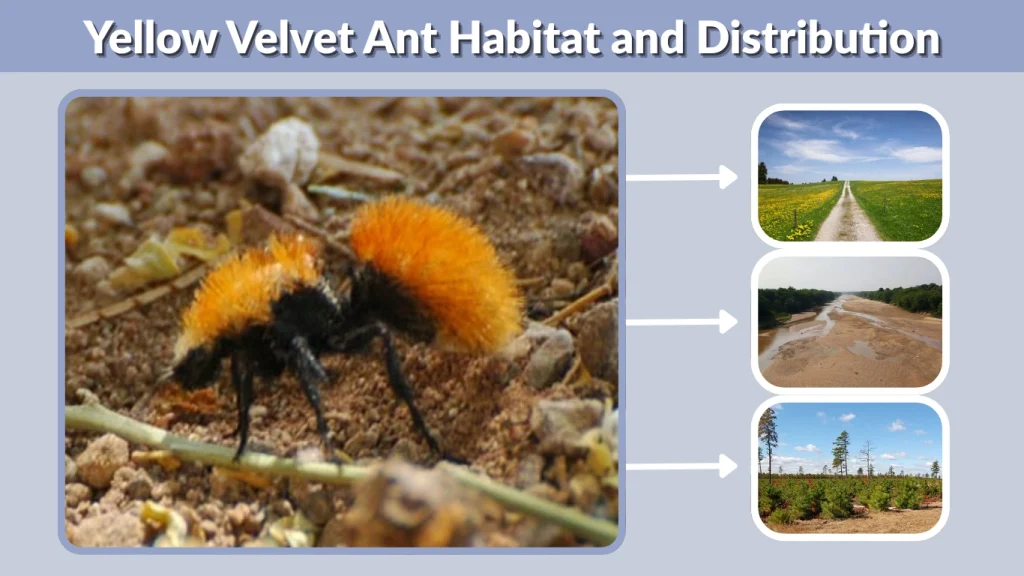
Yellow velvet ants prefer sandy or loose soil where they can move easily while searching for host nests. They are commonly found in:
- Open fields and grasslands
- Forest edges and clearings
- Sandy riverbanks and pine barrens
- Gardens and backyards with exposed soil
These environments provide warmth, access to host nests, and open areas for females to forage.
Distribution
Yellow velvet ants are distributed throughout the southern and eastern United States, including states like Texas, Florida, Georgia, and surrounding areas. They are more prevalent in regions with dry, sandy soils, though they may occasionally appear in disturbed habitats such as cleared fields or yards.
Yellow Velvet Ant Behavior
Yellow velvet ants are solitary and primarily ground-dwelling. Females roam the soil in search of host nests to lay eggs. They are active during the day, particularly in warm weather. When threatened, they may produce a high-pitched squeaking sound. Their bright yellow coloration, combined with a hard exoskeleton and rapid movement, serves as a strong defense against predators.
Yellow Velvet Ant Nest and Parasitic Lifestyle
Yellow velvet ants do not construct nests. Instead, females are parasitic: they lay eggs inside the nests of ground-nesting bees or wasps. The developing larvae feed on the host’s young, consuming them while remaining safely underground. This parasitic behavior ensures adequate nutrition and protection, allowing the species to thrive without building nests of their own.
Yellow Velvet Ant Diet
Adult Diet
Adult yellow velvet ants feed mainly on nectar, plant sap, and honeydew. This diet provides the energy needed for females to search for host nests and for males to fly and locate mates.
Larval Diet
Larvae are obligate parasites, feeding exclusively on the larvae or pupae of host insects. This ensures they have sufficient nutrients to develop fully into adults.
Yellow Velvet Ant Life Cycle
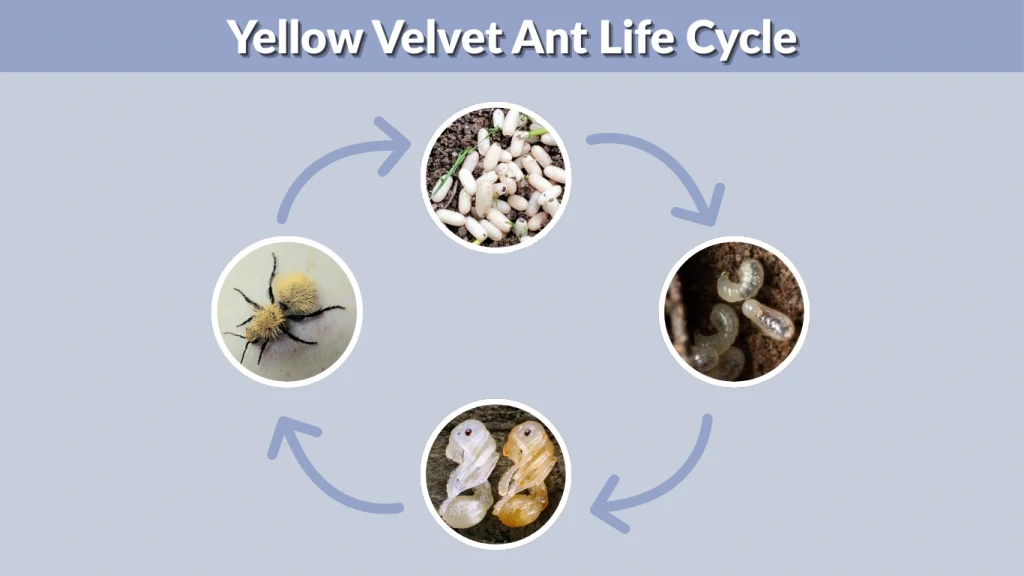
The life cycle of yellow velvet ants consists of four stages:
- Egg Stage: Females lay eggs in underground host nests.
- Larval Stage: Larvae feed on the host insect.
- Pupa Stage: Larvae pupate within the nest, undergoing metamorphosis.
- Adult Stage: Adults emerge, with females remaining wingless and males winged for mating purposes.
This lifecycle allows yellow velvet ants to maintain populations in areas where host insects are present.
Yellow Velvet Ant Sting and Defense
Sting
The female’s sting is extremely painful, earning the insect nicknames like “cow killer.” The venom produces a burning, sharp pain, sometimes accompanied by swelling and redness. While intense, stings are rarely dangerous unless the person has an allergic reaction.
Bite
Bites are rare and generally harmless; the sting is the primary defense.
Defense Mechanisms
Yellow velvet ants rely on warning coloration, a tough exoskeleton, rapid movement, and squeaking sounds to deter predators. These adaptations make them difficult to handle or harm.
Yellow Velvet Ant Facts
- Not a true ant; wingless females are wasps
- Solitary and parasitic
- Bright yellow coloration warns predators
- Females have an extremely painful sting
- Larvae feed on the young of ground-nesting bees and wasps
- Found in sandy soils, grasslands, and open fields
- Hard exoskeleton protects against predators
Yellow Velvet Ant Around Homes and Gardens
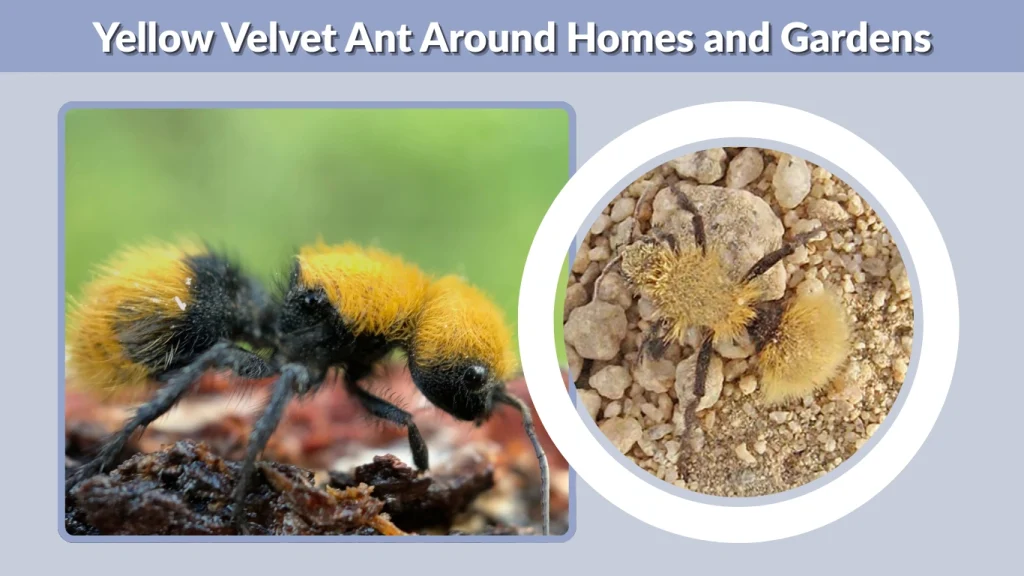
Yellow velvet ants may occasionally appear in yards, gardens, or sandy fields, but they do not infest homes. They are beneficial by regulating populations of ground-nesting bees and wasps. Observing them from a distance is safe, and handling should be avoided to prevent stings.
How to Avoid Yellow Velvet Ants
- Wear protective shoes and clothing outdoors, especially in sandy areas
- Avoid handling the insects directly
- Keep children and pets away from areas with high velvet ant activity
- Observe without disturbing, as their stings are painful but defensive
Yellow Velvet Ant vs Similar Insects
Yellow velvet ants are often confused with red velvet ants, Eastern velvet ants, and true ants. Key differences include:
- Females are wingless while males are winged
- Bright yellow coloration with velvety hair
- Solitary and parasitic, unlike social ants or bees
FAQs
Are yellow velvet ants dangerous?
Yellow velvet ants are not life-threatening to humans. However, females can deliver a very painful sting if handled or threatened. The sting can cause sharp burning pain, temporary swelling, and redness. They are best admired from a distance to avoid discomfort.
How painful is a yellow velvet ant sting?
The sting of a yellow velvet ant is extremely painful and often compared to a sharp, burning sensation. Pain intensity can vary, but it generally lasts a few minutes, and the site may remain sore for hours. Allergic reactions are rare but possible.
Where are yellow velvet ants most commonly found?
Yellow velvet ants are commonly found in the southern and eastern United States, including Georgia, Florida, and Texas. They prefer open fields, sandy soils, grasslands, and forest edges, often near host insect nests where females can lay eggs.
How can you tell a female yellow velvet ant from a male?
Females are wingless, larger, and have bright yellow velvety bodies. Males are smaller, winged, and less brightly colored. Females are the ones that crawl on the ground and are capable of stinging, while males are primarily flying insects focused on mating.
Do yellow velvet ants infest homes?
No, yellow velvet ants do not infest homes. They are solitary, ground-dwelling insects that rely on host insect nests for reproduction. They may occasionally appear in yards or gardens but pose no risk of forming colonies indoors.
