


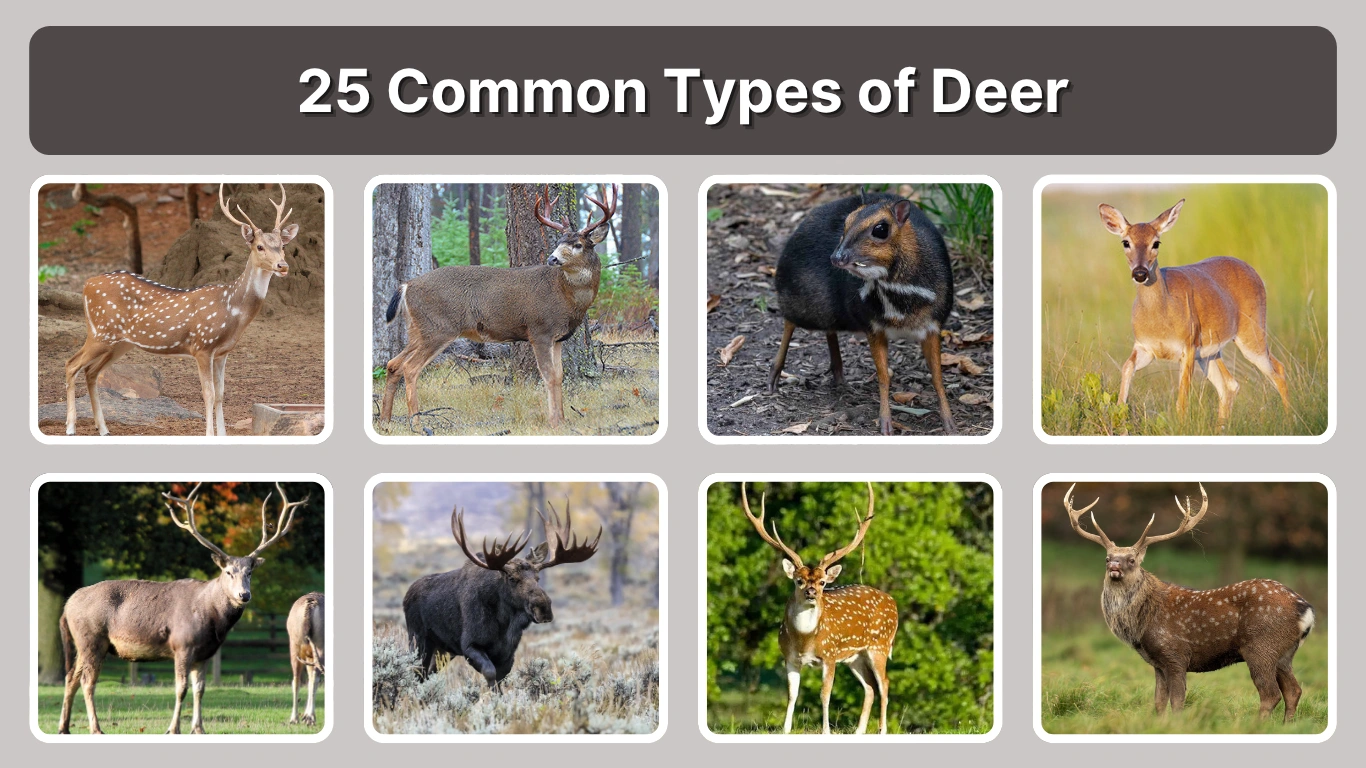
Deer are among the most graceful and widespread mammals on Earth, found across forests, grasslands, mountains, and wetlands worldwide. With their elegant antlers, keen senses, and incredible adaptability, deer species have evolved to thrive in a wide variety of environments—from the icy tundras of the north to the dense rainforests of Southeast Asia.
This guide explores 25 fascinating types of deer, each with its own unique features, behaviors, and habitats. From giants like the Moose and Elk to rare and tiny species like the Balabac Mouse-deer, you’ll discover how each species differs in size, diet, habitat preference, and more. Whether you’re interested in wildlife biology, conservation, or just love learning about nature, this list offers a detailed look at the world’s most remarkable deer species.
1. White-tailed Deer
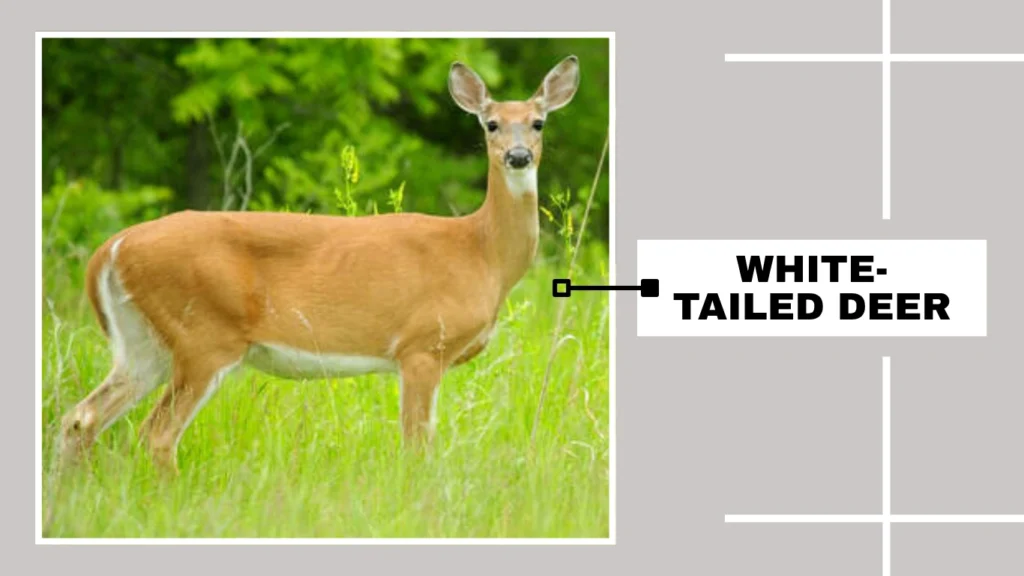
The White-tailed Deer (Odocoileus virginianus) is one of the most widely distributed and well-known deer species in North America. Named for the characteristic white underside of its tail, which it raises as a warning signal, this species thrives in a variety of habitats and plays an important ecological and cultural role.
Identification
- Size: 3.5–7 feet in body length
- Height: 2–4 feet at the shoulder
- Color: Reddish-brown in summer; grayish-brown in winter
- Tail: Long and bushy with a white underside
- Antlers: Only males grow antlers; typically have a main beam with multiple tines
- Weight: 90–300 pounds, varying by region and sex
Natural Habitat and Range
White-tailed Deer are highly adaptable and inhabit forests, grasslands, wetlands, and even suburban areas. They are found throughout the United States, Canada, Mexico, and parts of Central and South America. They prefer areas with dense vegetation for cover and open clearings for grazing.
Diet and Feeding Habits
As herbivores, White-tailed Deer feed on a wide range of vegetation including grasses, leaves, twigs, fruits, and agricultural crops. Their diet changes with the seasons—green plants dominate in spring and summer, while woody plants, nuts, and shrubs are preferred in fall and winter.
Behavior and Activity
These deer are most active at dawn and dusk (crepuscular), using cover to avoid predators. They are strong runners and excellent swimmers. Males, known as bucks, are typically solitary or form small bachelor groups, while females (does) may be seen with their young. During the fall rut, bucks compete for mates by sparring with their antlers.
2. Mule Deer
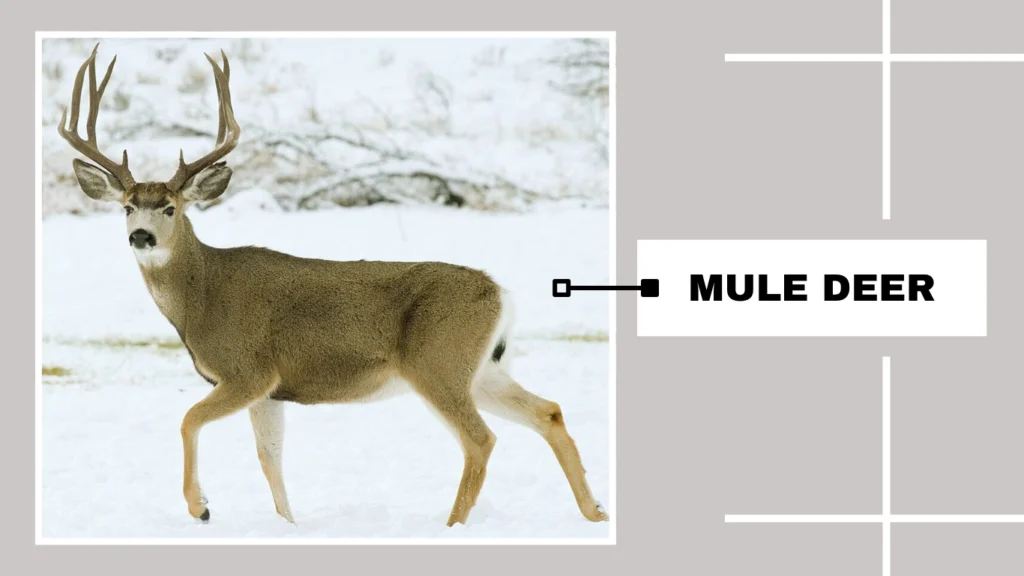
The Mule Deer (Odocoileus hemionus) is a large, western North American deer species known for its oversized ears—resembling those of a mule—and distinctive black-tipped tail. It thrives in diverse habitats, from deserts to mountainous forests.
Identification
- Size: 4.5–7 feet in body length
- Height: 3–3.5 feet at the shoulder
- Color: Grayish-brown body with a white rump patch
- Tail: Short with a black tip
- Antlers: Bifurcated (forked), spreading into Y-shaped branches
- Weight: 100–300 pounds
Natural Habitat and Range
Mule Deer are found mainly in western North America, including deserts, foothills, open woodlands, and alpine meadows. They prefer areas with a mix of shrubs and open space for browsing and visibility.
Diet and Feeding Habits
They are browsers and feed on woody plants, shrubs, twigs, and leaves. In the summer, they may eat wildflowers and grasses, while in winter they rely more on evergreen plants and dry twigs. Their diet is adapted to arid and semi-arid environments.
Behavior and Activity
Mule Deer are mostly active at dawn and dusk. They use a bounding gait called “stotting” to flee predators, leaping with all four legs off the ground. Males shed and regrow their antlers annually. During the rut, bucks fight for access to females, often using their antlers in sparring matches.
3. Red Deer
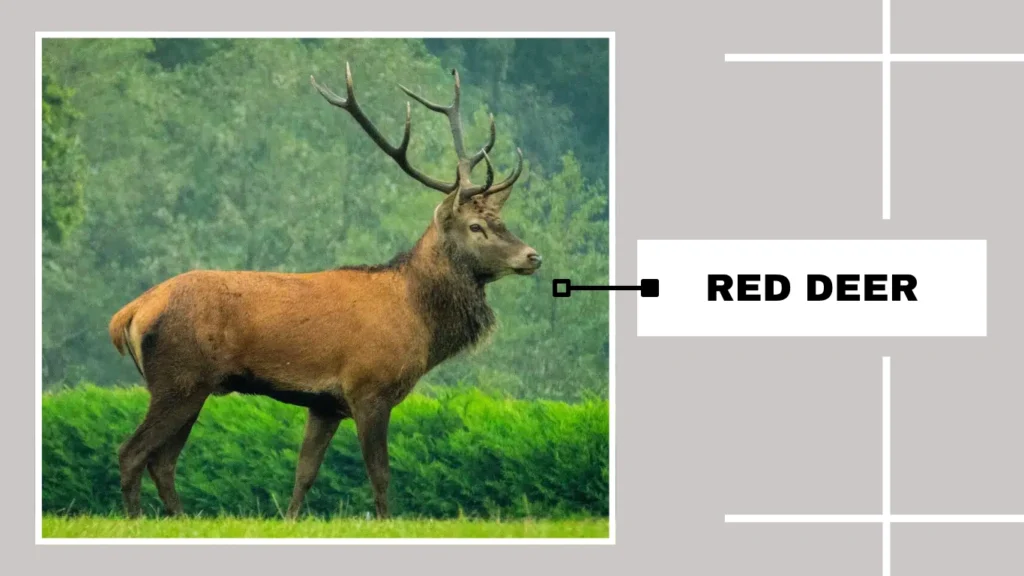
The Red Deer (Cervus elaphus) is one of the largest deer species in the world and is native to Europe, parts of Asia, and North Africa. It has also been introduced to other regions, including New Zealand and Argentina.
Identification
- Size: 5–8 feet in body length
- Height: 3.5–4.5 feet at the shoulder
- Color: Reddish-brown coat in summer; turns grayish in winter
- Tail: Short and not prominently marked
- Antlers: Large and branching; stags can grow impressive racks with multiple tines
- Weight: 200–500 pounds
Natural Habitat and Range
Red Deer inhabit woodlands, grasslands, and moorlands. They are highly adaptable and are found across much of Europe, the Caucasus Mountains, Central Asia, and parts of North Africa. In introduced ranges like New Zealand, they thrive in mountainous and forested terrain.
Diet and Feeding Habits
They feed on grasses, heather, bark, twigs, and leaves. Red Deer are grazers and browsers, adjusting their diet seasonally. In winter, they may strip bark and dig through snow to find food.
Behavior and Activity
Red Deer are social animals and live in herds. Stags and hinds typically live separately except during the rutting season in autumn. During this period, males roar loudly to challenge rivals and attract females. Their vocalizations can be heard from great distances and are a signature of the mating season.
4. Roe Deer

The Roe Deer (Capreolus capreolus) is a small, graceful species native to Europe and parts of Asia. It is known for its alert nature, reddish-brown summer coat, and white rump patch. This deer is commonly found in woodlands and farmland edges.
Identification
- Size: 3–4.5 feet in body length
- Height: 2–2.5 feet at the shoulder
- Color: Reddish-brown in summer; grayish-brown in winter
- Tail: Very short, almost invisible
- Antlers: Small and upright with 2–3 tines; found only in males
- Weight: 30–75 pounds
Natural Habitat and Range
Roe Deer are found throughout Europe and into western Asia. They prefer mixed woodlands with dense undergrowth and open meadows nearby for grazing. They are also seen near agricultural fields and even suburban gardens in some regions.
Diet and Feeding Habits
They are browsers that feed on a variety of plants including young shoots, buds, herbs, berries, and agricultural crops. Their selective feeding helps them obtain high-quality nutrients, particularly during spring and summer.
Behavior and Activity
Roe Deer are typically solitary or found in small family groups. They are shy and elusive, often active at dawn and dusk. During summer, they may be more visible in open areas. The rut occurs in mid to late summer, when males become territorial and chase females with fast, circular runs known as “roe rings.”
5. Sika Deer

The Sika Deer (Cervus nippon) is a medium-sized deer native to East Asia but also introduced in parts of Europe, New Zealand, and the U.S. It is known for its spotted coat, which it retains into adulthood—unlike most other deer species.
Identification
- Size: 3–5.5 feet in body length
- Height: 2.5–3.5 feet at the shoulder
- Color: Reddish-brown with white spots in summer; darker and more uniform in winter
- Tail: Short with a distinctive white rump patch
- Antlers: Males grow narrow, upright antlers with several tines
- Weight: 70–200 pounds
Natural Habitat and Range
Sika Deer inhabit woodlands, grasslands, marshes, and forested hills. They are native to Japan, China, Korea, and parts of Russia but have established populations in the U.K., Ireland, and elsewhere due to introductions.
Diet and Feeding Habits
They feed on a range of plant material including grasses, sedges, leaves, shoots, bark, and acorns. In some regions, they may cause damage to crops and forest understory due to overbrowsing.
Behavior and Activity
Sika Deer are more vocal than many other deer and emit high-pitched whistles or squeals. They can be solitary or live in small groups. Males become aggressive during the rut, which takes place in autumn, and may form harems of females. They are excellent swimmers and often retreat to water to avoid predators.
6. Fallow Deer

The Fallow Deer (Dama dama) is a medium-sized, elegant deer species known for its palmate (broad and flat) antlers and wide variation in coat colors. Originally native to the Mediterranean region, it has been introduced across Europe, the Americas, and parts of Asia.
Identification
- Size: 4–5.5 feet in body length
- Height: 2.5–3.5 feet at the shoulder
- Color: Variable—spotted fawn color, dark brown, white, or black
- Tail: Long with a black stripe running down the back to a white rump
- Antlers: Broad and flattened in adult males; unique among deer
- Weight: 90–220 pounds
Natural Habitat and Range
Fallow Deer prefer mixed woodland and open grassland environments. They are adaptable and commonly found in parklands, estates, and even near human settlements where cover and grazing are available. Their range now includes many parts of Europe, North America, and Oceania.
Diet and Feeding Habits
They are grazers and browsers, feeding on grasses, herbs, leaves, nuts, and fruits. In agricultural areas, they may also feed on cereal crops and vegetables. Their diet shifts seasonally depending on availability.
Behavior and Activity
Fallow Deer are social and often form herds, especially in open areas. Males are solitary outside the rutting season. During autumn, bucks compete for females through vocalizations and displays in “rutting stands” or leks. Their postures, calls, and antler duels help establish dominance.
7. Axis Deer (Chital)
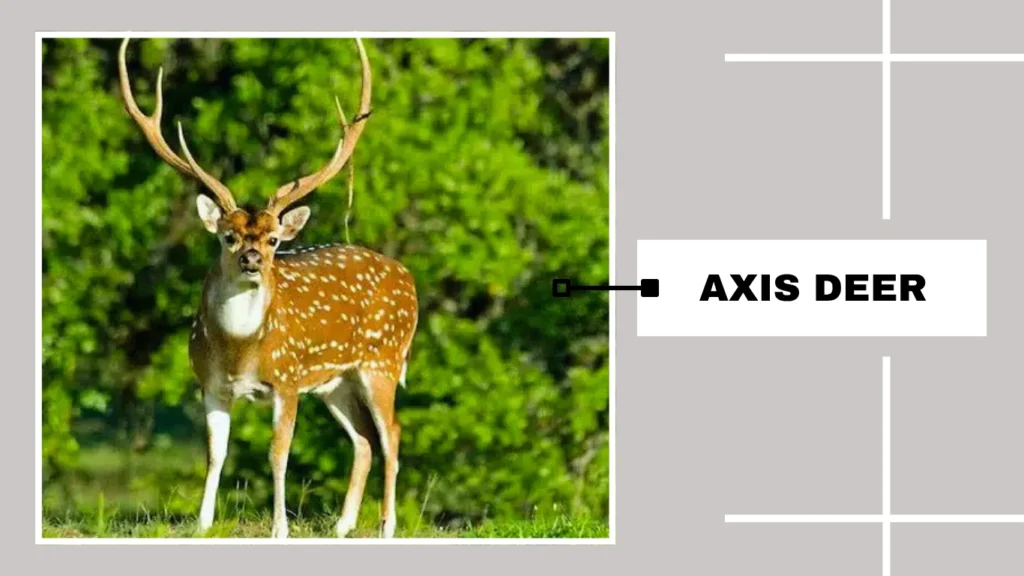
The Axis Deer (Axis axis), also known as the Chital, is a strikingly beautiful deer species native to the Indian subcontinent. It is known for its permanent white spots and harmonious social structure.
Identification
- Size: 3.5–5.5 feet in body length
- Height: About 3 feet at the shoulder
- Color: Reddish-brown coat with permanent white spots
- Tail: Medium-length with a white underside
- Antlers: Slender and three-pronged; grown only by males
- Weight: 90–200 pounds
Natural Habitat and Range
Axis Deer are found in grasslands, forests, and wooded scrublands across India, Sri Lanka, and Nepal. They have also been introduced to Texas, Hawaii, and Australia. They prefer areas near water and often coexist with other herbivores like langurs or sambar deer.
Diet and Feeding Habits
They graze and browse depending on the season. Their diet includes grasses, fruits, flowers, and tree bark. They are most active in the early morning and late afternoon and often feed in open spaces.
Behavior and Activity
Axis Deer are social and form large herds consisting of females, young, and a few males. Males are not strongly territorial and may join or leave herds freely. They communicate using alarm calls, especially when predators are near. Their high-pitched calls are commonly heard in the wild.
8. Elk (Wapiti)

The Elk (Cervus canadensis), also known as Wapiti, is one of the largest species in the deer family. Native to North America and parts of Asia, elk are known for their impressive antlers and loud bugling calls during the mating season.
Identification
- Size: 6–8 feet in body length
- Height: 4–5 feet at the shoulder
- Color: Tan body with darker neck and legs; rump patch is pale
- Tail: Short and light-colored
- Antlers: Large, sweeping antlers with many tines; found only in males
- Weight: 500–1,100 pounds
Natural Habitat and Range
Elk inhabit forests, grasslands, meadows, and mountain ranges. They are found throughout western North America, parts of eastern Asia, and have been reintroduced to parts of the eastern U.S. and Europe. They prefer open areas with access to forest cover for shelter.
Diet and Feeding Habits
They graze on grasses, shrubs, and tree bark, with their diet changing seasonally. In summer, they consume tender grasses and forbs, while in winter they eat woody vegetation and bark. Elk feed primarily in the early morning and evening.
Behavior and Activity
Elk are social animals and form large herds, especially during migration or winter. During the fall rut, males compete for harems through displays and bugling—loud, high-pitched calls that echo across valleys. Bulls often engage in antler clashes to establish dominance.
9. Moose

The Moose (Alces alces) is the largest and heaviest member of the deer family. It is easily recognized by its long legs, humped shoulders, and massive, palm-shaped antlers. Moose are solitary forest dwellers, mostly found in the Northern Hemisphere.
Identification
- Size: 7–10 feet in body length
- Height: 5–6.5 feet at the shoulder
- Color: Dark brown to black coat; legs often lighter
- Tail: Very short and barely visible
- Antlers: Broad and flat (palmate) antlers grown by males
- Weight: 800–1,600 pounds
Natural Habitat and Range
Moose are found in northern North America, Europe, and Asia, favoring boreal forests, swamps, and wetlands. They require cold climates and are often found near lakes, rivers, and bogs where aquatic vegetation is abundant.
Diet and Feeding Habits
Moose are browsers that feed on leaves, twigs, bark, and aquatic plants. In summer, they wade into lakes and ponds to eat water lilies and pondweed. In winter, they rely on woody shrubs and trees like willow, birch, and aspen.
Behavior and Activity
Moose are typically solitary, except during mating season or when females are with calves. They are excellent swimmers and can dive underwater to feed. Males become aggressive during the rut and may engage in antler fights. Their deep grunts and bellows are used for communication during mating season.
10. Reindeer (Caribou)
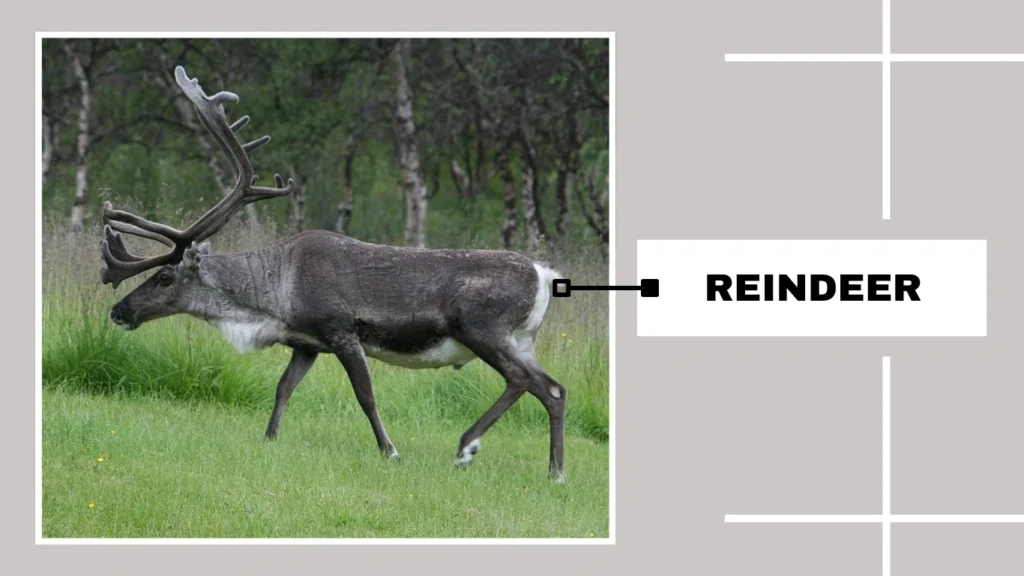
The Reindeer (Rangifer tarandus), known as Caribou in North America, is a cold-adapted deer species native to Arctic, sub-Arctic, and boreal regions. Uniquely, both males and females grow antlers—an adaptation that sets them apart from other deer.
Identification
- Size: 4–7 feet in body length
- Height: 3–4.5 feet at the shoulder
- Color: Varies by subspecies; generally gray-brown with a white neck and underparts
- Tail: Short and bushy
- Antlers: Large and complex; both sexes grow them, but male antlers are larger
- Weight: 180–400 pounds (females), 350–700 pounds (males)
Natural Habitat and Range
Reindeer are found across the northern latitudes of North America, Europe, and Asia. They inhabit tundra, taiga, and mountainous regions, and often migrate long distances between summer and winter ranges.
Diet and Feeding Habits
Their diet includes lichens, mosses, grasses, sedges, and shrubs. In winter, they use their hooves to dig through snow to access lichens (reindeer moss). They also consume mushrooms and leaves during the warmer months.
Behavior and Activity
Reindeer are highly migratory, with some herds traveling up to 3,000 miles annually. They form large herds, especially during migrations. Vocalizations and scent marking are used for communication, and their broad hooves help them traverse snow and soft ground effectively.
11. Barasingha (Swamp Deer)
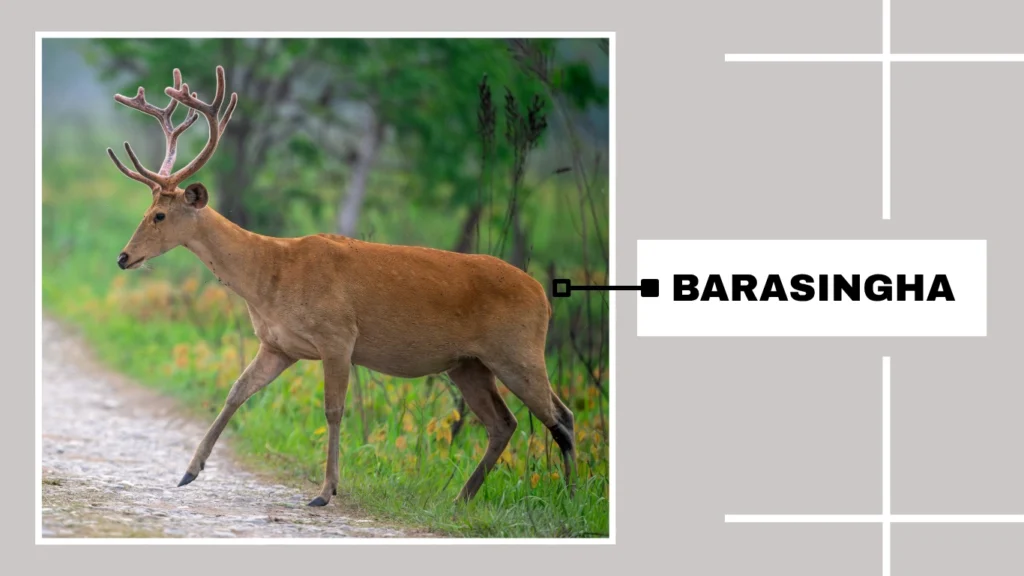
The Barasingha (Rucervus duvaucelii), also known as the Swamp Deer, is a rare deer species native to the Indian subcontinent. Its name means “twelve-tined,” referring to the male’s impressive antlers.
Identification
- Size: 5–6.5 feet in body length
- Height: 4 feet at the shoulder
- Color: Golden-brown coat with white underparts and spots along the back
- Tail: Medium-length and bushy
- Antlers: Multi-tined (up to 12–14 points), long and slightly curved
- Weight: 350–620 pounds
Natural Habitat and Range
Barasingha are found in marshy grasslands, floodplains, and riverine forests in India and Nepal. They require moist ground and tall grasses for cover and feeding. Most remaining wild populations live in protected reserves.
Diet and Feeding Habits
They feed on grasses, aquatic plants, and marsh vegetation. Barasingha prefer tender shoots and occasionally graze on crop fields near their habitat. Their broad hooves help them walk on swampy terrain without sinking.
Behavior and Activity
Barasingha are social and live in herds of up to 60 individuals. During the rut, males display by bugling and challenging rivals. They are diurnal, most active in early morning and late afternoon. Due to habitat loss and hunting, they are classified as vulnerable and are under active conservation.
12. Père David’s Deer
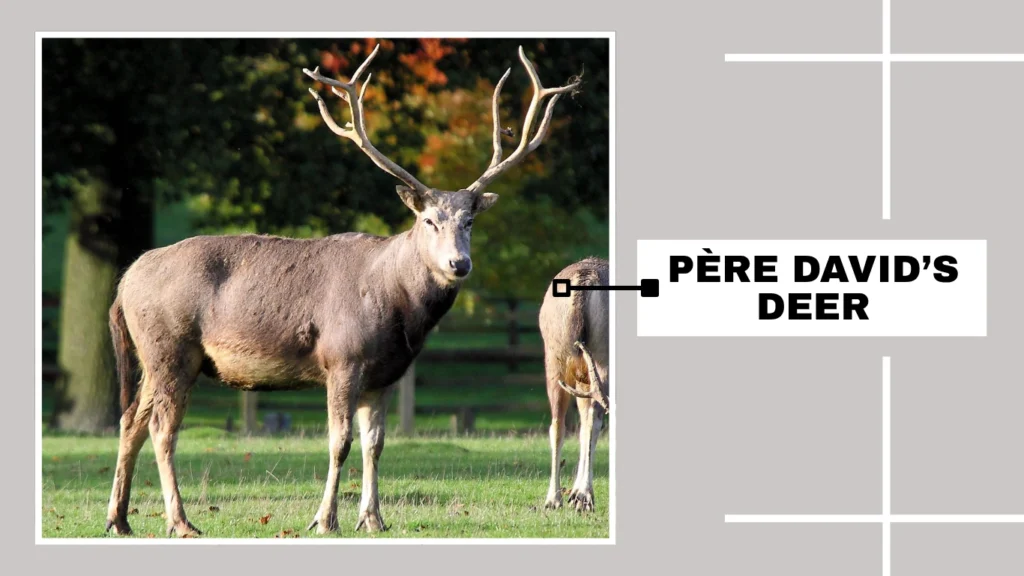
Père David’s Deer (Elaphurus davidianus) is a unique and rare species native to China. It became extinct in the wild in the early 20th century but was saved through captive breeding and later reintroduced to protected areas.
Identification
- Size: 6–7.5 feet in body length
- Height: 3.5–4 feet at the shoulder
- Color: Reddish-brown in summer; grayish-brown in winter
- Tail: Long with a black tuft at the end
- Antlers: Males have large, backward-sweeping antlers with multiple tines
- Weight: 330–440 pounds
Natural Habitat and Range
Originally native to the subtropical marshes of China’s river valleys, Père David’s Deer now survives in reserves and parks. Wild populations have been reestablished in limited areas of China, primarily in wetlands or swampy grasslands.
Diet and Feeding Habits
Their diet includes grasses, aquatic plants, and leaves. In the wild or in reserves, they browse on soft vegetation and graze when available. Their feeding habits are closely tied to wetland environments.
Behavior and Activity
These deer are social and live in herds, especially during the non-breeding season. Males become territorial during the rut and compete for harems. They are good swimmers and often retreat into water when disturbed. Their conservation is considered a global success story.
13. Marsh Deer

The Marsh Deer (Blastocerus dichotomus) is the largest deer species in South America, primarily found in wetland regions. It is well adapted to aquatic environments and is often spotted in marshes and flooded grasslands.
Identification
- Size: 5.5–7 feet in body length
- Height: About 3.5–4 feet at the shoulder
- Color: Reddish-brown to golden-brown with white throat and inner legs
- Tail: Short and bushy
- Antlers: Large, branched antlers in males, resembling those of North American deer
- Weight: 200–300 pounds
Natural Habitat and Range
Marsh Deer inhabit swampy lowlands, wetlands, and seasonally flooded savannas in central and southern South America, particularly in the Pantanal and Paraná River regions. They prefer areas with tall grasses and aquatic vegetation.
Diet and Feeding Habits
Their diet includes aquatic plants, reeds, grasses, and soft vegetation. They often wade through shallow water to access food and are excellent swimmers. Their long, wide hooves help distribute weight and prevent sinking into soft, muddy ground.
Behavior and Activity
Marsh Deer are generally solitary or found in small groups. They are shy and elusive, using dense vegetation for cover. Active during the early morning and late afternoon, they remain near water and use it as an escape route from predators. Habitat destruction and poaching have led to declining numbers in many areas.
14. Pampas Deer

The Pampas Deer (Ozotoceros bezoarticus) is a medium-sized deer species native to the grasslands of South America, particularly the Pampas region. Once abundant, its population has declined due to habitat loss and hunting.
Identification
- Size: 3.5–5 feet in body length
- Height: Around 2.5–3 feet at the shoulder
- Color: Light brown to reddish-tan coat with a white underside
- Tail: Short and white
- Antlers: Small, with 3 tines typically seen in adult males
- Weight: 60–90 pounds
Natural Habitat and Range
Pampas Deer are found in open grasslands, savannas, and shrublands of Brazil, Argentina, Uruguay, and Paraguay. They prefer areas with low vegetation that allows for good visibility and easy movement.
Diet and Feeding Habits
They graze on grasses, herbs, and low-growing shrubs. Pampas Deer are selective feeders, choosing nutrient-rich plants. They often feed during the cooler hours of morning and late afternoon.
Behavior and Activity
Pampas Deer are social and usually seen in small groups of 2 to 6 individuals. They are alert and rely on speed and agility to escape predators. Males may display territorial behavior during the mating season, using scent marking and posture to communicate dominance.
15. Tufted Deer
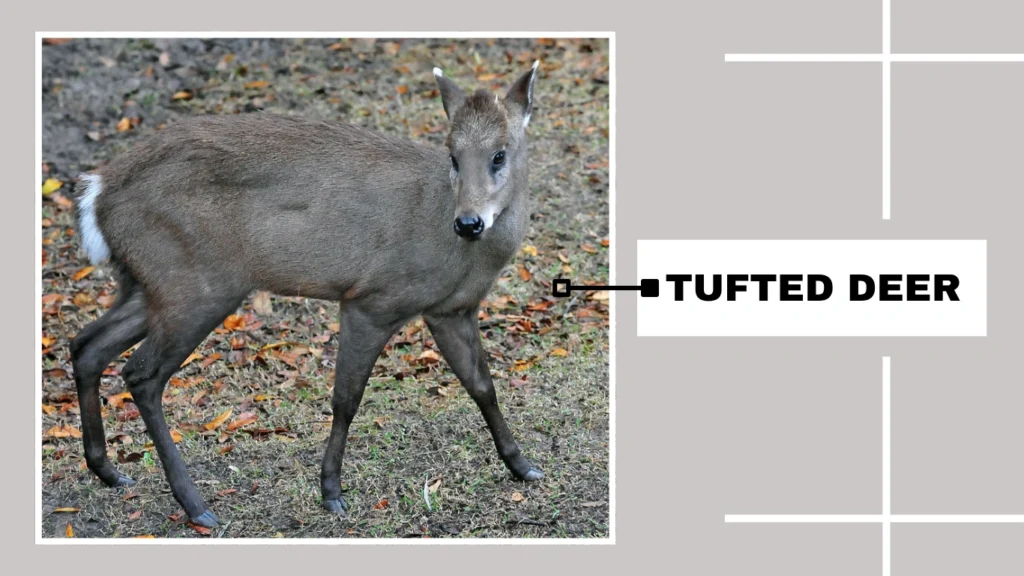
The Tufted Deer (Elaphodus cephalophus) is a small, shy deer species found in forested mountains of China and northeastern Myanmar. It is named for the prominent tuft of dark hair on its forehead and the fang-like canines found in males.
Identification
- Size: 3–4 feet in body length
- Height: About 2 feet at the shoulder
- Color: Dark brown or grayish coat with a lighter underside
- Tail: Short and white-tipped
- Antlers: Tiny spikes in males, often hidden by the head tuft
- Weight: 35–70 pounds
Natural Habitat and Range
Tufted Deer live in dense, humid forests and hilly regions at elevations between 500 to 4,500 meters. They prefer areas with thick vegetation and cover, which helps them stay hidden from predators.
Diet and Feeding Habits
They browse on leaves, twigs, fruits, bark, and shrubs. Their small size allows them to feed in dense underbrush where larger herbivores cannot reach. Feeding is mostly nocturnal or crepuscular.
Behavior and Activity
Tufted Deer are solitary or seen in pairs, especially during the mating season. Males use their tusk-like upper canines for fighting and displays during territorial disputes. They are secretive and tend to freeze or flee silently when disturbed, relying on camouflage and stealth rather than speed.
16. Chinese Water Deer
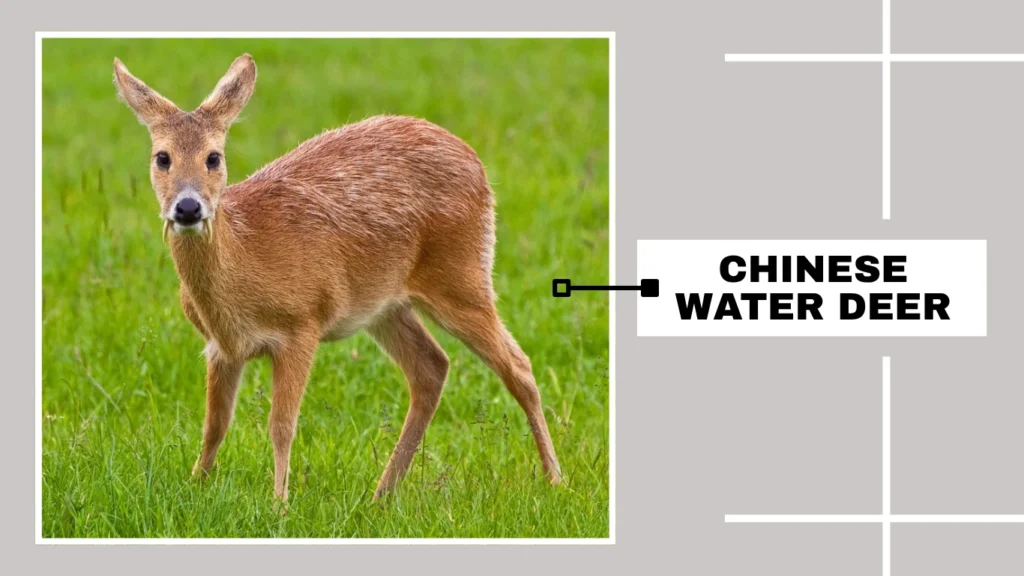
The Chinese Water Deer (Hydropotes inermis) is a small, tusked deer species native to eastern China and Korea. Uniquely, it lacks antlers—both males and females—but males possess prominent canine tusks used in dominance battles.
Identification
- Size: 2.5–3.5 feet in body length
- Height: 1.5–2 feet at the shoulder
- Color: Reddish-brown in summer; grayer in winter
- Tail: Short and not prominent
- Antlers: Absent in both sexes
- Tusk: Males have long, downward-curving canine teeth
- Weight: 20–30 pounds
Natural Habitat and Range
Chinese Water Deer inhabit swamps, reed beds, riverbanks, and wetlands with thick vegetation. Though native to China and Korea, they’ve also established feral populations in the U.K., where they thrive in wet meadows and agricultural areas.
Diet and Feeding Habits
They are herbivores that feed on grasses, sedges, reeds, and soft foliage. In agricultural zones, they may graze on root crops and cereals. Their diet is adapted to moist environments with abundant vegetation.
Behavior and Activity
These deer are solitary and highly territorial. Males use their tusks to fight rivals during the rut. They are secretive and crepuscular, most active during dawn and dusk. When alarmed, they bark or emit a sharp whistle and retreat into dense cover.
17. Muntjac (Barking Deer)
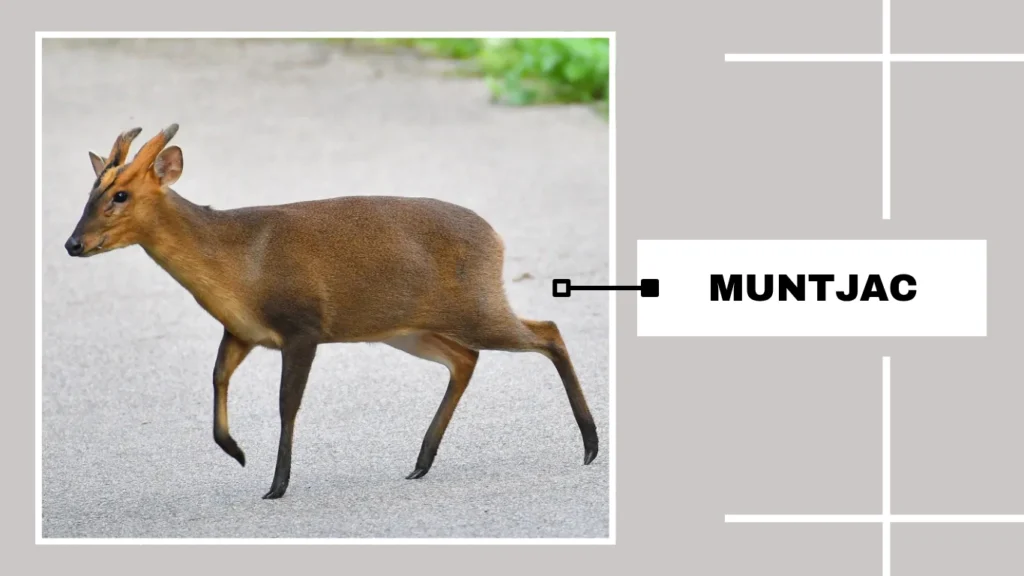
The Muntjac, commonly known as the Barking Deer, belongs to the genus Muntiacus and is native to South and Southeast Asia. Named for its dog-like bark, this small deer is among the most primitive in evolutionary terms.
Identification
- Size: 2.5–3 feet in body length
- Height: 1.5–2 feet at the shoulder
- Color: Reddish-brown or dark brown with a white underside
- Tail: Short and bushy
- Antlers: Small, simple spikes with a single tine (males only)
- Tusk: Males also have visible downward-pointing canines
- Weight: 33–75 pounds
Natural Habitat and Range
Muntjacs inhabit dense forests, scrublands, and hilly terrain from India and Sri Lanka to Southeast Asia and southern China. They have also been introduced to the U.K. and parts of Europe, where they adapt well to woodlands and farmland edges.
Diet and Feeding Habits
They browse on leaves, fruits, seeds, bark, and shoots. Opportunistic feeders, they also eat fungi and even bird eggs if available. Their diet varies widely depending on seasonal availability and local flora.
Behavior and Activity
Muntjacs are solitary or live in pairs. They are territorial and mark boundaries with scent glands on their face. Males use both tusks and antlers in combat. Their distinctive barking call, used to signal alarm or ward off intruders, gives them their nickname. They are active during both day and night, especially in thick vegetation.
18. Indian Hog Deer

The Indian Hog Deer (Axis porcinus) is a small, sturdy deer species native to the Indian subcontinent and parts of Southeast Asia. It gets its name from its unique hog-like posture and movement—keeping its head low as it runs through underbrush.
Identification
- Size: 3.5–5 feet in body length
- Height: 2–2.5 feet at the shoulder
- Color: Brown coat with lighter underparts; sometimes faintly spotted
- Tail: Short with a white underside
- Antlers: Short and three-tined in males, angled forward
- Weight: 100–150 pounds
Natural Habitat and Range
Hog Deer are typically found in tall grasslands, floodplains, forest edges, and river valleys across northern India, Nepal, Bangladesh, and western Myanmar. They prefer areas with thick vegetation for cover and nearby water sources.
Diet and Feeding Habits
They feed on grasses, herbs, and tender shoots. In agricultural regions, they may also graze on crop fields. As low browsers, they often feed close to the ground and rely on stealth rather than speed when threatened.
Behavior and Activity
Unlike many deer, Hog Deer tend to live alone or in very small groups. When startled, they run in a zigzag pattern with their heads held low—similar to a hog—making them difficult to track. Males become territorial during the rut and may engage in brief antler battles.
19. Sambar Deer

The Sambar Deer (Rusa unicolor) is one of the largest deer species in Asia and is widely distributed across the Indian subcontinent, Southeast Asia, and parts of China. Known for its rugged build and large, rugged antlers, it inhabits dense forests and hilly terrain.
Identification
- Size: 5–8 feet in body length
- Height: 4–5 feet at the shoulder
- Color: Dark brown to grayish-brown, often with a coarse mane on the neck
- Tail: Short with a black tip and white underside
- Antlers: Large and rugged, typically with three tines; only in males
- Weight: 350–1,200 pounds
Natural Habitat and Range
Sambar Deer are found in tropical and subtropical forests, hilly woodlands, swamps, and grasslands. They range across India, Sri Lanka, Nepal, Southeast Asia, southern China, and have also been introduced to Australia and New Zealand.
Diet and Feeding Habits
They browse on leaves, shrubs, grasses, fruits, and aquatic plants. Their diet is highly adaptable to seasonal availability and forest density. They often feed near water bodies and wallow in mud to cool down and deter parasites.
Behavior and Activity
Sambar are mostly solitary or found in small groups. They are elusive, shy, and primarily nocturnal or crepuscular. During the rut, males become vocal, emitting deep bellowing calls to attract females or challenge rivals. They are strong swimmers and use water bodies for both feeding and escape from predators.
20. Eld’s Deer

Eld’s Deer (Rucervus eldii), also known as the Thamin or Brow-antlered Deer, is a rare and elegant species native to Southeast Asia. It is known for its distinctive, bow-shaped antlers and slender build. Several subspecies exist, with some critically endangered.
Identification
- Size: 5.5–6.5 feet in body length
- Height: 3.5–4 feet at the shoulder
- Color: Reddish-brown in summer; duller and grayer in winter
- Tail: Medium-length with a white underside
- Antlers: Long, sweeping antlers curving outward and backward with multiple tines (males only)
- Weight: 275–375 pounds
Natural Habitat and Range
Eld’s Deer inhabit open grasslands, moist deciduous forests, and swampy meadows in India, Myanmar, Laos, Cambodia, and Vietnam. They require a mix of open feeding grounds and dense cover for resting and protection.
Diet and Feeding Habits
They graze on grasses, aquatic plants, and herbs, occasionally browsing on shrubs and leaves. Their feeding activity peaks during early morning and evening hours.
Behavior and Activity
These deer are generally crepuscular and live in small herds. Males are territorial during the rut and engage in antler fights to compete for females. Due to habitat destruction, poaching, and limited range, some subspecies—like the Manipur Eld’s Deer—are critically endangered.
21. Thorold’s Deer (White-lipped Deer)

Thorold’s Deer (Cervus albirostris), also called the White-lipped Deer, is a large and rare high-altitude deer species native to the Tibetan Plateau. It is adapted to extreme cold and is one of the few deer species living above 4,000 meters.
Identification
- Size: 6–7.5 feet in body length
- Height: 4–4.5 feet at the shoulder
- Color: Brown to grayish coat with a white throat patch, lips, and rump
- Tail: Medium-length, white with a dark tip
- Antlers: Thick and complex with several tines; only males have antlers
- Weight: 300–550 pounds
Natural Habitat and Range
This species lives in alpine meadows, shrublands, and coniferous forests at high elevations (3,500–5,100 meters) in Tibet, western China, and parts of Bhutan. They are highly cold-tolerant and migrate vertically with the seasons.
Diet and Feeding Habits
Thorold’s Deer graze on grasses, sedges, lichens, and shrubs. In winter, they dig through snow to find food and may eat woody plants and bark when vegetation is scarce.
Behavior and Activity
They are typically active at dawn and dusk and may form small herds. During the rut, males use their antlers in head-to-head battles to gain access to females. Their rugged build and thick fur help them survive in harsh mountain conditions. Due to habitat loss and hunting, they are listed as vulnerable.
22. Key Deer

The Key Deer (Odocoileus virginianus clavium) is a small subspecies of the White-tailed Deer found only in the Florida Keys. It is the smallest North American deer and is federally endangered due to habitat loss and road mortality.
Identification
- Size: 2.5–3.5 feet in body length
- Height: 24–32 inches at the shoulder
- Color: Brownish-gray with a white underside and tail
- Tail: White with a black border, often raised when alarmed
- Antlers: Small and simple; present in males only
- Weight: 45–85 pounds
Natural Habitat and Range
Key Deer are native to the lower Florida Keys, especially Big Pine Key and nearby islands. They live in pine rocklands, mangroves, hardwood hammocks, and freshwater wetlands. Their range is very limited due to the island geography.
Diet and Feeding Habits
They feed on over 150 species of plants including grasses, fruits, leaves, and shrubs. They prefer native vegetation but will also consume garden plants and ornamental landscaping in residential areas.
Behavior and Activity
Key Deer are diurnal and often active during the day. They are relatively tame and have little fear of humans, making them vulnerable to vehicle collisions. Males are solitary or travel in small groups, while females are seen with fawns. Breeding occurs year-round, peaking in fall and winter.
23. Black-tailed Deer
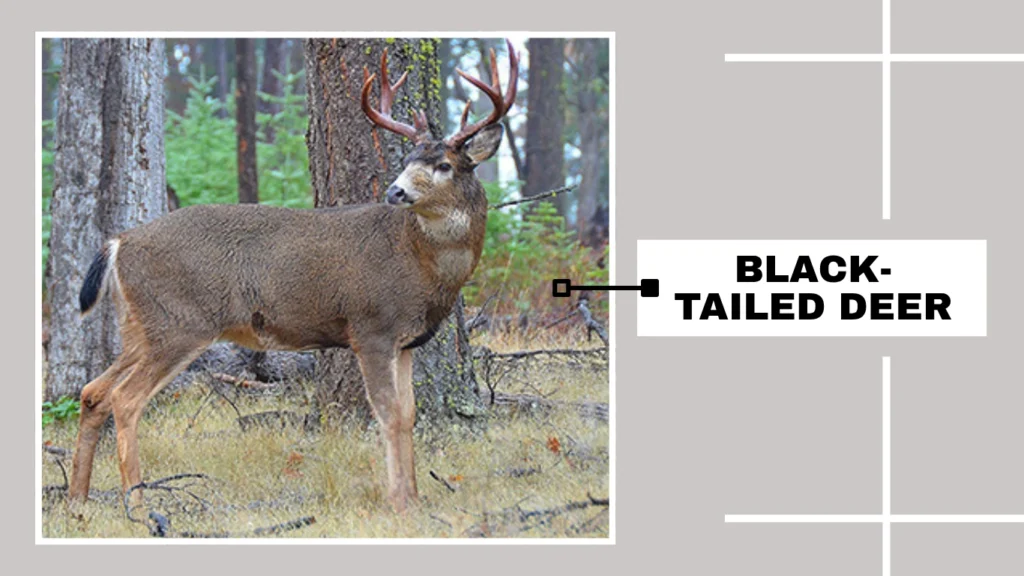
The Black-tailed Deer (Odocoileus hemionus columbianus) is a subspecies of the Mule Deer, found along the Pacific coast of North America. It is known for its dark-colored tail and preference for moist, forested habitats.
Identification
- Size: 4.5–6.5 feet in body length
- Height: 3–3.5 feet at the shoulder
- Color: Reddish-brown to grayish-brown with a white rump
- Tail: Short and wide with a dark black upper surface
- Antlers: Forked, Y-shaped antlers typical of mule deer (males only)
- Weight: 100–200 pounds
Natural Habitat and Range
Black-tailed Deer are found along the Pacific Northwest, from northern California to British Columbia and parts of Alaska. They inhabit coastal rainforests, mixed woodlands, and mountain slopes with dense vegetation.
Diet and Feeding Habits
Their diet includes shrubs, leaves, acorns, mushrooms, grasses, and berries. They are primarily browsers and adapt their diet based on seasonal plant availability.
Behavior and Activity
These deer are crepuscular, most active during dawn and dusk. Bucks are solitary or form bachelor groups, while does are often seen with fawns. During the rut, bucks compete for females through displays and short fights. Their behavior and range may vary with elevation and weather patterns.
24. Balabac Mouse-deer
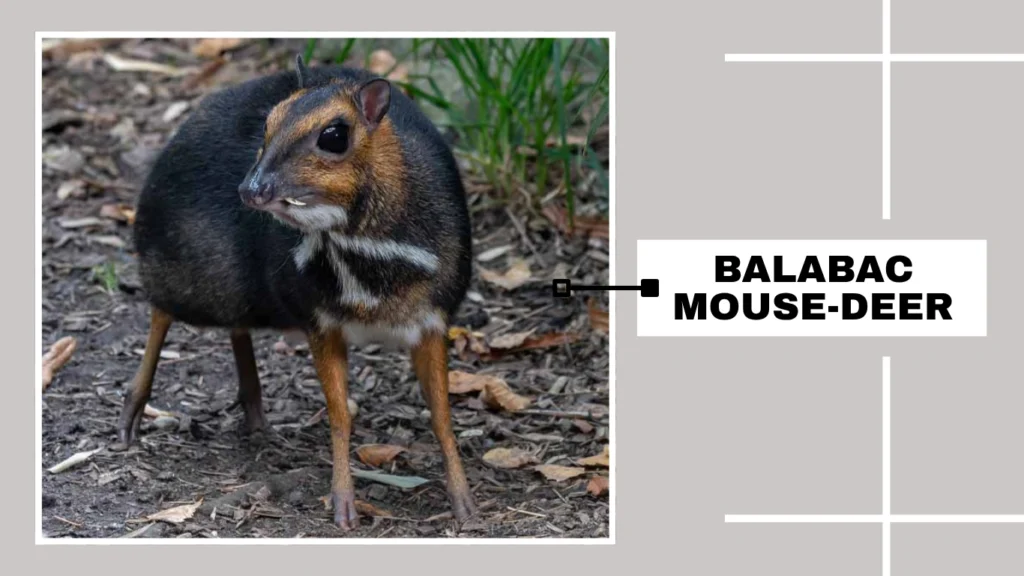
The Balabac Mouse-deer (Tragulus nigricans), also known as the Philippine Mouse-deer, is a tiny, primitive ungulate that belongs to the chevrotain family. Despite its name, it is not a true deer but closely resembles one in appearance.
Identification
- Size: 18–22 inches in body length
- Height: 7–9 inches at the shoulder
- Color: Dark brown body with lighter underparts and white markings on the throat
- Tail: Short and thin
- Antlers: None
- Weight: 1.5–2.5 kilograms
Natural Habitat and Range
This mouse-deer is endemic to Balabac and nearby islands in the Philippines. It inhabits lowland tropical forests and thick underbrush near coastal areas. Its small range and secretive habits make it difficult to study.
Diet and Feeding Habits
The Balabac Mouse-deer is herbivorous, feeding on leaves, fruits, flowers, and shoots. It forages on the forest floor, often at night or during twilight hours to avoid predators.
Behavior and Activity
It is solitary, shy, and nocturnal. Unlike true deer, it lacks antlers but may use sharp canine teeth for defense. It remains close to dense vegetation and is very sensitive to disturbances. Its small population and limited habitat make it vulnerable to extinction.
25. Visayan Spotted Deer

The Visayan Spotted Deer (Rusa alfredi) is one of the rarest and most endangered deer species in the world. Native to the Visayan Islands in the Philippines, it is known for its dark coat with distinctive white spots.
Identification
- Size: 4–5 feet in body length
- Height: About 2.5–3 feet at the shoulder
- Color: Dark brown coat with white spots on the back and sides
- Tail: Short with a pale underside
- Antlers: Present in males; short with simple branching
- Weight: 55–80 kilograms
Natural Habitat and Range
The Visayan Spotted Deer is native to dense rainforests and grasslands on Panay and Negros Islands. It prefers high-elevation forests with minimal human disturbance, though its range has been severely reduced.
Diet and Feeding Habits
It feeds on grasses, leaves, twigs, and fruit. It browses on native vegetation and may venture into agricultural areas when wild food is scarce.
Behavior and Activity
This deer is elusive and primarily nocturnal. It is usually seen alone or in pairs. Due to habitat destruction and hunting, the species is critically endangered. Conservation programs have been established to protect the remaining populations and support breeding efforts.