The cookiecutter shark is one of the ocean’s strangest and most fascinating predators. Despite its small size, this deep-sea shark is famous for leaving perfectly round bite marks on much larger animals. From whales to tuna—and even submarines—few creatures are completely safe from its unusual feeding style. Understanding cookiecutter shark facts and exploring the cookiecutter shark habitat reveals how this tiny shark survives in the dark depths of tropical oceans around the world.
What Is a Cookiecutter Shark?
Scientific Classification and Name Origin
The cookiecutter shark’s scientific name is Isistius brasiliensis. It belongs to the Dalatiidae family, which includes other small deep-sea sharks. The genus name Isistius is derived from Isis, an ancient Egyptian goddess, though the connection is mostly symbolic rather than biological.
Its common name comes from the neat, circular wounds it leaves behind on its prey. These bites look as if they were made using a round cookie cutter pressed into dough. This unusual feeding mark is one of the most recognizable signs of the species and plays a major role in its reputation among marine scientists.
Physical Appearance and Size
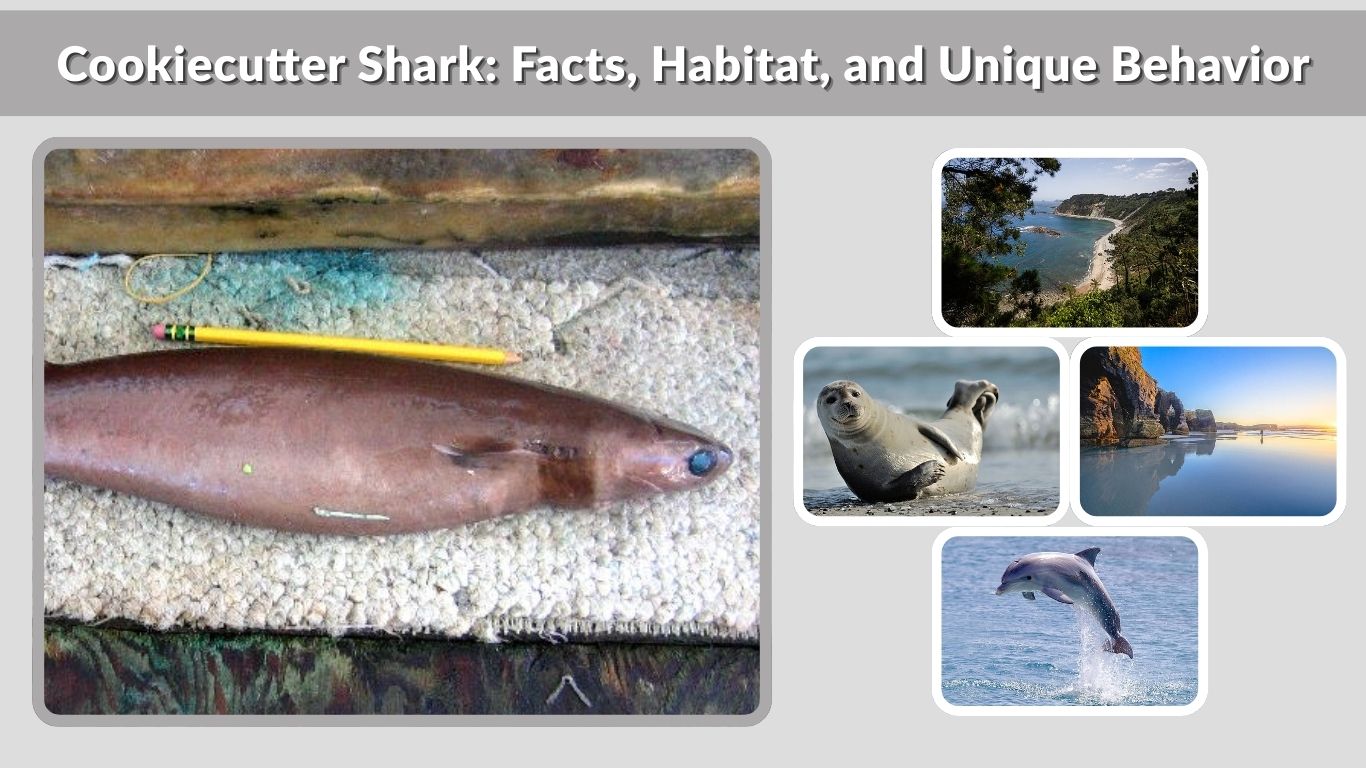
The cookiecutter shark is relatively small compared to many other shark species. Most adults measure between 14 and 22 inches (35–56 cm) in length. Its body is cylindrical and compact, allowing it to move efficiently through deep water.
It has large, greenish eyes that are specially adapted for seeing in low-light conditions. The shark’s body is typically dark brown, with a lighter underside. One distinctive feature is a dark collar-like band around its throat. Its small dorsal fins are positioned far back on its body, contributing to its streamlined shape.
Although it may not look intimidating at first glance, its mouth contains one of the most specialized biting mechanisms in the shark world.
Cookiecutter Shark Habitat

Geographic Distribution
The cookiecutter shark habitat spans tropical and subtropical oceans worldwide. These sharks are found in the Atlantic, Pacific, and Indian Oceans. They prefer warm waters and are commonly located far from shore in open-ocean environments.
Unlike coastal sharks that patrol beaches and reefs, cookiecutter sharks are pelagic. This means they live in the open sea rather than near the ocean floor or along coastlines. Because of this offshore lifestyle, they are rarely seen by humans.
Depth Range and Vertical Migration
One of the most interesting cookiecutter shark facts involves its depth range. During the day, these sharks often remain at depths of up to 3,000 meters (nearly 10,000 feet). At such depths, sunlight barely penetrates the water, creating a dark and cold environment.
However, cookiecutter sharks are known for their nightly vertical migration. At night, they swim closer to the ocean’s surface to feed. This movement allows them to encounter larger animals that travel through upper layers of water under cover of darkness.
This daily migration is energy-efficient and increases their chances of finding prey while reducing their exposure to larger predators.
Environmental Preferences
The cookiecutter shark habitat typically includes warm-water regions with stable ocean temperatures. They thrive in areas where deep waters are accessible, as this supports their vertical migration behavior.
Because they inhabit deep offshore waters, encounters with humans are extremely rare. Their habitat also provides protection from many coastal predators. The dark, open ocean serves as both a hunting ground and a safe refuge.
Unique Feeding Behavior

How the Cookiecutter Shark Attacks
The cookiecutter shark’s feeding method is unlike that of most other sharks. Instead of chasing and tearing apart prey, it uses a suction-based technique. First, it attaches itself to a larger animal using its thick, fleshy lips, which act like a suction cup.
Once attached, the shark rotates its body while using its sharp lower teeth to carve out a circular plug of flesh. The result is a clean, round wound. After removing this piece of tissue, the shark quickly releases and swims away.
This strategy allows the cookiecutter shark to feed on animals much larger than itself without engaging in a prolonged struggle.
What Do Cookiecutter Sharks Eat?
Cookiecutter sharks feed on a wide variety of marine animals. Their prey includes whales, dolphins, seals, large fish such as tuna and marlin, and even squid. In rare cases, bite marks attributed to cookiecutter sharks have been found on submarines and undersea cables.
Rather than killing their prey outright, these sharks remove small chunks of flesh. This parasitic feeding strategy allows them to gain nutrients while minimizing risk. It is a remarkable survival adaptation in the competitive deep-sea ecosystem.
Fascinating Cookiecutter Shark Facts
The cookiecutter shark may be small, but it has several extraordinary adaptations that help it survive in the deep sea. One of the most impressive cookiecutter shark facts is its ability to glow. Its underside produces bioluminescent light, which helps it blend in with faint light from above. This camouflage technique, known as counter-illumination, makes it nearly invisible to predators or prey looking up from below.
Another remarkable feature is its unique teeth structure. The lower teeth are large, triangular, and razor-sharp, forming a continuous cutting edge. Unlike many sharks that lose individual teeth, the cookiecutter shark can shed and replace an entire row of lower teeth at once. Scientists believe this ensures the cutting surface remains extremely sharp for its specialized feeding style.
Despite their small size, cookiecutter sharks have left evidence of their presence across the oceans. Circular wounds found on large marine animals have helped researchers map their distribution. These bite marks serve as clues that reveal how widespread and active this species truly is.
Reproduction and Life Cycle
Reproductive Method
Cookiecutter sharks are ovoviviparous. This means that eggs develop inside the mother’s body, and the young hatch internally before being born live. Unlike egg-laying sharks, they do not deposit eggs in the ocean.
The number of pups per litter is not well documented, largely because observing these sharks in their deep-sea habitat is difficult. However, like many small shark species, they likely produce relatively few offspring at a time.
Growth and Lifespan
At birth, cookiecutter shark pups are already independent and capable of surviving on their own. They resemble miniature versions of adults and quickly adapt to deep-water conditions.
Although their exact lifespan is not well studied, scientists estimate that cookiecutter sharks may live for several years, possibly over a decade. Their small size and deep-sea lifestyle likely protect them from many predators, contributing to their survival.
Are Cookiecutter Sharks Dangerous to Humans?

Given their unusual feeding behavior, many people wonder if cookiecutter sharks pose a threat to humans. Documented incidents involving humans are extremely rare. Most encounters occur accidentally, often involving deep-sea divers or researchers.
Because the cookiecutter shark habitat is primarily in deep offshore waters, human interaction is minimal. They do not actively hunt humans, and their feeding strategy is designed for larger marine animals. Compared to well-known species like great white or tiger sharks, the cookiecutter shark presents a very low risk.
In short, while their bite marks may look dramatic, they are not considered a significant danger to people.
Cookiecutter Shark vs. Other Sharks

Differences from Great White Sharks
The difference between a cookiecutter shark and a great white shark is striking. Great whites can grow over 20 feet long and are apex predators that kill and consume large prey. In contrast, the cookiecutter shark rarely exceeds two feet in length and feeds by removing small plugs of flesh.
Their hunting strategies are also vastly different. Great whites rely on speed, power, and strong jaws, while cookiecutter sharks depend on stealth, suction, and precise cutting teeth.
Differences from Typical Predatory Sharks
Most sharks chase, bite, and tear apart their prey. The cookiecutter shark’s parasitic feeding style sets it apart. Instead of killing its target, it takes a small portion and moves on.
Additionally, many shark species inhabit coastal waters or coral reefs. The cookiecutter shark habitat, however, is mainly in deep, open ocean environments. This makes it one of the more mysterious members of the shark family.
Why the Cookiecutter Shark Matters in Marine Ecosystems
Although it may seem like a minor player in the ocean, the cookiecutter shark plays an important ecological role. By feeding on large marine animals, it participates in the marine food web and helps regulate energy flow in deep-sea ecosystems.
Its presence also provides valuable scientific insight. Bite marks on marine animals help researchers understand migration patterns and deep-ocean biodiversity. Studying cookiecutter shark facts contributes to broader knowledge about life in extreme ocean environments.
FAQs
How big is a cookiecutter shark?
Most cookiecutter sharks grow between 14 and 22 inches long. This makes them much smaller than many well-known shark species. Despite their modest size, their specialized teeth and feeding technique allow them to target animals many times larger than themselves.
Where is the cookiecutter shark habitat located?
The cookiecutter shark habitat is found in tropical and subtropical oceans worldwide. They live mainly in deep offshore waters of the Atlantic, Pacific, and Indian Oceans. During the day, they stay in deep waters and migrate closer to the surface at night.
Why do cookiecutter sharks glow?
Cookiecutter sharks glow due to bioluminescent cells on their underside. This glow helps them blend in with faint surface light, a technique called counter-illumination. It allows them to camouflage themselves from predators and potentially lure prey closer.
Do cookiecutter sharks attack humans?
Attacks on humans are extremely rare. These sharks live mostly in deep offshore waters, which limits contact with people. While they are capable of biting, they do not actively hunt humans and are considered low risk compared to other shark species.
How deep can cookiecutter sharks live?
Cookiecutter sharks can live at depths of up to 3,000 meters during the day. They migrate toward shallower waters at night to feed. This vertical movement helps them find prey while remaining protected in deeper waters during daylight hours.
Conclusion
The cookiecutter shark may be small, but it is one of the ocean’s most unusual predators. From its deep-sea habitat and nightly migrations to its glowing underside and circular bite marks, this shark stands out among marine species. Learning cookiecutter shark facts reveals a creature perfectly adapted to survival in the dark open ocean. Though rarely seen, its impact can be found across tropical seas worldwide.