




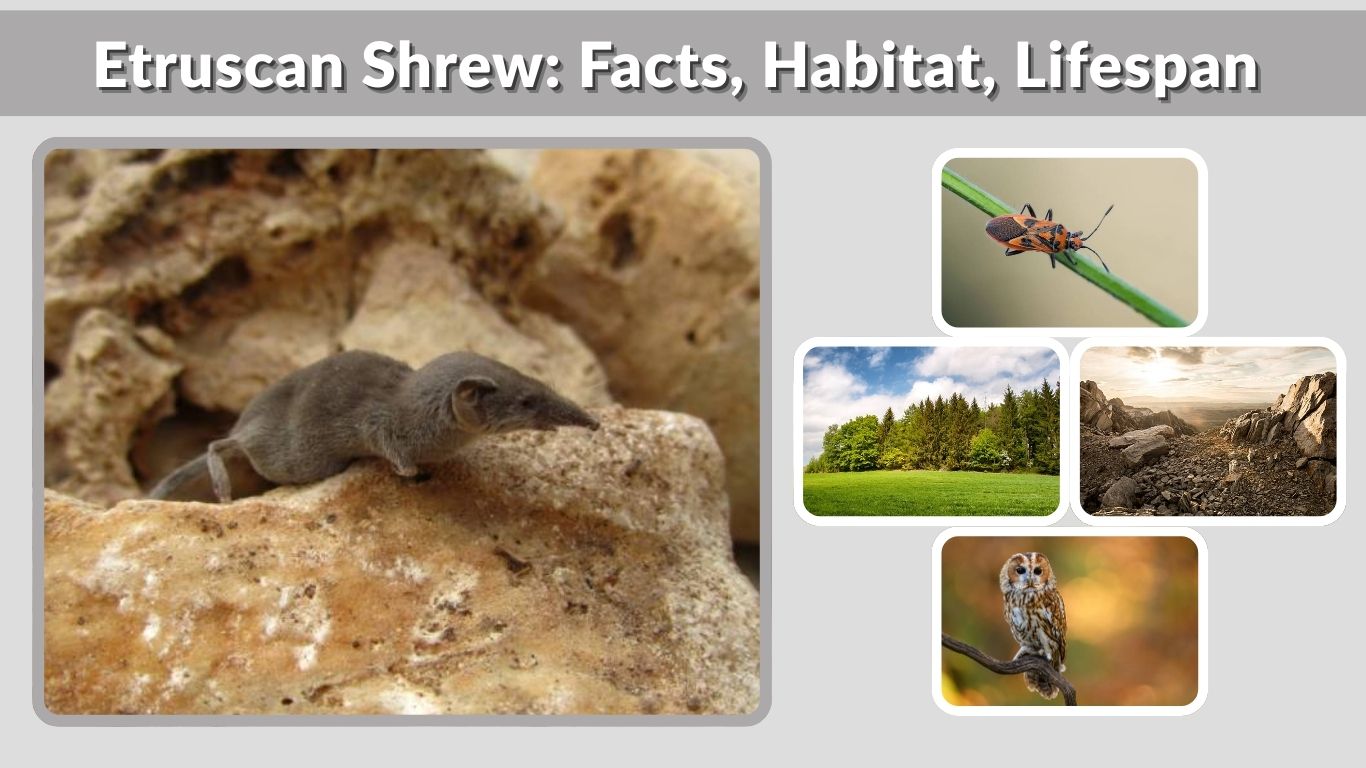
The Etruscan shrew (Suncus etruscus) is one of the most remarkable small mammals in the world. Known as the smallest mammal by mass, this tiny creature weighs only a few grams but is an incredibly active predator. Despite its size, the Etruscan shrew has a fast metabolism and must eat constantly to survive. It is found mainly in warm regions of Europe, North Africa, and Asia, where it lives in grasslands, rocky areas, and forest edges. Scientists are fascinated by this species because of its unique biology, rapid movements, and extraordinary energy needs.
Scientific Classification
Taxonomy
The Etruscan shrew belongs to the Soricidae family, a large group of small insect-eating mammals commonly known as shrews. Although they resemble mice, shrews are not rodents and belong to a different mammalian order. The scientific classification of the Etruscan shrew is:
- Kingdom: Animalia
- Phylum: Chordata
- Class: Mammalia
- Order: Eulipotyphla
- Family: Soricidae
- Genus: Suncus
- Species: Suncus etruscus
Shrews in this family are known for their high metabolic rates, sharp teeth, and active hunting behavior.
Discovery and Naming
The Etruscan shrew was first scientifically described in the early 19th century. Its name comes from the ancient region of Etruria in Italy, where the species was initially studied. Over time, scientists discovered that this tiny mammal is distributed across many warm regions of the Old World.
Today, the Etruscan shrew is widely recognized as the smallest mammal by mass, a title that makes it especially interesting to researchers studying animal physiology and metabolism.
Physical Characteristics
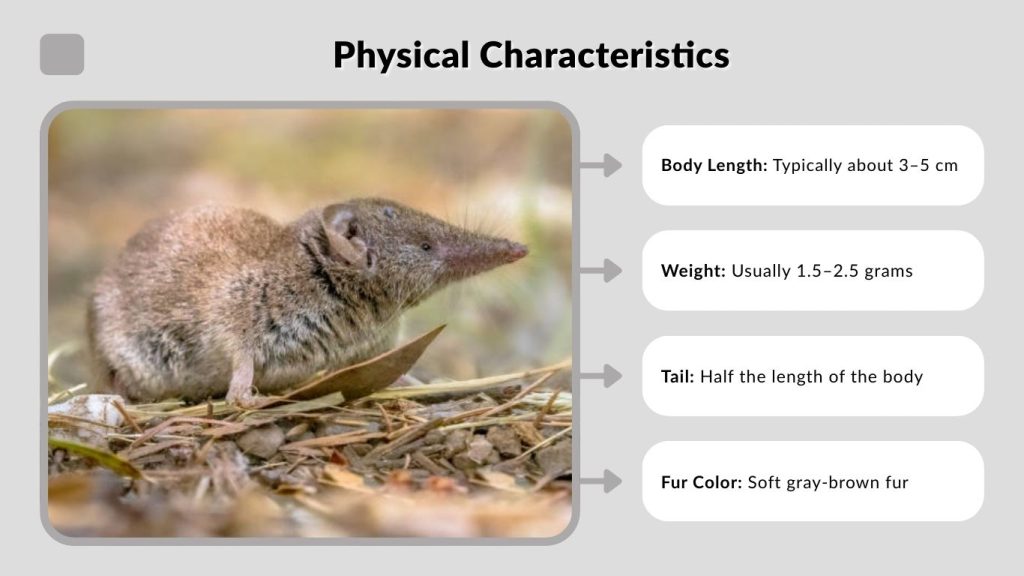
The Etruscan shrew has several physical features that allow it to survive despite its extremely small size. Its body is designed for speed, agility, and efficient hunting in dense vegetation and narrow spaces.
Some of the key physical characteristics include:
- Body Length: Typically about 3–5 cm (1.2–2 inches) excluding the tail.
- Weight: Usually 1.5–2.5 grams, making it the smallest mammal by mass.
- Tail: A thin tail that measures about half the length of the body.
- Fur Color: Soft gray-brown fur with a slightly lighter underside.
- Pointed Snout: A long, narrow snout that helps detect prey.
- Small Eyes: Tiny eyes adapted for low-light environments.
- Sensitive Whiskers: Whiskers that help the shrew sense vibrations and locate insects.
Because of its extremely small size, the Etruscan shrew moves very quickly and continuously while searching for food. Its lightweight body allows it to squeeze through narrow gaps and dense vegetation.
Etruscan Shrew Habitat
Geographic Distribution
The Etruscan shrew is found in many parts of the Old World, especially in regions with warm climates. Its distribution includes:
- Southern Europe
- Mediterranean countries
- North Africa
- Parts of the Middle East
- South and Central Asia
Although small and rarely seen, this species is fairly widespread in suitable habitats.
Preferred Habitats
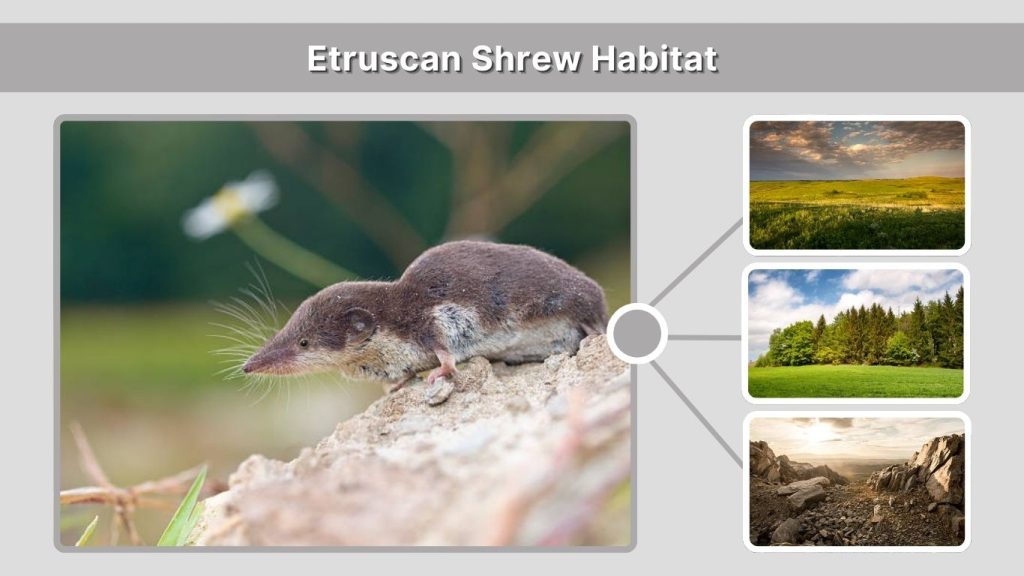
Etruscan shrews prefer environments that provide both shelter and access to insects. Their common habitats include:
- Grasslands and meadows
- Forest edges
- Rocky areas and stone walls
- Agricultural fields and farmland
These locations provide plenty of hiding places as well as abundant insect populations for food.
Shelter and Nesting
The Etruscan shrew does not usually dig deep burrows like some mammals. Instead, it often uses natural crevices, vegetation, and abandoned tunnels created by other animals.
For resting or raising young, the shrew builds small nests using grass, leaves, and other plant materials. These nests are usually hidden beneath rocks, inside dense vegetation, or within cracks in the ground.
Diet and Feeding Behavior
Primary Food Sources
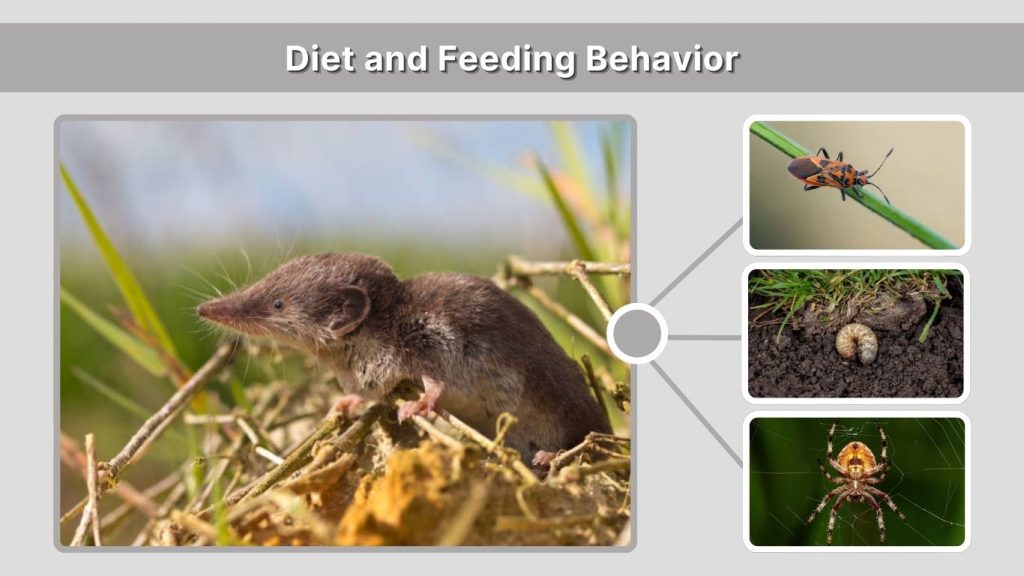
The Etruscan shrew is an insectivore, meaning its diet mainly consists of insects and other small invertebrates. Because of its tiny size, it usually hunts very small prey.
Common food sources include:
- Beetles and small insects
- Insect larvae
- Spiders
- Small worms and arthropods
These foods provide the protein and energy needed to support the shrew’s rapid metabolism.
Hunting Behavior
Despite being extremely small, the Etruscan shrew is an efficient and active predator. It constantly moves through vegetation and narrow spaces while searching for prey.
The shrew relies heavily on its sense of smell and sensitive whiskers to locate insects hidden in soil or plant matter. Once it detects prey, it quickly grabs it with its sharp teeth and consumes it immediately.
High Metabolism
One of the most remarkable features of the Etruscan shrew is its extremely fast metabolism. To maintain its energy levels, the shrew must eat frequently throughout the day and night.
In fact, an Etruscan shrew may eat up to twice its body weight in food each day. Because of this high energy demand, it spends most of its time actively hunting for insects.
Behavior and Lifestyle
Activity Patterns
The Etruscan shrew is highly active both during the day and at night, although it tends to be more active after sunset. Because of its extremely high metabolism, it cannot remain inactive for long periods. Instead, it constantly moves through vegetation, stones, and soil while searching for food.
Unlike some small mammals, the Etruscan shrew does not hibernate. Even in cooler seasons, it must continue hunting to maintain enough energy to survive.
Movement and Speed
Despite its tiny size, the Etruscan shrew is extremely fast and agile. It moves quickly through narrow spaces and dense vegetation while hunting insects. Its lightweight body allows it to change direction rapidly and squeeze through very small openings.
Scientists have observed that this species makes rapid, jerky movements when searching for prey, which helps it locate insects hiding in the ground or plants.
Social Behavior
Etruscan shrews are generally solitary animals. Each individual usually occupies a small territory where it hunts and shelters. They may become aggressive if another shrew enters their area.
Communication between individuals often occurs through high-pitched sounds and scent markings. These signals help them establish territory boundaries and avoid unnecessary conflict.
Etruscan Shrew Lifespan
Average Lifespan
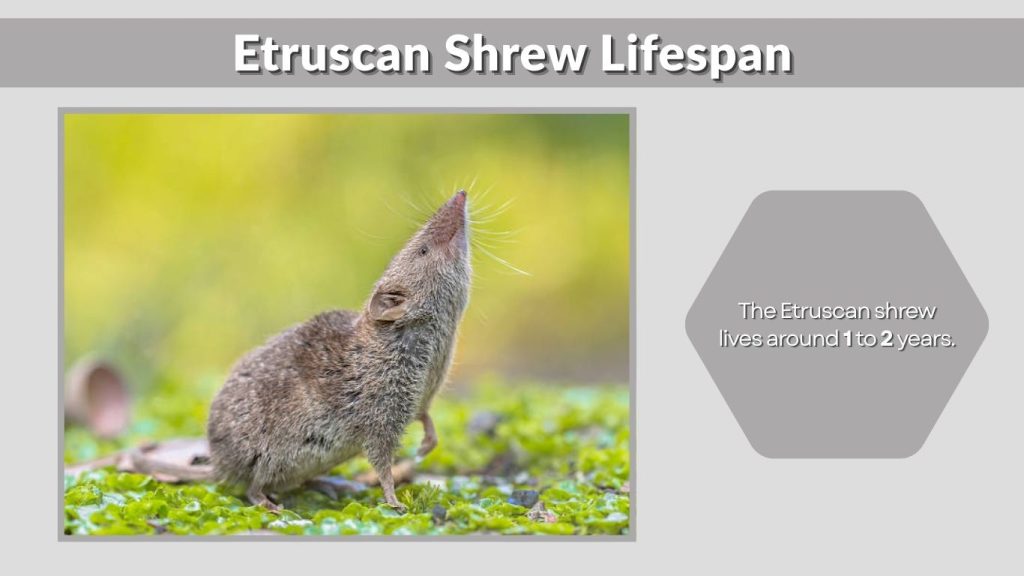
The Etruscan shrew has a relatively short lifespan, which is common among many small mammals. In the wild, it typically lives around 1 to 2 years.
Its short life expectancy is largely due to its extremely high metabolism, constant activity, and exposure to predators.
Growth and Development
Young Etruscan shrews grow very quickly after birth. They begin life blind and hairless, relying entirely on their mother for warmth and nourishment.
Within a few weeks, the young develop fur, open their eyes, and begin exploring their surroundings. They usually become independent within about one month.
Factors Affecting Lifespan
Several environmental and biological factors can influence how long an Etruscan shrew lives, including:
- Predation from birds and carnivorous animals
- Availability of food resources
- Environmental conditions and habitat quality
- Competition with other small mammals
Because of these challenges, many individuals do not survive beyond their first year.
Predators and Threats
Natural Predators
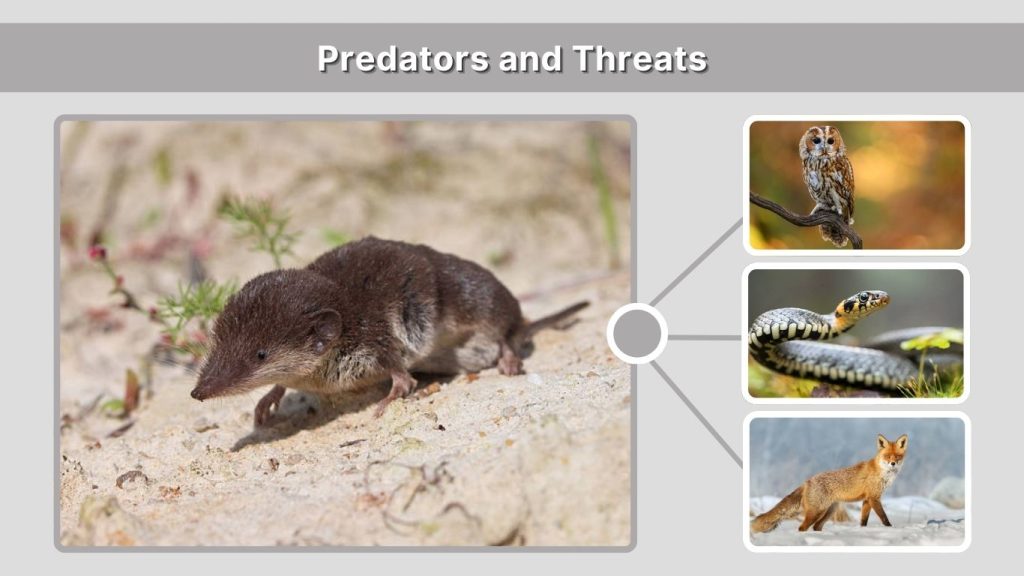
Due to its tiny size, the Etruscan shrew is vulnerable to many predators. Common predators include:
- Owls and other birds of prey
- Snakes
- Small carnivorous mammals such as foxes or weasels
- Larger insect-eating animals
These predators often capture shrews when they move above ground while searching for food.
Survival Strategies
To survive in such a dangerous environment, the Etruscan shrew relies on several defense strategies. Its small body size allows it to hide in narrow spaces where larger predators cannot reach.
Its fast movements and ability to remain hidden within vegetation also help it avoid detection. In addition, its gray-brown fur provides natural camouflage against soil and plant material.
Environmental Challenges
Like many small wildlife species, the Etruscan shrew may be affected by habitat destruction and environmental changes. Urban development, agricultural expansion, and changes in climate can reduce suitable habitats for this tiny mammal.
However, because it can live in a variety of environments, the species remains relatively widespread in many regions.
Role in the Ecosystem

Insect Population Control
Etruscan shrews play an important ecological role by feeding on insects and other small invertebrates. By consuming large numbers of insects, they help control pest populations and maintain balance in local ecosystems.
Role in the Food Chain
Although they are predators of insects, Etruscan shrews also serve as an important food source for many larger animals. Birds of prey, reptiles, and carnivorous mammals all rely on small mammals like shrews as part of their diet.
Because they act as both predator and prey, they are an essential component of many natural food webs.
Contribution to Soil Health
While moving through soil and vegetation in search of insects, Etruscan shrews help disturb and aerate the soil. This activity can contribute to the movement of organic material and support healthy plant growth.
Interesting Etruscan Shrew Facts
The Etruscan shrew is a remarkable animal with several unique traits that make it stand out among mammals.
- It is the smallest mammal in the world by mass.
- It weighs only around 2 grams, lighter than many insects.
- Its heart beats extremely fast, supporting its high metabolism.
- It must eat very frequently to survive because of its rapid energy use.
- Despite its tiny size, it is an efficient and aggressive insect hunter.
These characteristics make the Etruscan shrew one of the most fascinating tiny predators in the animal kingdom.
Conclusion
The Etruscan shrew may be incredibly small, but it is an impressive and important member of many ecosystems. As the smallest mammal by mass, it demonstrates remarkable adaptations that allow it to survive despite intense energy demands and numerous predators. By feeding on insects and serving as prey for larger animals, the Etruscan shrew plays a key role in maintaining ecological balance. Studying this tiny mammal helps scientists better understand metabolism, animal behavior, and the importance of even the smallest species in the natural world.