
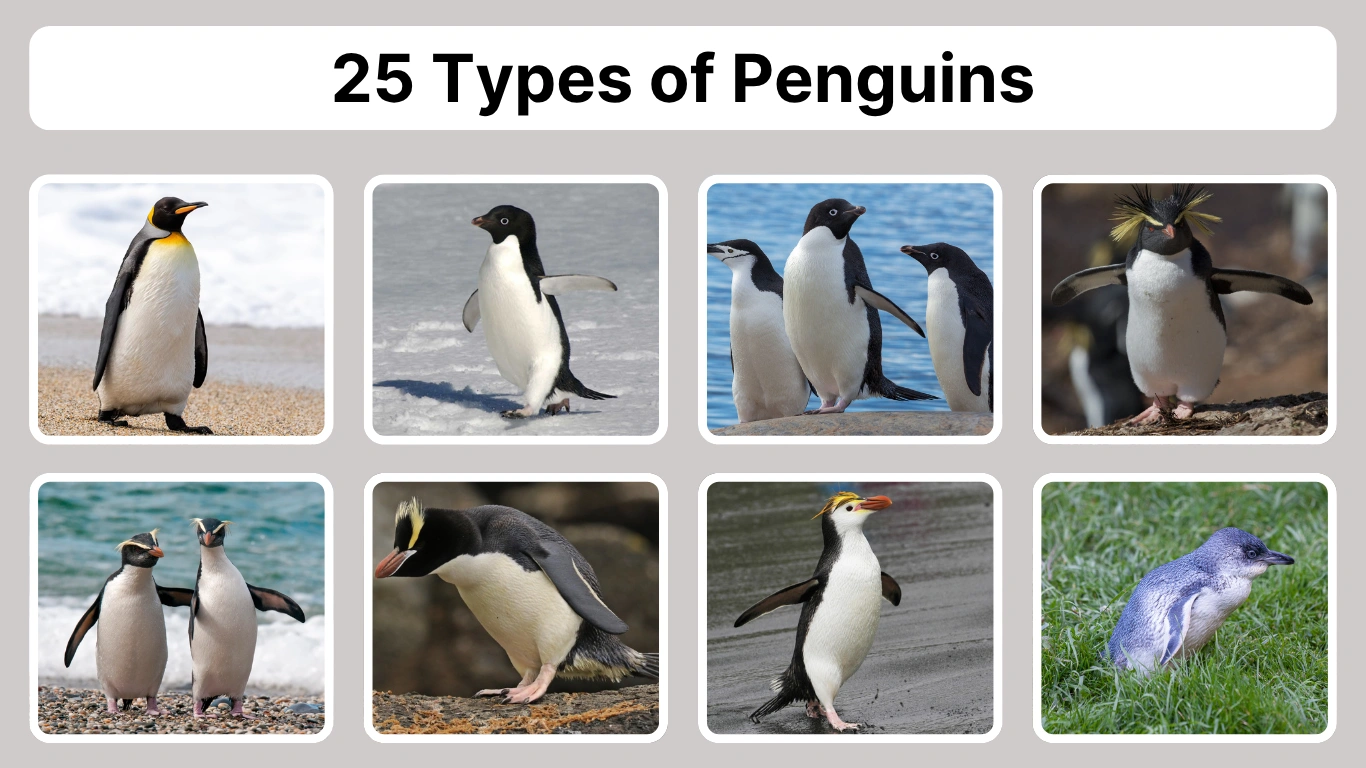
Penguins are some of the most fascinating and beloved birds on the planet, known for their charismatic personalities, striking plumage, and remarkable adaptations to life both on land and in the sea. From the towering Emperor Penguin of Antarctica to the tiny Little Blue Penguin of Australia and New Zealand, each species brings its own unique charm and survival strategies to the wild places they call home. While most penguins are found in the Southern Hemisphere’s cold waters and remote islands, a few have ventured into tropical climates or, sadly, into extinction.
This guide explores 25 types of penguins, including both living and extinct species, providing an overview of their distinguishing traits, behaviors, and the environments they inhabit. Whether you’re an avid birdwatcher, a wildlife enthusiast, or simply curious about these incredible creatures, discover the rich diversity and intriguing history of the world’s penguins below.
1. Emperor Penguin
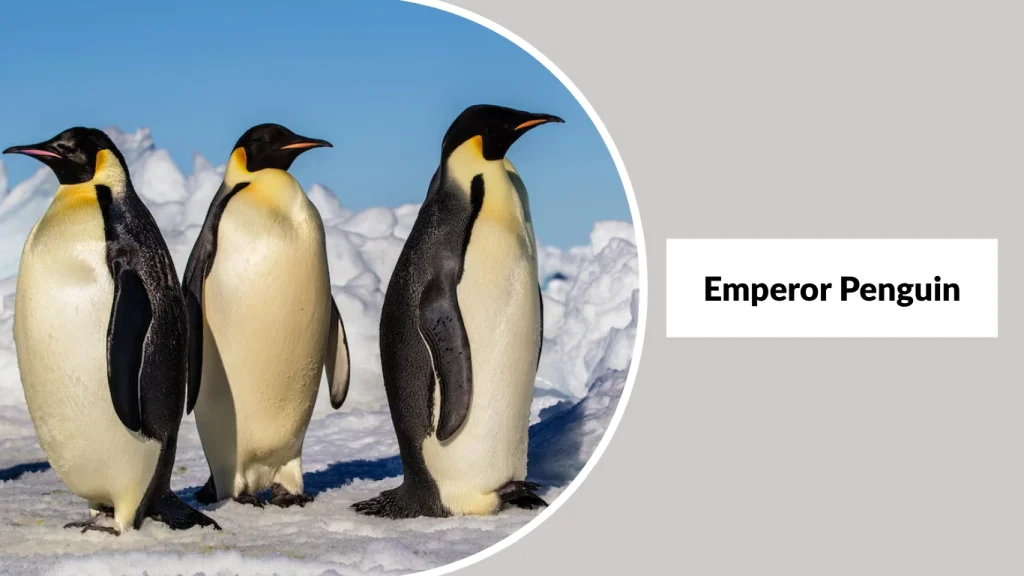
The Emperor Penguin is the largest and heaviest of all living penguin species. Native to Antarctica, it is renowned for its remarkable adaptations to extreme cold and for its fascinating breeding cycle, which occurs during the harsh Antarctic winter. These majestic birds are highly social and are known for their endurance, strong swimming abilities, and striking black-and-white coloration accented by golden hues around the neck.
Identification
- Size: 45–48 inches (115–122 cm) in height
- Weight: 50–100 pounds (22–45 kg), depending on season
- Coloration: Black head, chin, and back with a white belly
- Neck Markings: Bright yellow to orange patches on the sides of the neck
- Bill: Long, slender, and slightly curved with orange or pink markings
- Feet: Black and webbed, adapted for walking on ice
- Wings: Modified into strong, flipper-like structures for swimming
- Habitat: Sea ice and surrounding oceans of Antarctica
- Lifespan: Typically 15–20 years in the wild
Behavior and Diet
Emperor Penguins feed primarily on fish, squid, and krill. They are exceptional divers, capable of reaching depths over 1,800 feet and staying submerged for more than 20 minutes. Their diet varies seasonally based on availability beneath the ice.
Breeding and Parenting
Mating begins in late autumn. After the female lays a single egg, she transfers it to the male, who incubates it on his feet under a brood pouch for about two months. During this time, the male fasts while the female returns to the ocean to feed. Once hatched, both parents take turns feeding and guarding the chick.
Range and Conservation
Emperor Penguins are found exclusively in Antarctica. While their population is currently stable, climate change poses a significant threat due to melting sea ice, which affects breeding success and food availability. They are currently listed as Near Threatened by the IUCN.
2. King Penguin

The King Penguin is the second-largest penguin species, distinguished by its tall stature, vivid plumage, and stately posture. Native to the sub-Antarctic islands and parts of the southern ocean, it thrives in cold marine environments. King Penguins are known for their graceful swimming, deep diving skills, and long chick-rearing period.
Identification
- Size: 35–39 inches (90–100 cm) in height
- Weight: 25–35 pounds (11–16 kg)
- Coloration: Silver-gray back, white belly, and black head
- Neck Markings: Bright orange ear patches that extend to the upper chest
- Bill: Long, slender, and slightly curved with orange sides
- Feet: Black and webbed for swimming
- Wings: Strong, flipper-like, adapted for underwater propulsion
- Habitat: Sub-Antarctic islands like South Georgia, Crozet, and Kerguelen
- Lifespan: 20–25 years in the wild
Behavior and Diet
King Penguins feed mainly on lanternfish and squid, diving up to 1,000 feet in search of prey. They are strong, efficient swimmers, using their flippers to glide through water at high speed. During foraging trips, they may travel hundreds of kilometers from the colony.
Breeding and Parenting
King Penguins have one of the longest chick-rearing periods among birds. They lay a single egg, which is incubated on their feet for about 55 days. After hatching, the chick is fed regurgitated food and stays with the parents for over a year. Breeding occurs in large, noisy colonies that can include thousands of individuals.
Range and Conservation
This species is widespread across sub-Antarctic islands, preferring flat or gently sloped beaches near the sea. Their global population is stable, and they are classified as Least Concern by the IUCN. However, they may face future challenges from warming ocean temperatures and overfishing of key prey species.
3. Adélie Penguin

Adélie Penguins are small, bold, and highly social seabirds native to the Antarctic coast. Named after the wife of French explorer Jules Dumont d’Urville, they are recognized for their tuxedo-like appearance and strong colony bonding. These penguins are among the most widely distributed species in Antarctica.
Identification
- Size: 18–28 inches (46–71 cm) in height
- Weight: 7–13 pounds (3–6 kg)
- Coloration: Classic black back and white belly
- Eye Markings: Distinctive white ring around the eyes
- Bill: Short and black, partly covered with facial feathers
- Feet: Pale pink with black claws
- Wings: Stiff and narrow, suited for diving
- Habitat: Ice-free coastal regions around the Antarctic continent
- Lifespan: 10–20 years in the wild
Behavior and Diet
Adélie Penguins feed on krill, fish, and small squid. They are agile swimmers and can dive over 500 feet to hunt. On land, they waddle and toboggan (slide on their bellies) across icy surfaces.
Breeding and Parenting
They build stone nests on rocky beaches, often stealing stones from neighbors. Both parents take turns incubating the eggs for about 35 days and then feeding the chicks. Chicks form crèches (group nurseries) while parents forage.
Range and Conservation
Found all around the Antarctic coastline, Adélie Penguins have a strong presence across multiple research bases and protected areas. Their population is considered stable and they are listed as Least Concern by the IUCN, though they are sensitive to changes in sea ice and food distribution caused by climate shifts.
4. Chinstrap Penguin

Chinstrap Penguins are easily recognized by the narrow black band under their heads that looks like a helmet strap—hence their name. These medium-sized penguins are highly vocal and active, nesting in huge, noisy colonies on rocky, ice-free islands around Antarctica.
Identification
- Size: 28–30 inches (71–76 cm) in height
- Weight: 7–11 pounds (3–5 kg)
- Coloration: White face and underparts, with a solid black back and head
- Distinctive Mark: Thin black “chinstrap” line running under the lower jaw
- Bill: Short, black, and strong
- Eye Color: Reddish-brown
- Legs and Feet: Pink with black soles
- Wings: Short and rigid, flipper-shaped for swimming
- Habitat: Sub-Antarctic islands, South Shetland Islands, and Antarctic Peninsula
- Lifespan: 15–20 years
Behavior and Diet
Chinstrap Penguins are energetic swimmers and hunt primarily for krill, but also eat fish and squid. They are known to dive to depths of 200 feet or more. These birds are aggressive defenders of their nests and often engage in loud vocal displays.
Breeding and Parenting
They build nests from small stones on steep rocky slopes. Both parents share incubation duties for about 35 days. After hatching, the chicks are brooded for the first few weeks, then form crèches while the parents forage at sea.
Range and Conservation
With populations in the millions, Chinstrap Penguins are one of the most abundant penguin species. They are classified as Least Concern by the IUCN. However, some regional populations have declined due to warming temperatures and changes in krill abundance caused by reduced sea ice.
5. Gentoo Penguin
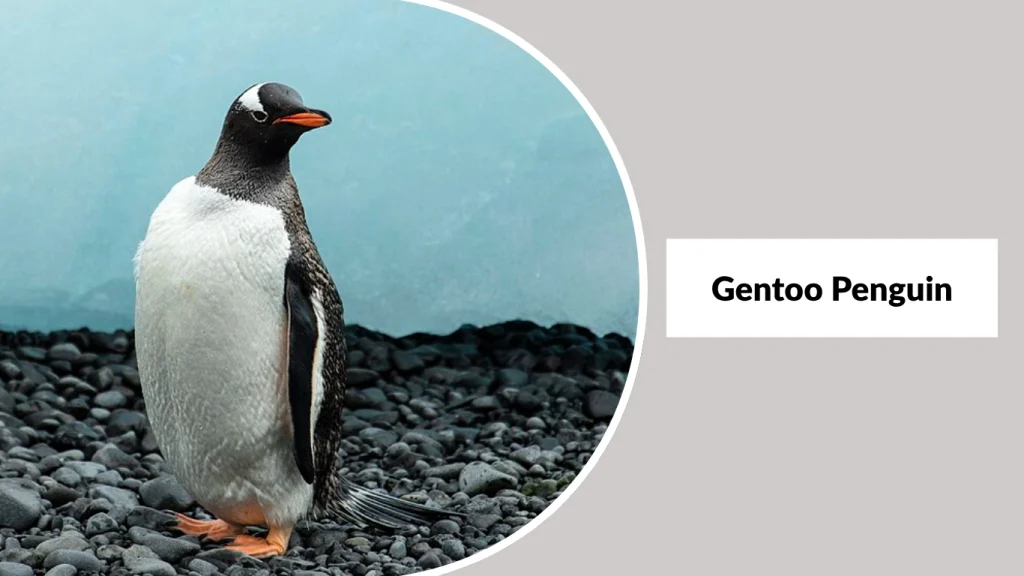
Gentoo Penguins are recognizable by their white head stripe and bright orange bill. Known for being the fastest swimmers among penguins, they inhabit a wide range of sub-Antarctic islands and are highly adaptable to both icy and rocky shorelines.
Identification
- Size: 20–35 inches (50–90 cm) in height
- Weight: 10–19 pounds (4.5–8.5 kg)
- Coloration: Black head and back with white underparts
- Distinctive Mark: White patch across the top of the head connecting both eyes
- Bill: Bright orange with a black tip
- Legs and Feet: Orange-pink and webbed
- Eye Color: Dark brown
- Habitat: Sub-Antarctic islands such as the Falklands, South Georgia, and Kerguelen
- Lifespan: 15–20 years
Behavior and Diet
Gentoo Penguins feed on krill, squid, and various fish. They are excellent swimmers, reaching speeds of up to 22 mph (36 km/h), making them the fastest underwater swimmers of all penguins.
Breeding and Parenting
They nest in large colonies on flat, open ground and build nests using pebbles and plant material. Gentoos typically lay two eggs, and both parents take turns incubating them. Chicks fledge in about 80–100 days.
Range and Conservation
Gentoo Penguins have a stable population and are classified as Least Concern by the IUCN. However, like other polar species, they face potential threats from climate change and local fishing activity that may affect their prey availability.
6. Little Blue Penguin

The Little Blue Penguin, also known as the Fairy Penguin, is the smallest penguin species in the world. Native to the coastlines of New Zealand and southern Australia, it is known for its charming appearance and nocturnal behavior on land.
Identification
- Size: 12–13 inches (30–33 cm) in height
- Weight: 2.2–3.3 pounds (1–1.5 kg)
- Coloration: Slate-blue to indigo feathers on back and head; white belly
- Bill: Short, dark gray
- Legs and Feet: Pale pink with black soles
- Wings: Small and flipper-like
- Habitat: Coastal dunes, rocky shores, and grassy burrows
- Lifespan: 6–10 years
Behavior and Diet
Little Blue Penguins feed primarily on small fish, squid, and crustaceans. They hunt close to shore and are known for short, shallow dives. On land, they often return to their burrows after dark to avoid predators.
Breeding and Parenting
They nest in burrows, crevices, or artificial boxes. Breeding pairs often mate for life and raise two chicks per season. Both parents incubate the eggs and care for the young.
Range and Conservation
These penguins are found along the southern coast of Australia, Tasmania, and across New Zealand. Their population is considered stable, but they are vulnerable to habitat destruction, domestic animals, and marine pollution.
7. Northern Rockhopper Penguin

The Northern Rockhopper Penguin is easily distinguished by its spiky yellow crest feathers and red eyes. It is slightly larger than its southern counterpart and is found in the temperate islands of the South Atlantic and Indian Oceans.
Identification
- Size: 20–22 inches (50–56 cm) in height
- Weight: 5.5–6.6 pounds (2.5–3 kg)
- Coloration: Black head and back, white belly
- Crest: Long yellow crest plumes extending from above the eyes
- Bill: Orange-brown
- Legs and Feet: Pink with black claws
- Wings: Short and stiff, adapted for swimming
- Habitat: Rocky cliffs, grassy slopes, and coastal meadows
- Lifespan: 10–15 years
Behavior and Diet
They feed on krill, squid, and small fish. Their strong legs allow them to hop across rocky terrain, which gives them their name. They are social and nest in densely packed colonies.
Breeding and Parenting
Nesting takes place in rock crevices or under shrubs. Two eggs are laid, but usually only one chick survives. Parents take turns incubating and feeding the chick until it fledges.
Range and Conservation
Found primarily on Tristan da Cunha and Gough Island, the Northern Rockhopper Penguin is classified as Endangered due to population declines caused by overfishing, climate change, and pollution.
8. Southern Rockhopper Penguin

The Southern Rockhopper Penguin is a feisty, small-sized penguin recognized by its striking red eyes, yellow eyebrows, and spiky crest feathers. Unlike its northern cousin, this species inhabits colder, sub-Antarctic islands and is known for its impressive agility across steep rocky landscapes.
Identification
- Size: 18–23 inches (46–58 cm) in height
- Weight: 4.5–6.6 pounds (2–3 kg)
- Coloration: Black back and head, white underparts
- Crest: Yellow stripe extending from above the eye to behind the head
- Bill: Short, thick, and orange
- Eyes: Bright red
- Legs and Feet: Pinkish with black claws
- Wings: Rigid and flipper-like for underwater propulsion
- Habitat: Rocky coastlines on southern islands near Antarctica
- Lifespan: 10–20 years
Behavior and Diet
Southern Rockhoppers feed on krill, squid, and small fish. They are excellent climbers and often leap up rocky cliffs to reach nesting sites, hence their name. Their vocalizations are loud and raspy, especially during the breeding season.
Breeding and Parenting
They nest in tight colonies, often hidden in crevices or grassy clumps. Two eggs are laid, but typically only one chick is raised. Both parents alternate roles in incubation and chick feeding.
Range and Conservation
This species is found on sub-Antarctic islands such as the Falklands, Crozet Islands, and Prince Edward Islands. Though still numerous, populations have declined due to climate change, overfishing, and oil pollution. They are listed as Vulnerable by the IUCN.
9. Fiordland Penguin

The Fiordland Penguin, also known as the Fiordland Crested Penguin, is a shy and elusive species native to the rugged coastal rainforests of New Zealand’s South Island. Its dark face, broad yellow eyebrow-stripes, and thick body feathers help distinguish it from other crested penguins.
Identification
- Size: 22–24 inches (56–61 cm) in height
- Weight: 5.5–6.6 pounds (2.5–3 kg)
- Coloration: Dark blue-black upperparts and white underparts
- Crest: Broad yellow eyebrow stripes extending back along the head
- Bill: Thick and reddish-brown
- Eyes: Reddish
- Legs and Feet: Pale pink with black soles
- Wings: Short, strong, and adapted for diving
- Habitat: Dense temperate rainforests and rocky coastal areas
- Lifespan: 10–20 years
Behavior and Diet
These penguins feed at sea on small fish, squid, and crustaceans. They are solitary feeders and travel long distances during foraging trips. On land, they are secretive and prefer dense vegetation for nesting.
Breeding and Parenting
Nests are built in secluded forested sites or caves. Like many crested penguins, they lay two eggs, but usually only the second, smaller egg hatches and survives. Both parents incubate the eggs and rear the chick.
Range and Conservation
The Fiordland Penguin is found along the southwestern coasts of New Zealand’s South Island and on nearby offshore islands. It is classified as Vulnerable due to threats from introduced predators, habitat degradation, and climate-related changes in food supply.
10. Snares Penguin

The Snares Penguin is a medium-sized, crested penguin endemic to the Snares Islands, located south of New Zealand. Known for its bold yellow eyebrow crests and pinkish skin at the base of its bill, this penguin prefers dense coastal forests for nesting and is rarely seen outside its remote breeding grounds.
Identification
- Size: 20–24 inches (50–61 cm) in height
- Weight: 6.6–7.7 pounds (3–3.5 kg)
- Coloration: Slate-black upperparts, white underparts
- Crest: Bright yellow eyebrow stripes curving up and backward
- Bill: Thick, reddish-brown with exposed pink skin at the base
- Eyes: Dark red
- Legs and Feet: Pale pink with black soles
- Wings: Short, powerful flippers for underwater agility
- Habitat: Forested slopes and rocky areas of the Snares Islands
- Lifespan: 15–20 years
Behavior and Diet
Snares Penguins feed primarily on krill, small fish, and cephalopods. They are skilled divers and forage in the cold waters surrounding the Snares Islands. Social and vocal, they form tight breeding colonies and communicate with loud calls and visual displays.
Breeding and Parenting
They breed exclusively on the Snares Islands. Nesting occurs under tree ferns or in dense brush. As with most crested penguins, they lay two eggs but only raise one chick. Both parents share responsibilities for incubation and feeding.
Range and Conservation
Restricted to a small geographic range, the entire population of Snares Penguins is confined to the Snares Islands. Despite the limited range, their population is currently stable and protected, leading to their IUCN status of Vulnerable. Human disturbance and climate change are the main future concerns.
11. Erect-crested Penguin
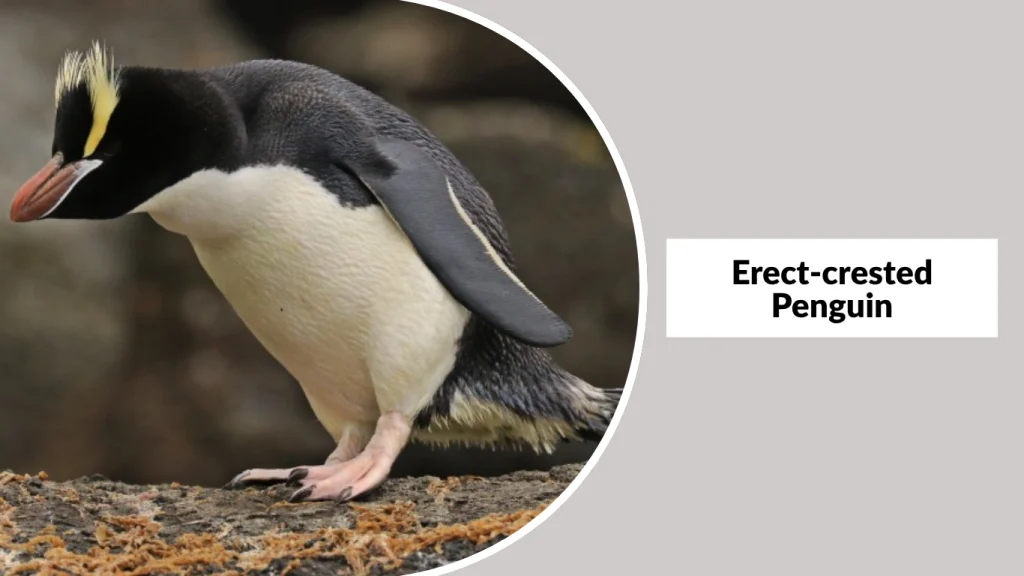
The Erect-crested Penguin is a rare and little-known species that nests only on remote islands of New Zealand. It is named for the upright yellow feather crests that extend above its eyes. These penguins are among the largest of the crested group and are poorly studied due to their remote habitat.
Identification
- Size: 24–27 inches (60–68 cm) in height
- Weight: 6.6–8.8 pounds (3–4 kg)
- Coloration: Glossy black upperparts and white belly
- Crest: Prominent, upright yellow plumes above the eyes
- Bill: Large, reddish-brown and slightly curved
- Eyes: Reddish
- Legs and Feet: Pale pink with dark soles
- Wings: Short, strong flippers suited for high-speed diving
- Habitat: Rocky coasts and cliffs of Antipodes and Bounty Islands
- Lifespan: Estimated 10–20 years
Behavior and Diet
They forage at sea on krill, squid, and small fish. Little is known about their specific hunting behavior, but they are believed to dive deeply and forage far from their breeding sites. On land, they are aggressive nest defenders.
Breeding and Parenting
Breeding takes place on steep rocky islands with few natural predators. As typical of crested species, two eggs are laid, but only one chick is usually reared. Parental duties are equally shared between the male and female.
Range and Conservation
Erect-crested Penguins are found only on the remote Antipodes and Bounty Islands of New Zealand. They are listed as Endangered by the IUCN due to population declines and a lack of comprehensive monitoring. Their breeding grounds are protected, but their limited range makes them especially vulnerable to environmental changes.
12. Macaroni Penguin
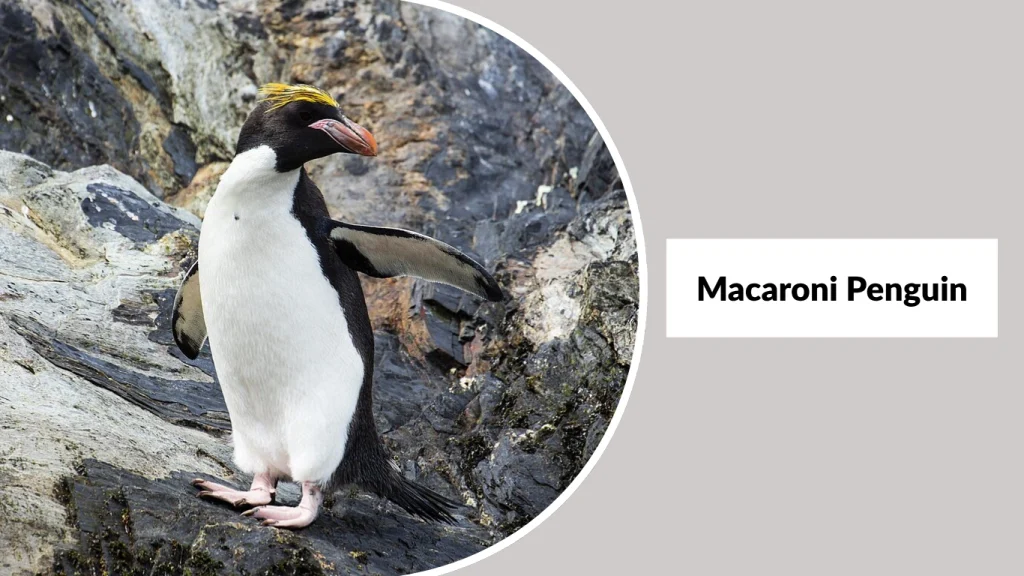
The Macaroni Penguin is one of the most numerous penguin species in the world. It’s best known for its extravagant yellow-orange crest feathers and striking red eyes. These bold seabirds inhabit the sub-Antarctic region and are powerful swimmers and divers, spending much of their lives at sea.
Identification
- Size: 27–28 inches (68–71 cm) in height
- Weight: 8–14 pounds (3.5–6.5 kg)
- Coloration: Black head and upperparts, white underparts
- Crest: Thick, golden-yellow feathers that start above each eye and droop backward
- Bill: Strong, reddish-brown
- Eyes: Red
- Legs and Feet: Pink with black soles
- Wings: Flipper-like, short and strong for underwater movement
- Habitat: Rocky cliffs and slopes of sub-Antarctic islands
- Lifespan: 10–15 years
Behavior and Diet
Macaroni Penguins feed mainly on krill, but also consume fish and squid. They can dive over 200 feet deep in pursuit of prey and may travel long distances between breeding and feeding areas. On land, they are loud, social, and often seen engaging in vocal displays.
Breeding and Parenting
They nest in huge colonies—sometimes numbering hundreds of thousands—on steep slopes and rock outcrops. Like most crested penguins, they lay two eggs but only raise one chick. Both parents take turns incubating the egg and feeding the chick.
Range and Conservation
This species breeds on many sub-Antarctic islands, including South Georgia, Heard Island, and the Crozet Islands. Despite their large population, they are listed as Vulnerable by the IUCN due to observed population declines, likely linked to climate change and reduced prey availability.
13. Royal Penguin

The Royal Penguin is closely related to the Macaroni Penguin and shares similar golden crests, but is distinguishable by its white face and lighter-colored plumage. Found primarily on Macquarie Island, this species breeds in massive, noisy colonies and spends much of its life foraging at sea.
Identification
- Size: 26–30 inches (65–76 cm) in height
- Weight: 8–12 pounds (3.5–5.5 kg)
- Coloration: White face and underparts, dark gray to black back
- Crest: Golden-yellow feathers that start at the forehead and arch backward
- Bill: Large and reddish-orange
- Eyes: Reddish
- Legs and Feet: Pink with black claws
- Wings: Short and stiff, ideal for diving
- Habitat: Coastal plains and rocky areas of Macquarie Island
- Lifespan: Around 15 years
Behavior and Diet
Royal Penguins are excellent swimmers, feeding primarily on krill, small fish, and squid. They can dive to moderate depths and often forage communally. On land, they are noisy and active, especially during breeding season.
Breeding and Parenting
Breeding occurs in enormous colonies on Macquarie Island. Two eggs are laid, but as with most crested penguins, usually only the second egg is incubated and hatched. Both parents care for the chick until it fledges.
Range and Conservation
Royal Penguins are considered endemic to Macquarie Island and a few nearby islets. Though their population is relatively stable and protected, their limited range and reliance on specific food sources make them vulnerable. They are classified as Near Threatened by the IUCN.
14. Humboldt Penguin

The Humboldt Penguin is a medium-sized species found along the Pacific coasts of Peru and Chile. Named after the cold Humboldt Current, it thrives in temperate climates and nests in rocky coastal regions and islands.
Identification
- Size: 24–28 inches (61–71 cm) in height
- Weight: 8–13 pounds (3.6–5.9 kg)
- Coloration: Black head with a distinctive white border running from behind the eye, around the black ear-coverts and chin, and joining at the throat
- Chest Markings: Black band across the upper chest and spots on the belly
- Bill: Robust and black with a pale base
- Eyes: Brownish-red
- Legs and Feet: Black with pinkish patches
- Wings: Flipper-like for agile swimming
- Habitat: Rocky coastal areas, guano cliffs, and offshore islands
- Lifespan: 15–20 years
Behavior and Diet
They primarily feed on small fish and anchovies, foraging close to shore. Humboldt Penguins are social and nest in colonies, using burrows or crevices for protection from the sun and predators.
Breeding and Parenting
Breeding can occur year-round. Pairs dig burrows or use natural caves for nests, laying two eggs per clutch. Both parents share incubation and chick-rearing duties.
Range and Conservation
This species is native to the coastal regions of Peru and northern Chile. They are classified as Vulnerable due to habitat loss, overfishing, climate fluctuations, and guano harvesting.
15. Magellanic Penguin
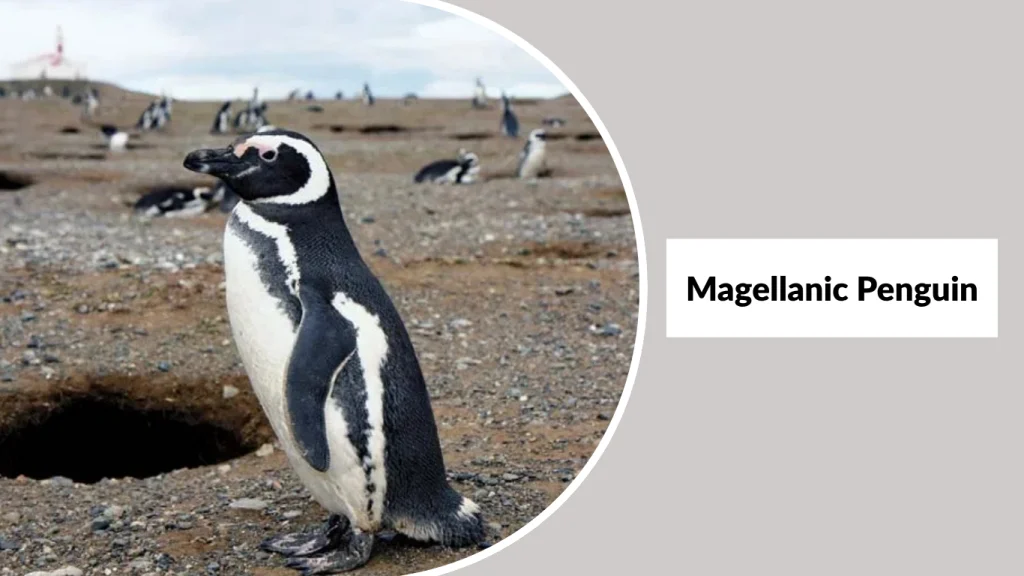
The Magellanic Penguin is a South American species that breeds along the coasts of Argentina, Chile, and the Falkland Islands. Named after the explorer Ferdinand Magellan, it is closely related to the Humboldt and African penguins.
Identification
- Size: 24–30 inches (61–76 cm) in height
- Weight: 6.5–14 pounds (3–6.5 kg)
- Coloration: Black back and white belly
- Head Markings: Broad white band extends from above the eye, around the black ear-coverts and chin, and meets at the throat
- Chest Markings: Two black bands between the head and the chest; the lower band is shaped like an upside-down horseshoe
- Bill: Strong and black
- Eyes: Brownish-red
- Legs and Feet: Black with pinkish patches
- Wings: Short and rigid, suited for swimming
- Habitat: Coastal beaches, burrowed areas, and islands
- Lifespan: 10–20 years
Behavior and Diet
Magellanic Penguins feed on anchovies, sardines, and squid. They are migratory, traveling long distances between feeding and breeding sites. Social and noisy, they nest in large colonies.
Breeding and Parenting
They dig burrows or use thick vegetation for nests. Usually, two eggs are laid, and both parents incubate and raise the chicks.
Range and Conservation
Found in Argentina, Chile, and the Falkland Islands, their range extends north during the non-breeding season. Classified as Near Threatened, the species faces threats from oil spills, overfishing, and habitat disturbance.
16. African Penguin

The African Penguin, also called the Jackass Penguin for its braying call, is native to the southwestern coast of Africa. It is the only penguin species found on the African continent and is recognized for its distinctive facial pattern and pink gland above each eye.
Identification
- Size: 24–27 inches (60–69 cm) in height
- Weight: 5.5–8.8 pounds (2.5–4 kg)
- Coloration: Black back and face, white belly
- Head Markings: Unique black facial mask with a curved white band above the eyes and around the cheeks
- Chest Markings: Black horseshoe-shaped band and scattered black spots on the belly
- Bill: Short, thick, and black
- Eyes: Brown with a noticeable pink gland above, used for thermoregulation
- Legs and Feet: Black with pink patches
- Wings: Flipper-like, short and strong
- Habitat: Rocky shores and offshore islands along Namibia and South Africa
- Lifespan: 10–15 years
Behavior and Diet
They feed on small fish like sardines and anchovies, often hunting in groups. African Penguins are strong swimmers and can travel considerable distances in search of food. On land, they are social and nest in burrows or under bushes.
Breeding and Parenting
Nesting occurs in burrows or scrapes dug into guano or sand. Typically, two eggs are laid and both parents take turns incubating and feeding the chicks.
Range and Conservation
This species is found from Namibia to South Africa. African Penguins are classified as Endangered due to rapid population declines from overfishing, oil spills, habitat destruction, and climate change.
17. Galápagos Penguin

The Galápagos Penguin is the only penguin species living north of the equator. Found exclusively on the Galápagos Islands, it has adapted to a tropical climate and is the rarest penguin species in the world.
Identification
- Size: 19–20 inches (48–53 cm) in height
- Weight: 4.5–5.5 pounds (2–2.5 kg)
- Coloration: Black head and back, white underparts
- Head Markings: Narrow white band runs from the eye to the throat
- Chest Markings: Black horseshoe-shaped band across the chest
- Bill: Thin and dark
- Eyes: Brown
- Legs and Feet: Black with pink patches
- Wings: Small, rigid, adapted for warm-water swimming
- Habitat: Rocky shorelines and coastal caves of the Galápagos Islands
- Lifespan: 10–15 years
Behavior and Diet
Galápagos Penguins feed on small fish and occasionally crustaceans, hunting close to shore in cool upwelling waters. They avoid midday heat by sheltering in caves or swimming.
Breeding and Parenting
Breeding occurs in shaded rocky crevices and caves. Two eggs may be laid, but typically only one chick survives. Parental care is shared.
Range and Conservation
Restricted to the Galápagos Islands, especially Fernandina and Isabela. They are listed as Endangered due to their small population size and threats from climate change, El Niño events, and introduced predators.
18. Yellow-eyed Penguin

The Yellow-eyed Penguin, known locally as “Hoiho,” is one of the rarest and most unique penguin species. Endemic to New Zealand, it is instantly recognizable by its pale yellow eyes and band of yellow feathers encircling the head. This solitary and shy species prefers quiet, forested or scrubby coastal areas for nesting.
Identification
- Size: 24–31 inches (62–79 cm) in height
- Weight: 11–13 pounds (5–6 kg)
- Coloration: Slate-grey back, white belly, and pale yellow head
- Eye Markings: Distinct yellow eyes and yellow band running from eyes around the back of the head
- Bill: Long, slender, and pinkish-orange
- Legs and Feet: Pink
- Wings: Short and rigid, used for powerful swimming
- Habitat: Coastal forests, scrublands, and rocky shores of New Zealand’s South Island and surrounding islands
- Lifespan: 8–20 years
Behavior and Diet
Yellow-eyed Penguins hunt alone, feeding mostly on small fish, squid, and sometimes crustaceans. They are excellent divers, often foraging offshore and returning to land at dusk.
Breeding and Parenting
Nests are built in secluded locations with dense vegetation to avoid disturbance. The female lays two eggs, and both parents incubate and care for the chicks. The chicks fledge after about 100 days.
Range and Conservation
Found mainly on the southeast coast of New Zealand’s South Island, Stewart Island, and a few sub-Antarctic islands. The species is classified as Endangered, threatened by habitat loss, introduced predators, disease, and human disturbance.
19. White-flippered Penguin

The White-flippered Penguin is a small and rare subspecies of the Little Blue Penguin, distinguished by the white edges on its flippers. Found only in a small region of New Zealand, it is celebrated for its distinctive markings and secretive nature.
Identification
- Size: 12–13 inches (30–33 cm) in height
- Weight: 2.2–3.3 pounds (1–1.5 kg)
- Coloration: Slate-blue upperparts and white underparts
- Flippers: Unique white margins along the flipper edges
- Bill: Short, dark gray
- Legs and Feet: Pale pink
- Eyes: Dark
- Wings: Flipper-like, compact for agile swimming
- Habitat: Coastal caves and burrows on Banks Peninsula and Motunau Island, New Zealand
- Lifespan: 6–10 years
Behavior and Diet
These penguins are nocturnal on land and feed at sea during the day, preying mainly on small fish, squid, and crustaceans. They are shy and often nest in burrows or rocky crevices for protection.
Breeding and Parenting
Breeding pairs nest in hidden burrows or rock cavities, laying two eggs per season. Both parents take turns incubating and rearing the chicks.
Range and Conservation
The White-flippered Penguin is found exclusively on Banks Peninsula and nearby Motunau Island in New Zealand. Classified as Endangered due to small population size, habitat loss, and predation by introduced mammals. Conservation programs are underway to protect nesting sites and restore populations.
20. Eastern Rockhopper Penguin
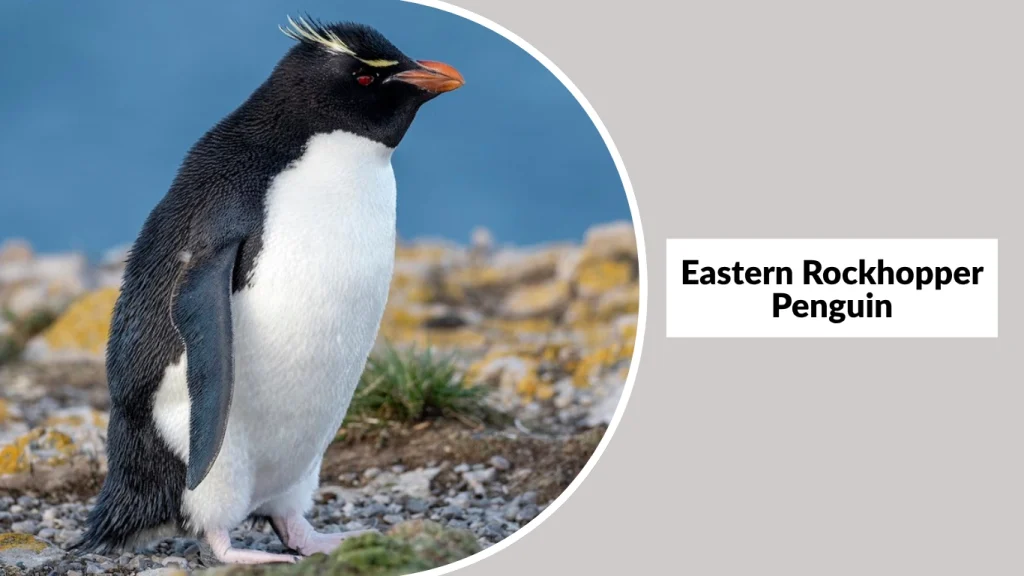
The Eastern Rockhopper Penguin is a bold, crested penguin species native to sub-Antarctic islands in the southern Indian and western Pacific Oceans. Known for its spiky yellow eyebrow crests and energetic personality, this bird is an agile climber and powerful swimmer, often navigating steep rocky shorelines with ease.
Identification
- Size: 18–23 inches (46–58 cm) in height
- Weight: 4.4–6.6 pounds (2–3 kg)
- Coloration: Black head and back, white underparts
- Crest: Bright yellow eyebrow plumes extending from the bill over the eyes and back
- Bill: Short, thick, and orange-brown
- Eyes: Red
- Legs and Feet: Pinkish with black claws
- Wings: Stiff and flipper-like for underwater movement
- Habitat: Rocky coastal cliffs and grassy slopes of sub-Antarctic islands
- Lifespan: 10–15 years
Behavior and Diet
Eastern Rockhopper Penguins feed on krill, squid, and small fish. They are agile both on land and in the water, and their loud calls and group displays are a hallmark of breeding colonies.
Breeding and Parenting
Nests are built among rocks or dense vegetation, typically in large, noisy colonies. Two eggs are laid, with both parents sharing incubation and chick-rearing duties, though usually only one chick survives to fledge.
Range and Conservation
Found on sub-Antarctic islands like the Campbell and Auckland Islands, the Eastern Rockhopper is currently listed as Vulnerable, with threats including climate change, fisheries competition, and habitat disturbance.
21. Western Rockhopper Penguin

The Western Rockhopper Penguin is another lively crested penguin, distinguished by its spiky yellow and black crest and red eyes. This subspecies is found mostly on islands in the southern Atlantic Ocean, including the Falklands and Tristan da Cunha.
Identification
- Size: 18–22 inches (46–56 cm) in height
- Weight: 4.4–6.2 pounds (2–2.8 kg)
- Coloration: Black upperparts and head, white underparts
- Crest: Prominent yellow crest plumes above the eyes, mixed with black
- Bill: Short, strong, and orange
- Eyes: Red
- Legs and Feet: Pinkish with black claws
- Wings: Rigid and short for swimming
- Habitat: Rocky, windswept shorelines and grassy coastal cliffs
- Lifespan: 10–15 years
Behavior and Diet
Western Rockhoppers feed primarily on krill, small fish, and squid. They are quick and agile, often hopping up rocky cliffs to reach their nests.
Breeding and Parenting
Breeding in dense colonies, they build nests among rocks or tufts of grass. Both parents alternate incubation and chick care. As with most rockhoppers, usually only one chick is successfully raised.
Range and Conservation
This subspecies inhabits islands in the southern Atlantic, such as the Falkland Islands, Tristan da Cunha, and neighboring isles. Classified as Vulnerable, Western Rockhopper populations are threatened by overfishing, pollution, and changing ocean temperatures.
22. Victoria Penguin (extinct subspecies)

The Victoria Penguin is an extinct penguin subspecies once thought to have lived in the region of Victoria Land in Antarctica. Little is known about this penguin, as it was identified from limited subfossil remains, and there are no living representatives today.
Identification
- Size: Estimated to be similar to modern medium-sized penguins
- Weight: Exact weight unknown, likely comparable to Adélie or Chinstrap Penguins
- Coloration: Presumed to have had typical penguin black-and-white coloring
- Fossil Evidence: Subfossil remains, no complete skeleton
- Bill and Feet: Specific details unknown due to limited remains
- Habitat: Coastal Antarctic regions, specifically Victoria Land
- Extinction: Believed to have become extinct thousands of years ago
Behavior and Diet
Details are largely unknown, but, based on similar species, Victoria Penguins likely fed on small fish, krill, and other marine life, foraging in the cold waters surrounding their Antarctic habitat.
Breeding and Parenting
With only fragmentary fossil evidence, specific breeding habits are unknown. They probably bred in colonies like many other penguin species and constructed nests using stones or burrowed into the substrate.
Range and Conservation
This penguin lived in prehistoric times in the Victoria Land region of Antarctica. It is now extinct, possibly due to natural environmental changes over millennia.
23. Waitaha Penguin (extinct)

The Waitaha Penguin was a recently discovered extinct species from New Zealand, identified from subfossil bones. It existed until about 500 years ago, when it is believed to have disappeared shortly after the arrival of Polynesian settlers.
Identification
- Size: Slightly smaller than the modern Yellow-eyed Penguin
- Weight: Estimated 6.6–11 pounds (3–5 kg)
- Coloration: Details unknown, but likely had classic penguin coloring
- Bill and Feet: Not enough remains to describe
- Fossil Evidence: Subfossil bones found in coastal New Zealand
- Habitat: Coastal areas of the South Island, New Zealand
- Extinction: Around the 15th century
Behavior and Diet
Likely fed on small fish and squid, similar to other temperate penguin species. It may have been a strong swimmer and foraged in the cold, productive waters of the region.
Breeding and Parenting
Specifics are not known, but it probably nested in coastal colonies and laid two eggs, similar to related species. Chicks would have been raised in protected nests.
Range and Conservation
The Waitaha Penguin lived along the southeastern coast of New Zealand’s South Island. Its extinction is linked to human arrival and associated impacts such as hunting and the introduction of predators. Its ecological niche was later filled by the Yellow-eyed Penguin.
24. Chatham Penguin (extinct)

The Chatham Penguin is an extinct species that once inhabited the Chatham Islands east of New Zealand. Known only from subfossil remains, it was identified as a unique species after comparative genetic and bone analysis. It disappeared shortly after Polynesian settlers arrived on the islands.
Identification
- Size: Estimated to be medium-sized, similar to other Eudyptes (crested) penguins
- Weight: Believed to range between 6.6–11 pounds (3–5 kg)
- Coloration: Exact coloring unknown, but likely displayed typical penguin black-and-white with possible yellow crest features
- Bill and Feet: Details unclear due to fragmentary remains
- Fossil Evidence: Subfossil bones from Chatham Islands
- Habitat: Coastal beaches and rocky outcrops of the Chatham Islands
- Extinction: Around the 16th century
Behavior and Diet
Probably foraged in local coastal waters, feeding on small fish, squid, and crustaceans. Based on similar species, they would have been agile swimmers and skilled divers.
Breeding and Parenting
Breeding is presumed to have occurred in colonies on the islands’ rocky shores, with nesting habits similar to those of other crested penguins—two eggs laid, but typically only one chick raised to fledging.
Range and Conservation
Once restricted to the Chatham Islands, this species’ extinction was likely caused by hunting, predation by introduced mammals, and habitat changes following human arrival. The Chatham Penguin left no direct descendants.
25. Pygoscelis tyreei (extinct species)

Pygoscelis tyreei is an extinct penguin species from New Zealand, closely related to the modern Adélie and Chinstrap penguins. It is known only from fossil records and is thought to have lived during the late Pleistocene or early Holocene.
Identification
- Size: Estimated similar to or slightly larger than Adélie Penguins
- Weight: Likely between 7–13 pounds (3–6 kg)
- Coloration: No direct evidence; presumed classic penguin black-and-white
- Fossil Evidence: Fossilized bones discovered in coastal deposits in New Zealand
- Bill and Feet: Specific characteristics unknown
- Habitat: Coastal environments in prehistoric New Zealand
- Extinction: Thought to have occurred thousands of years ago
Behavior and Diet
Presumed to have fed on marine prey like small fish, squid, and krill, similar to other species in the Pygoscelis genus. Likely a strong diver and swimmer adapted to cold coastal waters.
Breeding and Parenting
Breeding biology is unknown but likely resembled that of modern relatives, with colonial nesting and shared parental care.
Range and Conservation
Pygoscelis tyreei was native to prehistoric New Zealand. Extinction is believed to be due to natural environmental changes or possibly early human activity, though no direct evidence exists.