


Animals that start with the letter M represent a diverse range of species across various habitats and animal classes. From majestic mammals like the mountain lion to vibrant birds such as the macaw, and fascinating marine creatures like the manatee, these animals captivate our interest with their unique traits and behaviors. This guide explores 60 common animals beginning with M, grouped by category for easy discovery and learning.
Mammals That Start with M

Mammals starting with the letter M are a diverse group found in various habitats worldwide. From the stealthy mountain lion roaming forests to the small and social meerkat living in arid regions, these mammals showcase an incredible range of sizes, behaviors, and adaptations. They play important roles in their ecosystems, whether as predators, prey, or contributors to biodiversity.
1. Mountain Lion
The mountain lion, also known as a cougar or puma, is a large and elusive cat native to the Americas. It is an apex predator capable of stalking and ambushing prey silently.
Mountain lions have powerful bodies, sharp claws, and excellent night vision, enabling them to thrive in forests, mountains, and deserts.
2. Meerkat
Meerkats are small, social mammals belonging to the mongoose family, native to southern Africa’s deserts and grasslands. They live in large family groups and are famous for standing upright to survey for predators.
They primarily eat insects but will also consume small reptiles and plants, using cooperative behaviors to forage and protect their group.
3. Moose
The moose is the largest member of the deer family, known for its broad antlers and towering stature. Found in northern forests of North America and Eurasia, moose are browsers feeding mostly on leaves, twigs, and aquatic vegetation.
Despite their size, moose are strong swimmers and often dive underwater to reach food, making them well adapted to wetland habitats.
4. Marmoset
Marmosets are tiny monkeys found in the rainforests of Central and South America. They are among the smallest primates, characterized by their quick movements and vocal communication.
Living in family groups, marmosets feed mainly on tree sap, insects, and fruit, using their sharp claws to cling to tree trunks and branches.
5. Mink
Minks are small, semi-aquatic carnivores related to weasels, native to North America and Europe. They have sleek, dark fur and are skilled hunters, feeding on fish, small mammals, birds, and amphibians.
Minks prefer habitats near water such as rivers and lakes, where they build dens and swim proficiently to catch their prey.
6. Mole
Moles are small burrowing mammals known for their cylindrical bodies, large forelimbs, and tiny eyes. They spend most of their lives underground, tunneling through soil in search of insects and earthworms.
Their keen sense of touch helps them navigate in the dark underground environment, and they play an important role in soil aeration.
Birds That Start with M

Birds beginning with the letter M include a variety of species found across the globe, each with unique adaptations and behaviors. From the colorful macaw of tropical rainforests to the common magpie known for its intelligence, these birds occupy diverse habitats and niches. Many are admired for their songs, plumage, or social behaviors.
7. Magpie
Magpies are striking black-and-white birds known for their intelligence and complex social behavior. They belong to the crow family and are often seen in open woodlands and urban areas.
Magpies are omnivores, feeding on insects, small animals, seeds, and even carrion. They are also famous for collecting shiny objects and building large nests.
8. Macaw
Macaws are large, colorful parrots native to Central and South America’s rainforests. They have bright feathers in blue, red, yellow, and green, making them highly recognizable.
These birds are social and often seen in pairs or flocks, feeding on fruits, nuts, and seeds. Macaws use their strong beaks to crack tough shells and communicate through loud calls.
9. Mallard
The mallard is a common and widespread duck species found in freshwater lakes and rivers worldwide. Male mallards are known for their distinctive glossy green heads, while females are mottled brown.
Mallards feed on aquatic plants, insects, and small fish. They are migratory in colder regions and are a familiar sight in parks and wetlands.
10. Mockingbird
Mockingbirds are medium-sized songbirds famous for their ability to mimic sounds from other birds, animals, and even human noises. They are mostly found in the Americas.
They have grayish plumage and are highly territorial. Their diet mainly consists of insects and berries, and their varied songs are used to attract mates and defend territories.
11. Martin
Martins are a group of small to medium-sized swallows known for their aerial agility. They often nest in colonies and catch insects in flight.
Purple martins, popular in North America, prefer man-made birdhouses and feed on flying insects, playing an important role in controlling pest populations.
12. Mourning Dove
The mourning dove is a slender, soft-colored bird commonly found throughout North America. It is known for its mournful cooing call.
These doves feed mainly on seeds and grains, often seen feeding on the ground. They are gentle birds that adapt well to urban and rural environments.
Marine Animals That Start with M
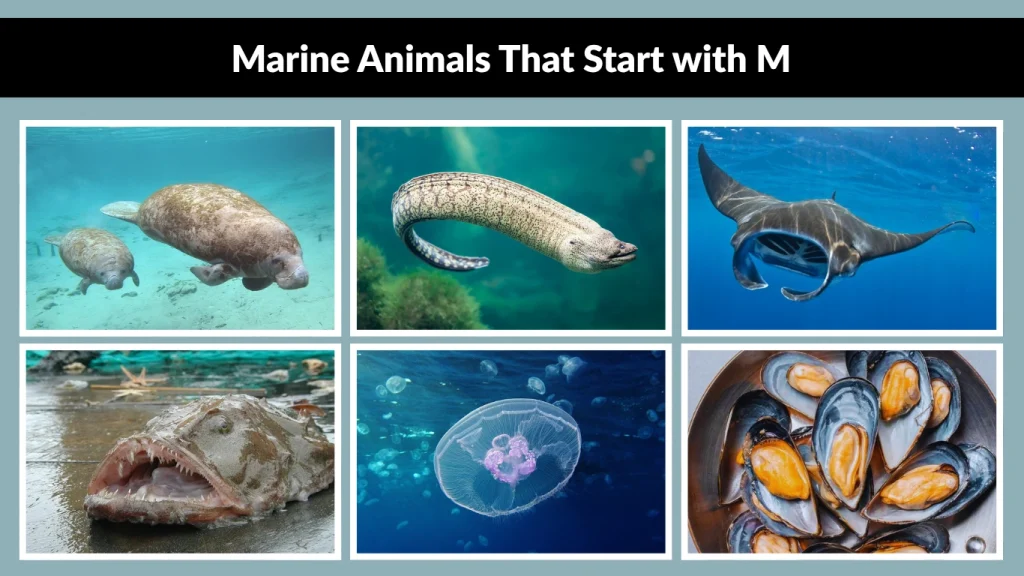
Marine animals starting with M encompass a fascinating range of creatures living in oceans and freshwater habitats. From gentle giants like the manatee to vibrant species like the moon jellyfish, these animals exhibit diverse adaptations for underwater life. They contribute significantly to marine ecosystems as grazers, predators, and filter feeders.
13. Manatee
Manatees, often called sea cows, are large, slow-moving marine mammals that inhabit warm coastal waters and rivers. They feed mostly on aquatic plants, grazing underwater for hours daily.
These gentle giants have paddle-shaped flippers and rounded tails, helping them navigate calm waters. Manatees are vulnerable due to habitat loss and boat collisions but remain beloved marine icons.
14. Moray Eel
Moray eels are elongated, snake-like fish found hiding in crevices of coral reefs and rocky underwater habitats worldwide. They have sharp teeth and a powerful bite for capturing prey.
They feed on fish, crustaceans, and cephalopods, often hunting at night. Moray eels are known for their vibrant colors and sometimes aggressive behavior when threatened.
15. Manta Ray
Manta rays are large, graceful fish characterized by their triangular pectoral fins and cephalic lobes near the mouth. They glide through warm oceans feeding on plankton and small fish.
Manta rays are filter feeders, swimming with mouths open to filter tiny food particles. Despite their size, they are gentle and often curious about divers.
16. Monkfish
Monkfish are bottom-dwelling fish known for their large heads and wide mouths filled with sharp teeth. They use a specialized lure on their heads to attract prey in dark ocean floors.
They feed mainly on smaller fish and invertebrates. Monkfish are commercially important seafood but have a somewhat grotesque appearance compared to other fish.
17. Moon Jellyfish
Moon jellyfish are translucent, delicate creatures found in oceans worldwide. They drift with currents, using pulsating movements to propel themselves slowly through the water.
Their diet consists mainly of plankton and small fish larvae, which they capture using stinging tentacles. Moon jellyfish are often seen glowing softly at night due to bioluminescence.
18. Mussel
Mussels are bivalve mollusks that attach to rocks and other surfaces in saltwater and freshwater environments. They filter water to extract plankton and organic matter for food.
They form dense colonies and provide important habitat and food sources for other marine animals. Mussels are also popular in human cuisine.
Insects and Arthropods That Start with M

Insects and arthropods beginning with M are a diverse and widespread group, inhabiting almost every environment on Earth. They play crucial roles in ecosystems, from pollination to decomposition, and sometimes as pests or beneficial predators. These species display a fascinating array of forms, behaviors, and adaptations.
19. Mosquito
Mosquitoes are small flying insects known for their biting habits and role as vectors for diseases like malaria and dengue. Female mosquitoes feed on blood to produce eggs, while males feed on nectar.
Despite their nuisance, mosquitoes are important in food chains, serving as prey for birds, bats, and fish. Their larvae develop in standing water, making water management key to control.
20. Mantis (Praying Mantis)
Praying mantises are predatory insects famous for their folded, prayer-like front legs used to grasp prey. They are skilled hunters feeding on various insects and sometimes small reptiles.
Mantises have excellent vision and camouflage, allowing them to ambush prey effectively. They play beneficial roles in gardens by controlling pest populations.
21. Mayfly
Mayflies are aquatic insects with short adult lifespans, often just a day. They are important indicators of water quality and form a significant food source for fish.
Adults have delicate wings and emerge in large swarms for mating. Their larvae live underwater for months, feeding on algae and detritus.
22. Millipede
Millipedes are elongated, many-legged arthropods that feed mainly on decaying plant material. They play essential roles in soil health by breaking down organic matter.
They move slowly and curl into a coil when threatened. Millipedes are generally harmless to humans but can release defensive chemicals if disturbed.
23. Metallic Wood-boring Beetle
These beetles are known for their shiny, iridescent exoskeletons that gleam like metal. Their larvae bore into wood, sometimes causing damage to trees and timber.
Adults often feed on pollen and nectar. Despite their beauty, they can be pests in forests and lumber industries, requiring management in affected areas.
24. Mud Dauber Wasp
Mud dauber wasps are solitary wasps that build nests from mud. They are known for their slender bodies and long legs.
They hunt spiders to provision their nests, paralyzing them with venom. Mud daubers are generally non-aggressive toward humans and help control spider populations.
Reptiles and Amphibians That Start with M
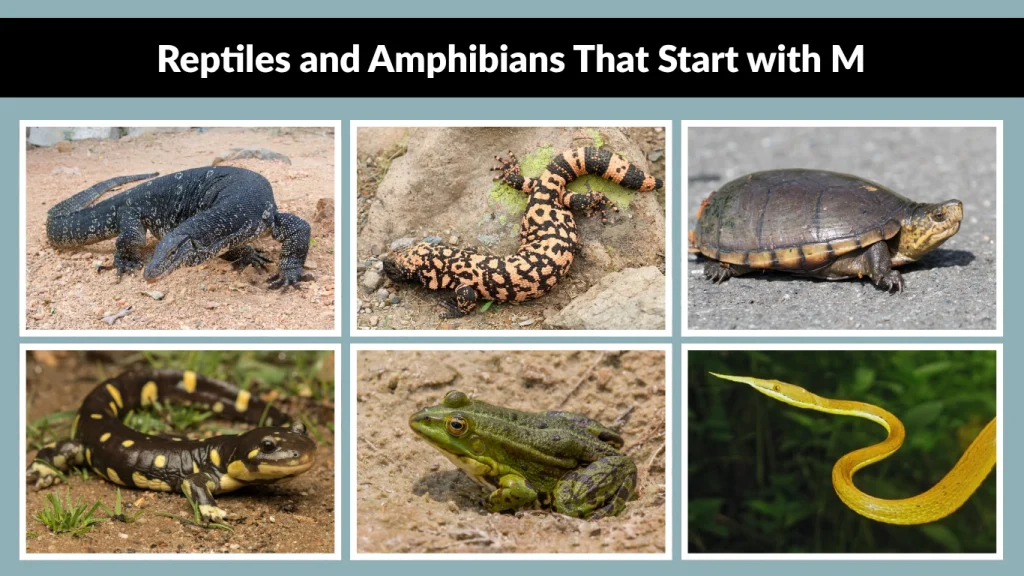
Reptiles and amphibians beginning with the letter M include a variety of species adapted to land, freshwater, and sometimes semi-aquatic environments. These animals exhibit fascinating behaviors and physiological traits, playing key roles in their ecosystems as predators, prey, and environmental indicators.
25. Monitor Lizard
Monitor lizards are large, powerful reptiles found in Africa, Asia, and Australia. They have long necks, strong limbs, and sharp claws for climbing and hunting.
These lizards are carnivorous, feeding on insects, small mammals, birds, and carrion. Some species, like the Komodo dragon, are among the largest reptiles on Earth.
26. Mexican Beaded Lizard
The Mexican beaded lizard is a venomous lizard native to Mexico and Central America. It has a distinctive beaded, armored skin and a thick tail.
It primarily feeds on eggs, small mammals, and insects. This lizard uses venom to subdue prey and defend itself from predators.
27. Mud Turtle
Mud turtles are small aquatic turtles found in North and South America. They prefer slow-moving waters with muddy bottoms, where they can hide and forage.
Their diet includes aquatic plants, insects, and small fish. Mud turtles are known for their ability to survive in temporary dry conditions by burrowing into mud.
28. Mole Salamander
Mole salamanders are amphibians known for their secretive, burrowing lifestyle. They spend much time underground, emerging mainly during rainy seasons to breed.
They feed on insects, worms, and other small invertebrates. Their skin is smooth and moist, essential for respiration in amphibians.
29. Marsh Frog
The marsh frog is the largest frog species in Europe, commonly found in wetlands and marshes. It has a greenish-brown color with dark spots.
Marsh frogs eat insects, spiders, and small invertebrates. Their loud croaking is a familiar sound in wetland habitats during mating season.
30. Malagasy Leaf-nosed Snake
This unique snake species is native to Madagascar and named for its leaf-shaped nasal appendage. It is a nocturnal predator feeding on small animals.
The Malagasy leaf-nosed snake uses camouflage and stealth to hunt frogs, lizards, and rodents. It is a relatively rare species due to habitat loss.
Rodents That Start with M
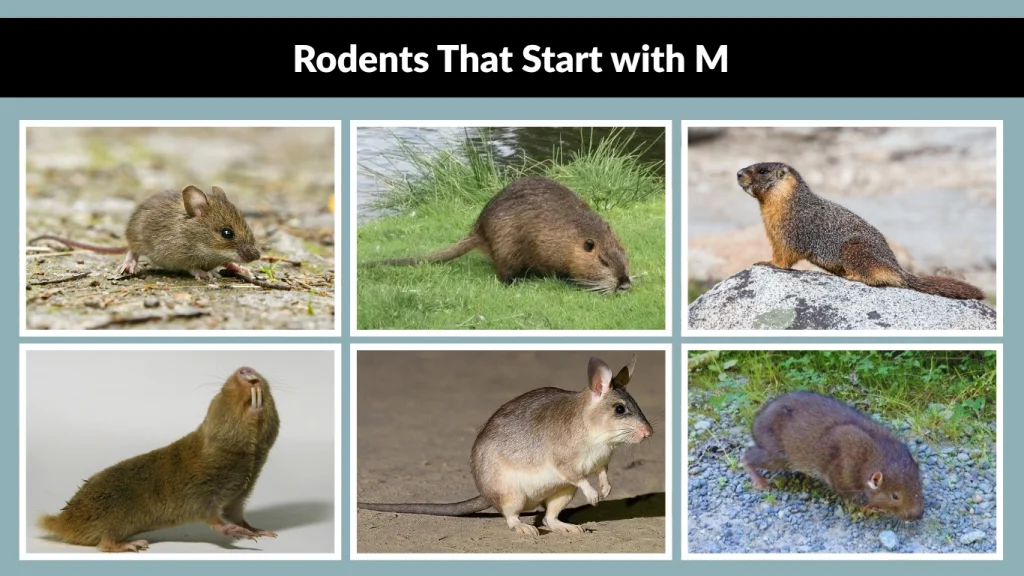
Rodents beginning with M include a variety of small to medium-sized mammals that are often highly adaptable and found in diverse environments worldwide. These animals play vital roles in ecosystems as seed dispersers, prey, and sometimes as pests.
31. Mouse
Mice are small rodents known for their agility and ability to live close to humans. They have sharp teeth for gnawing and a highly developed sense of smell.
Mice feed on seeds, grains, and scraps. They reproduce quickly and are important in both natural food webs and scientific research.
32. Muskrat
Muskrats are semi-aquatic rodents native to North America. They build lodges and burrows near freshwater habitats such as marshes and ponds.
Their diet mainly consists of aquatic plants, roots, and small animals. Muskrats are excellent swimmers and use their long tails for balance.
33. Marmot
Marmots are large, ground-dwelling rodents found in mountainous regions of North America, Europe, and Asia. They live in burrows and hibernate during winter.
They feed on grasses, flowers, and seeds. Marmots are social animals often seen sunbathing on rocks during the day.
34. Mole Rat
Mole rats are subterranean rodents adapted for digging and living underground. They have powerful claws and reduced eyesight.
They feed on roots and tubers, creating extensive tunnel systems. Some species show unique social behaviors similar to insect colonies.
35. Malagasy Giant Rat
Native to Madagascar, this large rat species inhabits forests and rocky areas. It has coarse fur and is primarily nocturnal.
Its diet includes fruits, seeds, and insects. The Malagasy giant rat plays a role in seed dispersal within its habitat.
36. Mountain Beaver
Despite its name, the mountain beaver is not closely related to true beavers. It is a primitive rodent found in the Pacific Northwest of North America.
Mountain beavers live in dense forests and feed on ferns, roots, and shrubs. They are solitary and create burrows for shelter.
Carnivores That Start with M
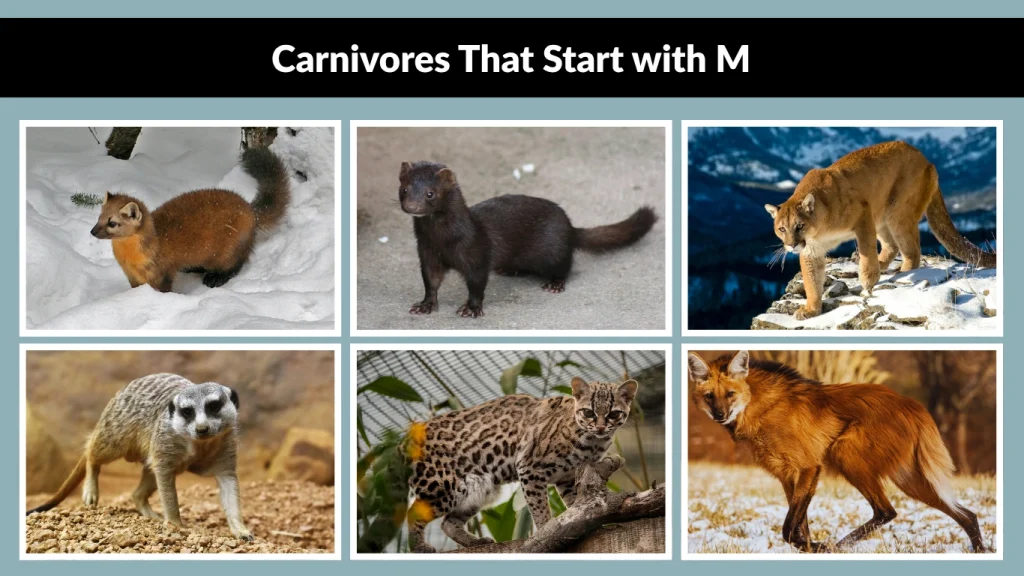
Carnivores beginning with M include a variety of mammals known for their meat-eating habits and adaptations as predators. These animals often play crucial roles in maintaining the balance of their ecosystems by controlling prey populations.
37. Marten
Martens are small, agile members of the weasel family found in forests across North America and Eurasia. They have thick fur and sharp teeth for hunting small mammals and birds.
Martens are excellent climbers and feed on rodents, insects, and berries. Their adaptability helps them thrive in diverse forest habitats.
38. Mink
Minks are semi-aquatic carnivores known for their luxurious dark fur. They are skilled hunters, preying on fish, amphibians, birds, and small mammals.
Native to North America and Europe, minks are solitary and territorial. They play important roles in controlling populations of aquatic and terrestrial prey.
39. Mountain Lion
The mountain lion is a powerful apex predator native to the Americas. It primarily hunts deer but can take down various mammals and birds.
Also called cougar or puma, this large cat has keen senses and stealthy hunting techniques, making it a dominant carnivore in its range.
40. Meerkat
Though primarily insectivores, meerkats also hunt small vertebrates, making them partial carnivores. They live in social groups in African deserts.
Meerkats use cooperative hunting and vigilant lookout behaviors to survive, feeding on insects, small reptiles, and occasionally eggs.
41. Margay
The margay is a small wild cat native to Central and South American rainforests. It is nocturnal and arboreal, hunting birds, rodents, and reptiles.
Its exceptional climbing skills allow it to pursue prey through trees. Margays are solitary and elusive, with spotted coats for camouflage.
42. Maned Wolf
Native to South America, the maned wolf is a unique carnivore with long legs adapted to tall grasslands. It has a diet that includes small animals and fruits.
Though called a wolf, it is not closely related to true wolves. The maned wolf plays an important ecological role as both predator and seed disperser.
Farm and Domesticated Animals That Start with M
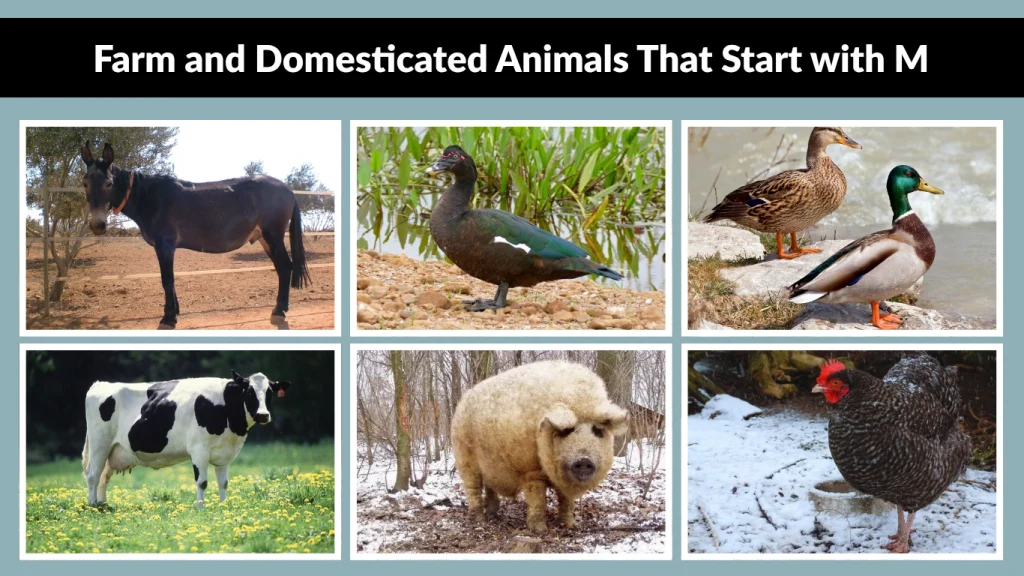
Farm and domesticated animals starting with M are species commonly raised for food, labor, or companionship. These animals have been selectively bred over centuries to enhance traits beneficial to humans and play key roles in agriculture and rural life.
43. Mule
Mules are the hybrid offspring of a male donkey and a female horse. They are known for their strength, endurance, and sure-footedness.
Widely used as working animals, mules serve in agriculture, transportation, and pack carrying, especially in rough terrains where horses struggle.
44. Muscovy Duck
The Muscovy duck is a large, heavy-bodied duck native to Central and South America but widely domesticated worldwide. It has a distinctive red facial caruncle.
They are raised for meat and eggs and are known for their quiet nature compared to other ducks. Muscovy ducks can forage in a variety of habitats.
45. Mallard
The mallard is a wild duck species that has been domesticated in many regions. It is the ancestor of most domestic duck breeds.
Mallards have a varied diet and adapt well to different environments. Their colorful males and brown females are familiar sights in ponds and parks.
46. Milch Cow
A milch cow is a term for a cow bred and raised primarily for milk production. These cows are essential to dairy farming worldwide.
Breeds like Holstein and Jersey are popular milch cows due to their high milk yield and quality, supporting large-scale dairy industries.
47. Mangalitsa Pig
The Mangalitsa pig is a Hungarian breed known for its curly, woolly coat and high-quality fatty meat. It is prized in gourmet cooking.
This breed is hardy and well-suited for extensive farming systems. Mangalitsa pigs have a slower growth rate but produce flavorful pork.
48. Marans Chicken
Marans chickens are a French breed famous for their dark brown eggs and calm temperament. They are dual-purpose birds raised for meat and eggs.
These chickens have attractive plumage and are popular among backyard poultry keepers. Their eggs are especially valued by chefs and bakers.
Mythical and Extinct Animals That Start with M
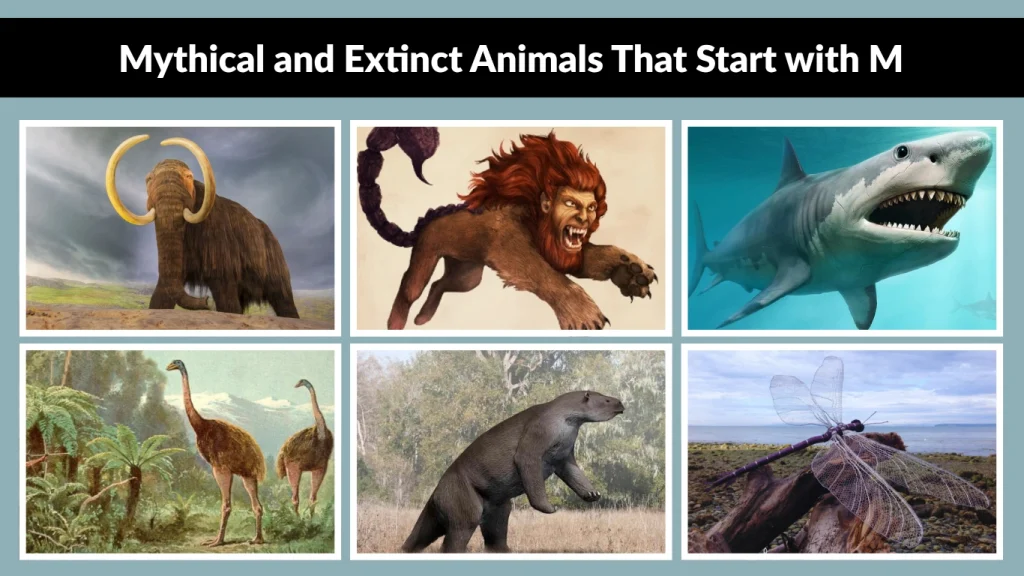
This group features animals that are either mythical, legendary creatures or species that once roamed the Earth but are now extinct. These animals have captured human imagination or scientific interest due to their unique traits and historical significance.
49. Mastodon
Mastodons were prehistoric elephant-like mammals that lived millions of years ago. They had long, curved tusks and a thick coat of fur.
These herbivores roamed forests and grasslands before becoming extinct around 10,000 years ago, likely due to climate change and human hunting.
50. Megalodon
Megalodon was a gigantic prehistoric shark that lived millions of years ago and is considered one of the largest predators to ever exist.
With teeth over seven inches long, Megalodon preyed on whales and large fish. Its extinction remains a topic of scientific study and popular fascination.
51. Manticore
The manticore is a mythical creature from Persian folklore, often depicted with the body of a lion, a human head with three rows of sharp teeth, and a tail of venomous spines.
It is said to be a fearsome predator and symbol of danger in many legends, capturing imaginations in art and literature for centuries.
52. Moa
Moas were large, flightless birds native to New Zealand that became extinct around 1400 AD due to hunting by the Maori people.
Some moa species stood up to 12 feet tall and weighed several hundred kilograms, making them among the largest birds ever known.
53. Megatherium
Megatherium was a genus of giant ground sloths that lived during the Pleistocene epoch. They were massive herbivores, reaching the size of modern elephants.
These slow-moving creatures used their large claws to pull down branches and strip leaves, becoming extinct approximately 10,000 years ago.
54. Meganeura
Meganeura was a giant prehistoric insect resembling a dragonfly, with a wingspan of up to 70 centimeters. It lived around 300 million years ago.
As one of the largest flying insects ever, Meganeura dominated the skies during its time, feeding on smaller insects and contributing to ancient ecosystems.
Miscellaneous Animals That Start with M
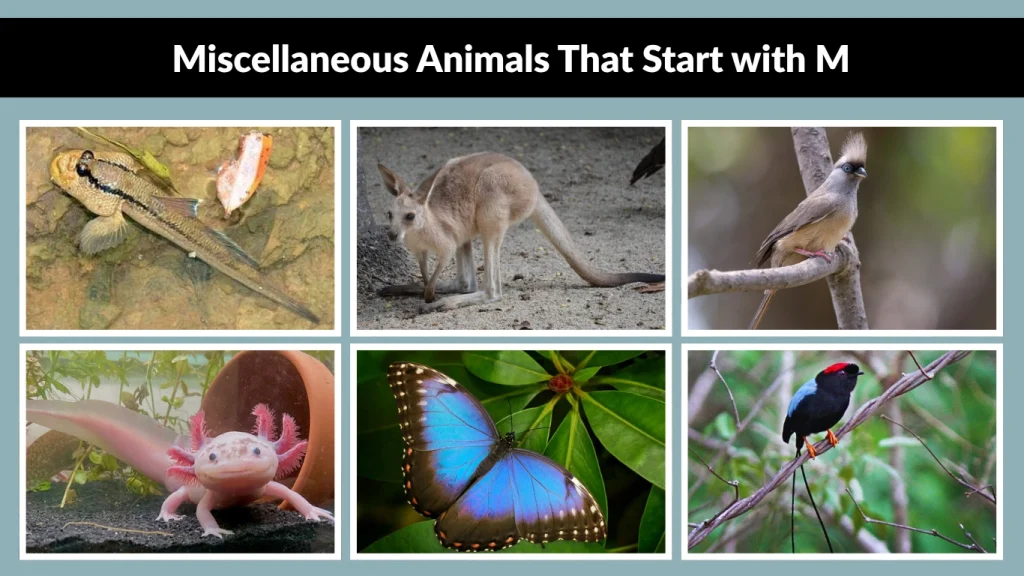
This group includes a variety of animals starting with M that don’t fit neatly into other categories. They represent diverse species from different animal classes and habitats, each with unique characteristics.
55. Mudskipper
Mudskippers are amphibious fish that can walk on land using their pectoral fins. They inhabit intertidal zones in tropical and subtropical regions.
These fish feed on algae, small invertebrates, and detritus. Their ability to breathe through skin and gills allows them to survive both in water and on land.
56. Macropod
Macropods are a family of marsupials including kangaroos, wallabies, and related species. They are native to Australia and New Guinea.
Known for their powerful hind legs and long tails, macropods are herbivores that use hopping as their primary mode of locomotion.
57. Mousebird
Mousebirds are small, slender birds found in sub-Saharan Africa. They have soft, mouse-like fur and long tails, giving them their name.
These birds feed on fruits, leaves, and flowers. They are social and often travel in flocks, using their agile feet to climb branches.
58. Mexican Axolotl
The Mexican axolotl is a neotenic salamander famous for retaining its larval features throughout life. It is native to lakes around Mexico City.
Axolotls have remarkable regenerative abilities and are studied extensively in scientific research. They feed on small aquatic animals and insects.
59. Morpho Butterfly
Morpho butterflies are large, tropical butterflies known for their brilliant blue iridescent wings. They are native to Central and South American rainforests.
Their wings’ reflective scales help deter predators. Morphos feed mainly on fermenting fruit and tree sap.
60. Manakin
Manakins are small, colorful birds native to Central and South America. They are renowned for their elaborate courtship dances and displays.
These birds eat mainly fruit and insects. Males perform complex rituals involving acrobatics and sounds to attract females.