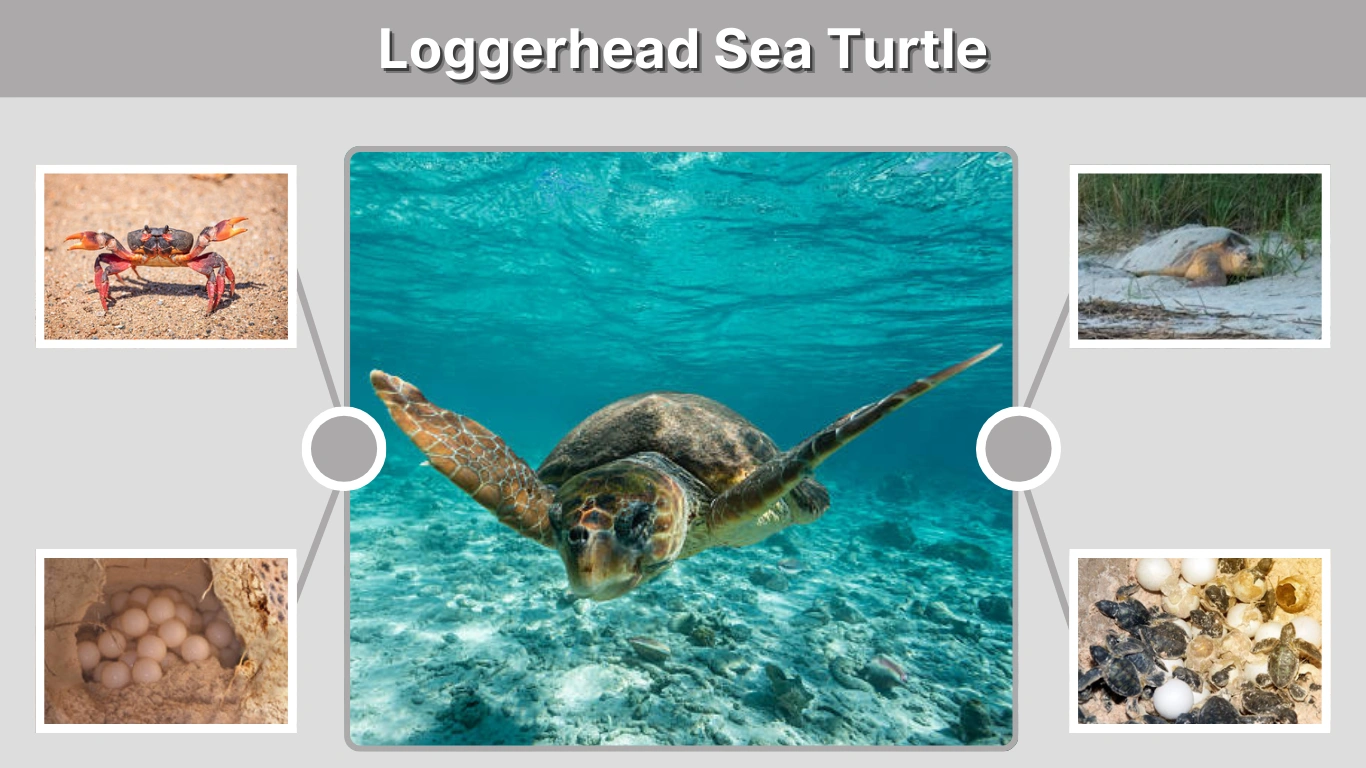
The loggerhead sea turtle (Caretta caretta) is one of the most widespread and recognizable sea turtle species. Known for its large, broad head and reddish-brown shell, the loggerhead plays a vital role in maintaining healthy marine ecosystems, particularly in controlling crab, mollusk, and other invertebrate populations. These turtles inhabit coastal areas, bays, and open oceans and undertake long migrations between feeding grounds and nesting beaches. Unfortunately, loggerheads are listed as vulnerable due to human activities such as fishing bycatch, coastal development, and pollution.
Identification of Loggerhead Sea Turtles
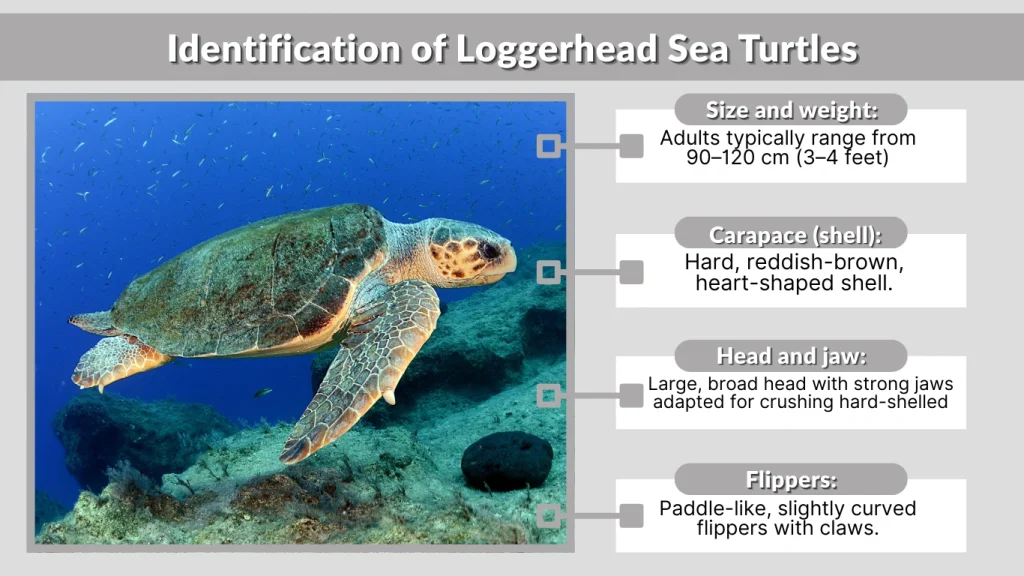
Loggerhead sea turtles have several distinctive features that help distinguish them from other sea turtles:
- Size and weight: Adults typically range from 90–120 cm (3–4 feet) in carapace length and weigh 135–200 kilograms (300–440 pounds).
- Carapace (shell): Hard, reddish-brown, heart-shaped shell with a moderately domed profile.
- Head and jaw: Large, broad head with strong jaws adapted for crushing hard-shelled prey like crabs and mollusks.
- Flippers: Paddle-like, slightly curved flippers with claws for digging and swimming efficiently.
- Coloration: Reddish-brown carapace with yellowish plastron (underside).
- Comparison with other species: Smaller than leatherbacks, less colorful than hawksbills, and with a broader head than green turtles.
These features make loggerheads easily recognizable in both coastal waters and nesting beaches.
Physical Characteristics
Loggerheads are medium to large-sized sea turtles, notable for their robust bodies and strong jaws. The carapace is slightly domed and heart-shaped, providing protection while allowing maneuverability in shallow coastal waters. The broad head is ideal for their diet, allowing them to crush shells and extract invertebrates from coral reefs or the seabed.
The flippers are long and paddle-like, with front flippers providing propulsion and rear flippers aiding steering. Unlike hawksbills, loggerheads do not have a narrow beak but possess a powerful jaw capable of handling hard prey. Coloration ranges from reddish-brown to dark brown on the top, while the underside is pale yellow, offering some camouflage in the water.
Diet of Loggerhead Sea Turtles
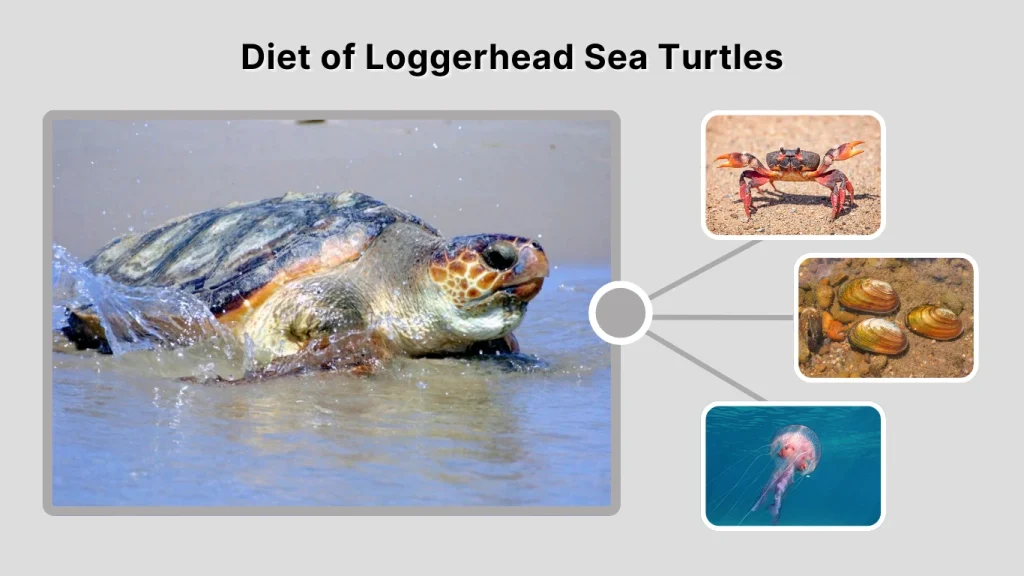
Loggerheads are primarily carnivorous and play a key ecological role in controlling invertebrate populations. Their diet mainly consists of:
- Crabs and crustaceans: Including hermit crabs and small lobsters.
- Mollusks: Clams, mussels, and snails, crushed with their strong jaws.
- Jellyfish and soft-bodied organisms: Occasionally consumed, especially in pelagic zones.
- Occasional plant matter: Some algae and seagrass may be eaten but are not a major dietary component.
By feeding on invertebrates, loggerheads maintain the balance of benthic ecosystems and prevent overpopulation of certain species that could damage coral reefs or seagrass beds.
Habitat and Range
Loggerhead sea turtles are highly adaptable, inhabiting tropical and subtropical waters globally. They are found in the Atlantic, Pacific, and Indian Oceans, frequently near coastal areas, bays, estuaries, and occasionally in open ocean.
Nesting Sites
Loggerheads nest on sandy beaches, usually returning to the same locations where they were born. Nesting occurs during warmer months, with females laying 4–5 clutches per season, each containing around 100–120 eggs.
Migration
These turtles are long-distance migrators, traveling hundreds to thousands of kilometers between feeding and nesting sites. Migration is guided by a combination of magnetic cues, ocean currents, and environmental signals.
Water Preferences
Loggerheads prefer coastal waters, generally remaining in depths up to 200 meters, but juveniles and adults may occasionally venture further offshore. Water temperatures typically range between 20–28°C (68–82°F).
Behaviors of Loggerhead Sea Turtles
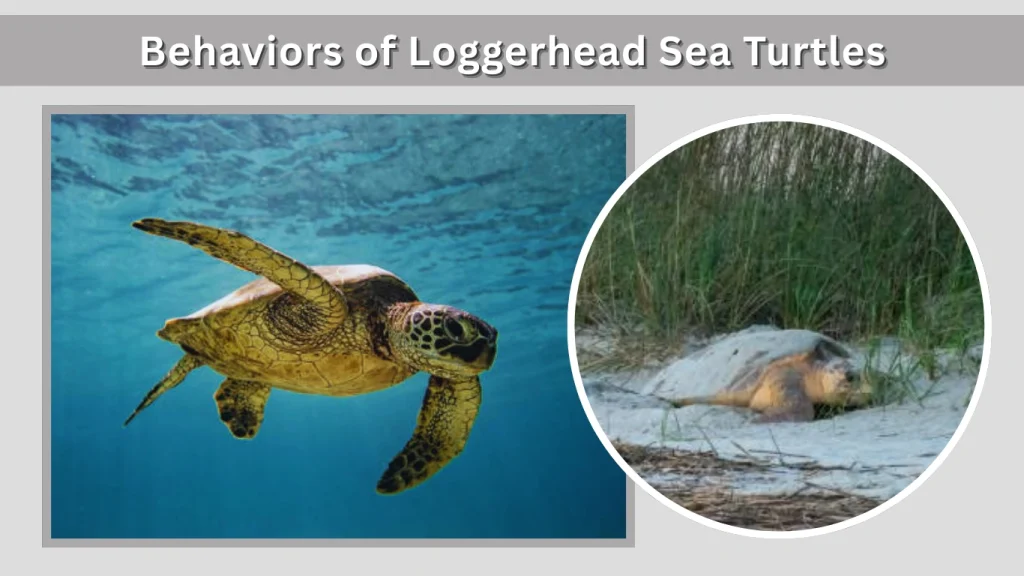
Loggerhead sea turtles are generally solitary creatures, spending most of their lives alone in coastal or pelagic waters. Their behavior is strongly linked to feeding, migration, and nesting activities.
Feeding Behavior
Loggerheads are opportunistic feeders but rely heavily on hard-shelled prey like crabs, mollusks, and shrimp. They use their strong, crushing jaws to break shells and access the soft tissues inside. Juveniles tend to feed in pelagic zones, while adults focus on shallow coastal habitats and reef areas.
Nesting Behavior
Female loggerheads return to the beaches where they hatched to lay eggs. Nesting occurs at night to reduce predation risk. Each female may lay 4–5 clutches per season, with around 100–120 eggs per clutch. After covering the eggs with sand, they return to the ocean, leaving hatchlings to fend for themselves.
Migration and Navigation
Loggerheads are long-distance migrators, traveling hundreds to thousands of kilometers between feeding grounds and nesting beaches. They navigate using magnetic cues, ocean currents, and possibly environmental signals, returning to natal beaches with remarkable precision.
Lifecycle of Loggerhead Sea Turtles

Loggerheads have a multi-stage lifecycle that begins and ends on sandy beaches.
- Egg stage: Eggs incubate for about 60 days, with temperature-dependent sex determination—warmer sand produces more females.
- Hatchlings: Tiny turtles face predators such as crabs, birds, and fish on their way to the sea. Only a small percentage survive to adulthood.
- Juvenile stage: Hatchlings spend several years in open ocean or coastal habitats, feeding and growing while avoiding predators.
- Adult stage: Loggerheads reach sexual maturity at around 17–33 years, continuing the reproductive cycle for decades. Adults can live up to 50 years in the wild.
Threats and Conservation Status
Loggerhead sea turtles face multiple natural and human-induced threats.
Natural Threats
- Predation of eggs and hatchlings by raccoons, crabs, birds, and sharks
- Extreme weather events destroying nests
Human-Induced Threats
- Fishing bycatch: Longlines, gillnets, and trawls capture turtles unintentionally.
- Coastal development: Habitat loss reduces safe nesting beaches.
- Pollution: Plastic ingestion and chemical contamination.
- Climate change: Rising temperatures affect hatchling sex ratios and beach stability.
The loggerhead is currently listed as Vulnerable by the IUCN, with population trends varying regionally. Conservation programs include protected nesting beaches, marine reserves, and fishing regulations.
Fascinating Facts About Loggerhead Sea Turtles
- Loggerheads have powerful jaws capable of crushing hard-shelled prey.
- They are long-distance migrators, often traveling thousands of kilometers.
- Adults are primarily solitary, interacting mainly during mating or in shared feeding grounds.
- Lifespan can reach 50 years or more in the wild.
- They contribute to coastal ecosystem health by controlling invertebrate populations.
How to Observe and Protect Loggerhead Sea Turtles
- Responsible wildlife tourism: Observe nesting and feeding from a distance without disturbance.
- Protect nesting beaches: Avoid lights, foot traffic, and vehicles during nesting season.
- Reduce marine pollution: Dispose of plastics properly to prevent ingestion.
- Support conservation efforts: Volunteer or donate to programs protecting loggerheads and their habitats.
FAQs
What do loggerhead sea turtles eat?
Loggerheads primarily feed on crabs, mollusks, shrimp, and other invertebrates. They occasionally eat algae or jellyfish but are mainly carnivorous, helping control benthic invertebrate populations.
Where do loggerhead turtles nest?
Loggerheads nest on sandy beaches worldwide, especially in the Atlantic, Pacific, and Indian Oceans. Females often return to their natal beaches for reproduction.
How long do loggerhead sea turtles live?
Loggerheads can live up to 50 years, reaching sexual maturity between 17–33 years depending on environmental conditions.
Why are loggerhead turtles endangered?
They are vulnerable due to fishing bycatch, coastal development, pollution, poaching, and climate change, all of which threaten nesting success and survival rates.
How can humans help protect loggerhead turtles?
Humans can help by protecting nesting beaches, reducing marine pollution, practicing responsible tourism, and supporting conservation programs.