





Leatherback sea turtles (Dermochelys coriacea) are the largest and most unique of all sea turtle species. Known for their soft, leathery shell, long-distance migrations, and deep-diving capabilities, leatherbacks have fascinated researchers and conservationists for centuries. These turtles are globally distributed, ranging from tropical to temperate waters, and play a critical role in marine ecosystems by controlling jellyfish populations. Despite their impressive size and ancient lineage, leatherbacks face numerous threats, including human activities and climate change. Here are 20 fascinating facts about these incredible reptiles.
Identification and Physical Features

- Largest Sea Turtle Species – Leatherbacks can grow up to 2 meters (6.5 feet) long and weigh as much as 700 kilograms (1,500 pounds), making them the largest living sea turtle species.
- Leathery Shell – Unlike other sea turtles with hard, bony shells, leatherbacks have a soft, flexible carapace covered with oily, rubber-like skin. This adaptation allows them to compress slightly during deep dives.
- Seven Longitudinal Ridges – Their carapace features seven ridges running from head to tail, which help streamline their body and improve hydrodynamics in the water.
- Distinctive Coloration – Leatherbacks are dark grey to black with pale spots on the head, flippers, and carapace. The coloration provides camouflage in the open ocean and protects them from predators.
- Large Flippers – Leatherbacks have long, paddle-like flippers that can be nearly half their body length. These flippers allow them to travel thousands of kilometers across oceans with remarkable speed and efficiency.
- Elongated Head – Their head is narrow and elongated, unlike the broader heads of loggerhead turtles, allowing them to feed efficiently on jellyfish and other soft-bodied prey.
- Partial Endothermy – Leatherbacks are partially endothermic, meaning they can regulate their body temperature above the surrounding water. This adaptation allows them to dive into colder waters that most other reptiles cannot survive in.
Diet and Feeding

- Primarily Feed on Jellyfish – Leatherbacks’ diet consists almost exclusively of jellyfish and other soft-bodied organisms. Their throat is lined with backward-pointing papillae to help swallow slippery prey while minimizing the risk of stings.
- Role in Ocean Ecosystems – By feeding on jellyfish, leatherbacks help control jellyfish populations, which in turn maintains balance in marine ecosystems and supports the health of fish populations.
- Occasional Other Prey – While jellyfish dominate their diet, leatherbacks occasionally eat small fish, squid, and crustaceans, particularly in regions where jellyfish are less abundant.
- Unique Feeding Adaptations – The papillae in their throat not only prevent stings from jellyfish but also act like a filter, allowing them to consume large numbers efficiently without injury.
Habitat and Migration

- Global Distribution – Leatherbacks are found in oceans worldwide, from tropical to temperate waters, making them the most widely distributed sea turtle species.
- Long-Distance Migrators – Leatherbacks are known for their extraordinary migrations, traveling thousands of kilometers between feeding grounds and nesting beaches. Some populations cross entire oceans during seasonal migrations.
- Deep Divers – They can dive over 1,200 meters (nearly 4,000 feet), deeper than most other sea turtles, allowing them to access prey unavailable to competitors.
- Temperature Flexibility – Thanks to partial endothermy, leatherbacks can survive in cold temperate waters, which enables them to expand their range far beyond tropical regions.
Reproduction and Lifecycle
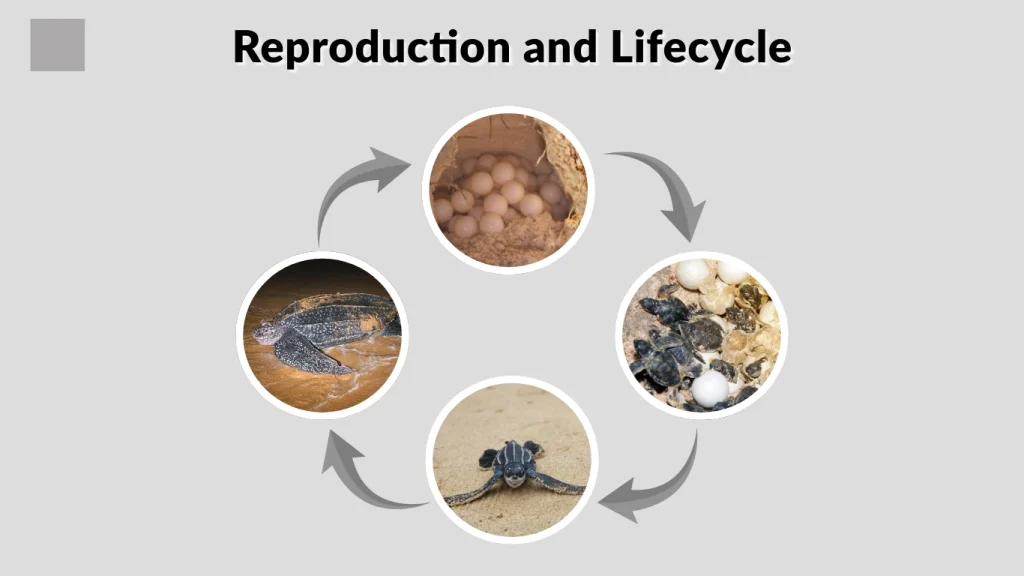
- Natal Homing – Female leatherbacks return to the same beaches where they hatched to lay their eggs. This remarkable homing ability ensures that hatchlings emerge in safe, suitable environments.
- Egg Clutches – A single female can lay 80–90 eggs per clutch and may nest multiple times per season. She typically deposits eggs in sandy nests above the high tide line.
- Temperature-Dependent Sex Determination – The temperature of the sand during incubation determines hatchling sex. Warmer sand produces more females, while cooler sand produces more males. This makes nesting beaches extremely sensitive to climate change.
- Hatchling Challenges – After emerging from their nests, hatchlings face predators such as crabs, birds, and fish. Only a small percentage survive to adulthood, highlighting the importance of protecting nesting sites.
- Long Lifespan – Leatherback sea turtles can live up to 45 years or more in the wild. Adults continue to migrate, feed, and reproduce for decades, making them long-lived keystone species in marine ecosystems.
Conservation and Threats
Leatherback sea turtles face numerous natural and human-induced threats that have led to their classification as Vulnerable or Endangered depending on the population.
- Fishing bycatch – Leatherbacks often get accidentally captured in longlines, gillnets, and trawl nets.
- Plastic ingestion – Floating plastics, such as bags, are mistaken for jellyfish and can cause injury or death.
- Coastal development – Nesting beaches are destroyed or disturbed by tourism, urban expansion, and artificial lighting.
- Climate change – Rising global temperatures affect sand temperature at nesting beaches, influencing hatchling sex ratios.
- Pollution and oil spills – Contaminants in the water can damage habitats and affect turtle health.
Global conservation programs, including marine protected areas, beach protection initiatives, and international agreements, aim to reduce these threats and help stabilize leatherback populations.
Fascinating Facts About Leatherback Sea Turtles
- Leatherbacks are ancient species, existing for over 100 million years, making them one of the oldest living reptiles.
- They are the largest living sea turtles, capable of extraordinary migrations across oceans.
- Their partially endothermic physiology allows them to dive into cold waters unreachable by other reptiles.
- Leatherbacks play a crucial role in controlling jellyfish populations, maintaining marine ecosystem balance.
- Despite their size, leatherbacks are highly agile swimmers, capable of covering 35–40 kilometers per day during migrations.
Conclusion
Leatherback sea turtles are truly remarkable animals, combining enormous size, ancient lineage, long-distance migrations, and specialized diets. Protecting them is crucial not only for their survival but also for maintaining healthy marine ecosystems. From their leathery shells and deep-diving abilities to their precise natal homing and long lifespans, these turtles are a testament to the resilience and adaptability of life in the oceans. Conservation efforts, such as nesting beach protection, reducing bycatch, and controlling marine pollution, are vital to ensure leatherbacks continue to thrive for generations to come.