



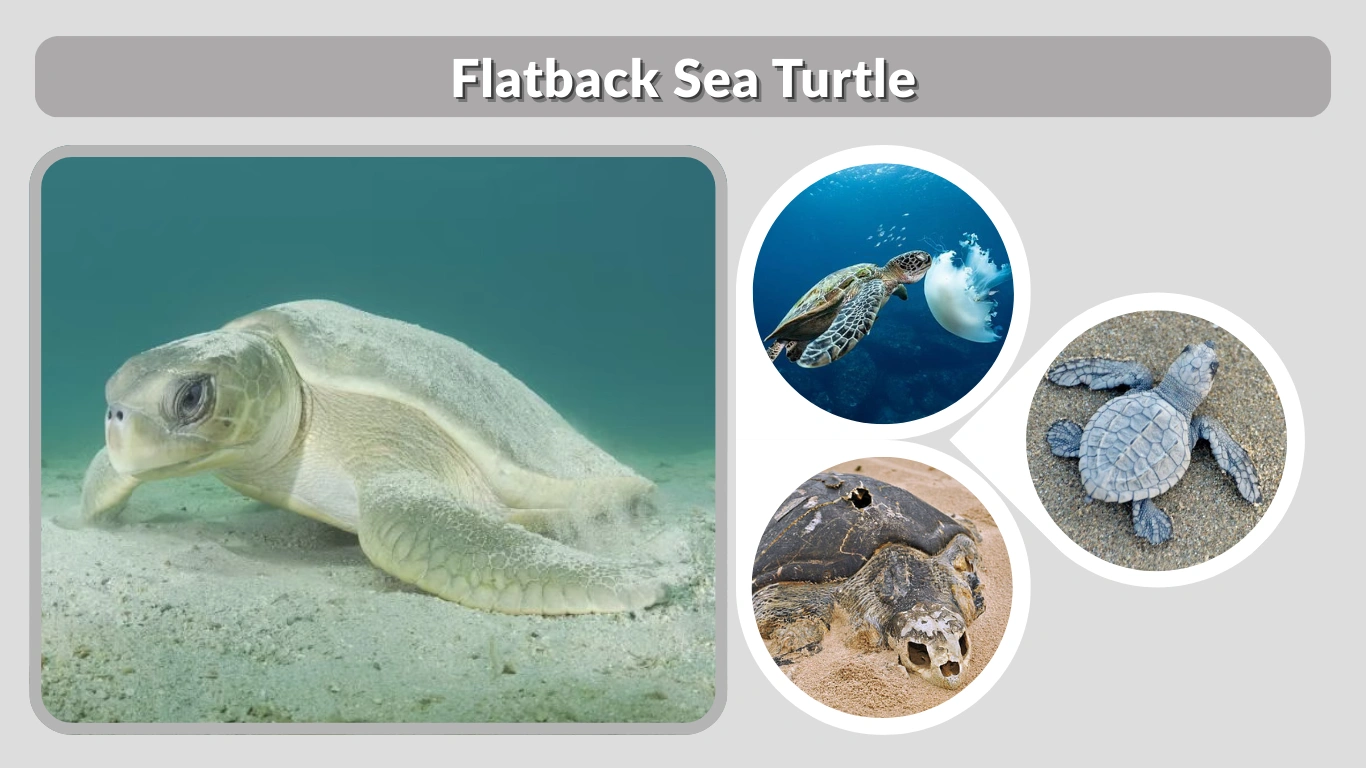
The flatback sea turtle is one of the least-known sea turtles in the world, mainly because it lives almost entirely in Australian waters. Unlike other sea turtles that travel across entire oceans, flatbacks stay close to continental shelves and shallow coastal seas. They are named for their unusually low, flattened shell and soft outer edge. People commonly search for flatback sea turtle facts, identification, habitat, diet, lifespan, and whether flatback sea turtles are endangered. Understanding this unique species is essential for appreciating Australia’s marine biodiversity.
What Is a Flatback Sea Turtle?
The flatback sea turtle is a medium-sized marine reptile found primarily along the northern coast of Australia and southern Papua New Guinea. It is unique among sea turtles because it does not migrate across entire ocean basins. Instead, it spends most of its life in warm, shallow waters over continental shelves.
Flatback turtles are specially adapted to coastal environments. Their flatter shell helps them glide through shallow seas and soft-bottom habitats. They come ashore only to nest, often returning to the same remote beaches where they were born.
Flatback Sea Turtle Scientific Name
The scientific name of the flatback sea turtle is Natator depressus. It belongs to the family Cheloniidae but is the only living species in its genus. The name depressus refers to its flattened shell, which clearly distinguishes it from other sea turtles such as the green turtle or loggerhead.
Flatback Sea Turtle Identification
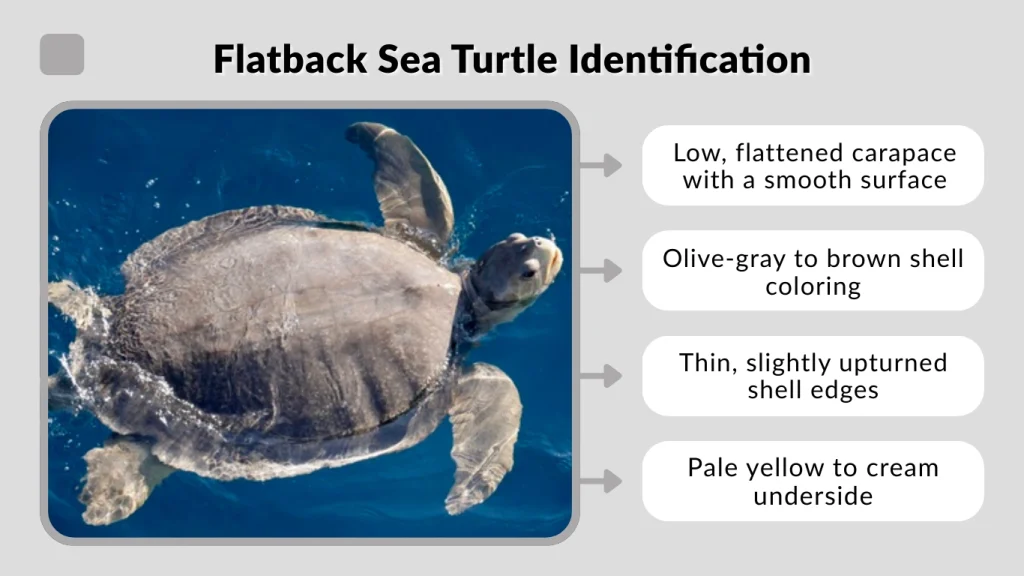
The flatback sea turtle has several physical traits that make identification easier.
- Low, flattened carapace with a smooth surface
- Olive-gray to brown shell coloring
- Thin, slightly upturned shell edges
- Pale yellow to cream underside
- Large head and strong flippers
Unlike most sea turtles, flatbacks have a softer outer shell edge and a noticeably lower dome. Their hatchlings are also much larger than those of any other sea turtle species.
Flatback Sea Turtle Characteristics
Flatback sea turtles have broad bodies, strong front flippers, and relatively large heads. Their shells are thinner and flatter than those of other sea turtles, making them more flexible in shallow coastal waters. This design allows them to maneuver easily over sandy and muddy seafloors where much of their food is found.
Adult flatbacks are generally solitary, except during the breeding season. Females come ashore at night to dig nests in soft sand above the high-tide line. Males rarely leave the water, spending most of their lives feeding and migrating along coastal shelves.
Flatback Sea Turtle Size, Weight & Lifespan

Adult flatback sea turtles usually reach 30 to 38 inches (76 to 96 cm) in shell length and weigh between 150 and 200 pounds (70 to 90 kg). This places them in the medium range compared to other sea turtles. Their bodies are wide and robust, giving them strong swimming power despite their relatively short migrations.
Hatchlings are unusually large, measuring about 2.5 inches at birth. This larger size may improve early survival by making them harder for small predators to eat.
Flatback Sea Turtle Lifespan
The flatback sea turtle is believed to live 50 years or more in the wild. Like most sea turtles, they grow slowly and take many years to reach sexual maturity, likely between 10 and 20 years. Their long lifespan means population recovery is slow, making conservation protection especially important.
Flatback Sea Turtle Habitat
Flatback sea turtles are strongly associated with coastal and continental shelf waters. They prefer warm, shallow seas with soft bottoms where food is plentiful. Unlike other species, flatbacks rarely venture into deep, open oceans.
Nesting beaches are typically remote, low-energy shorelines with gentle slopes. These beaches are critical habitats because flatback turtles rely on very specific environmental conditions for successful incubation and hatchling emergence.
Australian Flatback Sea Turtle Range
Flatback sea turtles are found almost exclusively around northern Australia, including the coasts of Western Australia, the Northern Territory, Queensland, and the Gulf of Carpentaria. Small populations also occur near southern Papua New Guinea. Because their range is so limited, any environmental disturbance in this region can significantly affect the global population.
Flatback Sea Turtle Diet

Flatback sea turtles are mostly carnivorous, feeding on soft-bodied marine animals found on or near the seafloor.
- Sea cucumbers
- Jellyfish and soft corals
- Snails and clams
- Prawns and small crustaceans
- Small fish
Their strong jaws help them crush soft shells and grasp slippery prey. By feeding on jellyfish and invertebrates, flatbacks help regulate marine populations and contribute to healthy coastal ecosystems.
What Does a Flatback Sea Turtle Eat?
Juvenile flatbacks feed mainly on small invertebrates near coastal nursery areas. As adults, they move across continental shelves searching for jellyfish, sea pens, and bottom-dwelling organisms. Their feeding behavior helps maintain balance in marine food webs and prevents certain species from becoming overly abundant.
Flatback Sea Turtle Life Cycle

The flatback sea turtle life cycle begins when females crawl ashore to lay around 40 to 60 eggs per nest. After an incubation period of roughly 50 to 60 days, large hatchlings emerge and head toward the ocean. Unlike other sea turtles, flatback hatchlings tend to stay in coastal waters instead of drifting far offshore.
After entering the sea, flatback hatchlings move into nearby coastal nursery zones instead of drifting into the open ocean like most other sea turtles. Juveniles grow in shallow waters rich in food and shelter. As they mature, they expand their range across continental shelves, eventually reaching breeding age. Adult flatbacks migrate seasonally between feeding areas and nesting beaches, continuing the life cycle that has existed for millions of years.
Flatback Sea Turtle Predators
Flatback sea turtles face predators at every stage of life. Eggs and hatchlings are the most vulnerable.
On nesting beaches, eggs are often eaten by monitor lizards, ghost crabs, dogs, pigs, and birds. Once hatchlings reach the water, fish, seabirds, and larger invertebrates prey on them. In the ocean, juvenile flatbacks may fall victim to large fish and sharks.
Adult flatback sea turtles have fewer natural predators, but large sharks and saltwater crocodiles are known to attack them. Despite their size and strong shells, flatbacks still rely on camouflage, swimming speed, and shallow-water habitats to reduce predation risk.
Are Flatback Sea Turtles Endangered?

Flatback sea turtles are currently listed as Data Deficient on the IUCN Red List, meaning there is not enough global information to accurately determine their overall population trend. However, in Australia, flatbacks are considered a species of conservation concern and are fully protected under national environmental laws.
Because flatbacks have a very limited geographic range, any major environmental change in northern Australia can significantly impact the entire species. This restricted distribution makes them more vulnerable than widely roaming sea turtles.
Threats to Flatback Sea Turtles
One of the biggest threats to flatbacks is accidental capture in commercial fishing gear. Trawling and net fisheries operating on continental shelves often overlap with their feeding grounds. Boat strikes also pose a danger, especially in busy coastal areas.
Coastal development can destroy or disturb nesting beaches. Artificial lighting disorients hatchlings, leading them away from the ocean. Pollution, particularly plastics and discarded fishing gear, increases the risk of entanglement and ingestion. Climate change further threatens nesting success by altering sand temperatures and increasing storm erosion.
Australian Flatback Sea Turtle Facts
The flatback sea turtle is one of the most unusual sea turtles on Earth. It is the only sea turtle species found almost entirely within Australian waters. Flatback hatchlings are the largest of any sea turtle species, giving them a stronger swimming ability when they first enter the ocean.
Their shells are softer and flatter than those of other turtles, with thin, upturned edges. Flatbacks are also culturally important to many Indigenous Australian communities, where they feature in traditional stories and coastal knowledge systems. Unlike most sea turtles, flatbacks are rarely seen far offshore.
Conservation and Protection Efforts
Flatback sea turtles are protected under Australia’s Environment Protection and Biodiversity Conservation Act, along with various state wildlife regulations. Several important nesting beaches are located within marine parks and protected reserves.
Conservation programs monitor nesting activity, protect eggs from predators, and track turtle movements using satellite tags. Fisheries in key habitats are increasingly required to use turtle-excluder devices to reduce accidental captures.
Public awareness campaigns encourage boaters to reduce speed in turtle habitats and promote responsible coastal development. Supporting marine conservation groups, reducing plastic use, and respecting nesting beaches all help protect flatback populations.
FAQs
What is the scientific name of the flatback sea turtle?
The scientific name of the flatback sea turtle is Natator depressus. It is the only living species in its genus and is easily distinguished by its low, flattened shell and restricted Australian range.
What do flatback sea turtles eat?
Flatback sea turtles mainly eat soft-bodied marine animals such as sea cucumbers, jellyfish, soft corals, mollusks, prawns, and small fish. Their diet focuses on coastal and seafloor species found in shallow continental shelf waters.
How long do flatback sea turtles live?
Flatback sea turtles are believed to live for 50 years or more. They grow slowly and take many years to reach maturity, which makes population recovery difficult if adult turtles are lost.
Are flatback sea turtles endangered?
Flatback sea turtles are listed as Data Deficient globally, but they are protected and considered vulnerable within Australia. Their limited range makes them sensitive to fishing impacts, coastal development, and climate change.
Where do flatback sea turtles live?
Flatback sea turtles live mainly in warm coastal waters around northern Australia and southern Papua New Guinea. They prefer shallow continental shelf seas and rarely venture into the open ocean.