



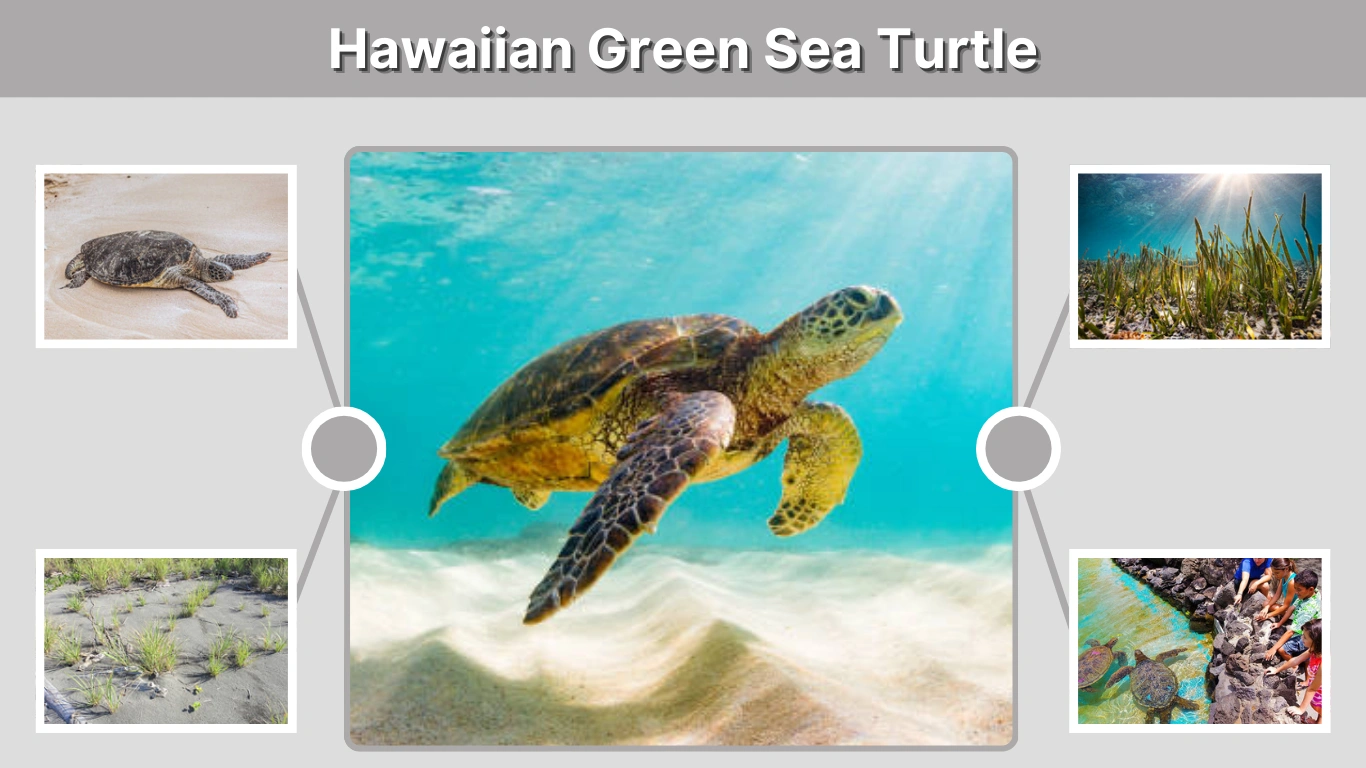
The Hawaiian green sea turtle, locally known as the honu, is one of the most beloved marine animals in Hawaii. These gentle reptiles are commonly seen gliding through coral reefs, resting on sandy beaches, and surfacing in clear coastal waters. People often search for Hawaiian green sea turtle facts, habitat, diet, lifespan, and endangered status. Beyond their biological importance, honu also hold deep cultural meaning in Hawaiian tradition, symbolizing wisdom, protection, and long life.
What Is a Hawaiian Green Sea Turtle?
The Hawaiian green sea turtle is a regional population of the green sea turtle species that lives throughout the Hawaiian Islands. While genetically part of the global green turtle species, Hawaiian green sea turtles form a distinct population that nests mainly in the Northwestern Hawaiian Islands and feeds around the main islands.
These turtles are named “green” not because of their shell color, but because of the greenish fat beneath their skin, which comes from their plant-based diet. Hawaiian green sea turtles are known for their calm behavior, slow movements, and strong loyalty to specific feeding and resting areas.
Hawaiian Green Sea Turtle Scientific Name
The scientific name of the Hawaiian green sea turtle is Chelonia mydas. It belongs to the family Cheloniidae, which includes most hard-shelled sea turtles. Scientists recognize the Hawaiian population as a unique genetic stock because of its isolation and strong site fidelity to Hawaiian waters.
Hawaiian Green Sea Turtle Identification
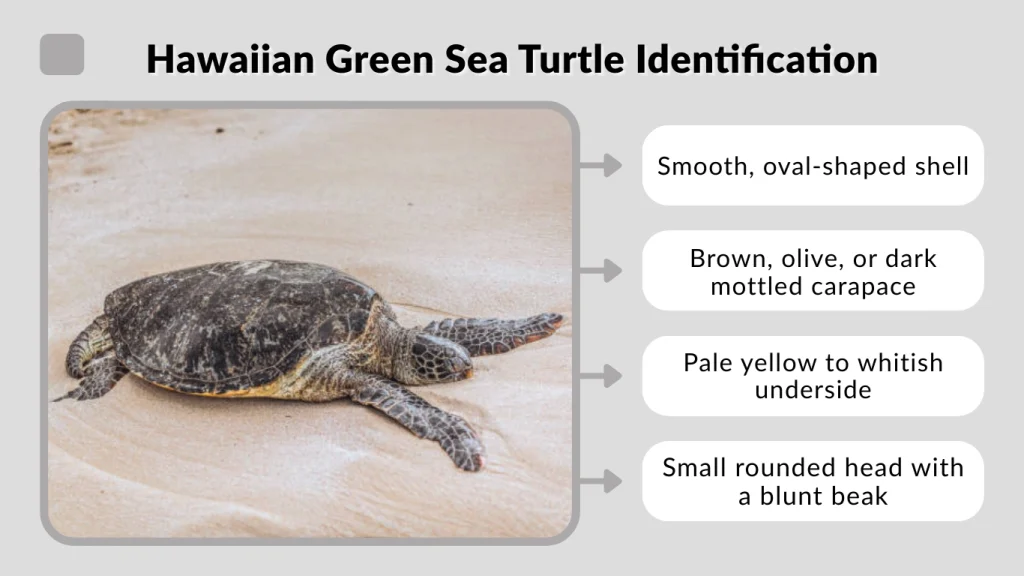
Hawaiian green sea turtles have distinctive features that make them easy to recognize.
- Smooth, oval-shaped shell
- Brown, olive, or dark mottled carapace
- Pale yellow to whitish underside
- Small rounded head with a blunt beak
- Long, paddle-like front flippers
Unlike hawksbill turtles, green sea turtles have a smooth shell edge and a short beak. Adults are often seen basking on Hawaiian beaches, a behavior that is relatively rare in other parts of the world.
Hawaiian Green Sea Turtle Characteristics
Hawaiian green sea turtles are strong swimmers with streamlined bodies designed for long-distance travel and efficient reef foraging. Their powerful front flippers propel them through currents, while their rear flippers help steer and stabilize.
As they mature, their jaws become finely serrated, allowing them to graze on algae and sea grasses. Adults are mostly herbivorous, which is unusual among sea turtles. Males develop longer tails and curved claws on their flippers, which help them hold onto females during mating.
These turtles are known for their calm nature around reefs and their habit of returning to the same feeding and resting areas year after year.
Hawaiian Green Sea Turtle Size, Weight & Lifespan
Adult Hawaiian green sea turtles typically measure 3 to 4 feet (0.9 to 1.2 meters) in shell length and can weigh between 250 and 400 pounds (113 to 180 kg). Some individuals may grow even larger, making them one of the bigger sea turtle species found around coral reefs.
They grow slowly, taking many years to reach full size. Their large bodies help them store energy for long migrations between feeding areas and nesting beaches.
Hawaiian Green Sea Turtle Lifespan
Hawaiian green sea turtles are believed to live 60 to 80 years or more. They usually reach sexual maturity between 20 and 35 years of age. Their long lifespan means that population recovery takes decades, which is why strong legal protection is essential.
Hawaiian Green Sea Turtle Habitat

Hawaiian green sea turtles live primarily in shallow coastal waters, coral reefs, lagoons, and seagrass beds. These habitats provide abundant food and shelter from predators. They are often seen resting under ledges, in underwater caves, or floating near reef flats.
Some Hawaiian green sea turtles regularly haul out onto beaches to bask in the sun. This behavior may help control body temperature, remove parasites, and conserve energy.
Hawaiian Green Sea Turtle Range
Hawaiian green sea turtles are found throughout the main Hawaiian Islands and the Northwestern Hawaiian Islands. Most nesting occurs on remote, protected beaches in the northwest, while feeding grounds are mainly around the populated islands. Adults migrate hundreds or even thousands of miles between nesting and feeding areas.
Hawaiian Green Sea Turtle Diet

Hawaiian green sea turtles are mainly herbivores, especially as adults.
- Marine algae
- Sea grasses
- Seaweed
- Limu (native Hawaiian algae)
- Occasionally jellyfish and invertebrates (juveniles)
Their grazing helps keep algae growth under control, which supports coral reef health.
What Do Hawaiian Green Sea Turtles Eat?
Young green sea turtles are more omnivorous and eat small invertebrates along with plant matter. As they mature, they shift toward a plant-based diet, feeding mostly on algae growing on rocks and reef surfaces. This feeding behavior plays an important role in maintaining balanced reef ecosystems.
Hawaiian Green Sea Turtle Life Cycle
The Hawaiian green sea turtle life cycle begins when females migrate to nesting beaches, mainly in the Northwestern Hawaiian Islands. They lay around 80 to 120 eggs per nest, covering them with sand before returning to the sea. After about 50 to 60 days, hatchlings emerge and scramble toward the ocean.
Once in the ocean, hatchlings enter a critical early stage where they drift and swim in offshore waters, feeding on plankton and tiny organisms. As juveniles grow, they gradually move into nearshore habitats such as reefs and bays. Over many years, they mature into adults that establish regular feeding territories. When ready to reproduce, they migrate long distances back to traditional nesting beaches, continuing a life cycle that has existed for millions of years.
Are Hawaiian Green Sea Turtles Endangered?

Hawaiian green sea turtles are protected under the U.S. Endangered Species Act and are listed as Threatened. Historically, they were heavily hunted for meat, shells, and eggs, causing severe population declines. Thanks to decades of conservation, the Hawaiian population has shown encouraging signs of recovery, with increasing nesting activity and more turtles seen around the islands.
Despite this progress, they remain vulnerable. Their slow growth, late maturity, and dependence on specific habitats make them highly sensitive to environmental change and human impact.
Threats to Hawaiian Green Sea Turtles
One of the most common threats is boat strikes, especially in shallow coastal waters. Turtles also become entangled in fishing lines, nets, and discarded gear. Plastic pollution is another major danger, as turtles may mistake floating debris for food.
Disease is an increasing concern. Many Hawaiian green sea turtles suffer from fibropapillomatosis, a tumor-forming disease that can impair vision, swimming, and feeding. Climate change adds further stress by warming oceans, eroding nesting beaches, and altering food availability.
Cultural Importance of the Honu in Hawaii
The honu holds deep cultural and spiritual importance in Hawaiian tradition. In ancient Hawaiian mythology, sea turtles are seen as guardians and guides, often associated with creation stories and navigation. They symbolize longevity, peace, and the connection between land and sea.
Historically, honu were respected and used sparingly for ceremonial purposes. Today, harming or harassing Hawaiian green sea turtles is illegal, and they are honored as living cultural treasures. Many Hawaiians view their protection as both an environmental and cultural responsibility.
Hawaiian Green Sea Turtle Facts
Hawaiian green sea turtles are remarkable animals with many unique traits. They can migrate thousands of miles between feeding and nesting areas, guided by Earth’s magnetic field. Some individuals return to the same reef or beach year after year.
Unlike most sea turtles, Hawaiian green sea turtles are often seen basking on beaches. They can hold their breath for several hours while resting. Their grazing helps prevent algae from overwhelming coral reefs, supporting healthy marine ecosystems. Many individuals live long enough to see multiple human generations pass.
Conservation and Protection Efforts
Hawaiian green sea turtles are protected by federal and state laws that prohibit harming, feeding, or disturbing them. Several important habitats are included in marine protected areas, including the Papahānaumokuākea Marine National Monument, one of the largest marine reserves in the world.
Rescue and rehabilitation centers treat injured and sick turtles, especially those affected by boat strikes and disease. Scientists monitor nesting beaches, tag turtles, and track migration routes to better understand population trends. Public education programs encourage responsible wildlife viewing, such as keeping distance from resting turtles and properly disposing of fishing gear.
FAQs
Are Hawaiian green sea turtles endangered?
Hawaiian green sea turtles are listed as threatened under the U.S. Endangered Species Act. Although their population has improved due to strong conservation laws, they are still vulnerable to boat strikes, pollution, disease, and habitat loss.
What do Hawaiian green sea turtles eat?
Adult Hawaiian green sea turtles mainly eat marine algae and sea grasses. Juveniles eat a more mixed diet that includes small invertebrates. Their plant-based feeding helps keep coral reefs healthy by controlling algae growth.
How long do Hawaiian green sea turtles live?
Hawaiian green sea turtles can live 60 to 80 years or longer. They grow slowly and may take over 20 years to reach maturity, which is why protecting adults is crucial for population recovery.
Where do Hawaiian green sea turtles nest?
Most Hawaiian green sea turtles nest in the Northwestern Hawaiian Islands, especially at French Frigate Shoals. These remote beaches provide safe nesting environments away from heavy human activity.
Why are Hawaiian green sea turtles important?
They help maintain reef ecosystems by grazing algae, which supports coral growth. Culturally, they are respected symbols of wisdom, protection, and longevity in Hawaiian tradition.