




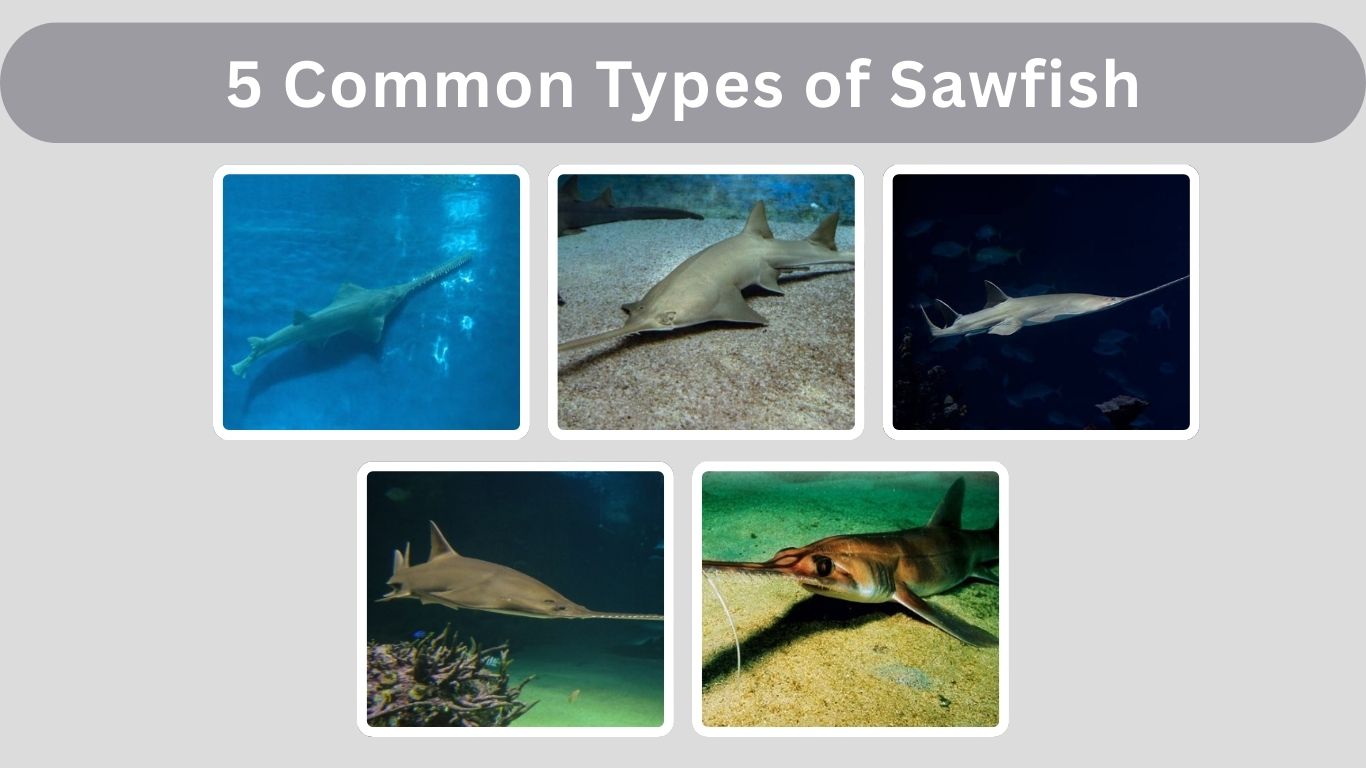
Sawfish are among the most unusual and ancient-looking fish in the ocean, easily recognized by their long, flat snout lined with sharp teeth. Although they resemble sharks, sawfish are actually rays, closely related to stingrays. They inhabit warm coastal waters, estuaries, and even freshwater rivers in some regions. Once widespread around the world, sawfish populations have declined dramatically due to fishing and habitat loss, making them some of the most endangered marine fish today.
1. Smalltooth Sawfish (Pristis pectinata)
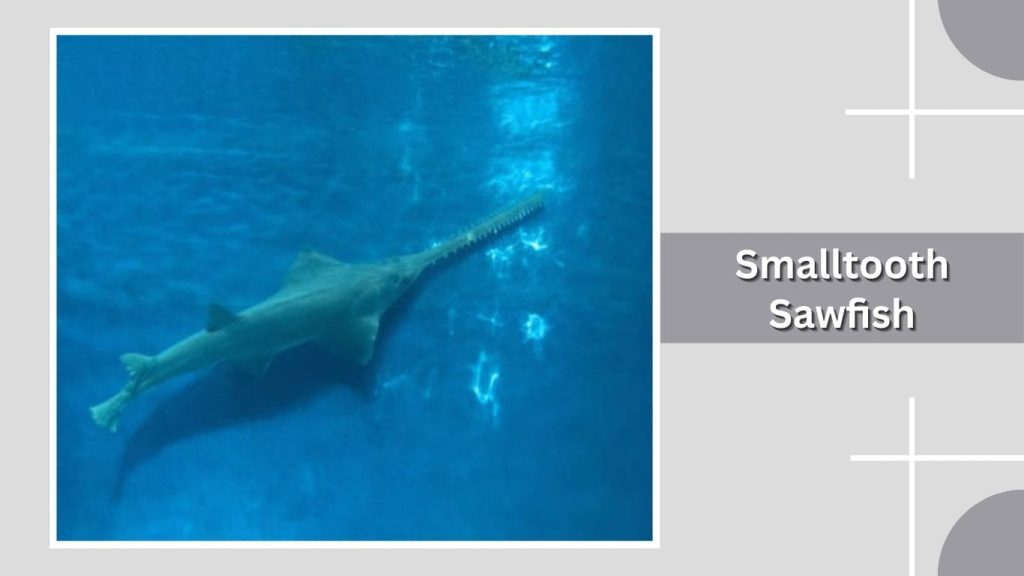
The smalltooth sawfish is a critically endangered marine fish best known for its long, flat, saw-like snout edged with sharp teeth. This unusual rostrum makes it one of the most distinctive fish in the world. Once common along tropical and subtropical coastlines, the species has suffered dramatic population declines due to habitat destruction, bycatch, and overfishing. Today, it is protected in many countries and considered a priority species for marine conservation.
Identification
- Long, narrow rostrum (“saw”) with 20–30 small teeth on each side
- Gray to olive-brown upper body with a pale underside
- Shark-like body shape with flattened head and underside
- Two dorsal fins positioned far back on the body
- Large pectoral fins fused to the head
- Can reach 16–18 feet (5–5.5 m) in length
Habitat
Smalltooth sawfish primarily inhabit warm, shallow coastal waters. They are commonly found in estuaries, mangrove forests, river mouths, coastal lagoons, and muddy or sandy flats. Juveniles strongly depend on mangrove-lined shorelines, where dense roots provide shelter from predators and abundant food. Adults may move between nearshore habitats and deeper coastal waters, but they usually stay in relatively shallow environments compared to many large marine fish.
Behaviors
This species is slow-moving and often cruises close to the seafloor. The saw-like rostrum is used both as a weapon and a sensory tool. Smalltooth sawfish swing it side to side to slash and stun schooling fish or to disturb the sand and uncover hidden prey. They are generally shy, non-aggressive, and avoid human activity when possible. Young sawfish spend several years in sheltered nursery areas before gradually moving into broader coastal zones.
Diet and Lifespan
Smalltooth sawfish feed mainly on fish, shrimp, crabs, and other bottom-dwelling animals. They use electroreceptors in their rostrum to detect prey hidden in murky water or sediment. After stunning prey with quick strikes, they swallow it whole. Although precise data is limited, smalltooth sawfish are believed to live 30 years or longer, with slow growth and late maturity contributing to their vulnerability.
2. Largetooth Sawfish (Pristis pristis)
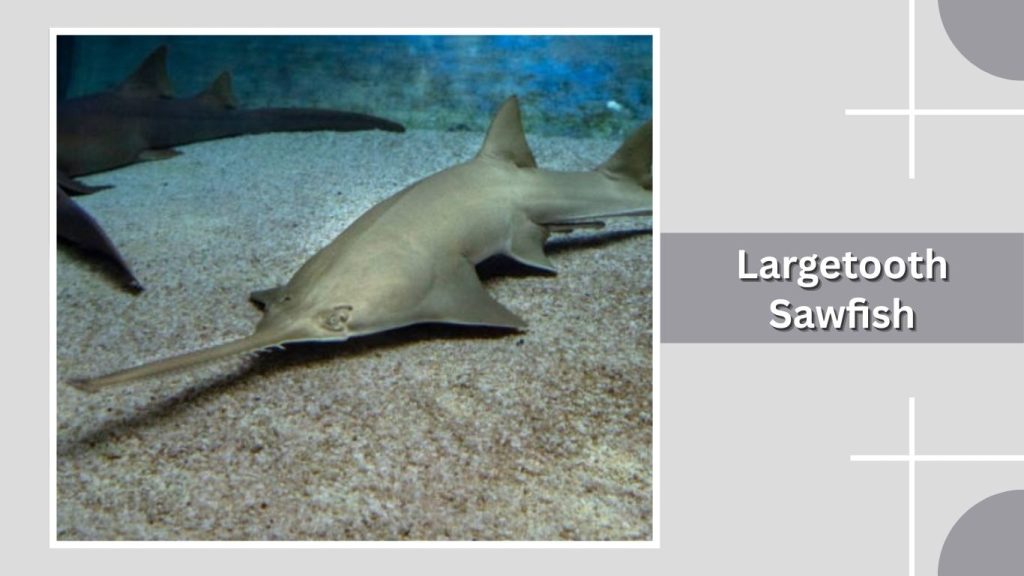
The largetooth sawfish is one of the biggest and rarest sawfish species in the world. It is named for the large, widely spaced teeth along its long, blade-like snout. This species is especially unique because it can live in both saltwater and freshwater, traveling far up rivers. Today, largetooth sawfish are critically endangered due to fishing pressure, habitat loss, and accidental capture in nets.
Identification
- Very long, broad rostrum with large, widely spaced teeth
- Gray to brown upper body with a pale underside
- Shark-like body with flattened head and underside
- Two dorsal fins similar in size
- Large pectoral fins fused to the head
- Can grow over 20 feet (6 m) in length
Habitat
Largetooth sawfish inhabit tropical and subtropical coastal waters, estuaries, river mouths, and large freshwater rivers. They are famous for migrating far inland, sometimes hundreds of kilometers upriver. Juveniles are often found in rivers, lakes, and floodplains, while adults may move between freshwater systems and coastal marine environments.
Behaviors
This species is slow-moving and usually stays close to the bottom. It uses its saw to slash at fish, dig in the sediment, and defend itself from predators. Largetooth sawfish are solitary and shy, avoiding busy coastal areas when possible. Young individuals rely heavily on river habitats for protection during early life.
Diet and Lifespan
Their diet consists mainly of fish, along with crustaceans such as crabs and shrimp. The rostrum is used to stun prey before consumption. Largetooth sawfish grow slowly and reproduce late. They are believed to live 30 to 40 years or possibly longer in the wild.
3. Narrow Sawfish (Anoxypristis cuspidata)
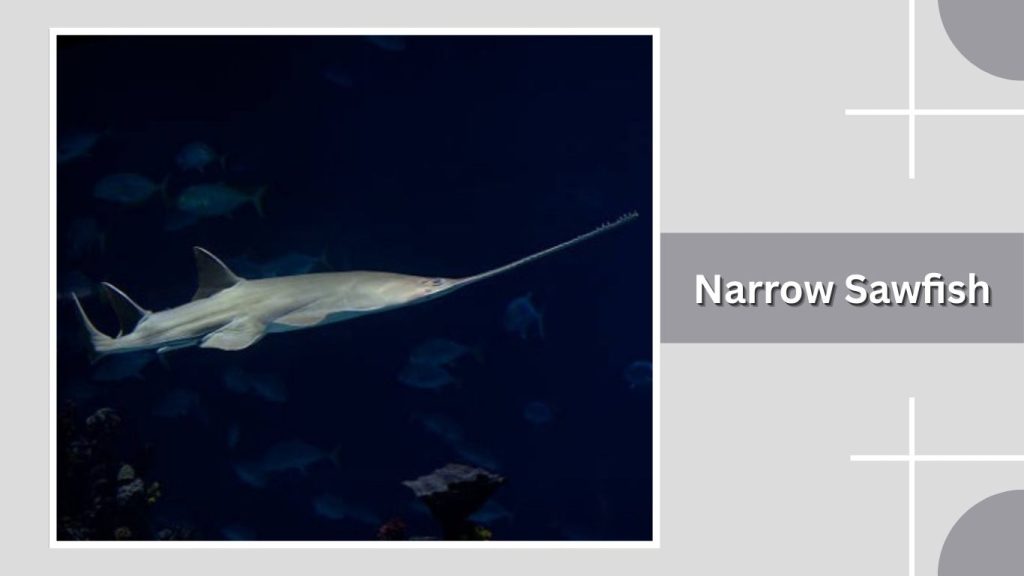
The narrow sawfish is easily distinguished from other sawfish by its slimmer body and much narrower, knife-like snout. It is more oceanic than most sawfish species and is often found in coastal marine waters rather than deep inside rivers. Like all sawfish, its populations have declined sharply, and it is now considered endangered across much of its range.
Identification
- Very narrow, elongated rostrum with evenly spaced teeth
- Slender body compared to other sawfish
- Gray to bluish-gray upper surface
- Pale white underside
- Two dorsal fins positioned far back on the body
- Can reach about 11–12 feet (3.5 m) in length
Habitat
Narrow sawfish live mainly in tropical Indo-Pacific waters. They are commonly found in shallow coastal seas, continental shelves, lagoons, and offshore sandbanks. Unlike largetooth sawfish, they are less dependent on freshwater but may occasionally enter estuaries and brackish waters.
Behaviors
This species is more active in open coastal waters than other sawfish. It often swims just above the seabed and uses its rostrum to slash through schools of fish. Narrow sawfish are generally solitary and avoid areas with heavy human activity.
Diet and Lifespan
Their diet is dominated by small schooling fish, along with shrimp and other crustaceans. They detect prey using sensory pores on the rostrum. Narrow sawfish are believed to live around 20 to 30 years in the wild.
4. Green Sawfish (Pristis zijsron)
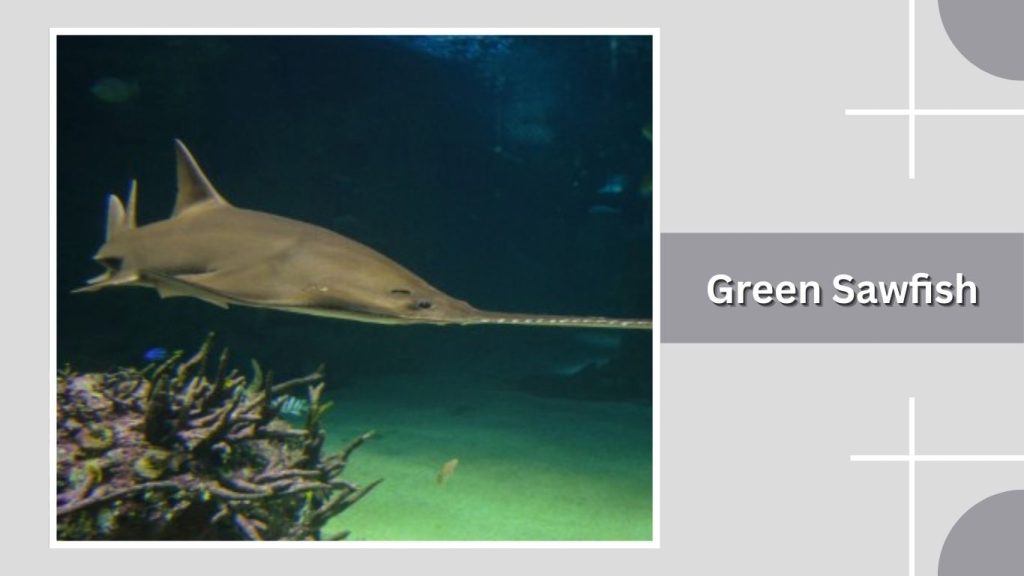
The green sawfish is one of the longest sawfish species and is named for its olive-green to greenish-brown body coloration. It has an extremely long, narrow rostrum and once ranged widely across the Indo-West Pacific. Today, it is critically endangered due to heavy fishing pressure, coastal development, and entanglement in nets.
Identification
- Very long, narrow rostrum with many evenly spaced teeth
- Slender, elongated body
- Greenish-brown to olive upper surface
- White or pale underside
- Two dorsal fins set far back on the body
- Can exceed 23 feet (7 m) in length
Habitat
Green sawfish inhabit shallow coastal waters, sandy and muddy flats, lagoons, estuaries, and protected bays. Juveniles often depend on sheltered nearshore habitats, while adults may range along continental shelves and deeper coastal waters.
Behaviors
This species is slow-moving and typically cruises close to the seabed. It uses its saw to slash at fish and to disturb sediment while hunting. Green sawfish are solitary, shy, and avoid busy coastal zones when possible.
Diet and Lifespan
Their diet consists mainly of fish, along with shrimp, crabs, and other bottom-dwelling animals. The rostrum helps both in detecting and stunning prey. Green sawfish are long-lived, with an estimated lifespan of 30 years or more.
5. Dwarf Sawfish (Pristis clavata)
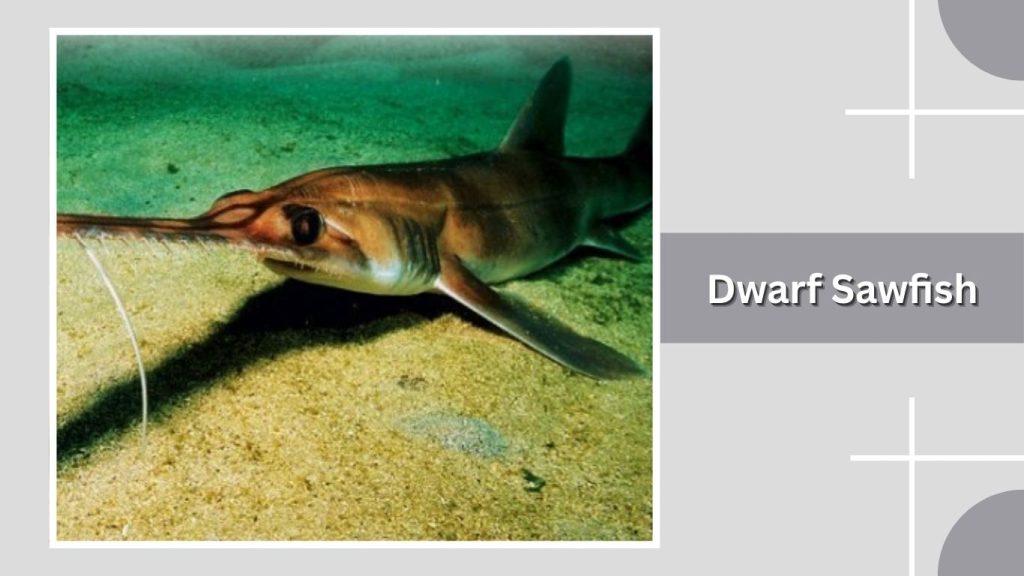
The dwarf sawfish is the smallest of all sawfish species, but it still possesses the iconic long, tooth-lined snout that defines the group. It is native mainly to northern Australia and nearby regions, where it inhabits warm, shallow coastal waters. Despite its smaller size, it faces the same serious threats as other sawfish, including habitat loss and entanglement in fishing gear.
Identification
- Shorter, relatively broad rostrum compared to larger sawfish
- Fewer, widely spaced teeth on the saw
- Brown to gray upper body
- Pale underside
- Two dorsal fins of similar size
- Usually grows up to 10–10.5 feet (3–3.2 m)
Habitat
Dwarf sawfish live in shallow tropical waters, including coastal bays, sandy flats, estuaries, and nearshore marine environments. Juveniles often use sheltered coastal zones as nursery grounds, where food is plentiful and predators are fewer.
Behaviors
This species is slow-moving and bottom-oriented. It spends much of its time near the seabed, using its saw to detect and strike prey. Dwarf sawfish are shy and non-aggressive, relying on camouflage and avoidance rather than confrontation.
Diet and Lifespan
Their diet mainly consists of small fish, crustaceans, and other bottom-dwelling animals. They swing their rostrum to stun prey before feeding. Dwarf sawfish are believed to live around 20 to 30 years in the wild.
FAQs
Are sawfish dangerous to humans?
Sawfish are not aggressive toward humans and rarely cause injuries. Their long, tooth-lined snout looks intimidating, but it is mainly used to find and stun prey. Most incidents occur when a sawfish becomes accidentally entangled or handled, causing it to thrash defensively.
Why are sawfish critically endangered?
Sawfish populations have declined due to overfishing, accidental capture in nets, destruction of mangroves, and coastal development. Their slow growth, late maturity, and low reproductive rates make it difficult for populations to recover once numbers drop.
What is the purpose of a sawfish’s “saw”?
The saw, called a rostrum, is used to detect, stun, and slash prey such as fish. It also contains sensory pores that help sawfish locate animals hidden in murky water or sand. Additionally, it can be used for defense against predators.
Can sawfish live in freshwater?
Yes, some sawfish species, especially the largetooth sawfish, can live in freshwater rivers and lakes as well as saltwater. They may travel far inland and spend many years in river systems before returning to coastal waters.
How long do sawfish live?
Sawfish are long-lived fish. Depending on the species, they may live 20 to 40 years or more. Their slow life cycle is one reason they are especially vulnerable to human threats and population declines.