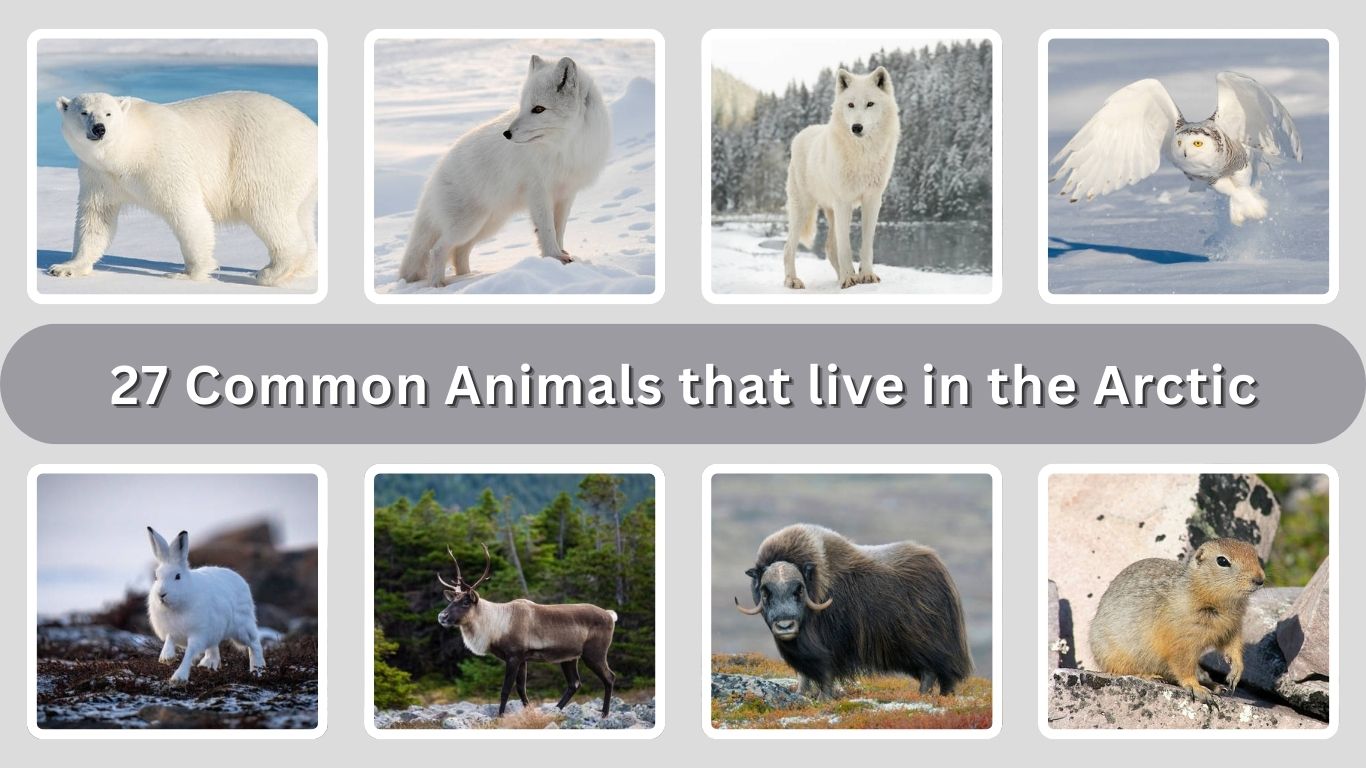
The Arctic is one of the most extreme environments on Earth, yet it supports a remarkable variety of wildlife. From powerful predators like polar bears to small but vital species such as Arctic fish, each animal plays an important role in maintaining the region’s fragile ecosystem. These animals have evolved unique adaptations that help them survive freezing temperatures, long winters, and limited food resources, making Arctic wildlife both resilient and fascinating.
1. Polar Bear
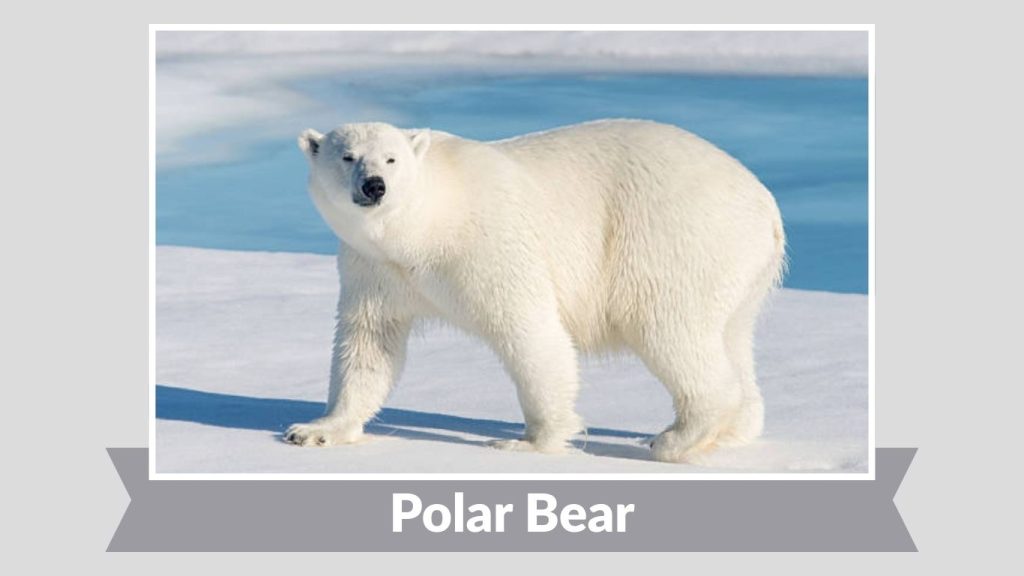
The polar bear is the largest land-dwelling carnivore in the world and one of the most iconic animals of the Arctic. Built for survival in extreme cold, it has thick fur, a deep layer of body fat, and powerful limbs that allow it to thrive in icy environments. Polar bears rely heavily on sea ice for hunting and travel, making them closely tied to the Arctic ecosystem. Their survival is strongly influenced by climate and ice conditions.
Identification
- Scientific name: Ursus maritimus
- Average length: 2–3 meters
- Weight: 350–700 kg (males), smaller for females
- Fur color: White or creamy yellow
- Key features: Long neck, small ears, large paws with sharp claws
Habitat
Polar bears are found throughout the Arctic Circle, including regions of Canada, Greenland, Russia, Alaska, and Norway. They primarily inhabit coastal areas and sea ice, where they hunt seals. Sea ice is essential to their lifestyle, as it provides access to food and resting platforms.
Behaviors
Polar bears are mostly solitary animals, except during mating season or when females are raising cubs. They are strong swimmers and can travel long distances between ice floes. Much of their time is spent roaming in search of prey.
Diet
Their diet mainly consists of seals, particularly ringed and bearded seals. Occasionally, they may eat fish, birds, eggs, or carrion when seals are scarce.
Lifespan
In the wild, polar bears generally live between 20 and 25 years, though some may live longer under favorable conditions.
2. Arctic Fox
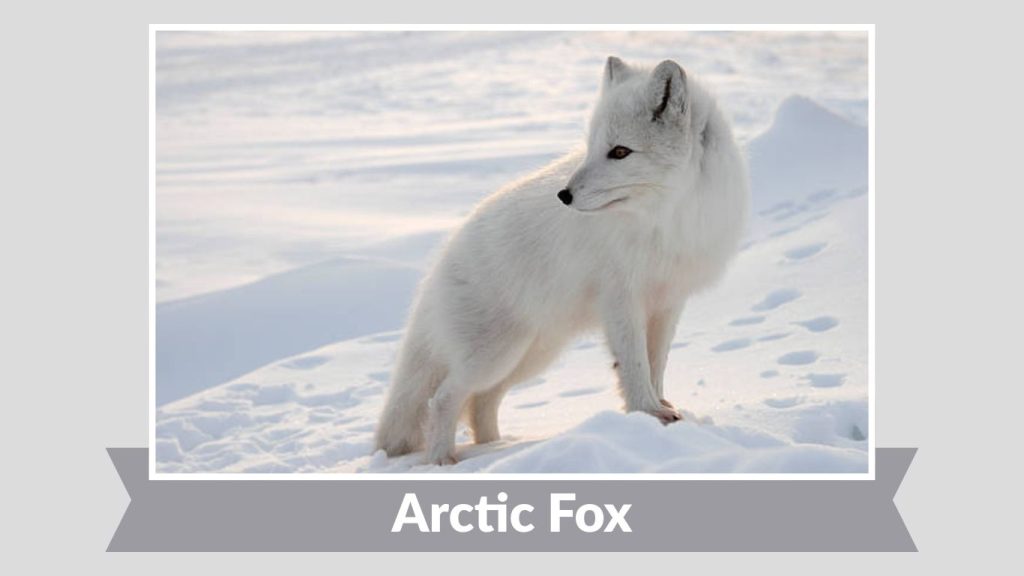
The Arctic fox is a small but highly resilient mammal that thrives in one of the coldest environments on Earth. Known for its thick fur and adaptability, this fox can survive temperatures far below freezing. Its ability to change fur color with the seasons helps it blend into the snowy Arctic landscape in winter and the rocky tundra in summer.
Identification
- Scientific name: Vulpes lagopus
- Average length: 46–68 cm
- Weight: 3–9 kg
- Fur color: White in winter, brown or gray in summer
- Distinct feature: Thick fur covering body, legs, and even paws
Habitat
Arctic foxes live throughout the Arctic tundra in North America, Greenland, Europe, and Asia. They prefer coastal areas, plains, and low hills where they can dig dens. These dens are often used for many generations and may have numerous entrances.
Behaviors
Arctic foxes are active year-round and do not hibernate. They are skilled travelers, sometimes covering long distances in search of food. During breeding season, they form monogamous pairs and raise their young together.
Diet
They are omnivores with a flexible diet that includes lemmings, birds, eggs, fish, insects, berries, and carrion. They often follow polar bears to scavenge leftover food.
Lifespan
In the wild, Arctic foxes usually live 3 to 6 years, though some may live longer in protected environments.
3. Arctic Wolf
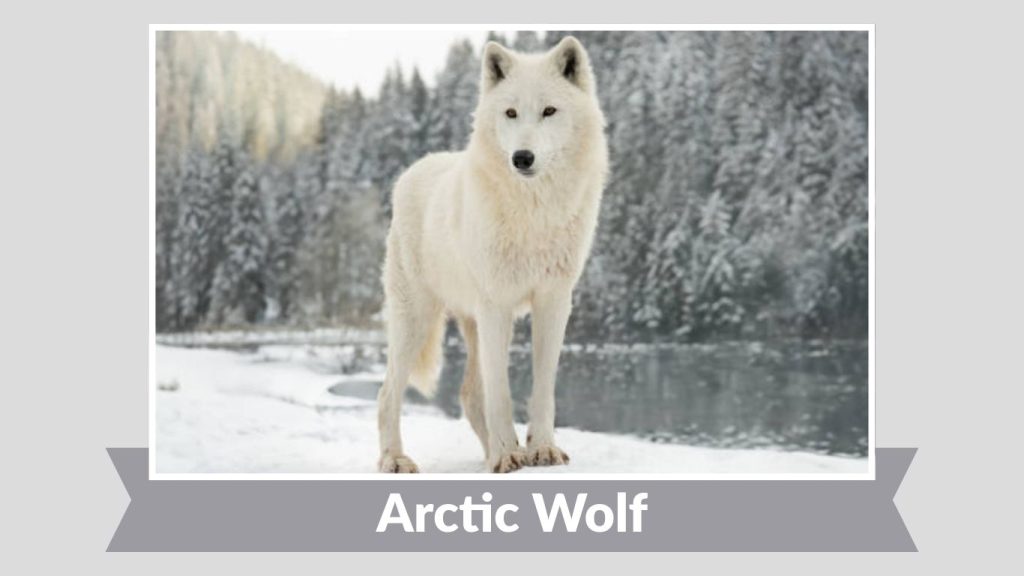
The Arctic wolf is a hardy subspecies of the gray wolf, specially adapted to survive in the harsh conditions of the Arctic. Living in one of the most remote regions on Earth, it endures extreme cold, long winters, and limited food availability. Its thick white fur provides both insulation and camouflage in the snowy landscape.
Identification
- Scientific name: Canis lupus arctos
- Average length: 1–1.8 meters
- Weight: 40–80 kg
- Fur color: Mostly white
- Key features: Thick fur, smaller ears, strong jaws
Habitat
Arctic wolves inhabit the Arctic tundra and polar deserts of northern Canada and Greenland. They live in areas with minimal human presence, often far from forests. Unlike other wolves, they do not rely on tree cover and are well adapted to open, frozen terrain.
Behaviors
They are social animals that live in packs, usually smaller than those of other wolf subspecies. Pack cooperation is essential for hunting large prey. Arctic wolves are highly resilient and can go for long periods without food.
Diet
Their diet mainly includes musk oxen, Arctic hares, and caribou. When large prey is scarce, they may also hunt smaller animals or scavenge.
Lifespan
In the wild, Arctic wolves typically live around 7 to 10 years, depending on environmental conditions and food availability.
4. Snowy Owl
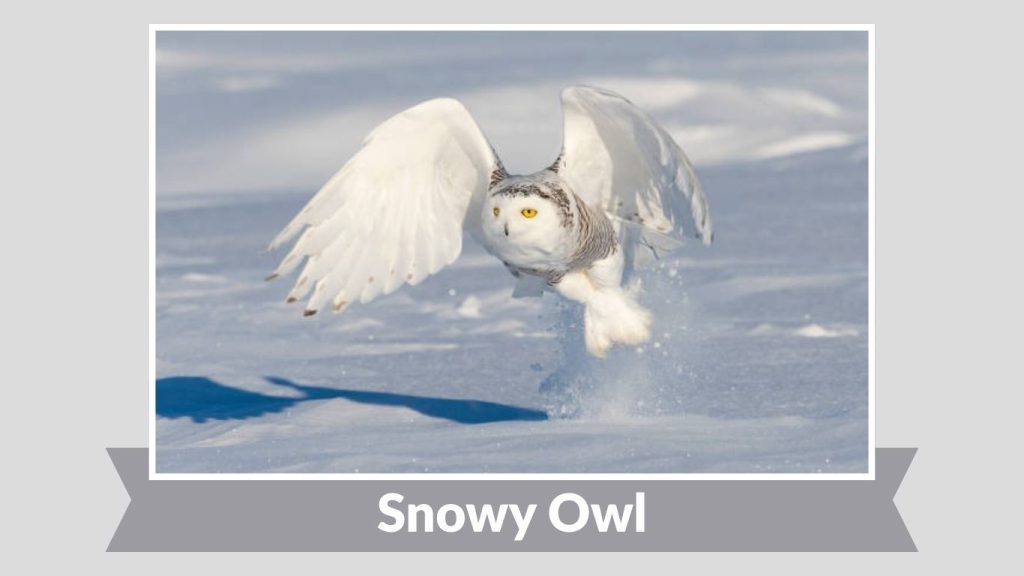
The snowy owl is a striking bird of prey known for its brilliant white plumage and powerful hunting skills. Unlike most owls, it is active during the day, especially in summer, making it a prominent predator of the Arctic tundra. Its appearance and behavior make it one of the most recognizable Arctic birds.
Identification
- Scientific name: Bubo scandiacus
- Average wingspan: 125–150 cm
- Weight: 1.6–3 kg
- Plumage color: White with varying dark markings
- Distinct feature: Large round head and bright yellow eyes
Habitat
Snowy owls inhabit open Arctic tundra regions across North America, Europe, and Asia. They prefer wide, treeless landscapes that allow clear visibility for spotting prey. During winter, some migrate south to grasslands, coastal areas, and agricultural fields.
Behaviors
These owls are mostly solitary and highly territorial during the breeding season. They perch on low mounds or rocks to scan for prey and are strong fliers capable of covering long distances during migration.
Diet
Their primary food source is lemmings, but they also hunt voles, rabbits, birds, and fish when available. Food availability strongly influences their breeding success.
Lifespan
Snowy owls generally live 10 years or more in the wild, with some individuals living longer under favorable conditions.
5. Arctic Hare
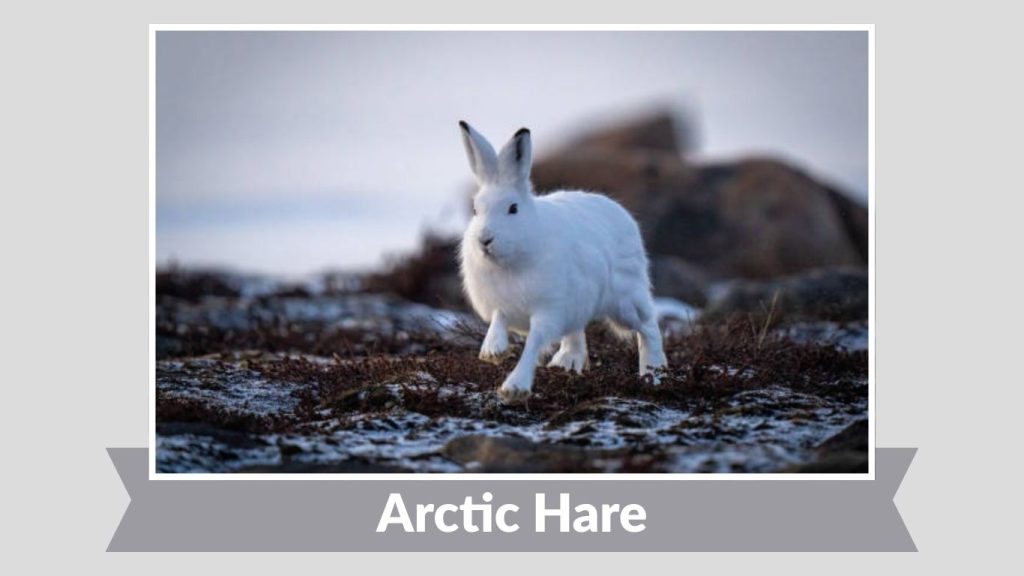
The Arctic hare is a fast and well-adapted mammal that lives in some of the coldest parts of the Arctic. Its thick fur, compact body, and powerful hind legs help it survive freezing temperatures and escape predators. Seasonal color changes allow it to blend into its surroundings throughout the year.
Identification
- Scientific name: Lepus arcticus
- Average length: 43–70 cm
- Weight: 2.5–7 kg
- Fur color: White in winter, gray-brown in summer
- Key features: Short ears, strong hind legs
Habitat
Arctic hares inhabit Arctic tundra regions of Greenland, Canada, and nearby islands. They prefer open plains, rocky slopes, and coastal lowlands where vegetation is sparse but accessible.
Behaviors
They can live alone or in groups, sometimes forming large gatherings during winter. Arctic hares rely on speed and agility rather than burrows to avoid predators. They are active year-round.
Diet
Their diet consists mainly of woody plants, mosses, lichens, roots, and grasses. In winter, they dig through snow to reach food.
Lifespan
In the wild, Arctic hares typically live between 3 and 5 years, though some may live longer in favorable conditions.
6. Caribou
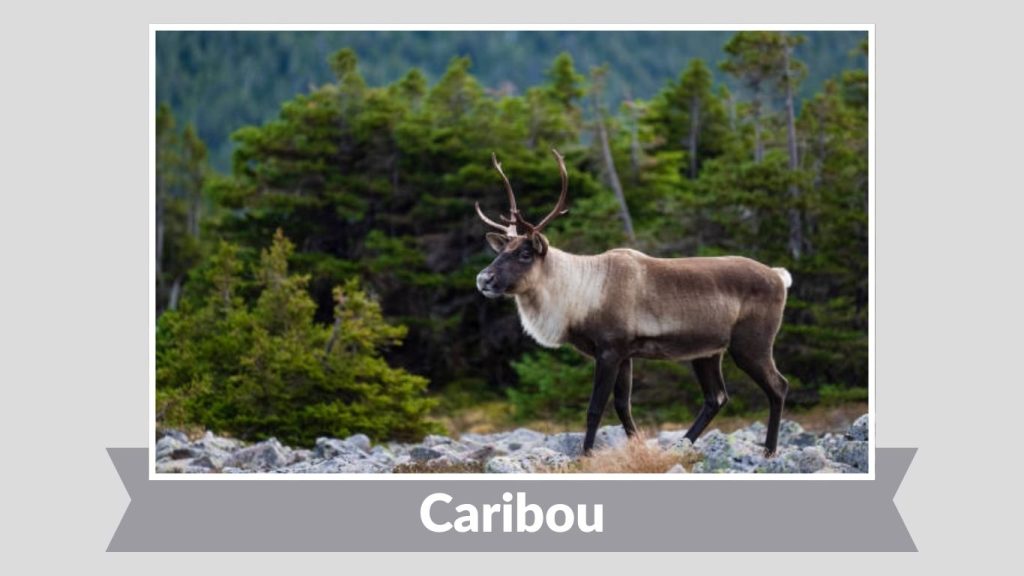
The caribou, also known as reindeer in Europe, is one of the most important large mammals of the Arctic. It is well known for its long-distance migrations and its close relationship with Arctic ecosystems and Indigenous cultures. Both males and females grow antlers, a rare trait among deer species.
Identification
- Scientific name: Rangifer tarandus
- Average length: 1.8–2.1 meters
- Weight: 80–180 kg
- Coat color: Brown with lighter underparts
- Distinct feature: Large antlers on both sexes
Habitat
Caribou inhabit Arctic tundra, boreal forests, and coastal plains across North America, Greenland, Russia, and Scandinavia. They are highly migratory and move seasonally between feeding and calving grounds.
Behaviors
They live in herds that can range from small groups to thousands of individuals. Migration helps them avoid predators and find fresh food. Caribou are strong swimmers and can cross wide rivers during migration.
Diet
Their diet mainly includes lichens, grasses, sedges, mosses, leaves, and shrubs. In winter, lichens are a critical food source.
Lifespan
Caribou typically live 10 to 15 years in the wild, depending on environmental conditions and predation pressure.
7. Musk Ox
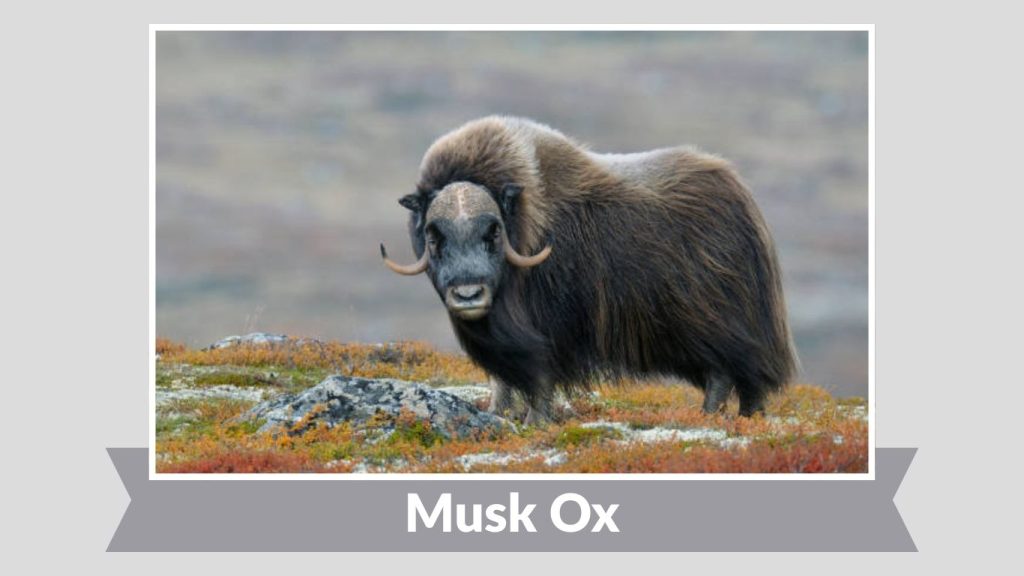
The musk ox is a large, shaggy mammal that has survived in the Arctic since the Ice Age. Despite its name, it is more closely related to goats and sheep than to oxen. Its thick coat and strong social behavior help it endure extreme cold and predator threats.
Identification
- Scientific name: Ovibos moschatus
- Average length: 1.3–2.5 meters
- Weight: 200–400 kg
- Coat color: Dark brown to black
- Distinct feature: Long, thick outer hair and curved horns
Habitat
Musk oxen live in Arctic tundra regions of Canada, Greenland, Alaska, and parts of Siberia. They prefer flat plains, river valleys, and areas with access to grasses and shrubs.
Behaviors
They live in herds and use a defensive formation when threatened, forming a circle with calves in the center. Musk oxen are slow-moving but strong and resilient against predators.
Diet
Their diet includes grasses, sedges, mosses, lichens, and small shrubs. They use their hooves to dig through snow to reach food in winter.
Lifespan
Musk oxen generally live 12 to 20 years in the wild under favorable conditions.
8. Arctic Ground Squirrel
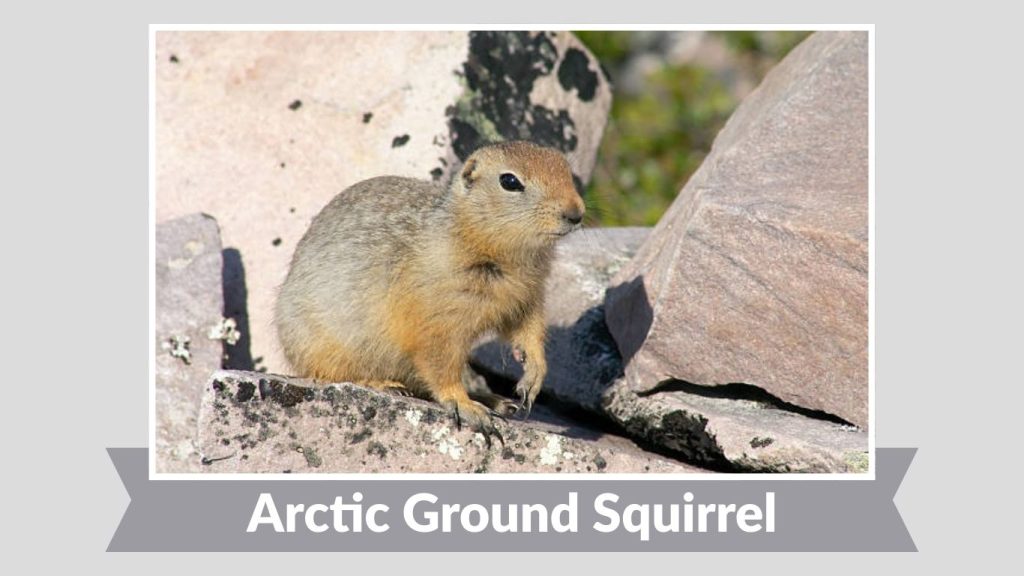
The Arctic ground squirrel is a small but remarkable rodent known for surviving extreme Arctic conditions through deep hibernation. It holds the record for the lowest body temperature of any mammal during hibernation. Despite its size, it plays an important role in the Arctic food chain.
Identification
- Scientific name: Urocitellus parryii
- Average length: 23–30 cm
- Weight: 500–800 g
- Fur color: Brownish with lighter underparts
- Distinct feature: Short tail and sharp claws
Habitat
Arctic ground squirrels inhabit tundra and open meadows across Alaska, northern Canada, and parts of Siberia. They prefer well-drained soils where they can dig complex burrow systems.
Behaviors
They spend much of the year hibernating, sometimes up to eight months. During summer, they are active, alert, and vocal, using alarm calls to warn others of predators.
Diet
Their diet consists of grasses, seeds, berries, roots, insects, and occasionally small animals. They gather and store food before hibernation.
Lifespan
In the wild, Arctic ground squirrels typically live 7 to 9 years, though survival depends heavily on environmental conditions.
9. Lemming
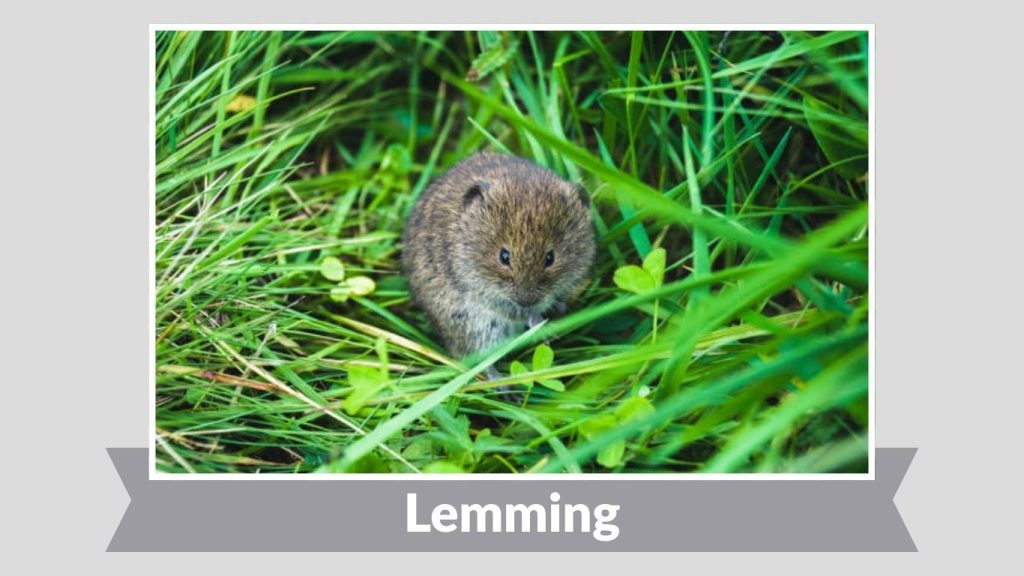
Lemmings are small rodents that play a crucial role in the Arctic ecosystem, serving as a primary food source for many predators. They are well adapted to cold climates and are known for their dramatic population cycles, which strongly influence Arctic wildlife dynamics.
Identification
- Scientific name: Lemmus spp. and Dicrostonyx spp.
- Average length: 7–15 cm
- Weight: 30–110 g
- Fur color: Brown, gray, or white (varies by species and season)
- Distinct feature: Short tail and compact body
Habitat
Lemmings live in Arctic tundra regions across North America, Europe, and Asia. They prefer areas with thick vegetation, mosses, and grasses, which provide both food and cover. In winter, they live beneath the snow in insulated tunnels.
Behaviors
They are active year-round and do not hibernate. Lemmings reproduce rapidly during favorable conditions, leading to population booms. These cycles help sustain predator populations such as Arctic foxes and snowy owls.
Diet
Their diet mainly consists of grasses, sedges, mosses, lichens, and roots. Some species also eat bark and leaves.
Lifespan
Lemmings usually live 1 to 2 years in the wild, with lifespan closely tied to environmental conditions and predation.
10. Ermine
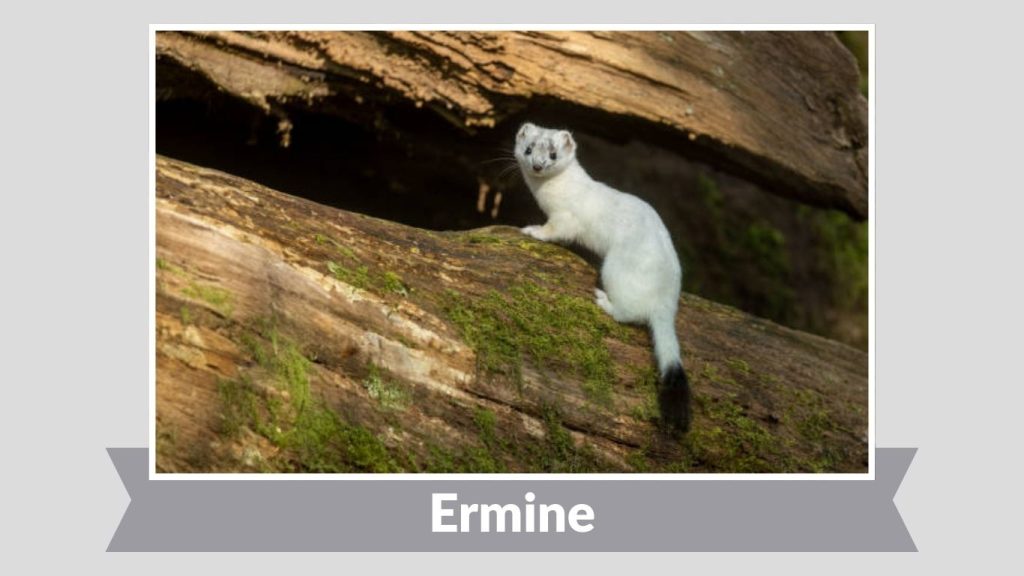
The ermine, also known as the stoat, is a small but fierce predator of the Arctic and sub-Arctic regions. Despite its slender size, it is highly agile and an efficient hunter. Its seasonal coat change provides excellent camouflage against snow-covered landscapes.
Identification
- Scientific name: Mustela erminea
- Average length: 17–33 cm
- Weight: 170–450 g
- Fur color: White in winter, brown with white underside in summer
- Distinct feature: Black tip on the tail
Habitat
Ermines are found in Arctic tundra, coastal areas, and northern forests across North America, Europe, and Asia. They prefer regions with dense ground cover, rock piles, or burrows where prey is abundant.
Behaviors
They are solitary and territorial animals, active both day and night. Ermines are quick, curious, and known for their bold hunting behavior, often taking on prey larger than themselves.
Diet
Their diet mainly includes lemmings, voles, mice, birds, eggs, and insects. They are skilled hunters that rely on speed and sharp teeth.
Lifespan
In the wild, germs typically live 4 to 6 years, though many do not survive due to predation and harsh conditions.
11. Ringed Seal
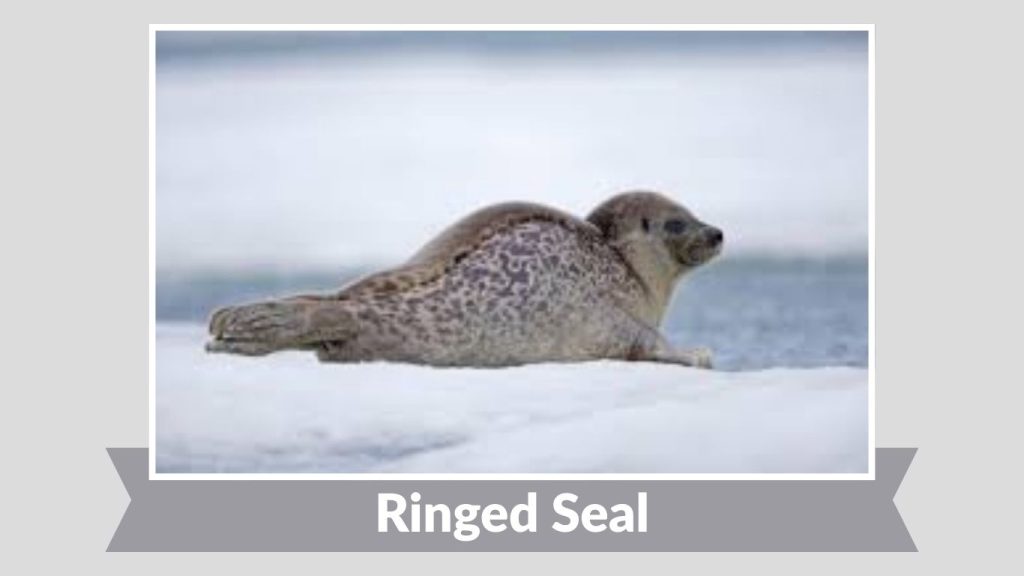
The ringed seal is one of the most common and important marine mammals of the Arctic. It is especially well adapted to life on and under sea ice, where it plays a key role in the Arctic food web. Ringed seals are a primary prey species for polar bears and are vital to the balance of the Arctic ecosystem.
Identification
- Scientific name: Pusa hispida
- Average length: 1.1–1.6 meters
- Weight: 50–110 kg
- Coat color: Gray to silver with dark ring-shaped spots
- Distinct feature: Small head with short snout
Habitat
Ringed seals live throughout the Arctic Ocean and surrounding seas, including coastal and offshore ice-covered waters. They depend heavily on sea ice for resting, breeding, and raising pups. They maintain breathing holes in thick ice using their strong claws.
Behaviors
These seals are mostly solitary and spend much of their time in the water. They are excellent divers and can remain underwater for several minutes. During winter and spring, females give birth to pups in snow-covered ice dens, which provide protection from predators and harsh weather.
Diet
Their diet includes fish such as Arctic cod, along with crustaceans and other small marine invertebrates. They hunt underwater using agility and sharp senses.
Lifespan
Ringed seals typically live 25 to 30 years in the wild, though survival depends on ice conditions and predator presence.
12. Bearded Seal
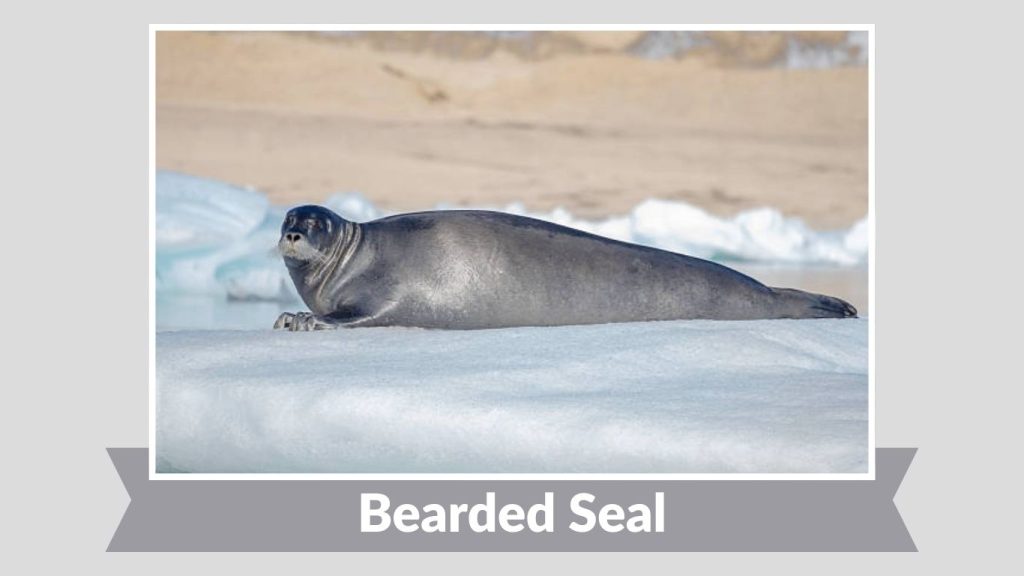
The bearded seal is a large Arctic seal recognized by its long, thick whiskers, which give it a “bearded” appearance. It is well adapted to life in cold, shallow waters and plays an important role in Arctic marine ecosystems. Compared to other seals, it prefers areas with moving ice rather than dense pack ice.
Identification
- Scientific name: Erignathus barbatus
- Average length: 2.1–2.5 meters
- Weight: 200–430 kg
- Coat color: Gray to brown
- Distinct feature: Long, pale whiskers (vibrissae)
Habitat
Bearded seals are found in Arctic and sub-Arctic waters of the North Atlantic and North Pacific Oceans. They usually inhabit shallow coastal waters with drifting ice, which provides resting platforms close to feeding areas on the sea floor.
Behaviors
These seals are generally solitary and less agile on land compared to other seals. They are strong swimmers and capable divers. Bearded seals are also known for their unique underwater vocalizations, especially during the breeding season.
Diet
Their diet mainly consists of bottom-dwelling animals such as clams, crabs, shrimp, snails, and small fish. They use their sensitive whiskers to detect prey on the ocean floor.
Lifespan
Bearded seals typically live 25 to 30 years in the wild under favorable conditions.
13. Harp Seal
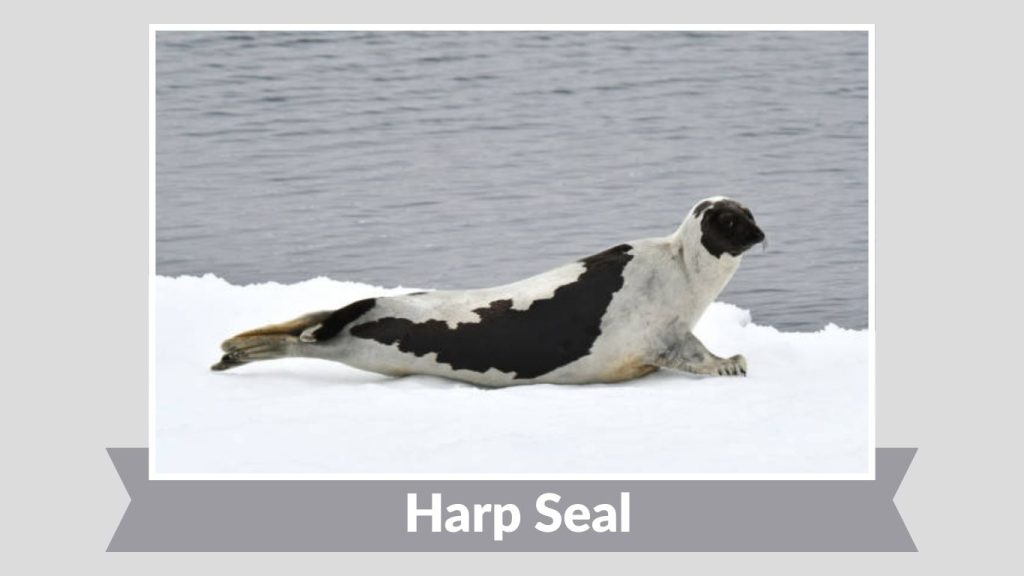
The harp seal is a well-known Arctic marine mammal famous for its striking appearance and large population size. Named after the dark, harp-shaped pattern on the backs of adults, this seal is highly adapted to life in icy waters. Harp seals are strong swimmers and spend most of their lives at sea, coming onto ice mainly for breeding and resting. They are an important species in Arctic marine ecosystems and a key prey animal for large predators.
Identification
- Scientific name: Pagophilus groenlandicus
- Average length: 1.7–2 meters
- Weight: 130–180 kg
- Coat color: Silvery gray with black harp-shaped markings (adults)
- Distinct feature: Black face and harp pattern on the back
Habitat
Harp seals live in the cold waters of the North Atlantic and Arctic Oceans. They are commonly found near drifting pack ice, where they give birth and nurse their pups. Major populations occur near Greenland, eastern Canada, and parts of Russia. Outside the breeding season, they migrate widely in open ocean waters.
Behaviors
These seals are highly social and often gather in large groups, especially during breeding and molting seasons. They are excellent swimmers and can dive to significant depths in search of food. Harp seal pups are born with fluffy white coats that provide insulation during their first weeks of life.
Diet
Their diet includes fish such as Arctic cod, capelin, and herring, as well as crustaceans like shrimp. Diet composition changes with age and location.
Lifespan
Harp seals typically live 30 to 35 years in the wild, making them one of the longer-lived seal species.
14. Walrus
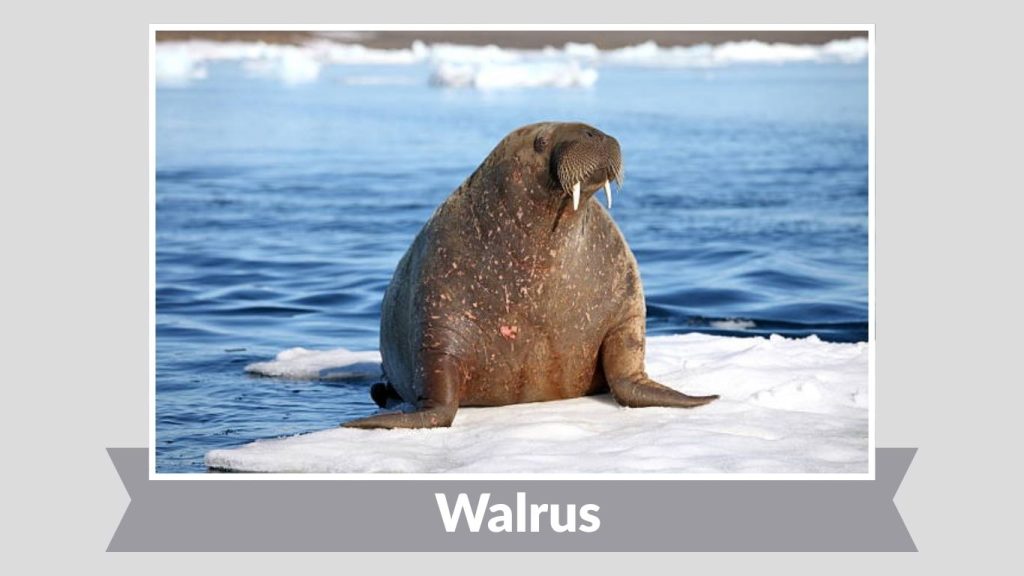
The walrus is one of the most distinctive and powerful marine mammals of the Arctic, easily recognized by its long tusks and prominent whiskers. It is a keystone species in Arctic marine ecosystems and has strong cultural importance for many Indigenous Arctic communities. Walruses are highly adapted to cold ocean environments and spend much of their lives in the water or resting on sea ice.
Identification
- Scientific name: Odobenus rosmarus
- Average length: 2.5–3.5 meters
- Weight: 600–1,500 kg
- Skin color: Brown to pinkish
- Distinct feature: Long ivory tusks and thick whiskers
Habitat
Walruses live in Arctic and sub-Arctic waters of the Northern Hemisphere, mainly in shallow coastal areas. They prefer regions with drifting sea ice near productive feeding grounds on the ocean floor. Haul-out sites include ice floes and rocky shorelines.
Behaviors
They are highly social animals and often gather in large groups. Walruses use their tusks to pull themselves onto ice, defend against predators, and establish dominance. They are capable of deep dives but usually feed in relatively shallow waters.
Diet
Their diet mainly consists of bottom-dwelling invertebrates such as clams, mussels, snails, and worms. A single walrus can consume thousands of clams in one feeding session.
Lifespan
Walruses typically live 30 to 40 years in the wild, depending on environmental conditions and human impact.
15. Beluga Whale
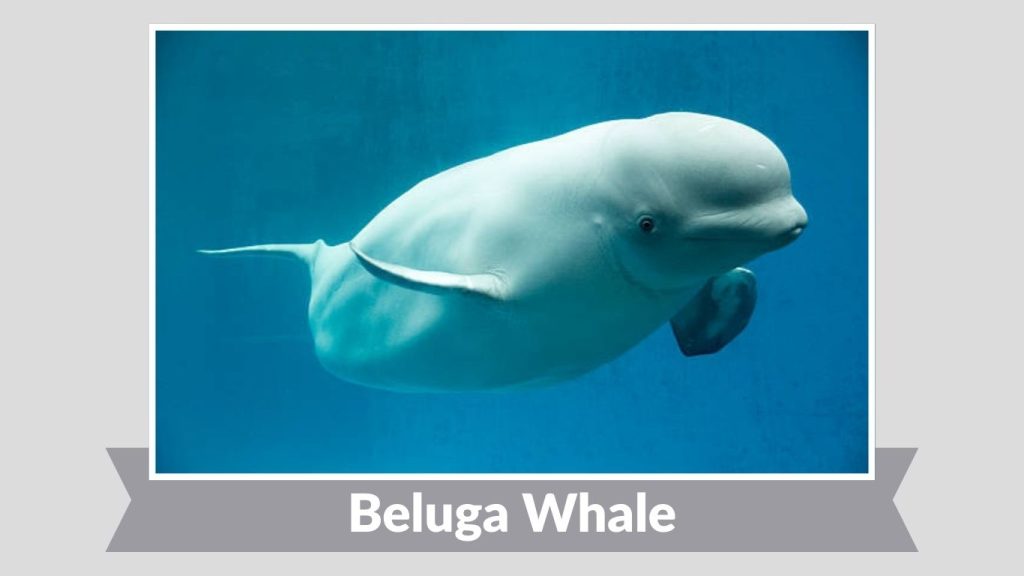
The beluga whale is a small, white whale often called the “canary of the sea” because of its wide range of vocal sounds. Highly social and intelligent, belugas are well adapted to the icy waters of the Arctic with thick blubber and flexible necks. Their bright white coloration helps them blend into ice-filled environments and makes them easy to recognize.
Identification
- Scientific name: Delphinapterus leucas
- Average length: 3–5.5 meters
- Weight: 700–1,600 kg
- Skin color: White (adults), gray or brownish (calves)
- Distinct feature: Rounded forehead (melon) and lack of dorsal fin
Habitat
Beluga whales inhabit Arctic and sub-Arctic waters across North America, Greenland, Russia, and parts of Europe. They are commonly found in coastal areas, estuaries, and river mouths during summer, moving to deeper offshore waters in winter as ice conditions change.
Behaviors
Belugas are highly social and live in pods that can range from a few individuals to hundreds. They communicate using clicks, whistles, and chirps. Unlike most whales, they have flexible necks, allowing them to turn their heads in different directions.
Diet
Their diet includes fish such as Arctic cod, salmon, and herring, along with crustaceans, squid, and worms. They use echolocation to find prey in dark or murky waters.
Lifespan
Beluga whales typically live 35 to 50 years in the wild under favorable conditions.
16. Narwhal
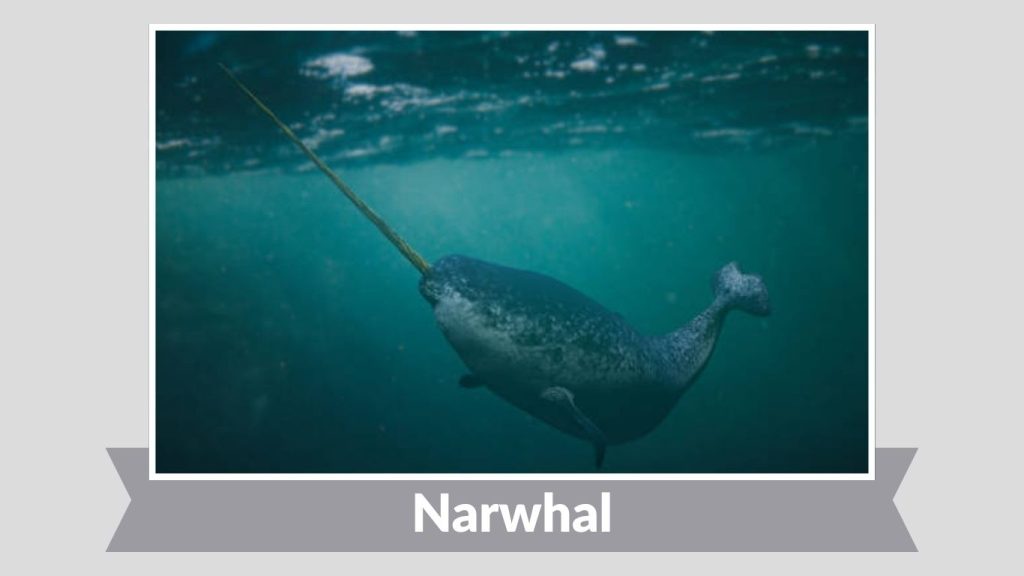
The narwhal is one of the most mysterious and iconic animals of the Arctic, often called the “unicorn of the sea” because of its long, spiral tusk. This tusk is actually an elongated tooth and is most commonly found in males. Narwhals are deep-diving whales uniquely adapted to life in icy Arctic waters and are closely tied to sea ice conditions.
Identification
- Scientific name: Monodon monoceros
- Average length: 4–5 meters
- Weight: 800–1,600 kg
- Skin color: Mottled gray, black, and white
- Distinct feature: Long spiral tusk (mainly in males)
Habitat
Narwhals live year-round in Arctic waters around Canada, Greenland, and Russia. They prefer deep offshore areas with dense pack ice and often migrate seasonally between coastal summer grounds and deeper winter habitats.
Behaviors
They are social animals and usually travel in groups called pods. Narwhals are capable of extremely deep dives, reaching depths of over 1,500 meters. They rely on echolocation to navigate and hunt in dark waters beneath thick ice.
Diet
Their diet mainly includes Arctic cod, Greenland halibut, squid, and shrimp. They feed mostly at great depths during winter months.
Lifespan
Narwhals typically live 40 to 50 years in the wild, though some individuals may live even longer.
17. Bowhead Whale
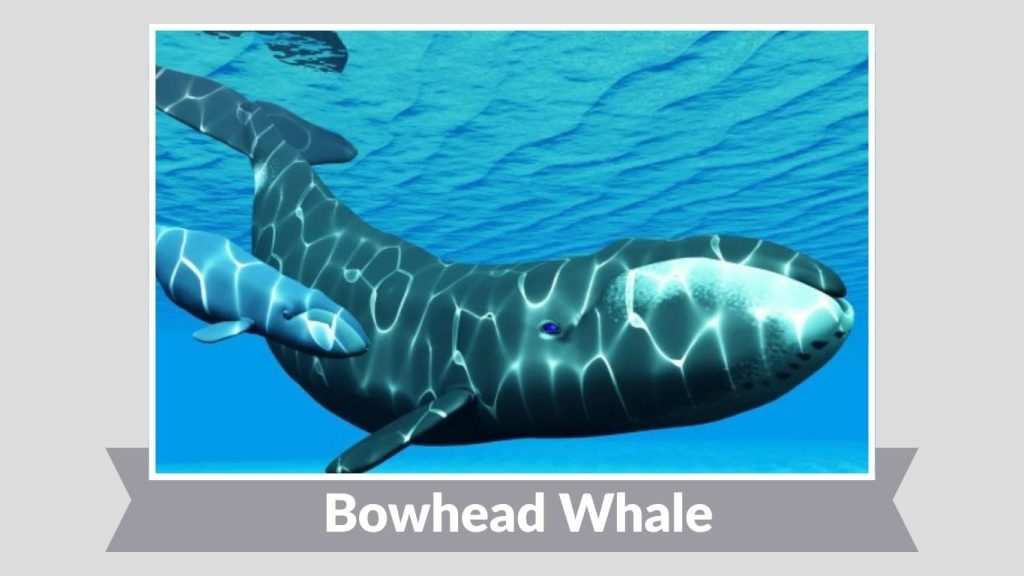
The bowhead whale is one of the largest and longest-living mammals on Earth. Perfectly adapted to Arctic waters, it has a massive skull and thick blubber that allow it to break through sea ice and survive extreme cold. Bowhead whales have been central to Arctic marine ecosystems and Indigenous cultures for thousands of years.
Identification
- Scientific name: Balaena mysticetus
- Average length: 14–18 meters
- Weight: 75,000–100,000 kg
- Skin color: Black with white markings on the chin
- Distinct feature: Large bow-shaped head and very thick blubber
Habitat
Bowhead whales live exclusively in Arctic and sub-Arctic waters, including regions around Alaska, Canada, Greenland, and Russia. They are closely associated with sea ice and often remain in icy waters year-round, migrating seasonally with changing ice conditions.
Behaviors
These whales are slow-moving and often travel alone or in small groups. They are capable of breaking through thick ice using their strong heads. Bowhead whales produce complex vocalizations that can travel long distances underwater.
Diet
Their diet consists mainly of zooplankton such as copepods and krill. They are filter feeders, using long baleen plates to strain food from the water.
Lifespan
Bowhead whales are known for their exceptional longevity, often living over 100 years, with some individuals estimated to reach 200 years.
18. Arctic Cod
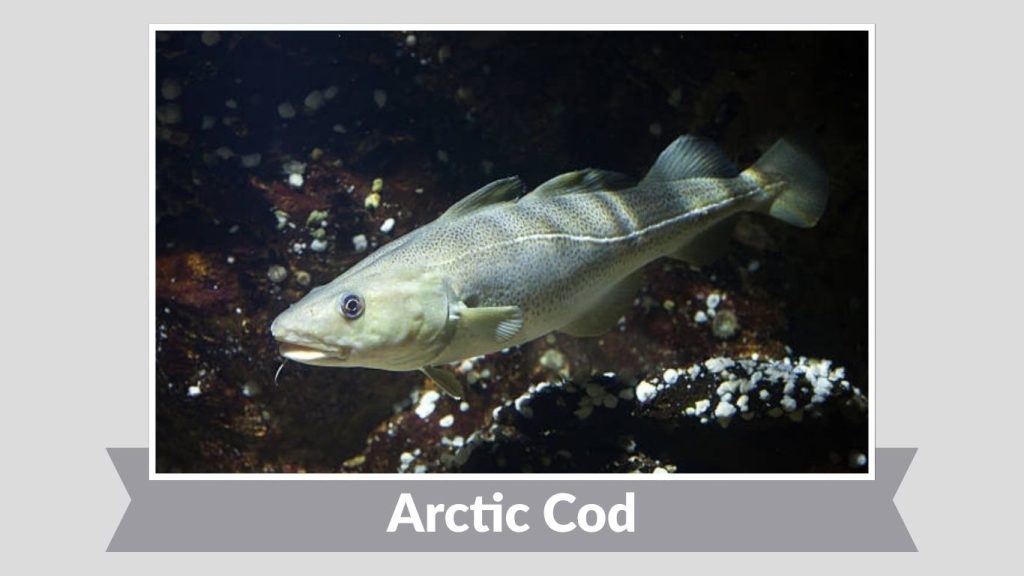
The Arctic cod is a small but extremely important fish species in the Arctic ecosystem. Despite its modest size, it forms the foundation of many Arctic food webs, serving as a primary food source for seals, whales, seabirds, and larger fish. Its ability to survive in freezing waters makes it one of the most successful Arctic fish species.
Identification
- Scientific name: Boreogadus saida
- Average length: 15–30 cm
- Weight: Up to 70 g
- Body color: Silvery-gray to brownish
- Distinct feature: Slender body with a small chin barbel
Habitat
Arctic cod inhabit cold Arctic and sub-Arctic waters across the Northern Hemisphere. They are commonly found near sea ice, under ice edges, and in deep waters. Juveniles often shelter beneath ice, where they find protection and abundant food.
Behaviors
They are schooling fish and often gather in large numbers. Arctic cod are highly tolerant of icy temperatures and can survive in water close to the freezing point. They play a key role in transferring energy from plankton to higher predators.
Diet
Their diet mainly consists of zooplankton such as copepods, amphipods, and small crustaceans. As they grow, they may also feed on small fish and larvae.
Lifespan
Arctic cod typically live 10 to 20 years in the wild, depending on environmental conditions and predation pressure.
19. Puffin
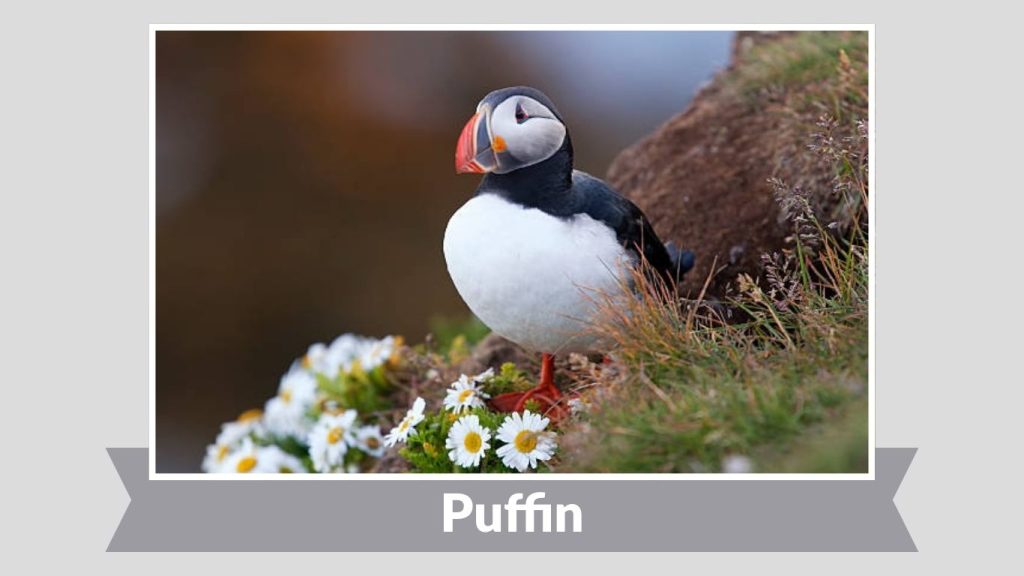
The puffin is a small, colorful seabird often called the “clown of the sea” because of its bright beak and expressive appearance. Although strongly associated with cold northern waters, puffins spend most of their lives at sea and only come ashore to breed. They are excellent swimmers and divers, using their wings to “fly” underwater.
Identification
- Scientific name: Fratercula arctica
- Average length: 28–34 cm
- Weight: 400–600 g
- Plumage color: Black and white body
- Distinct feature: Bright, triangular beak during breeding season
Habitat
Puffins live in the North Atlantic and Arctic regions, including coastal areas of Greenland, Iceland, northern Canada, and Scandinavia. They nest on rocky cliffs and grassy slopes near the sea, often in burrows they dig themselves. Outside the breeding season, they remain far offshore.
Behaviors
Puffins are highly social during breeding season and nest in large colonies. They are strong fliers and skilled divers, capable of reaching depths of up to 60 meters. Parents can carry multiple fish crosswise in their beaks to feed their chicks.
Diet
Their diet mainly consists of small fish such as sand eels, herring, and capelin. They also eat crustaceans and other small marine organisms.
Lifespan
Puffins typically live 20 to 30 years in the wild, with some individuals reaching even older ages.
20. Gyrfalcon
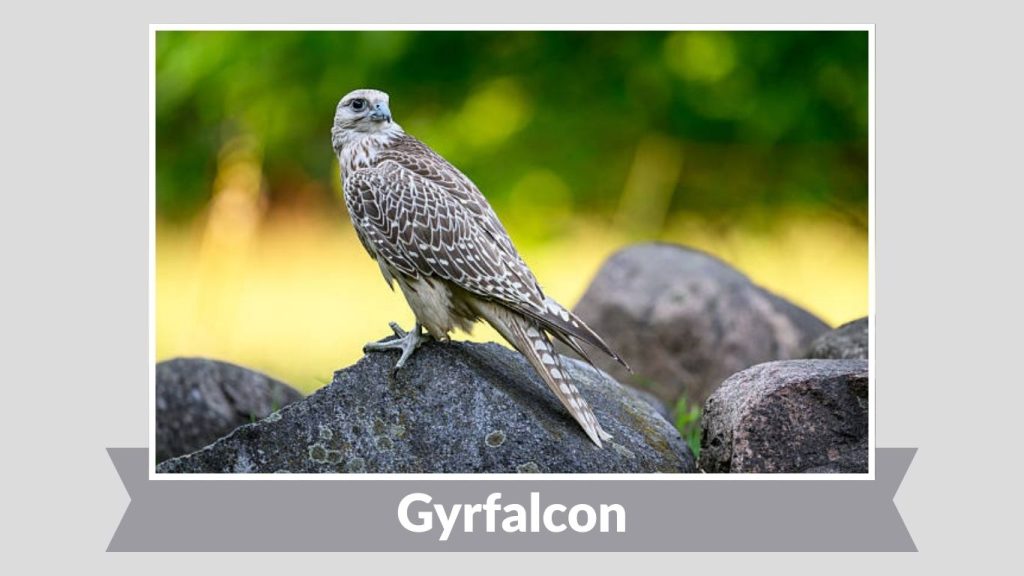
The gyrfalcon is the largest falcon species in the world and a powerful predator of the Arctic skies. Highly valued in falconry for centuries, it is known for its speed, strength, and adaptability to harsh environments. Its plumage varies widely, allowing it to blend into different Arctic landscapes.
Identification
- Scientific name: Falco rusticolus
- Average length: 48–65 cm
- Weight: 800–2,100 g
- Plumage color: White, gray, or dark brown (varies)
- Distinct feature: Broad wings and powerful hooked beak
Habitat
Gyrfalcons inhabit Arctic and sub-Arctic regions across North America, Europe, and Asia. They prefer open tundra, coastal cliffs, and mountainous areas where prey is abundant. Nesting often occurs on cliff ledges or abandoned nests of other birds.
Behaviors
They are usually solitary or found in breeding pairs. Gyrfalcons are fast and agile fliers, capable of high-speed pursuits. They defend large territories and are active hunters throughout the year, even in extreme cold.
Diet
Their diet mainly includes birds such as ptarmigan, seabirds, and ducks, as well as small mammals. They hunt by swift aerial attacks.
Lifespan
Gyrfalcons typically live 10 to 15 years in the wild, though some individuals may live longer under favorable conditions.
21. Ivory Gull
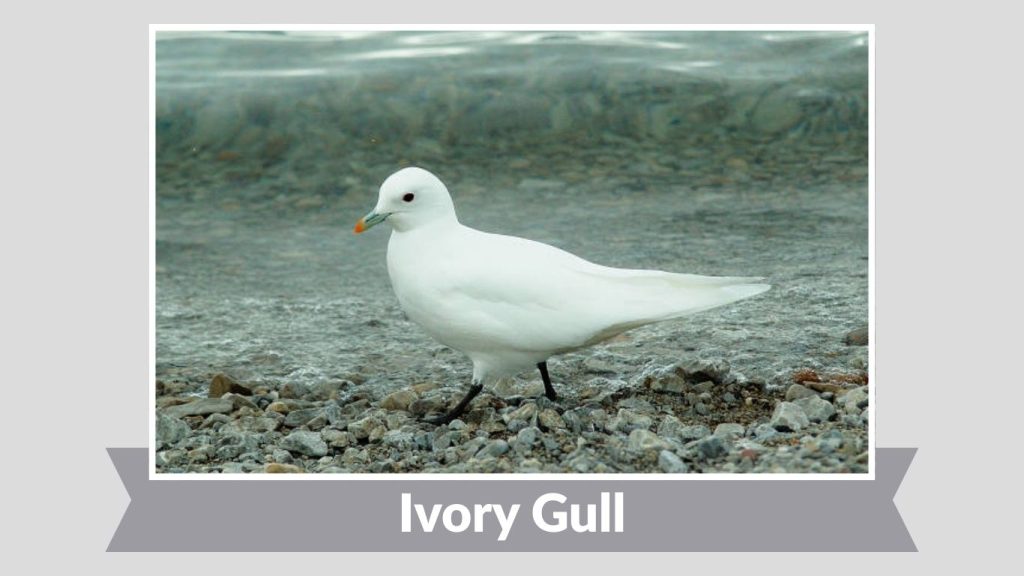
The ivory gull is a rare and elegant seabird strongly associated with Arctic sea ice. Its pure white plumage allows it to blend seamlessly into icy environments, making it one of the most distinctive birds of the high Arctic. The species is considered an important indicator of Arctic ecosystem health.
Identification
- Scientific name: Pagophila eburnea
- Average length: 40–43 cm
- Weight: 450–700 g
- Plumage color: Pure white
- Distinct feature: Black legs and dark-tipped bill
Habitat
Ivory gulls live almost exclusively in high Arctic regions, including northern Canada, Greenland, and parts of Russia. They are closely tied to pack ice and coastal areas, often nesting on remote cliffs and rocky islands near the sea.
Behaviors
They are agile fliers and often follow polar bears to scavenge leftover prey. Ivory gulls are usually seen alone or in small groups and spend much of their time flying over ice-covered waters in search of food.
Diet
Their diet consists of fish, crustaceans, carrion, and remains of seals killed by polar bears. They are opportunistic feeders.
Lifespan
Ivory gulls typically live 15 to 20 years in the wild, though population numbers are sensitive to environmental change.
22. Arctic Tern
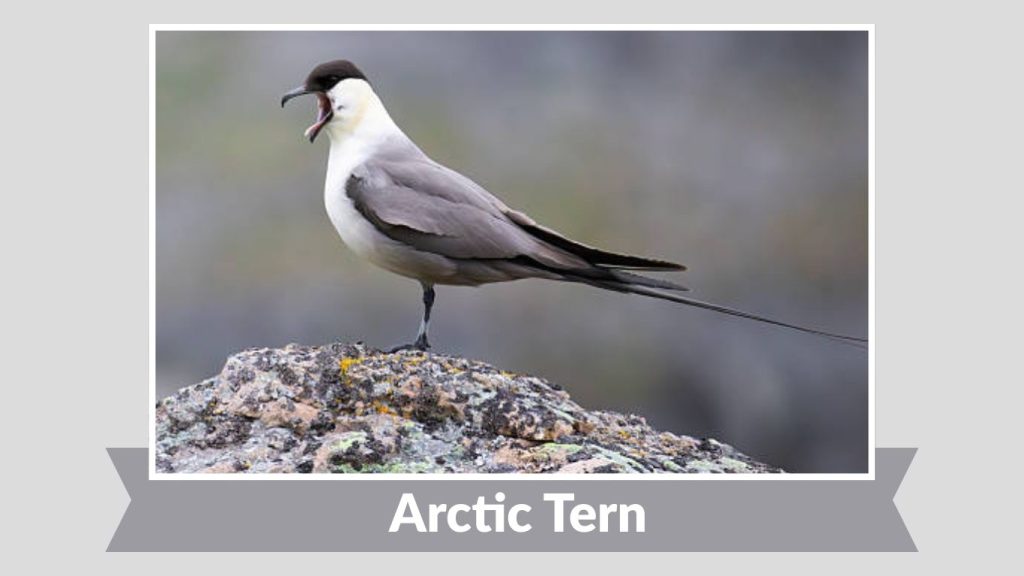
The Arctic tern is famous for having the longest migration of any animal on Earth. This small seabird travels from the Arctic to the Antarctic and back each year, experiencing more daylight than any other species. Its endurance and navigational ability make it one of the most remarkable birds in the natural world.
Identification
- Scientific name: Sterna paradisaea
- Average length: 33–39 cm
- Weight: 85–125 g
- Plumage color: Gray and white body with black cap
- Distinct feature: Long pointed wings and forked tail
Habitat
Arctic terns breed in Arctic and sub-Arctic regions across North America, Europe, and Asia. They nest on coastal tundra, islands, and shorelines. Outside the breeding season, they migrate over oceans to Antarctic waters.
Behaviors
They are highly agile fliers and aggressively defend their nesting sites from predators. Arctic terns are known for their precise navigation and long-distance travel, covering tens of thousands of kilometers each year.
Diet
Their diet mainly includes small fish, plankton, and crustaceans. They hunt by hovering and diving into the water to catch prey.
Lifespan
Arctic terns typically live 20 to 30 years in the wild, with some individuals reaching over 30 years.
23. Snow Goose
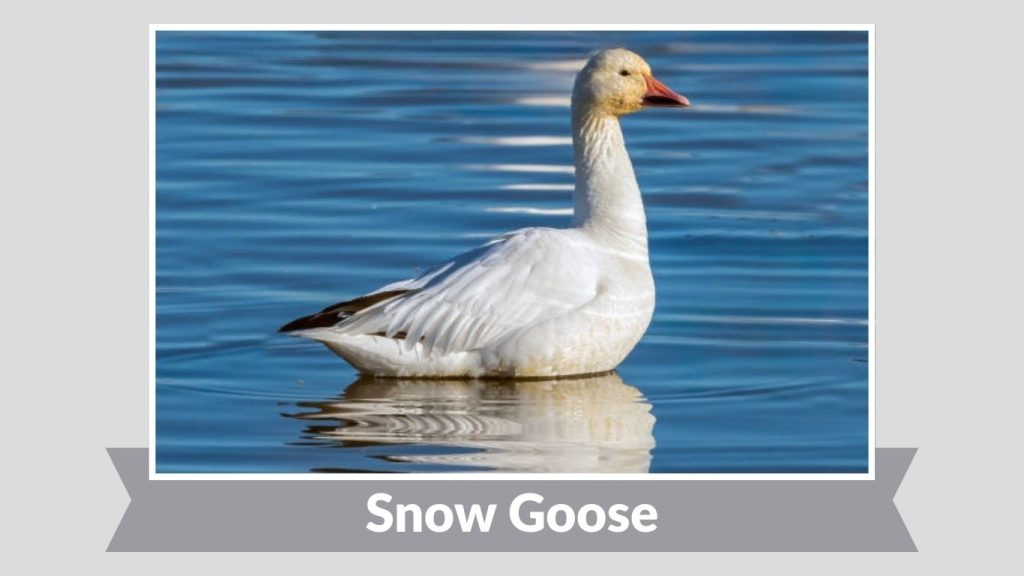
The snow goose is a large, migratory waterfowl species well known for its bright white plumage and loud calls. It plays a significant role in Arctic ecosystems and is one of the most abundant geese species in North America. During migration, snow geese travel in massive flocks that can number in the thousands.
Identification
- Scientific name: Anser caerulescens
- Average length: 64–79 cm
- Weight: 2–4.5 kg
- Plumage color: White with black wingtips (blue morph also exists)
- Distinct feature: Pink bill with a dark “grin patch”
Habitat
Snow geese breed in Arctic tundra regions of Canada and Greenland. They prefer coastal marshes, wetlands, and grassy tundra areas. During winter, they migrate south to temperate regions with open fields and wetlands.
Behaviors
They are highly social birds and travel, feed, and nest in large colonies. Snow geese are strong fliers and highly vocal, using calls to maintain flock cohesion. Their large populations can significantly impact vegetation in breeding areas.
Diet
Their diet consists mainly of grasses, sedges, roots, leaves, and grains. They forage on land and in shallow wetlands.
Lifespan
Snow geese typically live 10 to 20 years in the wild, with some individuals living longer under favorable conditions.
24. King Eider
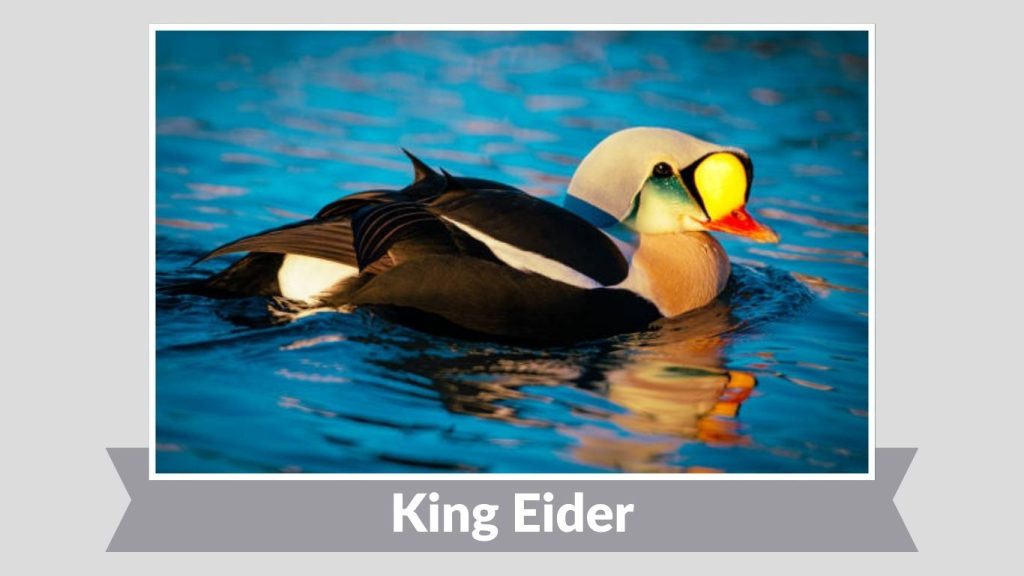
The king eider is a large and striking sea duck, especially known for the male’s colorful head during the breeding season. It is well adapted to cold Arctic waters and is a strong diver, capable of feeding at considerable depths. King eiders are an important part of Arctic coastal and marine ecosystems.
Identification
- Scientific name: Somateria spectabilis
- Average length: 50–63 cm
- Weight: 1.6–2.4 kg
- Plumage color: Males are brightly colored; females are mottled brown
- Distinct feature: Prominent orange knob on male’s bill
Habitat
King eiders breed in Arctic tundra near freshwater ponds and coastal areas across North America, Greenland, and Eurasia. Outside the breeding season, they move to cold marine waters, often near pack ice and rocky coastlines.
Behaviors
They are social birds and often gather in flocks, especially during migration and winter. King eiders are excellent divers, using their wings to swim underwater while searching for food.
Diet
Their diet includes mollusks, crustaceans, sea urchins, and small fish. They feed by diving to the sea floor.
Lifespan
King eiders typically live 15 to 25 years in the wild under favorable conditions.
25. Wolverine
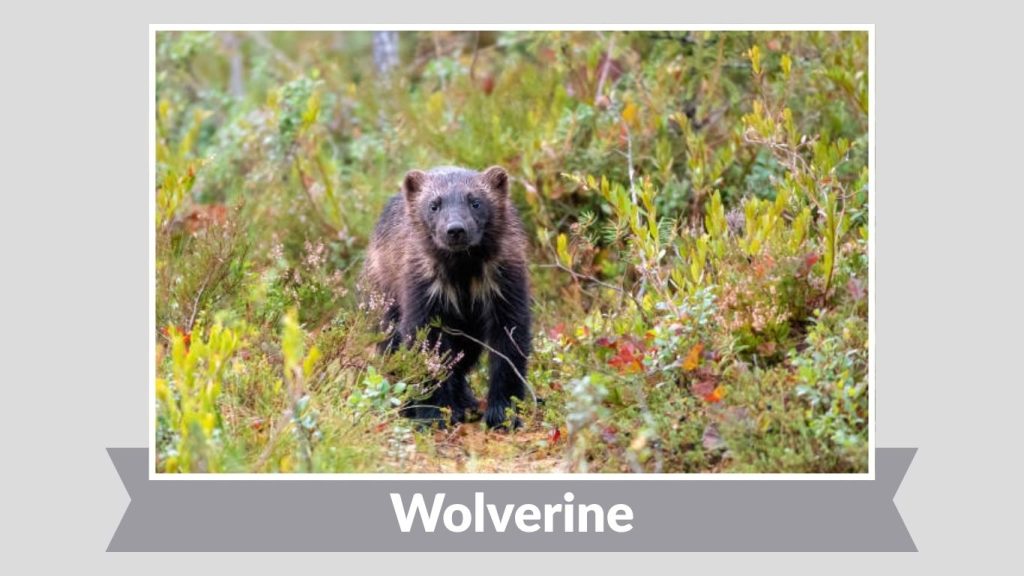
The wolverine is a powerful and elusive mammal known for its strength, endurance, and fearless behavior. Despite its stocky size, it can take down prey much larger than itself and survive in some of the harshest Arctic and sub-Arctic environments. Wolverines are solitary animals and play an important role as both predators and scavengers.
Identification
- Scientific name: Gulo gulo
- Average length: 65–110 cm
- Weight: 9–25 kg
- Fur color: Dark brown with lighter side stripes
- Distinct feature: Stocky build with strong jaws and claws
Habitat
Wolverines inhabit Arctic tundra, boreal forests, and mountainous regions across North America, Europe, and Asia. They prefer remote areas with deep snow, which helps them cache food and avoid competition.
Behaviors
They are solitary and highly territorial animals. Wolverines are known for traveling long distances in search of food and can be aggressive when defending territory or carcasses. They often scavenge kills left by larger predators.
Diet
Their diet includes small to medium-sized mammals, birds, eggs, carrion, and occasionally plant material. They are opportunistic feeders.
Lifespan
Wolverines typically live 7 to 12 years in the wild, though some may live longer under favorable conditions.
26. Greenland Shark
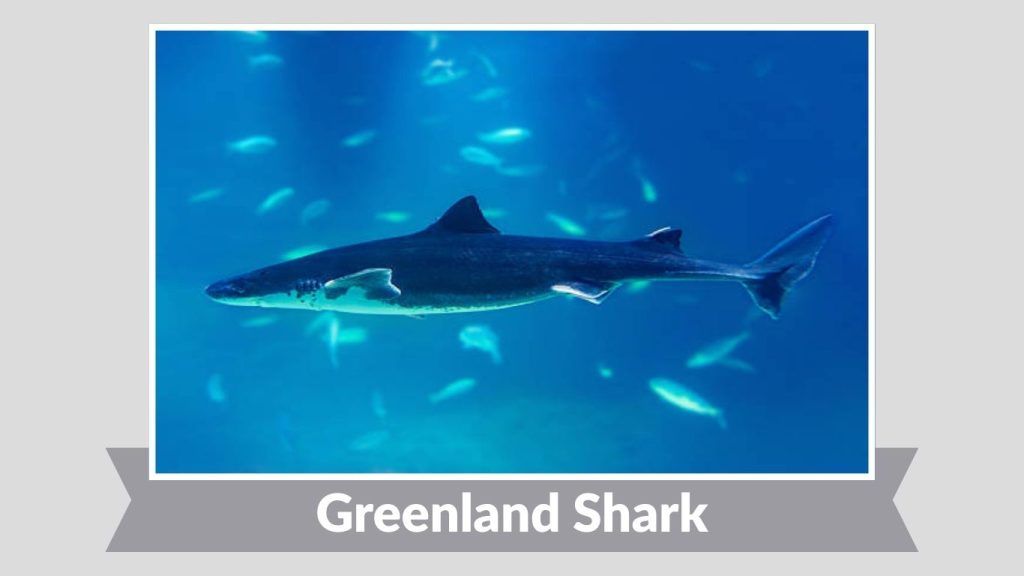
The Greenland shark is one of the most mysterious and slow-moving predators of the Arctic Ocean. Living in deep, icy waters, it is famous for being one of the longest-living vertebrates on Earth. Its slow metabolism and cold-water lifestyle allow it to survive in extreme environments where few large animals can thrive.
Identification
- Scientific name: Somniosus microcephalus
- Average length: 4–6 meters
- Weight: 400–1,400 kg
- Skin color: Gray to brown
- Distinct feature: Large cylindrical body and small eyes
Habitat
Greenland sharks inhabit cold Arctic and North Atlantic waters, often at great depths ranging from 200 to over 2,000 meters. They are commonly found near continental shelves and deep fjords, though they may also move into shallower waters in colder seasons.
Behaviors
They are extremely slow swimmers and rely on stealth rather than speed. Greenland sharks are usually solitary and poorly understood due to their deep-water habitat. Many individuals host parasitic copepods on their eyes, which may impair vision.
Diet
Their diet includes fish, seals, squid, carrion, and occasionally large marine mammals. Evidence suggests they often scavenge as well as hunt.
Lifespan
Greenland sharks are the longest-living known vertebrates, with estimated lifespans of 250 to over 400 years.
27. Polar Cod
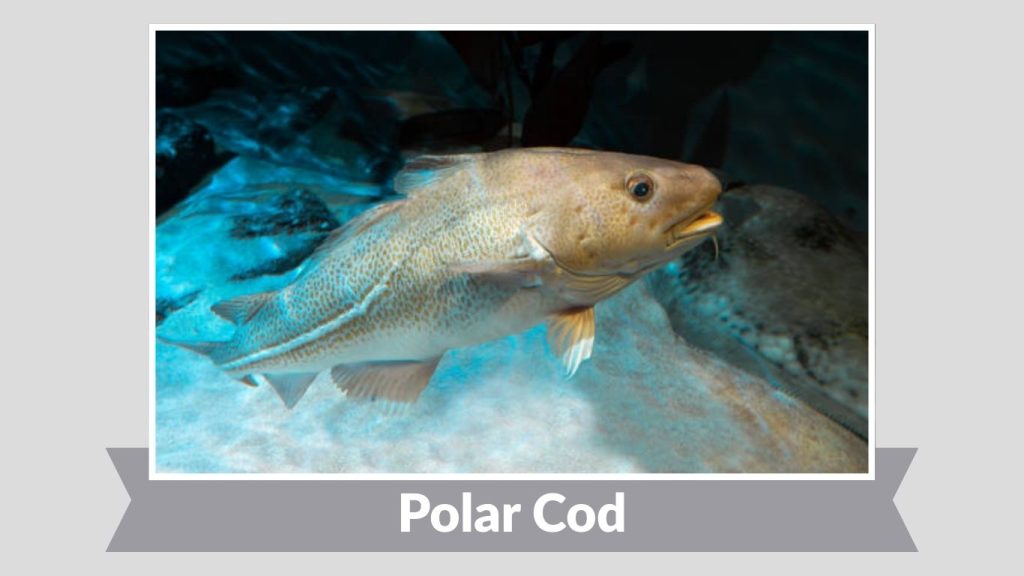
The polar cod is a key fish species of the Arctic and one of the most important links between lower and higher levels of the Arctic food web. Though small in size, it supports a wide range of predators, including seals, whales, seabirds, and larger fish. Its close association with sea ice makes it especially significant in Arctic ecosystems.
Identification
- Scientific name: Arctogadus glacialis
- Average length: 20–35 cm
- Weight: Up to 100 g
- Body color: Pale brown to gray
- Distinct feature: Elongated body with small chin barbel
Habitat
Polar cod live in cold Arctic waters across the Arctic Ocean and surrounding seas. They are commonly found near sea ice, under ice shelves, and in deep offshore waters. Juveniles often shelter beneath ice, where food and protection are abundant.
Behaviors
They are schooling fish and are well adapted to freezing temperatures. Polar cod can survive in icy waters thanks to antifreeze proteins in their blood. They play a major role in transferring energy from plankton to larger predators.
Diet
Their diet mainly consists of zooplankton such as copepods and amphipods, along with small crustaceans and fish larvae.
Lifespan
Polar cod typically live 8 to 12 years in the wild, depending on environmental conditions and predation pressure.
FAQs
What types of animals live in the Arctic?
The Arctic is home to a wide range of animals, including mammals, birds, and fish. Common Arctic animals include polar bears, Arctic foxes, seals, whales, seabirds, and cold-adapted fish species. These animals have special adaptations that help them survive extreme cold, ice, and limited food availability.
How do Arctic animals survive extreme cold?
Arctic animals survive extreme cold through adaptations such as thick fur or blubber, compact body shapes, antifreeze proteins in their blood, and behaviors like migration or hibernation. These features help conserve heat and energy in freezing temperatures.
Do all Arctic animals live on land?
No, Arctic animals live in different environments. Some live on land, such as Arctic wolves and caribou, while others are marine animals like seals, whales, and Arctic fish. Many species depend on sea ice for feeding or breeding.
What do Arctic animals eat?
Arctic animal diets vary by species. Herbivores eat plants like grasses, mosses, and lichens, while carnivores feed on fish, seals, birds, or smaller mammals. Many food chains in the Arctic are closely connected and depend on a few key species.
Why are Arctic animals important to the ecosystem?
Arctic animals help maintain balance in the ecosystem by controlling populations, recycling nutrients, and supporting food webs. They are also important indicators of environmental change, especially climate change.