
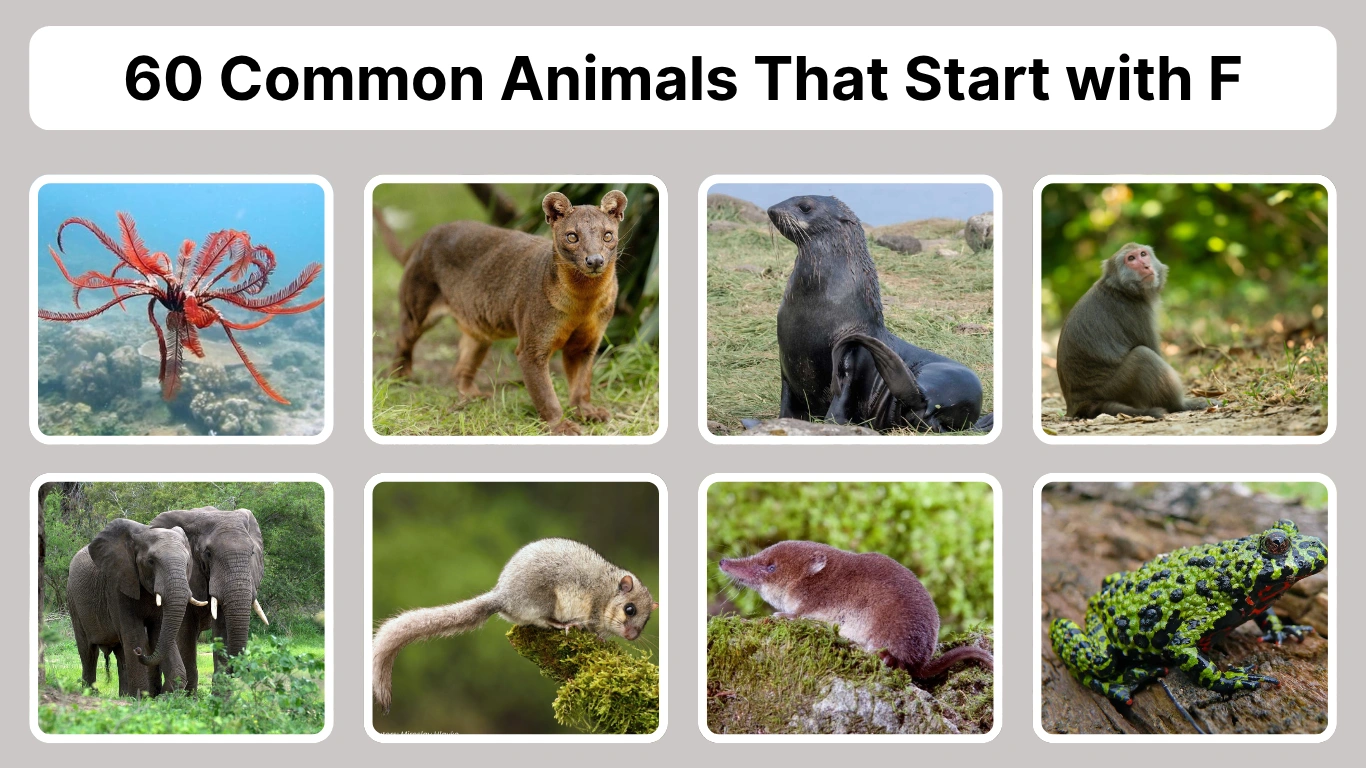
From furry forest dwellers to fascinating fish and fluttering birds, the animal kingdom is full of species whose names begin with the letter F. This guide explores 60 such animals across diverse habitats—including deserts, oceans, farms, and even the skies. Divided into 10 themed groups, each section provides brief yet informative descriptions, helping you discover and learn more about these fascinating creatures—some familiar, some rare, and others truly extraordinary.
Mammals That Start with F
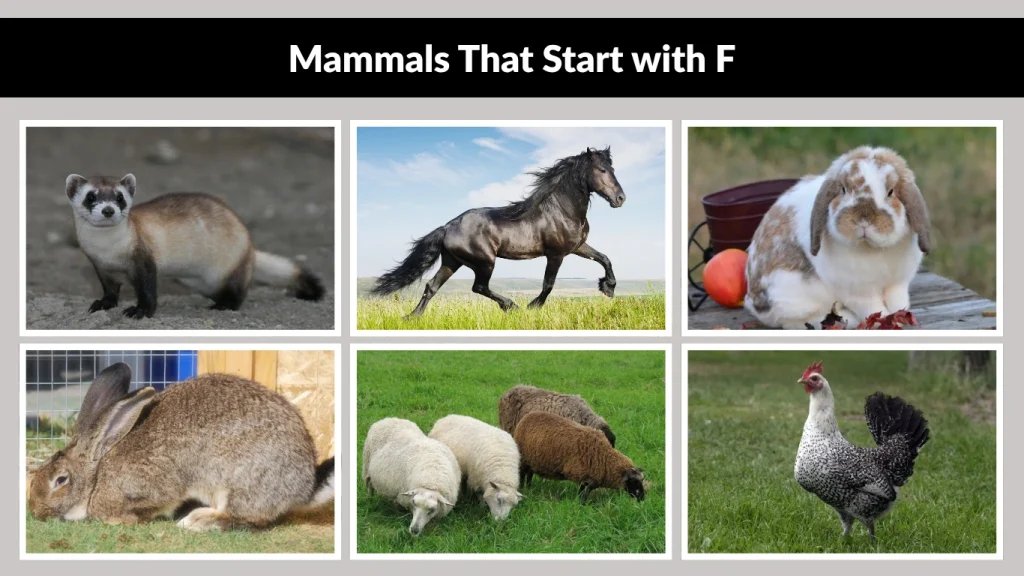
Mammals that start with the letter F include a diverse mix of domesticated and wild animals. From farm favorites to furry companions, these animals are known for their unique traits, adaptability, and in some cases, their usefulness to humans in daily life.
1. Ferret
Ferrets are small, playful mammals that belong to the weasel family. Known for their curiosity and energy, they make popular pets in many households.
They have long, slender bodies and a keen sense of smell. Ferrets have been domesticated for centuries, often used for hunting rodents and small prey.
2. Friesian Horse
The Friesian horse is a majestic, large draft horse breed that originated in the Netherlands. It is easily recognized by its black coat, feathered legs, and powerful build.
Despite their strength, Friesians are known for being gentle and intelligent. They are commonly used in dressage, movies, and ceremonial events.
3. French Lop (Rabbit Breed)
The French Lop is a large, heavy rabbit breed with long lopped ears and a gentle temperament. It was developed in France in the 19th century.
This breed is often kept as a pet and requires ample space due to its size. French Lops are calm, social, and enjoy human interaction.
4. Flemish Giant
The Flemish Giant is one of the largest rabbit breeds in the world. These rabbits can weigh up to 15 pounds and have a calm, docile nature.
Originally bred for meat and fur, they are now popular as pets. Despite their size, they are friendly and good with children.
5. Finnsheep
Finnsheep are a Finnish breed of domestic sheep known for their high lambing rate and soft wool. They are often used in breeding programs to increase productivity.
These sheep are also prized for their calm temperament and adaptability. Their wool is popular among fiber artists for spinning and felting.
6. Fayoumi Chicken
The Fayoumi chicken is a small, hardy bird that originated in Egypt. It is known for its resistance to disease and ability to thrive in hot climates.
Though not a mammal, it’s often found on farms alongside mammals. Fayoumis are active foragers and lay a good number of small, white eggs.
Forest Animals That Start with F
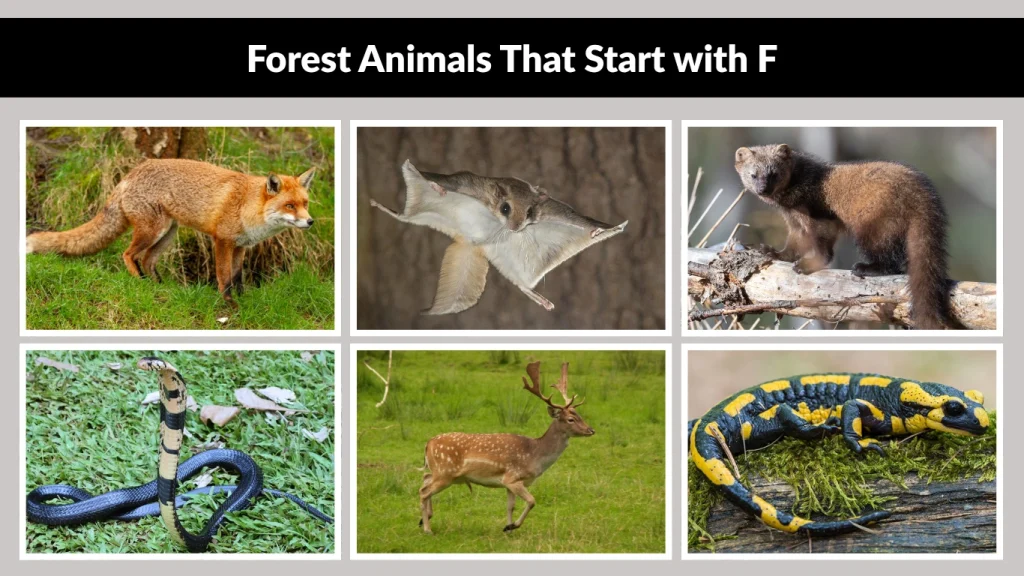
Forests are home to many fascinating creatures whose names begin with F. These animals have adapted to life among trees, dense vegetation, and varying climates—from tropical rainforests to temperate woodlands. Let’s explore six forest-dwelling animals starting with the letter F.
7. Fox
Foxes are clever and agile mammals that thrive in forested environments. They have pointed ears, bushy tails, and sharp senses that help them hunt small prey.
Red foxes are the most common, but there are many species worldwide. Foxes are omnivores and are known for their cunning behavior and adaptability.
8. Flying Squirrel
Flying squirrels don’t actually fly—they glide using a membrane called the patagium that stretches between their limbs. They are small, nocturnal mammals.
These squirrels live in tree hollows and glide from branch to branch to search for food. Their diet includes nuts, seeds, fruits, and insects.
9. Fisher Cat
Despite its name, the fisher cat isn’t a cat. It’s a medium-sized carnivorous mammal in the weasel family, native to North American forests.
Fishers are excellent climbers and fierce hunters. They are one of the few predators that can hunt porcupines by attacking their unprotected faces.
10. Forest Cobra
The forest cobra is a highly venomous snake found in central and western African forests. It is one of the largest cobra species and can reach over 10 feet in length.
Its powerful venom and intimidating hood make it a feared predator. Forest cobras prefer dense forests but may also live near water.
11. Fallow Deer
Fallow deer are graceful herbivores with palmate antlers and spotted coats. They are commonly found in European woodlands and are often introduced to parks.
These deer are social and live in herds. Males (bucks) are known for their dramatic antler displays during the rutting season.
12. Fire Salamander
The fire salamander is a striking amphibian with black skin and bright yellow markings. It inhabits moist, shaded forests in Europe.
They are nocturnal and often found near streams or under logs. Despite their vivid appearance, they secrete toxins as a defense against predators.
Ocean and Freshwater Animals That Start with F
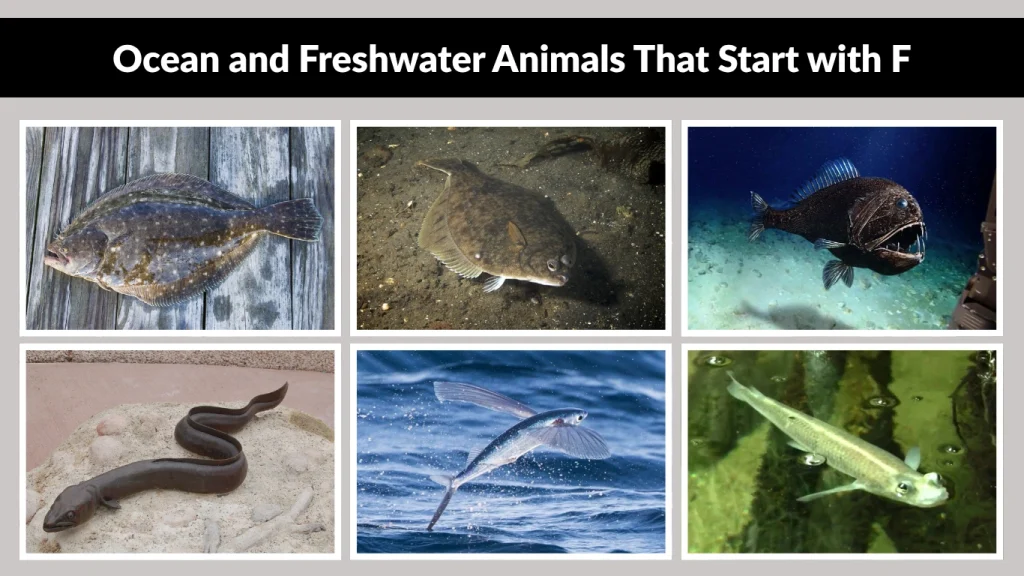
Aquatic animals that begin with F can be found in oceans, rivers, and lakes across the world. These species vary from bottom-dwelling flatfish to fast-moving swimmers, each with fascinating adaptations for life in water.
13. Flounder
Flounders are flatfish that live on the seafloor, usually in coastal waters. They have both eyes on one side of their body, helping them stay camouflaged.
Their ability to blend into the sandy ocean floor protects them from predators. Flounders are also popular targets in commercial and recreational fishing.
14. Flatfish
Flatfish is a general term for a group of bottom-dwelling fish with flattened bodies, including flounders, soles, and halibuts.
These fish are masters of camouflage. As juveniles, one eye migrates to the other side of the head, allowing them to lie flat against the ocean bottom.
15. Fangtooth Fish
Fangtooth fish are deep-sea dwellers known for their oversized fangs and fearsome appearance. Despite their terrifying look, they are relatively small.
They live in dark, high-pressure depths of the ocean. Their huge teeth help them catch prey in a world where food is scarce and competition is fierce.
16. Freshwater Eel
Freshwater eels have elongated, snake-like bodies and can be found in rivers and lakes worldwide. They are famous for their mysterious life cycle.
Many species, like the American eel, migrate to the ocean to spawn. These eels are nocturnal and feed on small fish, insects, and crustaceans.
17. Flying Fish
Flying fish can leap out of the water and glide for considerable distances using their wing-like pectoral fins. They live in warm ocean waters.
This gliding ability helps them escape predators like tuna and dolphins. They can glide up to 650 feet in a single leap.
18. Four-Eyed Fish
Despite the name, four-eyed fish actually have two eyes, each split into two parts—one for seeing above water and one for below.
They live in freshwater rivers and mangroves in Central and South America. This unique vision allows them to scan for predators and prey simultaneously.
Birds That Start with F
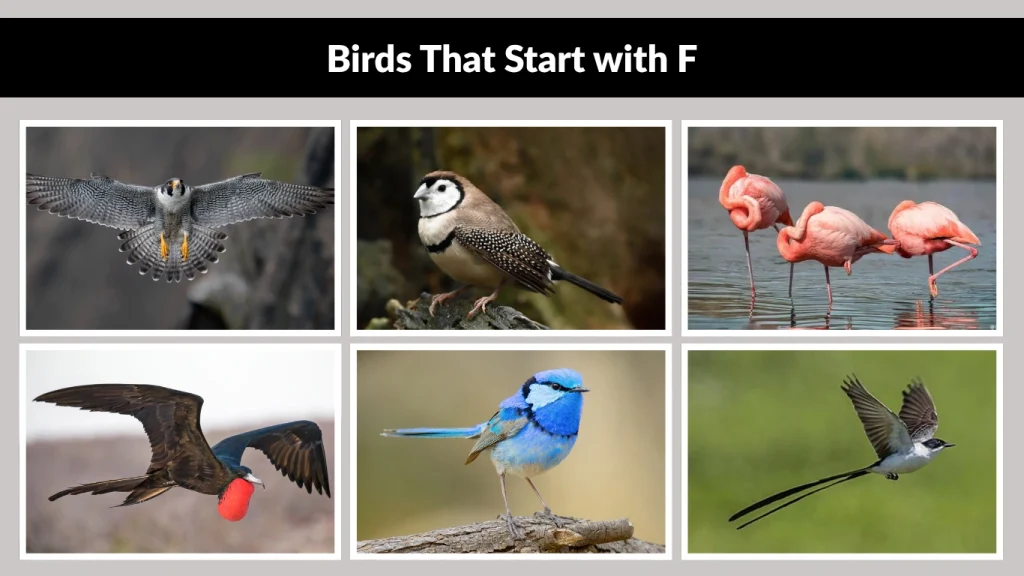
Birds that start with the letter F are diverse in appearance, behavior, and habitat. From colorful songbirds to powerful aerial hunters, these feathered creatures display remarkable traits that make them stand out in the avian world.
19. Falcon
Falcons are swift, agile birds of prey known for their sharp vision and high-speed dives. The peregrine falcon, in particular, is the fastest bird on Earth.
They use their powerful beaks and talons to catch small birds and mammals. Falcons are commonly found in open areas, cliffs, and urban environments.
20. Finch
Finches are small, active birds with conical beaks ideal for eating seeds. They are found in various habitats, including forests, grasslands, and backyards.
Many species of finches are known for their cheerful songs and bright plumage. They play an important role in seed dispersal and ecological balance.
21. Flamingo
Flamingos are wading birds recognized by their long legs, curved beaks, and pink feathers. Their color comes from the shrimp and algae in their diet.
They live in large colonies near salt lakes, lagoons, and estuaries. Flamingos often stand on one leg and are famous for their graceful group behavior.
22. Frigatebird
Frigatebirds are large seabirds with long wings and forked tails. Males have a red throat pouch that inflates to attract females during mating season.
They are excellent fliers and can stay airborne for days. Frigatebirds often snatch food from other birds in mid-air, earning the nickname “pirates of the sky.”
23. Fairy-wren
Fairy-wrens are small, brightly colored birds native to Australia. Males often display vivid blue plumage during the breeding season.
These birds are social and live in cooperative groups. Despite their delicate appearance, fairy-wrens are tough and can survive in harsh habitats.
24. Fork-tailed Flycatcher
The fork-tailed flycatcher is known for its dramatically long, split tail. It breeds in South America and migrates north to Central America during certain seasons.
They are agile fliers and feed on insects mid-air. Their distinctive tail helps with balance and quick turns during flight.
Insects and Arachnids That Start with F
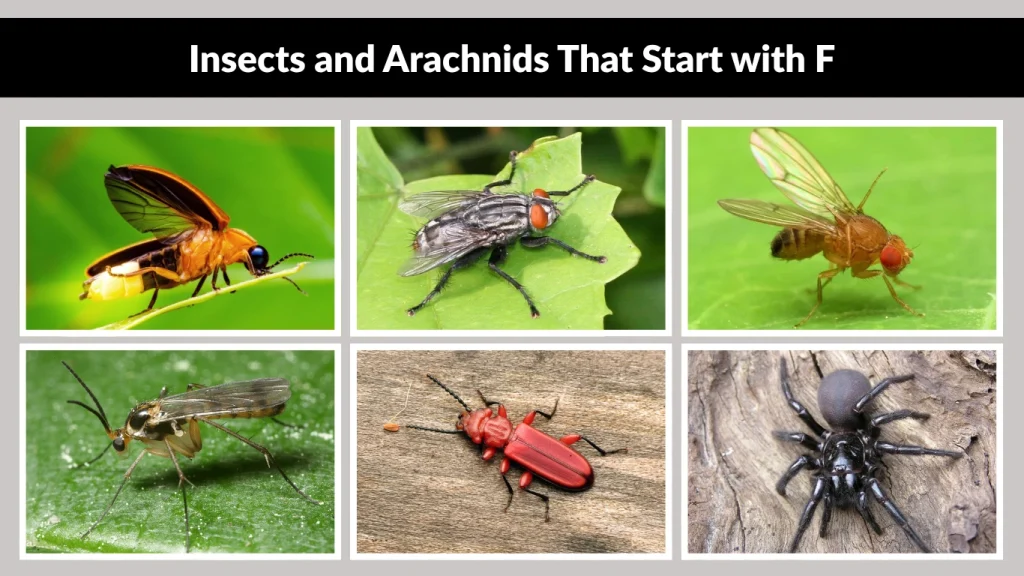
Insects and arachnids that begin with F include luminous beetles, tiny flies, and web-spinning spiders. Though small in size, these creatures play vital roles in ecosystems—from pollination to decomposition and pest control.
25. Firefly
Fireflies are beetles known for their ability to produce light through a chemical reaction in their abdomen. This glow is used to attract mates or prey.
They are most active at night during warm seasons. Fireflies thrive in moist habitats like meadows, forests, and marshes, creating magical nighttime displays.
26. Flesh Fly
Flesh flies are medium-sized insects that lay their eggs in decaying matter, wounds, or carrion. Some species give birth to live larvae instead of eggs.
They are often found around garbage or animal remains. Though unpleasant, flesh flies help break down organic material in natural and urban ecosystems.
27. Fruit Fly
Fruit flies are tiny insects often seen hovering around ripe or rotting fruits. They’re famous for their role in genetic research due to their short life cycle.
These flies reproduce rapidly and can become indoor pests. Despite this, they help scientists understand genetics, heredity, and biological development.
28. Fungus Gnat
Fungus gnats are small, mosquito-like flies often found around houseplants and damp soil. Their larvae feed on fungi and organic matter in the soil.
While adults are mostly harmless, larvae can damage plant roots. Overwatering is a common cause of fungus gnat infestations in homes and greenhouses.
29. Flat Bark Beetle
Flat bark beetles are small, flat-bodied insects that live beneath the bark of trees. They are often found in decaying wood or fallen logs.
These beetles help decompose dead wood and recycle nutrients. Some species are also predators, feeding on other insects and pest larvae.
30. Funnel-Web Spider
Funnel-web spiders are known for spinning dense, funnel-shaped webs. Some species, like the Sydney funnel-web, are highly venomous and pose a danger to humans.
They hide at the back of the funnel, waiting to ambush prey. These spiders are usually found in moist forested areas or gardens.
Desert and Dryland Animals That Start with F

Animals that thrive in deserts and arid regions often have special adaptations to survive heat, dryness, and scarce water. The following species, starting with the letter F, are built to endure some of the world’s harshest environments.
31. Fennec Fox
The fennec fox is a small desert-dwelling fox with enormous ears. Native to the Sahara, its ears help release heat and improve hearing.
Its light-colored coat reflects sunlight, and it burrows underground to stay cool. Despite its size, it is a skilled predator of insects, rodents, and birds.
32. Fringe-toed Lizard
Fringe-toed lizards live in sandy deserts and have fringe-like scales on their toes to help them move across loose sand. They are active during the day.
These reptiles bury themselves to escape heat and predators. Their diet includes insects and small plants, and they’re excellent at camouflage.
33. Fat-Tailed Scorpion
The fat-tailed scorpion is one of the most dangerous scorpions, found in arid regions of North Africa and the Middle East. Its thick tail holds potent venom.
It hides under rocks during the day and hunts at night. These scorpions are feared for their sting but are important in controlling insect populations.
34. Fire Skink
Fire skinks are brightly colored reptiles with red and orange scales. Though not limited to deserts, they are found in dry, open woodlands and savannas.
They are ground-dwelling and feed on insects. Fire skinks are secretive, spending much of their time under leaf litter or logs.
35. False Cobra
The false cobra is a mildly venomous snake that flattens its neck when threatened, mimicking a true cobra. It inhabits dry forests and scrublands in Africa.
Its display is a defense mechanism rather than an attack. These snakes feed on rodents, frogs, and birds, and are mostly active at night.
36. Five-lined Skink
Five-lined skinks are small lizards known for their five distinct stripes and bright blue tails in juveniles. They live in dry woodlands and rocky areas.
They are fast movers and can detach their tails to escape predators. Their diet includes insects, spiders, and small invertebrates.
Reptiles and Amphibians That Start with F
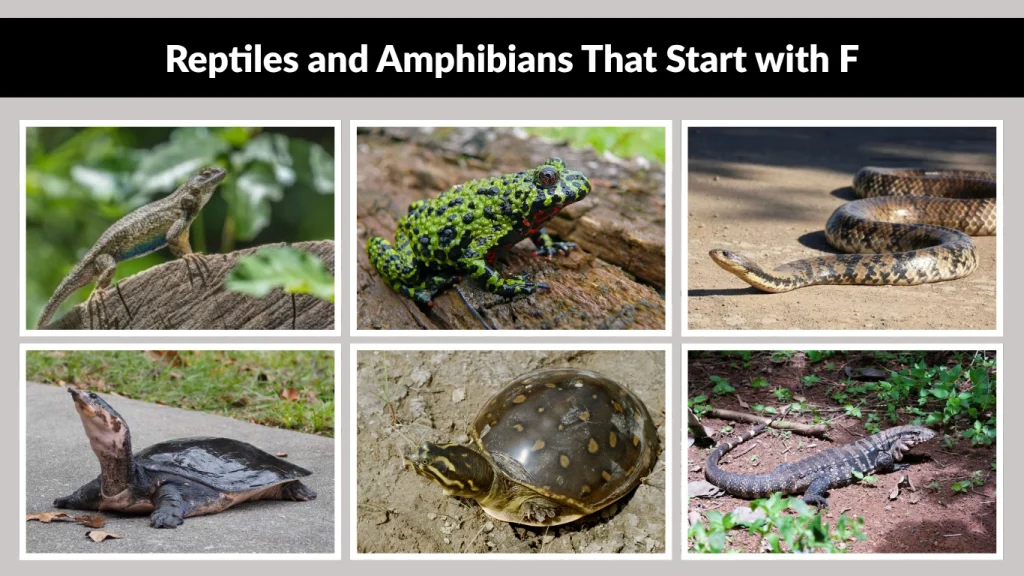
Reptiles and amphibians that start with F include snakes, lizards, turtles, and toads, many of which are adapted to a mix of land and aquatic environments. These cold-blooded animals play key roles in controlling pests and maintaining ecological balance.
37. Fence Lizard
Fence lizards are small, spiny lizards found in North America. They are often seen basking on fences, rocks, and logs in warm, sunny areas.
These reptiles are insectivores and have quick reflexes to escape predators. Males often show off bright blue patches on their bellies during mating season.
38. Fire-bellied Toad
The fire-bellied toad is a colorful amphibian with a bright red or orange belly that warns predators of its toxicity. It lives in wetlands and slow-moving waters.
These toads are semi-aquatic and feed on insects and small invertebrates. When threatened, they display their bellies in a behavior called the unken reflex.
39. False Water Cobra
The false water cobra is a rear-fanged, mildly venomous snake native to South America. It flattens its neck when threatened, similar to a cobra.
Despite the display, it is less dangerous than a true cobra. It prefers wetlands and is a strong swimmer, feeding on fish, amphibians, and rodents.
40. Florida Softshell Turtle
The Florida softshell turtle has a flat, leathery shell and a long, snorkel-like nose. It is one of the fastest turtles in water and on land.
It inhabits rivers, lakes, and ponds in the southeastern United States. These turtles are carnivorous and hunt fish, insects, and crustaceans.
41. Flapshell Turtle
The Indian flapshell turtle is a freshwater species found in South Asia. It has small flaps of skin that cover its limbs when retracted.
It feeds on plants, snails, and insects. This turtle is often seen in rice paddies and ponds and is known for its peaceful temperament.
42. Forest Tegu
The forest tegu is a medium-sized lizard native to South America’s tropical forests. It is less known than its cousin, the Argentine black and white tegu.
Forest tegus are omnivores, feeding on fruits, insects, and small animals. They are shy, solitary creatures and are mostly active during the day.
Rodents and Small Mammals That Start with F
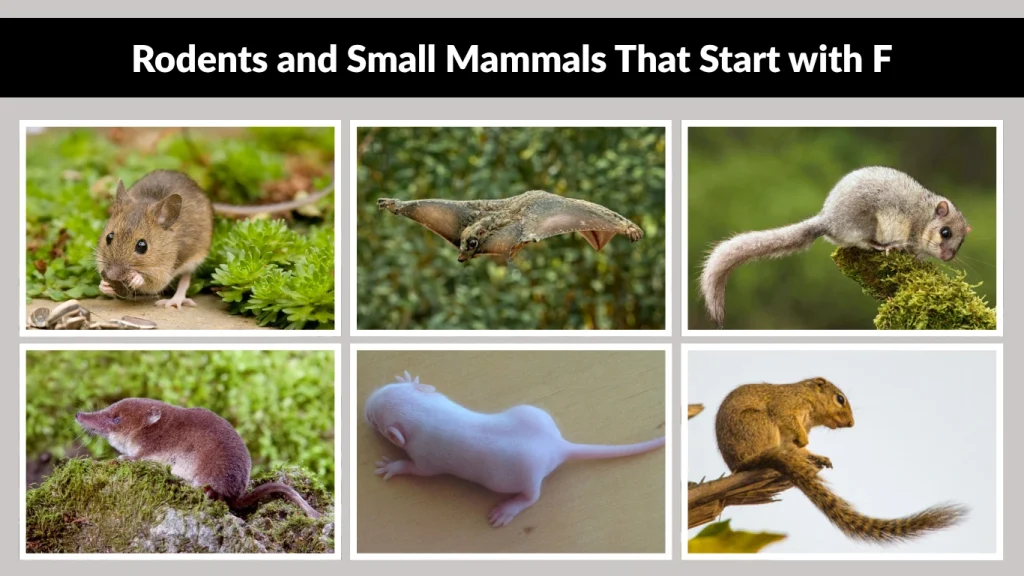
Rodents and other small mammals that start with the letter F are found in a variety of habitats, from fields and forests to rooftops and attics. These creatures may be tiny, but they play important roles in food chains and ecosystems.
43. Field Mouse
Field mice are small rodents commonly found in grassy and agricultural areas. They are excellent burrowers and build nests underground or in thick vegetation.
These mice are nocturnal and feed on seeds, grains, and small insects. Though cute, they are considered pests in homes and crop fields.
44. Flying Lemur
Despite the name, flying lemurs neither fly nor are true lemurs. Also known as colugos, they glide using a large membrane stretching from neck to tail.
Native to Southeast Asia, they live in forests and spend most of their lives in trees. They feed on leaves, flowers, and fruit.
45. Fat Dormouse
The fat dormouse is a small rodent known for hibernating up to seven months a year. It is found in Europe and prefers wooded areas and old buildings.
These nocturnal animals feed on nuts, fruits, and insects. They are skilled climbers and are sometimes called “edible dormice” in parts of Europe.
46. Forest Shrew
Forest shrews are tiny insectivores found in tropical and subtropical forests. They have elongated snouts, small eyes, and high metabolisms.
They’re constantly on the move, feeding on insects, worms, and spiders. Though small, they are important for pest control in forest ecosystems.
47. Fuzzy Rat
Fuzzy rats are domesticated fancy rats with soft, velvety fur. They are often bred for their unique coat types, like the rex or double rex.
They are intelligent and social, making them popular as pets. These rats thrive in clean habitats and need interaction, toys, and mental stimulation.
48. Fire-footed Rope Squirrel
Native to Africa, the fire-footed rope squirrel gets its name from its reddish-orange limbs. It lives in tropical forests and is active during the day.
It spends most of its time in trees, jumping from branch to branch. Its diet includes fruit, nuts, and seeds, making it an important seed disperser.
Wild and Exotic Mammals That Start with F
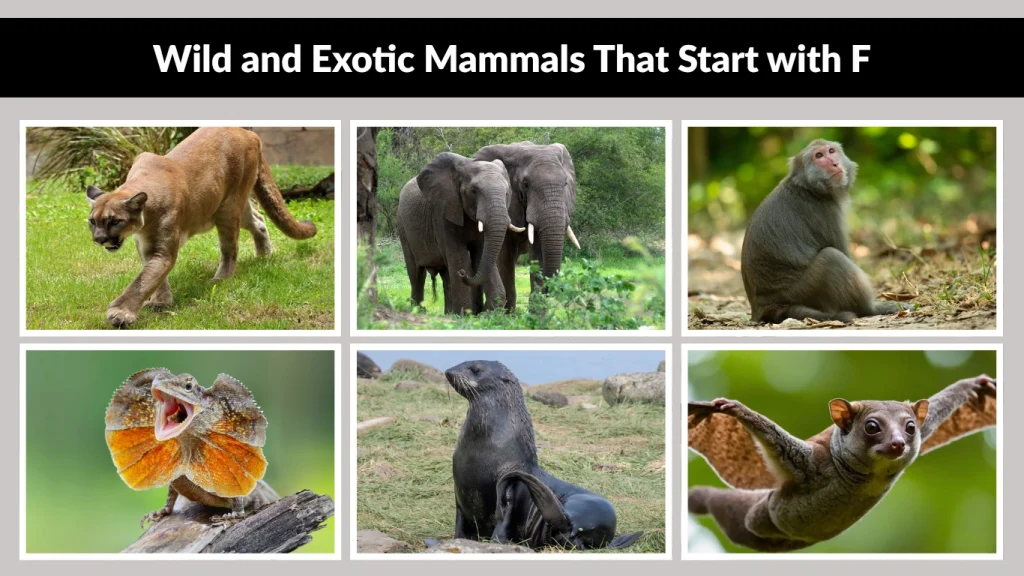
These wild and exotic mammals starting with F come from diverse habitats such as rainforests, mountains, and coastal areas. They are often elusive, unique in appearance, and adapted to specialized niches in their ecosystems.
49. Florida Panther
The Florida panther is a subspecies of cougar found in southern Florida. It is critically endangered, with only a small population remaining in the wild.
These solitary cats prefer swamps and forests. They are powerful hunters and feed on deer, wild hogs, and small mammals.
50. Forest Elephant
Forest elephants are smaller than African savannah elephants and have straighter tusks. They live in dense tropical forests of Central and West Africa.
These elephants are essential for forest health, spreading seeds and creating paths. Unfortunately, they are under threat due to poaching and habitat loss.
51. Formosan Rock Macaque
The Formosan rock macaque is the only monkey native to Taiwan. It inhabits forests, mountains, and coastal cliffs across the island.
They live in social groups and have complex behaviors. Their diet is omnivorous, including fruits, leaves, insects, and even small animals.
52. Frilled-neck Lizard
The frilled-neck lizard is famous for its dramatic frill, which it fans out when threatened. Despite its name, it’s often included in mammal-related lists due to its visual appeal.
It’s native to Australia and Papua New Guinea and spends much of its life in trees. It feeds on insects and small vertebrates.
53. Fur Seal
Fur seals are marine mammals with thick, luxurious fur. They are agile swimmers and spend much of their time in cold ocean waters.
These seals haul out on rocky shores to breed and rest. They feed on fish and squid, diving deep to hunt their prey.
54. Flying Lemur
Flying lemurs, or colugos, appear again here due to their unusual nature and limited range. Their gliding membrane makes them look like living kites.
They are tree-dwellers and rarely descend to the ground. These gentle creatures are herbivores and are mostly active at night.
Unusual or Mythical Animals That Start with F
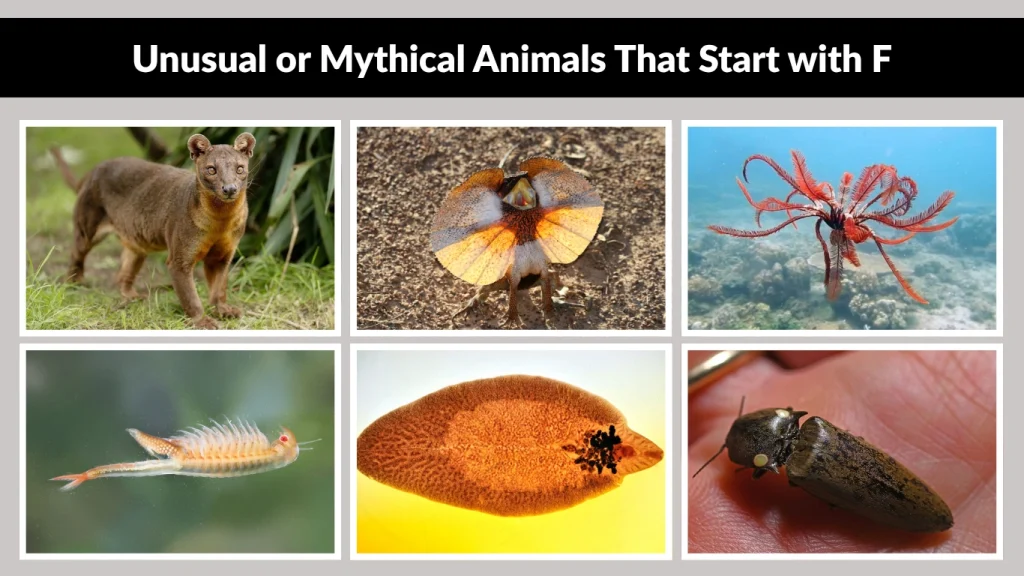
This group features lesser-known, unusual, and even mythical creatures whose names begin with F. Some are real but rarely seen, while others spark curiosity due to their strange features or folklore connections.
55. Fossa
The fossa is a carnivorous mammal native to Madagascar. Though it resembles a cat, it is more closely related to mongooses and is the island’s top predator.
It’s agile and hunts lemurs by leaping through trees. Fossas are elusive and mainly active at dawn and dusk, making them hard to observe in the wild.
56. Frill-necked Lizard
This striking reptile is known for the large frill around its neck, which it expands to scare predators. It stands on two legs and runs upright when startled.
Although not mythical, its dramatic display often gives it a legendary reputation. It inhabits dry woodlands of northern Australia and southern New Guinea.
57. Feather Star
Feather stars are marine invertebrates with feathery arms that capture plankton. They belong to the same group as sea stars and sea urchins.
They cling to coral or rocks in shallow tropical seas. Despite looking plant-like, they are animals and can swim slowly using their arms.
58. Fairy Shrimp
Fairy shrimp are small, translucent crustaceans found in seasonal pools and vernal ponds. They swim upside down and feed on algae and microorganisms.
They have short lifespans and produce drought-resistant eggs. These creatures are vital food sources for migrating birds in wetland habitats.
59. Fluke
Flukes are flatworms that live as parasites inside the bodies of various animals, including humans. They often infect the liver, lungs, or blood vessels.
Though tiny, they can cause serious diseases. Their life cycles are complex, involving multiple hosts like snails, fish, or mammals.
60. Fire Beetle
Fire beetles, or pyrophilous beetles, are attracted to freshly burned wood. They detect forest fires from miles away using heat-sensitive organs.
They lay their eggs in burnt trees, where their larvae feed on dead wood. This unique behavior links them closely to wildfire ecology.