
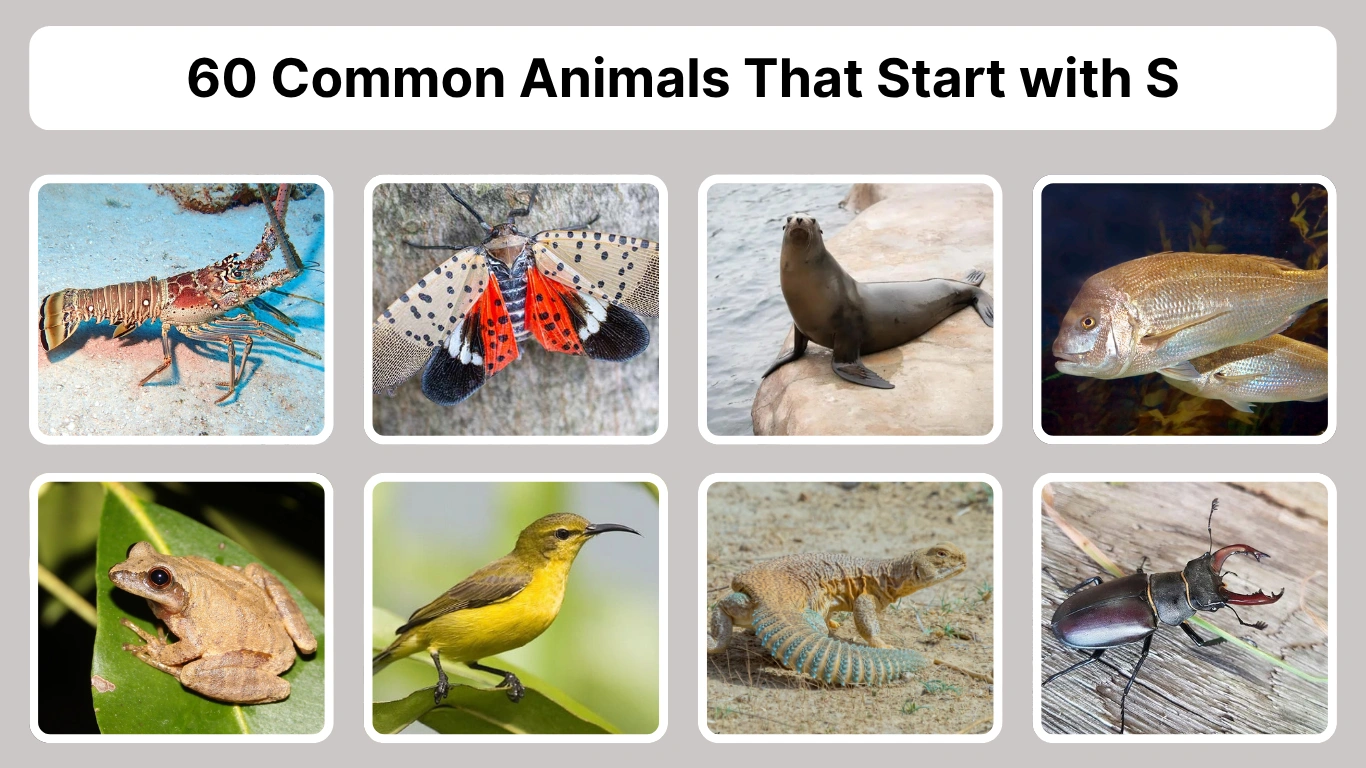
From swift predators to gentle grazers, the animal kingdom is full of fascinating species whose names begin with the letter S. These creatures inhabit every corner of the planet — soaring through skies, swimming in oceans, and roaming forests and deserts. In this list, we explore 60 common animals starting with S, grouped by type, highlighting their unique traits and remarkable roles in nature.
Mammals that Start with S
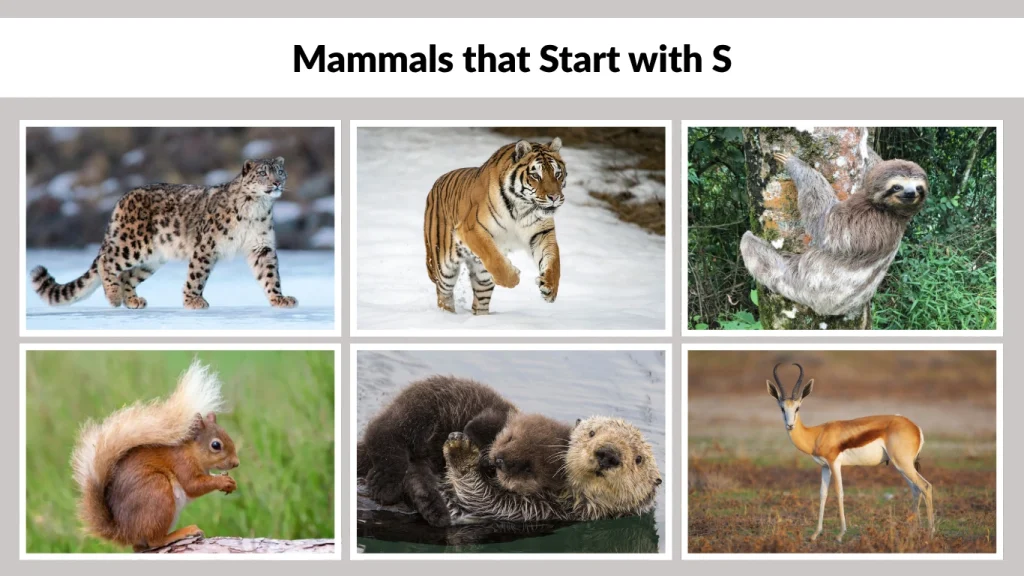
Mammals beginning with the letter S include predators, grazers, and unique species adapted to various habitats worldwide. From snow-covered mountains to tropical forests, these creatures showcase incredible diversity in behavior, diet, and survival strategies. Many are well-known icons of the animal kingdom, while others remain elusive in the wild.
1. Snow Leopard
The snow leopard is a rare big cat found in the high mountains of Central and South Asia. Its thick, spotted fur provides camouflage against rocky slopes and insulation in freezing temperatures. Powerful legs allow it to leap great distances while hunting prey like ibex and blue sheep.
These solitary cats are elusive and mainly active at dawn and dusk. Snow leopards are threatened by poaching and habitat loss, leading to conservation programs that protect their ranges. They play a key role in maintaining mountain ecosystem balance.
2. Siberian Tiger
The Siberian tiger, also known as the Amur tiger, is the largest cat in the world. Native to Russia’s Far East, it has a thick orange coat with black stripes and a dense layer of fat to survive harsh winters. Males can weigh over 600 pounds.
These tigers are solitary hunters, preying on deer, wild boar, and sometimes bears. They have large territories and require vast forested areas to thrive. Although still endangered, anti-poaching measures have helped increase their population in recent decades.
3. Sloth
Sloths are slow-moving tree dwellers found in Central and South America. They have long claws for hanging from branches and algae that grow in their fur, providing camouflage. Their diet consists mainly of leaves, which are low in nutrients.
Because of their slow metabolism, sloths move rarely and sleep up to 20 hours a day. They descend from trees only to defecate, which they do about once a week. Their calm nature helps them avoid predators.
4. Squirrel
Squirrels are agile rodents found worldwide, with bushy tails and sharp teeth adapted for gnawing. They come in many varieties, from tree squirrels to ground squirrels, and are well-known for hoarding nuts for winter.
These intelligent mammals play a vital role in seed dispersal, helping forests grow. Their quick movements and sharp senses help them evade predators like hawks, snakes, and foxes. Many species thrive in both rural and urban areas.
5. Sea Otter
Sea otters are marine mammals native to the northern and eastern coasts of the Pacific Ocean. They have dense, waterproof fur and spend most of their lives in the water, floating on their backs while eating or grooming.
They are known for using tools, such as rocks, to crack open shellfish. Sea otters play a critical role in maintaining healthy kelp forest ecosystems by controlling sea urchin populations, which can otherwise overgraze kelp.
6. Springbok
The springbok is a medium-sized antelope native to southern Africa. Recognized for its white face, tan body, and unique leap called “pronking,” it thrives in arid regions. These jumps may be a display to deter predators or signal health.
Springboks are herbivores, feeding mainly on grasses and shrubs. They are highly adaptable and can survive without direct water for long periods, deriving moisture from plants. Large herds can be seen grazing in open plains.
Birds that Start with S
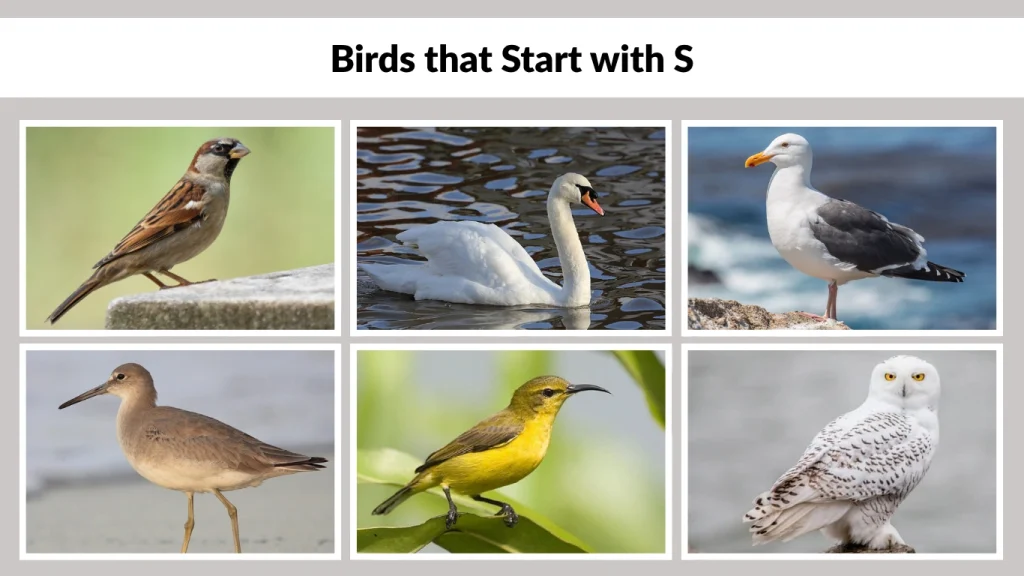
Birds beginning with the letter S range from tiny songbirds to large, majestic waterfowl. They inhabit a variety of ecosystems, from icy tundras to tropical forests, and play important roles in pollination, seed dispersal, and controlling insect populations. Many are also admired for their beauty and distinctive calls.
7. Sparrow
Sparrows are small, social birds found worldwide, often in urban and rural areas. They have short, stout beaks ideal for eating seeds, though they also consume insects. Their brown and grey plumage helps them blend into surroundings.
Known for their cheerful chirping, sparrows adapt well to human presence. They often nest in buildings, trees, or shrubs, and their resilience has made them one of the most common birds globally.
8. Swan
Swans are large waterfowl known for their long necks, graceful swimming, and strong pair bonds. They are usually white, though some species have black or mixed plumage. Swans feed mainly on aquatic plants and small invertebrates.
Highly territorial during breeding season, swans can be aggressive in protecting their nests. They are symbols of beauty and loyalty in many cultures and are found across Europe, Asia, and North America.
9. Seagull
Seagulls, or simply gulls, are medium to large seabirds with long wings and webbed feet. They are intelligent scavengers, often found near coastlines, lakes, and human settlements.
Gulls have diverse diets, eating fish, insects, and discarded human food. Their adaptability allows them to thrive in various environments, from remote islands to busy cities, making them one of the most familiar seaside birds.
10. Sandpiper
Sandpipers are slender, long-legged shorebirds that forage along beaches, mudflats, and marshes. They use their long bills to probe the sand for insects, crustaceans, and worms.
Many sandpiper species are migratory, traveling thousands of miles between breeding and wintering grounds. Their rapid, darting movements along the shore are a common sight in coastal areas.
11. Sunbird
Sunbirds are small, colorful birds found mainly in Africa and Asia. With iridescent plumage and curved bills, they resemble hummingbirds and feed primarily on nectar, though they also eat insects.
They are vital pollinators, transferring pollen as they feed on flowers. Sunbirds are active and quick, often seen flitting between blooms in gardens and forests.
12. Snowy Owl
The snowy owl is a large, striking white owl native to Arctic regions. Its thick feathers and camouflage make it well-suited to snowy landscapes. It primarily hunts lemmings and other small mammals.
Snowy owls are diurnal, often hunting during the day. In winter, some migrate south, giving birdwatchers in Canada, the northern United States, and Europe a chance to spot them.
Reptiles that Start with S
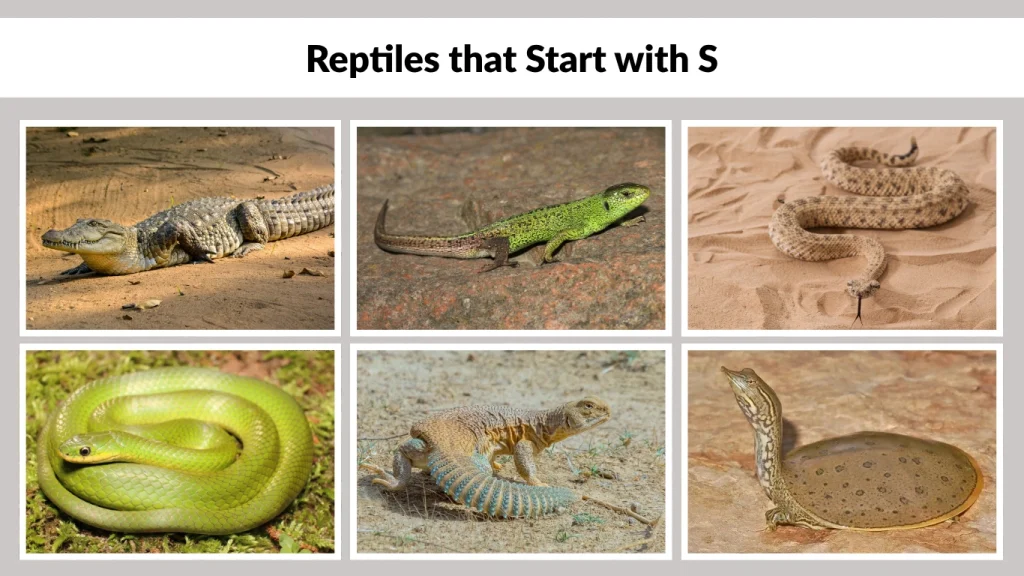
Reptiles beginning with the letter S include powerful predators, agile climbers, and species well-adapted to both land and water. They thrive in a range of environments, from deserts to tropical rivers. Many play key ecological roles as both predators and prey, maintaining balance in their ecosystems.
13. Saltwater Crocodile
The saltwater crocodile is the largest living reptile, found in coastal regions from India to Australia. Males can exceed 20 feet in length and are apex predators, feeding on fish, birds, and mammals.
Known for their power and aggression, these crocodiles can live over 70 years. They are strong swimmers and can travel long distances in the ocean to reach new territories.
14. Sand Lizard
The sand lizard is a small reptile native to parts of Europe and Asia. Males develop bright green flanks during breeding season, while females are more brown and camouflaged.
These lizards prefer sandy heathlands and dunes, where they bask in the sun and hunt insects. Habitat loss has reduced their range, making them a protected species in some countries.
15. Sidewinder Snake
The sidewinder snake is a desert-dwelling viper known for its unique sideways movement, which helps it travel across loose sand efficiently. It has horn-like scales above its eyes for protection.
Found in North America, it hunts small mammals, lizards, and birds. Its sandy coloration offers camouflage, making it an effective ambush predator in harsh desert environments.
16. Smooth Green Snake
The smooth green snake is a slender, bright green, non-venomous species found in North America. Its coloration helps it blend into vegetation, making it nearly invisible to predators.
It feeds mainly on insects and spiders, contributing to natural pest control. This gentle snake is harmless to humans and is often admired by nature enthusiasts.
17. Spiny-tailed Lizard
The spiny-tailed lizard, or uromastyx, is native to arid regions of Africa and Asia. It has a thick tail covered in spiny scales, used for defense against predators.
Primarily herbivorous, it feeds on leaves, flowers, and seeds. These lizards bask in the sun to regulate their body temperature and shelter in burrows during extreme heat.
18. Softshell Turtle
Softshell turtles are freshwater turtles with flattened, leathery shells instead of hard ones. They are strong swimmers, using their long necks to catch prey.
Found in rivers and lakes across Asia, Africa, and North America, they feed on fish, insects, and plants. Their ability to bury themselves in sand or mud makes them expert ambush hunters.
Amphibians that Start with S
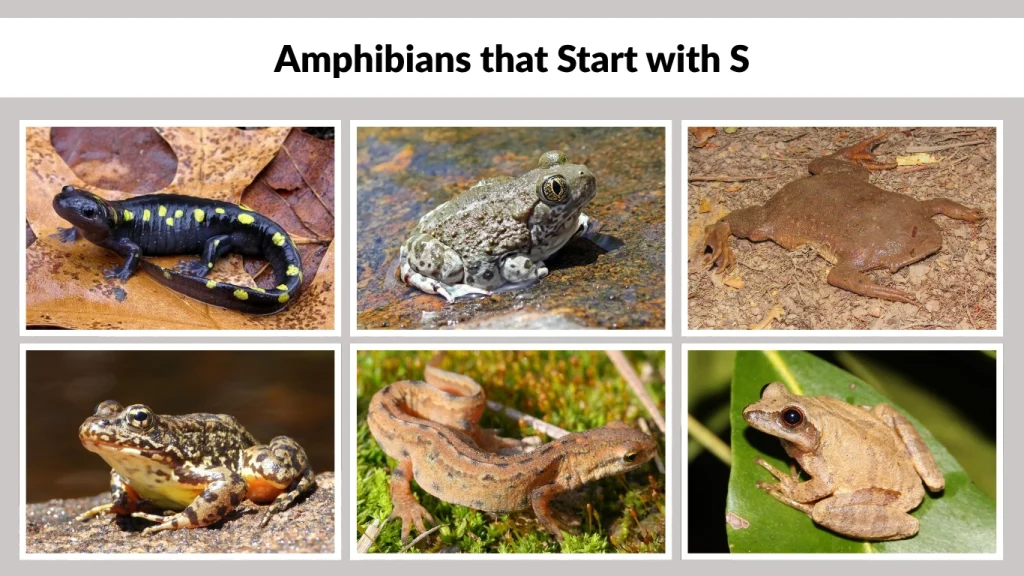
Amphibians beginning with the letter S are found in wetlands, forests, and mountainous regions across the globe. Many have unique adaptations for survival, such as camouflaged skin, toxic secretions, and remarkable reproductive strategies. They play an important role in ecosystems by controlling insect populations and serving as food for other animals.
19. Salamander
Salamanders are amphibians with slender bodies, long tails, and smooth, moist skin. They can regenerate lost limbs, a rare trait among vertebrates.
They live in damp habitats, such as forests and streams, feeding on insects, worms, and small invertebrates. Many species are sensitive to environmental changes, making them indicators of ecosystem health.
20. Spadefoot Toad
Spadefoot toads are named for the hard, spade-like projections on their hind feet, which they use for digging. They are found in North America and parts of Europe.
They spend most of their lives underground, emerging mainly during heavy rains to breed. Their rapid life cycle allows them to survive in temporary pools that dry quickly.
21. Surinam Toad
The Surinam toad is a flat-bodied amphibian found in South American rivers. Females carry fertilized eggs in pockets on their backs until fully developed froglets emerge.
This unusual reproductive method provides protection for the young, reducing the risk of predation. Surinam toads feed on small aquatic animals, using suction feeding to catch prey.
22. Sierra Nevada Yellow-legged Frog
Native to high mountain lakes and streams in California, the Sierra Nevada yellow-legged frog has a mottled brown and yellow body. It is adapted to cold, alpine environments.
Its population has declined due to habitat loss, introduced predators, and disease. Conservation efforts are ongoing to restore healthy populations in its native range.
23. Smooth Newt
The smooth newt is a small amphibian found across Europe and parts of Asia. During breeding season, males develop bright colors and a wavy crest along their backs.
They live in ponds during breeding and move to damp forests or grasslands afterward. Smooth newts feed on insects, worms, and aquatic larvae.
24. Spring Peeper
The spring peeper is a tiny tree frog found in eastern North America. It is well-known for its loud, high-pitched calls signaling the arrival of spring.
These frogs are nocturnal and often found near wetlands during breeding season. Their tan or brown coloration helps them blend into leaf litter.
Fish that Start with S
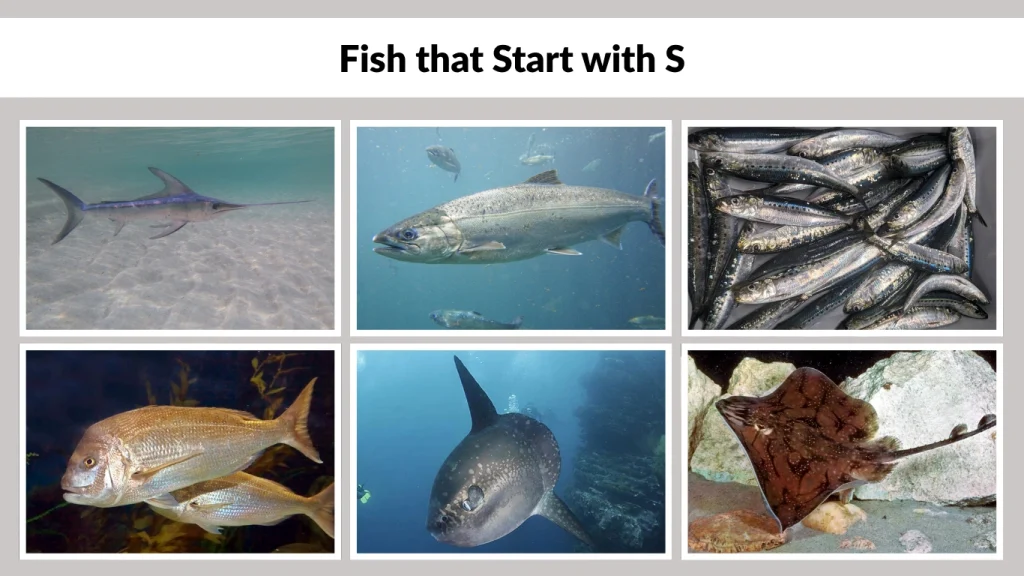
Fish beginning with the letter S include some of the most well-known and economically important species, as well as striking reef dwellers. They inhabit a variety of waters — from deep oceans to fast-flowing rivers — and display unique hunting, schooling, and migratory behaviors that make them fascinating to study and observe.
25. Swordfish
Swordfish are large, predatory fish recognized by their long, flat bills used to slash and stun prey. They are powerful swimmers found in warm and temperate oceans worldwide.
Highly sought after by sport and commercial fisheries, swordfish feed on squid and smaller fish. Their streamlined bodies and speed make them one of the ocean’s top hunters.
26. Salmon
Salmon are migratory fish famous for their upstream journeys from the ocean to freshwater rivers to spawn. They are found in both the Atlantic and Pacific Oceans.
Valued for their nutritional and economic importance, salmon also play a vital ecological role. After spawning, their bodies provide nutrients to river ecosystems, benefiting wildlife and plant life.
27. Sardine
Sardines are small, oily fish that travel in large schools in oceans worldwide. They are a major food source for larger fish, seabirds, and marine mammals.
Humans harvest sardines for food, often canned or smoked. Their schooling behavior offers protection against predators but also makes them easy targets for large-scale fishing.
28. Snapper
Snappers are medium to large saltwater fish known for their firm, tasty flesh. They are found in tropical and subtropical waters, often near reefs.
They feed on smaller fish, crustaceans, and invertebrates. Snappers are popular among recreational anglers and contribute significantly to coastal economies.
29. Sunfish
The ocean sunfish, or mola mola, is one of the heaviest bony fish in the world, weighing over 2,000 pounds. Its unique, flattened body makes it instantly recognizable.
Sunfish drift near the surface, feeding on jellyfish and other soft-bodied prey. Despite their size, they are gentle giants and pose no threat to humans.
30. Skate
Skates are flat-bodied fish related to rays, found on the seafloor in oceans around the world. They have long, wing-like pectoral fins and a long tail.
Unlike stingrays, skates lack venomous spines. They feed on small fish, crustaceans, and mollusks, using their mouths to crush hard shells.
Insects that Start with S
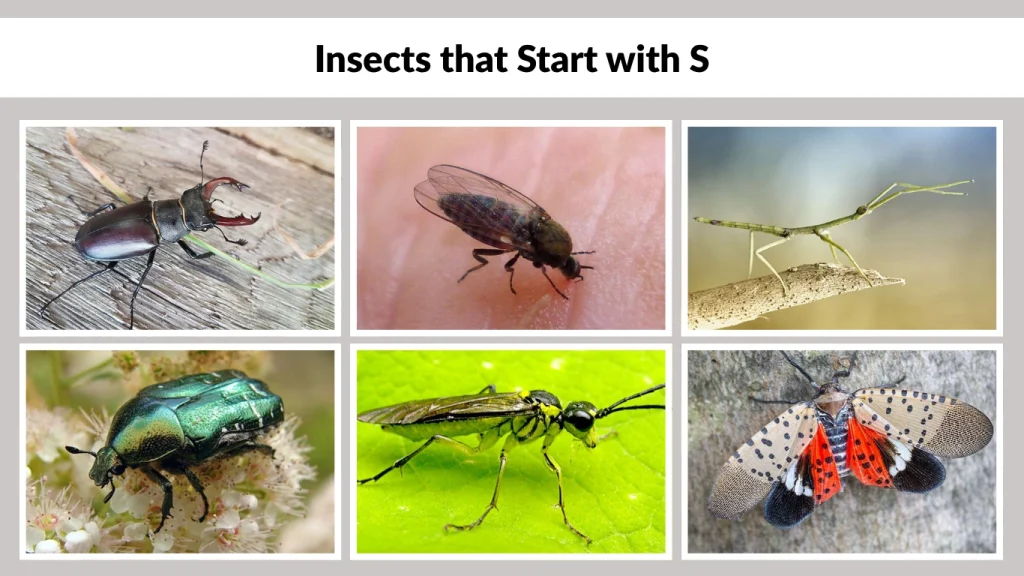
Insects beginning with the letter S are among the most diverse and widespread in the animal kingdom. They include important pollinators, decomposers, and predators that influence ecosystems and human life. Some are admired for their beauty, while others are known as pests due to their impact on agriculture and health.
31. Stag Beetle
The stag beetle is named for the large, antler-like mandibles found on males, which are used in combat during mating season. These beetles can be quite large, with shiny brown or black bodies.
They feed mainly on decaying wood as larvae, playing a role in nutrient recycling. Adults are often seen during warm summer evenings.
32. Sandfly
Sandflies are tiny biting insects found in tropical and subtropical regions. Despite their small size, they can transmit diseases such as leishmaniasis to humans and animals.
They are most active at dawn and dusk, feeding on blood for reproduction. Their bites can cause irritation, swelling, and itching.
33. Stick Insect
Stick insects are masters of camouflage, resembling twigs or branches to avoid predators. They are herbivorous, feeding on leaves, and are found mainly in tropical and subtropical regions.
Some species can regenerate lost limbs, and females of certain species can reproduce without males through parthenogenesis.
34. Scarab Beetle
Scarab beetles are a diverse group, with some species considered sacred in ancient Egypt. They have stout bodies and strong legs for digging.
Many feed on dung, helping to recycle nutrients back into the soil. Others feed on plants, fruits, or fungi.
35. Sawfly
Sawflies are wasp-like insects whose larvae resemble caterpillars. They are named for the saw-like ovipositor females use to cut into plant tissue to lay eggs.
The larvae can cause significant damage to plants, especially in forestry and agriculture, making them important to monitor in pest control.
36. Spotted Lanternfly
The spotted lanternfly is an invasive pest native to Asia but now spreading to other countries. It has striking spotted wings and a bright red underwing.
It feeds on sap from trees and plants, weakening them over time. This insect poses a threat to agriculture and forestry industries.
Marine Animals that Start with S
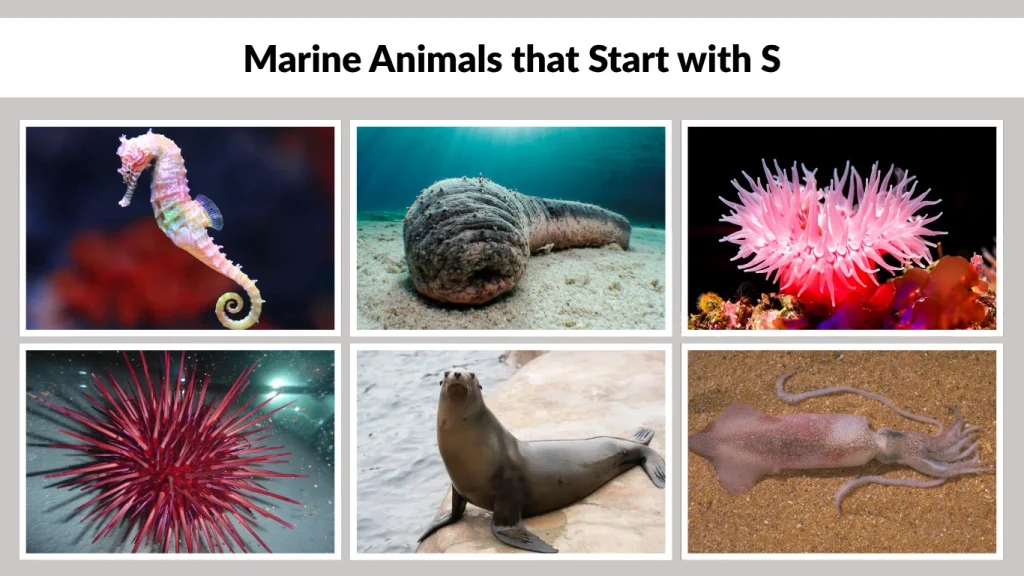
Marine animals beginning with the letter S range from small reef dwellers to massive ocean giants. They inhabit a variety of marine ecosystems, including coral reefs, open seas, and coastal waters. Many of these species are vital to the balance of marine life, acting as predators, prey, and contributors to healthy ocean habitats.
37. Seahorse
Seahorses are small, upright-swimming fish with horse-like heads and curled tails. They use their tails to anchor themselves to seagrass or coral.
Males carry the fertilized eggs in a special pouch until they hatch, a rare trait in the animal kingdom. They feed on tiny crustaceans by sucking them through their long snouts.
38. Sea Cucumber
Sea cucumbers are soft-bodied echinoderms found on the ocean floor. They play an important role in recycling nutrients by breaking down detritus and organic matter.
When threatened, some species expel their internal organs as a defense mechanism, which can later regenerate. They are also harvested for food in some cultures.
39. Sea Anemone
Sea anemones are colorful, flower-like marine animals related to corals and jellyfish. They have stinging tentacles used to capture prey such as small fish and plankton.
They form symbiotic relationships with certain fish, like clownfish, which gain protection among the stinging tentacles while providing food scraps in return.
40. Sea Urchin
Sea urchins are spiny, spherical echinoderms that graze on algae. Their grazing helps maintain the health of coral reefs and kelp forests.
They move slowly using tube feet and spines, and their hard shells protect them from predators. Some species are harvested for their edible roe.
41. Sea Lion
Sea lions are large, social marine mammals with external ear flaps and strong flippers, allowing them to move well both in water and on land.
They are intelligent and agile hunters, feeding on fish and squid. Sea lions often gather in large colonies on beaches and rocky shores.
42. Squid
Squid are fast-swimming cephalopods with elongated bodies, large eyes, and tentacles lined with suckers. They are skilled hunters, feeding on fish, crustaceans, and other squid.
They can change color rapidly for camouflage or communication and release ink to escape predators. Some species are important in commercial fishing.
Exotic and Rare Animals that Start with S
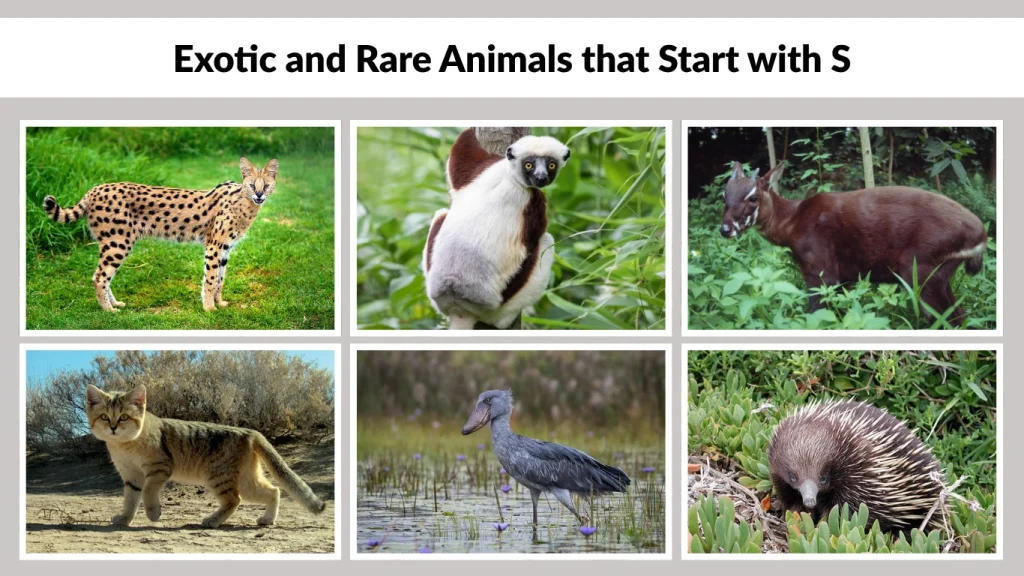
Exotic and rare animals beginning with the letter S often have unusual adaptations, striking appearances, or limited geographic ranges. Many are endangered due to habitat loss, poaching, or climate change. These species are less familiar to most people but are fascinating examples of nature’s diversity and resilience.
43. Serval
The serval is a medium-sized wild cat native to Africa, known for its long legs and large, rounded ears. These features make it an exceptional hunter in tall grasses.
It preys on rodents, birds, and insects, using its remarkable jumping ability to pounce on prey. Servals are solitary and mainly active at dawn and dusk.
44. Sifaka
Sifakas are lemurs found only in Madagascar, recognized for their unique sideways hopping movement on the ground. They have long tails and thick fur in varying colors.
They live in family groups and feed mainly on leaves, fruit, and flowers. Habitat loss threatens their survival, making conservation efforts crucial.
45. Saola
The saola, often called the “Asian Unicorn,” is a rare antelope native to Laos and Vietnam. It has long, straight horns and distinctive facial markings.
Extremely elusive, it was first documented by scientists in the 1990s. Habitat loss and hunting have made it critically endangered, with very few sightings in the wild.
46. Sand Cat
The sand cat is a small wild feline adapted to desert life in Africa and Asia. It has thick fur on its paws to protect against hot sand.
It hunts small rodents, reptiles, and insects, often surviving without direct access to water by getting moisture from its prey.
47. Shoebill Stork
The shoebill stork is a large African bird with a massive, shoe-shaped bill used to catch fish and amphibians. Its tall, statuesque posture makes it easy to spot in wetlands.
It is a slow, patient hunter, often standing still for long periods before striking. Habitat loss threatens its limited populations.
48. Spiny Anteater (Echidna)
The spiny anteater, or echidna, is a mammal that lays eggs, one of only two monotremes in the world. It is covered in spines for protection.
Echidnas use a long, sticky tongue to eat ants and termites. They are found in Australia and New Guinea and can live in various habitats, from forests to deserts.
Domesticated and Farm Animals that Start with S
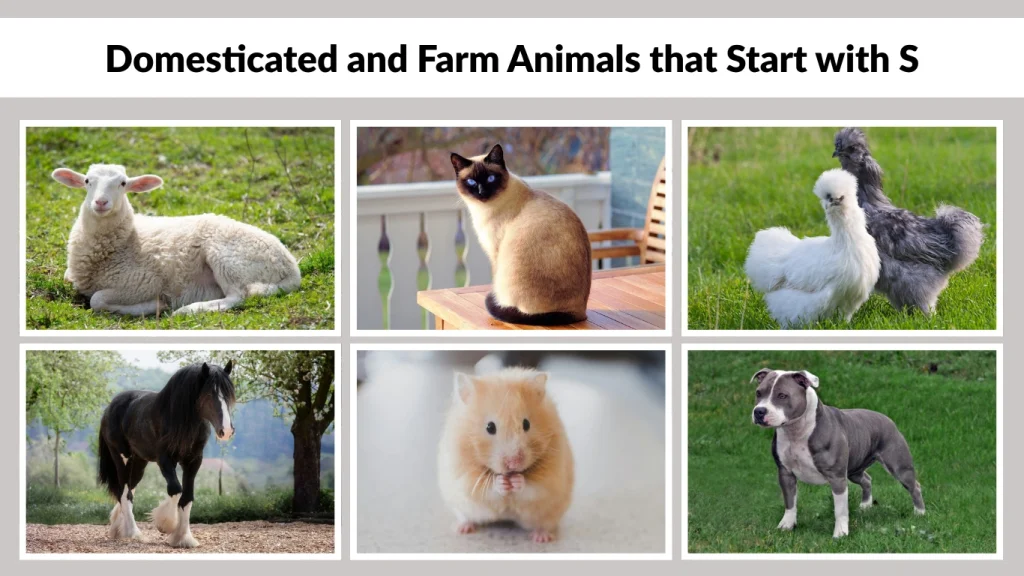
Domesticated and farm animals beginning with the letter S include species raised for food, fiber, companionship, and work. Many have been bred for specific traits, making them well-suited for life alongside humans. These animals play vital roles in agriculture, economy, and culture across different parts of the world.
49. Sheep
Sheep are wool-producing livestock domesticated thousands of years ago. They are raised for meat, milk, and wool, with hundreds of breeds adapted to different climates.
Grazing in open pastures, sheep help manage vegetation but require protection from predators. They are social animals that live in flocks for safety and companionship.
50. Siamese Cat
The Siamese cat is a domestic breed from Thailand, famous for its sleek cream coat, dark points, and striking blue eyes. It is vocal and highly social.
Siamese cats are intelligent, affectionate, and enjoy human interaction, making them popular pets. They adapt well to indoor living but require mental stimulation and companionship.
51. Silkie Chicken
The Silkie chicken is a small, ornamental breed known for its fluffy plumage that feels like silk. It also has black skin, bones, and five toes per foot.
Gentle and friendly, Silkies are often kept as pets or for exhibition. They are also good brooders, capable of hatching eggs from other chicken breeds.
52. Shire Horse
The Shire horse is one of the largest horse breeds, originally from England. Known for its strength, it was historically used for farm work and hauling heavy loads.
Despite their size, Shires are gentle giants with calm temperaments. Today, they are often seen in shows, parades, and traditional farming demonstrations.
53. Syrian Hamster
The Syrian hamster is a small rodent popular as a pet, recognized for its golden coat and solitary nature. It is nocturnal and has cheek pouches for storing food.
Easy to care for, Syrian hamsters are a favorite among children and pet owners. They require spacious cages and enrichment to stay active and healthy.
54. Staffordshire Bull Terrier
The Staffordshire Bull Terrier is a medium-sized dog breed originally developed in England for bull-baiting, later becoming a loyal family companion.
Strong, muscular, and affectionate, they are good with children when properly trained and socialized. They require regular exercise to maintain their health and energy.
Miscellaneous Animals that Start with S
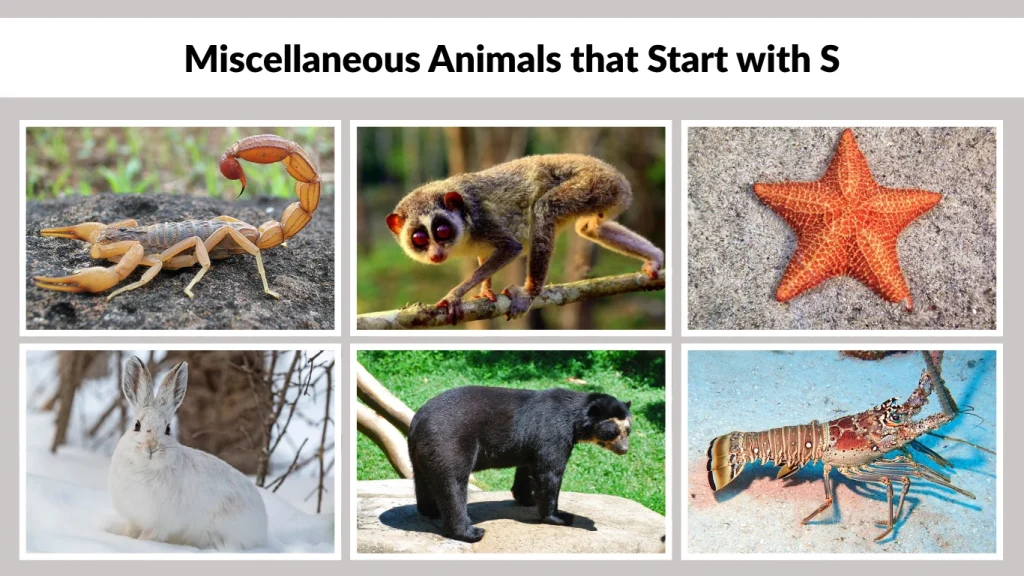
This final group includes a variety of animals beginning with the letter S that don’t neatly fit into previous categories. They range from land to sea species and come from different branches of the animal kingdom, showcasing the incredible diversity of life starting with this letter.
55. Scorpion
Scorpions are arachnids with segmented tails tipped by a venomous stinger. Found in deserts, forests, and grasslands worldwide, they are skilled nocturnal hunters.
They feed mainly on insects and small animals, using their pincers to grasp prey before delivering a sting. Some species have venom dangerous to humans, while most are harmless.
56. Slender Loris
The slender loris is a small, nocturnal primate from South and Southeast Asia. It has large, round eyes adapted for night vision and slow, deliberate movements.
It feeds on insects, fruit, and small animals, using its long limbs to navigate branches quietly. Habitat loss threatens many slender loris populations.
57. Starfish
Starfish, or sea stars, are echinoderms with radial symmetry, typically having five arms. They live on the seafloor in oceans around the world.
They can regenerate lost arms and feed by extending their stomachs into shellfish to digest them externally. Starfish play important roles in marine ecosystems.
58. Snowshoe Hare
The snowshoe hare is a North American rabbit known for its seasonal fur color change — brown in summer, white in winter — for camouflage.
It has large hind feet that act like snowshoes, allowing it to move quickly across snow. These hares are vital prey for predators like lynxes.
59. Spectacled Bear
The spectacled bear, also called the Andean bear, is the only bear species native to South America. It gets its name from the light markings around its eyes.
Living in cloud forests and mountainous regions, it feeds on fruit, plants, and occasionally small animals. It is considered vulnerable due to habitat loss.
60. Spiny Lobster
Spiny lobsters are crustaceans with long antennae and a hard exoskeleton but lack the large claws of true lobsters. They inhabit warm coastal waters worldwide.
They are nocturnal foragers, feeding on mollusks, sea urchins, and plant material. Spiny lobsters are commercially important seafood in many countries.