
Animals whose names begin with the letter V come from every corner of the globe, inhabiting forests, oceans, mountains, rivers, and even our backyards. From vibrant birds and rare amphibians to powerful marine predators and gentle farm breeds, this list highlights their diversity and uniqueness. In this guide, we’ll explore 60 fascinating species starting with V, organized into easy-to-read groups for better understanding.
Mammals that Start with V
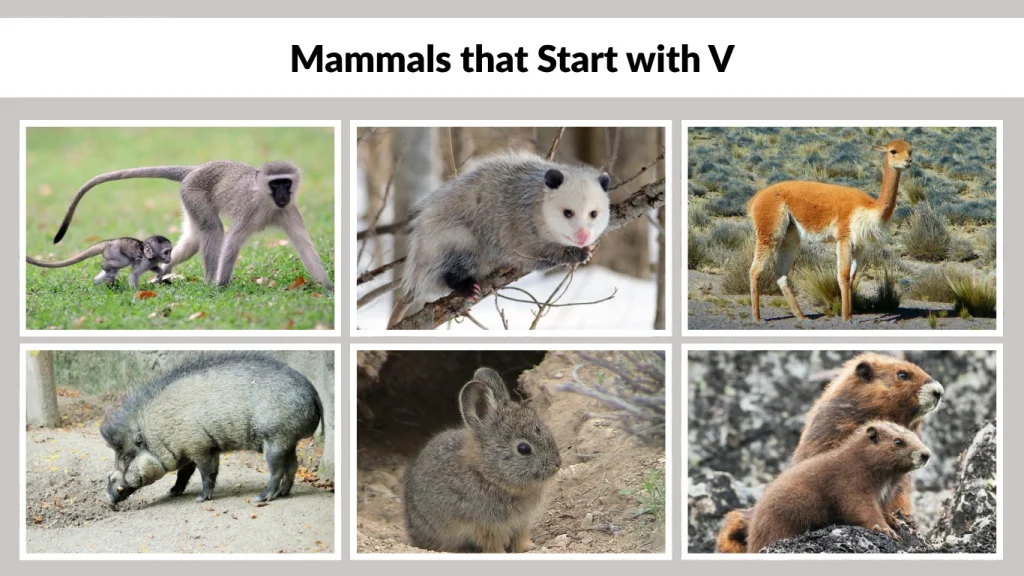
Mammals beginning with the letter V are a fascinating mix of primates, marsupials, rodents, and hoofed animals. They inhabit a wide variety of environments, from tropical forests to high-altitude grasslands. Many of them are rare or endangered, making them important for conservation efforts. Their unique adaptations help them thrive in very different ecosystems.
1. Vervet Monkey
The vervet monkey is a medium-sized primate found across sub-Saharan Africa. It has a greenish-grey coat, black face, and long limbs suited for agile movement through trees. These social animals live in troops, communicating through a variety of vocal calls.
They are opportunistic feeders, eating fruits, seeds, insects, and small vertebrates. Vervet monkeys are known for their intelligence and adaptability, often thriving near human settlements despite the risks of conflict and habitat loss.
2. Virginia Opossum
The Virginia opossum is North America’s only native marsupial. It has a white face, grey body, and a long, prehensile tail used for balance and grasping. When threatened, it famously “plays dead” to deter predators.
This adaptable omnivore feeds on insects, fruits, small animals, and carrion. It often lives near urban areas, where it helps control pests. Its resistance to snake venom and rabies makes it a unique member of North American wildlife.
3. Vicuna
The vicuna is a wild South American camelid native to the high Andes. It is smaller than its relative, the llama, and has a soft, fine wool prized for luxury fabrics. Vicunas are protected by law due to past overhunting.
They live in small herds in grassy plains, feeding on tough mountain vegetation. Adapted to high altitudes, they have specialized blood that allows them to survive in oxygen-poor environments.
4. Visayan Warty Pig
The Visayan warty pig is a critically endangered wild pig found only in the Philippines’ Visayan Islands. Males grow distinctive facial “warts” and long head crests during breeding season.
It inhabits forested areas, feeding on roots, tubers, and fruits. Habitat destruction and hunting have drastically reduced its population, making conservation programs vital for its survival.
5. Volcano Rabbit
The volcano rabbit, also known as the zacatuche, is one of the world’s smallest rabbits, native to the slopes of Mexico’s volcanoes. It has short ears, a stocky body, and dark fur.
It feeds mainly on grasses and hides in dense vegetation to avoid predators. Due to habitat loss, it is classified as endangered and is a focus of conservation research.
6. Vancouver Island Marmot
The Vancouver Island marmot is a large, burrowing rodent found only on Canada’s Vancouver Island. It has chocolate-brown fur and is among the rarest mammals in North America.
It lives in alpine meadows, feeding on wildflowers and grasses. Intensive conservation breeding programs have helped boost its numbers, but it remains endangered due to habitat changes and predation.
Birds that Start with V

Birds whose names begin with the letter V range from colorful songbirds to large scavengers. They inhabit a variety of ecosystems, including forests, wetlands, grasslands, and coastal areas. Many of them are important for seed dispersal, insect control, or cleaning up carrion. Their diverse appearances and behaviors make them fascinating to observe in the wild.
7. Vulture
Vultures are large scavenging birds found on every continent except Australia and Antarctica. They have strong beaks for tearing flesh and an incredible ability to locate carcasses from great distances.
By feeding on dead animals, vultures help prevent the spread of disease and keep ecosystems clean. Despite their importance, many species face population declines due to poisoning and habitat loss.
8. Violet-green Swallow
The violet-green swallow is a small, agile bird native to North America. Its striking green back and violet rump shimmer in the sunlight, while its white underparts make it easily recognizable.
It catches insects midair with remarkable precision. These swallows often nest in tree cavities or bird boxes, returning to the same breeding areas year after year.
9. Velvet Scoter
The velvet scoter is a large sea duck found in northern Europe and Asia. Males have black plumage with a distinctive white patch under the eye, while females are brown and more camouflaged.
They dive to feed on mollusks, crustaceans, and fish. In winter, they gather in coastal waters, often forming large flocks.
10. Varied Thrush
The varied thrush is a forest-dwelling bird native to the Pacific Northwest of North America. It has a vivid orange breast and striking black bands across its face and chest.
Its song is a haunting, whistled note that echoes through dense forests. These birds feed on insects, berries, and seeds, migrating to lower elevations in winter.
11. Verdin
The verdin is a tiny songbird found in the deserts of the southwestern United States and northern Mexico. It has a yellow head, gray body, and small, sharp bill perfect for insect hunting.
It builds intricate, enclosed nests to shield itself from extreme desert temperatures. Verdins are active year-round, feeding on insects, spiders, and nectar.
12. Village Weaver
The village weaver is a social bird found across sub-Saharan Africa. Males are bright yellow with black faces, while females are duller in color for camouflage.
These birds are known for their elaborate woven nests, often clustered in large colonies. Their diet consists of seeds, grains, and insects, and they frequently live near human settlements.
Reptiles that Start with V

Reptiles beginning with the letter V include a range of snakes, lizards, and turtles adapted to environments from tropical rainforests to arid deserts. Many are skilled hunters, while others rely on camouflage for protection. They play vital roles in ecosystems by controlling prey populations and serving as food for larger predators.
13. Vine Snake
The vine snake is a slender, tree-dwelling reptile found in parts of Asia and Central and South America. Its elongated body and green or brown coloration help it blend seamlessly into vegetation.
It uses its excellent vision to detect prey, striking quickly to capture lizards, frogs, and birds. Despite its mild venom, it poses little threat to humans.
14. Variable Skink
The variable skink is a small lizard native to parts of Australia. Its coloration can range from brown to golden, often with distinct striping along its sides.
It is an active forager, feeding on insects and small invertebrates. This adaptable reptile thrives in forests, grasslands, and urban gardens.
15. Venezuelan Anole
The Venezuelan anole is a colorful lizard species found in Venezuela’s forests. Males display a bright dewlap (throat fan) used in communication and territorial displays.
They are insectivorous, feeding mainly on ants, beetles, and other small arthropods. These agile climbers are often seen basking on branches or darting between leaves.
16. Viper (Gaboon Viper)
The Gaboon viper is one of Africa’s largest and heaviest venomous snakes. It has beautiful, leaf-like patterns that provide excellent camouflage on the forest floor.
Known for having the longest fangs of any snake, it delivers a powerful venomous bite. Despite this, it is generally slow-moving and relies on ambush hunting.
17. Vietnamese Long-tailed Lizard
This lizard, native to Vietnam, is easily recognized by its extremely long tail, often three times the length of its body. Its green or brown coloration blends into forest foliage.
It feeds on small insects and spiders. Agile and quick, it can shed its tail to escape predators, later regenerating it over time.
18. Virgin Islands Boa
The Virgin Islands boa is a non-venomous snake native to the Caribbean. It is usually brown or gray with subtle markings, making it well-camouflaged in dry forests.
It preys on small birds, reptiles, and mammals, hunting primarily at night. This species is considered threatened due to habitat loss and invasive predators.
Amphibians that Start with V
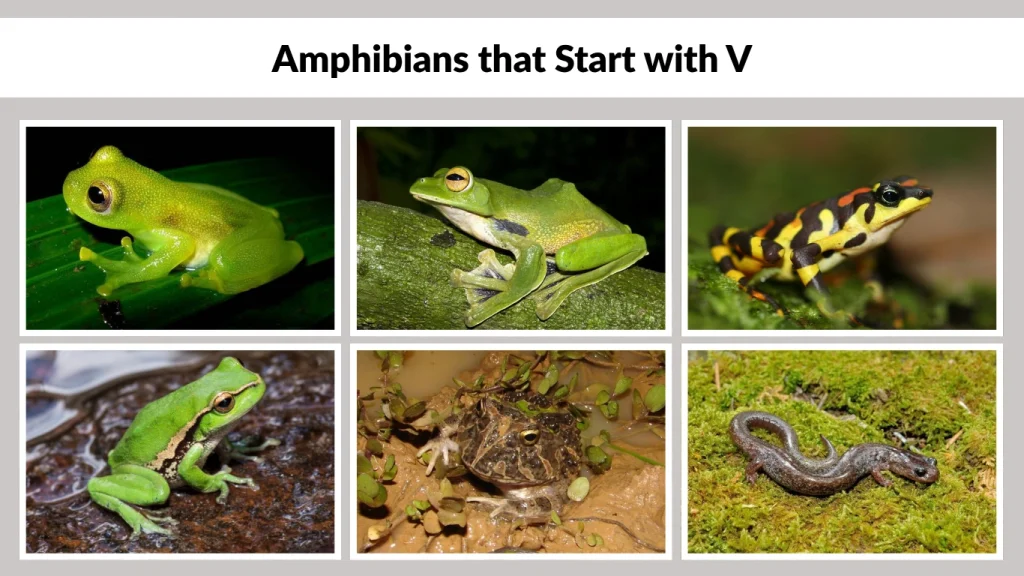
Amphibians beginning with the letter V are generally small, moisture-loving creatures found in tropical rainforests, wetlands, and highland streams. Many have bright colors as warnings to predators, while others rely on camouflage. They play important ecological roles by controlling insect populations and serving as indicators of environmental health due to their sensitivity to pollution.
19. Venezuelan Glass Frog
The Venezuelan glass frog is a tiny amphibian with translucent skin on its underside, revealing its internal organs. This unique trait helps it blend with leaves and avoid predators.
It inhabits humid forests near streams, where males call at night to attract females. They lay eggs on vegetation overhanging water, allowing tadpoles to drop in after hatching.
20. Vietnam Flying Frog
The Vietnam flying frog uses its webbed feet to glide between trees in the dense forests of Vietnam. Its green body and large eyes make it well-suited for nocturnal life.
It feeds on insects and other small invertebrates, and spends most of its life in the canopy. This species relies heavily on intact forest habitat to survive.
21. Variable Harlequin Frog
The variable harlequin frog is a brightly patterned amphibian native to Central and South America. Its colors range from yellow to green with dark markings, warning predators of its toxicity.
It lives near mountain streams and is highly sensitive to environmental changes. Sadly, many populations have declined due to habitat loss and fungal disease.
22. Victoria River Tree Frog
This Australian frog lives near the Victoria River and surrounding wetlands. It has smooth green skin and large toe pads for climbing.
Nocturnal by nature, it emerges at night to feed on insects. During the day, it rests in moist, shaded areas to avoid dehydration in the hot climate.
23. Venezuelan Stream Frog
The Venezuelan stream frog inhabits fast-flowing mountain streams in Venezuela’s highlands. It has a streamlined body and strong limbs, ideal for swimming against currents.
It lays its eggs in quiet stream pools, where tadpoles develop before moving into faster waters. This species is threatened by pollution and deforestation.
24. Volcano Salamander
The volcano salamander is a rare amphibian found on the slopes of volcanoes in Central America. Its dark body with bright markings helps it blend into rocky, mossy environments.
It is terrestrial, often hiding under logs or rocks during the day and emerging at night to hunt insects and worms. Its restricted range makes it vulnerable to habitat disturbances.
Fish that Start with V
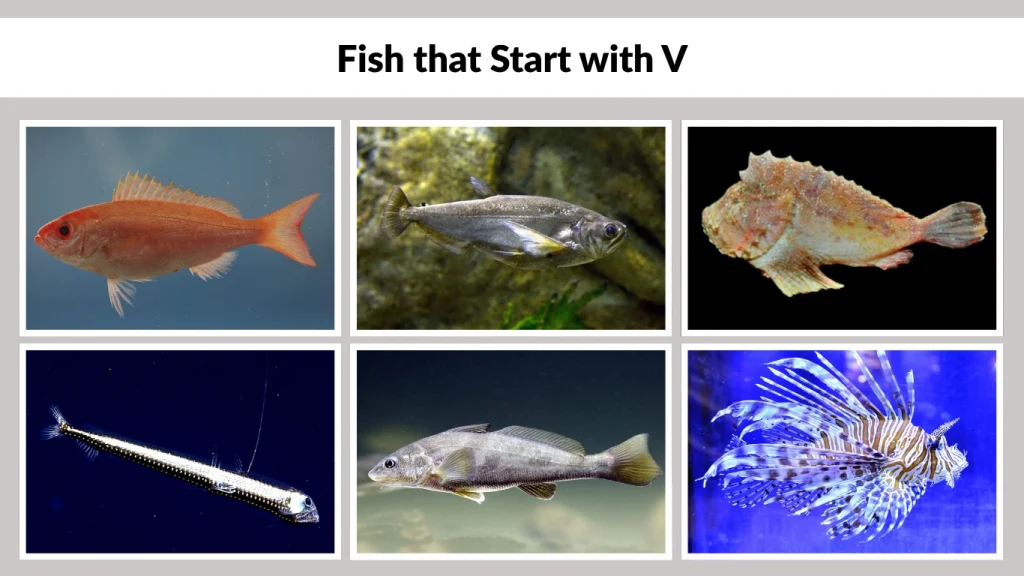
Fish whose names start with the letter V live in a variety of habitats, from deep ocean trenches to freshwater rivers and lakes. Some are colorful reef dwellers, while others are predatory species adapted for speed or stealth. Many play important roles in food webs, supporting both aquatic ecosystems and human fishing industries.
25. Vermilion Snapper
The vermilion snapper is a bright red saltwater fish found in the western Atlantic and Gulf of Mexico. Its streamlined body and sharp teeth make it an efficient predator.
It feeds on small fish, squid, and crustaceans. Popular among commercial and recreational fishers, it is valued for its mild, white flesh.
26. Vampire Tetra
The vampire tetra, also called the payara, is a large freshwater fish found in South America’s Amazon Basin. It is famous for its long, fang-like teeth protruding from its lower jaw.
It is a fierce predator, feeding mainly on other fish. Its dramatic appearance makes it a sought-after species for exotic aquariums, though it requires expert care.
27. Velvetfish
Velvetfish are small, bottom-dwelling marine fish with soft, velvety skin. They are found in tropical Indo-Pacific waters, often blending into coral and rocky reefs.
Their camouflage and slow movements make them difficult to spot. Some species have venomous spines for defense against predators.
28. Viperfish
The viperfish is a deep-sea predator known for its needle-like teeth and bioluminescent lure. It inhabits depths where sunlight doesn’t reach, often migrating toward the surface at night.
It uses its glowing lure to attract prey in the darkness. Despite its fearsome look, it is relatively small, usually under two feet long.
29. Virginia Mullet
The Virginia mullet, also known as the striped mullet, is a coastal fish found along the eastern United States. It has a cylindrical body with silver scales and dark horizontal stripes.
It feeds on algae and detritus, playing a role in nutrient cycling. This species is also valued as bait for larger game fish.
30. Volitans Lionfish
The volitans lionfish is a striking reef fish with long, flowing fins and bold red, white, and brown stripes. Native to the Indo-Pacific, it has become an invasive species in the Atlantic.
It preys on small fish and crustaceans, using its fan-like fins to corner prey. Its venomous spines deter predators, but not human handling accidents.
Insects that Start with V
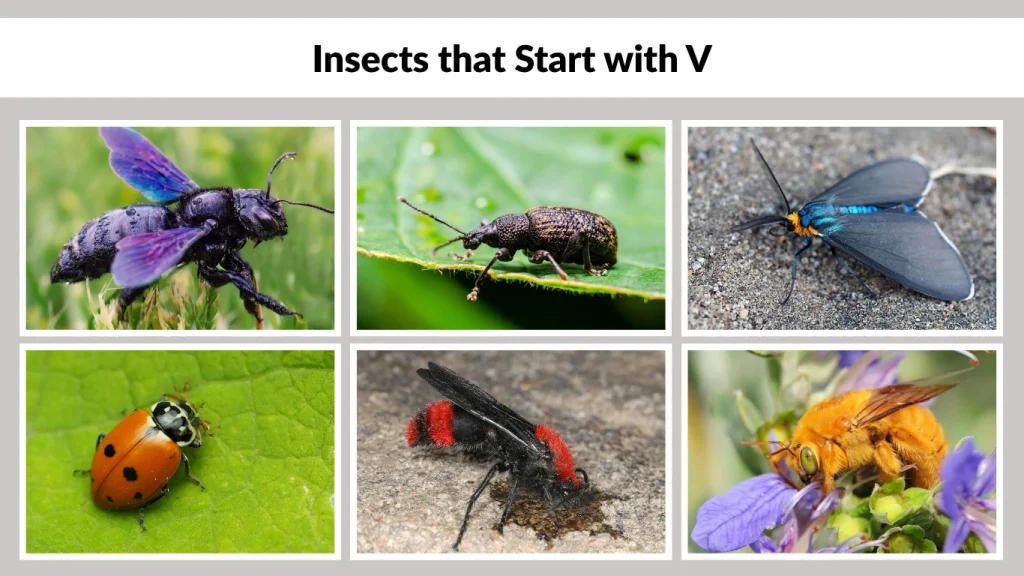
Insects beginning with the letter V include pollinators, agricultural pests, and fascinating species with unique defense mechanisms. They can be found in forests, gardens, deserts, and wetlands across the world. Many play important ecological roles by helping plants reproduce, breaking down organic matter, or controlling pest populations naturally.
31. Violet Carpenter Bee
The violet carpenter bee is a large, solitary bee with a metallic purple-black sheen. Found across Europe, Asia, and Africa, it nests in dead wood rather than in hives.
It is a valuable pollinator, visiting flowers for nectar and pollen. Despite its size and appearance, it is non-aggressive and rarely stings humans.
32. Vine Weevil
The vine weevil is a small, dark beetle known for damaging ornamental plants and crops. Native to Europe, it has spread to other regions through the plant trade.
Adults feed on leaves, while larvae attack plant roots, often killing young plants. Control measures focus on biological predators and careful monitoring.
33. Virginia Ctenucha Moth
The Virginia ctenucha moth is a day-flying moth native to North America. It has a metallic blue-green body, yellow-orange head, and dark wings.
Its caterpillars feed on grasses and sedges, while adults visit flowers for nectar. This moth is active in sunny meadows and grasslands during summer.
34. Variegated Lady Beetle
The variegated lady beetle is a small beetle with orange to red wing covers and irregular black spots. It is native to North America but also found in other regions.
It is an important predator of aphids and other plant pests. Gardeners often welcome its presence as a natural form of pest control.
35. Velvet Ant
Despite its name, the velvet ant is actually a wingless wasp. Females have bright red or orange furry bodies as a warning of their powerful sting.
They are solitary and lay their eggs in the nests of other insects. Their larvae feed on the host’s young, making them parasitic wasps.
36. Valley Carpenter Bee
The valley carpenter bee is one of the largest bees in North America, with males being golden-brown and females black and shiny.
They excavate tunnels in wood to create nests. These bees are efficient pollinators, visiting a wide range of plants, including crops and wildflowers.
Marine Animals that Start with V
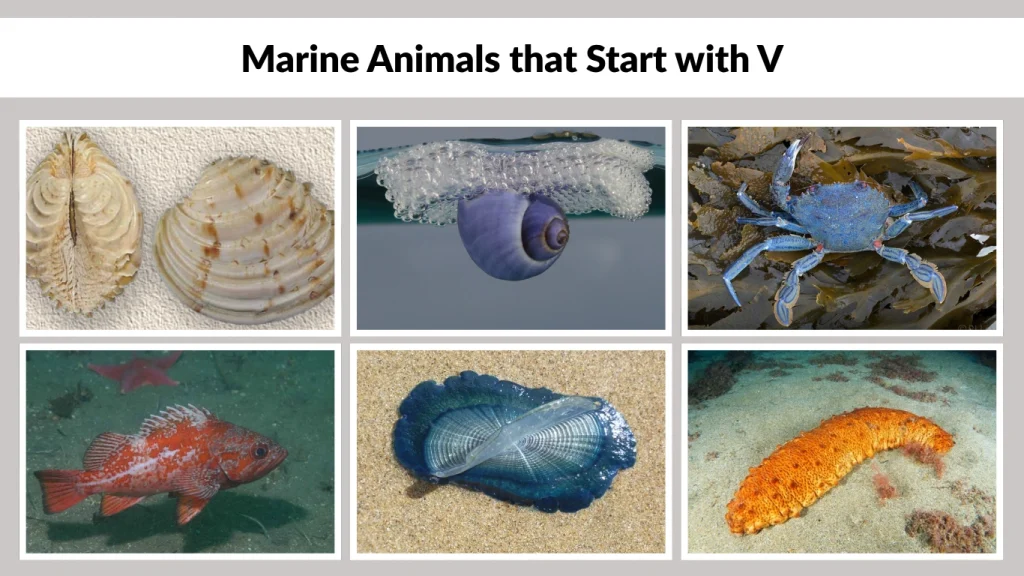
Marine animals beginning with the letter V inhabit a wide range of ocean environments, from coral reefs to deep waters. Some are colorful and delicate, while others are strong predators or vital members of the food chain. Many are specially adapted to survive in saltwater conditions and play key roles in marine ecosystems.
37. Venus Clam
The Venus clam is a bivalve mollusk found in sandy coastal waters worldwide. It has a rounded shell with smooth, radiating patterns that vary in color.
These clams feed by filtering plankton and organic matter from the water. They are also harvested for food in many coastal communities.
38. Violet Sea Snail
The violet sea snail is a small, buoyant mollusk that floats on the ocean surface by creating a raft of bubbles. Its shell has a striking purple hue.
It feeds on floating jellyfish and other soft-bodied prey. This snail spends its life drifting with ocean currents.
39. Velvet Crab
The velvet crab, also known as the devil crab, is a small, fast-moving crab with a velvety-textured shell. It is common along rocky coasts of the eastern Atlantic and Mediterranean.
It is an opportunistic feeder, eating algae, small invertebrates, and carrion. Despite its small size, it can be aggressive when threatened.
40. Vermilion Rockfish
The vermilion rockfish is a bright red fish found along the Pacific coast of North America. It lives in rocky reefs and can reach up to 30 inches in length.
It feeds on smaller fish, crustaceans, and squid. This species is popular with anglers and is valued for its firm, white flesh.
41. Velella (By-the-wind Sailor)
The velella is a small, free-floating colonial organism related to jellyfish. It has a blue, oval-shaped float topped with a triangular sail.
Winds carry it across the ocean’s surface. It feeds on plankton using tiny stinging cells and often washes ashore in large numbers.
42. Variable Sea Cucumber
The variable sea cucumber is a soft-bodied echinoderm found on sandy and muddy seabeds. It comes in a range of colors and can change its appearance slightly.
It feeds by sifting organic particles from the sand. Sea cucumbers play a vital role in cleaning and recycling nutrients in the ocean floor ecosystem.
Exotic and Rare Animals that Start with V
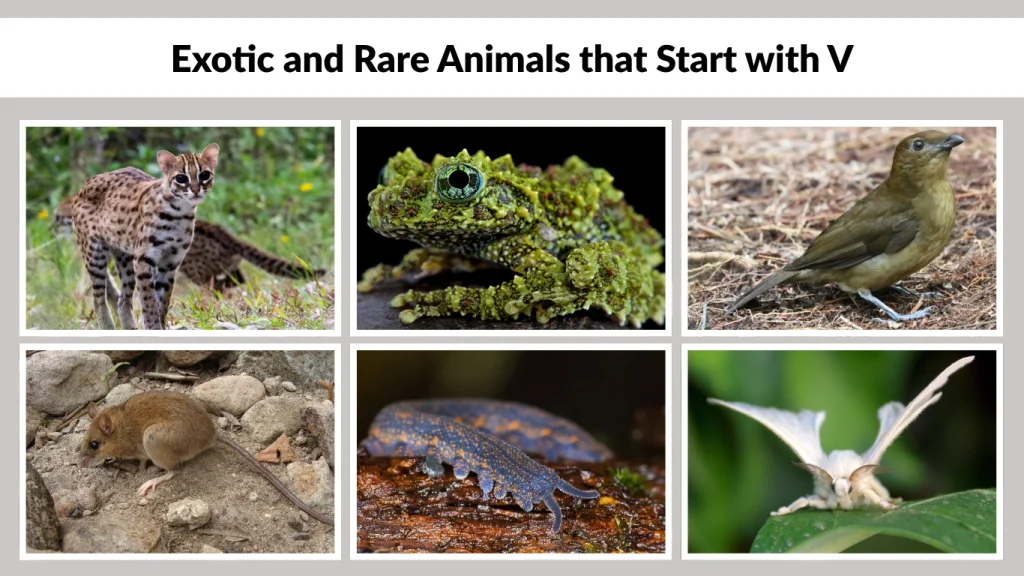
Exotic and rare animals beginning with the letter V are often found in limited geographic ranges, making them special and sometimes endangered. Many have striking appearances or unusual behaviors, which make them highly valued in conservation programs. Their rarity means that protecting their habitats is critical to ensuring their long-term survival.
43. Visayan Leopard Cat
The Visayan leopard cat is a small wild cat native to the Visayan Islands of the Philippines. It has a spotted coat and a lean, athletic build for hunting.
It feeds on birds, rodents, and reptiles. Due to deforestation and hunting, it is classified as vulnerable and is now mostly found in protected forest areas.
44. Vietnamese Mossy Frog
The Vietnamese mossy frog has bumpy, green-and-black skin that resembles moss, providing perfect camouflage among wet rocks and vegetation.
It lives in mountain streams and caves in northern Vietnam. This frog is nocturnal and feeds on insects, using its cryptic appearance to hide from predators.
45. Vogelkop Bowerbird
The Vogelkop bowerbird, native to New Guinea, is known for building elaborate bowers decorated with colorful objects to attract mates.
Males spend hours arranging shells, berries, and flowers in symmetrical patterns. Females choose mates based on the quality of these intricate displays.
46. Volcano Mouse
The volcano mouse is a small rodent found on the slopes of volcanic mountains in Central America. It has a thick coat to protect it from cool highland temperatures.
It forages for seeds, grasses, and insects. Its limited range makes it vulnerable to habitat disturbances such as farming and deforestation.
47. Velvet Worm
The velvet worm is a rare invertebrate with a soft, velvety body and stubby legs. It is considered a “living fossil” due to its ancient evolutionary lineage.
It hunts by shooting sticky slime to immobilize prey such as insects and small arthropods. Velvet worms live in moist forest habitats and avoid sunlight.
48. Venezuelan Poodle Moth
The Venezuelan poodle moth is a mysterious, fluffy moth species reportedly discovered in Venezuela in 2009. Its white, fur-like body and unique antennae make it look almost unreal.
Very little is known about its behavior or lifecycle. It remains one of the most intriguing and debated insect discoveries in recent years.
Domesticated and Farm Animals that Start with V
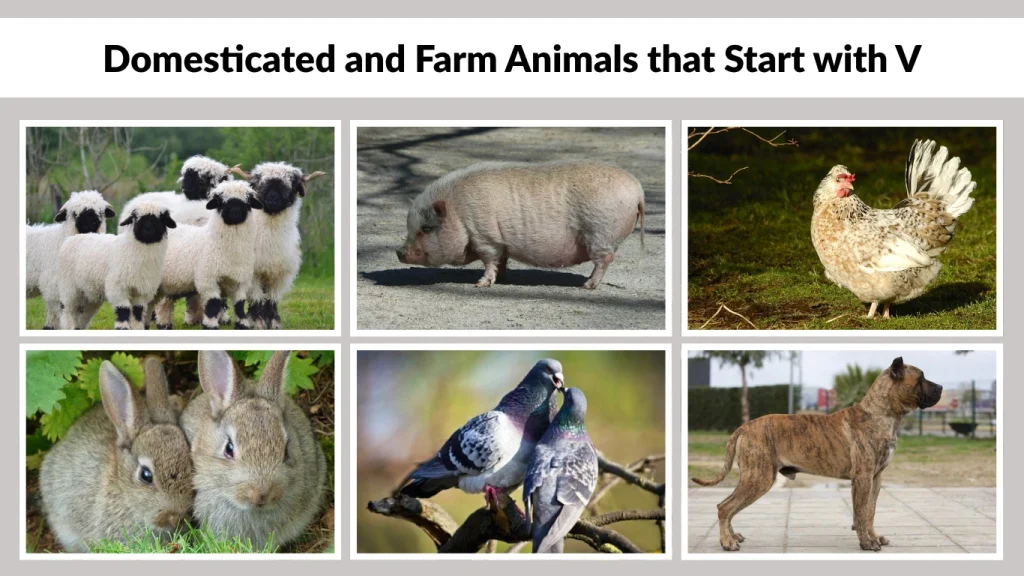
Domesticated and farm animals beginning with the letter V are not as numerous as in other letters, but they include unique breeds of livestock, poultry, and companion animals. Many of these species have been selectively bred for specific traits such as appearance, productivity, or temperament, making them valuable in both agriculture and pet keeping.
49. Valais Blacknose Sheep
The Valais Blacknose sheep is a Swiss breed known for its long, curly wool and distinctive black face, ears, and knees. Friendly and docile, they are often called the “cutest sheep in the world.”
They are primarily raised for their high-quality wool but are also kept as show animals and for conservation of the breed.
50. Vietnamese Pot-bellied Pig
The Vietnamese pot-bellied pig is a small domestic pig breed from Vietnam, easily recognized by its short stature and large, rounded belly.
They are intelligent, trainable, and often kept as pets, though they require proper care and space. In some regions, they are still raised for meat.
51. Viking Chicken
The Viking chicken is a hardy, cold-resistant breed believed to have been kept by early Norse settlers. It is valued for its ability to thrive in harsh climates.
They are dual-purpose birds, raised for both eggs and meat, and are known for their resilience and good foraging skills.
52. Valencia Rabbit
The Valencia rabbit is a domestic breed developed in Spain. It is medium-sized, with a smooth coat that comes in various colors.
Primarily bred for meat production, it is also kept as a pet due to its calm and gentle nature.
53. Vermouth Pigeon
The Vermouth pigeon is a fancy pigeon breed developed through selective breeding. It is admired for its posture, feather quality, and graceful flight.
These pigeons are often showcased in bird exhibitions and kept by pigeon enthusiasts worldwide.
54. Villano de Las Encartaciones
The Villano de Las Encartaciones is a rare Spanish working dog breed traditionally used for herding and cattle control.
It is strong, intelligent, and highly trainable, making it suitable for both farm work and as a loyal companion. Its rarity has led to conservation breeding programs.
Miscellaneous Animals that Start with V
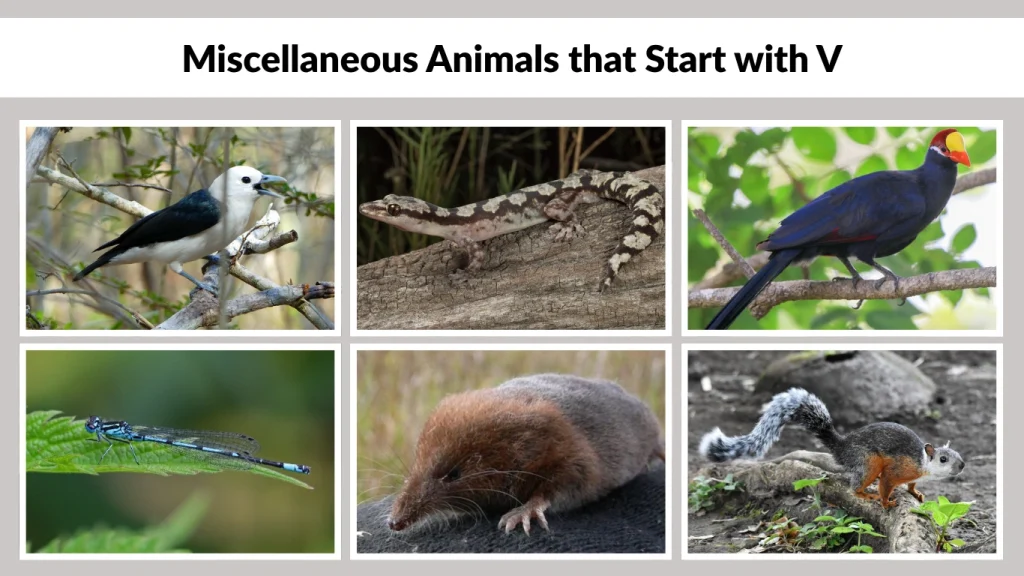
Miscellaneous animals beginning with the letter V include a mix of birds, reptiles, insects, and mammals that don’t fit neatly into other groups. They come from different environments across the globe, ranging from tropical rainforests to arid deserts. This diversity highlights how the letter V appears in species from all corners of the animal kingdom.
55. Vanga
The vanga is a family of birds found mainly in Madagascar, known for their wide variety of beak shapes adapted to different diets.
They feed on insects, fruit, and small animals, and their diversity is an example of adaptive radiation, where species evolve to fill different ecological niches.
56. Velvet Gecko
The velvet gecko is a nocturnal lizard found in Australia. It has soft, velvety skin and is skilled at climbing vertical surfaces.
It feeds on insects and spiders, hunting mostly at night. During the day, it shelters under bark, in rock crevices, or within tree hollows.
57. Violet Turaco
The violet turaco is a striking African bird with deep violet feathers, a yellow beak, and bright red wing patches.
It feeds on fruit, flowers, and leaves, playing an important role in seed dispersal. Its loud calls make it easy to locate in forest habitats.
58. Variable Damselfly
The variable damselfly is a delicate, slender insect found across Europe and parts of Asia. Males have blue and black markings, while females are more varied in color.
They inhabit ponds, lakes, and slow-moving rivers, where they prey on small flying insects. Their presence is often an indicator of healthy freshwater ecosystems.
59. Vagrant Shrew
The vagrant shrew is a small, insect-eating mammal found in western North America. It has a pointed snout, tiny eyes, and brownish fur.
It lives in moist meadows, marshes, and forests, foraging for insects, worms, and spiders. Its high metabolism requires it to eat frequently throughout the day.
60. Variegated Squirrel
The variegated squirrel is a colorful tree squirrel native to Central America. Its fur can be black, brown, red, or even white, often in bold patterns.
It feeds on fruit, seeds, and nuts, and plays a role in forest regeneration by spreading seeds. Agile and fast, it can leap between branches with ease.