
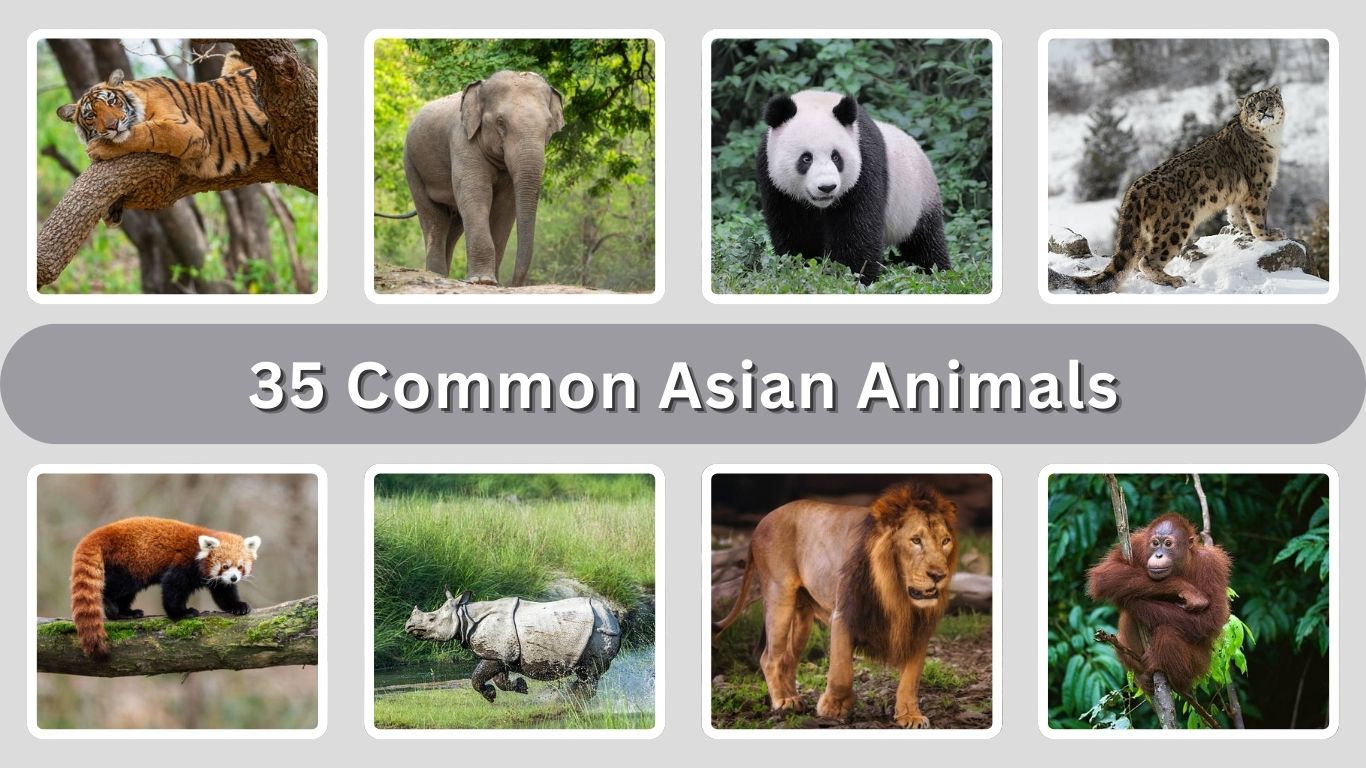
Asia is home to an extraordinary variety of wildlife, shaped by its vast landscapes, diverse climates, and rich ecosystems. From dense tropical rainforests and sprawling grasslands to icy mountain ranges and wetlands, the continent supports some of the world’s most iconic and unique animals. Many of these species play vital roles in maintaining ecological balance, while others hold deep cultural significance. Understanding and appreciating Asian animals is essential for promoting conservation and protecting this remarkable natural heritage.
1. Bengal Tiger
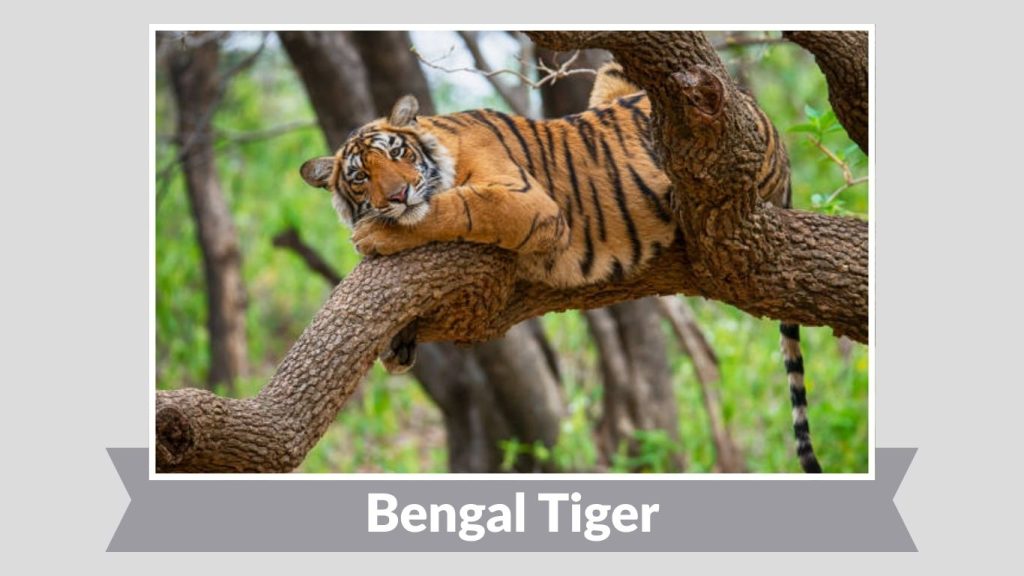
The Bengal tiger is one of the most recognizable wild animals in Asia and a symbol of strength and wilderness. Found mainly in the Indian subcontinent, this tiger subspecies is known for its bold black stripes, muscular build, and commanding presence. As an apex predator, it plays a crucial role in controlling prey populations and maintaining healthy ecosystems. Despite its importance, the Bengal tiger faces serious threats from habitat loss, poaching, and human–wildlife conflict, making conservation efforts essential for its survival.
Identification
- Scientific name: Panthera tigris tigris
- Common name: Bengal tiger
- Coat: Orange with black vertical stripes and white underparts
- Body length: 2.7–3.1 meters including tail
- Weight: Males 180–260 kg, females slightly smaller
- Distinctive features: Powerful limbs, large canine teeth, striped pattern unique to each individual
Habitat
Bengal tigers inhabit a variety of environments across India, Bangladesh, Nepal, Bhutan, and Myanmar. Their habitats include tropical and subtropical forests, grasslands, riverine forests, and mangrove swamps such as the Sundarbans. They prefer areas with dense cover for stalking prey and nearby water sources. The adaptability of the Bengal tiger allows it to survive in different climatic conditions, from hot plains to cooler forested regions.
Behaviors
Bengal tigers are solitary and highly territorial animals. Each adult maintains a large territory marked by scent markings, scratches, and vocalizations. They are mostly crepuscular, being active during early morning and late evening. Excellent swimmers, they often cross rivers and are comfortable in water. Communication includes roars, growls, and body language, mainly used to assert dominance or avoid conflict.
Diet and Lifespan
Bengal tigers are strict carnivores. Their diet mainly consists of deer species such as chital and sambar, along with wild boar, buffalo, and occasionally smaller animals. They are ambush hunters, relying on stealth and strength rather than speed. In the wild, Bengal tigers typically live 10–15 years, while those in protected reserves or captivity may live up to 20 years.
2. Asian Elephant
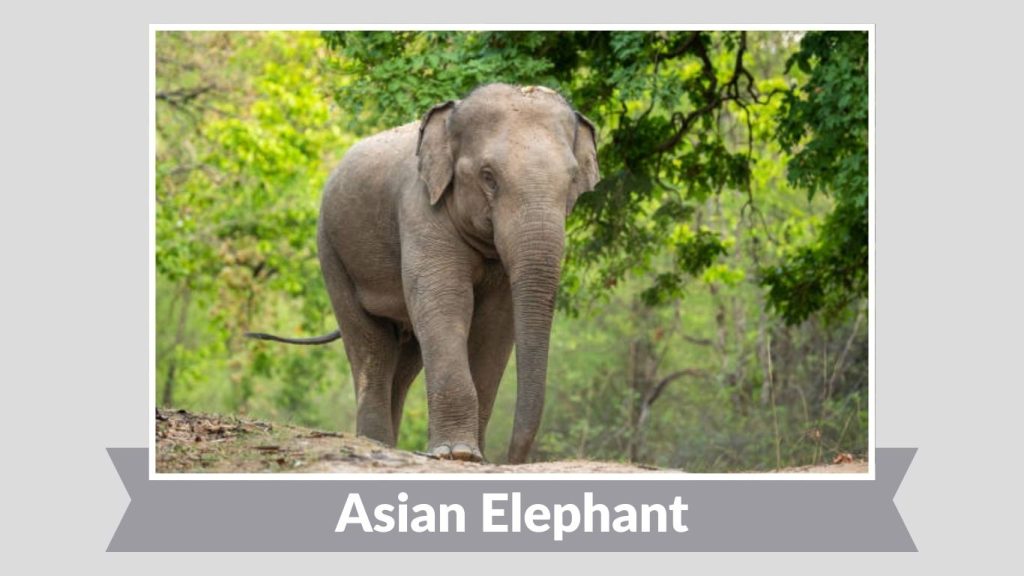
The Asian elephant is the largest land animal in Asia and one of the most intelligent and socially complex mammals in the world. Revered in many Asian cultures, it is closely associated with history, religion, and tradition. Asian elephants are smaller than their African counterparts but are equally impressive in strength and behavior. They play a key role in shaping forest ecosystems by dispersing seeds and creating clearings. Today, their populations are declining due to habitat fragmentation, human conflict, and poaching.
Identification
- Scientific name: Elephas maximus
- Common name: Asian elephant
- Skin color: Gray to brown
- Average height: 2–3 meters at the shoulder
- Average weight: 2,700–4,000 kg
- Distinctive features: Smaller ears than African elephants, single “finger” on the trunk tip, domed head
- Tusks: Present mostly in males; some males are tuskless
Habitat
Asian elephants are found across South and Southeast Asia, including India, Sri Lanka, Thailand, Myanmar, and parts of Indonesia. They inhabit tropical rainforests, dry deciduous forests, grasslands, and agricultural landscapes. Access to water and large feeding areas is essential, as elephants travel long distances daily in search of food and water.
Behaviors
Asian elephants are highly social animals that live in matriarchal family groups led by an older female. They communicate using vocal sounds, body language, and low-frequency vibrations. Elephants are known for their strong memory, problem-solving abilities, and emotional bonds. Adult males are more solitary and may roam alone or form small bachelor groups.
Diet and Lifespan
Asian elephants are herbivores, feeding on grasses, leaves, bark, fruits, and roots. An adult can consume up to 150 kg of food per day. In the wild, their average lifespan ranges from 50 to 60 years, with some individuals living even longer under protected conditions.
3. Giant Panda
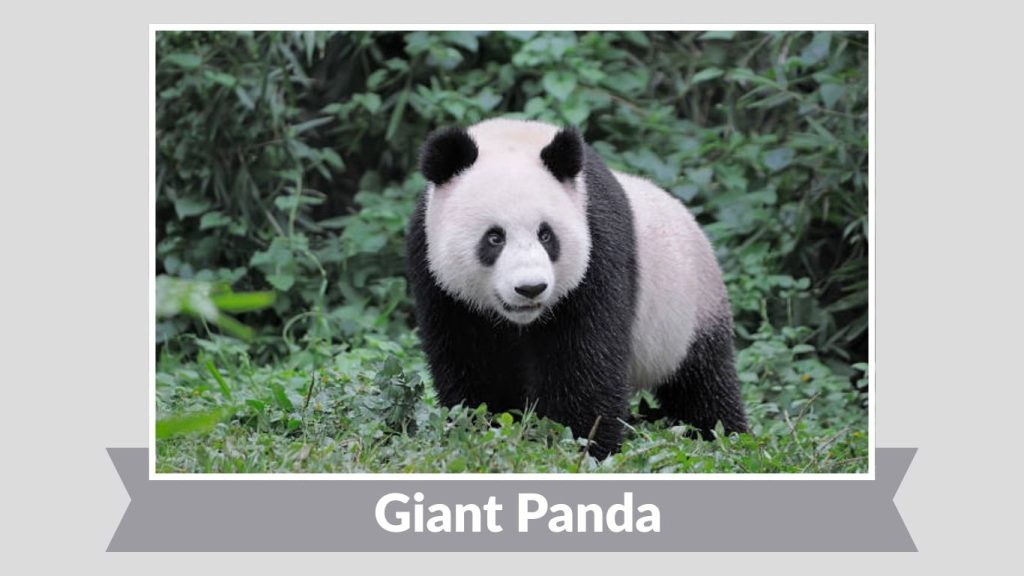
The giant panda is one of the most beloved and recognizable animals in the world, famous for its black-and-white fur and gentle nature. Native to China, it has become a global symbol of wildlife conservation. Although classified as a bear, the giant panda has a highly specialized diet centered almost entirely on bamboo. Its survival depends heavily on healthy forest ecosystems, making it an important indicator species for conservation efforts.
Identification
- Scientific name: Ailuropoda melanoleuca
- Common name: Giant panda
- Coat color: Black and white
- Body length: 1.2–1.9 meters
- Weight: 70–125 kg
- Distinctive features: Black patches around eyes, ears, shoulders, and legs
- Special adaptation: Enlarged wrist bone functioning as a “thumb” for gripping bamboo
Habitat
Giant pandas are found in mountainous regions of central China, mainly in Sichuan, Shaanxi, and Gansu provinces. They live in temperate broadleaf and mixed forests with dense bamboo undergrowth at elevations between 1,200 and 3,400 meters. These cool, moist forests provide the bamboo supply pandas rely on for survival.
Behaviors
Giant pandas are mostly solitary animals, spending much of their day feeding and resting. They are generally calm and non-aggressive, using scent markings and vocal sounds to communicate during mating season. Pandas are good climbers and can swim, although they prefer slow, ground-based movement. Their daily routine is dominated by eating due to the low nutritional value of bamboo.
Diet and Lifespan
Although classified as carnivores, giant pandas eat a diet that is over 99% bamboo, consuming up to 12–38 kg per day. Occasionally, they may eat small animals or eggs. In the wild, giant pandas typically live 18–20 years, while those in captivity can live over 30 years with proper care.
4. Snow Leopard
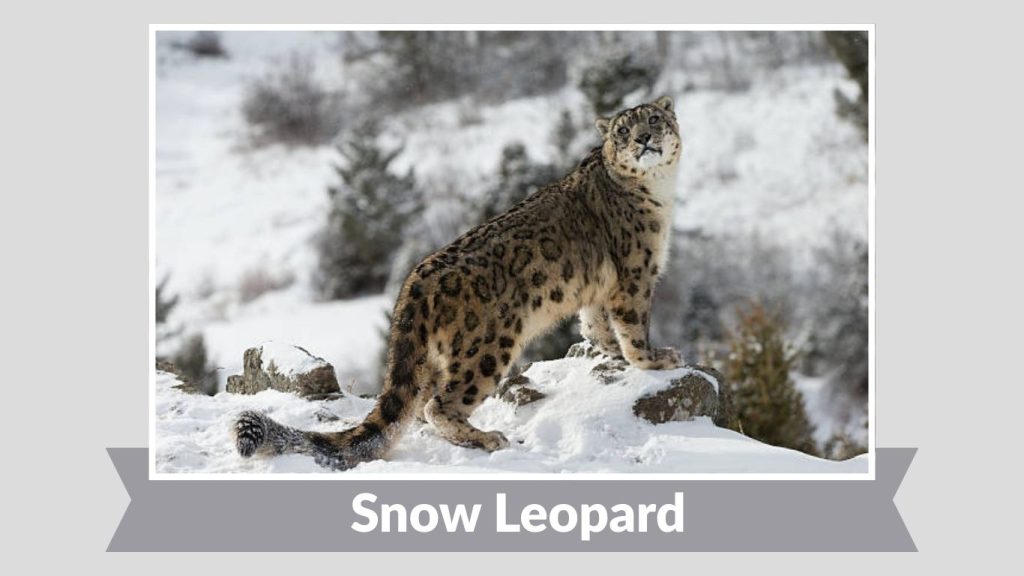
The snow leopard is a rare and elusive big cat adapted to life in the harsh, cold mountains of Central and South Asia. Often called the “ghost of the mountains,” it is known for its thick fur, long tail, and remarkable ability to blend into rocky terrain. Snow leopards play a crucial role in maintaining balance in high-altitude ecosystems. However, they face growing threats from climate change, habitat loss, and conflict with local herders.
Identification
- Scientific name: Panthera uncia
- Common name: Snow leopard
- Coat color: Smoky gray with black rosettes
- Body length: 1–1.3 meters (excluding tail)
- Tail length: Up to 1 meter
- Weight: 27–55 kg
- Distinctive features: Thick fur, long bushy tail, wide nasal passages for cold air
Habitat
Snow leopards inhabit high-altitude mountain ranges across 12 Asian countries, including Nepal, India, Bhutan, China, Mongolia, and Pakistan. They live at elevations ranging from 3,000 to 5,500 meters in alpine and subalpine zones. These areas are characterized by steep cliffs, rocky outcrops, and sparse vegetation, which provide ideal cover for stalking prey.
Behaviors
Snow leopards are solitary and extremely secretive animals. They are most active during dawn and dusk, using stealth and powerful leaps to hunt. Their long tails help with balance on steep slopes and also serve as insulation when wrapped around the body during rest. Unlike other big cats, snow leopards cannot roar but communicate through vocal sounds such as chuffing and growling.
Diet and Lifespan
Snow leopards are carnivores that primarily hunt mountain ungulates such as blue sheep and ibex. They also prey on marmots, hares, and birds. In the wild, snow leopards generally live 12–15 years, while individuals in captivity may live up to 20 years.
5. Red Panda
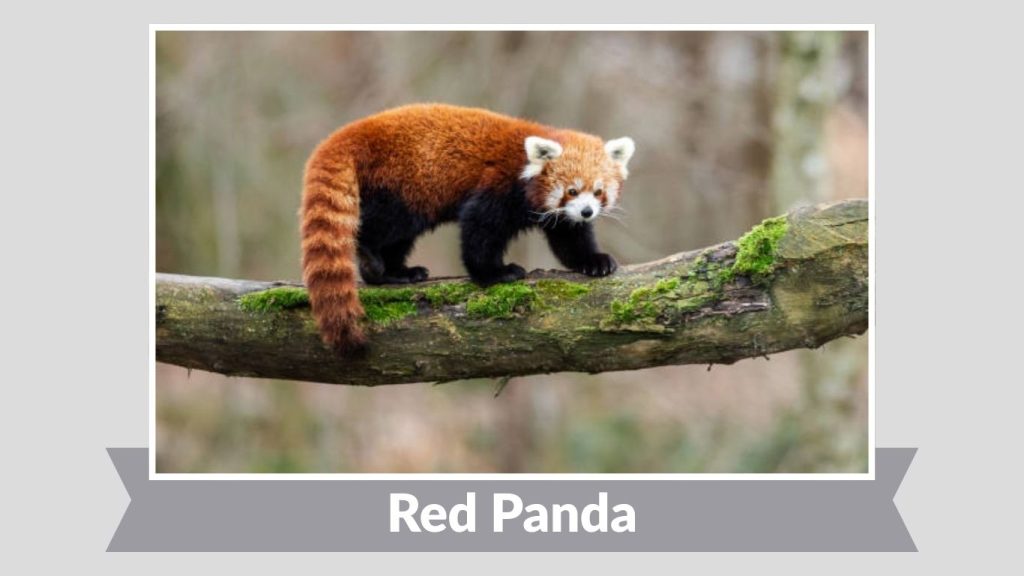
The red panda is a small, tree-dwelling mammal known for its reddish-brown fur, bushy tail, and playful appearance. Native to the eastern Himalayas and southwestern China, it is often called the “fire fox,” though it is not closely related to foxes or giant pandas. Red pandas are important for forest health and are considered a flagship species for conservation in mountain ecosystems.
Identification
- Scientific name: Ailurus fulgens
- Common name: Red panda
- Coat color: Reddish-brown with black legs and white facial markings
- Body length: 50–64 cm
- Tail length: 28–49 cm
- Weight: 3–6 kg
- Distinctive features: Ringed bushy tail, masked face, semi-retractile claws
Habitat
Red pandas inhabit temperate forests in the Himalayas, including parts of Nepal, India, Bhutan, Myanmar, and China. They live at elevations between 2,200 and 4,800 meters, where bamboo is abundant. These forests are cool, moist, and rich in trees such as oak and rhododendron, which provide shelter and nesting sites.
Behaviors
Red pandas are mostly solitary and arboreal, spending much of their time in trees. They are primarily crepuscular and nocturnal, being most active during early morning and evening. Red pandas use scent markings to communicate and establish territory. They are agile climbers and often sleep curled up on branches to conserve body heat.
Diet and Lifespan
Although classified as carnivores, red pandas eat a diet largely made up of bamboo leaves and shoots. They also consume fruits, berries, insects, and small animals. In the wild, red pandas typically live 8–10 years, while those in captivity may live up to 15 years.
6. Indian Rhinoceros
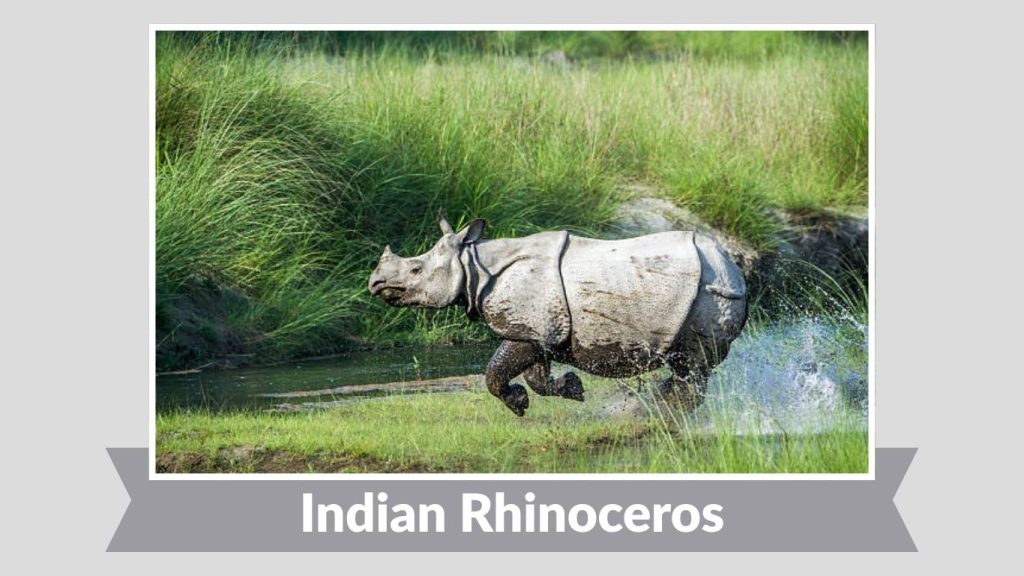
The Indian rhinoceros, also known as the greater one-horned rhinoceros, is one of the largest land mammals in Asia. It is easily recognized by its thick, armor-like skin and single horn. Once widespread across the northern Indian subcontinent, its range has significantly reduced due to hunting and habitat loss. Strong conservation efforts have helped stabilize and increase some populations, making it a major conservation success story.
Identification
- Scientific name: Rhinoceros unicornis
- Common name: Indian rhinoceros
- Skin color: Gray-brown
- Body length: 3–4 meters
- Weight: 1,800–2,700 kg
- Distinctive features: Single horn, thick folded skin resembling armor plates
- Horn material: Keratin
Habitat
Indian rhinoceroses are mainly found in northern India and southern Nepal. They inhabit alluvial grasslands, riverine forests, and wetlands, especially along the floodplains of major rivers. These areas provide abundant grasses, water, and mud wallows, which are essential for temperature regulation and skin health.
Behaviors
Indian rhinoceroses are generally solitary, except for mothers with calves. They are less aggressive than African rhinos but can be dangerous when threatened. Rhinos communicate through vocal sounds, scent marking, and dung piles. They are excellent swimmers and often spend long periods wallowing in mud to cool down and protect their skin from parasites.
Diet and Lifespan
Indian rhinoceroses are herbivores that primarily feed on tall grasses, aquatic plants, leaves, fruits, and crops. An adult can consume large quantities of vegetation daily. In the wild, they typically live 35–45 years, while individuals in protected environments may live slightly longer.
7. Asian Lion
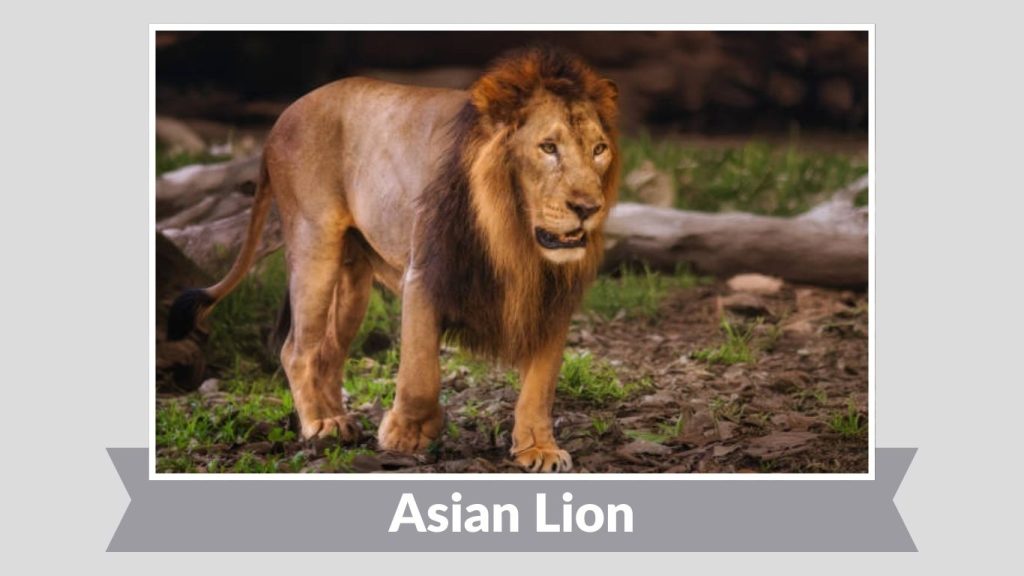
The Asian lion, also known as the Asiatic lion, is a rare lion subspecies found only in India. Smaller than its African relative, it is distinguished by a less developed mane and a prominent fold of skin along the belly. Once ranging across much of Asia, the Asian lion now survives mainly due to focused conservation efforts. It holds great cultural and historical significance in the region and represents a remarkable recovery from near extinction.
Identification
- Scientific name: Panthera leo persica
- Common name: Asian lion
- Coat color: Tawny to sandy brown
- Body length: 2–2.9 meters including tail
- Weight: Males 160–190 kg, females 110–120 kg
- Distinctive features: Shorter, sparser mane; longitudinal belly fold
Habitat
Asian lions are currently restricted to the Gir Forest and surrounding areas in Gujarat, India. Their habitat consists of dry deciduous forests, scrublands, and open grasslands. The region provides sufficient prey, cover, and water sources, although the limited range makes the population vulnerable to disease and environmental changes.
Behaviors
Asian lions are social animals but form smaller prides compared to African lions. Males often live alone or in small coalitions, while females do most of the hunting. They communicate through roars, growls, and scent marking. Hunting typically occurs at night or early morning, relying on teamwork and stealth.
Diet and Lifespan
Asian lions are carnivores that mainly prey on deer, antelope, wild boar, and occasionally livestock. In the wild, they usually live 15–20 years, while those in captivity may survive longer under managed care.
8. Clouded Leopard
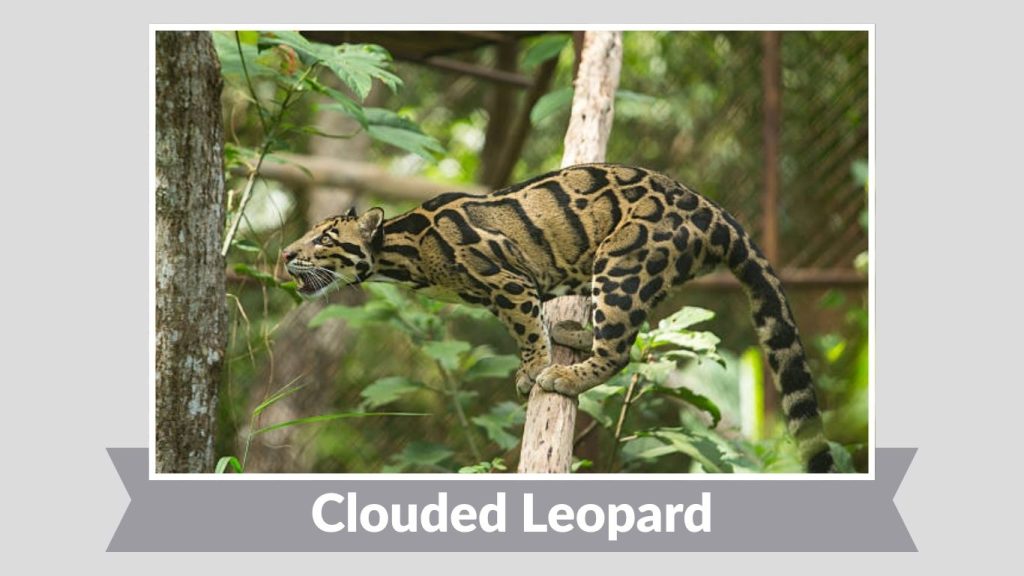
The clouded leopard is a medium-sized wild cat known for its beautiful cloud-shaped markings and secretive nature. Native to the forests of South and Southeast Asia, it is an excellent climber and spends much of its time in trees. This elusive predator plays an important role in maintaining forest ecosystems, but its population is declining due to deforestation and illegal wildlife trade.
Identification
- Scientific name: Neofelis nebulosa
- Common name: Clouded leopard
- Coat color: Yellowish-brown with dark cloud-shaped patterns
- Body length: 68–108 cm
- Tail length: 61–91 cm
- Weight: 11–23 kg
- Distinctive features: Large canine teeth, long tail, flexible ankle joints
Habitat
Clouded leopards inhabit dense tropical and subtropical forests across countries such as India, Nepal, Bhutan, Myanmar, Thailand, Malaysia, and southern China. They prefer forested areas with thick vegetation that provide cover for hunting and tree climbing. These cats are found from lowland rainforests to mountainous regions.
Behaviors
Clouded leopards are solitary and mostly nocturnal. They are exceptionally skilled climbers and can climb down trees headfirst or hang from branches using their strong hind legs. They use scent marking and vocal sounds to communicate. Due to their elusive nature, much of their behavior in the wild remains poorly understood.
Diet and Lifespan
Clouded leopards are carnivores, feeding on deer, monkeys, birds, and small mammals. They hunt both on the ground and in trees, using ambush tactics. In the wild, they typically live 11–17 years, while individuals in captivity may live longer.
9. Orangutan
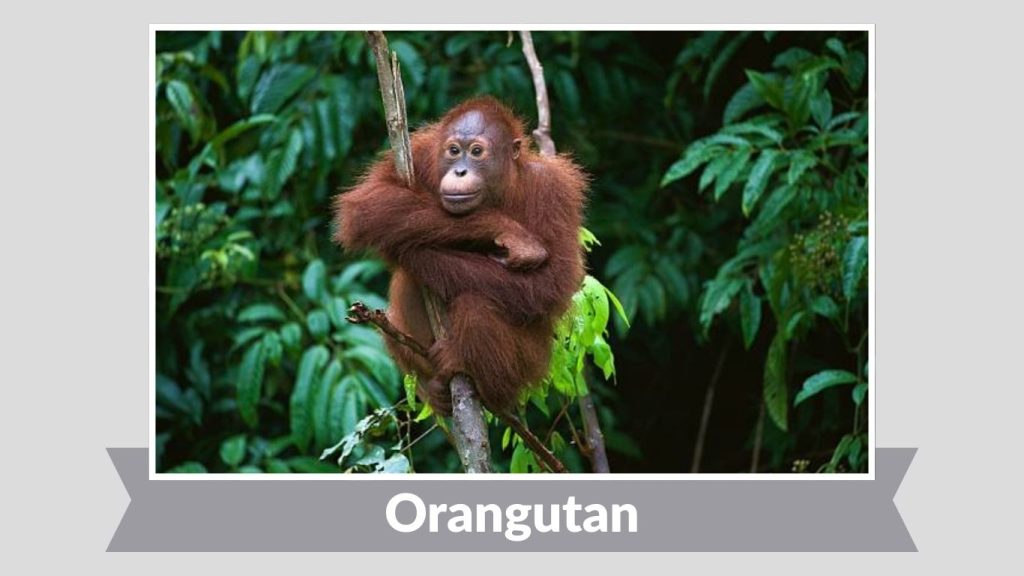
The orangutan is a highly intelligent great ape native to the rainforests of Southeast Asia. Known for its long arms and reddish-brown hair, it is one of the closest relatives to humans. Orangutans spend most of their lives in trees and are famous for their problem-solving skills and tool use. Sadly, they are critically threatened due to deforestation, palm oil plantations, and illegal wildlife trade.
Identification
- Scientific name: Pongo (genus)
- Common name: Orangutan
- Coat color: Reddish-brown
- Arm span: Up to 2.25 meters
- Weight: Males 50–90 kg, females 30–50 kg
- Distinctive features: Long arms, expressive face, cheek pads in adult males
Habitat
Orangutans are found only on the islands of Borneo and Sumatra. They inhabit tropical lowland and swamp rainforests with dense tree cover. These forests provide fruit, shelter, and nesting sites. Orangutans rely heavily on intact forest canopies, making them extremely vulnerable to logging and land conversion.
Behaviors
Orangutans are mostly solitary, unlike other great apes. They build new nests in trees each night for sleeping. Highly intelligent, they use tools to extract insects or seeds and show strong learning abilities. Communication includes vocal calls, facial expressions, and body movements, especially during mating seasons.
Diet and Lifespan
Orangutans are primarily frugivores, feeding mainly on fruits, along with leaves, bark, insects, and honey. In the wild, they typically live 35–45 years, while those in captivity may live beyond 50 years.
10. Gibbon
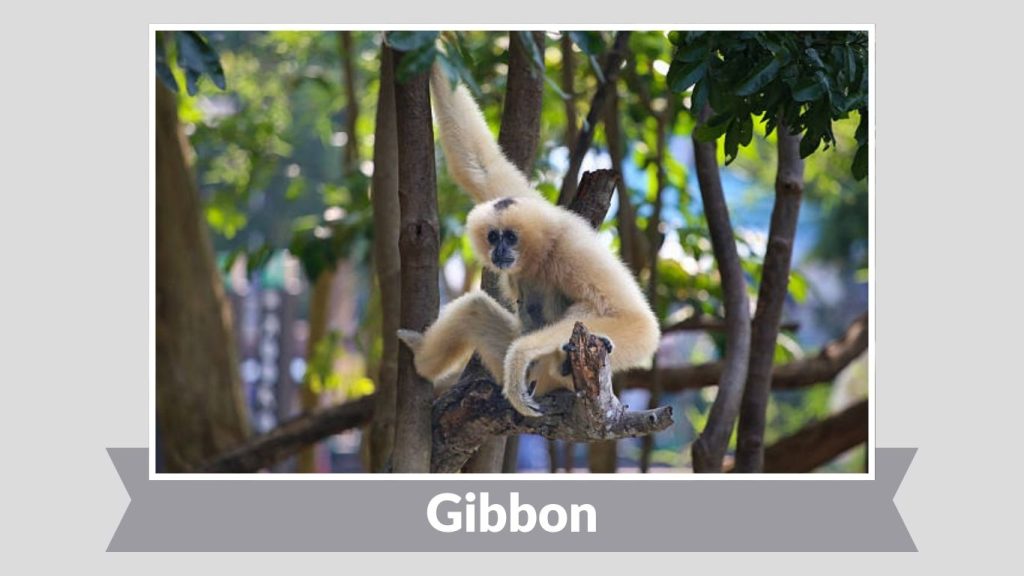
Gibbons are small, agile apes known for their incredible ability to swing through trees using their long arms, a movement called brachiation. Native to the forests of Southeast and East Asia, gibbons are often referred to as the “lesser apes.” They are famous for their loud, complex vocal calls, which echo through the forest and help strengthen family bonds and defend territory.
Identification
- Scientific name: Hylobatidae (family)
- Common name: Gibbon
- Coat color: Varies by species (black, brown, gray, or white)
- Body length: 40–65 cm
- Weight: 5–12 kg
- Distinctive features: Very long arms, no tail, lightweight body adapted for swinging
Habitat
Gibbons live in tropical and subtropical rainforests across countries such as Thailand, Malaysia, Indonesia, China, and India. They spend almost their entire lives in the forest canopy, rarely descending to the ground. Dense tree cover and continuous canopies are essential for their movement, feeding, and safety.
Behaviors
Gibbons are highly territorial and usually live in small family groups consisting of a mated pair and their offspring. They are diurnal and very active during the day. Their calls, often sung in duets, are used to mark territory and strengthen pair bonds. Gibbons are fast and graceful movers, capable of swinging distances of up to 10 meters in a single leap.
Diet and Lifespan
Gibbons are primarily frugivores, feeding mainly on fruits, along with leaves, flowers, and insects. In the wild, they generally live 25–30 years, with similar lifespans observed in protected environments.
11. Komodo Dragon
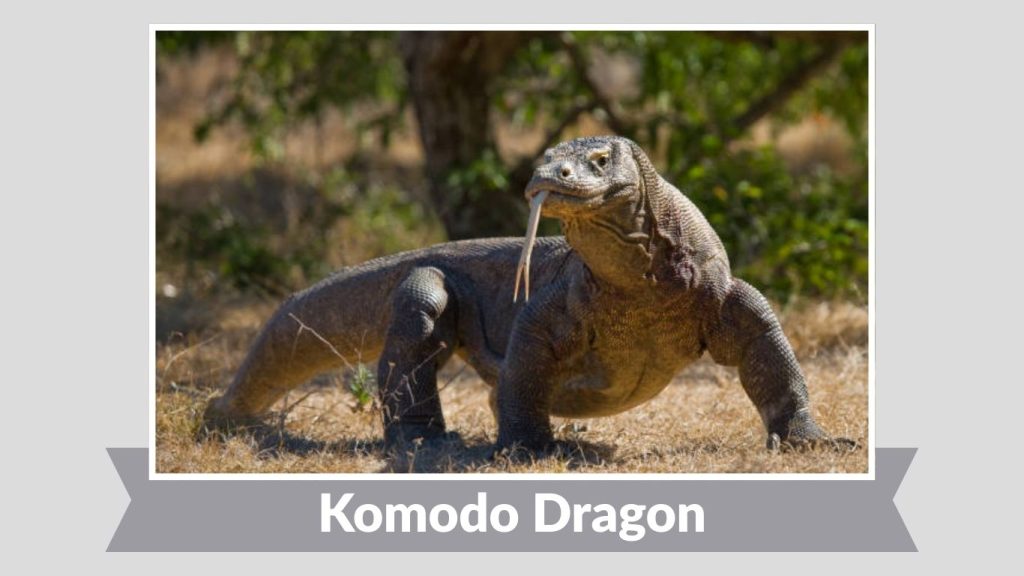
The Komodo dragon is the largest living lizard in the world and one of the most fascinating reptiles found in Asia. Native to a small group of Indonesian islands, it is a powerful predator with sharp senses and a formidable bite. Despite its heavy body, the Komodo dragon is capable of surprising speed and stealth. As an apex predator, it plays a key role in regulating prey populations within its limited island ecosystem.
Identification
- Scientific name: Varanus komodoensis
- Common name: Komodo dragon
- Skin color: Grayish-brown with rough, scaly texture
- Body length: Up to 3 meters
- Weight: 70–90 kg on average
- Distinctive features: Long muscular tail, forked tongue, strong limbs with sharp claws
Habitat
Komodo dragons are found only in Indonesia, mainly on the islands of Komodo, Rinca, Flores, Gili Motang, and Padar. They inhabit dry savannas, open woodlands, coastal forests, and grasslands. These environments provide warm temperatures and sufficient prey. Dragons often use burrows to escape heat and rest during the hottest parts of the day.
Behaviors
Komodo dragons are mostly solitary and territorial. They rely on stealth when hunting, lying in wait near trails used by prey. Their forked tongue helps detect scent over long distances. They are known to engage in dominance displays and physical combat, especially during mating season. Younger dragons are agile climbers and often live in trees to avoid predators.
Diet and Lifespan
Komodo dragons are carnivores, feeding on deer, wild pigs, water buffalo, and carrion. They use a combination of venom and bacteria to weaken prey. In the wild, Komodo dragons typically live 20–30 years under natural conditions.
12. King Cobra

The king cobra is the longest venomous snake in the world and one of the most feared reptiles in Asia. Known for its impressive hood and intimidating posture, it holds a unique place in many Asian cultures and myths. Unlike other cobras, the king cobra is a specialized predator that mainly hunts other snakes. Despite its dangerous reputation, it generally avoids humans unless threatened.
Identification
- Scientific name: Ophiophagus hannah
- Common name: King cobra
- Skin color: Olive, brown, or black with pale bands
- Body length: 3–5.5 meters
- Weight: Up to 6 kg
- Distinctive features: Large hood, narrow head, powerful venom delivery
Habitat
King cobras are found across South and Southeast Asia, including India, China, Thailand, Indonesia, and the Philippines. They inhabit dense forests, bamboo thickets, mangroves, and sometimes agricultural areas near water sources. A warm, humid environment with good cover is essential for their survival.
Behaviors
King cobras are mostly solitary and diurnal. When threatened, they raise the front part of their body, spread their hood, and emit a deep hiss as a warning. Uniquely, they build nests for their eggs and guard them until hatching. They rely on sharp vision and scent detection to locate prey.
Diet and Lifespan
King cobras primarily feed on other snakes, including both venomous and non-venomous species, as well as lizards. In the wild, they typically live around 20 years, although lifespan can vary depending on environmental conditions and threats.
13. Asian Black Bear
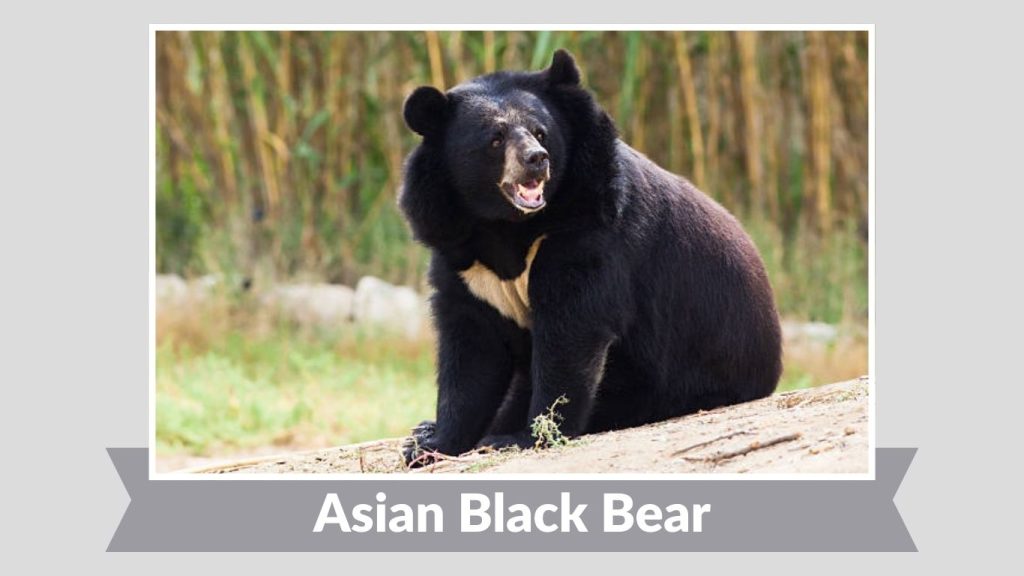
The Asian black bear, also known as the moon bear due to the crescent-shaped marking on its chest, is a medium-sized bear native to Asia. It is highly adaptable and can live in a wide range of forested habitats. Despite its shy nature, it is an important species for seed dispersal and forest regeneration. Unfortunately, it faces threats from habitat loss and illegal hunting.
Identification
- Scientific name: Ursus thibetanus
- Common name: Asian black bear
- Coat color: Black with a white or cream crescent on the chest
- Body length: 120–190 cm
- Weight: 90–200 kg
- Distinctive features: Pale chest mark, rounded ears, strong curved claws
Habitat
Asian black bears are found across South, East, and Southeast Asia, including India, China, Japan, Korea, and parts of Southeast Asia. They inhabit deciduous and evergreen forests, often in mountainous regions. These bears prefer areas with dense vegetation and seasonal food availability.
Behaviors
Asian black bears are generally solitary and mostly nocturnal, although they may be active during the day in undisturbed areas. They are good climbers and often rest or feed in trees. Communication involves vocal sounds, body posture, and scent marking. When threatened, they can be aggressive but usually avoid human contact.
Diet and Lifespan
Asian black bears are omnivores. Their diet includes fruits, nuts, berries, insects, small mammals, and occasionally carrion. In the wild, they typically live 25–30 years, with similar lifespans recorded in protected environments.
14. Sun Bear
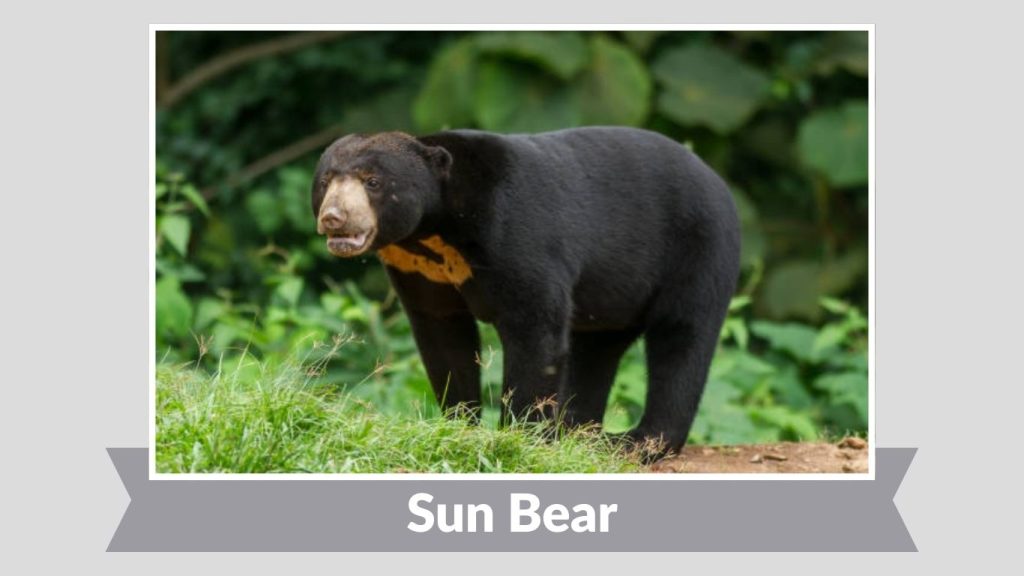
The sun bear is the smallest bear species in the world and is easily recognized by the pale, sun-shaped patch on its chest. Native to the tropical forests of Southeast Asia, it is a shy and elusive animal. Sun bears play an important ecological role by controlling insect populations and dispersing seeds. Despite this, they are threatened by deforestation and illegal wildlife trade.
Identification
- Scientific name: Helarctos malayanus
- Common name: Sun bear
- Coat color: Black or dark brown with a yellow or orange chest patch
- Body length: 100–150 cm
- Weight: 25–65 kg
- Distinctive features: Short snout, long tongue, curved claws
Habitat
Sun bears inhabit lowland tropical rainforests across Southeast Asia, including Malaysia, Indonesia, Thailand, and Myanmar. They prefer dense forest areas with plenty of fruiting trees and termite nests. Their strong climbing ability allows them to exploit both ground and canopy resources.
Behaviors
Sun bears are mostly solitary and are active during both day and night, depending on food availability and human disturbance. They are excellent climbers and often build resting platforms in trees. Sun bears use their long tongues to extract insects such as termites and ants from nests and crevices.
Diet and Lifespan
Sun bears are omnivores, feeding on fruits, honey, insects, small vertebrates, and plant matter. In the wild, they usually live 20–25 years, while individuals in captivity may live slightly longer.
15. Dhole
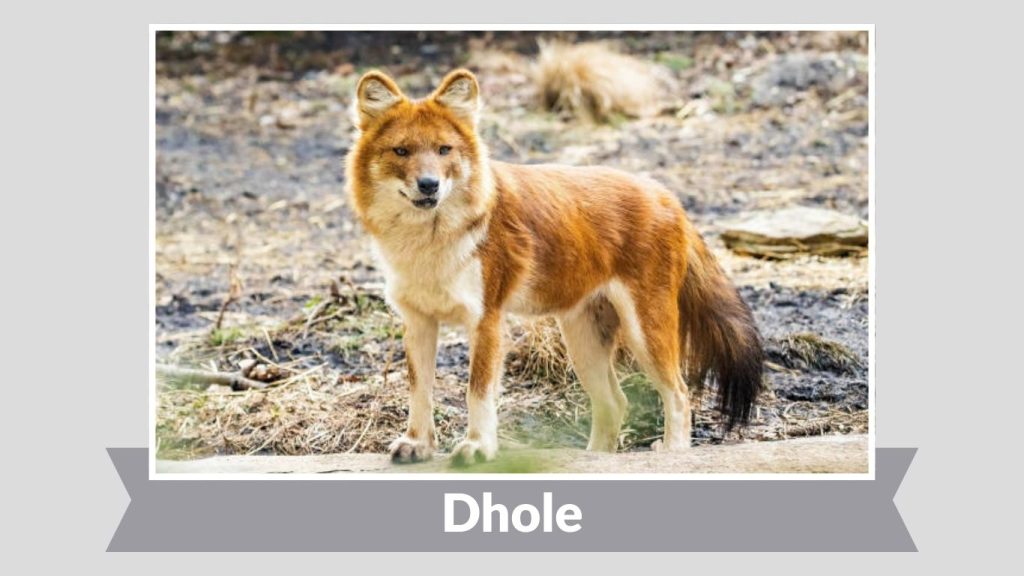
The dhole, also known as the Asiatic wild dog, is a highly social and efficient predator found in Asia. Recognized for its reddish coat and cooperative hunting behavior, the dhole plays a vital role in regulating prey populations in forest ecosystems. Once widespread, its numbers have declined sharply due to habitat loss, disease, and competition with other predators, making it one of Asia’s lesser-known but important carnivores.
Identification
- Scientific name: Cuon alpinus
- Common name: Dhole
- Coat color: Reddish-brown with lighter underparts
- Body length: 90–110 cm
- Weight: 10–20 kg
- Distinctive features: Bushy black-tipped tail, rounded ears, slender build
Habitat
Dholes are found across South, East, and Southeast Asia, including India, China, Thailand, and Indonesia. They inhabit a wide range of environments such as forests, grasslands, and mountainous regions. Dense vegetation and availability of prey are key factors for suitable dhole habitats.
Behaviors
Dholes are highly social animals that live in packs, often consisting of 5–12 members. They are known for their cooperative hunting strategies, using teamwork rather than strength to bring down prey larger than themselves. Communication includes whistles, yelps, and body signals. Unlike many other canids, dholes rarely bark.
Diet and Lifespan
Dholes are carnivores that mainly prey on deer, wild pigs, and smaller mammals. They occasionally hunt livestock, which can lead to conflict with humans. In the wild, dholes typically live 10–13 years under natural conditions.
16. Indian Peafowl
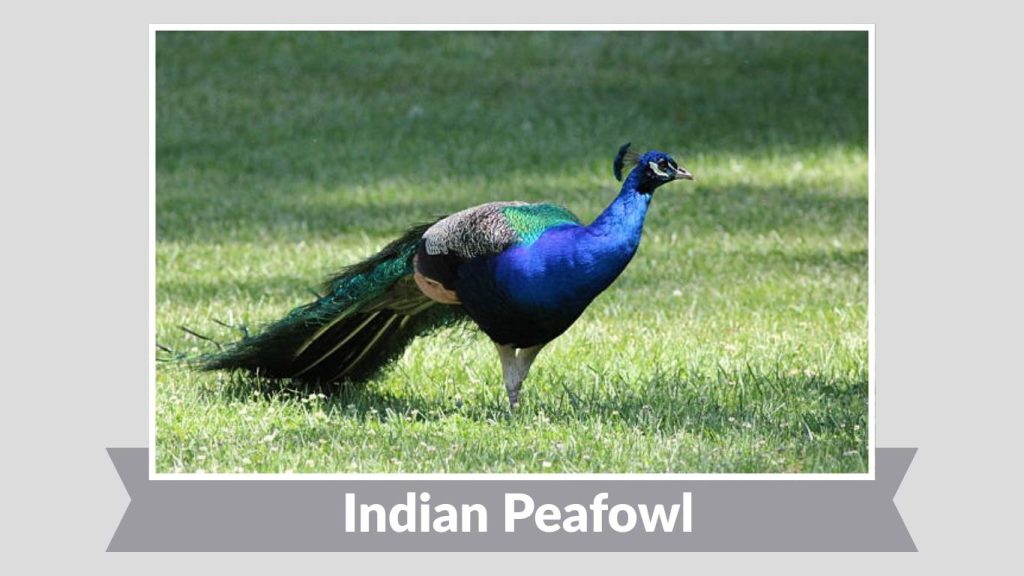
The Indian peafowl, commonly known as the peacock, is one of the most striking and recognizable birds in Asia. Famous for the male’s dazzling tail feathers and elaborate courtship display, it holds deep cultural and religious significance, especially in India where it is the national bird. Beyond its beauty, the Indian peafowl plays a role in controlling insects and small reptiles in its environment.
Identification
- Scientific name: Pavo cristatus
- Common name: Indian peafowl
- Body color: Males are bright blue and green; females are brownish with green tones
- Body length: 90–130 cm (excluding tail)
- Tail length (male): Up to 150 cm
- Weight: 3–6 kg
- Distinctive features: Iridescent train with eye-like spots in males, crest on head
Habitat
Indian peafowl are widely distributed across the Indian subcontinent, including India, Sri Lanka, Nepal, and Pakistan. They inhabit open forests, farmlands, grasslands, and areas near human settlements. They prefer regions with access to water and trees for roosting, adapting well to both wild and semi-domesticated environments.
Behaviors
Indian peafowl are ground-dwelling birds but roost in trees at night to avoid predators. Males perform elaborate courtship displays by fanning out their tail feathers and producing rattling sounds to attract females. They are mostly active during the day and are known for loud calls that can serve as warning signals of danger.
Diet and Lifespan
Indian peafowl are omnivores, feeding on seeds, grains, insects, small reptiles, and amphibians. In the wild, they generally live 15–20 years, while individuals in protected or captive environments may live longer.
17. Sarus Crane
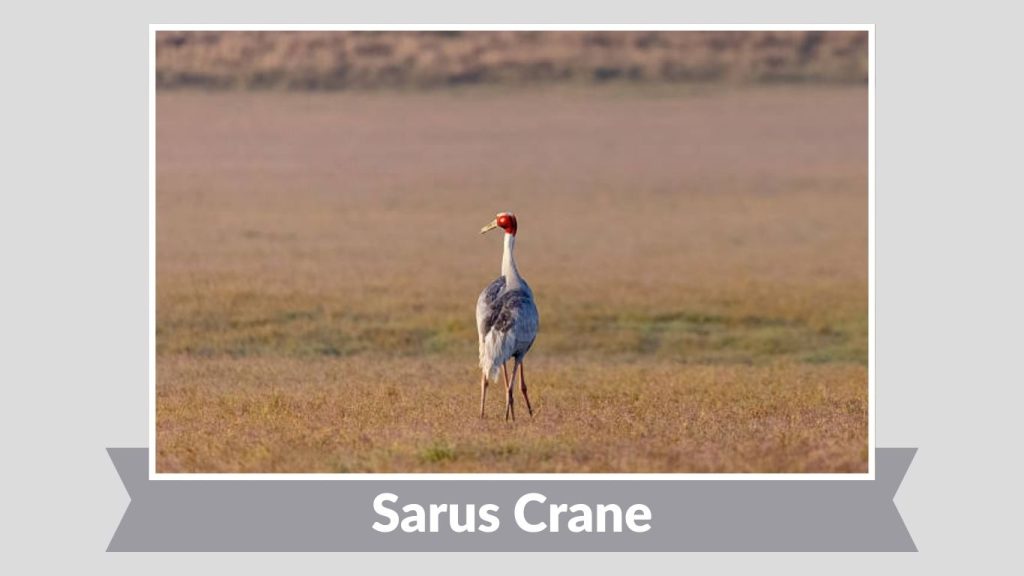
The sarus crane is the tallest flying bird in the world and a powerful symbol of grace and lifelong devotion. Native to parts of South and Southeast Asia, it is known for forming long-term pair bonds, often mating for life. With its elegant stature and striking red head, the sarus crane plays an important role in wetland ecosystems and is considered an indicator of healthy habitats.
Identification
- Scientific name: Antigone antigone
- Common name: Sarus crane
- Body color: Gray with a red head and upper neck
- Height: Up to 1.8 meters
- Wingspan: 2.4–2.8 meters
- Weight: 6–8 kg
- Distinctive features: Bare red skin on head and neck, long legs and neck
Habitat
Sarus cranes are found in India, Nepal, Cambodia, Vietnam, and parts of Southeast Asia. They primarily inhabit wetlands, marshes, flooded grasslands, and agricultural fields near water sources. Shallow wetlands are essential for feeding and nesting, making them highly dependent on healthy water ecosystems.
Behaviors
Sarus cranes are monogamous and often seen in pairs or small family groups. They are famous for their elaborate courtship dances, which include jumping, wing spreading, and loud calls. These behaviors strengthen pair bonds and play a role in mating. Sarus cranes are diurnal and highly territorial during the breeding season.
Diet and Lifespan
Sarus cranes are omnivores, feeding on aquatic plants, grains, insects, frogs, and small reptiles. In the wild, they typically live 20–25 years, with longer lifespans possible in protected environments.
18. Malayan Tapir
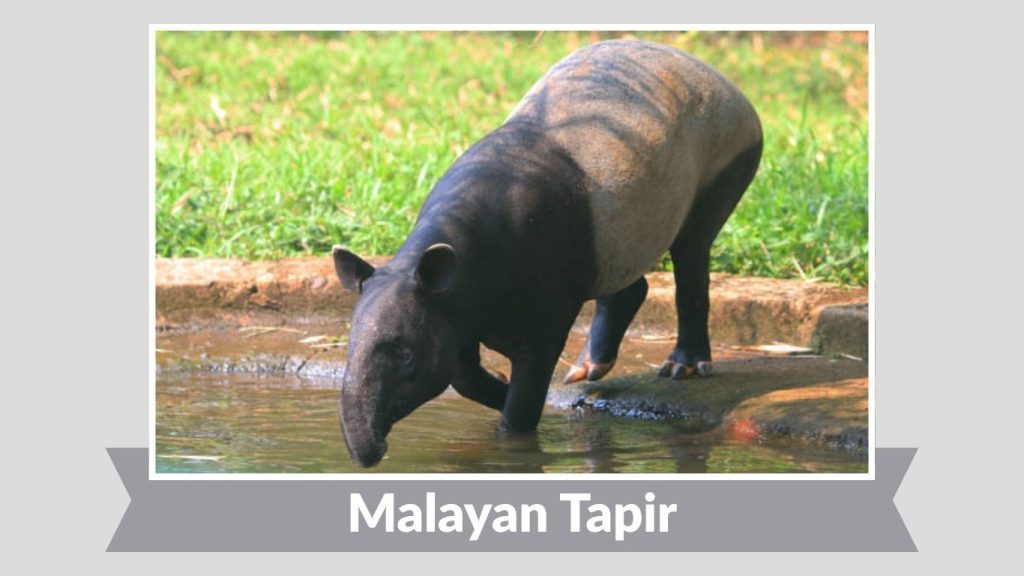
The Malayan tapir is a large, shy herbivore easily recognized by its unique black-and-white body pattern, which helps it blend into forest shadows. It is the only tapir species found in Asia and is mainly active at night. As a forest-dwelling animal, the Malayan tapir plays an important role in seed dispersal, helping maintain healthy tropical ecosystems. Unfortunately, it is increasingly threatened by habitat loss and road accidents.
Identification
- Scientific name: Tapirus indicus
- Common name: Malayan tapir
- Body color: Black with a white saddle-shaped marking
- Body length: 1.8–2.5 meters
- Weight: 250–320 kg
- Distinctive features: Short flexible snout, rounded body, stocky legs
Habitat
Malayan tapirs are found in Southeast Asia, mainly in Malaysia, Thailand, Myanmar, and the Indonesian island of Sumatra. They inhabit lowland tropical rainforests, swamps, and riverine forests. Access to dense vegetation and water sources is essential, as tapirs frequently bathe and use water to escape predators.
Behaviors
Malayan tapirs are solitary and mostly nocturnal animals. During the day, they rest in dense forest cover, becoming active at night to feed. They communicate using high-pitched whistles and scent markings. Despite their bulky appearance, they are good swimmers and can move quickly when threatened.
Diet and Lifespan
Malayan tapirs are herbivores, feeding on leaves, shoots, fruits, and aquatic plants. They browse on a wide variety of plant species, contributing to seed dispersal. In the wild, they typically live 25–30 years, with similar lifespans observed in captivity.
19. Water Buffalo
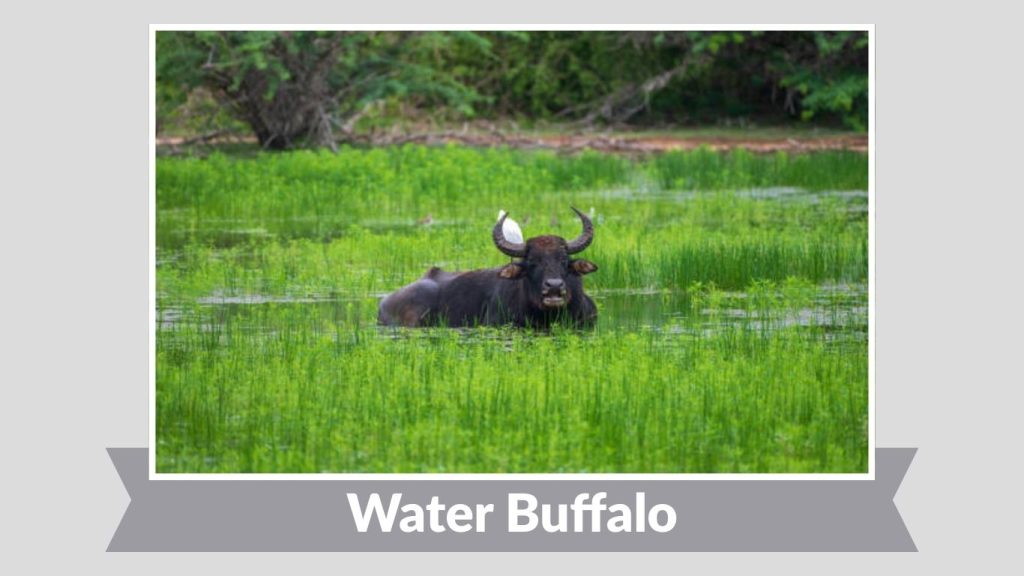
The water buffalo is a large and powerful bovine species widely associated with agriculture and wetlands across Asia. Known for its strength and ability to thrive in muddy, waterlogged environments, it has been domesticated for thousands of years. Wild water buffalo are far rarer and play an important role in maintaining grassland and wetland ecosystems. Both wild and domestic forms are highly adapted to hot, humid climates.
Identification
- Scientific name: Bubalus bubalis
- Common name: Water buffalo
- Skin color: Dark gray to black
- Body length: 2.4–3 meters
- Weight: 400–900 kg
- Distinctive features: Large curved horns, broad hooves, sparse hair
Habitat
Wild water buffalo are found in parts of South and Southeast Asia, including India, Nepal, Bhutan, and Thailand. They inhabit wetlands, river floodplains, marshes, and grasslands close to water sources. Domesticated water buffalo are commonly seen in agricultural areas such as rice paddies, where water and mud help regulate their body temperature.
Behaviors
Water buffalo are social animals that usually live in herds. They spend much of their time wallowing in mud or water to cool down and protect their skin from insects. While generally calm, wild water buffalo can be aggressive when threatened. They communicate through vocal sounds, body posture, and herd movement.
Diet and Lifespan
Water buffalo are herbivores, feeding mainly on grasses, aquatic plants, and crop residues. In natural conditions, they typically live 20–25 years, while domesticated individuals may live longer with proper care.
20. Yak
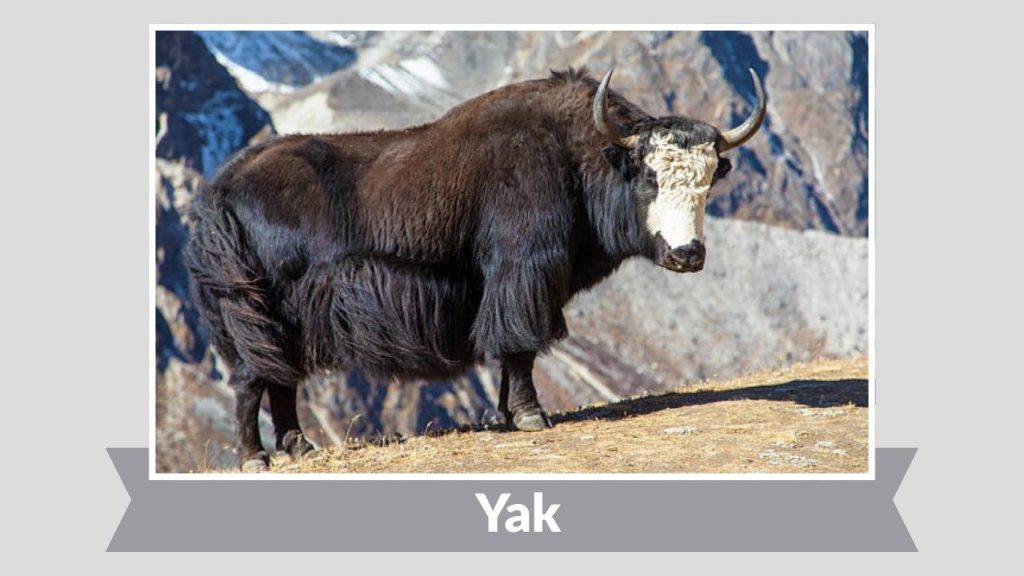
The yak is a large, long-haired bovine specially adapted to survive in the cold, high-altitude regions of Central Asia. It has been domesticated for centuries and is essential to the livelihoods of many Himalayan and Tibetan communities. Yaks provide milk, meat, fiber, and transportation, while wild yaks play an important role in maintaining alpine grassland ecosystems.
Identification
- Scientific name: Bos grunniens (domestic), Bos mutus (wild)
- Common name: Yak
- Coat color: Black, brown, or white
- Body length: 2–3.25 meters
- Weight: 300–1,000 kg
- Distinctive features: Long shaggy hair, large lungs, curved horns
Habitat
Yaks inhabit high-altitude plateaus and mountain regions of Tibet, China, Mongolia, Nepal, and India. Wild yaks are typically found at elevations above 3,000 meters, where temperatures are low and oxygen levels are reduced. These regions consist mainly of alpine meadows and cold steppe grasslands.
Behaviors
Yaks are social animals that live in herds. They are well adapted to cold climates and can withstand extremely low temperatures. Wild yaks tend to be more aggressive and wary of humans, while domesticated yaks are calmer. They use vocal sounds and body movements to communicate within the herd.
Diet and Lifespan
Yaks are herbivores, feeding mainly on grasses, mosses, lichens, and herbs found in alpine regions. In the wild, they typically live 20–25 years, while domesticated yaks may live longer under managed care.
21. Tibetan Antelope
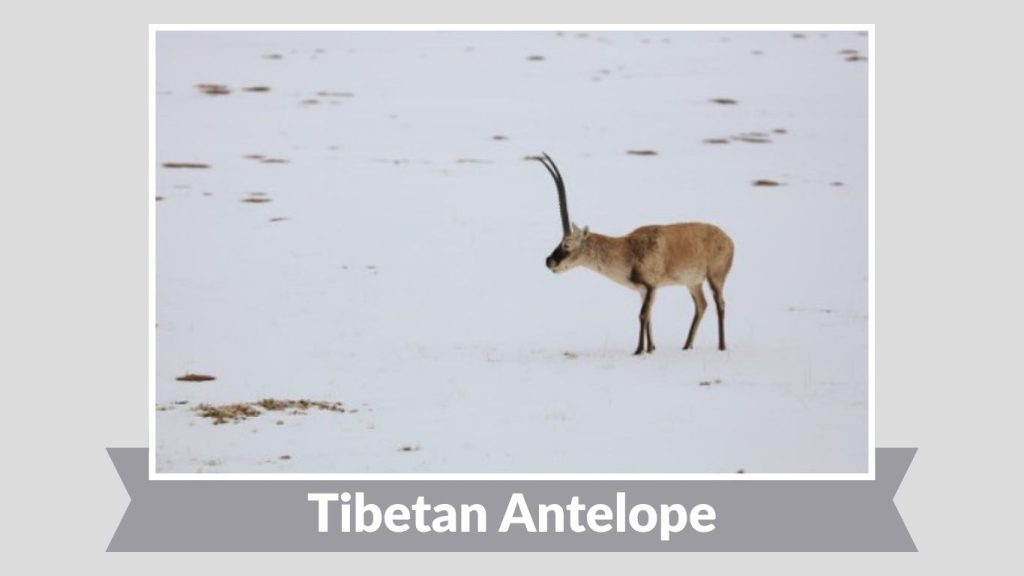
The Tibetan antelope, also known as the chiru, is a graceful and fast-running mammal native to the high-altitude plateaus of Central Asia. Perfectly adapted to extreme cold and thin air, it is best known for its fine underwool called shahtoosh, which unfortunately led to severe poaching in the past. Strong conservation measures have helped its populations recover, making it an important symbol of successful wildlife protection.
Identification
- Scientific name: Pantholops hodgsonii
- Common name: Tibetan antelope
- Coat color: Pale brown to reddish with a white underside
- Body length: 120–140 cm
- Weight: 26–40 kg
- Distinctive features: Slender body, black facial markings, long pointed horns in males
Habitat
Tibetan antelopes inhabit the cold, arid highlands of the Tibetan Plateau, mainly in China, India, and Nepal. They are found at elevations between 3,700 and 5,500 meters. Their habitat consists of alpine meadows, open plains, and rolling plateaus with sparse vegetation, where few large mammals can survive.
Behaviors
Tibetan antelopes are social animals and often form large herds, especially during seasonal migrations. Females are known for long-distance migrations to traditional calving grounds. They are extremely alert and fast, relying on speed and endurance to escape predators rather than aggression.
Diet and Lifespan
Tibetan antelopes are herbivores, feeding on grasses, herbs, and low-growing shrubs. In the wild, they generally live 10–15 years, depending on environmental conditions and predation pressures.
22. Asiatic Cheetah
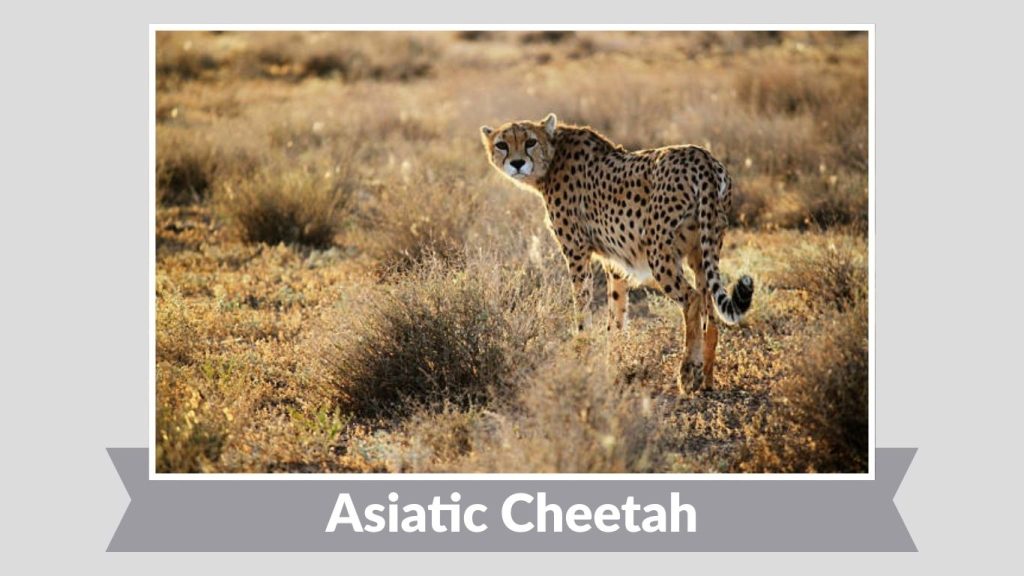
The Asiatic cheetah is one of the rarest big cats in the world and a critically endangered subspecies of cheetah. Once widespread across Asia, it now survives in very small numbers, mainly in Iran. Known for its incredible speed and slender build, the Asiatic cheetah is a specialized hunter adapted to open landscapes. Its survival is a major focus of global conservation concern.
Identification
- Scientific name: Acinonyx jubatus venaticus
- Common name: Asiatic cheetah
- Coat color: Pale yellow with black spots
- Body length: 110–150 cm
- Weight: 34–54 kg
- Distinctive features: Slim body, long legs, black tear marks on face
Habitat
Asiatic cheetahs inhabit arid and semi-arid regions, including deserts, dry grasslands, and open plains. Historically found across the Middle East and South Asia, they are now restricted mainly to remote regions of Iran. These habitats provide open visibility, which is essential for their high-speed hunting style.
Behaviors
Asiatic cheetahs are mostly solitary, with males sometimes forming small coalitions. They rely on sight rather than scent to locate prey and hunt mainly during the day to avoid competition with other predators. Unlike other big cats, cheetahs cannot roar and communicate using chirps and purrs.
Diet and Lifespan
Asiatic cheetahs are carnivores that primarily prey on small to medium-sized ungulates such as gazelles. In the wild, they typically live 10–12 years, although survival rates are much lower due to limited population size and human pressures.
23. Sloth Bear
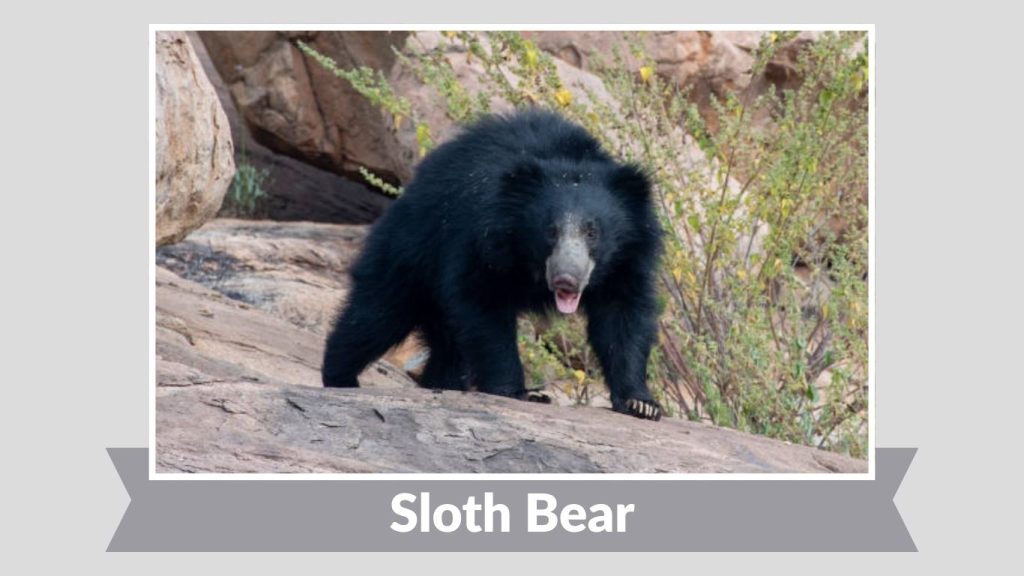
The sloth bear is a shaggy-coated bear species native to the Indian subcontinent. It is easily recognized by its long, curved claws, messy fur, and distinctive feeding behavior, especially its loud slurping sounds while eating insects. Unlike many other bears, the sloth bear is mainly adapted for feeding on termites and ants. Although generally shy, it can be aggressive when surprised.
Identification
- Scientific name: Melursus ursinus
- Common name: Sloth bear
- Coat color: Black with a white or cream chest mark
- Body length: 140–190 cm
- Weight: 55–145 kg
- Distinctive features: Long shaggy fur, long curved claws, flexible lips
Habitat
Sloth bears are found mainly in India, Sri Lanka, and Nepal. They inhabit dry and moist forests, grasslands, and scrublands. These environments provide abundant termite mounds, fruiting trees, and shelter. Sloth bears often use caves, dense vegetation, or termite mounds for resting.
Behaviors
Sloth bears are mostly nocturnal and solitary. They have a strong sense of smell and use it to locate insects underground. When feeding on termites, they tear open mounds with their claws and suck insects in with loud noises. Mothers are highly protective and often carry cubs on their backs.
Diet and Lifespan
Sloth bears are omnivores, feeding mainly on termites, ants, fruits, honey, and occasionally small vertebrates. In the wild, they typically live 20–25 years, with similar lifespans in protected areas.
24. Proboscis Monkey
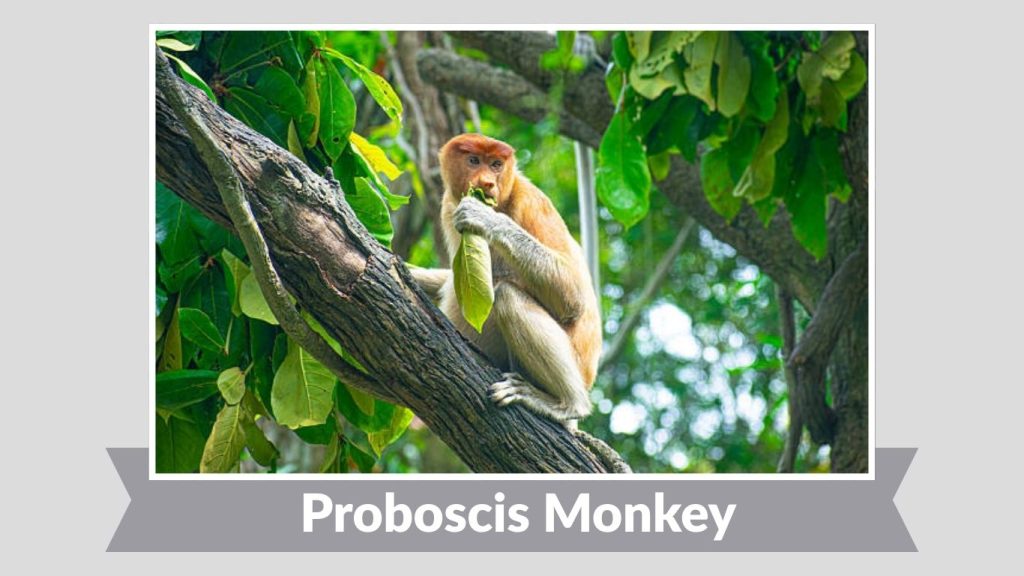
The proboscis monkey is a unique and easily recognizable primate known for its large, pendulous nose, especially in adult males. Native to the island of Borneo, this monkey is closely associated with riverine and coastal habitats. Its unusual appearance, combined with complex social behavior, makes it one of Asia’s most distinctive mammals. Proboscis monkeys are important for seed dispersal and forest health.
Identification
- Scientific name: Nasalis larvatus
- Common name: Proboscis monkey
- Coat color: Reddish-brown with gray limbs
- Body length: 66–76 cm
- Weight: Males 16–24 kg, females 7–12 kg
- Distinctive features: Large nose in males, pot-bellied appearance, long tail
Habitat
Proboscis monkeys are found only on the island of Borneo, in Malaysia, Indonesia, and Brunei. They inhabit mangrove forests, riverbanks, swamp forests, and coastal lowlands. These habitats provide abundant leaves and fruits, as well as easy access to water, which proboscis monkeys use to escape predators.
Behaviors
Proboscis monkeys live in social groups that may include one male with several females or larger mixed groups. They are diurnal and spend much of their time feeding and resting in trees near water. Strong swimmers, they can leap into rivers and swim efficiently using their partially webbed feet.
Diet and Lifespan
Proboscis monkeys are mainly herbivores, feeding on young leaves, seeds, and unripe fruits. Their specialized stomach helps digest fibrous plant material. In the wild, they generally live 15–20 years.
25. Indian Pangolin
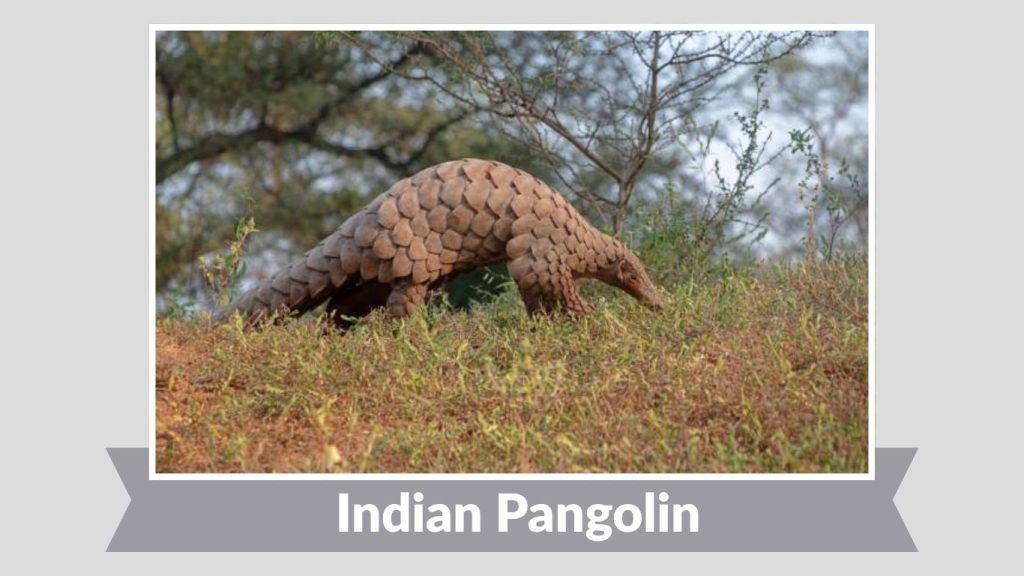
The Indian pangolin is a shy, nocturnal mammal best known for its protective armor made of overlapping keratin scales. Often called a “scaly anteater,” it curls into a tight ball when threatened, using its scales as defense. Native to the Indian subcontinent, the Indian pangolin plays an important role in controlling insect populations. Sadly, it is one of the most trafficked mammals in the world due to illegal hunting.
Identification
- Scientific name: Manis crassicaudata
- Common name: Indian pangolin
- Body color: Brown with large overlapping scales
- Body length: 84–122 cm (including tail)
- Weight: 10–16 kg
- Distinctive features: Hard keratin scales, long sticky tongue, strong claws
Habitat
Indian pangolins are found in India, Sri Lanka, Nepal, Pakistan, and Bangladesh. They inhabit forests, grasslands, agricultural areas, and scrublands. They prefer regions with loose soil suitable for digging burrows and areas rich in ants and termites, their primary food source.
Behaviors
Indian pangolins are solitary and mostly nocturnal. During the day, they rest in deep burrows, emerging at night to forage. They rely heavily on their sense of smell to locate insect nests. When threatened, they roll into a ball and may release a strong-smelling secretion as an additional defense.
Diet and Lifespan
Indian pangolins are insectivores, feeding mainly on ants and termites, which they capture using their long, sticky tongue. They do not have teeth and swallow small stones to aid digestion. In the wild, they typically live 15–20 years.
26. Hoolock Gibbon
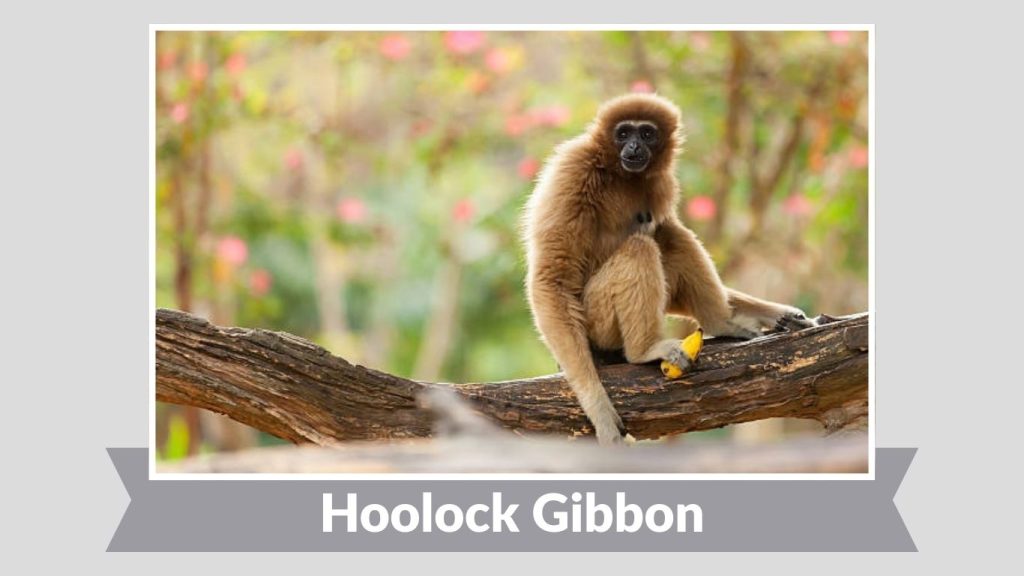
The hoolock gibbon is a lively and agile ape native to the forests of Northeast India, Bangladesh, and Myanmar. It is the only ape species found in India and is known for its loud, melodic calls that echo through the forest canopy. Hoolock gibbons play an important role in seed dispersal and are considered indicators of healthy forest ecosystems. Sadly, they are threatened by habitat loss and fragmentation.
Identification
- Scientific name: Hoolock (genus)
- Common name: Hoolock gibbon
- Coat color: Black in males; brown or grayish in females
- Body length: 60–90 cm
- Weight: 6–9 kg
- Distinctive features: Long arms, white facial markings, tailless body
Habitat
Hoolock gibbons inhabit tropical and subtropical evergreen forests in Northeast India, Bangladesh, and western Myanmar. They live almost entirely in the forest canopy, relying on continuous tree cover for movement. These forests provide fruits, leaves, and safe sleeping sites high above the ground.
Behaviors
Hoolock gibbons live in small family groups consisting of a monogamous pair and their offspring. They are diurnal and extremely territorial. Their loud morning songs help strengthen pair bonds and warn neighboring groups. They move through trees using brachiation, swinging gracefully from branch to branch with great speed.
Diet and Lifespan
Hoolock gibbons are mainly frugivores, feeding on fruits, along with leaves, flowers, and insects. In the wild, they typically live 25–30 years under natural conditions.
27. Markhor
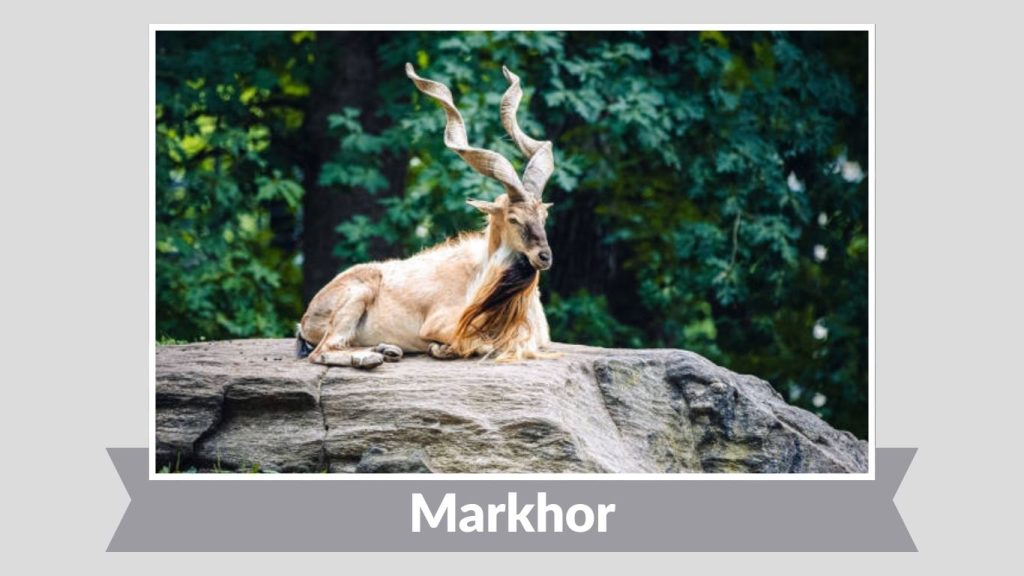
The markhor is a large and striking wild goat known for its impressive, spiraled horns. Native to the mountainous regions of Central and South Asia, it is the national animal of Pakistan and a symbol of rugged mountain wilderness. Markhors are highly adapted to steep, rocky terrain and play an important role in maintaining the balance of mountain ecosystems.
Identification
- Scientific name: Capra falconeri
- Common name: Markhor
- Coat color: Brown to gray with lighter underparts
- Body length: 130–170 cm
- Weight: 40–110 kg
- Distinctive features: Long corkscrew-shaped horns, shaggy mane on males
Habitat
Markhors inhabit mountainous regions of Pakistan, India, Afghanistan, Tajikistan, and Uzbekistan. They live in rugged terrain such as steep cliffs, rocky slopes, and open woodlands at elevations between 600 and 3,600 meters. These areas provide natural protection from predators and access to seasonal vegetation.
Behaviors
Markhors are generally active during early morning and late afternoon. They live in small herds, with males often separating from females outside the breeding season. Excellent climbers, they can navigate extremely steep and narrow ledges. During the mating season, males engage in horn displays and fights to establish dominance.
Diet and Lifespan
Markhors are herbivores, feeding on grasses, leaves, shrubs, and herbs. In the wild, they typically live 12–15 years, although some individuals may live longer in protected areas.
28. Nilgai
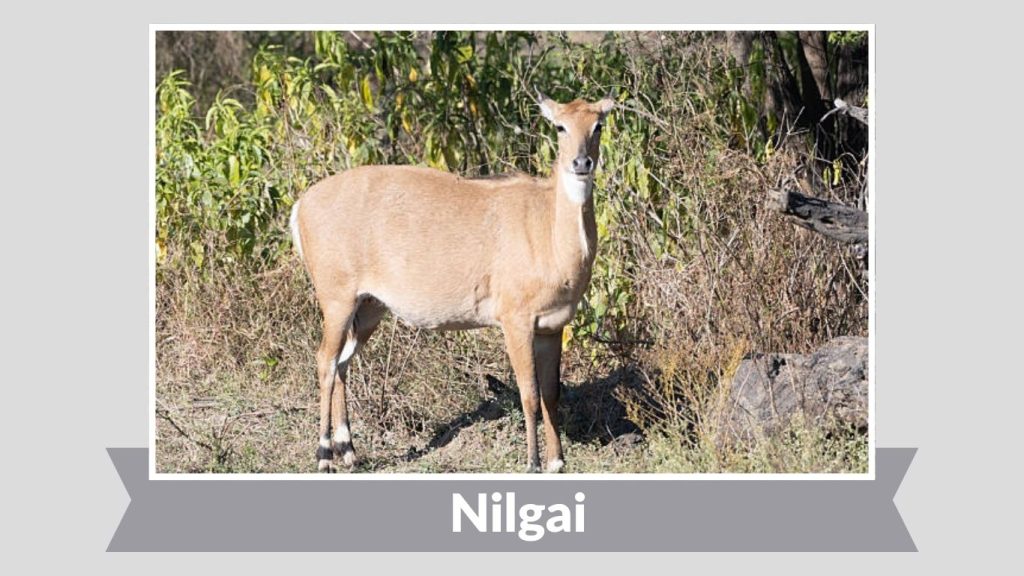
The nilgai, also known as the blue bull, is the largest antelope species in Asia. Native to the Indian subcontinent, it is well adapted to open landscapes and is often seen near agricultural areas. Despite being an antelope, its sturdy build and coloration give it a bull-like appearance. Nilgai play an important role in grassland and scrub ecosystems but are sometimes considered crop pests due to their feeding habits.
Identification
- Scientific name: Boselaphus tragocamelus
- Common name: Nilgai
- Coat color: Bluish-gray in adult males, light brown in females
- Body length: 180–200 cm
- Weight: Males 180–240 kg, females 120–160 kg
- Distinctive features: Short straight horns in males, white markings on legs and face
Habitat
Nilgai are found mainly in India, Nepal, and parts of Pakistan. They inhabit grasslands, scrub forests, open woodlands, and agricultural landscapes. They prefer areas with a mix of open space and tree cover, which provide both grazing opportunities and shelter.
Behaviors
Nilgai are diurnal and usually seen in small groups, although larger herds may form seasonally. Males are more solitary and territorial, especially during the breeding season. They are strong runners and rely on speed and alertness to escape predators rather than camouflage or hiding.
Diet and Lifespan
Nilgai are herbivores, feeding on grasses, herbs, leaves, and crops. In the wild, they typically live 15–20 years, depending on environmental conditions and human interaction.
29. Asian Palm Civet
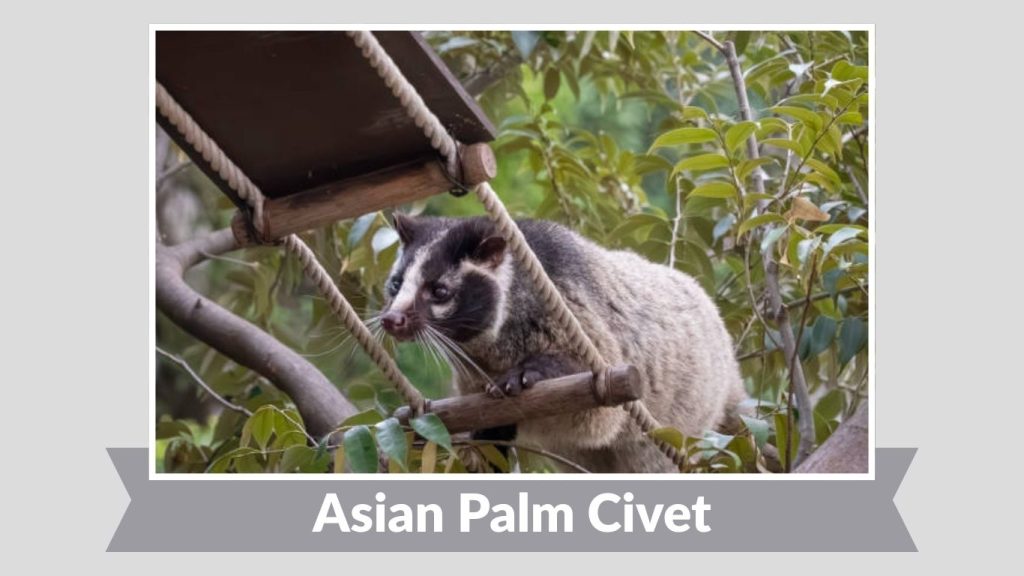
The Asian palm civet is a small, nocturnal mammal often found near forests and human settlements. Sometimes called the toddy cat, it is known for its role in seed dispersal and, controversially, in the production of kopi luwak coffee. Despite its cat-like appearance, it belongs to the civet family and plays an important role in maintaining forest ecosystems.
Identification
- Scientific name: Paradoxurus hermaphroditus
- Common name: Asian palm civet
- Coat color: Grayish-brown with darker markings
- Body length: 43–71 cm
- Tail length: 40–66 cm
- Weight: 2–5 kg
- Distinctive features: Long tail, pointed face, mask-like facial markings
Habitat
Asian palm civets are widely distributed across South and Southeast Asia. They inhabit forests, plantations, gardens, and even urban edges. Their adaptability allows them to survive in disturbed habitats as long as food and shelter are available.
Behaviors
Asian palm civets are solitary and nocturnal. During the day, they rest in tree hollows, roofs, or dense vegetation. They are good climbers and spend time both in trees and on the ground. Communication includes scent marking and vocal sounds, especially during mating periods.
Diet and Lifespan
Asian palm civets are omnivores, feeding on fruits, berries, insects, small vertebrates, and occasionally human food waste. In the wild, they typically live 15–20 years under favorable conditions.
30. Fishing Cat
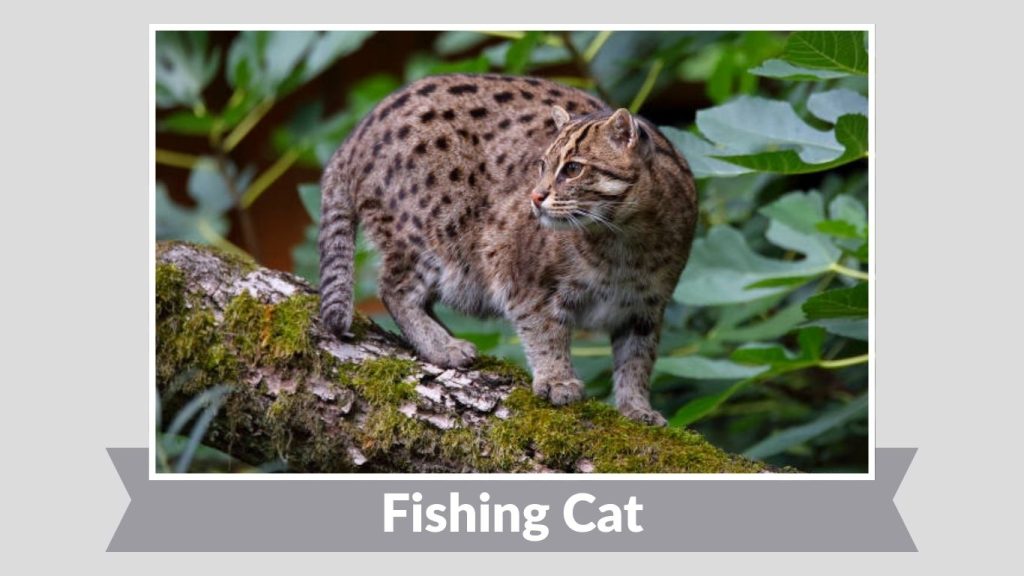
The fishing cat is a medium-sized wild cat uniquely adapted for life near water. Native to South and Southeast Asia, it is an excellent swimmer and a skilled hunter of aquatic prey. Unlike most cats, the fishing cat readily enters water to catch food, making it one of the most distinctive feline species in Asia. Wetland loss and pollution pose serious threats to its survival.
Identification
- Scientific name: Prionailurus viverrinus
- Common name: Fishing cat
- Coat color: Grayish-olive with dark spots and stripes
- Body length: 57–78 cm
- Tail length: 20–30 cm
- Weight: 8–16 kg
- Distinctive features: Stocky build, short tail, partially webbed feet
Habitat
Fishing cats are found in wetlands across India, Bangladesh, Sri Lanka, Nepal, Thailand, and parts of Southeast Asia. They inhabit marshes, swamps, mangroves, riversides, and floodplains. Dense vegetation near water bodies is essential, as it provides cover for hunting and resting.
Behaviors
Fishing cats are mostly nocturnal and solitary. They hunt by patiently waiting near water edges or slowly stalking prey in shallow water. Strong swimmers, they use their partially webbed feet to move efficiently in water. They communicate using scent markings and low vocal sounds.
Diet and Lifespan
Fishing cats primarily feed on fish, but their diet also includes frogs, crustaceans, birds, and small mammals. In the wild, they typically live 10–12 years, with slightly longer lifespans recorded in protected environments.
31. Golden Langur
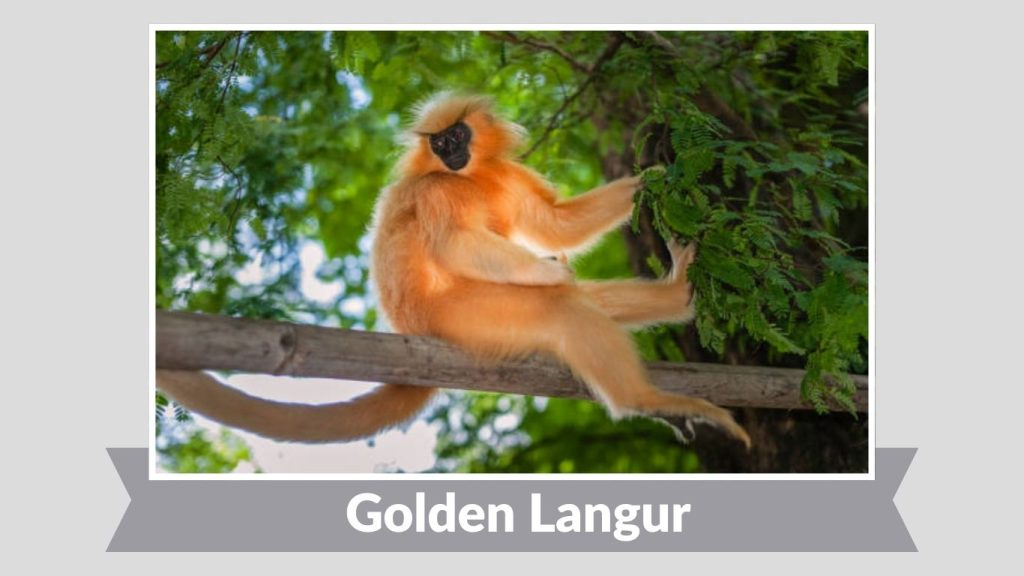
The golden langur is a rare and striking monkey known for its silky golden-blond fur. Native to a small region of northeastern India and Bhutan, it is considered one of the most beautiful primates in Asia. Golden langurs are important for forest regeneration through seed dispersal, but their limited range makes them highly vulnerable to habitat loss and fragmentation.
Identification
- Scientific name: Trachypithecus geei
- Common name: Golden langur
- Coat color: Golden to creamy white
- Body length: 50–75 cm
- Tail length: 70–100 cm
- Weight: 9–12 kg
- Distinctive features: Long tail, black face, thick silky fur
Habitat
Golden langurs inhabit subtropical and tropical forests along the border of India and Bhutan, particularly in Assam and southern Bhutan. They prefer evergreen and semi-evergreen forests with tall trees and dense canopies. These forests provide leaves, fruits, and safe pathways for movement.
Behaviors
Golden langurs live in social groups that may include several females, their offspring, and one or more males. They are diurnal and arboreal, spending most of their time in the forest canopy. Communication involves vocal calls, facial expressions, and body posture. They move gracefully through trees using leaping and climbing.
Diet and Lifespan
Golden langurs are mainly folivores, feeding on young leaves, along with fruits, flowers, and seeds. Their specialized stomach helps digest fibrous plant material. In the wild, they typically live 20–25 years.
32. Himalayan Monal
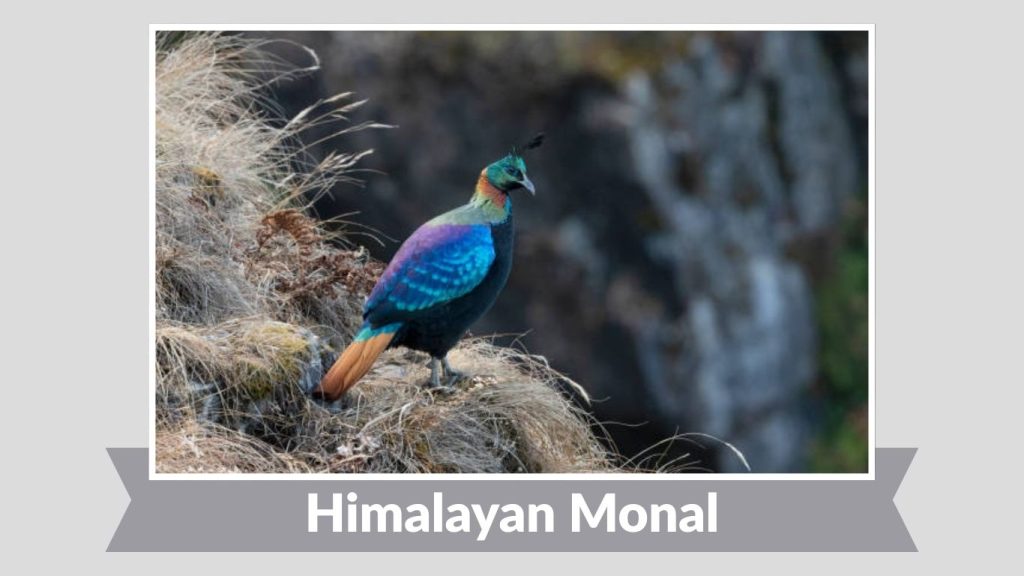
The Himalayan monal is a brilliantly colored pheasant native to the Himalayan mountain range. Known for its iridescent plumage and striking metallic hues, it is the national bird of Nepal. This bird plays an important role in mountain forest ecosystems by aiding in seed dispersal and soil disturbance while foraging.
Identification
- Scientific name: Lophophorus impejanus
- Common name: Himalayan monal
- Body color: Males display iridescent blue, green, copper, and purple; females are brown and mottled
- Body length: 60–70 cm
- Weight: 2–2.5 kg
- Distinctive features: Metallic feathers, green crest in males
Habitat
Himalayan monals are found across the Himalayas, including Nepal, India, Bhutan, and Pakistan. They inhabit alpine meadows, coniferous forests, and rocky slopes at elevations between 2,100 and 4,500 meters. These regions provide seasonal food and nesting sites.
Behaviors
Himalayan monals are usually seen alone or in pairs, although small groups may form outside the breeding season. They are strong fliers but spend much of their time on the ground foraging. When disturbed, they take off suddenly with loud wingbeats. They are most active during early morning and late afternoon.
Diet and Lifespan
Himalayan monals are omnivores, feeding on roots, tubers, seeds, insects, and berries. In the wild, they typically live 10–12 years, depending on environmental conditions.
33. Indian Wolf
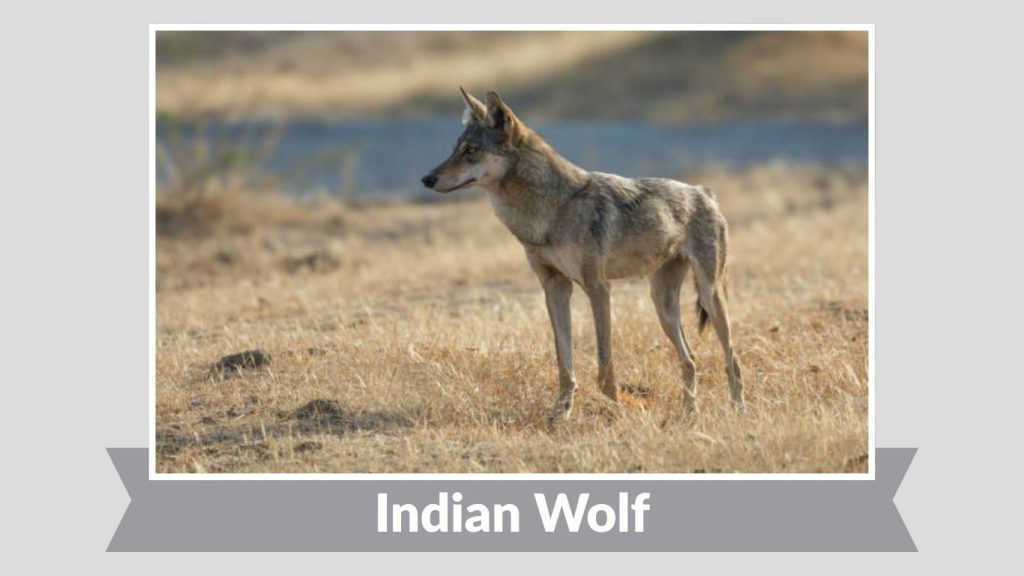
The Indian wolf is a lean, highly adaptable subspecies of the gray wolf, native to the Indian subcontinent. It is one of the oldest wolf lineages and is well adapted to hot, dry environments. Often misunderstood and persecuted, the Indian wolf plays a crucial role in controlling herbivore populations and maintaining ecological balance in grassland and scrub ecosystems.
Identification
- Scientific name: Canis lupus pallipes
- Common name: Indian wolf
- Coat color: Gray to brown with lighter underparts
- Body length: 100–120 cm
- Weight: 18–30 kg
- Distinctive features: Slender build, long legs, narrow muzzle
Habitat
Indian wolves inhabit grasslands, scrublands, semi-arid plains, and open forests across India, Pakistan, and parts of the Middle East. Unlike many wolf populations, they often live outside protected areas and coexist near human settlements, relying on open terrain for hunting.
Behaviors
Indian wolves are social animals that live in small packs or family groups. They are mostly nocturnal or crepuscular, especially in warmer regions. Communication includes howling, growling, and scent marking. They are intelligent, cautious, and capable of traveling long distances in search of food.
Diet and Lifespan
Indian wolves are carnivores, feeding on antelope, rodents, hares, and occasionally livestock. In the wild, they typically live 8–13 years, depending on environmental pressures and human conflict.
34. Smooth-coated Otter
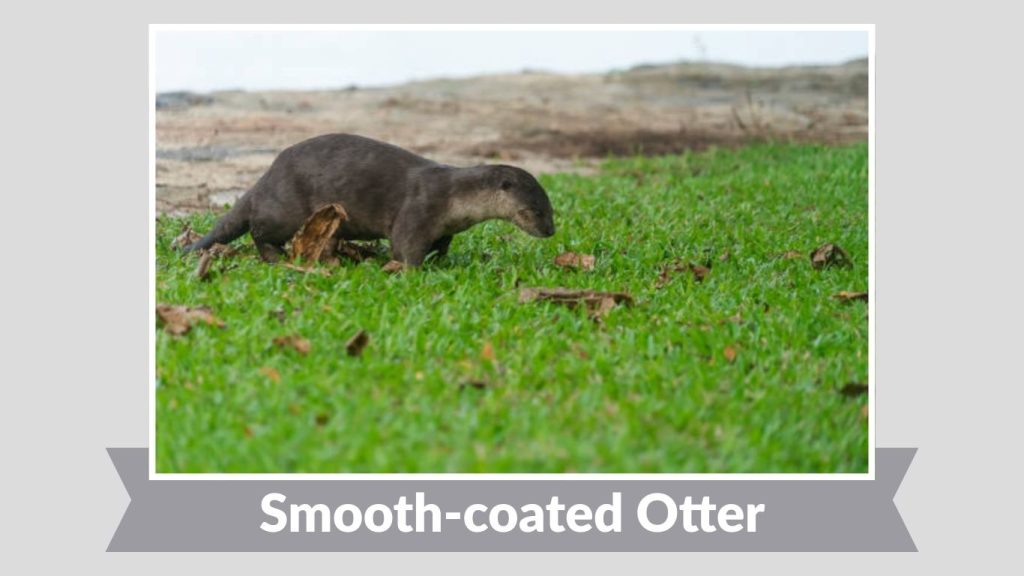
The smooth-coated otter is a social and highly playful aquatic mammal found across parts of South and Southeast Asia. It is named for its short, sleek fur, which is smoother than that of other otter species. Living closely around rivers and wetlands, this otter plays an important role in maintaining healthy aquatic ecosystems. However, habitat destruction and water pollution are major threats to its survival.
Identification
- Scientific name: Lutrogale perspicillata
- Common name: Smooth-coated otter
- Coat color: Brown to dark brown with a lighter underside
- Body length: 59–64 cm
- Tail length: 37–43 cm
- Weight: 7–11 kg
- Distinctive features: Smooth short fur, broad head, strong flattened tail
Habitat
Smooth-coated otters inhabit rivers, lakes, marshes, mangroves, and coastal wetlands across India, Sri Lanka, Nepal, Bangladesh, and Southeast Asia. They prefer large water bodies with abundant fish and vegetated banks for resting and breeding. Clean water and stable river systems are crucial for their survival.
Behaviors
These otters are highly social and often live in family groups. They are diurnal and very active, spending much of the day swimming, grooming, and playing. Smooth-coated otters communicate using whistles, chirps, and body signals. They are intelligent and cooperative hunters, often working together to herd fish.
Diet and Lifespan
Smooth-coated otters mainly feed on fish, along with crustaceans, amphibians, and small aquatic animals. In the wild, they typically live 10–14 years, while individuals in protected environments may live longer.
35. Indian Star Tortoise
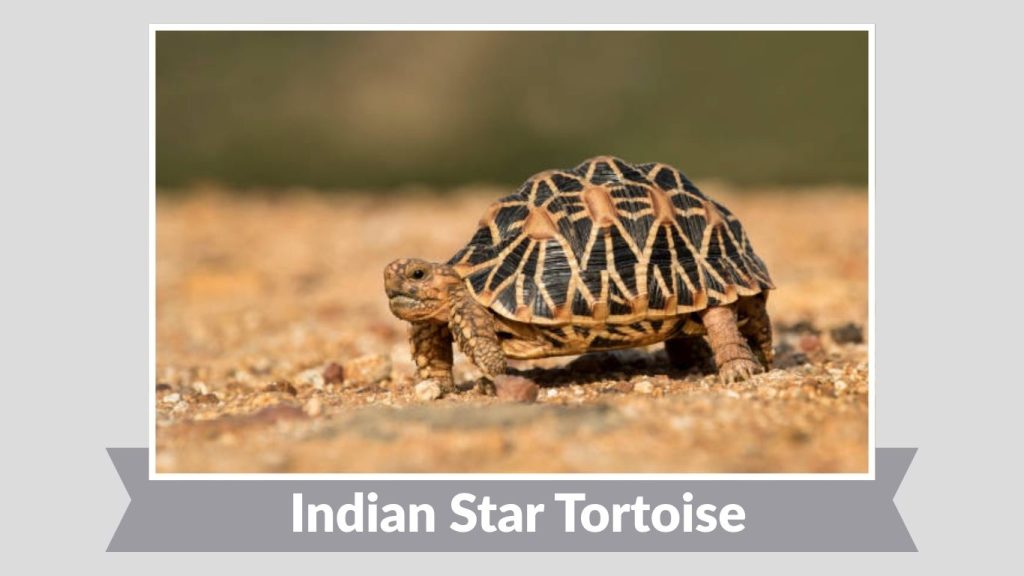
The Indian star tortoise is a beautifully patterned reptile known for the star-like markings on its shell. Native to the dry regions of the Indian subcontinent, it is highly adapted to arid and semi-arid environments. Due to its attractive appearance, it has been heavily targeted for the illegal pet trade, making conservation efforts increasingly important.
Identification
- Scientific name: Geochelone elegans
- Common name: Indian star tortoise
- Shell color: Dark brown or black with yellow star-shaped patterns
- Shell length: 25–35 cm
- Weight: 1–2 kg
- Distinctive features: High-domed shell with radiating star patterns
Habitat
Indian star tortoises are found in India, Sri Lanka, and parts of Pakistan. They inhabit dry grasslands, scrub forests, and semi-arid regions with sparse vegetation. These habitats provide shelter, basking areas, and access to seasonal plants.
Behaviors
Indian star tortoises are mostly solitary and active during cooler parts of the day. They spend much of their time grazing or resting under vegetation to avoid extreme heat. During very hot or dry periods, they may remain inactive for extended durations to conserve energy and moisture.
Diet and Lifespan
Indian star tortoises are herbivores, feeding on grasses, leaves, flowers, and fallen fruits. In the wild, they can live 30–40 years, and in protected conditions, some individuals may live even longer.
FAQs
What makes Asian animals unique compared to other regions?
Asian animals are unique due to the continent’s wide range of climates and habitats, from tropical rainforests to high mountain plateaus. This diversity has led to highly specialized species such as the snow leopard, which is adapted to cold, high altitudes, and the Komodo dragon, which thrives on isolated islands. Many Asian animals also have strong cultural and religious significance.
Are many Asian animals endangered?
Yes, a large number of Asian animals are endangered or threatened. Habitat loss, deforestation, illegal wildlife trade, and human–animal conflict are major causes. Species like the Asiatic cheetah, Indian pangolin, and Asian elephant are particularly at risk, although conservation efforts have helped some populations recover.
Which Asian animals are most adapted to extreme environments?
Several Asian animals are adapted to extreme conditions. The yak and Tibetan antelope survive in cold, low-oxygen highlands, while the camel and desert fox thrive in hot, arid regions. These animals have evolved physical and behavioral traits that help them cope with harsh climates.
Why are Asian animals important for ecosystems?
Asian animals play vital roles in maintaining ecological balance. Predators control prey populations, herbivores shape vegetation, and animals like elephants, bears, and primates help disperse seeds. Without them, ecosystems can become unstable and lose biodiversity.
How can people help protect Asian wildlife?
People can help by supporting conservation organizations, avoiding products made from endangered animals, promoting sustainable practices, and spreading awareness about wildlife protection. Responsible tourism and habitat conservation also play key roles in safeguarding Asian animals for future generations.