





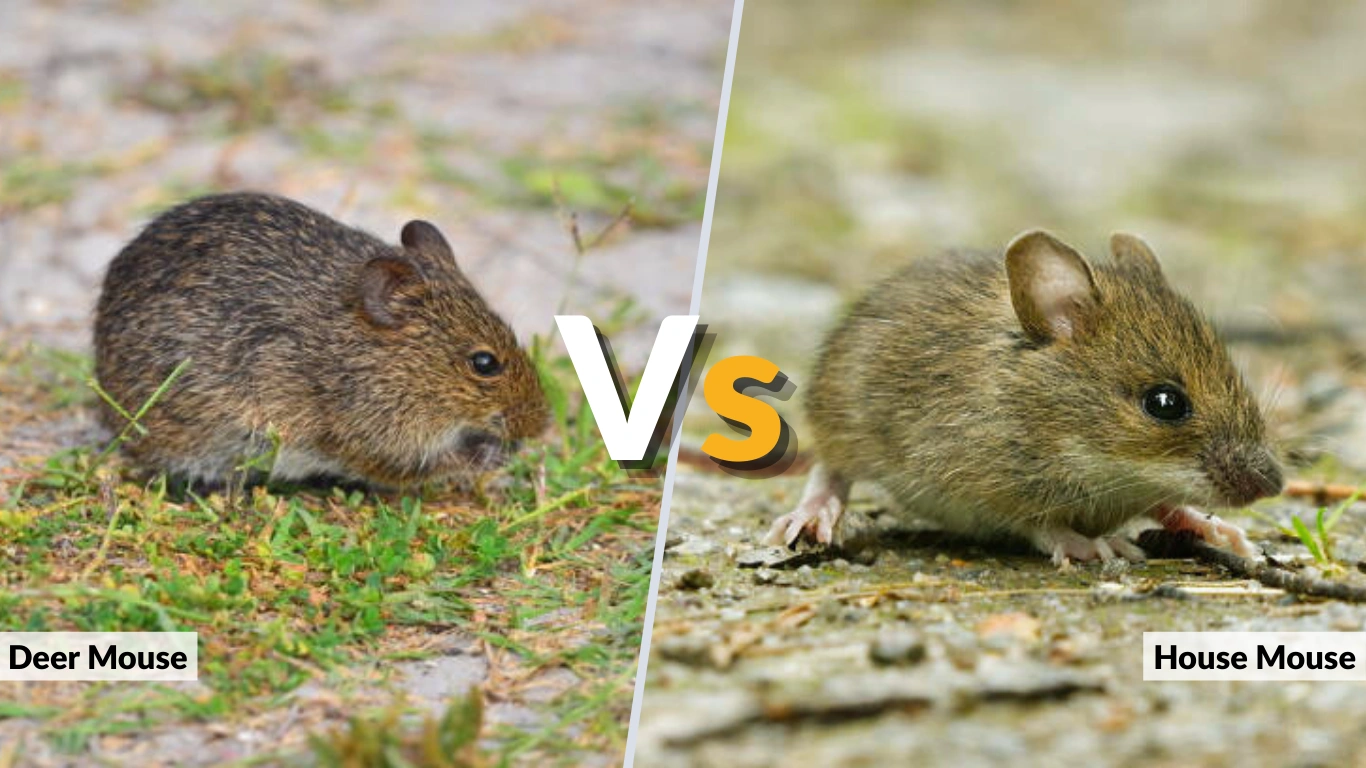
Deer mice and house mice are often confused because they are similar in size and both may appear around human structures. However, they belong to different species and behave very differently. Deer mice are primarily wild rodents that sometimes enter cabins or rural homes, while house mice are true domestic pests that thrive indoors. Understanding the differences is important for health safety, proper control methods, and accurate identification, especially because disease risks and infestation patterns are not the same.
Deer Mouse vs House Mouse: Quick Comparison
| Feature | Deer Mouse | House Mouse |
| Scientific name | Peromyscus maniculatus | Mus musculus |
| Typical habitat | Forests, fields, rural areas | Homes, cities, farms |
| Body color | Brown/gray with white belly | Gray or light brown overall |
| Belly contrast | Very sharp white underside | Little to no contrast |
| Tail | Two-colored (dark top, white bottom) | Single-colored, scaly |
| Eyes | Large and prominent | Smaller and less rounded |
| Relationship with humans | Accidental indoor visitor | Permanent indoor pest |
| Major health concern | Hantavirus | Food contamination, bacteria |
What Is a Deer Mouse?
Scientific Classification and Overview
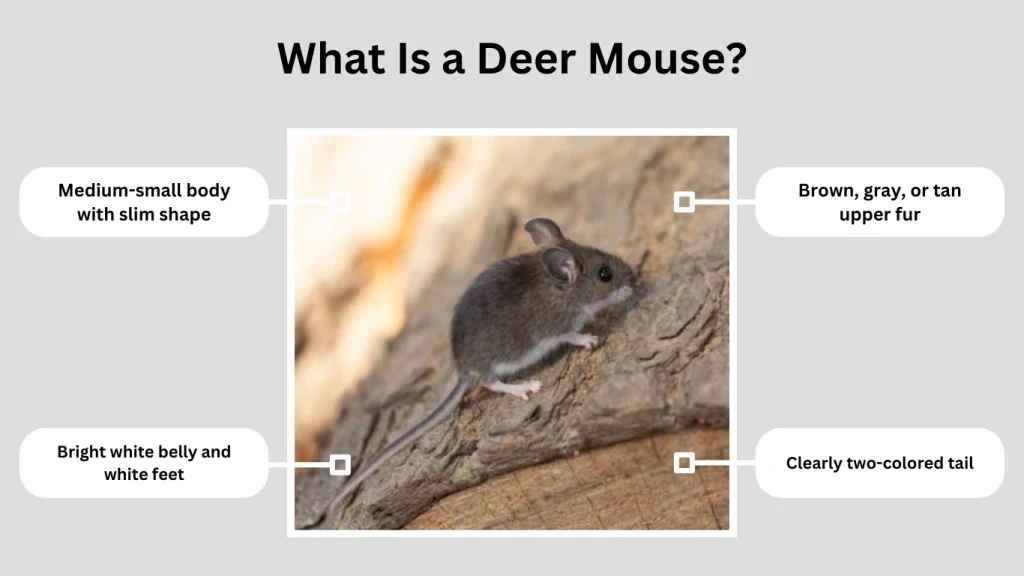
The deer mouse (Peromyscus maniculatus) is a small wild rodent native to North America. It is one of the most widespread mammals on the continent, living in forests, grasslands, deserts, and agricultural regions. Unlike house mice, deer mice evolved in natural ecosystems and play an important role as seed dispersers and prey animals. They are agile climbers and strong jumpers, which helps them survive in diverse outdoor environments.
Identification Features of Deer Mouse
- Medium-small body with slim shape
- Brown, gray, or tan upper fur
- Bright white belly and white feet
- Clearly two-colored tail
- Large black eyes
- Prominent ears
- Soft, fine fur texture
- Droppings similar to rice grains
Natural Habitat and Distribution
Deer mice are found across most of North America, from Canada to Mexico. They prefer fields, woodlands, rocky slopes, barns, and forest edges. Although mainly outdoor animals, they may enter cabins, sheds, or rural homes during cold months. Indoors, they usually build temporary nests rather than permanent colonies.
Behavior and Lifestyle
Deer mice are nocturnal and highly active at night. They are excellent climbers and can leap impressive distances. In the wild, they store seeds, nuts, and insects. They usually live alone or in small family groups. Indoors, they are cautious and tend to avoid open spaces, often staying close to walls and hidden areas.
What Is a House Mouse?
Scientific Classification and Overview
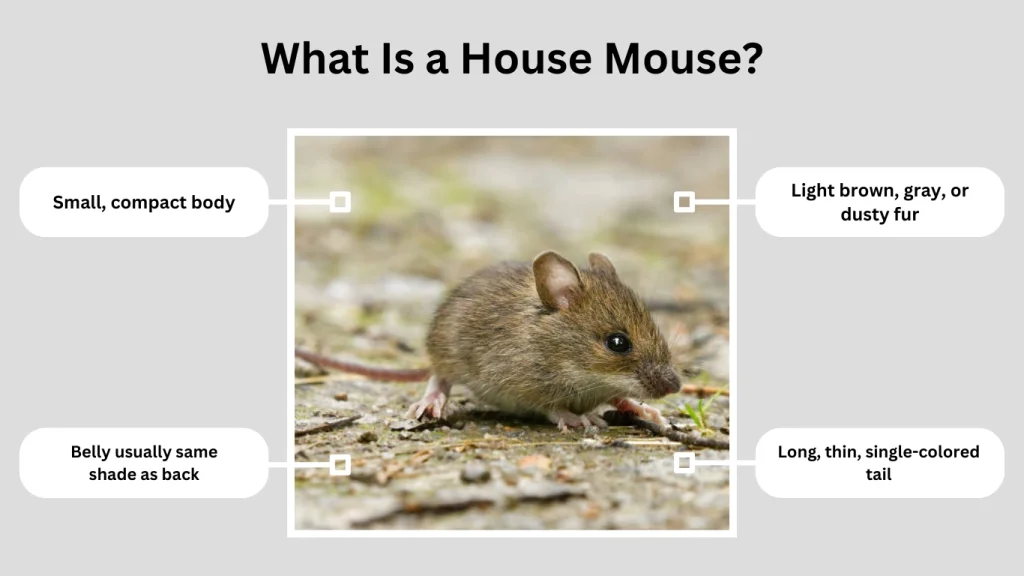
The house mouse (Mus musculus) is one of the most successful mammals on Earth. It originally evolved in Asia but now lives worldwide alongside humans. Unlike deer mice, house mice depend heavily on human structures for shelter and food. They are true commensal rodents, meaning they thrive in homes, restaurants, warehouses, and farms.
Identification Features of House Mouse
- Small, compact body
- Light brown, gray, or dusty fur
- Belly usually same shade as back
- Long, thin, single-colored tail
- Smaller eyes relative to head
- Shorter ears than deer mice
- Slight musky odor
- Smooth, sparse fur texture
Common Living Environments
House mice are strongly associated with buildings. They live inside walls, ceilings, kitchens, storage rooms, and appliances. Outdoors, they may survive near garbage areas, crops, or animal feed, but they usually move indoors quickly. Once inside, they establish long-term nests close to food and warmth.
Behavior and Daily Activity
House mice are active year-round and breed extremely fast. A single pair can produce dozens of offspring in one year. They constantly gnaw to control tooth growth and contaminate food with urine and droppings. They are less fearful of human environments than deer mice and often move openly along walls and pipes.
Deer Mouse vs House Mouse: Physical Differences

Size, Fur, and Body Shape
Both species are similar in length, but deer mice usually appear more delicate with softer fur and longer legs. House mice tend to look rounder with smoother coats. The most noticeable difference is the belly: deer mice have a bright white underside, while house mice are usually one solid color.
Deer Mouse vs House Mouse: Physical Differences (Continued)
Tail, Eyes, and Ears Comparison
One of the clearest differences between deer mice and house mice is the tail. Deer mice have a sharply two-colored tail—dark on top and white underneath—while house mice have a single-colored, scaly tail. Deer mice also have noticeably larger black eyes and bigger ears, giving them a more rounded, almost squirrel-like appearance. House mice have smaller eyes, shorter ears, and a sleeker, more uniform look.
Color Patterns and Underbelly
Deer mice usually show strong contrast between their brown or gray back and their bright white belly and feet. This contrast is rarely seen in house mice, which are typically light brown, gray, or dusty black all over. The clear color separation is one of the fastest visual ways to tell them apart.
Deer Mouse vs House Mouse: Habitat and Range

- Deer mice mainly live in forests, grasslands, farms, and natural outdoor environments.
- House mice are closely tied to human buildings and urban areas.
- Deer mice enter homes seasonally, especially cabins, barns, and rural houses.
- House mice establish permanent indoor colonies.
- Deer mice build temporary nests indoors, while house mice create long-term nesting networks.
Deer mice are widespread across North America, while house mice are found almost everywhere humans live. Seeing repeated activity deep inside kitchens or walls usually suggests house mice rather than deer mice.
Behavioral Differences Between Deer Mice and House Mice
Activity Patterns
Deer mice are excellent climbers and jumpers, often found on shelves, beams, and stored items. They are cautious and tend to flee quickly when disturbed. House mice move rapidly along walls and floors and adapt easily to human routines.
Breeding Speed and Population Growth
House mice reproduce extremely fast, which is why infestations can explode within weeks. Deer mice breed more slowly and rarely reach the dense indoor populations typical of house mice.
Interaction With Humans
Deer mice usually avoid people and open spaces, entering homes mainly for shelter. House mice show little fear of buildings, frequently traveling between nesting and feeding areas, even in active human environments.
Health Risks and Diseases
Diseases Linked to Deer Mice
Deer mice are the primary carriers of hantavirus in North America. This virus can become airborne when droppings, urine, or nests are disturbed and may cause severe respiratory illness. They can also carry plague bacteria and other pathogens in some regions.
Diseases Linked to House Mice
House mice commonly spread bacteria such as salmonella and leptospira. They contaminate food, surfaces, and packaging. While often less deadly than hantavirus, these pathogens are a frequent cause of foodborne illness and allergic reactions.
Which One Is More Dangerous?
Deer mice pose a higher risk for rare but serious diseases, while house mice present constant everyday health hazards through contamination, property damage, and long-term infestations.
Droppings, Nests, and Signs of Infestation
- Deer mouse droppings are usually slightly pointed and scattered in limited areas.
- House mouse droppings are numerous, blunt-ended, and widespread.
- Deer mice often nest in sheds, woodpiles, or stored boxes.
- House mice nest inside walls, appliances, insulation, and cabinets.
- House mice leave stronger odors, gnaw marks, and greasy rub trails.
Which Mouse Is in Your Home or Property?
Visual Identification Tips
Look closely at belly color, tail pattern, and eye size. A bright white belly and two-tone tail strongly suggest a deer mouse.
Location-Based Clues
Cabins, barns, and rural outbuildings are more likely to attract deer mice. Apartments, kitchens, and food storage areas usually indicate house mice.
When Professional Identification Is Needed
If droppings are widespread or health risks are a concern, professional pest control or local health departments can confirm species and guide safe cleanup.
Control and Prevention Methods
- Seal cracks, vents, and gaps around doors and foundations.
- Store food in metal or glass containers.
- Remove outdoor shelter like woodpiles and tall grass near buildings.
- Use snap traps instead of poison when possible.
- Wear gloves and masks when cleaning droppings, especially in cabins.
FAQs
Is a deer mouse the same as a house mouse?
No. Deer mice are wild rodents native to North America, while house mice are domestic pests that evolved to live alongside humans. They differ in appearance, behavior, habitat, and disease risks, even though they are similar in size.
Which is more dangerous, deer mouse or house mouse?
Deer mice are more dangerous in terms of severe disease because they can carry hantavirus. House mice are more dangerous in daily life because they spread bacteria, contaminate food, and create long-term infestations.
How can I tell if I have a deer mouse or house mouse?
Check the belly color and tail. Deer mice have a bright white belly and two-colored tail, while house mice are usually one color all over. Location also matters: rural cabins suggest deer mice, kitchens suggest house mice.
Do deer mice infest homes like house mice?
No. Deer mice usually enter homes temporarily, often in colder months. House mice establish permanent indoor colonies and reproduce rapidly, which leads to ongoing infestations.
Should deer mouse droppings be handled differently?
Yes. Because deer mice can carry hantavirus, droppings should never be swept or vacuumed dry. They should be sprayed with disinfectant and cleaned while wearing gloves and a mask to reduce airborne exposure.