




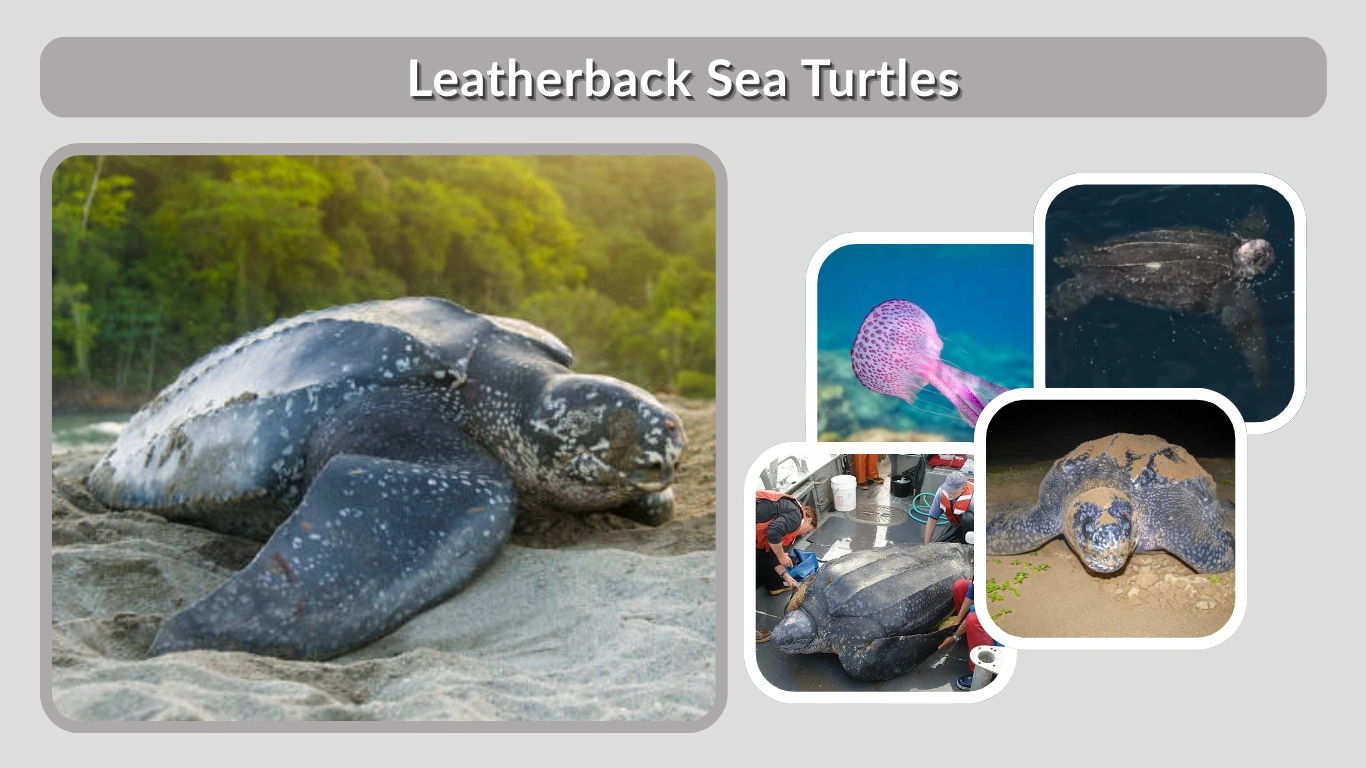
Leatherback sea turtles (Dermochelys coriacea) are the largest and most unique species of sea turtles in the world. Unlike other turtles with hard shells, leatherbacks have a flexible, leathery carapace, allowing them to dive deep into the ocean and withstand colder waters. These majestic reptiles are highly migratory, traveling thousands of miles between feeding grounds and nesting beaches. Understanding their identification, diet, habitat, behavior, and lifecycle is essential for conservation and appreciating their role in marine ecosystems.
Identification of Leatherback Sea Turtles
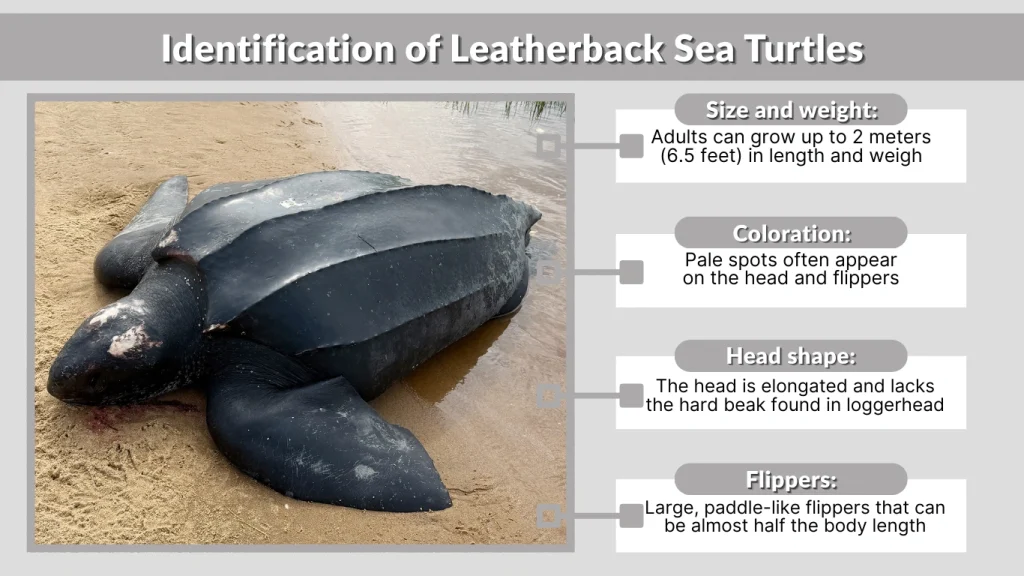
Leatherback sea turtles are easily distinguishable from other sea turtle species due to several unique features:
- Size and weight: Adults can grow up to 2 meters (6.5 feet) in length and weigh as much as 700 kilograms (1,500 pounds).
- Shell type: Covered with a dark grey or black leathery shell instead of hard scutes. The carapace has seven longitudinal ridges.
- Coloration: Pale spots often appear on the head and flippers, making them distinctive.
- Head shape: The head is elongated and lacks the hard beak found in loggerhead or hawksbill turtles.
- Flippers: Large, paddle-like flippers that can be almost half the body length; no claws on the flippers.
- Movement: Streamlined body and long flippers allow efficient gliding through open oceans.
These features make leatherbacks immediately recognizable to researchers, conservationists, and turtle enthusiasts alike.
Physical Characteristics
Leatherbacks have several adaptations that make them unique among reptiles. Their leathery, flexible shell is covered with oily, rubber-like skin instead of hard scutes. This allows them to compress their body during deep dives and navigate colder waters.
They are also partially endothermic, meaning they can maintain a body temperature higher than the surrounding water. This adaptation allows them to forage in temperate and even sub-polar waters where other sea turtles cannot survive.
Their streamlined body, long flippers, and lightweight skeleton make them highly efficient long-distance swimmers. These traits, combined with their size, allow leatherbacks to traverse thousands of miles annually, crossing entire oceans to reach feeding and nesting grounds.
Diet of Leatherback Sea Turtles
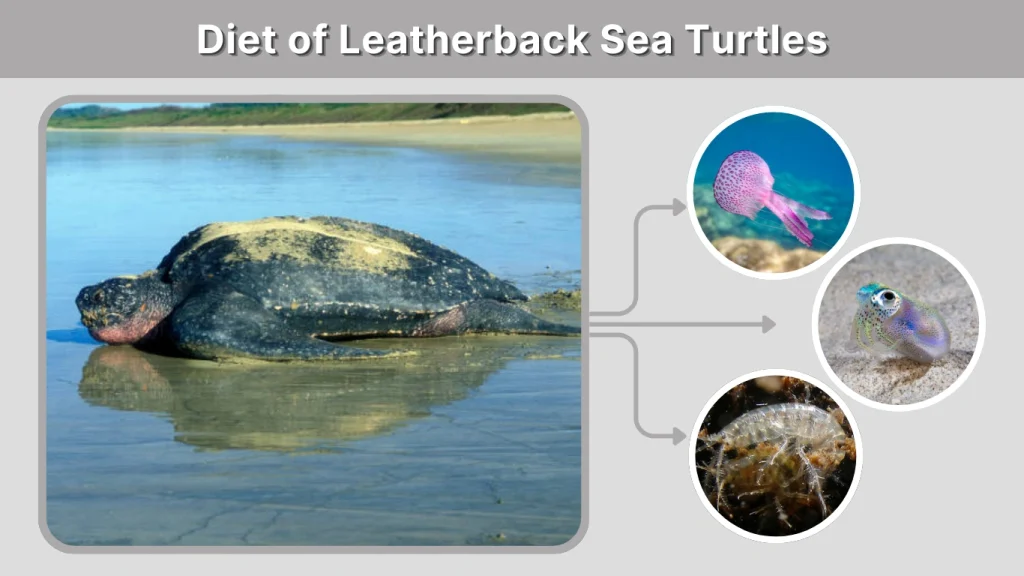
Leatherback sea turtles are primarily carnivorous, with their diet consisting almost entirely of jellyfish and other soft-bodied animals. Their sharp, backward-pointing papillae in the throat help them consume slippery jellyfish while minimizing the risk of being stung.
Occasionally, leatherbacks may consume small fish, squid, or crustaceans, but these make up a very small portion of their diet. By feeding extensively on jellyfish, leatherbacks play a vital ecological role, controlling jellyfish populations that can otherwise explode and disrupt marine ecosystems.
Their preference for gelatinous prey also means they are highly vulnerable to plastic pollution, as floating plastic bags and debris often resemble jellyfish, leading to ingestion that can be fatal.
Habitat and Range
Leatherback sea turtles are oceanic wanderers, found in tropical, subtropical, and temperate waters worldwide. They are the most widely distributed of all sea turtles, inhabiting the Atlantic, Pacific, and Indian Oceans.
During nesting season, females return to sandy beaches in the Caribbean, Central America, Southeast Asia, and parts of the Pacific islands to lay eggs. Leatherbacks migrate vast distances between feeding grounds in colder waters and nesting sites near the equator.
They can dive to depths of over 1,200 meters (nearly 4,000 feet) and are comfortable in water temperatures as low as 8°C (46°F). This deep-diving capability allows them to access prey unavailable to other sea turtles and helps them evade some predators.
Behaviors of Leatherback Sea Turtles
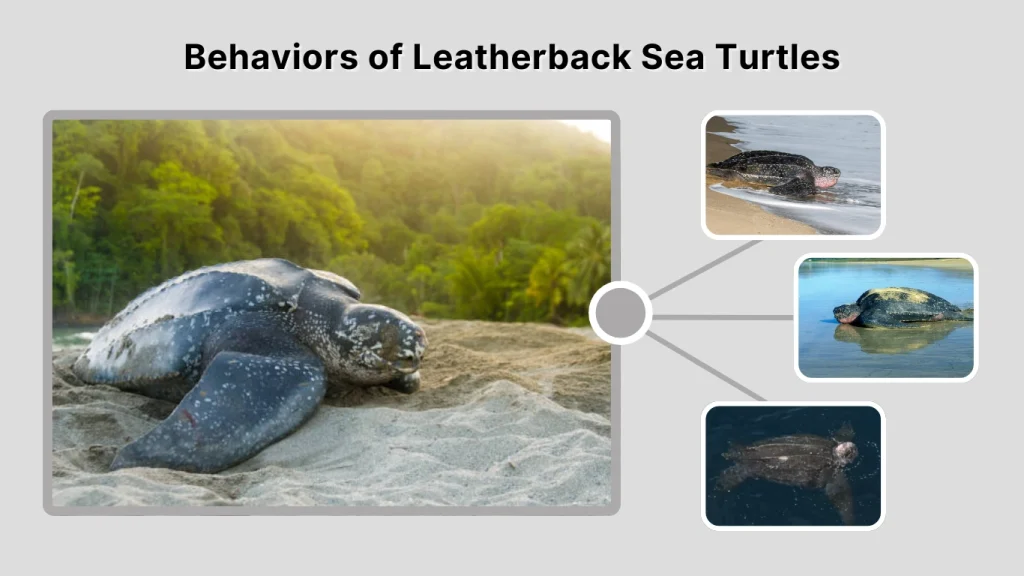
Leatherbacks are largely solitary animals, spending most of their lives alone in the open ocean. They are highly migratory, using ocean currents and magnetic cues to navigate thousands of kilometers between feeding and nesting areas.
Their feeding behavior is specialized: they float with the ocean currents, spotting jellyfish from below, then gently snatch them with their wide mouths. Leatherbacks are nocturnal nesters, typically coming ashore at night to avoid predators and human disturbance.
They exhibit homing instincts, returning to the same beaches where they were born, sometimes traveling across entire oceans to reach those nesting sites. Unlike some turtles, leatherbacks do not exhibit extensive social interaction, interacting mostly during mating or in shared feeding grounds.
Lifecycle of Leatherback Sea Turtles
Leatherback sea turtles have a complex and fascinating lifecycle that begins and ends on beaches. Females return to the same sandy nesting grounds where they hatched—a phenomenon known as natal homing. Nesting occurs at night, and each female may lay 4 to 7 clutches per season, with 50–100 eggs per clutch.
The eggs are buried in warm sand, and the incubation period lasts approximately 60 days, during which temperature plays a critical role in determining the sex of the hatchlings. Warmer sand produces more females, while cooler sand favors males. Once hatched, the tiny turtles make a perilous journey to the ocean, avoiding predators such as crabs, birds, and mammals.
Juvenile leatherbacks spend several years in open oceans, growing rapidly while feeding on abundant jellyfish. They reach sexual maturity at 9–15 years, after which they begin migrating back to nesting beaches. Adult leatherbacks continue to molt throughout their lives and can live up to 45 years or more in the wild.
Threats and Conservation Status

Leatherbacks face multiple threats, both natural and human-induced.
Natural threats
Predators of eggs and hatchlings include raccoons, crabs, birds, and sharks. Storms and beach erosion can also destroy nests.
Human-induced threats
- Fishing bycatch: Leatherbacks often get entangled in longlines, gillnets, and trawling nets.
- Plastic pollution: Mistaking plastic bags for jellyfish, they ingest harmful debris.
- Coastal development: Nesting beaches are disturbed or destroyed by tourism and urban expansion.
- Climate change: Rising temperatures affect sex ratios and nesting success.
Currently, leatherbacks are classified as Vulnerable or Endangered by the IUCN, depending on regional populations. Global conservation programs include protected nesting sites, marine reserves, and international agreements aimed at reducing bycatch and preserving critical habitats.
Fascinating Facts About Leatherback Sea Turtles
- Deep divers: Leatherbacks can dive over 1,200 meters (nearly 4,000 feet).
- Longest migrations: Some travel over 10,000 kilometers annually between feeding and nesting areas.
- Ancient species: Leatherbacks have existed for more than 100 million years, making them one of the oldest reptiles.
- Body temperature regulation: Unique among reptiles, they can maintain internal warmth in cold waters.
- Largest sea turtle: Adults can weigh up to 700 kilograms, with flippers spanning up to 2.7 meters.
Related Species and Comparisons
While leatherbacks are unique, they share ocean habitats with other sea turtles:
- Loggerhead: Smaller, hard-shelled, mostly coastal.
- Green turtle: Herbivorous, medium-sized, prefers shallow tropical waters.
- Hawksbill: Recognizable by sharp beak and colorful shell, feeds on sponges.
- Olive ridley: Small, olive-colored, known for mass arribada nesting events.
Leatherbacks stand out for their size, leathery shell, deep diving ability, and jellyfish-based diet.
How to Observe and Protect Leatherback Sea Turtles
- Responsible wildlife tourism: Observe nesting from a distance without disturbing turtles.
- Beach protection: Avoid bright lights, keep beaches clean, and respect nesting zones.
- Plastic reduction: Reduce marine debris to prevent ingestion and entanglement.
- Support conservation efforts: Donate to or volunteer with organizations protecting nesting sites and ocean habitats.
FAQs
What do leatherback sea turtles eat?
Leatherbacks primarily eat jellyfish and other soft-bodied organisms. Occasionally, they consume small fish, squid, or crustaceans, but jellyfish make up the majority of their diet. Their feeding helps control jellyfish populations in the ocean.
How long do leatherback sea turtles live?
Leatherbacks can live up to 45 years or more. Sexual maturity is reached between 9 and 15 years, and adults continue reproducing throughout much of their life.
Where do leatherback sea turtles nest?
They nest on sandy beaches in the Caribbean, Central America, Southeast Asia, and Pacific islands. Females often return to the exact beaches where they hatched.
How deep can leatherback turtles dive?
Leatherbacks are capable of diving over 1,200 meters (nearly 4,000 feet), making them the deepest-diving sea turtle species. This allows access to jellyfish and other prey not available to other turtles.
Why are leatherback sea turtles endangered?
Leatherbacks face threats from fishing bycatch, plastic ingestion, beach development, and climate change. Egg and hatchling predation, along with habitat loss, also contribute to population declines, making conservation critical.