

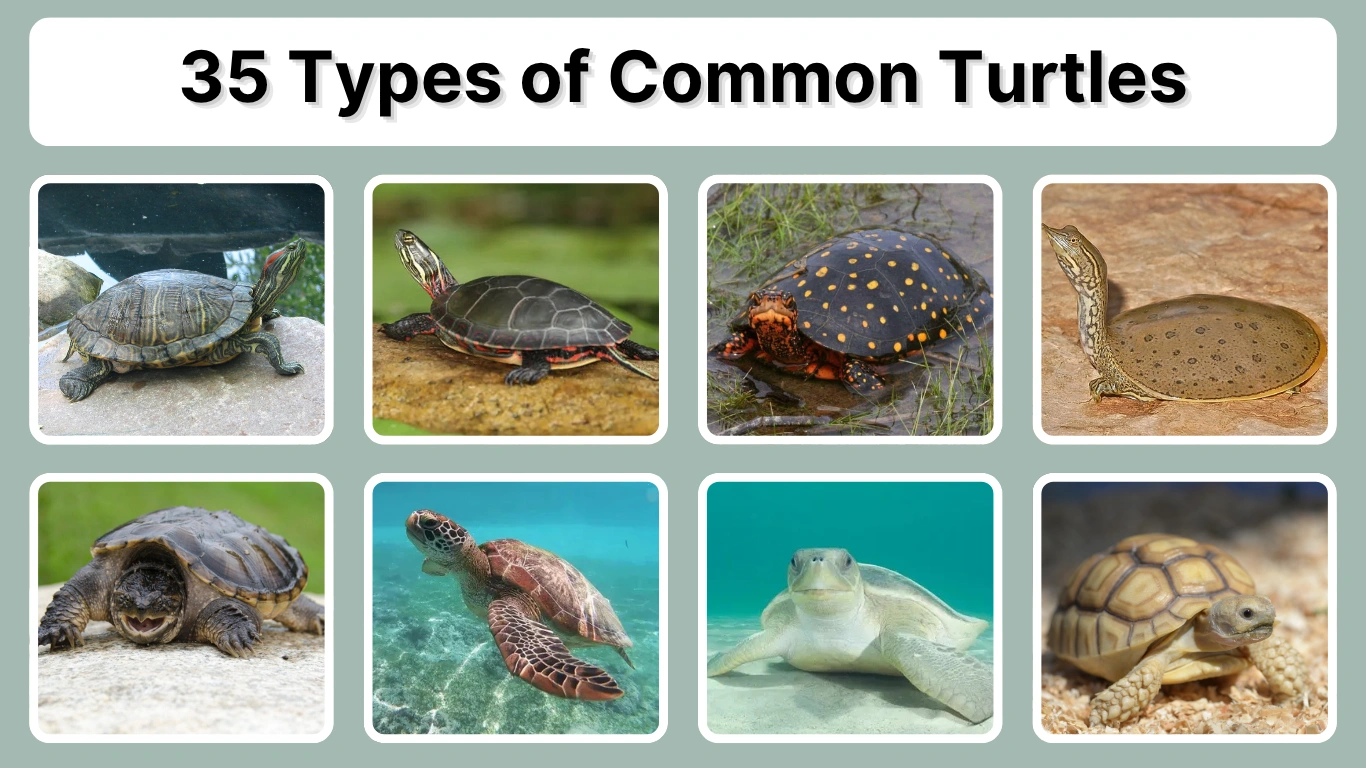
Turtles are some of the most fascinating reptiles on Earth, found across oceans, rivers, lakes, grasslands, forests, and even deserts. With hard protective shells and slow, steady movements, they symbolize longevity, patience, and resilience. This guide explores 35 types of common turtles and tortoises from all over the world—ranging from well-known species like the red-eared slider and box turtle to majestic sea turtles like the leatherback and hawksbill. Each type is introduced with detailed identification, natural habitat, and behavior to help you understand what makes every species unique and special. Whether you’re a nature lover, pet enthusiast, or turtle researcher, this list brings you closer to these ancient, shelled wonders.
Sure! Here’s the first one with serial number:
1. Red-Eared Slider
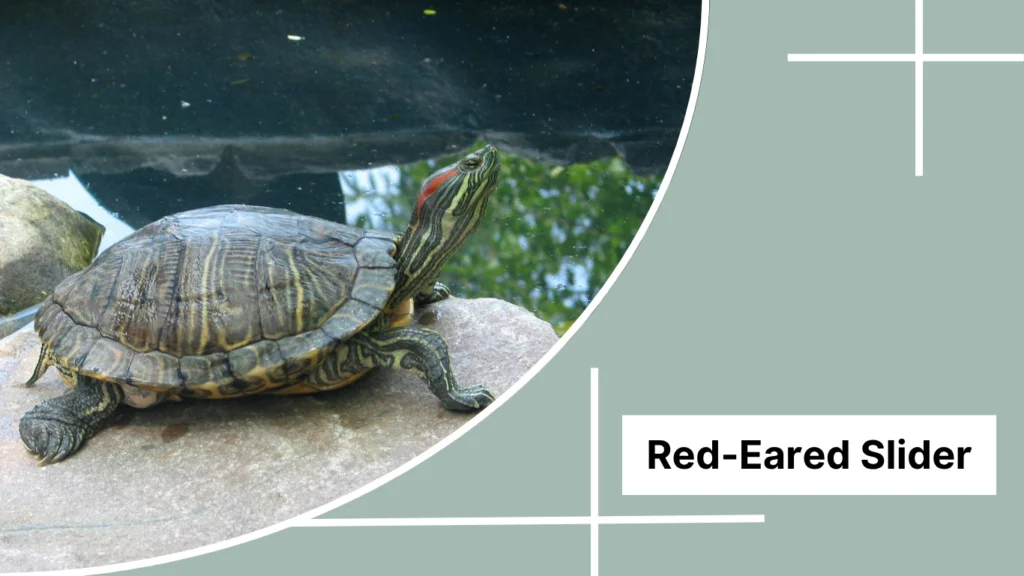
The red-eared slider is one of the most popular and widely recognized freshwater turtles in the world. Known for the distinctive red mark behind each eye, it is commonly kept as a pet and found in ponds, lakes, and slow-moving rivers.
Identification
- Color: Green to dark olive with yellow stripes on the legs and neck
- Marking: Red or orange “ear” stripe behind each eye
- Shell: Smooth, oval, and slightly domed
- Size: 5–12 inches (13–30 cm)
- Lifespan: 20–40 years in captivity; 20+ years in the wild
Habitat and Distribution
Native to the southern United States, especially around the Mississippi River, red-eared sliders are now found worldwide due to pet trade releases. They prefer calm freshwater environments with basking spots and abundant vegetation.
Behavior and Diet
They are omnivorous, eating aquatic plants, insects, fish, and commercial turtle food. Red-eared sliders are strong swimmers and love basking in the sun. They are most active during warm daylight hours and hibernate during cold winters in the wild.
2. Painted Turtle

The painted turtle is one of the most colorful and widespread freshwater turtles in North America. Its bright red, yellow, and black markings make it easy to identify and a favorite among turtle watchers.
Identification
- Color: Dark green to black shell with red and yellow markings on the neck, legs, and shell edge
- Shell: Smooth, flat, and oval
- Size: 4–10 inches (10–25 cm)
- Markings: Red stripes on limbs and lower shell (plastron) often has a symmetrical pattern
Habitat and Distribution
Painted turtles are found across the United States and southern Canada. They inhabit slow-moving freshwater bodies like ponds, lakes, marshes, and quiet streams with muddy bottoms and abundant basking spots.
Behavior and Diet
They are diurnal and love to bask in groups. Painted turtles are omnivores, feeding on aquatic insects, algae, fish, and plants. They hibernate in the mud at the bottom of water bodies during winter.
3. Common Musk Turtle (Stinkpot)

The common musk turtle, also known as the “stinkpot,” is a small but tough freshwater turtle named for the musky odor it releases when threatened. It’s secretive and prefers to stay hidden under vegetation or debris.
Identification
- Color: Dark brown to black with a high-domed, rough-textured shell
- Size: 3–5.5 inches (8–14 cm)
- Markings: Two light stripes running from the nose past the eyes
- Special Trait: Produces a foul-smelling musk from glands when disturbed
Habitat and Distribution
Found in eastern North America, especially in slow-moving rivers, swamps, ponds, and marshes with soft bottoms. They prefer shaded waters with dense vegetation.
Behavior and Diet
Common musk turtles are omnivorous, feeding on aquatic insects, snails, worms, algae, and carrion. They are mostly nocturnal and spend much of their time walking along the bottom rather than swimming. Despite their small size, they are known to be feisty if handled.
4. Common Map Turtle

Named for the map-like lines on its shell, the common map turtle is a freshwater species that thrives in rivers and large lakes. It’s shy and quick to dive into the water when disturbed.
Identification
- Color: Olive to dark brown shell with yellowish contour-like lines
- Size: Females: 6–10 inches (15–25 cm), Males: 3.5–6 inches (9–15 cm)
- Head Markings: Light yellow spots or stripes behind the eyes
- Shell: Keel (raised ridge) along the back, often with small knobs
Habitat and Distribution
Common map turtles are found throughout central and eastern North America. They prefer large bodies of freshwater with moderate to fast currents and plenty of basking logs or rocks.
Behavior and Diet
They are strong swimmers and wary of humans. Females have powerful jaws to crush snails and shellfish, while males eat more insects and aquatic plants. They bask frequently but are quick to retreat into the water when approached.
5. Spotted Turtle

The spotted turtle is a small, semi-aquatic turtle recognized by its dark shell dotted with bright yellow or orange spots. It’s one of the most attractive turtles in North America.
Identification
- Color: Black shell and skin with distinct yellow spots
- Size: 3.5–5 inches (9–13 cm)
- Head and Limbs: Also marked with spots or streaks of yellow or orange
- Shell: Smooth and slightly domed
Habitat and Distribution
Found in the northeastern U.S. and parts of the Great Lakes region, spotted turtles inhabit shallow wetlands, marshes, bogs, and forested swamps with soft, muddy bottoms.
Behavior and Diet
Spotted turtles are omnivores, eating worms, insects, tadpoles, aquatic vegetation, and snails. They are diurnal and very sensitive to habitat change. They often bask on logs or hummocks and may travel short distances on land to find new habitat or mates.
6. Yellow-Bellied Slider
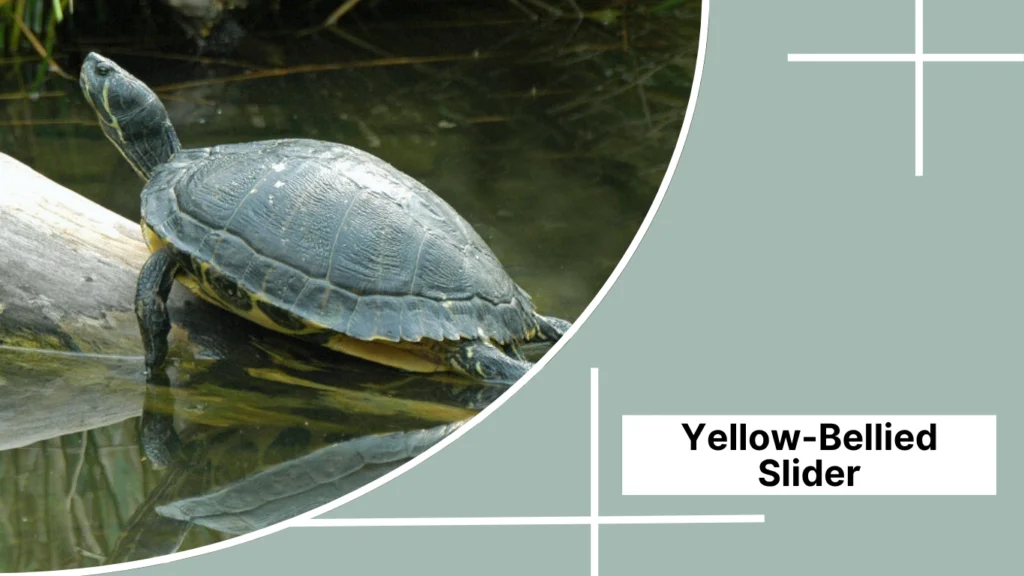
The yellow-bellied slider is a highly adaptable freshwater turtle known for the bright yellow coloring on its underside and striped head. It’s commonly seen basking on logs and rocks in warm climates.
Identification
- Color: Olive to dark brown shell with yellow markings; yellow plastron (underside) with dark blotches
- Size: 5–13 inches (13–33 cm)
- Head Markings: Prominent yellow stripes on the head and neck, including a distinctive yellow patch behind each eye
- Shell: Smooth, oval, and slightly domed
Habitat and Distribution
Native to the southeastern United States, especially in states like Florida, Georgia, and the Carolinas. Found in ponds, lakes, swamps, and slow rivers with soft bottoms and plenty of vegetation.
Behavior and Diet
Yellow-bellied sliders are omnivorous—eating aquatic plants, insects, fish, and carrion. They are strong baskers and can often be seen in large groups. Juveniles are more carnivorous, while adults tend to eat more plants.
7. Cooter Turtle

Cooter turtles are large, herbivorous freshwater turtles known for their flat, oval-shaped shells and calm demeanor. They’re often confused with sliders but usually have more subtle markings.
Identification
- Color: Dark green or brown shell with faint yellow or orange lines
- Size: 9–13 inches (23–33 cm)
- Markings: Yellow or orange stripes on the head, legs, and shell edge
- Shell: Broad and slightly flattened, often with lighter lines forming vague patterns
Habitat and Distribution
Common in the southeastern U.S., especially in Florida and the Gulf Coast. Cooters prefer large lakes, rivers, and swamps with slow currents and abundant aquatic vegetation.
Behavior and Diet
They are mostly herbivorous, feeding on aquatic plants and algae, though young cooters may eat insects or small fish. Cooters bask frequently and are social but tend to dive into the water when approached. They are strong swimmers and active during the day.
8. Softshell Turtle

Softshell turtles are unique among turtles for having a flat, leathery shell instead of a hard, bony one. They are powerful swimmers and surprisingly fast on land, with a long, snorkel-like nose.
Identification
- Color: Olive-gray to brown with a smooth, rubbery shell
- Size: Females: up to 24 inches (61 cm), Males: smaller, around 12 inches (30 cm)
- Shell: Flat, flexible, and leathery with a soft margin
- Head: Long neck and pointed snout used like a snorkel
Habitat and Distribution
Found across North America, especially in rivers, lakes, and large ponds with sandy or muddy bottoms. Common species include the spiny softshell and Florida softshell turtles.
Behavior and Diet
Softshell turtles are carnivorous, feeding on fish, insects, crustaceans, and amphibians. They bury themselves in sand or mud with only their eyes and snout exposed, ambushing prey. Known for their speed and defensive bites when threatened.
9. Snapping Turtle
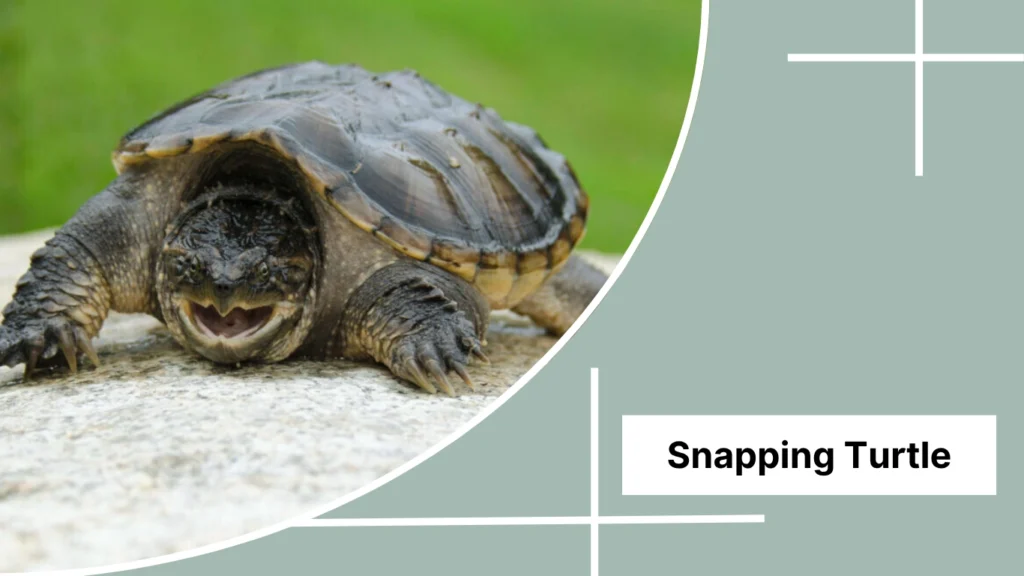
Snapping turtles are large, aggressive freshwater turtles with strong jaws and a prehistoric appearance. They are known for their powerful bite and are more likely to stand their ground than flee.
Identification
- Color: Dark brown, gray, or black with a rough, ridged carapace
- Size: 8–18 inches (20–46 cm) shell length
- Weight: Up to 35 pounds (16 kg) or more
- Tail: Long and saw-toothed like a dinosaur’s
- Head: Large, with strong hooked jaws
Habitat and Distribution
Found throughout North America in slow-moving rivers, lakes, swamps, and marshes. They prefer muddy bottoms with lots of vegetation and access to both land and water.
Behavior and Diet
Omnivorous, eating plants, fish, amphibians, carrion, and even small mammals or birds. They are mostly aquatic and come on land to lay eggs. Despite their aggressive reputation, they usually only snap in defense when out of water.
10. Wood Turtle

The wood turtle is a semi-aquatic species known for its beautifully sculpted shell and high intelligence. It spends time both in water and on land, often venturing into forests and fields near streams.
Identification
- Color: Brown or gray shell with raised, sculpted growth rings on each scute
- Size: 5–9 inches (13–23 cm)
- Skin: Legs and neck often have orange or reddish coloration
- Shell Texture: Rugged and pyramid-shaped, giving a “carved” look
Habitat and Distribution
Native to northeastern North America, especially the Great Lakes region, New England, and parts of eastern Canada. Found near clear, flowing streams and rivers bordered by woodlands and meadows.
Behavior and Diet
Wood turtles are omnivorous and opportunistic feeders—eating berries, fungi, worms, insects, and plants. They are highly terrestrial compared to most aquatic turtles, especially in spring and fall. Known for their problem-solving skills and complex behaviors.
11. Green Sea Turtle

The green sea turtle is one of the largest sea turtles in the world and is named for the greenish color of its body fat, not its shell. It’s known for long migrations and peaceful, plant-based diet as an adult.
Identification
- Color: Olive to dark brown shell with streaks or mottled patterns
- Size: 3–4 feet (90–120 cm)
- Weight: 240–420 pounds (110–190 kg)
- Shell: Smooth and oval-shaped
- Head: Small with a single pair of scales in front of the eyes
Habitat and Distribution
Found in tropical and subtropical seas worldwide, including the Caribbean, Pacific, and Indian Oceans. They nest on sandy beaches and forage in shallow seagrass beds and coral reefs.
Behavior and Diet
Juveniles are omnivores, but adults are primarily herbivorous, feeding on seagrass and algae. They migrate thousands of miles between feeding grounds and nesting beaches. Green sea turtles are calm and often seen by divers grazing on ocean vegetation.
12. Loggerhead Sea Turtle

The loggerhead sea turtle is known for its large, powerful head and strong jaws, which it uses to crush hard-shelled prey. It is one of the most widespread sea turtle species and plays a vital role in marine ecosystems.
Identification
- Color: Reddish-brown carapace with a yellowish plastron
- Size: 2.5–3.5 feet (75–105 cm)
- Weight: 170–350 pounds (77–159 kg)
- Head: Large and broad, giving the species its name
- Shell: Heart-shaped and moderately domed
Habitat and Distribution
Loggerheads are found in temperate and tropical oceans worldwide, including the Atlantic, Pacific, and Indian Oceans. They nest on sandy beaches and forage in coastal bays, estuaries, and open seas.
Behavior and Diet
Primarily carnivorous, loggerheads feed on crabs, mollusks, jellyfish, and other invertebrates. They migrate long distances between feeding and nesting grounds and are often spotted near reefs, seagrass beds, and rocky coastal zones.
13. Leatherback Sea Turtle
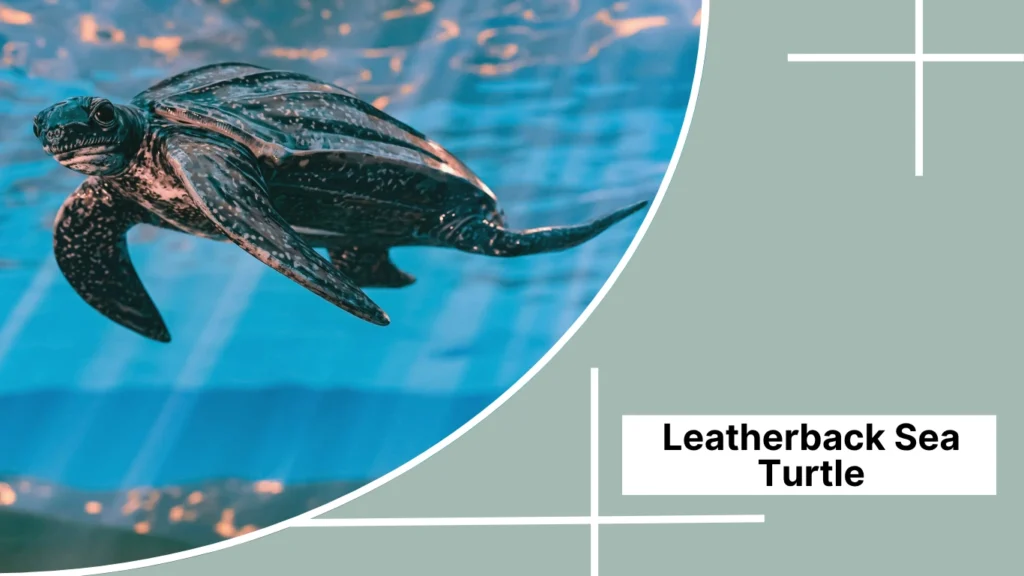
The leatherback is the largest sea turtle species and the only one without a hard shell. Instead, its back is covered in a leathery, flexible skin. It is also the deepest-diving and most migratory of all sea turtles.
Identification
- Color: Dark gray to black with white spots
- Size: 4–7 feet (1.2–2.1 meters)
- Weight: 500–2,000 pounds (225–900 kg)
- Shell: Soft, leathery, and ridged lengthwise
- Head: Tapered with sharp, scissor-like jaws
Habitat and Distribution
Found in oceans around the globe—from the Arctic Circle to southern Africa and Australia. Leatherbacks nest on tropical beaches but forage in cold, open ocean waters.
Behavior and Diet
They feed almost exclusively on jellyfish, helping control jellyfish populations. Leatherbacks are powerful swimmers and can dive over 3,000 feet deep. They are highly migratory, sometimes traveling over 10,000 miles a year between nesting and feeding areas.
14. Hawksbill Sea Turtle
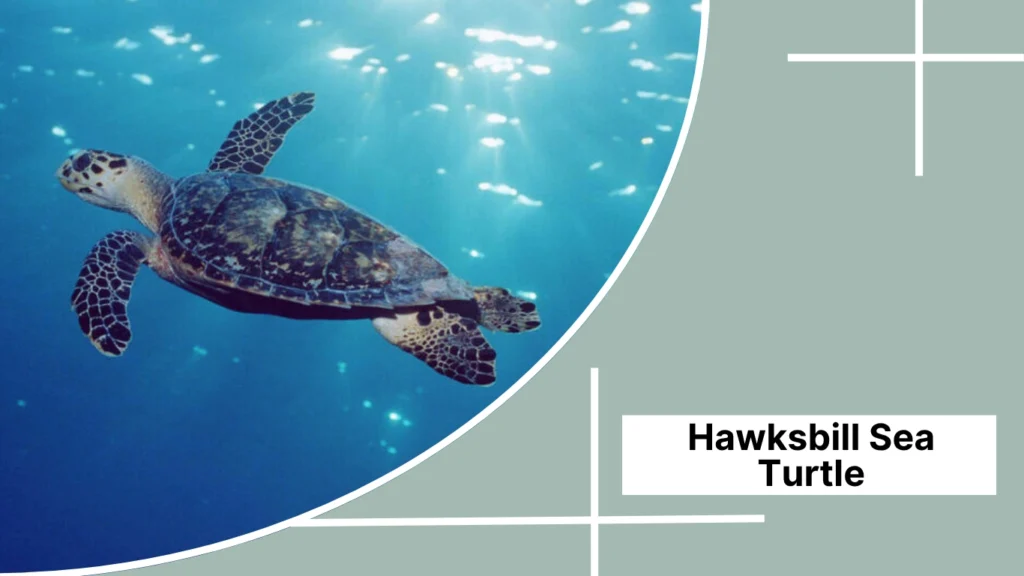
The hawksbill sea turtle is a small, beautifully patterned marine turtle recognized for its narrow, pointed beak and amber-colored shell with overlapping scutes. It plays a crucial role in maintaining coral reef health.
Identification
- Color: Amber shell with streaks of brown, black, and gold
- Size: 2.5–3 feet (60–90 cm)
- Weight: 100–150 pounds (45–68 kg)
- Beak: Sharp, curved like a hawk’s—ideal for reaching into crevices
- Shell: Overlapping scutes give a jagged appearance
Habitat and Distribution
Hawksbills are found in tropical coral reefs of the Atlantic, Indian, and Pacific Oceans, especially near the Caribbean, Southeast Asia, and Australia.
Behavior and Diet
They feed primarily on sponges, which few other animals eat, making them essential for coral reef balance. They also consume small invertebrates and algae. Hawksbills are solitary, active during the day, and known for nesting on remote tropical beaches.
15. Olive Ridley Sea Turtle
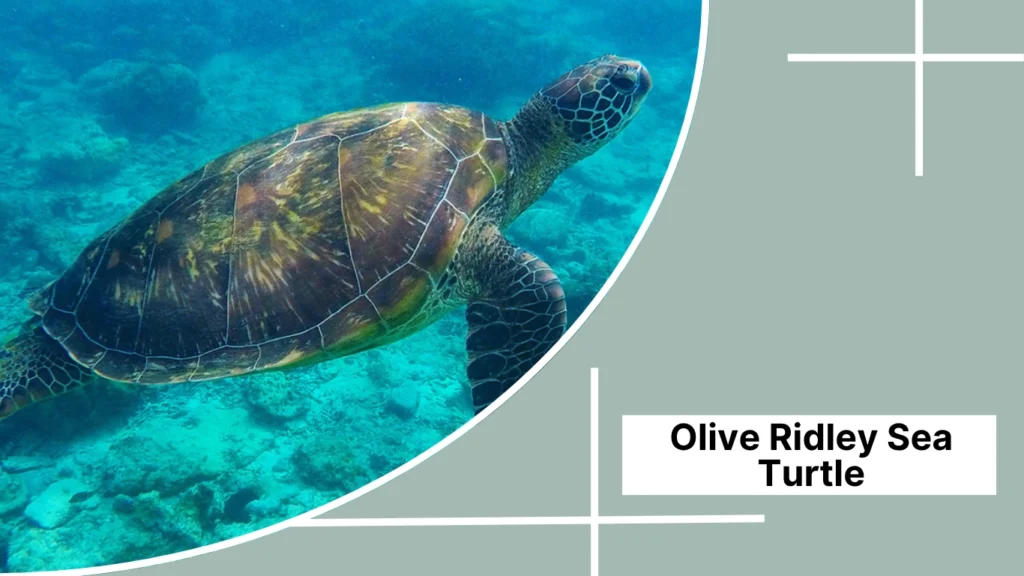
The olive ridley is one of the smallest and most abundant sea turtles, named for its olive-green shell. It’s famous for mass nesting events called “arribadas,” where thousands come ashore simultaneously.
Identification
- Color: Olive to grayish-green shell and skin
- Size: 2–2.5 feet (60–75 cm)
- Weight: 75–110 pounds (34–50 kg)
- Shell: Smooth, rounded, and heart-shaped with 6 or more scutes
- Head: Small and triangular
Habitat and Distribution
Olive ridleys are found in warm tropical waters of the Pacific, Indian, and Atlantic Oceans. Nesting beaches include Mexico, Costa Rica, India, and parts of West Africa.
Behavior and Diet
They are omnivores, feeding on jellyfish, shrimp, crabs, algae, and fish eggs. Olive ridleys are known for synchronized mass nesting events on specific beaches, a phenomenon rarely seen in other turtle species.
16. Kemp’s Ridley Sea Turtle

Kemp’s ridley is the rarest and most endangered sea turtle species in the world. It is also the smallest marine turtle, recognized for its rapid, synchronized nesting events similar to olive ridleys.
Identification
- Color: Grayish-green carapace with a pale, creamy underside
- Size: 2–2.5 feet (60–75 cm)
- Weight: 70–100 pounds (32–45 kg)
- Shell: Nearly circular, domed, and smooth
- Head: Broad and triangular
Habitat and Distribution
Kemp’s ridley turtles are found primarily in the Gulf of Mexico and along the Atlantic coast of the U.S. Their main nesting beach is in Tamaulipas, Mexico (Rancho Nuevo Beach).
Behavior and Diet
They are carnivorous, feeding on crabs, mollusks, jellyfish, and fish. Kemp’s ridleys nest in mass arribadas like olive ridleys but in smaller numbers. Conservation efforts have helped stabilize populations, but they remain critically endangered.
17. Flatback Sea Turtle
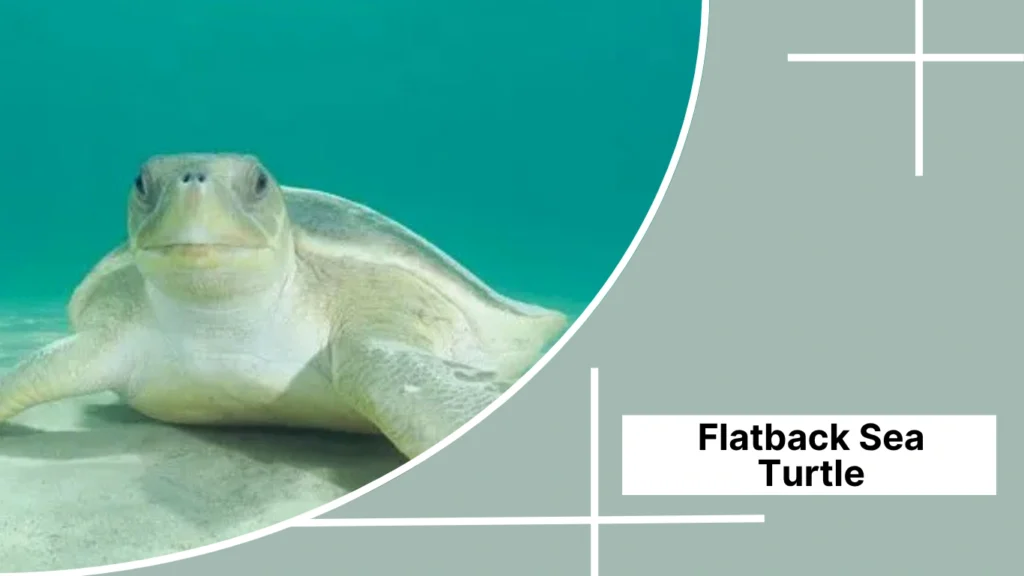
The flatback sea turtle is named for its uniquely flat and smooth shell. It is found only in Australian waters, making it one of the least widespread of all sea turtle species.
Identification
- Color: Olive-gray carapace with a pale yellow underside
- Size: About 3 feet (90 cm)
- Weight: 150–200 pounds (68–90 kg)
- Shell: Flat, rounded, and smooth with upturned edges
- Scales: Fewer and larger than other sea turtles
Habitat and Distribution
Flatbacks are native to northern Australia and the surrounding seas, including Papua New Guinea and southern Indonesia. They prefer shallow coastal waters, bays, and estuaries.
Behavior and Diet
They feed on soft-bodied invertebrates like sea cucumbers, jellyfish, and soft corals. Unlike other sea turtles, flatbacks do not travel long distances and have limited nesting sites—mostly along the northern Australian coast. They are considered vulnerable due to their restricted range and nesting habits.
18. Eastern Box Turtle

The eastern box turtle is a well-known land-dwelling turtle with a high-domed shell and the unique ability to completely close its shell using a hinged plastron—providing strong protection from predators.
Identification
- Color: Dark brown or black shell with bright yellow or orange markings
- Size: 4–6 inches (10–15 cm)
- Shell: High-domed and hinged at the bottom
- Head and Legs: Often patterned with orange or yellow spots or streaks
Habitat and Distribution
Native to the eastern United States, from Maine to Florida and as far west as Michigan and Texas. They live in moist woodlands, meadows, and near forest edges with access to water.
Behavior and Diet
Eastern box turtles are omnivorous, feeding on worms, insects, berries, mushrooms, and plants. They are slow-moving, long-lived (up to 100 years), and often remain in the same home range their entire lives. Their populations are declining due to habitat destruction and road mortality.
19. Ornate Box Turtle
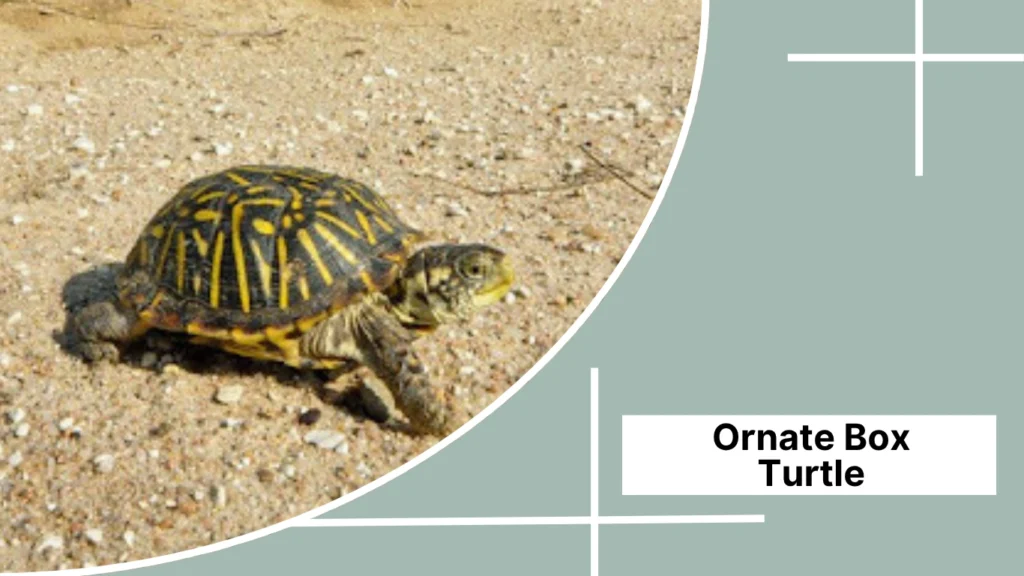
The ornate box turtle is a beautifully patterned terrestrial turtle named for the yellow lines radiating across its dark shell. It’s more tolerant of dry habitats compared to other box turtles.
Identification
- Color: Dark brown to black shell with bold yellow or orange radiating lines
- Size: 4–6 inches (10–15 cm)
- Shell: Flattened compared to the eastern box turtle
- Skin: Often mottled with orange or yellow markings
Habitat and Distribution
Found in the central United States, especially in the Great Plains, from South Dakota to Texas. They prefer prairies, grasslands, and sandy areas with sparse vegetation.
Behavior and Diet
They are omnivores, eating grasshoppers, beetles, worms, berries, and plants. Ornate box turtles are most active in the morning and after rain. They can burrow underground to escape extreme heat or cold and hibernate during winter months.
20. Gulf Coast Box Turtle

The Gulf Coast box turtle is the largest subspecies of the common box turtle. It thrives in warm, humid environments and is known for its darker shell and preference for aquatic edges.
Identification
- Color: Dark brown to black shell with faint yellow or orange markings
- Size: 6–8.5 inches (15–22 cm)
- Shell: High-domed and often flared at the rear edge
- Skin: May have orange or yellow spotting, especially on the head and legs
Habitat and Distribution
Native to the Gulf Coast region of the southeastern United States, from Louisiana to western Florida. They inhabit swampy woodlands, marshes, and wet meadows.
Behavior and Diet
They are omnivores, feeding on insects, snails, mushrooms, berries, and leafy greens. Gulf Coast box turtles are shy and prefer moist conditions, often hiding under vegetation or leaf litter. They are also good swimmers and may enter shallow water to forage.
21. Three-Toed Box Turtle

The three-toed box turtle is named for the three toes on its hind feet, setting it apart from other box turtles. It is well-adapted to a variety of habitats, especially humid and forested areas.
Identification
- Color: Olive-brown or grayish shell with minimal markings
- Size: 4.5–6 inches (11–15 cm)
- Toes: Typically three toes on each hind foot (though some variation exists)
- Head and Limbs: Often have yellow, orange, or reddish spots
Habitat and Distribution
Found throughout the south-central United States, especially in Missouri, Arkansas, Alabama, and surrounding regions. Prefers moist forests, grasslands, and floodplains.
Behavior and Diet
Three-toed box turtles are omnivorous, eating insects, earthworms, fungi, and fruits. They are solitary and often remain within a small home range. They tolerate drier conditions better than other box turtles and will burrow into the soil to escape heat.
22. African Spurred Tortoise (Sulcata)

The African spurred tortoise, also known as the Sulcata tortoise, is the third-largest tortoise in the world and the largest mainland tortoise. Known for its rugged appearance and friendly temperament, it is a popular pet in dry climates.
Identification
- Color: Light brown to sandy yellow
- Size: 24–30 inches (60–76 cm)
- Weight: 80–200+ pounds (36–91+ kg)
- Shell: Thick, domed with deep, well-defined growth rings
- Legs: Powerful with prominent spurs on the back thighs
Habitat and Distribution
Native to the southern edge of the Sahara Desert in countries like Chad, Sudan, and Mali. They live in arid grasslands and dry savannas.
Behavior and Diet
Sulcatas are herbivorous, feeding on grasses, hay, and leafy plants. They dig deep burrows to escape extreme heat and conserve moisture. These tortoises can live over 70 years and are known for being strong, active, and capable of moving heavy objects in captivity.
23. Russian Tortoise
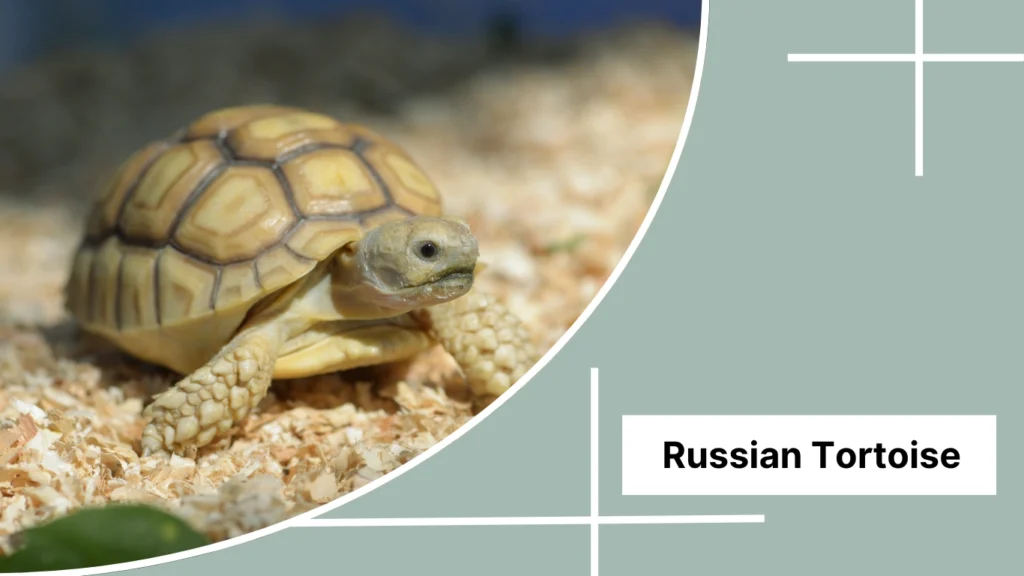
The Russian tortoise is a small, hardy land tortoise often kept as a pet. It’s well-known for its tolerance of cold weather and its energetic, curious personality.
Identification
- Color: Tan to olive-brown shell with darker brown markings
- Size: 5–8 inches (13–20 cm)
- Shell: Rounded, high-domed with slight flaring at the edges
- Limbs: Strong front legs with sharp claws for digging
- Toes: Four toes on each foot
Habitat and Distribution
Native to Central Asia, including parts of Russia, Iran, Afghanistan, Pakistan, and Uzbekistan. Lives in dry, rocky environments such as deserts, scrublands, and grasslands.
Behavior and Diet
They are herbivorous, feeding on grasses, leafy greens, and flowers. Russian tortoises are active diggers and hibernate for months in colder regions. They are social, curious, and thrive with proper care, making them a favorite among reptile enthusiasts.
24. Greek Tortoise

The Greek tortoise, also known as the Mediterranean tortoise, is a small, slow-moving land species prized for its beautiful shell and calm disposition. It is one of the oldest known tortoise species in captivity.
Identification
- Color: Golden to olive shell with black or dark brown markings
- Size: 5–8 inches (13–20 cm)
- Shell: Highly domed with distinct growth rings and well-defined scutes
- Tail: Males have a longer, thicker tail tucked to the side
- Scales: Large, symmetrical on the front legs
Habitat and Distribution
Native to southern Europe, northern Africa, and parts of western Asia. Found in dry, arid environments including scrublands, rocky hillsides, and Mediterranean forests.
Behavior and Diet
Greek tortoises are herbivores, feeding on grasses, weeds, and flowers. They are diurnal and spend much of their time basking or foraging. Known for their long lifespan, often exceeding 50 years in captivity, they are popular among hobbyists.
25. Hermann’s Tortoise

Hermann’s tortoise is a small, colorful Mediterranean tortoise known for its hardy nature and appealing personality. It’s one of the most popular tortoise species in the pet trade.
Identification
- Color: Yellow or tan shell with bold black patches
- Size: 5–8 inches (13–20 cm)
- Shell: Oval, domed, and lightly serrated at the back
- Tail: Has a horny spur at the tip (unique feature)
- Legs: Strong, with thick scales and sharp claws
Habitat and Distribution
Native to southern Europe, especially Italy, France, the Balkans, and the Iberian Peninsula. Inhabits dry, rocky areas, forests, and shrublands.
Behavior and Diet
Primarily herbivorous, eating grasses, leafy greens, and flowers. Hermann’s tortoises are active during the day, basking in the sun and hiding in burrows during extreme temperatures. With proper care, they can live 50–70 years or more.
26. Leopard Tortoise
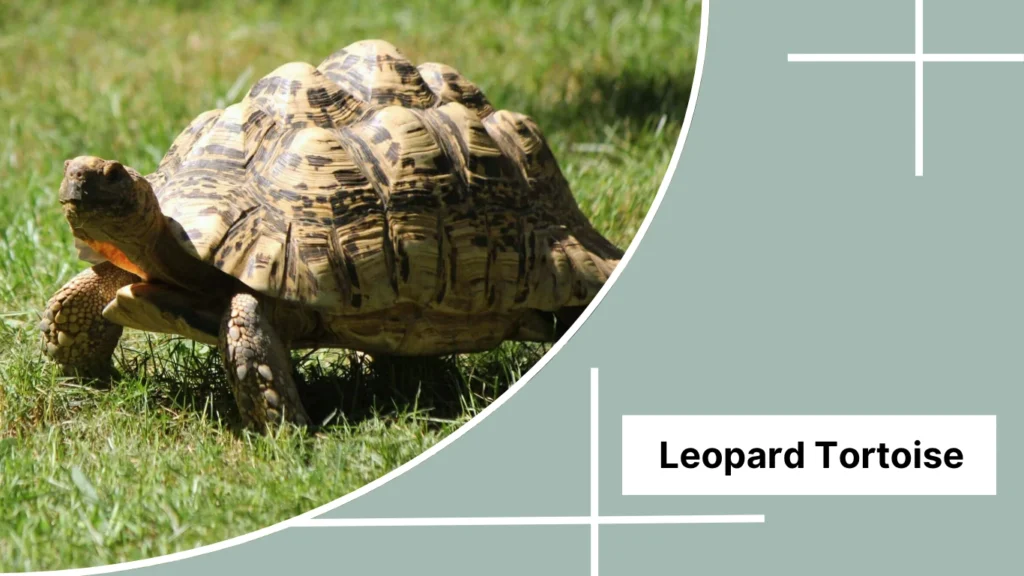
The leopard tortoise is a large, beautifully marked species named for the spotted, leopard-like pattern on its shell. It is the fourth-largest tortoise species and native to sub-Saharan Africa.
Identification
- Color: Yellow to tan shell with black or dark brown blotches and spots
- Size: 10–18 inches (25–46 cm), some up to 24 inches
- Weight: 40–70 pounds (18–32 kg)
- Shell: High-domed, steep sides, often with a pyramidal appearance
- Limbs: Thick, scaled, and elephant-like
Habitat and Distribution
Found in dry savannas and grasslands across eastern and southern Africa. Prefers semi-arid to arid regions with occasional shrubs and water access.
Behavior and Diet
Leopard tortoises are herbivores, grazing on grasses, weeds, succulents, and fruits. They are solitary and active during the day. They do not burrow but may seek shelter in vegetation or shade. Known for their gentle and shy nature.
27. Indian Star Tortoise
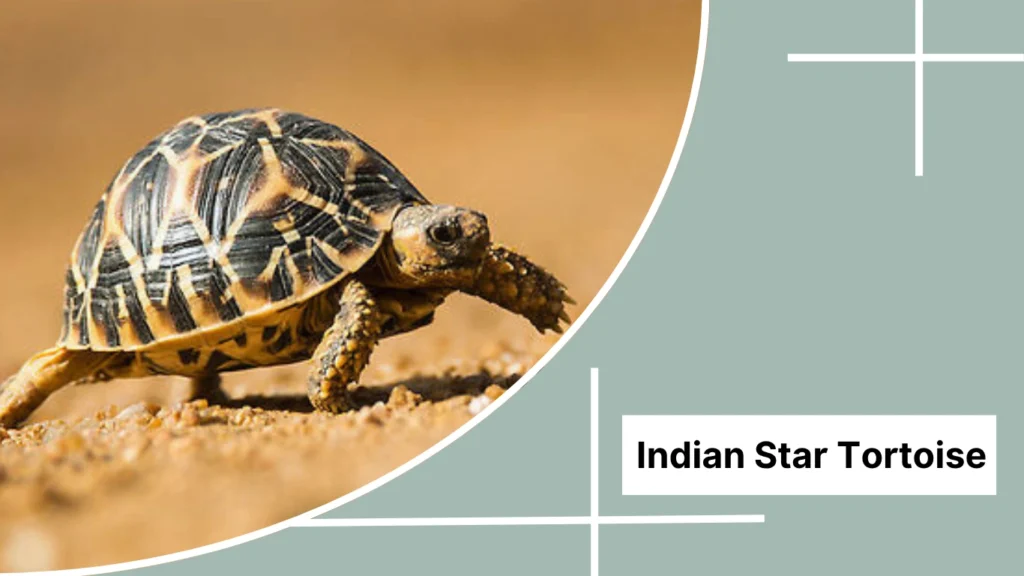
The Indian star tortoise is a small, eye-catching tortoise species known for its striking star-like shell patterns. It is often found in dry regions and is highly valued in the exotic pet trade.
Identification
- Color: Dark brown to black shell with radiating yellow or golden star patterns
- Size: 5–10 inches (13–25 cm)
- Shell: High-domed with sharply defined peaks
- Tail: Short and tucked tightly beneath the shell
Habitat and Distribution
Native to India, Sri Lanka, and parts of Pakistan. Found in dry scrub forests, grasslands, and semi-desert regions.
Behavior and Diet
Herbivorous, feeding on grasses, fruits, flowers, and leafy greens. Indian star tortoises are shy, slow-moving, and prefer to hide under vegetation. They are sensitive to humidity and do best in warm, dry climates.
28. Red-Footed Tortoise

The red-footed tortoise is a medium-sized, tropical tortoise with vibrant red or orange markings on its limbs and face. It is native to South America and well-known for its outgoing personality and colorful appearance.
Identification
- Color: Dark brown or black shell with lighter centers on each scute
- Size: 10–14 inches (25–36 cm)
- Weight: Up to 20 pounds (9 kg)
- Markings: Red, orange, or yellow scales on the legs and face
- Shell: Smooth and slightly domed
Habitat and Distribution
Found throughout northern South America, including the Amazon Basin, and into Central America and the Caribbean. Prefers tropical forests, savannas, and grasslands.
Behavior and Diet
Omnivorous—eats a mix of fruits, vegetables, fungi, flowers, and occasionally invertebrates. Red-footed tortoises are active, curious, and social among tortoises. They are popular as pets due to their hardy nature and striking appearance.