

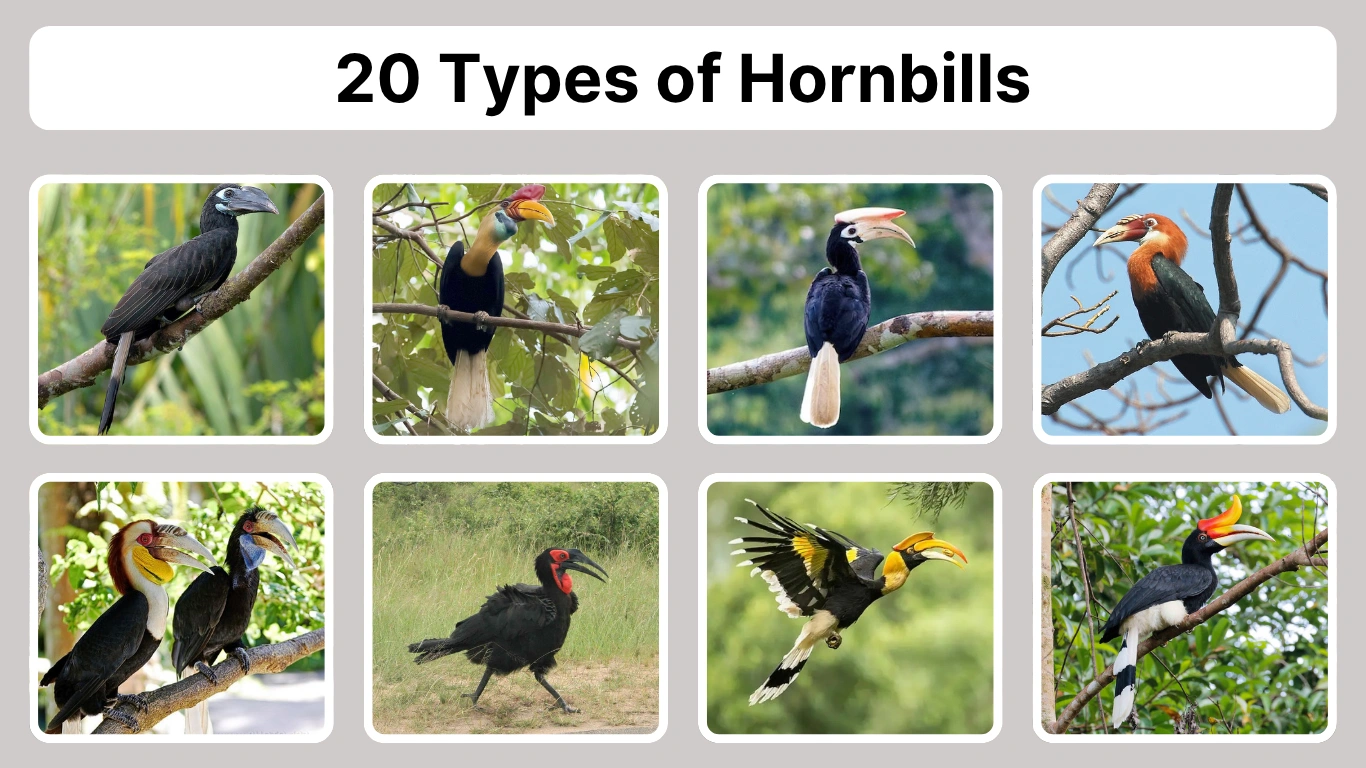
Hornbills are among the most distinctive and culturally significant birds in the tropical forests of Asia and Africa. With their oversized bills, elaborate casques, and theatrical nesting behavior, these birds play essential ecological roles—particularly in seed dispersal—and hold symbolic value for many indigenous cultures.
This guide introduces 20 fascinating types of hornbills from around the world. From the majestic Great Hornbill of India to the critically endangered Sulu Hornbill of the Philippines, each species showcases unique adaptations, appearances, and conservation stories. Whether you’re a birdwatcher, researcher, or simply curious about nature’s most remarkable birds, this curated list offers detailed insights into the world of hornbills—one bird at a time.
1. Great Hornbill

The Great Hornbill is one of the largest and most majestic members of the hornbill family. Native to the forests of the Indian subcontinent and Southeast Asia, it is renowned for its massive yellow and black casque atop its beak and its impressive wingspan. This bird is culturally significant in many indigenous communities and plays a crucial role in forest ecology by dispersing seeds.
Identification
- Size: 95–130 cm (37–51 inches) in length
- Wingspan: Up to 1.5 meters (5 feet)
- Weight: 2.15 to 4 kg (4.7–8.8 lbs)
- Color: Mostly black and white body with a yellow and black casque
- Beak: Long, down-curved, and bright yellow with a black stripe
- Casque: Large, U-shaped yellow casque on the upper mandible
- Eyes: Red in males and white-blue in females
- Legs: Short and strong, adapted for perching
- Habitat: Tropical and subtropical forests of India, Bhutan, Nepal, and Southeast Asia
Behavior and Diet
Great Hornbills are primarily frugivorous, with figs being a favorite. However, they also consume small mammals, reptiles, and insects. They are known for their loud calls and heavy wingbeats. Mated pairs are monogamous and display strong pair bonds.
Nesting and Reproduction
Females seal themselves inside tree cavities using mud, droppings, and fruit pulp, leaving only a narrow slit through which the male passes food. This nesting period may last several weeks until the chicks and female emerge.
Cultural and Ecological Significance
This species is considered sacred by many indigenous tribes in India and Southeast Asia. Its role as a seed disperser helps maintain forest diversity. However, habitat loss and hunting have led to population declines, making conservation efforts vital for its survival.
2. Rhinoceros Hornbill

The Rhinoceros Hornbill is one of the most iconic birds of the tropical rainforests of Southeast Asia. It gets its name from the prominent casque on its beak, which curves upward like a rhinoceros horn. Considered the national bird of Malaysia, it plays a vital role in forest health and has deep cultural importance among indigenous peoples.
Identification
- Size: 91–122 cm (36–48 inches) in length
- Wingspan: Approximately 1.5 meters (5 feet)
- Weight: 2–3 kg (4.4–6.6 lbs)
- Color: Black body with white legs and tail
- Beak: Bright yellow-orange, long and curved
- Casque: Orange-red, sharply curved, shaped like an upturned horn
- Eye Color: Red in males; white with red rims in females
- Tail Markings: White with a black band near the tip
- Habitat: Lowland and montane rainforests in Malaysia, Borneo, Sumatra, Thailand, and surrounding regions
Behavior and Diet
This species is primarily frugivorous, with a preference for figs, but also eats insects, small reptiles, and bird eggs. Rhinoceros Hornbills are strong fliers and may travel long distances in search of food. Their call is a loud, echoing honk, often heard before the bird is seen.
Nesting and Reproduction
As with most hornbills, the female seals herself inside a tree cavity using a mixture of mud, fruit pulp, and feces. Only a narrow slit is left for the male to pass food through during incubation and chick-rearing. This nesting phase can last over two months.
Cultural and Ecological Importance
In Borneo and parts of Malaysia, the Rhinoceros Hornbill is revered as a spiritual symbol, often associated with strength and honor. Ecologically, it contributes significantly to seed dispersal in tropical forests, helping regenerate tree diversity. Its declining numbers are due to deforestation and illegal pet trade, making it a near-threatened species.
3. Helmeted Hornbill

The Helmeted Hornbill is a rare and unusual hornbill species distinguished by its solid, helmet-like casque. Unlike other hornbills, whose casques are mostly hollow, this bird’s casque is made of dense keratin, giving it a unique appearance and making it a tragic target for illegal poaching.
Identification
- Size: 110–120 cm (43–47 inches) in length
- Wingspan: Around 1.5 meters (5 feet)
- Weight: 2.5–3.1 kg (5.5–6.8 lbs)
- Color: Mostly black with a white belly and tail
- Beak: Pale yellow with a large, solid red casque
- Casque: Heavy, solid, helmet-like structure used for combat
- Tail Feathers: Extremely long central tail feathers
- Eye Color: Brown
- Habitat: Lowland rainforests in Thailand, Malaysia, Borneo, and Sumatra
Behavior and Diet
Helmeted Hornbills feed on fruits, especially figs, and occasionally consume small animals. They are known for their bizarre, maniacal laughter-like calls. Males use their solid casques to engage in aerial head-butting contests to establish dominance.
Nesting and Reproduction
Females nest in tree cavities and seal themselves inside just like other hornbills. The male provides food throughout incubation and chick-rearing, lasting several months.
Conservation Status and Threats
This species is critically endangered due to habitat loss and poaching for its casque, known as “hornbill ivory,” which is carved and traded illegally. It is now one of the most threatened hornbills, and urgent conservation efforts are being made to protect remaining populations.
4. Indian Grey Hornbill
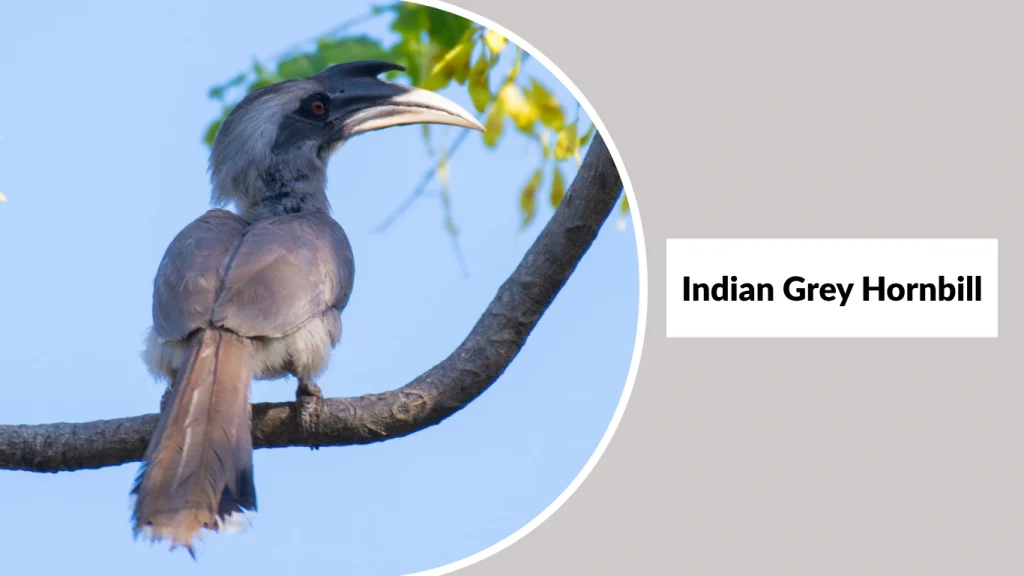
The Indian Grey Hornbill is a medium-sized hornbill widely found across the Indian subcontinent. Unlike its more colorful relatives, this species is subtle in appearance but equally important ecologically. It adapts well to urban environments and is often seen gliding through parks and gardens in cities as well as wooded areas.
Identification
- Size: 60–70 cm (24–28 inches) in length
- Wingspan: Approximately 90–100 cm
- Weight: 400–600 grams
- Color: Ashy grey body with a paler belly
- Beak: Long, curved, black with a yellowish base and a prominent casque
- Casque: Small and slightly curved; not as prominent as in larger species
- Tail: Long, with a black band at the tip
- Eye Color: Brownish-red
- Habitat: Deciduous forests, groves, city parks, and farmlands across India and Nepal
Behavior and Diet
Indian Grey Hornbills are omnivorous. Their diet mainly consists of figs, berries, and other fruits, but they also feed on insects, small reptiles, and bird eggs. They are strong fliers and are often seen in pairs or small groups, emitting a distinctive shrieking or cackling call while flying.
Nesting and Reproduction
Breeding season occurs from March to June. The female seals herself in a tree cavity with mud, droppings, and pulp, leaving only a narrow slit. She remains sealed inside for 1 to 2 months while the male brings her food. Once the chicks and female grow larger, the wall is broken from the inside.
Ecological Role and Adaptability
This hornbill plays a vital role in seed dispersal in both wild and urban landscapes. Its adaptability to human-altered environments makes it one of the most frequently observed hornbills in India. Unlike more forest-dependent species, it has a stable population and is listed as Least Concern.
5. Malabar Pied Hornbill

The Malabar Pied Hornbill is a striking black and white hornbill species native to the Western Ghats and adjoining regions of India and Sri Lanka. Known for its impressive size and massive yellow bill with a large casque, it is often seen near large fig trees, which form the bulk of its diet.
Identification
- Size: 65–90 cm (26–35 inches) in length
- Wingspan: Over 1 meter
- Weight: 1.5–2.2 kg (3.3–4.8 lbs)
- Color: Glossy black body with white belly and tail tip
- Beak: Yellow with a large black casque
- Casque: Prominent and fused with the beak; more exaggerated in males
- Eye Color: Red with long eyelashes in males; white in females
- Habitat: Evergreen and deciduous forests of peninsular India and Sri Lanka
Behavior and Diet
Their diet consists mainly of figs and other fruits, but they also consume insects, rodents, and small reptiles. Malabar Pied Hornbills are social birds and can often be found in small flocks. Their calls are deep, throaty, and repetitive, often heard at dawn and dusk.
Nesting and Reproduction
Breeding takes place during the dry season. The female seals herself into a tree cavity using mud and fruit pulp, relying on the male for food. Once the chicks and the female are large enough, they break out of the cavity.
Conservation and Cultural Significance
Though not currently endangered, habitat destruction and the loss of large trees for nesting pose long-term threats. This species is revered in some local traditions and serves as an important seed disperser in the Western Ghats ecosystem.
6. Oriental Pied Hornbill

The Oriental Pied Hornbill is a smaller, more adaptable species of hornbill commonly found across Southeast Asia. Its distinctive appearance, with a large yellow-and-black beak and prominent casque, makes it easy to identify. Unlike many hornbills, it thrives even in disturbed habitats and urban parks, making it one of the most frequently observed species in the region.
Identification
- Size: 55–60 cm (22–24 inches) in length
- Wingspan: Around 90 cm
- Weight: 600–900 grams
- Color: Glossy black body with white belly, thighs, and tail tip
- Beak: Pale yellow with a black base and a small casque
- Casque: More prominent in males, small and flat in females
- Eye Color: Blue skin around the eyes
- Habitat: Forests, plantations, city parks, and mangroves across India, Thailand, Malaysia, and Indonesia
Behavior and Diet
Oriental Pied Hornbills are omnivorous. They feed on a wide variety of fruits, especially figs, as well as insects, small animals, and even bird chicks. Their adaptability allows them to forage in both forests and human-dominated landscapes. They are highly vocal, emitting a range of cackles and yelps.
Nesting and Reproduction
The female nests in tree cavities, sealing herself in with help from the male. The breeding season varies by region but typically aligns with the dry season. Males bring food to the female and chicks through a narrow slit until they are ready to emerge.
Ecological and Urban Importance
Because of their tolerance to human presence and variety of habitats, Oriental Pied Hornbills are crucial seed dispersers even in urban environments. They help maintain plant diversity in parks, plantations, and forest edges.
7. Southern Ground Hornbill

The Southern Ground Hornbill is a unique and striking bird that spends most of its life walking on the ground. Native to sub-Saharan Africa, this species is easily recognized by its all-black plumage, bare red facial skin, and loud booming calls that echo across savannas and open woodlands.
Identification
- Size: 90–129 cm (35–51 inches) in length
- Wingspan: Up to 2 meters (6.6 feet)
- Weight: 3.5–6.2 kg (7.7–13.7 lbs)
- Color: Entirely black with white primary feathers visible in flight
- Beak: Long, black, and curved with a casque on the upper mandible
- Facial Skin: Bare, bright red in adults; males have a red throat pouch, females have a blue patch
- Legs: Long and strong, adapted for walking
- Habitat: Savannas, grasslands, and open woodlands of southern Africa
Behavior and Diet
These hornbills are carnivorous and spend most of their time foraging on the ground. Their diet includes insects, amphibians, snakes, tortoises, and small mammals. They hunt cooperatively in family groups and have an intelligent, methodical approach to catching prey.
Nesting and Reproduction
Nesting occurs in tree cavities or rocky outcrops. Breeding is slow, with pairs producing only one chick every few years. The chick takes a long time to fledge, and juveniles remain with their family group for several years, helping raise future offspring.
Conservation Status
The Southern Ground Hornbill is listed as Vulnerable due to habitat loss, low reproductive rate, and persecution. In some regions, it is considered a cultural symbol, while in others, it’s mistakenly viewed as a bad omen. Conservation efforts are ongoing to protect nesting sites and educate communities.
8. Abyssinian Ground Hornbill
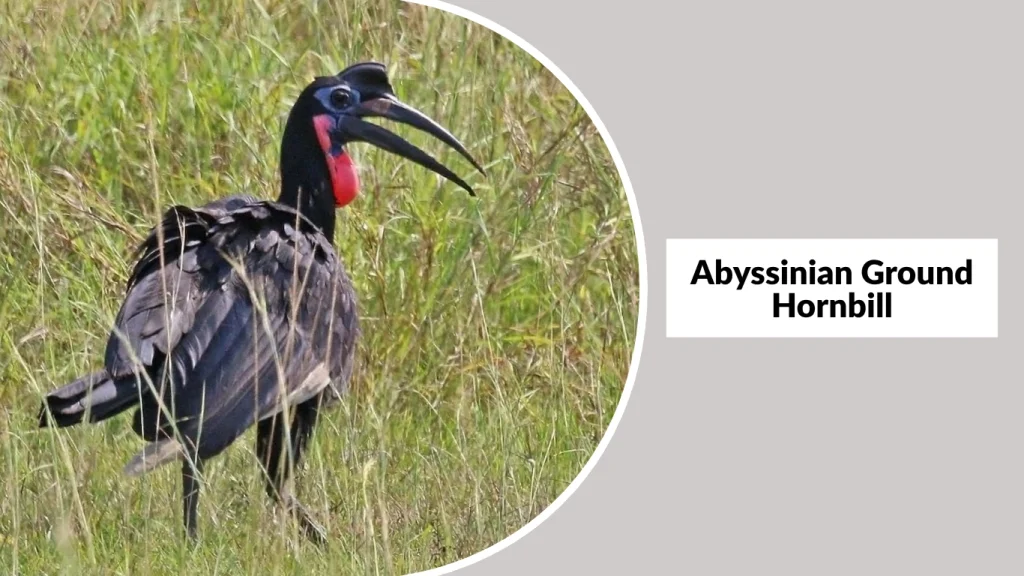
The Abyssinian Ground Hornbill is a large, terrestrial hornbill found across the savannas and open grasslands of East and Central Africa. Similar in behavior to its southern cousin, this species is a slow breeder and spends most of its life walking rather than flying. Its imposing figure, bright blue facial skin, and intelligent behavior make it one of Africa’s most charismatic birds.
Identification
- Size: 90–110 cm (35–43 inches) in length
- Wingspan: Around 1.8 meters (6 feet)
- Weight: 3–5.5 kg (6.6–12.1 lbs)
- Color: Entirely black body with white wing feathers visible in flight
- Beak: Long, black, and curved with a prominent casque
- Facial Skin: Bare and vividly blue; males have blue throats while females have a bluish-red patch
- Legs: Thick and powerful, adapted for walking long distances
- Habitat: Grasslands, savannas, and scrub regions in Ethiopia, Kenya, Uganda, and surrounding areas
Behavior and Diet
Abyssinian Ground Hornbills are carnivorous and forage on foot for insects, lizards, snakes, and small mammals. They are often seen walking in pairs or family groups and use their large bills to dig through soil and debris. They also use a booming call for communication, audible from several kilometers away.
Nesting and Reproduction
Nesting takes place in cavities of tall trees or cliffs. Females lay a single egg, and the chick is raised slowly with help from group members. These birds have long lifespans and low reproduction rates, often raising a chick only once every few years.
Conservation and Cultural Role
While still widespread, local populations are threatened by habitat loss, human disturbance, and slow breeding cycles. In many African cultures, the Abyssinian Ground Hornbill is seen as a messenger or symbol of wisdom and strength.
9. Wreathed Hornbill

The Wreathed Hornbill is a forest-dwelling species known for its elegant black-and-white plumage and wreathed yellow casque. Found in the dense lowland forests of Southeast Asia and the Indian subcontinent, it plays an essential role in tropical ecosystems through seed dispersal.
Identification
- Size: 75–100 cm (30–39 inches) in length
- Wingspan: Approximately 1.5 meters (5 feet)
- Weight: 2–3.6 kg (4.4–8 lbs)
- Color: Black body with white tail; males have a golden-yellow throat, females have blue
- Beak: Ivory-yellow with a series of black ridges or “wreaths” on the upper mandible
- Casque: Medium-sized, ridge-like, forming wavy bands
- Eye Color: Red in males; brown in females
- Habitat: Evergreen and moist deciduous forests in Northeast India, Bhutan, Myanmar, Thailand, and Indonesia
Behavior and Diet
Wreathed Hornbills primarily eat fruits, especially figs, but also consume small animals. They travel long distances in search of food and are often seen flying high above the canopy in small flocks or pairs. Their flight is strong and direct with heavy wingbeats.
Nesting and Reproduction
Like other hornbills, the female seals herself inside a nest cavity and remains there during the incubation and chick-rearing period, relying entirely on the male for food delivery. The pair exhibits strong monogamous bonds.
Conservation Status
Wreathed Hornbills are facing threats from logging, hunting, and habitat fragmentation. Despite being classified as Near Threatened, they are locally abundant in well-protected forests, and conservation efforts focus on preserving nesting trees and large forest blocks.
10. African Grey Hornbill

The African Grey Hornbill is a slender, medium-sized bird common throughout sub-Saharan Africa. Unlike many other hornbills, it is frequently seen in both wild and semi-urban areas. Its grey coloration, distinct curved beak, and shrill call make it easy to recognize in woodlands and savannas.
Identification
- Size: 45–50 cm (18–20 inches) in length
- Wingspan: Around 70–80 cm
- Weight: 200–300 grams
- Color: Grey overall with a pale belly and white-tipped tail
- Beak: Black and long with a narrow casque; slightly down-curved
- Casque: Small, narrow ridge above the beak
- Eye Color: Dark brown
- Habitat: Dry woodlands, savannas, open forests, and sometimes gardens or farms across sub-Saharan Africa
Behavior and Diet
This hornbill is omnivorous, feeding on fruits, seeds, insects, and small reptiles. It is particularly active during early morning and late afternoon. Its flight is light and swooping, and it is often heard before it is seen due to its high-pitched “ki-ki-ki” call.
Nesting and Reproduction
Nesting occurs during the dry season. The female seals herself inside a natural tree hole, relying on the male to provide food throughout incubation. After the chicks grow, the female breaks out and helps feed them until they fledge.
Ecological Role and Status
The African Grey Hornbill is an important seed disperser. Its ability to thrive in disturbed habitats and its wide range contribute to its stable population. It is currently listed as Least Concern.
11. White-crowned Hornbill

The White-crowned Hornbill is a visually distinctive species found in the dense rainforests of the Malay Peninsula, Borneo, and Sumatra. Its white crest and long tail give it a regal, almost mythical appearance. It is shy and elusive, typically staying high in the forest canopy.
Identification
- Size: 83–100 cm (33–39 inches) in length
- Wingspan: Over 1 meter
- Weight: Around 1–1.2 kg (2.2–2.6 lbs)
- Color: Black body with striking white head, crest, throat, and belly
- Beak: Pale ivory with a thin, narrow casque
- Tail: Extraordinarily long with a white tip
- Eye Color: Brown
- Habitat: Tropical rainforests of southern Thailand, Malaysia, Sumatra, and Borneo
Behavior and Diet
White-crowned Hornbills forage in small family groups, often following primates to feed on disturbed insects or dropped fruits. Their diet includes fruits, insects, and small vertebrates. They are known for their deep, laughing calls and high canopy activity.
Nesting and Reproduction
The species nests in tree cavities. Like other hornbills, the female seals herself in and depends on the male for feeding during incubation. Cooperative breeding is common, with helpers assisting the breeding pair.
Conservation Concerns
Habitat loss due to deforestation is a significant threat. This species is now classified as Vulnerable, with a declining population. Conservation efforts include forest protection and awareness programs in Southeast Asia.
12. Black-and-white-casqued Hornbill
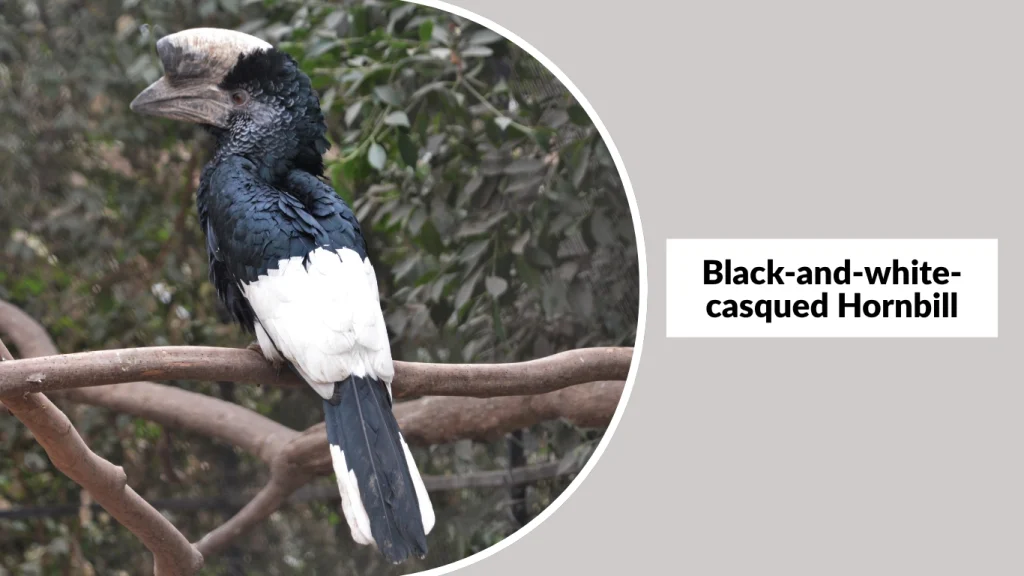
The Black-and-white-casqued Hornbill is a large, eye-catching bird found in the tropical forests of Central and West Africa. Named for its distinctive two-toned appearance and prominent casque, this species is a powerful flier and a key seed disperser in dense forest canopies.
Identification
- Size: 60–70 cm (24–28 inches) in length
- Wingspan: Up to 1 meter (3.3 feet)
- Weight: Around 1.2–1.5 kg (2.6–3.3 lbs)
- Color: Black body with white lower back, tail, and facial highlights
- Beak: Thick, black, and deeply curved with a large casque
- Casque: Prominent and ridged; white to yellowish in males, smaller in females
- Eye Color: Brown or reddish-brown
- Habitat: Rainforests, gallery forests, and forest edges in Central and Western Africa
Behavior and Diet
This hornbill is frugivorous, particularly fond of figs and other soft forest fruits, though it also eats insects and small animals. It usually forages high in the canopy, flying between large fruiting trees with powerful wingbeats and short glides.
Nesting and Reproduction
Like other hornbills, the female seals herself inside a tree cavity during nesting. Males feed the female and chicks through a narrow slit. The species typically raises one or two chicks per breeding season.
Ecological Role and Conservation
A vital disperser of tropical tree seeds, this hornbill supports forest regeneration. Though not currently endangered, deforestation is fragmenting its habitat. It is listed as Least Concern but requires habitat preservation to maintain stable populations.
13. Silvery-cheeked Hornbill

The Silvery-cheeked Hornbill is a large, striking bird native to the montane and coastal forests of East Africa. Its silvery-speckled head feathers and robust casque give it a unique and imposing appearance. It is typically seen in pairs or small flocks flying loudly across forested landscapes.
Identification
- Size: 75–90 cm (30–35 inches) in length
- Wingspan: Over 1.2 meters (4 feet)
- Weight: 1.2–1.5 kg (2.6–3.3 lbs)
- Color: Mostly black body with silvery-white streaks on the head and neck
- Beak: Large, pale ivory with a massive dark casque
- Casque: Ridged, thick, and prominent in males; smaller in females
- Eye Color: Brown
- Habitat: Highland forests, forest edges, and wooded valleys of eastern and southern Africa, especially Ethiopia, Tanzania, Malawi, and Zimbabwe
Behavior and Diet
The Silvery-cheeked Hornbill feeds mostly on fruit but also includes small reptiles, insects, and rodents in its diet. It often moves through the forest canopy with loud wingbeats and calls—a loud barking or braying noise. It can cover long distances between feeding sites.
Nesting and Reproduction
Nesting follows the typical hornbill pattern: females are sealed inside a tree cavity for the duration of incubation and chick rearing. Pairs may nest high in tall trees in well-preserved forest areas.
Conservation Notes
Though considered Least Concern, Silvery-cheeked Hornbill populations are declining in regions affected by deforestation and hunting. Conservation priorities include preserving large trees and ensuring safe nesting and feeding habitats.
14. Narcondam Hornbill
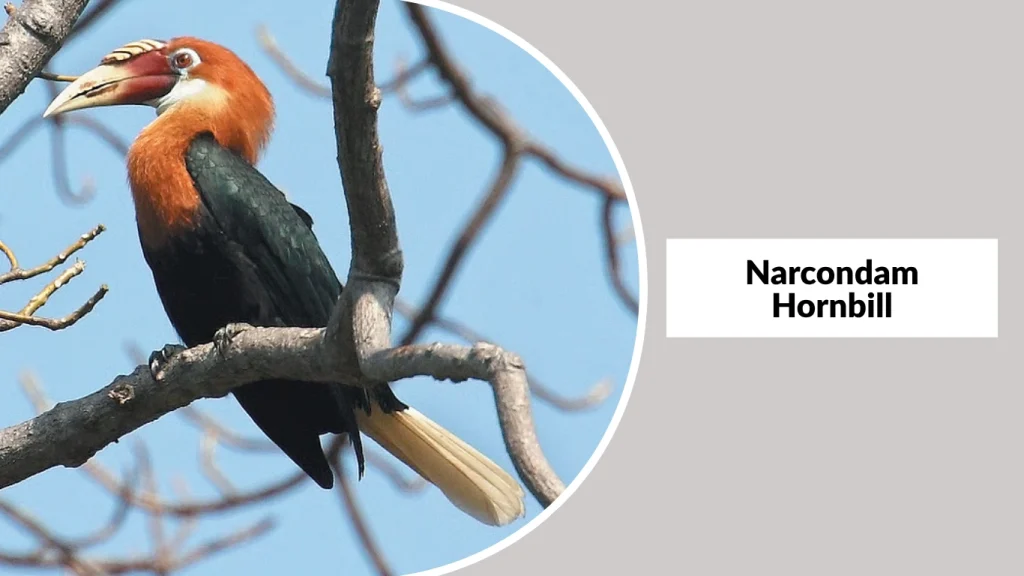
The Narcondam Hornbill is one of the rarest and most geographically restricted hornbill species in the world. Found only on the tiny volcanic Narcondam Island in the Andaman Sea (India), this bird is endemic to a single location, making it a critically important species for conservation.
Identification
- Size: Approximately 60–70 cm (24–28 inches) in length
- Wingspan: Around 90–100 cm
- Weight: Estimated between 600–800 grams
- Color: Glossy black body with a white tail and rump
- Beak: Creamy-yellow and long with a distinct casque
- Casque: Pale, narrow, slightly curved upward
- Eye Color: Reddish-orange surrounded by bare facial skin
- Habitat: Moist evergreen forests on Narcondam Island at various elevations
Behavior and Diet
The Narcondam Hornbill is primarily frugivorous, depending heavily on native fruiting trees—especially figs—for food. It also supplements its diet with small invertebrates and possibly lizards. It plays a critical role in seed dispersal across the island.
Nesting and Reproduction
Little is known about its nesting behavior due to its remote location, but it is believed to follow typical hornbill nesting patterns. Breeding likely occurs during the dry season when fruit availability is high. Tree cavities are used for nesting, and the female seals herself inside.
Conservation Status
Classified as Endangered due to its extremely small range and population (estimated under 500 individuals). Habitat loss, natural disasters, and invasive species are major threats. The entire global population exists on a single island, making it highly vulnerable to ecological disturbances.
15. Palawan Hornbill

The Palawan Hornbill is a glossy black hornbill with striking facial features, endemic to the Palawan group of islands in the Philippines. It is locally known as “Talusi” and plays an important role in the culture and ecology of the islands it inhabits.
Identification
- Size: 60–70 cm (24–28 inches) in length
- Wingspan: Around 90 cm
- Weight: Approximately 750–950 grams
- Color: Shiny black plumage with a white tail tip and ivory-colored bill
- Beak: Long, pale yellow to ivory with a low casque
- Casque: Minimal, flattened along the ridge of the upper beak
- Facial Skin: Bare white skin around the eyes and throat
- Habitat: Lowland forests, mangroves, and forest edges in Palawan and nearby islands
Behavior and Diet
Palawan Hornbills are frugivores that feed heavily on figs and other soft fruits. They are also known to eat insects, snails, and small vertebrates. Their foraging behavior helps maintain the health of forest ecosystems through seed dispersal.
Nesting and Reproduction
Breeding occurs during the dry season. Females seal themselves inside a nest cavity using a mixture of mud, droppings, and fruit pulp. Males feed the females and chicks throughout incubation. Only when the young are developed enough is the cavity opened.
Conservation Status
Threatened by deforestation, hunting, and habitat fragmentation, the Palawan Hornbill is currently listed as Vulnerable. Conservation efforts focus on habitat protection and community engagement to reduce hunting pressures and logging on the islands.
16. Sulu Hornbill

The Sulu Hornbill is one of the rarest hornbills in the world, critically endangered and possibly on the brink of extinction. Endemic to the Sulu Archipelago in the southern Philippines, it has suffered from extensive habitat destruction and hunting, leaving only a small population on the island of Tawi-Tawi.
Identification
- Size: Approximately 60–70 cm (24–28 inches) in length
- Wingspan: About 90–100 cm
- Weight: Estimated at 700–900 grams
- Color: Black plumage with a white tail and prominent white patch on the lower belly
- Beak: Pale cream to ivory-colored with a slightly raised casque
- Casque: Low and narrow, typical of smaller hornbill species
- Facial Skin: White with bluish skin around the eyes and throat
- Habitat: Primary lowland forest and forest edges of Tawi-Tawi Island in the Sulu Archipelago
Behavior and Diet
This hornbill feeds mainly on fruits such as figs, though it may also consume insects and small animals. It is generally shy and elusive, retreating into the canopy and dense forests. Its calls are loud and echoing, often heard in early morning.
Nesting and Reproduction
Likely follows the traditional hornbill nesting behavior, with females sealing themselves in tree cavities during incubation. However, due to the lack of research and small population, specific nesting data is scarce.
Conservation Status
Critically Endangered. Fewer than 40 individuals are estimated to remain in the wild. Its habitat has been almost entirely cleared due to logging and farming. Conservation efforts include reforestation, awareness campaigns, and surveys to locate any surviving populations.
17. Mindanao Hornbill

Also known as the Southern Rufous Hornbill, the Mindanao Hornbill is an endemic species found only in the forests of Mindanao and neighboring islands in the southern Philippines. Its deep rufous coloration and unique vocalizations make it a distinctive member of the hornbill family.
Identification
- Size: 60–70 cm (24–28 inches) in length
- Wingspan: Around 1 meter
- Weight: 800–1,100 grams
- Color: Rich rufous head and underparts with dark wings and tail
- Beak: Pale yellow with a narrow casque
- Casque: Slightly elevated and follows the curve of the beak
- Eye Color: Dark with bare skin around the eyes
- Habitat: Lowland to montane forests up to 2,000 meters elevation on Mindanao and nearby islands
Behavior and Diet
Mindanao Hornbills are largely frugivorous, favoring wild figs and other forest fruits. They also consume insects and small animals. They are typically seen in pairs or small groups, moving quietly through the mid to upper canopy.
Nesting and Reproduction
Breeding behavior is similar to that of other hornbills: cavity nesting with the female sealed inside during incubation. The male provides food through the narrow slit until the female and chick are ready to emerge.
Conservation Status
Endangered due to severe deforestation, hunting, and habitat fragmentation. It is now restricted to isolated patches of forest. Conservation actions are ongoing, including habitat protection, research, and community-based conservation programs.
18. Rufous-necked Hornbill

The Rufous-necked Hornbill is a striking and rare species found in the Eastern Himalayas and parts of Southeast Asia. It stands out with its rich chestnut head and neck, contrasting with a glossy black body. This hornbill is a flagship species for conservation efforts in the forests of Northeast India and neighboring regions.
Identification
- Size: 90–100 cm (35–39 inches) in length
- Wingspan: Approximately 1.2–1.4 meters
- Weight: 1.5–2.5 kg (3.3–5.5 lbs)
- Color: Males have a rufous-orange head and neck; females are mostly black with a white neck patch
- Beak: Creamy-yellow with black vertical ridges (especially in males)
- Casque: Large, pale, and slightly ridged, extending over the beak’s top
- Eye Color: Deep red in males, brown in females
- Habitat: Broadleaf subtropical and evergreen forests from Northeast India to western Thailand and northern Myanmar
Behavior and Diet
This species feeds on a variety of forest fruits, particularly figs, as well as insects and small vertebrates. It is mostly arboreal, spending time in the upper canopy, and has a powerful, flapping flight. Its calls are deep, croaking honks, often heard at dawn.
Nesting and Reproduction
Breeding takes place between March and June. Females seal themselves in tree cavities for up to 4 months, depending on food supply and chick development. The male provides all food until the female breaks out to assist with feeding the chick.
Conservation Status
Listed as Vulnerable due to extensive habitat loss, especially in the Eastern Himalayas. The Rufous-necked Hornbill depends on large, old trees for nesting, making deforestation especially damaging. Protected in several reserves, it serves as a key species for habitat conservation programs.
19. Knobbed Hornbill
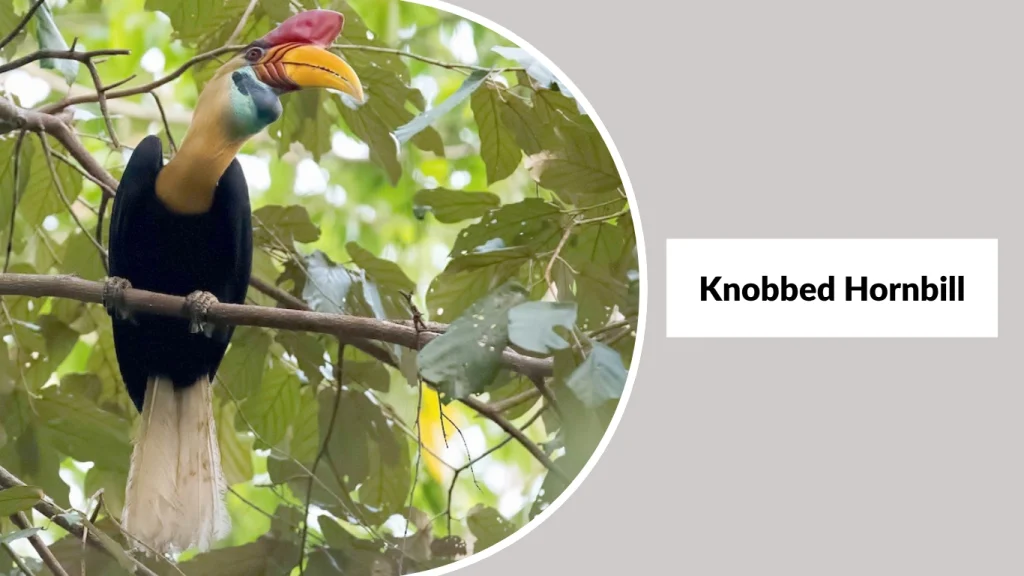
The Knobbed Hornbill, also known as the Sulawesi Wrinkled Hornbill, is a spectacular hornbill endemic to the Indonesian island of Sulawesi and nearby smaller islands. It is distinguished by its swollen casque, or “knob,” above the beak and its vivid coloration.
Identification
- Size: 80–90 cm (31–35 inches) in length
- Wingspan: Around 1.2 meters
- Weight: 1.3–1.7 kg (2.8–3.7 lbs)
- Color: Black body, white tail, and a yellow face and throat in males; females are mostly black with blue facial skin
- Beak: Bright yellow with a large reddish-orange knobbed casque
- Casque: Pronounced bulbous “knob” especially in males; smaller in females
- Eye Color: Red in males, brown in females
- Habitat: Tropical evergreen and lowland forests on Sulawesi and nearby Indonesian islands
Behavior and Diet
This hornbill feeds mainly on fruits but will also eat insects, small reptiles, and eggs. It plays a crucial role in seed dispersal and is most active in the early morning and late afternoon. Their loud honking calls carry far through the dense forest.
Nesting and Reproduction
Typical hornbill nesting behavior, with females sealed into tree cavities during breeding. The male provides food throughout incubation and early chick-rearing. Nesting requires large, mature trees, which are becoming increasingly scarce.
Conservation Status
Threatened by logging and habitat fragmentation, the Knobbed Hornbill is listed as Vulnerable. Conservation efforts include forest protection and education programs in Sulawesi to reduce hunting and preserve nesting habitats.
20. Bushy-crested Hornbill

The Bushy-crested Hornbill is a social, forest-dwelling species found in Southeast Asia. Smaller than many of its relatives, it lives and forages in flocks and is known for its more subdued appearance and communal behavior.
Identification
- Size: 60–70 cm (24–28 inches) in length
- Wingspan: Around 90–100 cm
- Weight: 600–900 grams
- Color: Mostly dark brown to black with lighter brown crests and neck
- Beak: Yellowish or pale ivory with a slight curve and minimal casque
- Casque: Very low and narrow
- Eye Color: Brown
- Habitat: Evergreen and lowland forests of Myanmar, Thailand, Malaysia, and Borneo
Behavior and Diet
Bushy-crested Hornbills travel in noisy flocks of 5 to 15 birds. They feed on fruits, insects, and small animals. Their social nature helps them locate food sources efficiently and contributes to their strong group cohesion.
Nesting and Reproduction
Unusually for hornbills, this species may breed communally. While the main female seals herself inside a nest cavity, other members of the flock help feed her and the chicks. Nesting occurs during the dry season and follows the standard hornbill pattern.
Conservation Notes
Although not currently endangered, the Bushy-crested Hornbill faces habitat threats from deforestation and logging. Its ability to live in secondary forests gives it an edge, but preserving primary forest is still crucial for long-term survival. It is currently listed as Least Concern.