
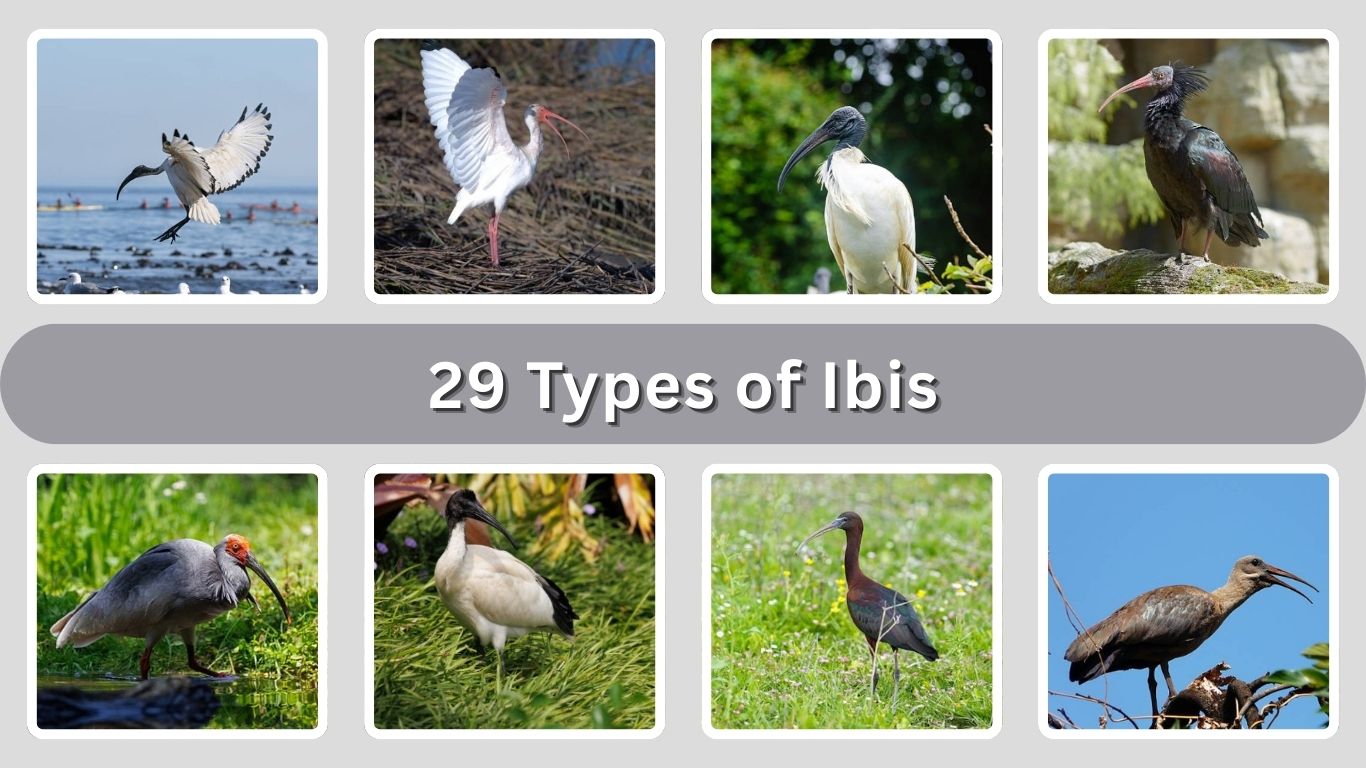
Ibises are long-legged wading birds known for their curved bills, graceful movements, and strong connection to wetlands around the world. Found across Africa, Asia, Australia, Europe, and the Americas, these birds occupy habitats ranging from marshes and riverbanks to grasslands and coastal lagoons. Some ibis species are brightly colored, like the scarlet ibis, while others are dark and secretive. Together, the 29 types of ibis show remarkable diversity in size, behavior, and ecological roles.
1. African Sacred Ibis
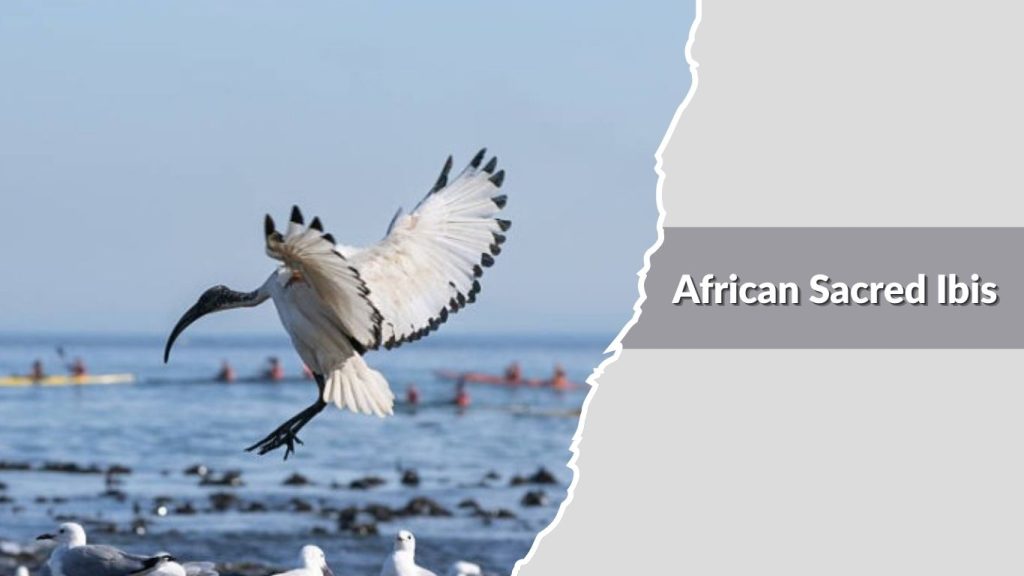
The African Sacred Ibis is a large, striking wading bird native to sub-Saharan Africa and parts of the Middle East. Known for its white body, black head, and long curved bill, this ibis is often seen around wetlands, rivers, and agricultural fields. It is highly adaptable, social, and historically significant, especially in ancient Egyptian culture.
Identification
- White body with contrasting black head and neck
- Long, downward-curved black bill
- Black flight feathers visible in wings
- Long black legs adapted for wading
- Average length: about 65–75 cm
Habitat
African Sacred Ibises prefer wetlands, lakeshores, floodplains, marshes, and riverbanks. They are also commonly found in farmland, garbage dumps, and urban outskirts, showing strong adaptability to human-modified environments.
Behavior
This species is highly social and usually seen in flocks. It spends much of the day walking slowly through shallow water, probing mud with its bill. African Sacred Ibises often roost and nest in large colonies, sometimes mixed with other waterbirds.
Diet and Lifespan
African Sacred Ibises are omnivorous. Their diet includes insects, crustaceans, small fish, frogs, worms, and scraps of human food. In the wild, they typically live around 15 years, though some individuals may survive longer in protected environments.
2. American White Ibis
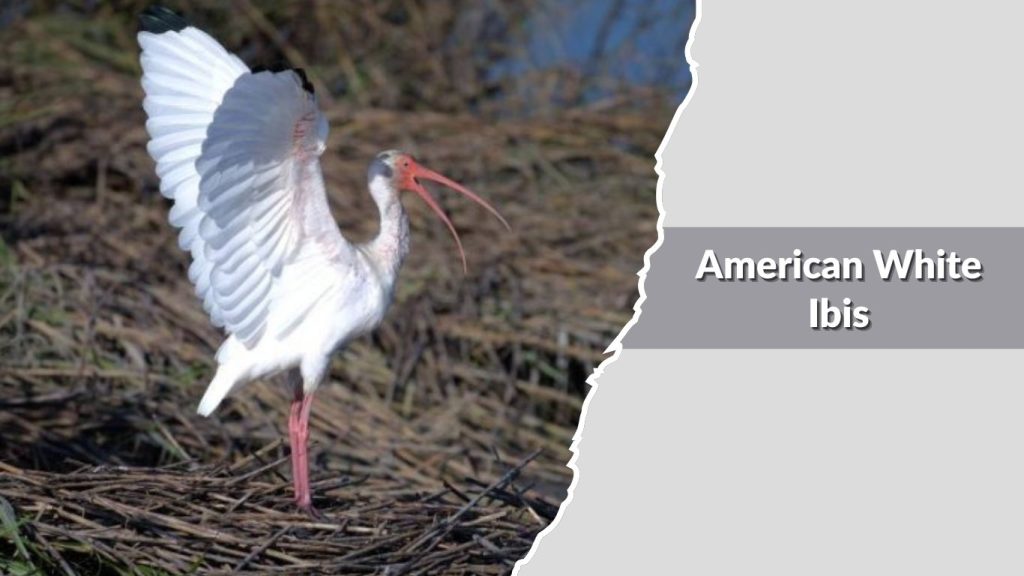
The American White Ibis is a graceful wading bird widely found across the southeastern United States, Central America, the Caribbean, and northern South America. It is easily recognized by its bright white body and long, curved reddish bill. This species often forages in shallow wetlands and coastal marshes and is commonly seen feeding in flocks.
Identification
- Bright white body with black wing tips visible in flight
- Long, slender, downward-curved reddish bill
- Pinkish-red legs and feet
- Medium to large-sized wading bird
- Average length: about 55–70 cm
Habitat
American White Ibises inhabit marshes, swamps, mangroves, mudflats, lagoons, and coastal wetlands. They are also frequently seen in freshwater ponds, flooded fields, and even urban parks near water.
Behavior
This ibis is highly social and usually feeds and roosts in groups. It walks slowly through shallow water, probing with its bill to locate prey. During breeding season, large nesting colonies form in trees or dense wetland vegetation.
Diet and Lifespan
American White Ibises feed mainly on insects, crayfish, crabs, small fish, frogs, and other aquatic invertebrates. Their average lifespan in the wild is around 10 to 15 years, depending on environmental conditions and predation.
3. Black-headed Ibis
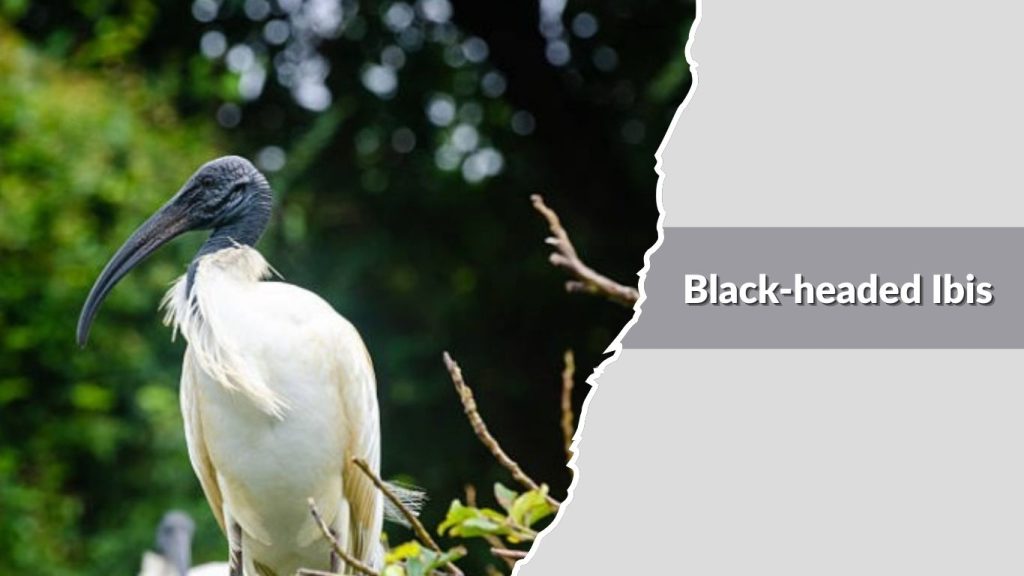
The Black-headed Ibis is a large, elegant wading bird commonly found across South and Southeast Asia. It is known for its striking contrast between a white body and a bare black head and neck. This species prefers open wetlands and agricultural landscapes, where it feeds in shallow water and muddy fields.
Identification
- White body with a bare black head and upper neck
- Long, slightly down-curved black bill
- Black wing tips visible in flight
- Long grey to black legs
- Average length: about 65–75 cm
Habitat
Black-headed Ibises are typically found in marshes, swamps, lakes, riverbanks, flooded fields, and rice paddies. They often stay near open water and are also seen in farmlands and grasslands close to wetlands.
Behavior
This species is social and is usually observed in pairs or small flocks. It forages slowly, probing mud and shallow water with its bill. During the breeding season, it nests in colonies, often in tall trees near water.
Diet and Lifespan
Their diet includes insects, frogs, small fish, crustaceans, snails, and other aquatic invertebrates. In the wild, Black-headed Ibises can live around 12 to 18 years, depending on habitat quality and threats.
4. Bald Ibis
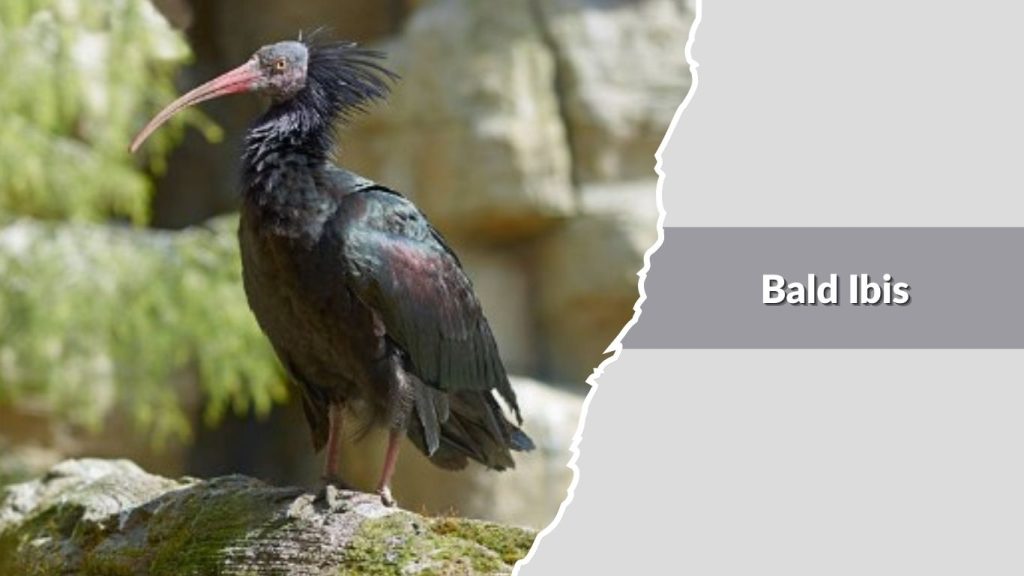
The Bald Ibis is a distinctive and rare ibis species known for its bare reddish face, glossy dark plumage, and long curved bill. Historically widespread across parts of Europe, North Africa, and the Middle East, it is now mostly restricted to small, protected populations. This bird often forages in open landscapes rather than deep wetlands.
Identification
- Bare reddish face and crown
- Long, slender, down-curved reddish bill
- Dark glossy black to purplish plumage
- Long dark legs
- Average length: about 70–80 cm
Habitat
Bald Ibises typically inhabit semi-arid regions, rocky cliffs, open grasslands, river valleys, and coastal plains. Unlike many ibises, they often feed in dry fields, pastures, and lightly vegetated areas rather than standing water.
Behavior
They are highly social birds, usually seen in flocks. Bald Ibises forage by walking slowly and probing the ground. They nest colonially on cliff ledges or rocky outcrops and are known for strong pair bonds and site loyalty.
Diet and Lifespan
Their diet includes insects, beetles, grasshoppers, small reptiles, worms, and other ground-dwelling invertebrates. In the wild, Bald Ibises can live around 15 to 20 years, especially in well-protected populations.
5. Crested Ibis
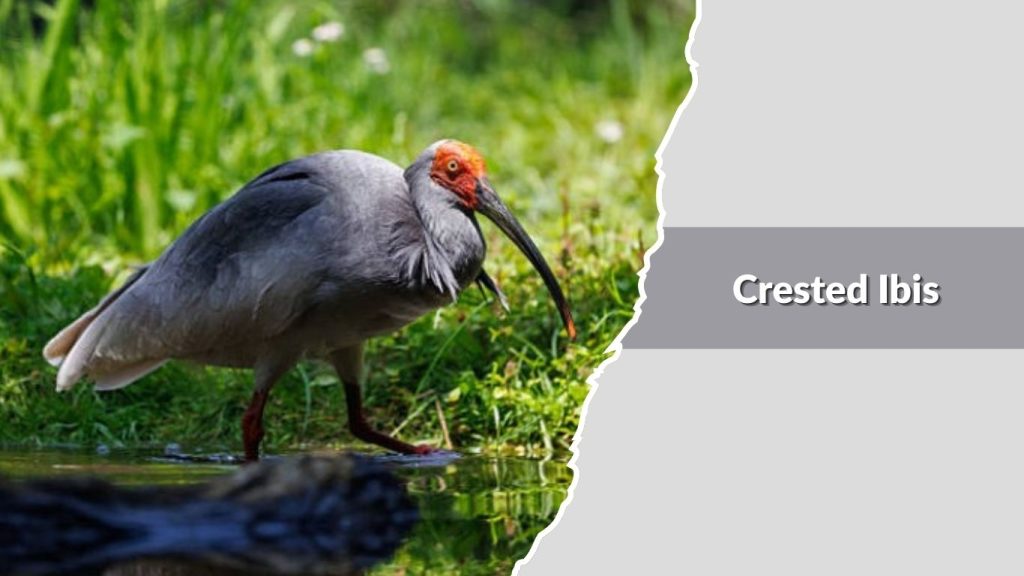
The Crested Ibis is a rare and elegant ibis species once widespread across East Asia, but now mainly found in protected areas of China. It is famous for its soft white plumage, long curved bill, and a delicate crest of feathers on the back of its head. This bird is strongly associated with conservation success due to intensive recovery efforts.
Identification
- White to pale pinkish body plumage
- Distinct narrow crest of elongated feathers on the head
- Long, slender, down-curved dark bill
- Red facial skin around the eyes
- Average length: about 55–65 cm
Habitat
Crested Ibises inhabit wetlands, rice paddies, slow-moving rivers, ponds, and forested valleys. They prefer quiet environments with shallow water where they can easily probe for food.
Behavior
This species is generally seen alone, in pairs, or small family groups. It forages slowly, using its sensitive bill to detect prey in mud and shallow water. During the breeding season, they nest in tall trees near wetlands.
Diet and Lifespan
Their diet consists mainly of small fish, frogs, insects, snails, and aquatic invertebrates. In the wild, Crested Ibises can live around 15 to 20 years, especially in well-managed conservation areas.
6. Giant Ibis
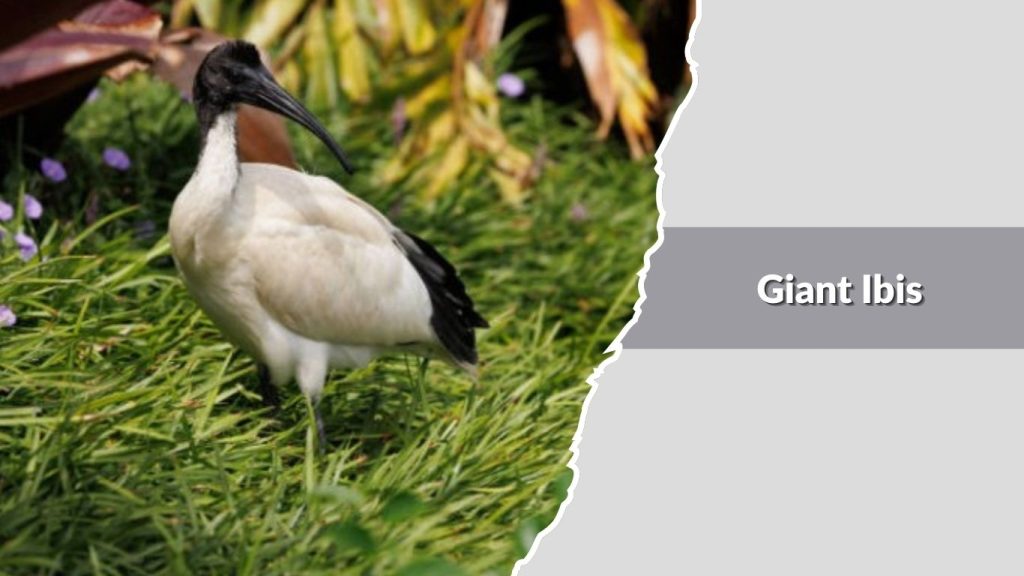
The Giant Ibis is the largest and one of the rarest ibis species in the world. Native mainly to northern Cambodia and small parts of Laos, this critically endangered bird is known for its massive size, long neck, and heavy curved bill. It depends heavily on undisturbed wetlands and seasonal pools.
Identification
- Very large body size, the largest of all ibises
- Brownish-grey plumage with darker head and neck
- Long, thick, downward-curved bill
- Bare dark facial skin
- Strong, long legs adapted for wading
Habitat
Giant Ibises inhabit lowland wetlands, marshes, seasonal pools, river edges, and flooded forests. During the dry season, they are often seen around shrinking waterholes where food becomes concentrated.
Behavior
This species is usually solitary or found in pairs. It forages slowly, probing deep mud for prey. Giant Ibises are shy, quiet birds and are extremely sensitive to habitat disturbance.
Diet and Lifespan
Their diet includes eels, frogs, crustaceans, insects, small reptiles, and aquatic invertebrates. In the wild, Giant Ibises are believed to live around 15 to 25 years under natural, protected conditions.
7. Glossy Ibis
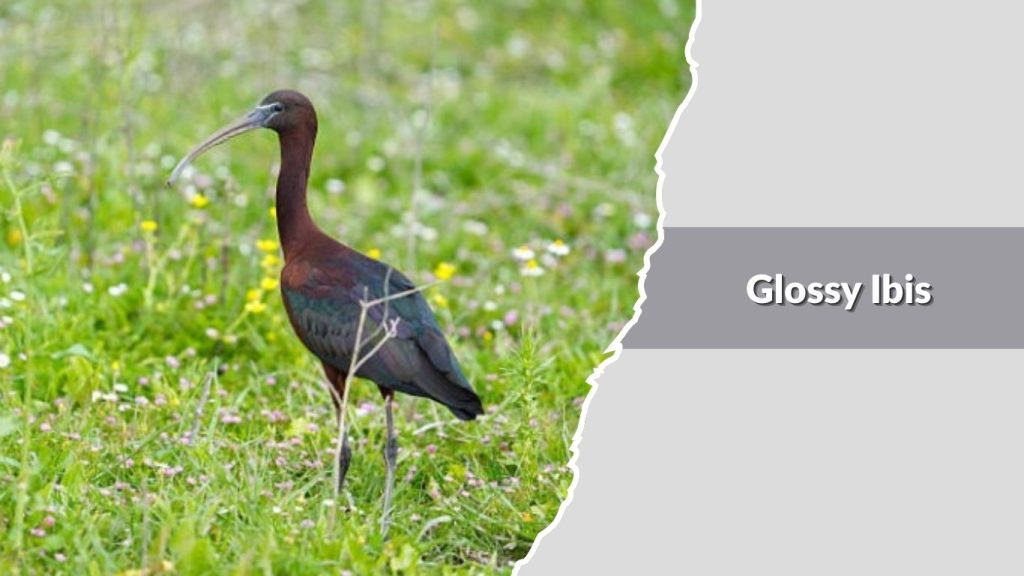
The Glossy Ibis is a slender, elegant ibis species with beautiful iridescent plumage. It has one of the widest distributions of any ibis, found across Europe, Africa, Asia, Australia, and the Americas. Its shimmering colors and graceful feeding behavior make it a favorite among wetland birdwatchers.
Identification
- Dark chestnut-brown body with green and purple iridescence
- Long, slender, downward-curved bill
- Bare dark facial skin around the eye
- Long dark legs
- Slim, streamlined body shape
Habitat
Glossy Ibises inhabit freshwater marshes, lakes, swamps, flooded fields, rice paddies, and coastal lagoons. They favor shallow wetlands with soft mud where prey is abundant.
Behavior
They are highly social and often feed in large flocks, sometimes mixed with herons and egrets. Glossy Ibises walk slowly through shallow water, probing mud rhythmically to locate food. They nest colonially in reed beds or trees near water.
Diet and Lifespan
Their diet includes insects, worms, crustaceans, mollusks, frogs, and small fish. In natural conditions, Glossy Ibises usually live around 10 to 15 years.
8. Hadada Ibis
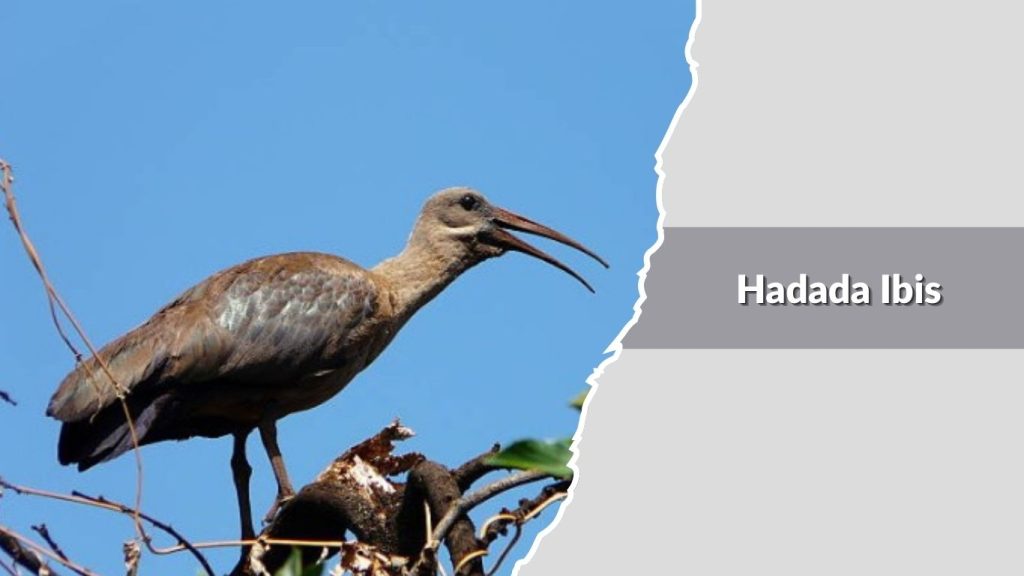
The Hadada Ibis is a large, noisy, and unmistakable ibis species native to sub-Saharan Africa. It is best known for its loud, trumpet-like calls and its rich bronze-green plumage. This adaptable bird is often seen in wetlands, open grasslands, and even urban parks.
Identification
- Brownish-grey body with metallic green and purple sheen on wings
- Long, thick, down-curved black bill
- Broad wings with glossy flight feathers
- Long dark legs
- Large, heavy-bodied ibis
Habitat
Hadada Ibises inhabit marshes, riversides, lakeshores, wet grasslands, savannas, and agricultural land. They have adapted well to human environments and are increasingly common in city parks and golf courses.
Behavior
This species is very vocal and social, often seen flying in groups while calling loudly. It forages by probing soil and shallow water for food. Hadada Ibises usually roost and nest in tall trees, often near water sources.
Diet and Lifespan
Their diet includes insects, earthworms, snails, frogs, small reptiles, and occasionally fish. In the wild, Hadada Ibises generally live about 15 to 20 years.
9. Northern Bald Ibis
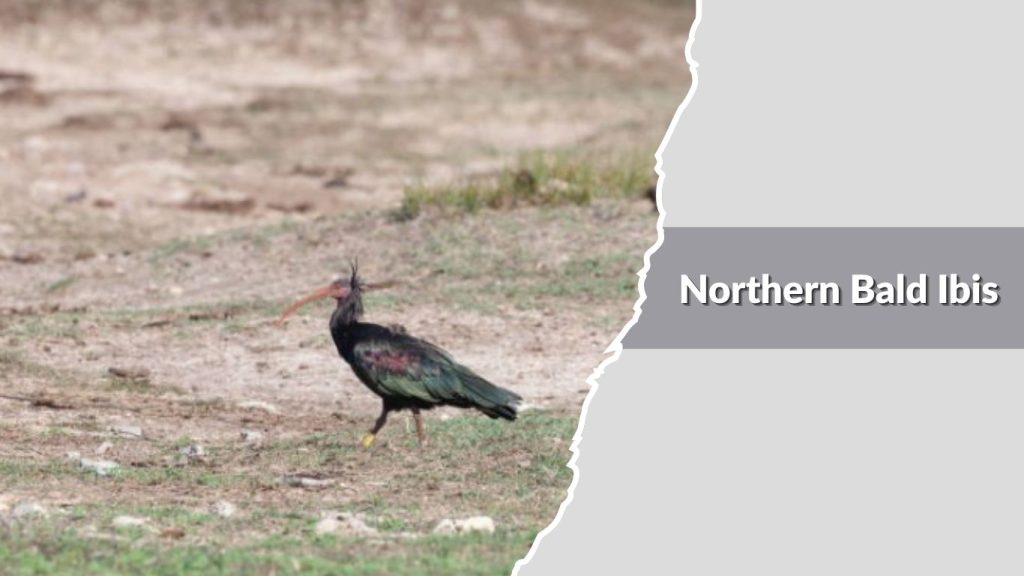
The Northern Bald Ibis is a critically endangered ibis species once widespread across Europe, North Africa, and the Middle East. It is easily recognized by its bare red face, long curved bill, and glossy black plumage with a green-purple sheen. Today, only a few small, protected populations remain.
Identification
- Bare reddish face and crown
- Long, slender, downward-curved red bill
- Glossy black plumage with metallic green and purple shine
- Shaggy crest of narrow feathers on the back of the head
- Long dark legs and broad wings
Habitat
Northern Bald Ibises prefer semi-arid regions, coastal plains, river valleys, and open grasslands. They often forage in dry or lightly moist ground rather than deep wetlands and usually nest on rocky cliffs or steep coastal ledges.
Behavior
This species is highly social and usually seen in small flocks. It feeds by slowly probing the soil for prey. Northern Bald Ibises form strong pair bonds and breed in colonies, showing strong loyalty to traditional nesting sites.
Diet and Lifespan
Their diet consists mainly of insects, beetles, larvae, small reptiles, and other ground-dwelling invertebrates. In protected conditions, Northern Bald Ibises can live 15 to 25 years.
10. Sacred Ibis
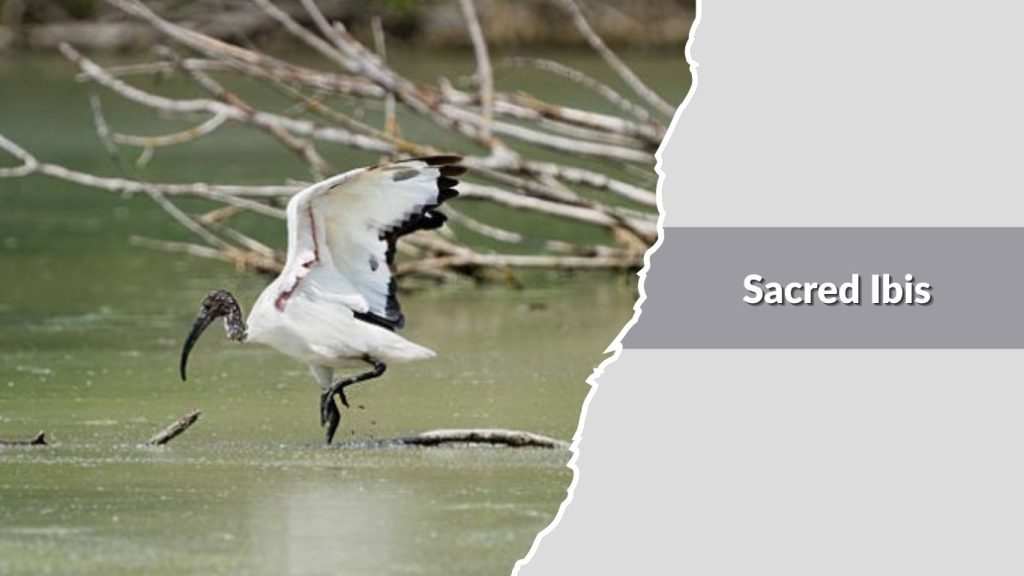
The Sacred Ibis is a large, striking wading bird closely associated with ancient Egyptian history and symbolism. It is best known for its white body contrasted by a bare black head and long curved bill. Today, it is widespread across much of Africa and has also been introduced to parts of Europe and the Middle East.
Identification
- White body with black head, neck, and tail plumes
- Long, downward-curved black bill
- Black flight feathers visible when wings are spread
- Long black legs adapted for wading
- Medium to large-sized ibis
Habitat
Sacred Ibises inhabit wetlands, marshes, lakeshores, riverbanks, floodplains, and agricultural fields. They are highly adaptable and may also be seen near urban water bodies and landfills.
Behavior
They are social birds often seen in large flocks. Sacred Ibises forage by probing mud and shallow water and also scavenge opportunistically. They nest in large colonies, often in trees or reed beds near water.
Diet and Lifespan
Their diet includes insects, fish, frogs, small reptiles, crustaceans, eggs of other birds, and human food waste. In the wild, Sacred Ibises generally live around 15 years, sometimes longer in safe environments.
11. Scarlet Ibis
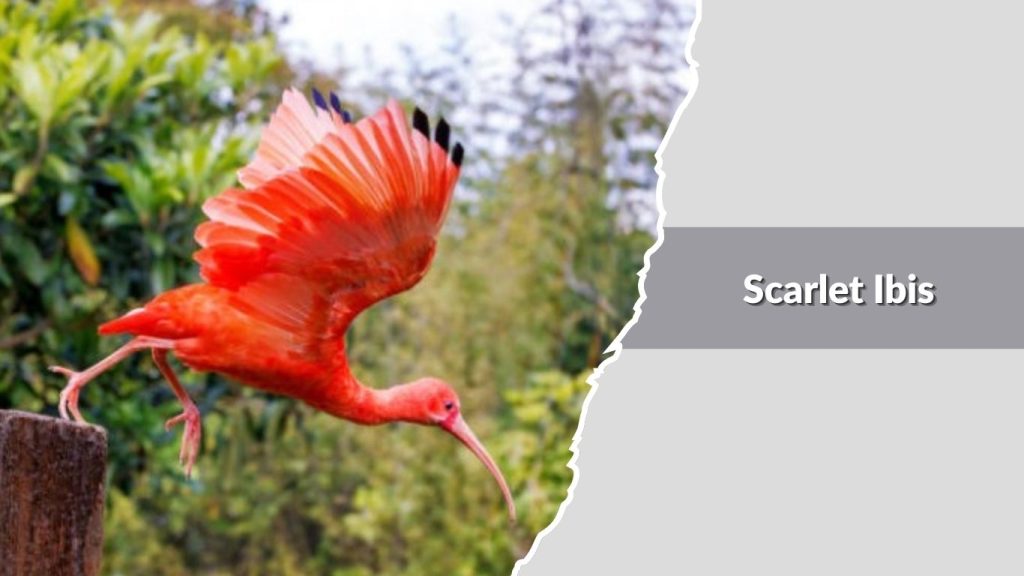
The Scarlet Ibis is one of the most visually striking wading birds in the world, famous for its brilliant red plumage. Native to northern South America, Central America, and the Caribbean, this ibis is closely associated with mangroves, estuaries, and coastal wetlands.
Identification
- Bright scarlet-red body and wings
- Long, slender, down-curved bill, pinkish to pale red
- Black wing tips visible in adult birds
- Long pink to reddish legs
- Medium-sized, slim-bodied ibis
Habitat
Scarlet Ibises inhabit mangrove swamps, tidal mudflats, estuaries, lagoons, and coastal marshes. They roost and nest in large colonies, often in mangrove trees near water.
Behavior
They are highly social and usually seen in flocks, especially at dawn and dusk. Scarlet Ibises forage in shallow water, sweeping and probing with their bills. Their bright color also plays a role in social signaling within colonies.
Diet and Lifespan
Their diet mainly consists of crabs, shrimp, insects, small mollusks, and other aquatic invertebrates. The pigments from crustaceans are responsible for their red coloration. In the wild, Scarlet Ibises typically live around 15 to 20 years.
12. Straw-necked Ibis
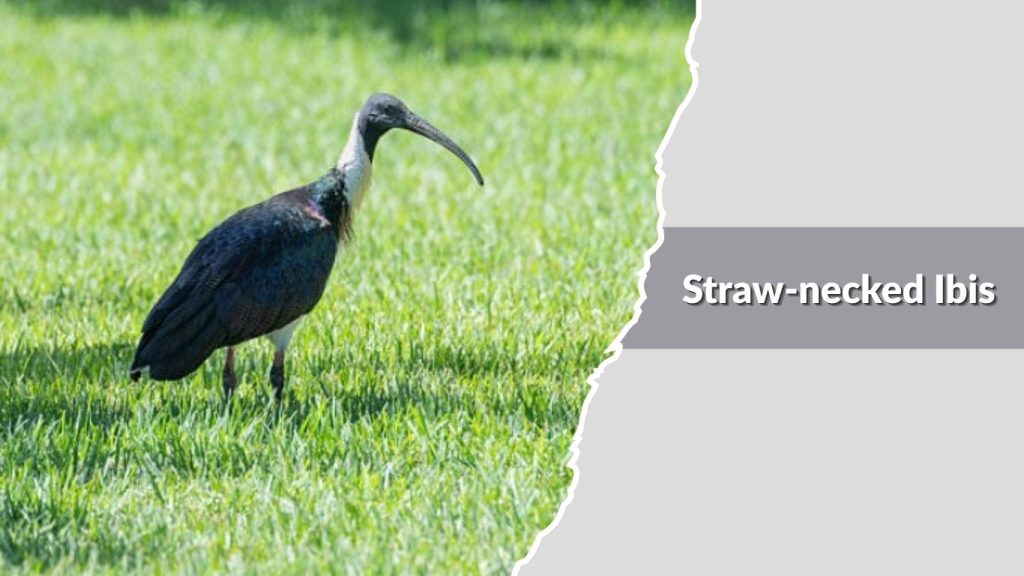
The Straw-necked Ibis is a large, impressive ibis species native to Australia and parts of New Guinea. It is known for its glossy dark body, strong curved bill, and the distinctive straw-like feathers on its neck. This species is highly mobile and often appears suddenly in large numbers after heavy rains.
Identification
- Dark brown to black glossy body plumage
- Straw-like pale feathers on the neck and upper chest
- Long, heavy, downward-curved black bill
- Broad wings with metallic green and purple sheen
- Large-bodied ibis
Habitat
Straw-necked Ibises inhabit freshwater wetlands, floodplains, marshes, lakes, and agricultural fields. They often move long distances to take advantage of temporary wetlands formed after rainfall.
Behavior
They are strongly social birds, often seen feeding and nesting in very large flocks. Straw-necked Ibises forage both in shallow water and dry fields, probing soil and vegetation. They breed colonially, sometimes in enormous nesting colonies.
Diet and Lifespan
Their diet includes insects, grasshoppers, beetles, frogs, small reptiles, fish, and other invertebrates. In the wild, Straw-necked Ibises can live around 10 to 20 years, depending on conditions.
13. Australian White Ibis
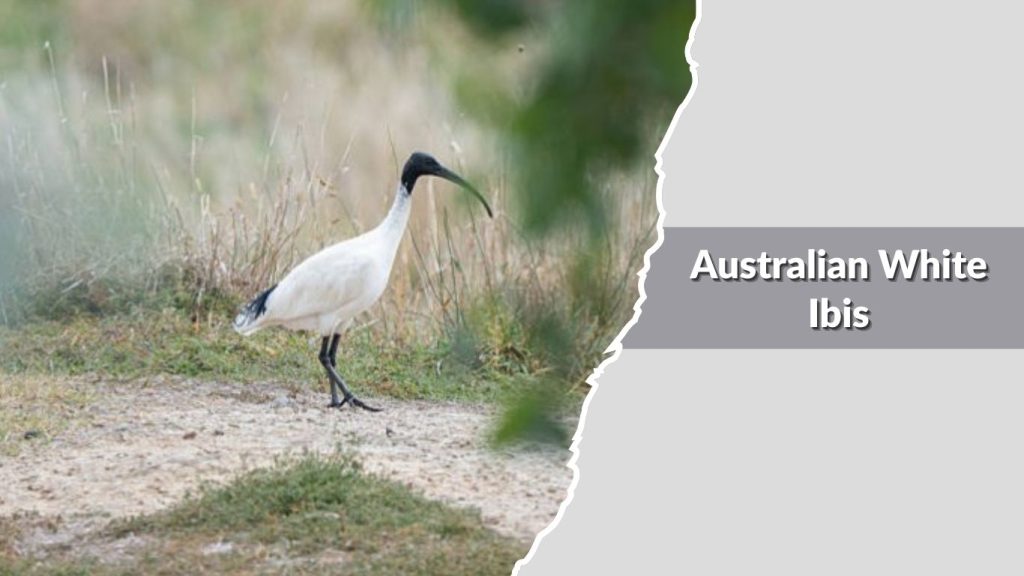
The Australian White Ibis is a familiar and highly adaptable ibis species native to Australia. Often seen in wetlands, coastal areas, and city parks, it has become well known for thriving around human settlements. Its white body, black head, and long curved bill make it easy to recognize.
Identification
- White body with contrasting black head and neck
- Long, down-curved black bill
- Black tail feathers and black wing tips
- Long dark legs
- Medium to large-sized ibis
Habitat
Australian White Ibises live in marshes, swamps, lakes, riverbanks, floodplains, and coastal wetlands. In recent decades, they have increasingly occupied urban parks, landfills, golf courses, and city waterways.
Behavior
They are social birds, usually seen in flocks. Australian White Ibises forage by probing soil, mud, and shallow water. In cities, they are bold and opportunistic, often scavenging near people. They nest colonially, often in trees near water.
Diet and Lifespan
Their natural diet includes insects, yabbies, frogs, small fish, and other invertebrates, but urban birds also eat scraps. In the wild, Australian White Ibises generally live about 10 to 15 years.
14. Buff-necked Ibis
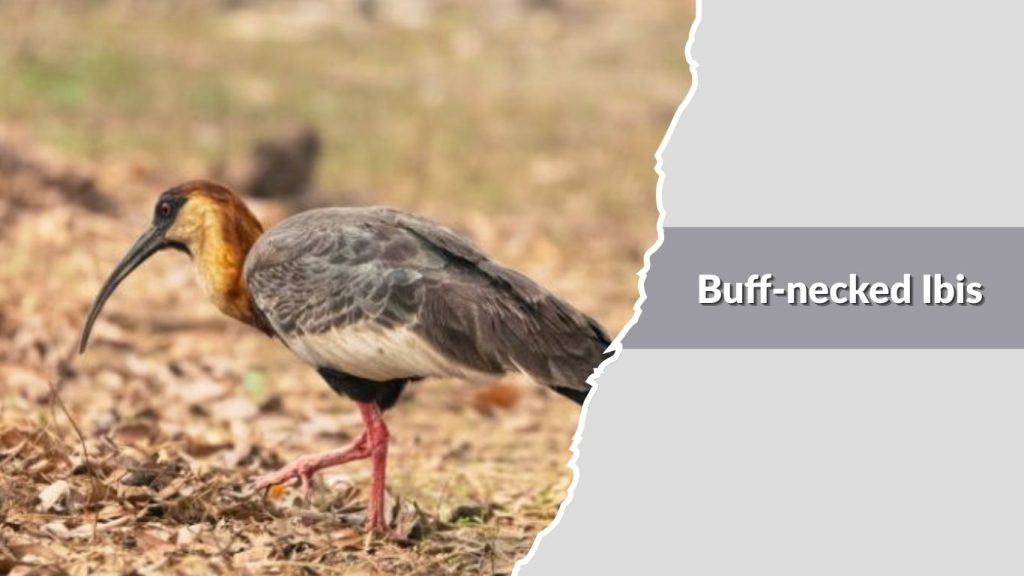
The Buff-necked Ibis is a striking ibis species native to South America, especially common in open grasslands and wetlands. It is known for its contrasting buff-colored neck, dark body, and strong curved bill. This bird is often seen walking slowly across fields rather than standing in deep water.
Identification
- Buff to yellowish neck and upper chest
- Dark brown to blackish body plumage
- Long, thick, downward-curved bill
- Bare reddish facial skin around the eyes
- Long dark legs adapted for walking and wading
Habitat
Buff-necked Ibises inhabit savannas, wet grasslands, marshes, flooded pastures, riverbanks, and agricultural fields. They are frequently found in open countryside rather than dense wetlands.
Behavior
They are usually seen in pairs or small groups. Buff-necked Ibises forage by probing soft ground and shallow water for food. They often perch in trees at night and nest colonially, sometimes alongside other wading birds.
Diet and Lifespan
Their diet includes insects, beetles, worms, snails, frogs, and small reptiles. In the wild, Buff-necked Ibises typically live around 12 to 18 years.
15. Green Ibis
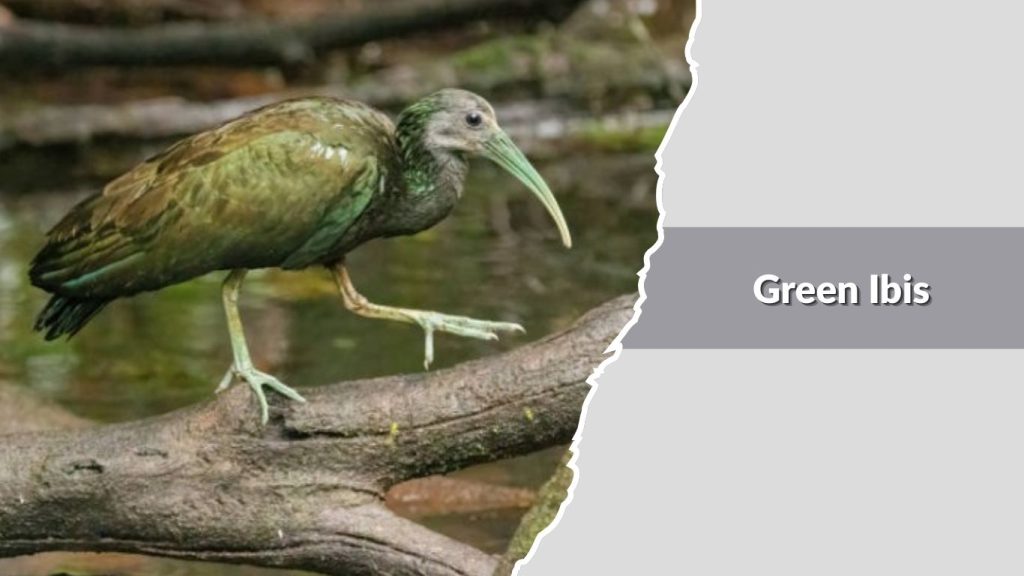
The Green Ibis is a secretive and forest-dwelling ibis species found mainly in Central America, northern South America, and parts of the Caribbean. Unlike many other ibises, it prefers shaded wetlands and dense vegetation. Its dark, glossy plumage and chestnut highlights give it a distinctive appearance.
Identification
- Dark greenish-bronze to black body plumage
- Chestnut-colored neck, upper chest, and shoulders
- Long, slender, down-curved dark bill
- Bare reddish facial skin
- Medium-sized, compact ibis
Habitat
Green Ibises inhabit forested wetlands, mangrove edges, slow rivers, flooded forests, and swampy woodlands. They are usually found in shaded, quiet environments with thick cover.
Behavior
This species is generally solitary or seen in pairs. It is shy and often remains hidden among dense vegetation. Green Ibises forage slowly along muddy banks or in shallow water, probing for prey.
Diet and Lifespan
Their diet includes insects, crustaceans, snails, frogs, small fish, and other aquatic invertebrates. In the wild, Green Ibises can live around 10 to 15 years.
16. Madagascar Sacred Ibis
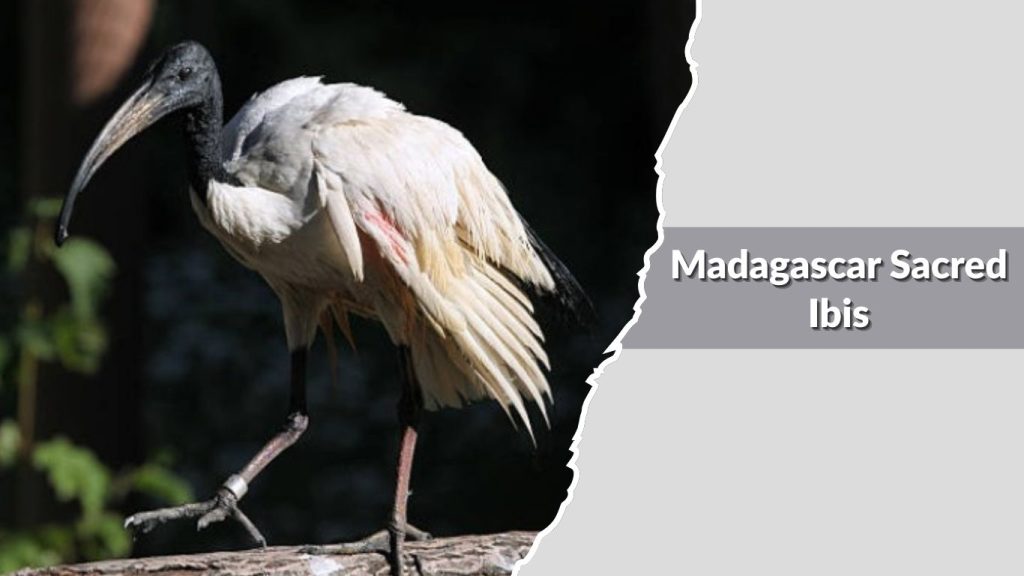
The Madagascar Sacred Ibis is an endangered ibis species endemic to Madagascar. It closely resembles the African Sacred Ibis but is more restricted in range and more vulnerable to habitat loss. This bird is known for its white body, dark head, and strong association with freshwater and coastal wetlands.
Identification
- White body with contrasting dark head and neck
- Long, downward-curved black bill
- Black wing tips and tail feathers
- Long dark legs
- Medium to large-sized ibis
Habitat
Madagascar Sacred Ibises inhabit lakes, rivers, marshes, mangroves, coastal mudflats, and rice fields. They depend heavily on undisturbed wetlands and shallow water ecosystems.
Behavior
They are social birds often seen in small flocks. Madagascar Sacred Ibises forage in shallow water and muddy areas, probing for prey. They usually nest in colonies, often in trees near water or in mangrove habitats.
Diet and Lifespan
Their diet includes insects, crustaceans, mollusks, small fish, frogs, and other aquatic prey. In the wild, Madagascar Sacred Ibises are believed to live around 12 to 18 years.
17. Olive Ibis
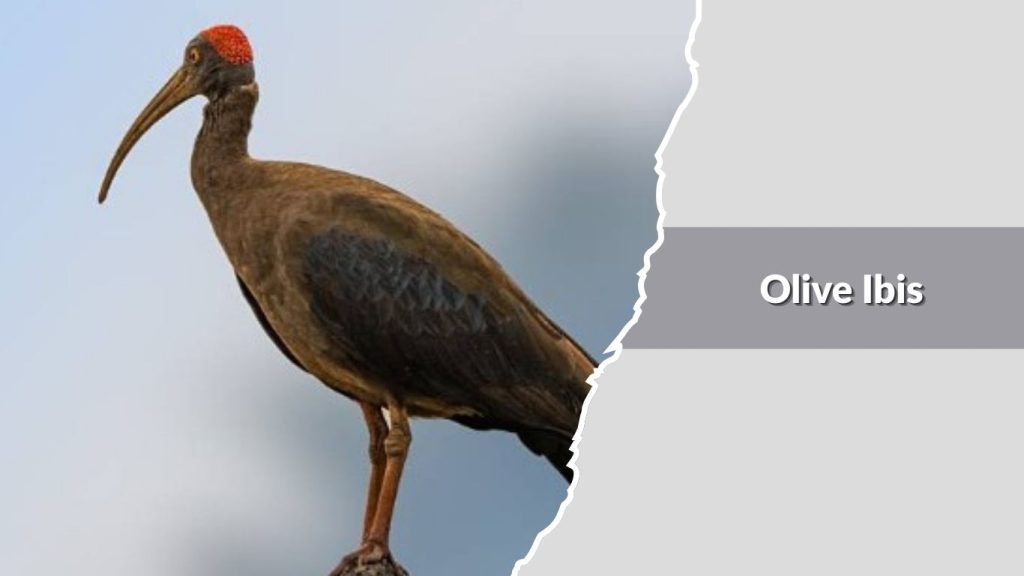
The Olive Ibis is a dark, forest-associated ibis species found in parts of Central and West Africa. It is one of the least-known ibises due to its secretive habits and preference for dense tropical forests. Its overall dark coloration allows it to blend easily into shaded environments.
Identification
- Dark olive-brown to blackish plumage
- Subtle green and bronze sheen on wings
- Long, slightly down-curved dark bill
- Bare dark facial skin
- Medium-sized, stocky ibis
Habitat
Olive Ibises inhabit tropical rainforests, swamp forests, forested rivers, and shaded wetlands. They are rarely seen in open landscapes and usually stay close to dense vegetation.
Behavior
They are generally solitary or found in pairs. Olive Ibises are shy, quiet birds that forage slowly along muddy forest floors and shallow streams. They are most active at dawn and dusk.
Diet and Lifespan
Their diet includes insects, earthworms, snails, crustaceans, and small amphibians. In the wild, Olive Ibises are thought to live around 10 to 15 years.
18. Puna Ibis
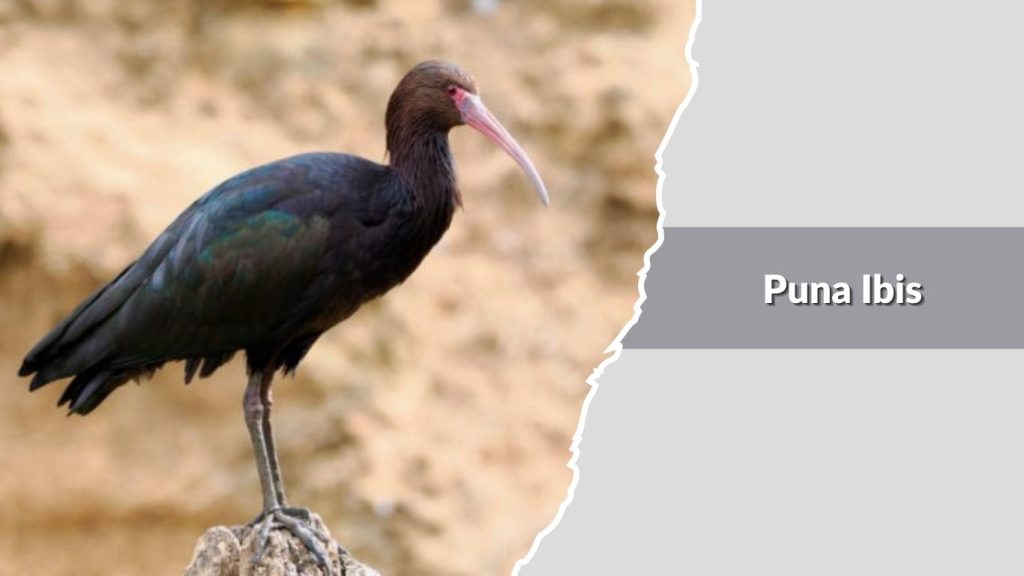
The Puna Ibis is a high-altitude ibis species native to the Andes of South America. It is well adapted to cold, open environments and is commonly seen around mountain lakes and wetlands. This bird has dark plumage, a long curved bill, and a distinctive reddish facial area.
Identification
- Dark brown to blackish body plumage
- Bare reddish facial skin
- Long, slender, downward-curved black bill
- Long dark legs suited for wading
- Medium to large-sized ibis
Habitat
Puna Ibises inhabit high-altitude lakes, marshes, peat bogs, and wetlands, often above 3,000 meters. They are commonly found near Andean lakes and shallow pools.
Behavior
They are usually seen alone, in pairs, or small groups. Puna Ibises forage in shallow water and wet grasslands, probing for prey. They often walk slowly along lake edges and flooded areas.
Diet and Lifespan
Their diet includes insects, aquatic larvae, crustaceans, small mollusks, and amphibians. In the wild, Puna Ibises typically live around 10 to 15 years.
19. Red-naped Ibis
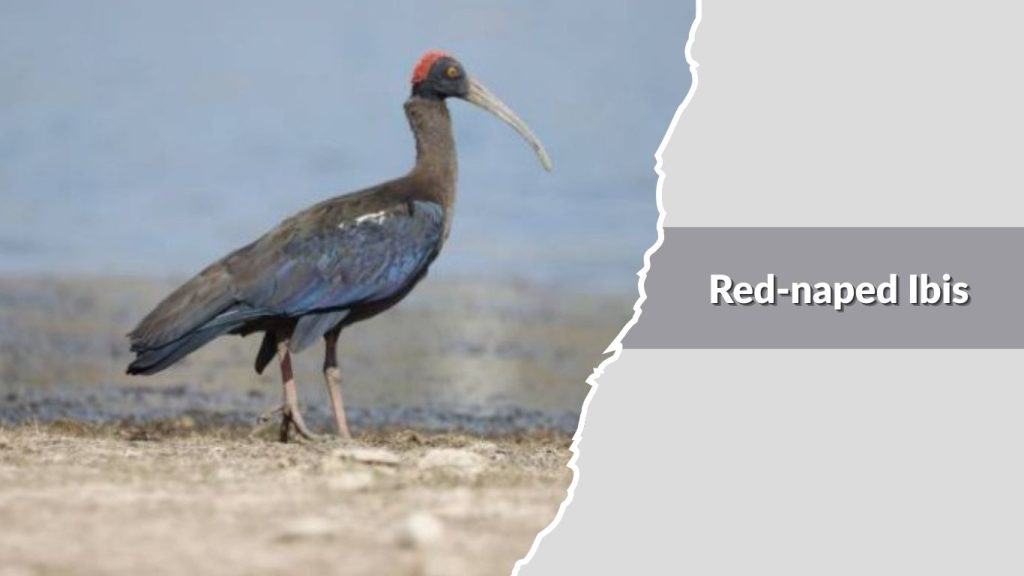
The Red-naped Ibis is a distinctive ibis species native to the Indian subcontinent and parts of Southeast Asia. It is easily recognized by the red patch on the back of its head, along with its grey body and black crown. This bird is often seen near wetlands, farmland, and open countryside.
Identification
- Greyish-white body with darker wings
- Black crown and nape with a noticeable red patch
- Long, slightly down-curved dark bill
- Bare reddish facial skin
- Medium to large-sized ibis
Habitat
Red-naped Ibises inhabit marshes, lakes, riversides, flooded fields, grasslands, and agricultural landscapes. They are frequently found in rural areas close to water sources.
Behavior
They are usually seen in pairs or small flocks. Red-naped Ibises forage slowly by probing mud and soft soil. They often perch in trees and nest colonially, sometimes near human settlements.
Diet and Lifespan
Their diet includes insects, frogs, small reptiles, crustaceans, worms, and occasionally small fish. In natural habitats, Red-naped Ibises generally live about 12 to 18 years.
20. Sharp-tailed Ibis
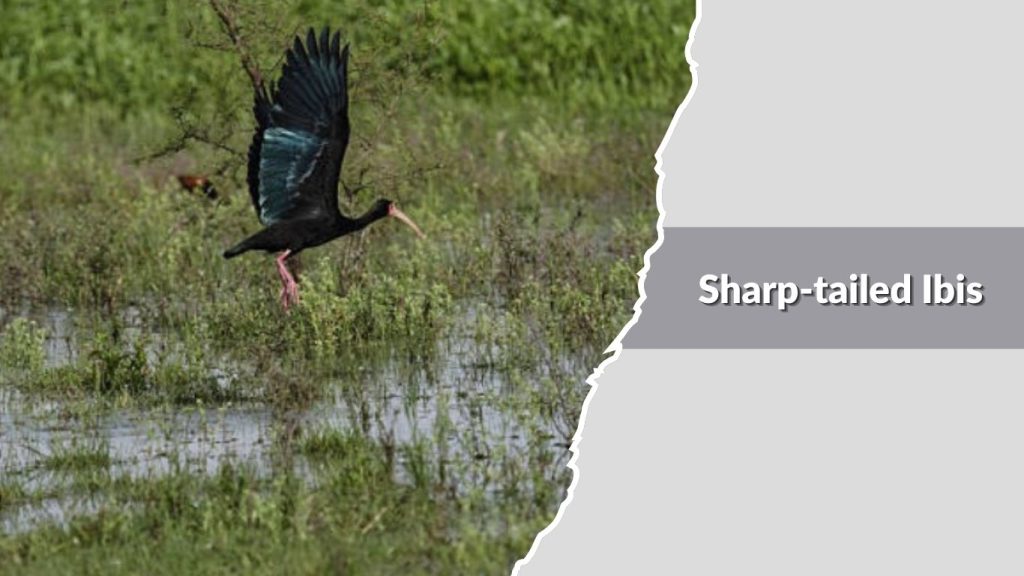
The Sharp-tailed Ibis is a rare and localized ibis species found mainly in parts of South America. It is named for its distinctive pointed tail feathers and is usually associated with open wetlands and seasonally flooded grasslands. This species is less well known than many other ibises and is seldom seen in large numbers.
Identification
- Dark brown to blackish body plumage
- Long, slender, downward-curved bill
- Noticeably pointed tail feathers
- Bare dark facial skin
- Medium-sized, slim-built ibis
Habitat
Sharp-tailed Ibises inhabit freshwater marshes, wet savannas, floodplains, shallow lagoons, and seasonally flooded grasslands. They prefer open, quiet wetlands with soft muddy substrates.
Behavior
They are usually observed alone or in pairs, occasionally in small groups. Sharp-tailed Ibises forage slowly, probing mud and shallow water. They are generally shy and tend to avoid heavily disturbed areas.
Diet and Lifespan
Their diet consists of insects, worms, crustaceans, small mollusks, and amphibians. In the wild, Sharp-tailed Ibises are believed to live around 10 to 15 years.
21. Southern Bald Ibis
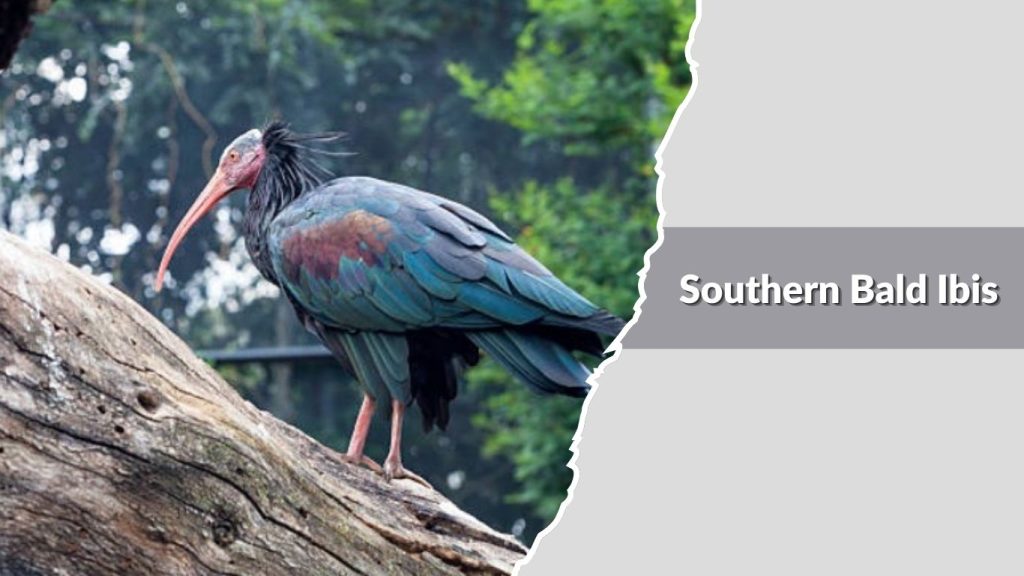
The Southern Bald Ibis is a distinctive ibis species native mainly to southern Africa. It is closely related to the Northern Bald Ibis and is known for its bare red face, long curved bill, and dark glossy plumage. This bird often feeds in open grasslands rather than deep wetlands.
Identification
- Bare reddish face and crown
- Long, slender, down-curved reddish bill
- Dark glossy black plumage with greenish sheen
- Shaggy feathers on the back of the head and neck
- Long dark legs
Habitat
Southern Bald Ibises inhabit open grasslands, savannas, rocky hillsides, farmland, and lightly wet areas. They often forage in dry fields, pastures, and short-grass landscapes.
Behavior
They are social birds, usually seen in small flocks. Southern Bald Ibises feed by probing soil for insects and invertebrates. They nest colonially on cliffs, rocky ledges, and sometimes on buildings.
Diet and Lifespan
Their diet includes insects, beetles, larvae, earthworms, small reptiles, and other ground-dwelling invertebrates. In the wild, Southern Bald Ibises typically live around 15 to 20 years.
22. Spot-breasted Ibis
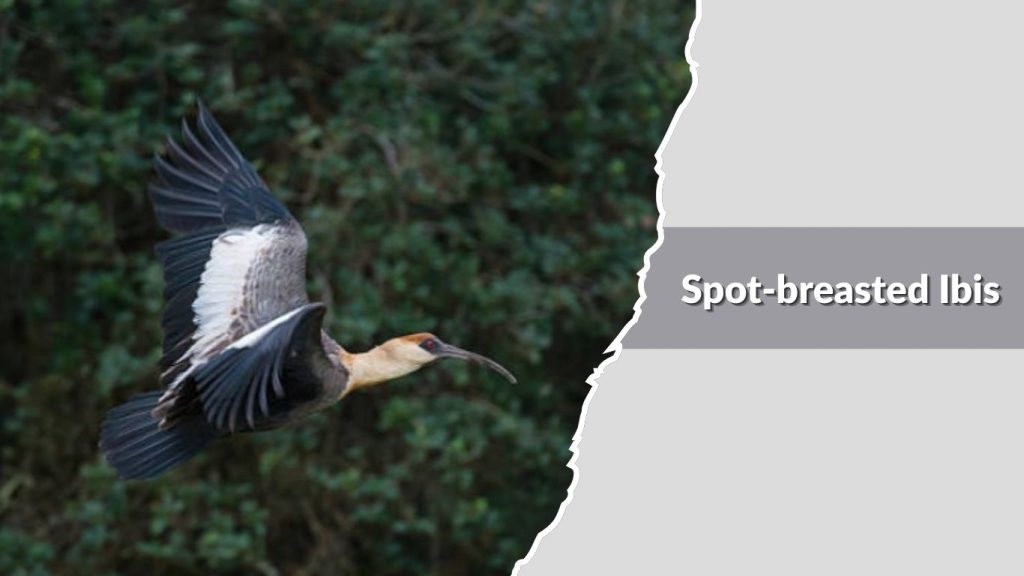
The Spot-breasted Ibis is a large, dark ibis species native to Central and South America. It is easily recognized by the pale spotting on its chest and shoulders, which contrasts with its otherwise dark plumage. This species prefers quiet, forested wetlands and slow-moving rivers.
Identification
- Dark brown to blackish body plumage
- Distinct pale or whitish spots on the breast and upper chest
- Long, strong, downward-curved dark bill
- Bare reddish facial skin
- Large-bodied ibis
Habitat
Spot-breasted Ibises inhabit forested swamps, mangroves, riverbanks, flooded forests, and shaded wetlands. They are usually found near slow-moving water in dense, tropical environments.
Behavior
They are generally solitary or seen in pairs. Spot-breasted Ibises are shy birds that forage quietly along muddy banks and shallow water, probing for food. They often remain hidden among thick vegetation.
Diet and Lifespan
Their diet includes insects, crustaceans, mollusks, small fish, frogs, and other aquatic invertebrates. In the wild, Spot-breasted Ibises typically live around 10 to 15 years.
23. Wattled Ibis
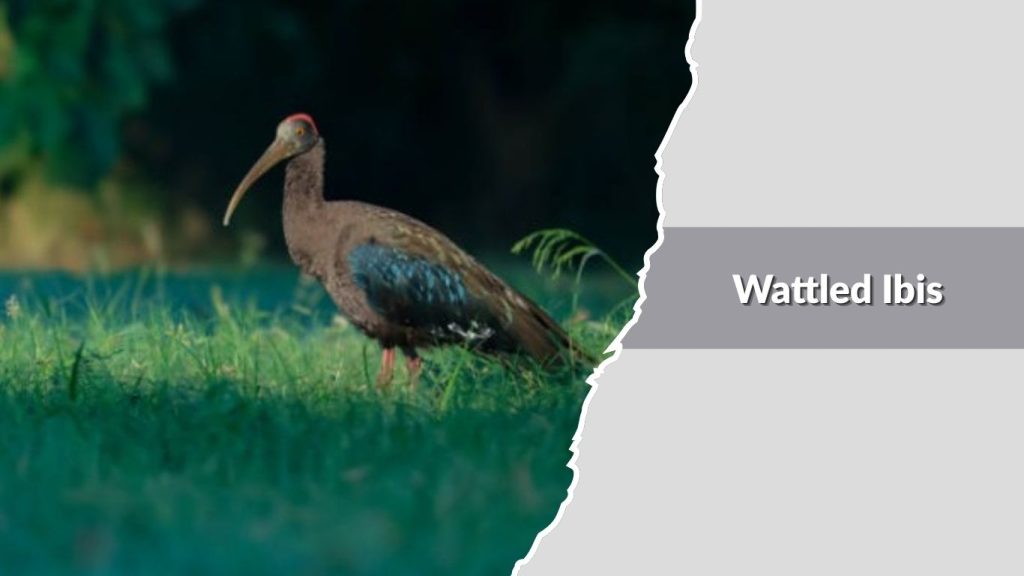
The Wattled Ibis is a distinctive ibis species native to eastern and southern Africa. It is best known for the fleshy red wattles that hang from its face, along with its dark body and long curved bill. This bird is often seen foraging in open grasslands and wet meadows.
Identification
- Dark brown to blackish body plumage
- Long, downward-curved dark bill
- Bare red facial skin with noticeable fleshy wattles
- Long dark legs
- Medium to large-sized ibis
Habitat
Wattled Ibises inhabit highland grasslands, wet meadows, marsh edges, cultivated fields, and riverbanks. They are often found in open country near water rather than deep wetlands.
Behavior
They are usually seen alone, in pairs, or small groups. Wattled Ibises forage by probing soft soil and shallow water for prey. They often soar on thermals and perch on trees or rocky outcrops.
Diet and Lifespan
Their diet includes insects, earthworms, snails, small reptiles, amphibians, and other invertebrates. In the wild, Wattled Ibises generally live around 12 to 18 years.
24. White-faced Ibis
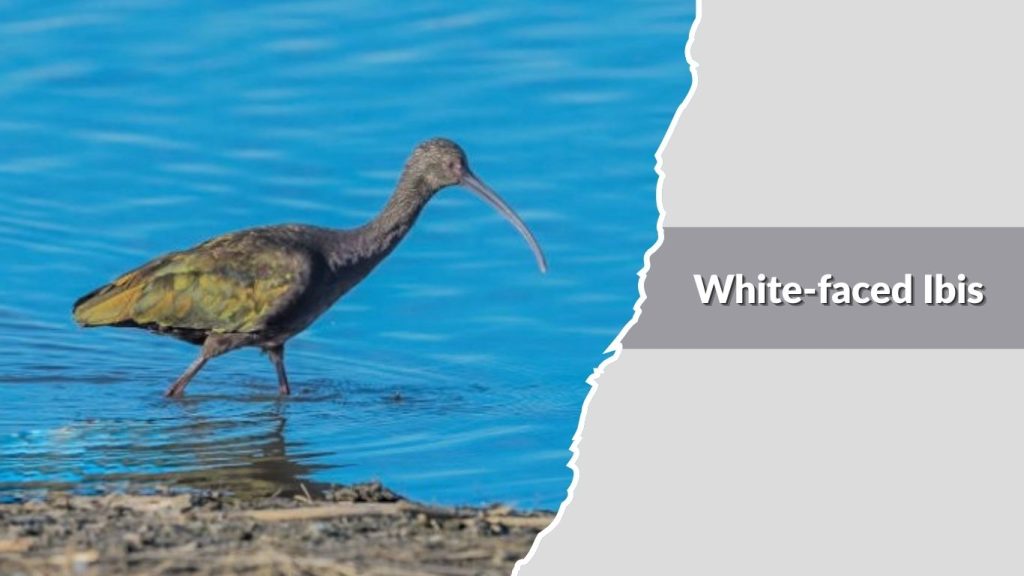
The White-faced Ibis is a medium-sized ibis species native to the Americas, widely distributed across western North America and parts of South America. It is often confused with the Glossy Ibis but can be identified by the white facial border seen in breeding adults.
Identification
- Dark chestnut to purplish body plumage with green sheen
- Distinct white feathered border around the face in breeding season
- Long, slender, downward-curved dark bill
- Reddish legs, especially during breeding season
- Slim, elegant body shape
Habitat
White-faced Ibises inhabit freshwater marshes, lakes, swamps, flooded fields, and wet grasslands. They often gather in large numbers in shallow wetlands and agricultural landscapes.
Behavior
They are highly social birds, commonly seen feeding in flocks. White-faced Ibises forage by probing mud and shallow water in a steady, rhythmic motion. They nest colonially in reed beds or low shrubs near water.
Diet and Lifespan
Their diet consists mainly of insects, crustaceans, worms, mollusks, frogs, and small fish. In the wild, White-faced Ibises usually live around 10 to 15 years.
25. Andean Ibis
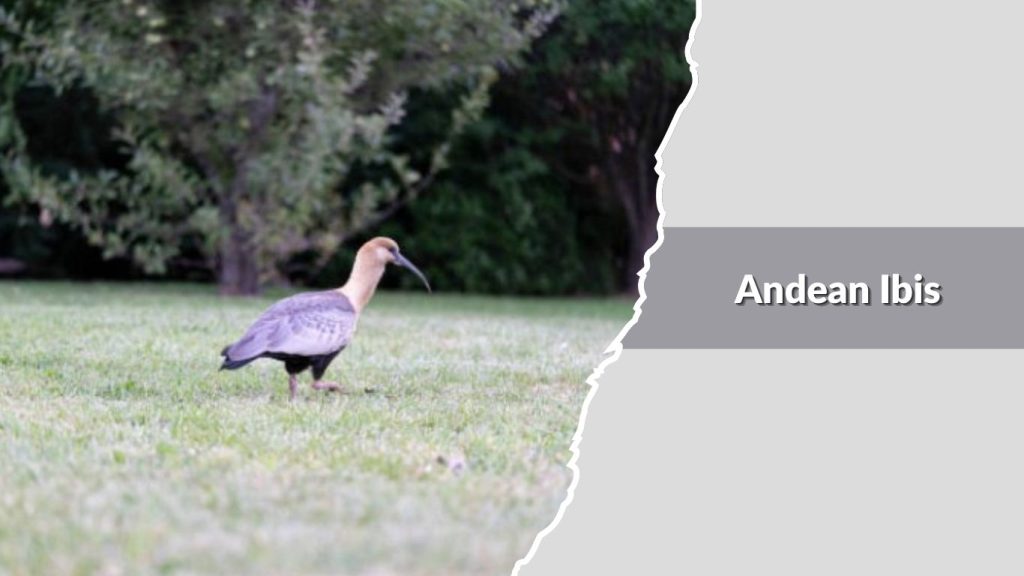
The Andean Ibis is a high-altitude ibis species found along the Andes Mountains of South America. It is adapted to cold, open landscapes and is often seen walking across rocky slopes, grasslands, and alpine wetlands. Unlike many ibises, it frequently forages far from standing water.
Identification
- Dark brown to blackish body plumage
- Pale facial skin with reddish tones
- Long, slender, downward-curved bill
- Broad wings suited for soaring
- Medium to large-sized ibis
Habitat
Andean Ibises inhabit high mountain grasslands, puna and páramo ecosystems, rocky hillsides, and alpine wetlands. They are commonly found near streams, glacial lakes, and moist highland valleys.
Behavior
They are usually seen alone or in pairs. Andean Ibises often walk long distances while foraging and may soar over valleys and ridges. They probe soil, moss, and shallow water in search of food.
Diet and Lifespan
Their diet includes insects, beetles, larvae, worms, small amphibians, and other invertebrates. In the wild, Andean Ibises are believed to live around 10 to 15 years.
26. Plumbeous Ibis
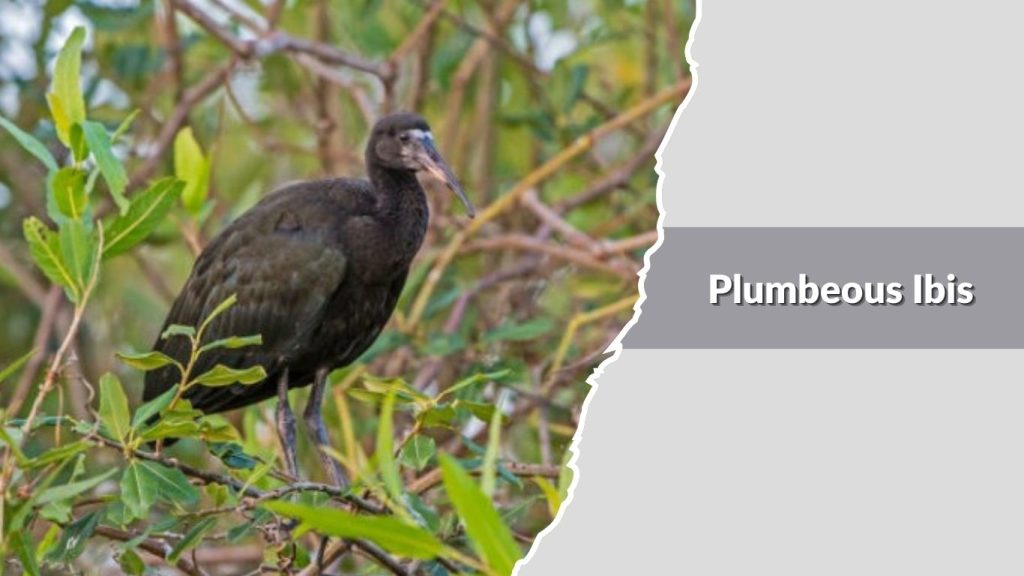
The Plumbeous Ibis is a dark, sleek ibis species native to South America. It is commonly found near rivers, wetlands, and flooded grasslands, where it feeds quietly along muddy banks. Its uniform dark coloration and long curved bill give it a very elegant appearance.
Identification
- Uniform dark grey to blackish plumage
- Long, slender, downward-curved dark bill
- Bare dark facial skin
- Long dark legs
- Medium-sized, slim-bodied ibis
Habitat
Plumbeous Ibises inhabit riverbanks, marshes, swamps, flooded savannas, and wetlands. They are especially common along slow-moving rivers and shallow freshwater systems.
Behavior
They are usually seen alone or in pairs, sometimes in small groups. Plumbeous Ibises forage slowly, probing mud and shallow water. They are generally quiet and less conspicuous than many other ibis species.
Diet and Lifespan
Their diet includes insects, worms, crustaceans, small mollusks, amphibians, and small fish. In the wild, Plumbeous Ibises typically live around 10 to 15 years.
27. Black Ibis
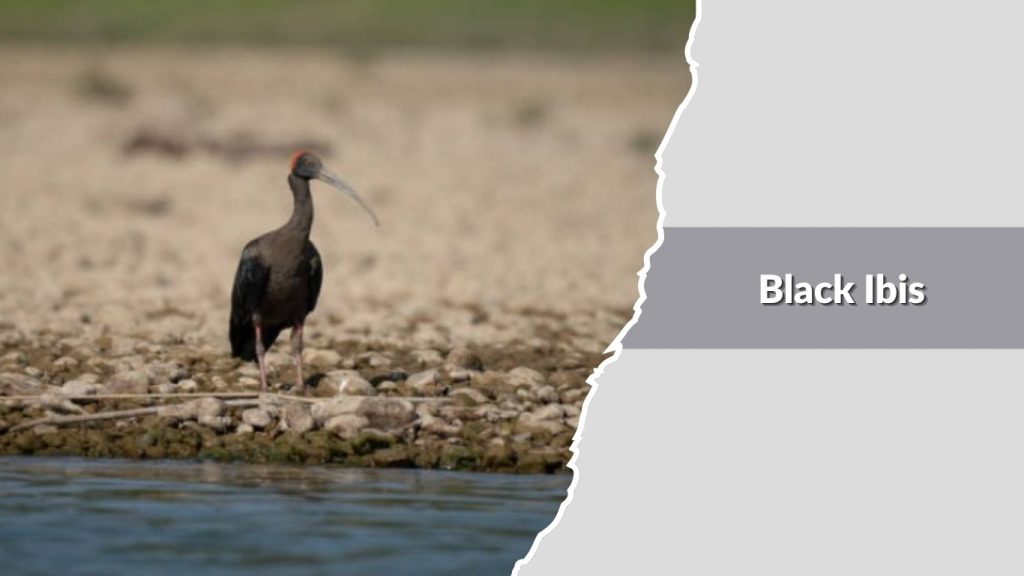
The Black Ibis, also known as the Red-naped Ibis in some regions, is a large dark ibis species found across the Indian subcontinent. It is well known for its glossy dark body and strong, curved bill, and is often seen in open countryside and wetlands.
Identification
- Dark brown to blackish body plumage
- Slight metallic sheen on wings
- Long, heavy, downward-curved dark bill
- Bare dark facial skin
- Medium to large-sized ibis
Habitat
Black Ibises inhabit marshes, lakes, riversides, open grasslands, and agricultural fields. They are often found near water but also forage far into dry fields.
Behavior
They are usually seen in pairs or small groups. Black Ibises walk slowly while feeding, probing soil and shallow water. They often perch in tall trees and nest colonially.
Diet and Lifespan
Their diet includes insects, frogs, small reptiles, crustaceans, worms, and occasionally small fish. In natural conditions, Black Ibises generally live about 12 to 18 years.
28. Bare-faced Ibis
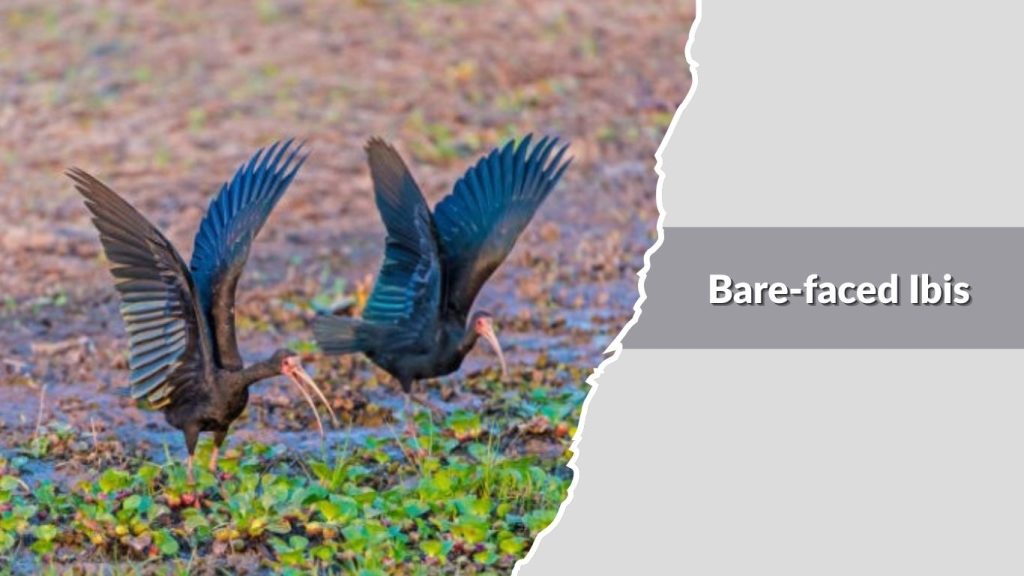
The Bare-faced Ibis is a large, dark ibis species native to southern South America. It is known for its extensive bare red skin on the face and throat, which contrasts strongly with its dark body. This bird is often seen in open wetlands and grassy plains.
Identification
- Dark brown to blackish plumage
- Extensive bare red facial and throat skin
- Long, thick, downward-curved dark bill
- Long dark legs
- Large-bodied ibis
Habitat
Bare-faced Ibises inhabit marshes, wet grasslands, floodplains, riverbanks, and open countryside. They are frequently seen in both freshwater wetlands and drier open areas.
Behavior
They are social birds, often seen in pairs or small flocks. Bare-faced Ibises forage by probing mud and soft ground. They nest in colonies, usually near water.
Diet and Lifespan
Their diet includes insects, worms, crustaceans, small reptiles, amphibians, and other invertebrates. In the wild, Bare-faced Ibises typically live around 10 to 15 years.
29. Eurasian Spoonbill Ibis
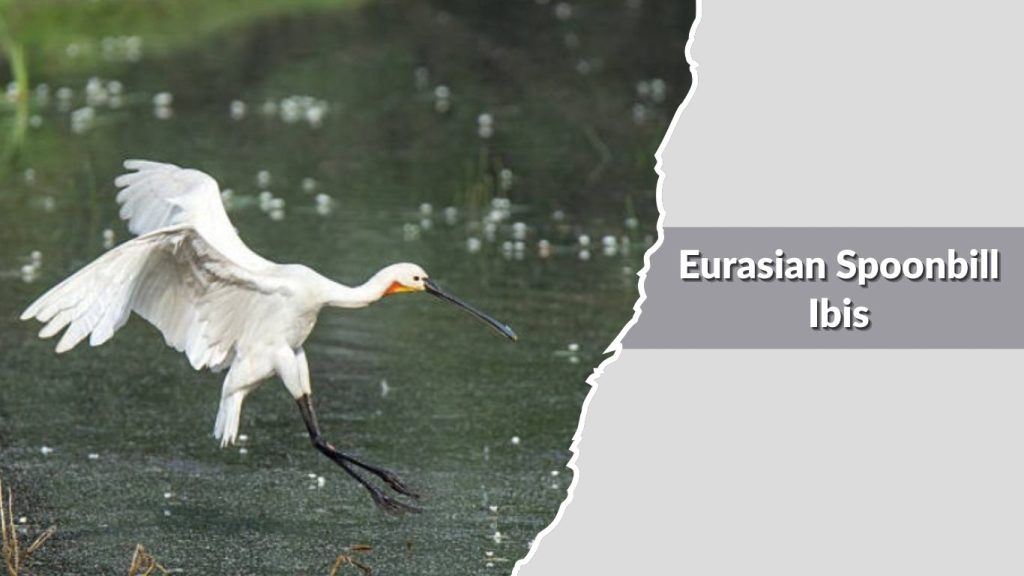
The Eurasian Spoonbill Ibis is a large white wading bird often associated with ibises due to similar habitats and feeding style, though it belongs to a closely related group. It is known for its long flat spoon-shaped bill and graceful appearance.
Identification
- Pure white body plumage
- Long black spoon-shaped bill
- Long black legs
- Slight yellowish patch on the chest in breeding adults
- Large, elegant wading bird
Habitat
Eurasian Spoonbills inhabit marshes, lagoons, estuaries, mudflats, lakes, and river deltas. They favor shallow waters where they can sweep their bills side to side.
Behavior
They are social birds, often seen feeding and roosting in flocks. Eurasian Spoonbills forage by sweeping their bills through shallow water to catch prey. They nest colonially in reed beds or trees near wetlands.
Diet and Lifespan
Their diet includes small fish, crustaceans, aquatic insects, mollusks, and amphibians. In the wild, Eurasian Spoonbills can live 15 to 25 years.
FAQs
What is the difference between an ibis and a spoonbill?
Ibises have long, slender, downward-curved bills designed for probing mud and shallow water, while spoonbills have wide, flat, spoon-shaped bills used to sweep side to side in water. Although they share similar habitats and belong to the same bird family group, their feeding techniques and bill shapes are the easiest ways to tell them apart.
Where are ibises most commonly found in the world?
Ibises are found on every continent except Antarctica. They are most common in Africa, Asia, Australia, and the Americas, where wetlands, marshes, floodplains, and coastal lagoons provide ideal feeding grounds. Some species also live in grasslands, farmland, forests, and even urban parks.
What do ibises mainly eat?
Most ibises are omnivorous wading birds. They mainly feed on insects, worms, crustaceans, snails, frogs, and small fish. Some species also eat small reptiles, bird eggs, and human food scraps, especially those living near agricultural land or cities.
Are ibis birds social or solitary?
Most ibis species are social birds. They often feed in groups, fly in flocks, and nest in large colonies near water. However, a few forest-dwelling species, such as the Green Ibis and Olive Ibis, are more solitary and secretive, usually seen alone or in pairs.
Why are some ibis species endangered?
Several ibis species are endangered due to wetland destruction, hunting, pollution, and disturbance of breeding colonies. Species like the Giant Ibis, Crested Ibis, and Northern Bald Ibis depend on protected habitats. Conservation programs, wetland restoration, and breeding projects are helping some populations slowly recover.