

Lemurs are one of the most fascinating groups of primates, found only on the island of Madagascar and a few surrounding islets. With more than 100 known species, lemurs display incredible diversity in size, behavior, coloration, and ecological roles. From the well-known Ring-tailed Lemur with its iconic striped tail to the tiny Madame Berthe’s Mouse Lemur, the world’s smallest primate, each species has adapted in remarkable ways to Madagascar’s unique landscapes.
This guide explores 25 types of lemurs, covering both famous and lesser-known species. For each one, you’ll learn how to identify them, where they live, what they eat, and how they behave in the wild. Whether you’re a wildlife enthusiast, student, or conservation advocate, this curated list gives you an in-depth look at the incredible biodiversity of Madagascar’s most cherished creatures.
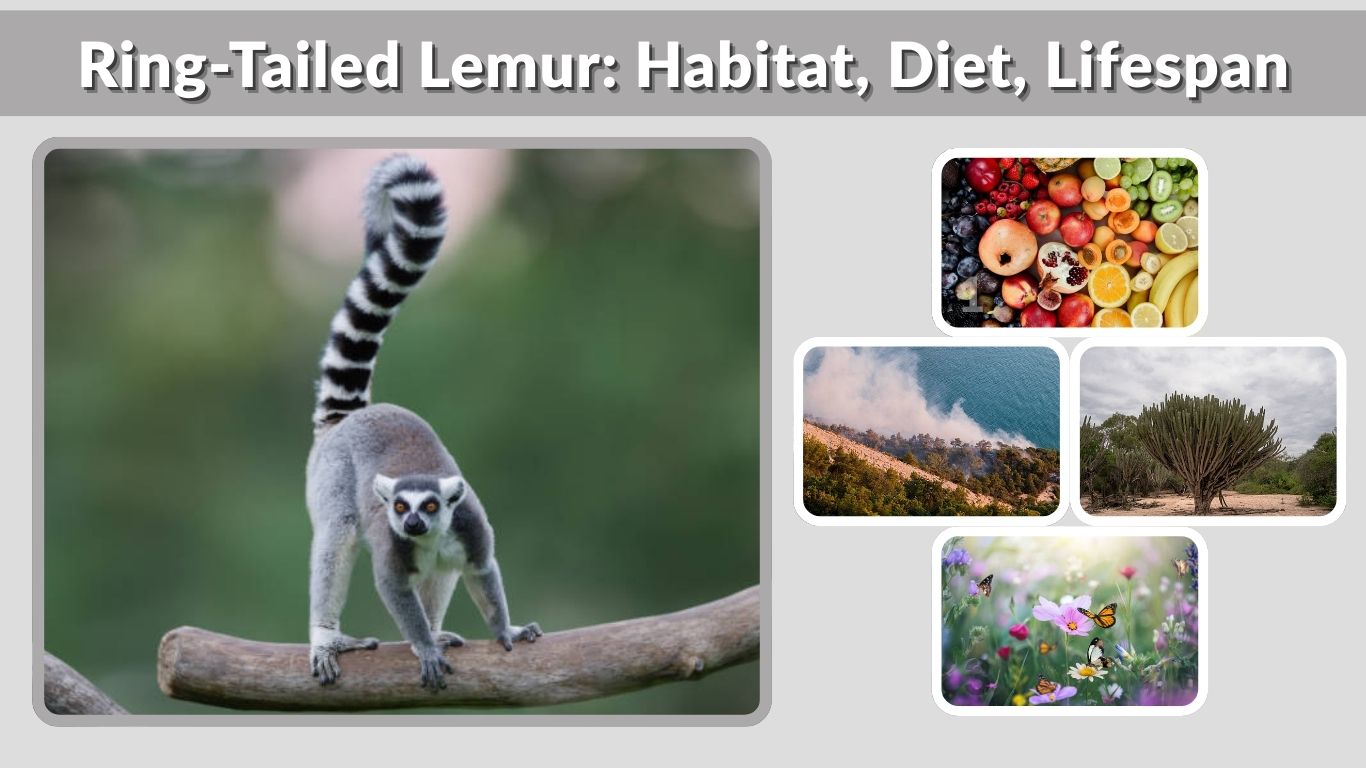
1. Ring-tailed Lemur (Lemur catta)

The Ring-tailed Lemur is the most iconic and easily recognizable lemur species, thanks to its long, bushy tail with alternating black and white rings. Native only to Madagascar, it plays a vital role in seed dispersal and is one of the most terrestrial of all lemur species.
Identification
- Size: Body length: 15–18 inches; tail length: 22–24 inches
- Color: Gray to rosy brown back, white underside, and black facial markings
- Tail: Long, black-and-white ringed, not prehensile
- Weight: 5–7.5 pounds
- Eyes: Large, bright orange or golden
Natural Habitat and Range
Ring-tailed Lemurs inhabit the dry forests, spiny scrublands, and gallery forests of southern and southwestern Madagascar. They are highly adaptable and may also be found in rocky outcrops, near rivers, and disturbed areas.
Diet and Feeding Habits
Primarily herbivorous, Ring-tailed Lemurs feed on fruit, leaves, flowers, bark, and sap. They also eat insects and small vertebrates on occasion. Their diet varies seasonally, depending on food availability, and they help disperse seeds through their droppings.
Behavior and Social Structure
They are highly social animals, living in troops of 6 to 30 individuals, often led by a dominant female. Ring-tailed Lemurs spend more time on the ground than most lemurs and use their tail for communication, especially in group movement. Males perform “stink fights” during the breeding season by rubbing scent glands on their tails and wafting the smell toward rivals.
Ring-tailed Lemurs are diurnal, active during daylight hours, and are one of the few lemur species that sunbathe in a seated, meditative posture to warm up in the morning.
2. Black Lemur (Eulemur macaco)

The Black Lemur is a striking and sexually dimorphic species native to the forests of northwestern Madagascar. Males and females have distinctly different appearances, which makes them one of the easiest lemurs to tell apart by sex.
Identification
- Size: Body length: 15–17 inches; tail: 20–24 inches
- Color:
- Males: All black with orange eyes
- Females: Brown with a lighter underside and tufts of white fur around the ears
- Males: All black with orange eyes
- Tail: Long, bushy, and non-prehensile
- Weight: 4.5–5.5 pounds
Natural Habitat and Range
Black Lemurs are found in the tropical moist and dry forests of the Sambirano region in northwestern Madagascar and on nearby islands like Nosy Be. They prefer areas with dense canopy and are good climbers and leapers.
Diet and Feeding Habits
These lemurs are mainly frugivorous, feeding on fruits, flowers, leaves, nectar, and occasionally insects. They are important pollinators, especially for traveler’s palms and other native flowering plants.
Behavior and Social Structure
Black Lemurs are diurnal and live in groups of 5 to 15 individuals. Females dominate social hierarchy, a trait common among lemurs. They are playful, vocal, and engage in mutual grooming to strengthen social bonds. During the dry season, they may shift toward crepuscular activity (active at dawn and dusk).
3. Red Ruffed Lemur (Varecia rubra)

The Red Ruffed Lemur is a large, vocal, and vividly colored lemur native to the rainforests of northeastern Madagascar. It is one of the two ruffed lemur species and is notable for its deep reddish coat and loud calls.
Identification
- Size: Body length: 20–22 inches; tail: 23–25 inches
- Color: Rich red body with a black face, limbs, and belly; ruff of longer fur around the neck
- Tail: Long, black, and very bushy
- Weight: 7–9 pounds
Natural Habitat and Range
This species is found in the lowland and mid-altitude rainforests of the Masoala Peninsula in northeastern Madagascar. They are strictly arboreal and favor tall primary forests.
Diet and Feeding Habits
Red Ruffed Lemurs are primarily frugivorous, with fruit making up over 75% of their diet. They also consume nectar, leaves, seeds, and fungi. They are key seed dispersers and important for forest regeneration.
Behavior and Social Structure
They live in small, loose groups and exhibit a fission–fusion social structure, meaning group composition may change throughout the day. They are among the loudest of all primates, using harsh barks and roars to communicate across the forest. Red Ruffed Lemurs are active during the day and may rest for long periods between feeding bouts. They are also known for having litters of 2–6 infants and often nest them in tree hollows or forks—a rare behavior among lemurs.
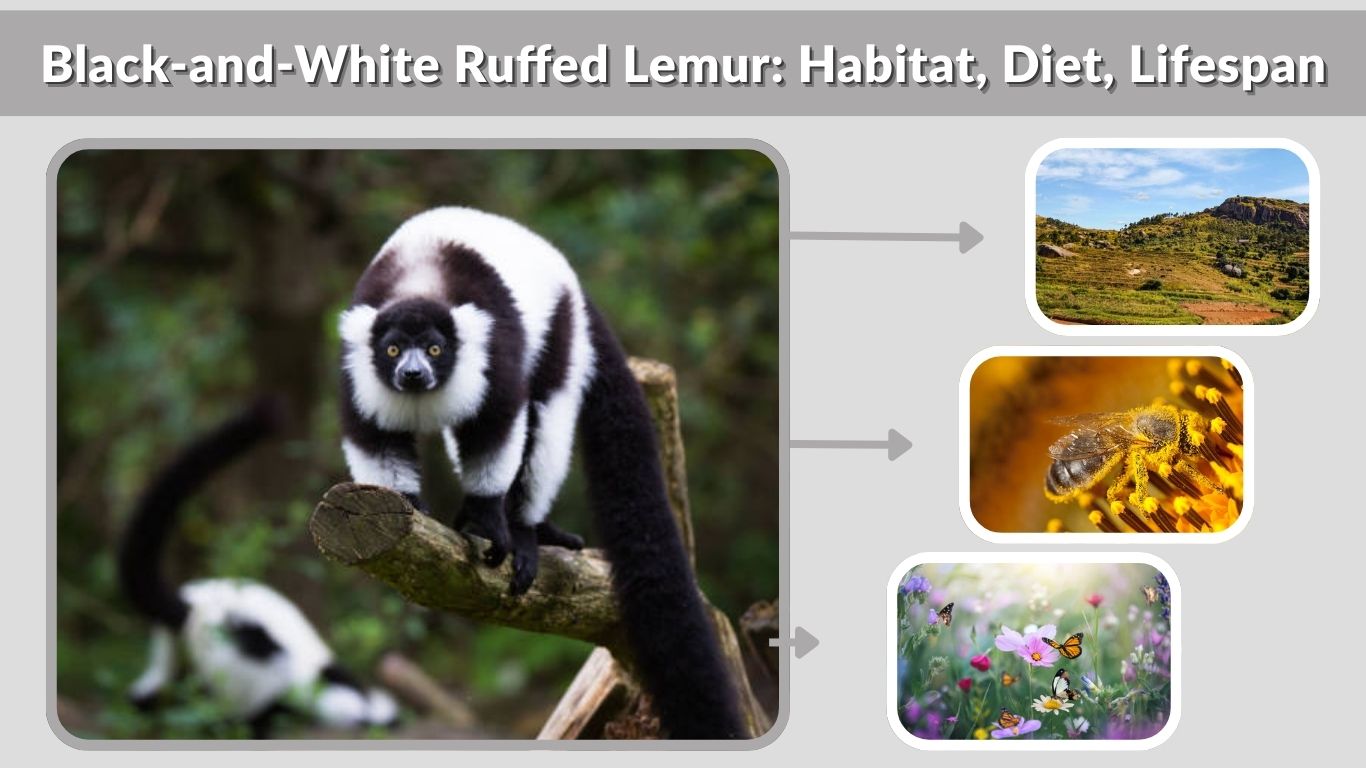
4. Black-and-white Ruffed Lemur (Varecia variegata)

The Black-and-white Ruffed Lemur is one of Madagascar’s largest and most vocal lemurs. Closely related to the Red Ruffed Lemur, it is known for its dramatic black-and-white coat and rainforest-dwelling habits.
Identification
- Size: Body length: 20–22 inches; tail: 23–25 inches
- Color: Black and white patches with a thick white ruff around the neck
- Tail: Long, black, and fluffy
- Weight: 7–10 pounds
Natural Habitat and Range
This species is found in the eastern rainforests of Madagascar, ranging from the Masoala Peninsula south to the Andasibe-Mantadia region. It inhabits the canopy of primary and secondary forests.
Diet and Feeding Habits
Primarily frugivorous, they consume large amounts of fruit but will also eat nectar, flowers, leaves, and seeds. They are major pollinators for several native plants and play a crucial role in seed dispersal.
Behavior and Social Structure
Black-and-white Ruffed Lemurs are diurnal and live in small groups that follow a fission–fusion structure. They are highly vocal and use deep, resonant calls to communicate over long distances. Unlike most lemurs, females may give birth to litters of up to six young, often placing them in nests rather than carrying them constantly. Their combination of complex social behavior and vital ecological role makes them one of Madagascar’s most ecologically important primates.
5. Aye-aye (Daubentonia madagascariensis)
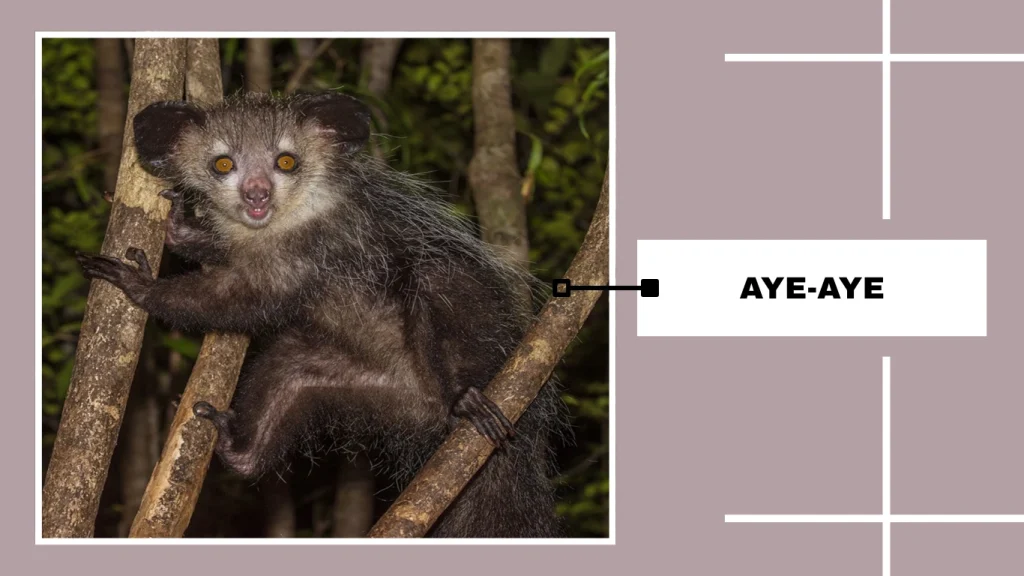
The Aye-aye is one of the most unusual and mysterious primates in the world. It has rodent-like teeth, bat-like ears, and a long, skeletal middle finger used for extracting insects from wood—earning it a place in Madagascar’s folklore as a symbol of superstition.
Identification
- Size: Body length: 14–17 inches; tail: 22–24 inches
- Color: Dark brown to black with a bushy tail and shaggy coat
- Face: Large eyes, big ears, and an elongated middle finger
- Weight: 4–6 pounds
Natural Habitat and Range
Aye-ayes are found in a variety of habitats including rainforests, dry deciduous forests, and mangroves, mostly in the eastern and northern regions of Madagascar. They are nocturnal and solitary.
Diet and Feeding Habits
Aye-ayes are omnivorous but specialize in insect larvae, which they locate by tapping on wood (a method called percussive foraging) and then use their long finger to extract. They also eat fruit, seeds, nectar, and fungi.
Behavior and Social Structure
Aye-ayes are solitary and nocturnal, using their keen hearing and night vision to forage. They spend most of their lives in the trees and build large, spherical nests out of branches and leaves. Their unusual appearance and habits have made them targets of superstition in local cultures, and they are sometimes killed on sight—contributing to their endangered status.
6. Coquerel’s Sifaka (Propithecus coquereli)

Coquerel’s Sifaka is a striking and acrobatic lemur species known for its upright posture and leaping ability. It’s one of the best-known sifakas and is easily identified by its contrasting white and chestnut-colored fur.
Identification
- Size: Body length: 17–20 inches; tail: 20–24 inches
- Color: White body with reddish-brown patches on the chest, arms, and thighs
- Tail: Long, bushy, and white
- Weight: 8–10 pounds
Natural Habitat and Range
This sifaka is found in the dry deciduous forests of northwestern Madagascar, particularly in the Ankarafantsika region. It is strictly arboreal and prefers tall trees with open canopies.
Diet and Feeding Habits
Coquerel’s Sifakas are herbivores that feed on leaves, flowers, bark, seeds, and fruit. Their diet shifts seasonally based on availability, and they are known to be selective feeders, choosing high-quality vegetation.
Behavior and Social Structure
They live in small matriarchal groups of 3–10 individuals. Sifakas move with dramatic leaping motions—springing from tree to tree using powerful hind legs. On the ground, they hop upright using both legs, with arms held aloft for balance. They are diurnal and spend much of their day resting or feeding high in the canopy.
7. Verreaux’s Sifaka (Propithecus verreauxi)

Verreaux’s Sifaka is another charismatic sifaka species, often called the “dancing lemur” for its unique, sideways bounding movement across the ground. It is highly adapted to the dry forests and thorny scrublands of southern Madagascar.
Identification
- Size: Body length: 16–19 inches; tail: 20–24 inches
- Color: Mostly white or cream with dark face and sometimes gray shoulders or crown
- Tail: Long and white, used for balance
- Weight: 7–9 pounds
Natural Habitat and Range
This species lives in southern and southwestern Madagascar, including spiny forests, dry deciduous woodlands, and scrub habitats. It prefers trees spaced far apart, where its powerful leaps can span wide gaps.
Diet and Feeding Habits
Verreaux’s Sifakas feed on leaves, buds, flowers, bark, and unripe fruit. They have a large, chambered stomach to help digest fibrous vegetation, and their diet varies with the seasons.
Behavior and Social Structure
They are highly social and live in groups of up to 12 individuals, often led by dominant females. On the ground, they move in an upright hopping motion that resembles dancing—an iconic behavior that makes them a favorite among wildlife watchers. They are territorial and use loud, repetitive vocalizations to defend their area.
8. Diademed Sifaka (Propithecus diadema)

The Diademed Sifaka is one of the largest and most colorful lemur species, known for its elegant appearance and impressive leaping ability. It is considered critically endangered due to habitat destruction.
Identification
- Size: Body length: 18–21 inches; tail: 20–24 inches
- Color: Silvery-white face framed with golden-orange fur, gray limbs, and creamy underside
- Tail: Long and bushy, often gray
- Weight: 13–15 pounds
Natural Habitat and Range
Diademed Sifakas are native to the eastern rainforests of Madagascar, particularly in the Andasibe and Mantadia regions. They dwell high in the canopy and are rarely seen on the ground.
Diet and Feeding Habits
Their diet consists mainly of leaves, seeds, fruit, flowers, and bark. As selective feeders, they choose nutrient-rich parts of plants, and their feeding habits play a key role in seed dispersal.
Behavior and Social Structure
These sifakas are diurnal and highly arboreal, living in groups of 2 to 10 individuals. They travel by leaping great distances between tree trunks using powerful hind limbs. Vocal communication and grooming are essential to their social structure. Due to habitat loss and hunting, their population is in rapid decline.
9. Indri (Indri indri)

The Indri is the largest living lemur and one of the most sacred animals in Malagasy culture. It is famous for its haunting, wailing calls that echo across Madagascar’s eastern rainforests.
Identification
- Size: Body length: 24–28 inches; tail is a stub, only about 2 inches
- Color: Black and white with varying patterns; some have more pale or golden tones
- Tail: Barely visible—unlike other lemurs
- Weight: 13–20 pounds
Natural Habitat and Range
Indris inhabit the dense, humid rainforests of eastern Madagascar, especially around the Andasibe-Mantadia region. They are strictly arboreal and prefer tall, continuous canopy forests.
Diet and Feeding Habits
They feed almost exclusively on leaves, along with some fruit, flowers, and bark. Their diet varies seasonally, and they forage in the mid to upper canopy.
Behavior and Social Structure
Indris live in small, monogamous family groups and are territorial. Their loud, eerie calls can be heard for up to 2 km and are used to communicate between groups. Unlike most lemurs, they do not survive in captivity, and conservation depends entirely on protecting their natural habitat. Indris move through trees using powerful vertical leaps, often spanning 30 feet between trunks.
10. Eastern Woolly Lemur (Avahi laniger)
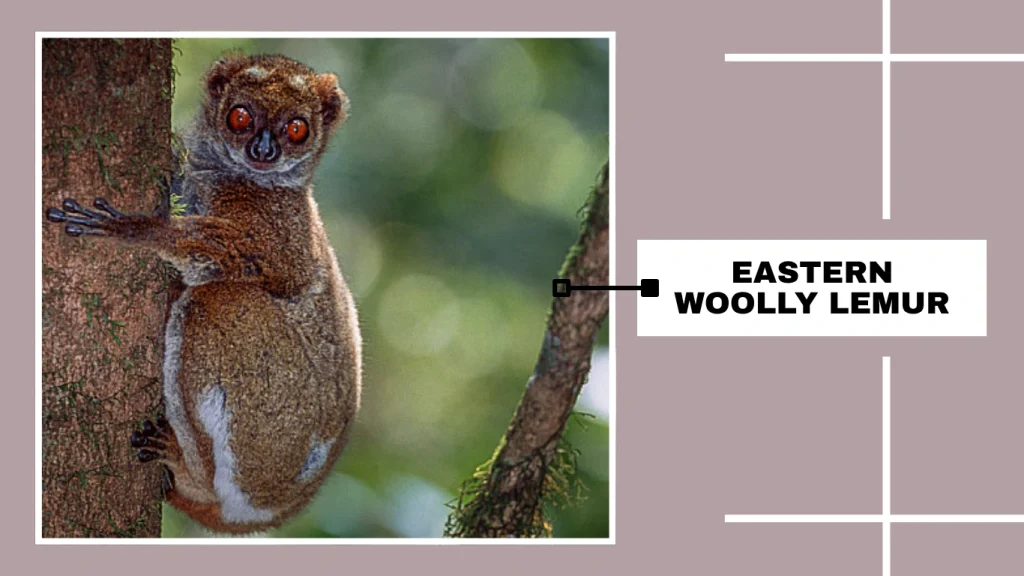
The Eastern Woolly Lemur, also known as the Gmelin’s Woolly Lemur, is a nocturnal, leaf-eating primate with dense, wool-like fur. It is among the smallest members of the Indriidae family and is rarely seen due to its quiet, nighttime habits.
Identification
- Size: Body length: 9–12 inches; tail: 12–15 inches
- Color: Gray-brown coat with a slightly lighter belly; thick, soft fur
- Tail: Long, bushy, used for balance
- Weight: 2–2.5 pounds
Natural Habitat and Range
This species is found in the eastern rainforests of Madagascar, including areas like Andasibe, Ranomafana, and Marojejy. It prefers dense, undisturbed forests with thick canopy cover.
Diet and Feeding Habits
Eastern Woolly Lemurs are folivores, feeding primarily on young leaves, buds, and occasionally flowers. Their specialized digestive system allows them to process fibrous plant material, and they forage silently to avoid predators.
Behavior and Social Structure
They live in monogamous pairs or small family groups. As nocturnal animals, they are most active shortly after dusk and just before dawn. They remain motionless for long periods during the day and use their strong hind limbs to leap between vertical supports at night.
11. Western Woolly Lemur (Avahi occidentalis)
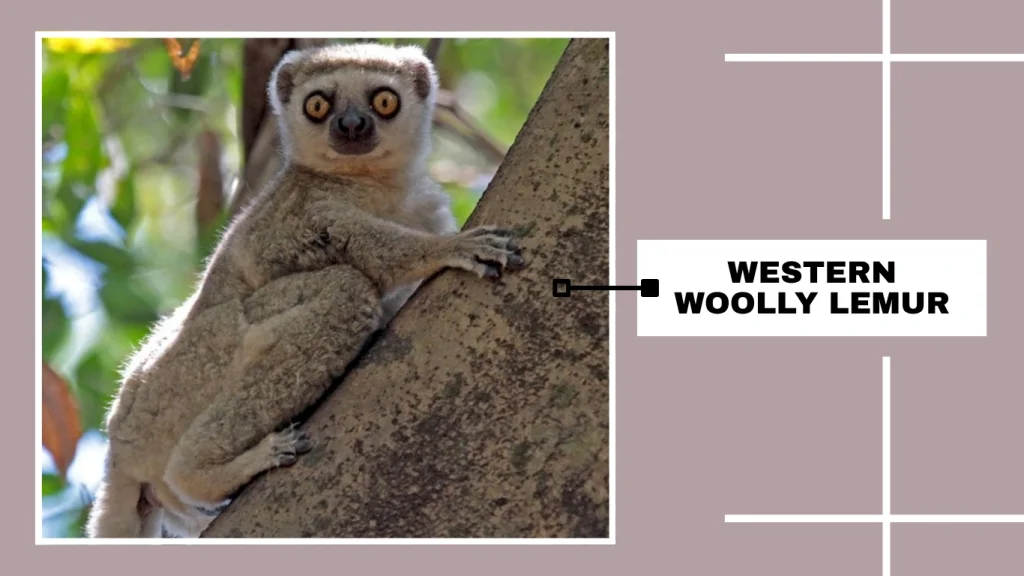
The Western Woolly Lemur, or Western Avahi, is a quiet, nocturnal primate found in Madagascar’s western dry forests. It is closely related to the Eastern Woolly Lemur but adapted to drier, seasonal habitats.
Identification
- Size: Body length: 9–11 inches; tail: 11–14 inches
- Color: Light brown to gray fur with a pale belly and dark eye rings
- Tail: Long, furry, and used for balance
- Weight: 1.8–2.2 pounds
Natural Habitat and Range
This species inhabits the dry deciduous forests of northwestern Madagascar, particularly in the Mahajanga and Ampijoroa regions. It prefers tree-dense areas where it can stay hidden during daylight hours.
Diet and Feeding Habits
Like its eastern cousin, the Western Woolly Lemur feeds mostly on leaves, especially young and tender foliage. It also consumes buds and occasional flowers, adapting its diet seasonally.
Behavior and Social Structure
Western Woolly Lemurs form tight monogamous pairs and are extremely elusive. They are quiet, avoiding detection by predators, and move cautiously through the canopy at night. They are among the least studied lemurs due to their shy behavior and limited visibility in the wild.
12. Brown Lemur (Eulemur fulvus)

The Brown Lemur is one of the most widespread lemur species in Madagascar. It is adaptable, social, and often seen in mixed-species groups in the wild. Several subspecies exist, each with slightly different physical traits and ranges.
Identification
- Size: Body length: 16–20 inches; tail: 18–22 inches
- Color: Brown to gray-brown coat with a lighter underside; dark face with white eyebrow patches
- Tail: Long and bushy, matching or darker than the body
- Weight: 4.5–6.5 pounds
Natural Habitat and Range
Brown Lemurs are found in a range of forest habitats across eastern and northwestern Madagascar, including both rainforests and dry deciduous forests. Some populations have also been introduced to nearby islands like Mayotte.
Diet and Feeding Habits
They are opportunistic omnivores, eating fruit, flowers, leaves, bark, and occasionally insects or small vertebrates. Their flexible diet helps them survive in both wet and dry seasons.
Behavior and Social Structure
Brown Lemurs are diurnal and highly social, living in groups of 5 to 12 individuals with no clear dominance hierarchy. They are curious, vocal, and often seen interacting with other lemur species in the wild. Their adaptability makes them one of the more resilient lemurs, though habitat loss still threatens their long-term survival.
13. Red-fronted Lemur (Eulemur rufifrons)

The Red-fronted Lemur is a medium-sized, forest-dwelling species closely related to the Brown Lemur. It gets its name from the reddish coloration on its forehead and is known for its adaptability and social complexity.
Identification
- Size: Body length: 15–18 inches; tail: 17–22 inches
- Color: Grayish-brown body with a reddish crown; males have darker faces than females
- Tail: Long, thick, and slightly darker than the body
- Weight: 4.5–6 pounds
Natural Habitat and Range
This lemur is found in both dry deciduous forests in western Madagascar and humid forests in the east. Its wide range reflects its ability to thrive in varying climates and elevations.
Diet and Feeding Habits
Red-fronted Lemurs feed on fruit, leaves, flowers, and occasionally insects. They are particularly skilled at adapting their diet to seasonal availability and will travel long distances to find food.
Behavior and Social Structure
They live in flexible groups ranging from 5 to 18 individuals, often with overlapping male and female hierarchies. Red-fronted Lemurs are diurnal and known for their vocalizations, grooming behaviors, and frequent group interactions. They are also one of the few lemur species observed to show seasonal migrations within their territory.
14. Sanford’s Brown Lemur (Eulemur sanfordi)

Sanford’s Brown Lemur is a relatively rare and localized lemur species found only in the northern tip of Madagascar. It is named after Leonard Cutler Sanford, a benefactor of natural history exploration.
Identification
- Size: Body length: 16–20 inches; tail: 18–22 inches
- Color: Grayish-brown coat; males have a dark face with a white beard, while females are lighter with facial markings
- Tail: Long, bushy, and dark-colored
- Weight: 4.5–6.5 pounds
Natural Habitat and Range
This lemur inhabits the tropical moist forests of northern Madagascar, particularly around Montagne d’Ambre and Ankarana. It prefers dense canopy but can also be found in degraded or secondary forest areas.
Diet and Feeding Habits
Sanford’s Brown Lemurs are frugivorous, with a diet mainly composed of fruit, but they also eat flowers, leaves, bark, and insects when necessary. Seasonal shifts influence their feeding behavior.
Behavior and Social Structure
They are diurnal and live in mixed-sex groups of up to 12 individuals. Social bonds are reinforced through grooming, vocal communication, and scent marking. They are threatened by hunting and habitat fragmentation, making them vulnerable in the wild.
15. Crowned Lemur (Eulemur coronatus)

The Crowned Lemur is a visually distinctive species with a “crown” pattern on its head, giving it its name. It is closely related to Sanford’s Brown Lemur and often shares parts of its range.
Identification
- Size: Body length: 13–15 inches; tail: 16–18 inches
- Color:
- Males: Gray body with orange crown and darker facial features
- Females: Lighter gray-brown with orange-buff crown and white underside
- Males: Gray body with orange crown and darker facial features
- Tail: Long, gray to dark brown
- Weight: 3–4.5 pounds
Natural Habitat and Range
Crowned Lemurs live in northern Madagascar, particularly in the forests of Montagne d’Ambre and Ankarana. They inhabit both dry deciduous and humid forests and are able to survive in disturbed areas as well.
Diet and Feeding Habits
Their diet is primarily frugivorous but also includes leaves, flowers, and insects. They adjust their diet seasonally, depending on fruit availability.
Behavior and Social Structure
Crowned Lemurs are social and diurnal, forming small groups of 5–8 individuals, typically with balanced male and female numbers. They are agile climbers and use both vocal and scent-based communication. While not as threatened as some lemurs, habitat loss and hunting continue to pose risks.
16. Mongoose Lemur (Eulemur mongoz)

The Mongoose Lemur is a small, arboreal primate with a fox-like face and subtle sexual dimorphism. It’s one of the few lemurs that is also found outside of Madagascar—in the Comoros Islands—due to historical introduction.
Identification
- Size: Body length: 12–15 inches; tail: 16–19 inches
- Color:
- Males: Gray coat with reddish beard and cheeks
- Females: Lighter gray with white cheeks and beard
- Males: Gray coat with reddish beard and cheeks
- Tail: Long and bushy, darker at the tip
- Weight: 3.5–4.5 pounds
Natural Habitat and Range
In Madagascar, they inhabit the dry deciduous forests of the northwest. In the Comoros Islands, they live in both wild and semi-wild areas, including cultivated land.
Diet and Feeding Habits
Mongoose Lemurs are frugivores but will also eat leaves, flowers, nectar, and occasionally insects. They are especially important pollinators when feeding on nectar-producing plants.
Behavior and Social Structure
They are cathemeral (active during day and night, depending on the season) and live in small family groups. Mongoose Lemurs are monogamous and highly vocal, using chirps and grunts to communicate. Though once more widespread, they are now considered endangered due to habitat loss and hunting.
17. Collared Brown Lemur (Eulemur collaris)
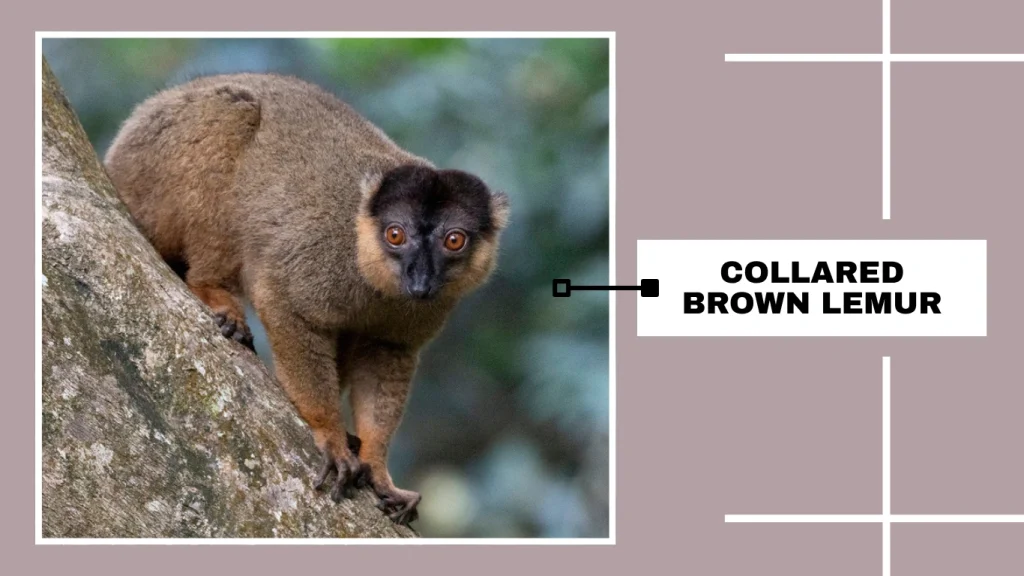
The Collared Brown Lemur is a large-bodied lemur known for the distinct “collar” or mantle of lighter fur around its neck. It is sometimes confused with other brown lemur species but is genetically and visually distinct.
Identification
- Size: Body length: 16–20 inches; tail: 18–22 inches
- Color: Brownish-gray coat with a lighter or cream-colored collar around the neck
- Tail: Thick and bushy, typically darker than the body
- Weight: 4.5–6.5 pounds
Natural Habitat and Range
This lemur is found in the southeastern rainforests of Madagascar, particularly in lowland forests like those in the Andohahela and Sainte Luce regions. It prefers humid, undisturbed environments but may adapt to secondary forests.
Diet and Feeding Habits
The Collared Brown Lemur’s diet consists of fruits, leaves, flowers, and nectar. Seasonal variations in food availability lead them to shift between plant types throughout the year.
Behavior and Social Structure
They are diurnal and live in social groups that may include multiple males and females. Like other Eulemur species, females often dominate group interactions. They are agile climbers, and their strong social structure is reinforced by grooming and vocal communication. They are considered vulnerable due to increasing deforestation and habitat fragmentation in southeastern Madagascar.
18. Greater Bamboo Lemur (Prolemur simus)

The Greater Bamboo Lemur is one of the rarest and most critically endangered lemurs in the world. It is uniquely adapted to eat giant bamboo, even tolerating high levels of cyanide that would be lethal to other animals.
Identification
- Size: Body length: 17–19 inches; tail: 18–22 inches
- Color: Olive-gray fur with a white face, ear tufts, and sometimes a faint stripe along the spine
- Tail: Long, thick, and darker than the body
- Weight: 5–6.5 pounds
Natural Habitat and Range
Once widespread, it now survives only in a few forest patches in southeastern Madagascar, particularly in the regions of Ranomafana and Kianjavato. It prefers dense rainforest with abundant bamboo stands.
Diet and Feeding Habits
Greater Bamboo Lemurs feed almost exclusively on giant bamboo shoots, leaves, and pith. Despite consuming large amounts of cyanide from bamboo, they appear to have evolved a unique tolerance.
Behavior and Social Structure
They live in small groups and are cathemeral, being active during both day and night. These lemurs are shy and elusive, making them difficult to study. Conservation efforts are focused heavily on this species due to its extremely limited population and habitat.
19. Golden Bamboo Lemur (Hapalemur aureus)

The Golden Bamboo Lemur is a beautifully colored and elusive primate that shares its range and diet with the Greater Bamboo Lemur. It was only discovered in 1987 and has since become a flagship species for rainforest conservation in Madagascar.
Identification
- Size: Body length: 11–13 inches; tail: 16–18 inches
- Color: Golden-orange fur with a grayish-brown back and a darker tail
- Tail: Long, thick, and slightly bushy
- Weight: 3–4 pounds
Natural Habitat and Range
This species is found in the southeastern rainforests of Madagascar, particularly in and around Ranomafana National Park. It requires areas rich in bamboo for both food and shelter.
Diet and Feeding Habits
Like its larger relative, the Golden Bamboo Lemur feeds mainly on bamboo shoots, especially those high in cyanide. It may also consume flowers, fruit, and young leaves when bamboo is scarce.
Behavior and Social Structure
Golden Bamboo Lemurs are crepuscular—most active at dawn and dusk. They live in small family groups and tend to be shy and quiet. Due to their specific dietary needs and habitat preferences, they are highly vulnerable to logging, slash-and-burn agriculture, and habitat fragmentation.
20. Eastern Lesser Bamboo Lemur (Hapalemur griseus)

The Eastern Lesser Bamboo Lemur, also known as the Gray Bamboo Lemur, is a small and secretive primate adapted to feeding on bamboo. It is one of the most widespread bamboo lemurs in Madagascar but remains elusive due to its quiet and nocturnal habits.
Identification
- Size: Body length: 10–12 inches; tail: 14–16 inches
- Color: Soft gray-brown coat with a paler underside and orange-tinged face
- Tail: Long and furry, gray to brown in color
- Weight: 2.2–2.8 pounds
Natural Habitat and Range
This species inhabits the eastern rainforests of Madagascar, including areas like Ranomafana, Andasibe, and Marojejy. It prefers moist, bamboo-rich environments and is mostly arboreal.
Diet and Feeding Habits
It primarily feeds on bamboo leaves and shoots but supplements its diet with fruits, flowers, and grasses when available. Its digestive system is well-suited to processing fibrous and sometimes toxic bamboo parts.
Behavior and Social Structure
Eastern Lesser Bamboo Lemurs are typically nocturnal or crepuscular and live in small groups, usually consisting of a female, her offspring, and one or two males. They are shy and tend to avoid human presence, spending much of their time foraging quietly in dense vegetation.
21. Northern Bamboo Lemur (Hapalemur occidentalis)
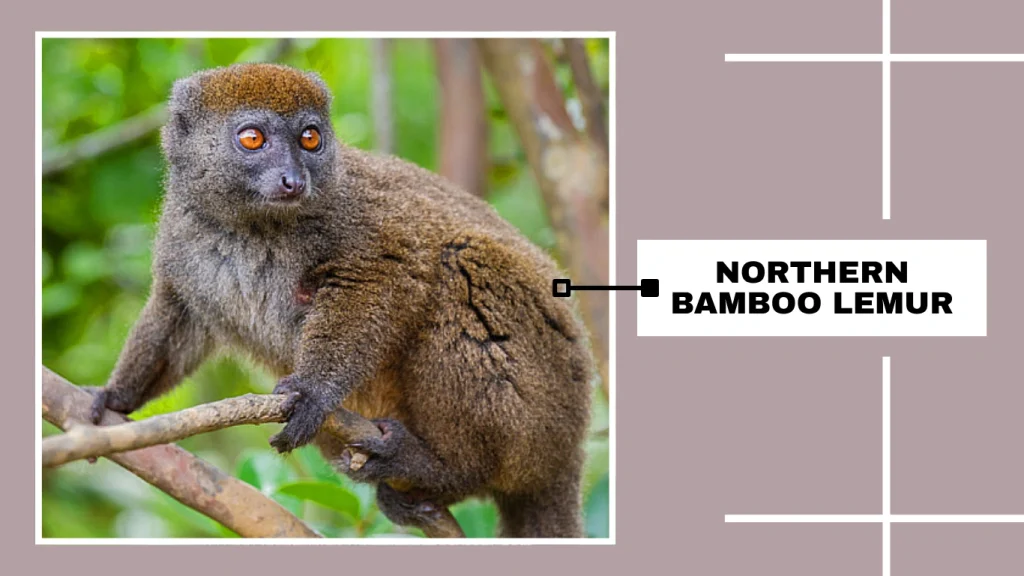
The Northern Bamboo Lemur is one of the least studied and rarest bamboo lemurs, native to the dry forests and swampy regions of northwestern Madagascar. Its preference for remote and difficult terrain has made scientific observation a challenge.
Identification
- Size: Body length: 10–12 inches; tail: 13–16 inches
- Color: Grayish-brown fur with a paler belly; short snout and small rounded ears
- Tail: Long, slender, and slightly darker than the body
- Weight: 2–2.5 pounds
Natural Habitat and Range
It occurs in a few fragmented populations in northwestern Madagascar, especially around Ampijoroa and Sahamalaza. It favors swamp-edge forests and bamboo thickets within lowland dry forest ecosystems.
Diet and Feeding Habits
Northern Bamboo Lemurs feed primarily on bamboo species native to their habitat but may also eat leaves, fruits, and grasses when bamboo is scarce. Their diet appears less dependent on toxic bamboo than other species.
Behavior and Social Structure
These lemurs are generally crepuscular, active at dawn and dusk, and live in small family groups. Due to habitat degradation and limited range, they are classified as endangered. Conservation programs are underway to better understand and protect the species.
22. Fat-tailed Dwarf Lemur (Cheirogaleus medius)

The Fat-tailed Dwarf Lemur is a small, nocturnal species known for storing fat in its tail to survive periods of food scarcity. It is the only primate known to hibernate for extended periods, making it a fascinating subject for scientific research.
Identification
- Size: Body length: 8–10 inches; tail: 6–7 inches
- Color: Gray-brown fur with a lighter underside and dark eye rings
- Tail: Thick and fat-storing during pre-hibernation months
- Weight: 5–7 ounces (varies with fat storage)
Natural Habitat and Range
Fat-tailed Dwarf Lemurs live in the dry deciduous forests of western and southwestern Madagascar. They are especially common in areas like Kirindy Forest.
Diet and Feeding Habits
Their diet includes fruit, flowers, nectar, and insects. During the wet season, they accumulate fat in their tails to sustain them during the dry season, when they hibernate in tree hollows.
Behavior and Social Structure
Nocturnal and solitary, they are rarely seen during the day. In the dry season, they enter torpor or full hibernation. They are quiet, slow-moving primates and are vital seed dispersers in their habitat.
23. Gray Mouse Lemur (Microcebus murinus)
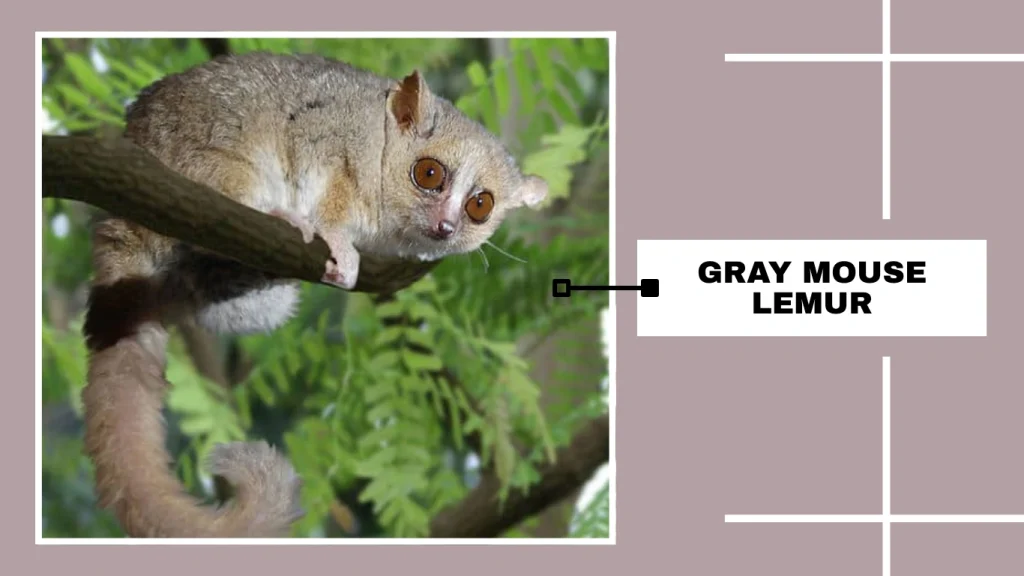
The Gray Mouse Lemur is one of the smallest primates on Earth. Despite its tiny size, it is incredibly agile and adaptable, found in a wide range of habitats in Madagascar.
Identification
- Size: Body length: 4.5–5.5 inches; tail: 5–6 inches
- Color: Grayish-brown upper body with a pale belly and large orange eyes
- Tail: Long, slender, and used for balance and fat storage
- Weight: 1.5–2.5 ounces
Natural Habitat and Range
This lemur occupies dry deciduous forests in western and southern Madagascar and adapts well to degraded forests and edge habitats. It often nests in tree hollows or leaf nests.
Diet and Feeding Habits
Gray Mouse Lemurs are omnivores, feeding on fruit, nectar, insects, small vertebrates, and even bird eggs. Their diverse diet helps them survive in fluctuating environments.
Behavior and Social Structure
They are nocturnal and often solitary but may nest in small groups during the day. Agile and fast, they can leap several times their body length. Their wide distribution and adaptability make them one of the more resilient lemur species, though they still face threats from deforestation and pet trade.
24. Madame Berthe’s Mouse Lemur (Microcebus berthae)

Madame Berthe’s Mouse Lemur holds the title of the smallest primate in the world, discovered only in 1992. Despite its tiny size, it plays a crucial ecological role and is an indicator of forest health in its limited habitat.
Identification
- Size: Body length: 3.5–3.7 inches; tail: 5 inches
- Color: Cinnamon-brown fur with a lighter underside and a dark stripe along the spine
- Tail: Long, slim, often used for balance and limited fat storage
- Weight: 1–1.2 ounces
Natural Habitat and Range
This species is endemic to the Kirindy Forest in western Madagascar. It prefers undisturbed, dry deciduous forest and is extremely sensitive to habitat disturbance and degradation.
Diet and Feeding Habits
Madame Berthe’s Mouse Lemur feeds on small insects, fruit, nectar, and sap. In dry periods, it reduces its activity and may enter torpor to conserve energy.
Behavior and Social Structure
These lemurs are nocturnal and solitary, using their large eyes and keen hearing to locate food in the dark. They nest in tree hollows and only interact with others during mating season. Their population is severely threatened by deforestation, making them a focus of urgent conservation work.
25. Fork-marked Lemur (Phaner furcifer)

The Fork-marked Lemur is named for the distinctive dark stripe that runs from its nose, splits above the eyes, and continues down the back. It’s one of the most elusive and poorly understood nocturnal lemurs.
Identification
- Size: Body length: 9–11 inches; tail: 10–12 inches
- Color: Gray-brown coat with a pale underside and a black forked stripe
- Tail: Long and bushy, often darker at the tip
- Weight: 10–13 ounces
Natural Habitat and Range
Fork-marked Lemurs are found in dry and spiny forests of western and southern Madagascar. They require trees with sap flows and often inhabit forests dominated by tamarind and other gum-producing species.
Diet and Feeding Habits
They are gumivores—feeding primarily on tree sap, which they gouge from bark using specially adapted lower incisors. Their diet is supplemented with insects and fruit.
Behavior and Social Structure
Fork-marked Lemurs are solitary and highly territorial. They are fast, agile climbers and often difficult to observe in the wild. Males and females maintain overlapping territories and come together mainly for breeding. Their vocalizations are used for territory defense and mate communication, especially at night.