





Whales are among the most extraordinary animals on Earth, ranging from the gigantic Blue Whale—the largest creature to ever live—to small and elusive species like the Pygmy Sperm Whale. These marine mammals are divided into two main groups: baleen whales (Mysticeti), which filter-feed with comb-like plates, and toothed whales (Odontoceti), which hunt fish and squid using echolocation.
In this article, you’ll discover 15 distinct types of whales found across the world’s oceans. Each whale has its own unique traits, habitats, behaviors, and adaptations—from the breaching antics of the Humpback Whale to the deep-diving power of the Sperm Whale and the Arctic mysteries of the Narwhal. Whether you’re a student, wildlife enthusiast, or simply curious about marine life, this guide offers an in-depth look into some of the most iconic and lesser-known giants of the sea.
1. Blue Whale (Balaenoptera musculus)

The Blue Whale is the largest animal ever known to have lived on Earth. These majestic marine mammals can grow up to 100 feet (30 meters) in length and weigh as much as 200 tons. Despite their massive size, blue whales are filter feeders that consume tiny shrimp-like animals called krill by the ton during feeding seasons.
Identification
- Length: 70–100 feet
- Weight: Up to 200 tons
- Color: Bluish-gray with lighter mottling, appearing blue underwater
- Dorsal Fin: Small and set far back on the body
- Blow: Tall and columnar, up to 30 feet high
Habitat and Distribution
Blue whales are found in oceans around the world, from the polar regions to the tropics. They migrate seasonally—feeding in cold, krill-rich waters in summer and breeding in warmer waters in winter.
Diet and Feeding Behavior
They feed almost exclusively on krill. A single adult blue whale can consume up to 4 tons of krill per day during peak feeding periods. They use a technique called lunge feeding, where they gulp large amounts of water and filter out the krill using their baleen plates.
Behavior and Social Life
Blue whales are generally solitary or found in pairs, although larger groups can form in rich feeding areas. They are known for their deep, low-frequency calls which can travel long distances underwater. These calls are believed to be used for communication and navigation.
Would you like the next whale?
2. Humpback Whale (Megaptera novaeangliae)

The Humpback Whale is renowned for its acrobatic breaches, complex songs, and long pectoral fins. It’s a favorite among whale watchers for its curious and often dramatic behavior at the surface.
Identification
- Length: 39–52 feet
- Weight: 25–40 tons
- Color: Black or dark gray with white patches on belly and flippers
- Dorsal Fin: Small and variable in shape
- Flippers: Very long (up to one-third of body length) and white underneath
Habitat and Distribution
Humpback whales are found in oceans worldwide. They migrate annually between polar feeding grounds in summer and tropical breeding grounds in winter.
Diet and Feeding Behavior
They eat small schooling fish and krill. Humpbacks are famous for “bubble net feeding,” a cooperative technique where whales create a ring of bubbles to trap prey before lunging through the middle with open mouths.
Behavior and Social Life
These whales are social and often seen in loose groups. Males are known for singing long, complex songs that may last up to 30 minutes and are thought to attract mates. They also display breaching, tail slapping, and fin waving.
3. Sperm Whale (Physeter macrocephalus)

The Sperm Whale is the largest of the toothed whales and has the largest brain of any animal on Earth. It is known for its square-shaped head and deep-diving capabilities.
Identification
- Length: 49–59 feet (males); 33–42 feet (females)
- Weight: Up to 45 tons (males)
- Color: Dark gray to brownish-gray
- Head: Massive and block-shaped, accounting for one-third of body length
- Blow: Bushy and angled forward-left
Habitat and Distribution
Sperm whales inhabit deep offshore waters across the world’s oceans. They prefer areas with steep underwater drop-offs where squid are plentiful.
Diet and Feeding Behavior
They primarily feed on large squid, including the giant squid, and also consume fish. Sperm whales are deep divers, regularly reaching depths of over 3,000 feet and holding their breath for up to 90 minutes.
Behavior and Social Life
Females and young whales live in matrilineal groups, while mature males are more solitary. Sperm whales communicate with a series of clicks known as codas and are frequently scarred by encounters with large squid.
4. Fin Whale (Balaenoptera physalus)

The Fin Whale, also called the “greyhound of the sea,” is the second-largest whale species. Known for its speed and slender build, it can swim up to 25 mph in short bursts.
Identification
- Length: 65–85 feet
- Weight: 40–80 tons
- Color: Asymmetrical jaw coloration—right lower jaw white, left dark; sleek gray body with lighter streaks
- Dorsal Fin: Curved and located far back on the body
- Blow: Tall and columnar, up to 20 feet high
Habitat and Distribution
Fin whales are found in all major oceans but prefer deep, offshore waters. They migrate seasonally between high-latitude feeding grounds and low-latitude breeding areas.
Diet and Feeding Behavior
Like other baleen whales, fin whales lunge feed on krill, small fish, and copepods. They use their asymmetric jaw coloring—possibly to confuse or herd prey during feeding.
Behavior and Social Life
They are typically seen alone or in pairs, but small groups may form during migration. Fin whales are fast swimmers and tend to avoid ships, making them harder to observe compared to more surface-active species.
5. Gray Whale (Eschrichtius robustus)

The Gray Whale is known for its long migrations and close approach to shorelines. It’s one of the most commonly sighted whales along the Pacific coast of North America.
Identification
- Length: 40–50 feet
- Weight: 30–40 tons
- Color: Mottled gray with barnacle scars and whale lice
- Dorsal Fin: None; has a series of low knuckles or humps along the back
- Blow: Low and heart-shaped when seen from the front
Habitat and Distribution
Gray whales are found in the North Pacific. They migrate annually between feeding areas in the Bering and Chukchi Seas and breeding lagoons along the Baja California coast—one of the longest migrations of any mammal.
Diet and Feeding Behavior
Unlike most baleen whales, gray whales are bottom feeders. They turn on their sides and scoop sediment from the seafloor, filtering out amphipods and other invertebrates through their baleen.
Behavior and Social Life
Gray whales are often curious and known for approaching boats. They are generally solitary but sometimes travel in small groups. Mothers and calves are frequently seen traveling together during migration.
6. Bowhead Whale (Balaena mysticetus)

The Bowhead Whale is a massive baleen whale uniquely adapted to Arctic life. It is known for its immense skull, which allows it to break through thick sea ice, and for its extremely long lifespan—possibly over 200 years.
Identification
- Length: 45–60 feet
- Weight: 60–100 tons
- Color: Black body with white chin patch and no dorsal fin
- Head: Very large, up to 40% of body length
- Blow: V-shaped and bushy
Habitat and Distribution
Bowhead whales are found only in Arctic and subarctic waters, especially near ice edges. Populations migrate seasonally with sea ice movement.
Diet and Feeding Behavior
They feed primarily on zooplankton, including copepods and small crustaceans. Bowheads skim-feed near the surface or just below it using long baleen plates to filter their food.
Behavior and Social Life
Generally slow-moving and not acrobatic, bowheads live in small groups. They produce a wide variety of vocalizations and are among the most vocal baleen whales. Some individuals may live for over two centuries, making them one of the longest-lived mammals on Earth.
7. Beluga Whale (Delphinapterus leucas)

The Beluga Whale, often called the “sea canary” due to its high-pitched calls, is a small, sociable whale known for its pure white coloration and flexible neck.
Identification
- Length: 13–20 feet
- Weight: 1–1.5 tons
- Color: White (adults); gray (juveniles)
- Dorsal Fin: Absent (helps navigate under sea ice)
- Head: Rounded forehead (melon) and short beak
Habitat and Distribution
Belugas are native to Arctic and sub-Arctic regions, often in shallow coastal areas and estuaries. They migrate with the ice and sometimes venture into rivers.
Diet and Feeding Behavior
Belugas eat a wide variety of prey including fish (like salmon and cod), squid, octopus, and crustaceans. They use echolocation to locate prey in dark or murky waters.
Behavior and Social Life
They are highly social and often seen in pods of 10–100 individuals. Belugas are known for their expressive faces, wide vocal range, and playful nature. They frequently interact with humans in captivity and in the wild.
8. Narwhal (Monodon monoceros)

Often called the “unicorn of the sea,” the Narwhal is a unique Arctic whale known for its long, spiral tusk—which is actually an elongated tooth found mostly in males.
Identification
- Length: 13–16 feet (excluding tusk)
- Weight: 1.5–2 tons
- Color: Mottled gray and black; lighter with age
- Tusk: Single, spiral tooth in males (up to 10 feet); occasionally seen in females
- Dorsal Fin: None
Habitat and Distribution
Narwhals inhabit Arctic waters, particularly around Greenland, Canada, and Russia. They spend much of their time in deep fjords and ice-covered regions, surfacing through leads in the sea ice.
Diet and Feeding Behavior
Narwhals dive deep (up to 1,500 meters) to feed primarily on fish such as Greenland halibut, along with squid and shrimp. They use echolocation to locate prey in the dark ocean depths.
Behavior and Social Life
They are social and usually found in groups of 5–20. Males may use their tusks for display or dominance interactions, though they are not typically used for fighting. Narwhals are elusive and sensitive to changes in sea ice and climate.
9. Minke Whale (Balaenoptera acutorostrata)

The Minke Whale is the smallest of the baleen whales, often identified by its speed, solitary nature, and distinctive white bands on its flippers.
Identification
- Length: 23–35 feet
- Weight: 5–10 tons
- Color: Dark gray to black with white belly and flipper stripes
- Dorsal Fin: Tall and curved, located two-thirds down the back
- Blow: Small and low
Habitat and Distribution
Minke whales are found in oceans worldwide, from the polar regions to the tropics. They are often seen near coasts and in open waters.
Diet and Feeding Behavior
They eat small fish, krill, and other zooplankton. Minke whales use lunge feeding and may circle schools of fish to trap them before engulfing them with their baleen-filtering system.
Behavior and Social Life
Usually solitary or in pairs, they are fast and elusive swimmers. They are less vocal than other baleen whales but produce low-frequency sounds. Minkes are one of the few whale species still hunted in some regions under whaling programs.
10. Bryde’s Whale (Balaenoptera brydei)

Bryde’s Whale is a medium-sized baleen whale that prefers warm, tropical, and subtropical waters. It’s often confused with other rorquals but can be distinguished by the three parallel ridges on its head.
Identification
- Length: 40–55 feet
- Weight: 13–25 tons
- Color: Dark gray to bluish-gray with a lighter underside
- Dorsal Fin: Tall, curved, and located far back on the body
- Distinctive Feature: Three longitudinal ridges on the head (most rorquals have one)
Habitat and Distribution
Bryde’s Whales are found in warm oceans around the world, particularly in the Atlantic, Pacific, and Indian Oceans. They are mostly coastal but can be seen offshore as well.
Diet and Feeding Behavior
They feed on anchovies, sardines, mackerel, and krill using lunge feeding. Unlike some larger whales, Bryde’s Whales feed throughout the year rather than seasonally.
Behavior and Social Life
Usually seen alone or in small groups, they are known for unpredictable surfacing behavior. They’re quick and shy, making them harder to study than many other whale species.
11. Sei Whale (Balaenoptera borealis)

The Sei Whale is a sleek, fast-swimming baleen whale that prefers deep offshore waters. It’s among the fastest whales, capable of reaching speeds over 30 mph.
Identification
- Length: 40–60 feet
- Weight: 20–30 tons
- Color: Dark steel gray with a lighter underside and white lower jaw
- Dorsal Fin: Prominent and curved, located two-thirds down the back
- Blow: Tall and column-like
Habitat and Distribution
Sei Whales are found in all major oceans, preferring deep, temperate waters. They migrate seasonally but are less predictable than other baleen species.
Diet and Feeding Behavior
They consume copepods, krill, and small fish using skimming and lunge feeding. They are known for sudden bursts of speed when chasing dense prey patches.
Behavior and Social Life
Usually solitary or in pairs, Sei Whales are quiet and elusive. They do not show much surface activity, making them hard to observe. Despite their size, they were once heavily targeted by commercial whalers and are still recovering.
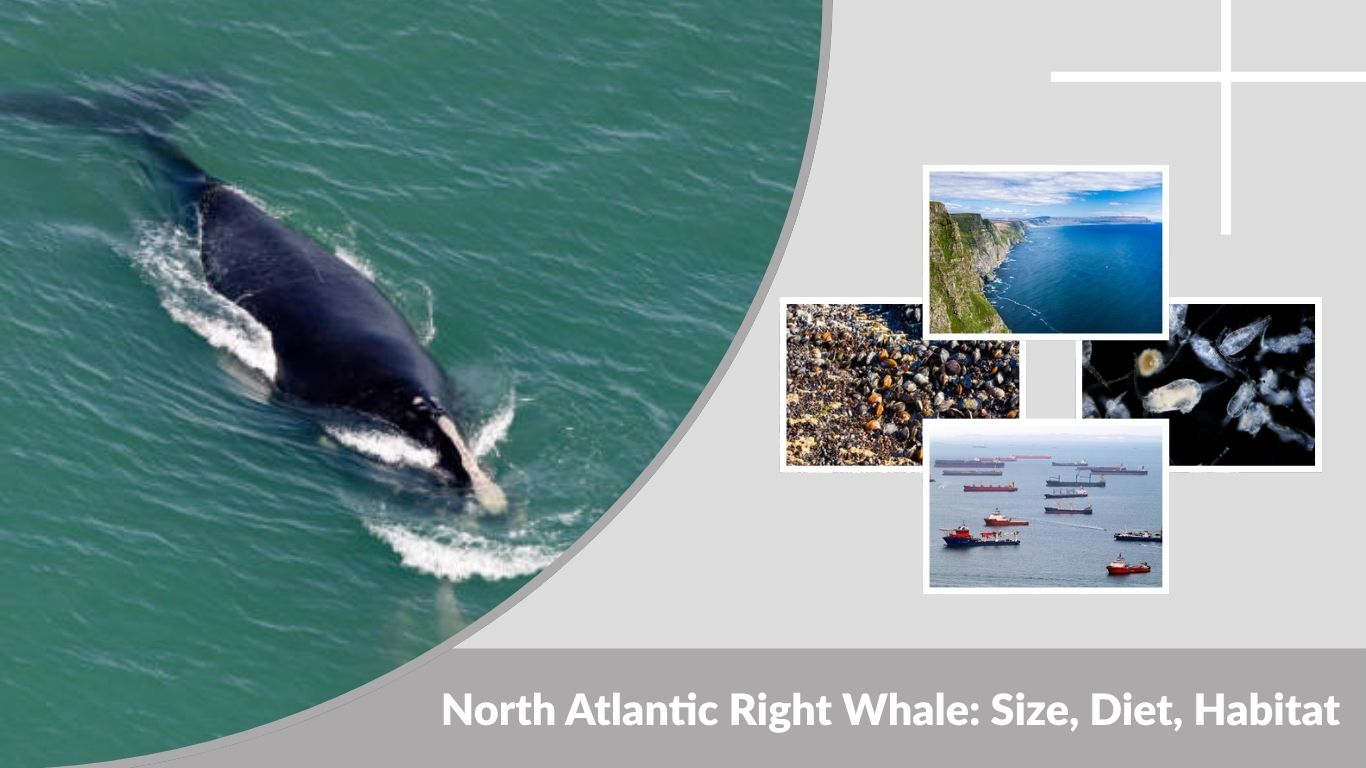
12. North Atlantic Right Whale (Eubalaena glacialis)

The North Atlantic Right Whale is one of the most endangered whale species in the world. Its name comes from early whalers who considered it the “right” whale to hunt due to its slow speed and tendency to float when killed.
Identification
- Length: 45–55 feet
- Weight: 40–70 tons
- Color: Mostly black with white patches on the belly and rough skin patches (callosities) on the head
- Dorsal Fin: Absent
- Blow: V-shaped and bushy
Habitat and Distribution
Found mainly along the eastern coasts of Canada and the United States, they inhabit shallow coastal waters and migrate between calving grounds in the southeastern U.S. and feeding areas in the north.
Diet and Feeding Behavior
They feed on zooplankton, especially copepods, by skimming near the surface with their mouths open. Their baleen plates trap tiny prey from the water.
Behavior and Social Life
North Atlantic Right Whales are slow swimmers and often seen near the surface. They are social and display behaviors like breaching and tail slapping. Ship strikes and fishing gear entanglement are their primary threats.
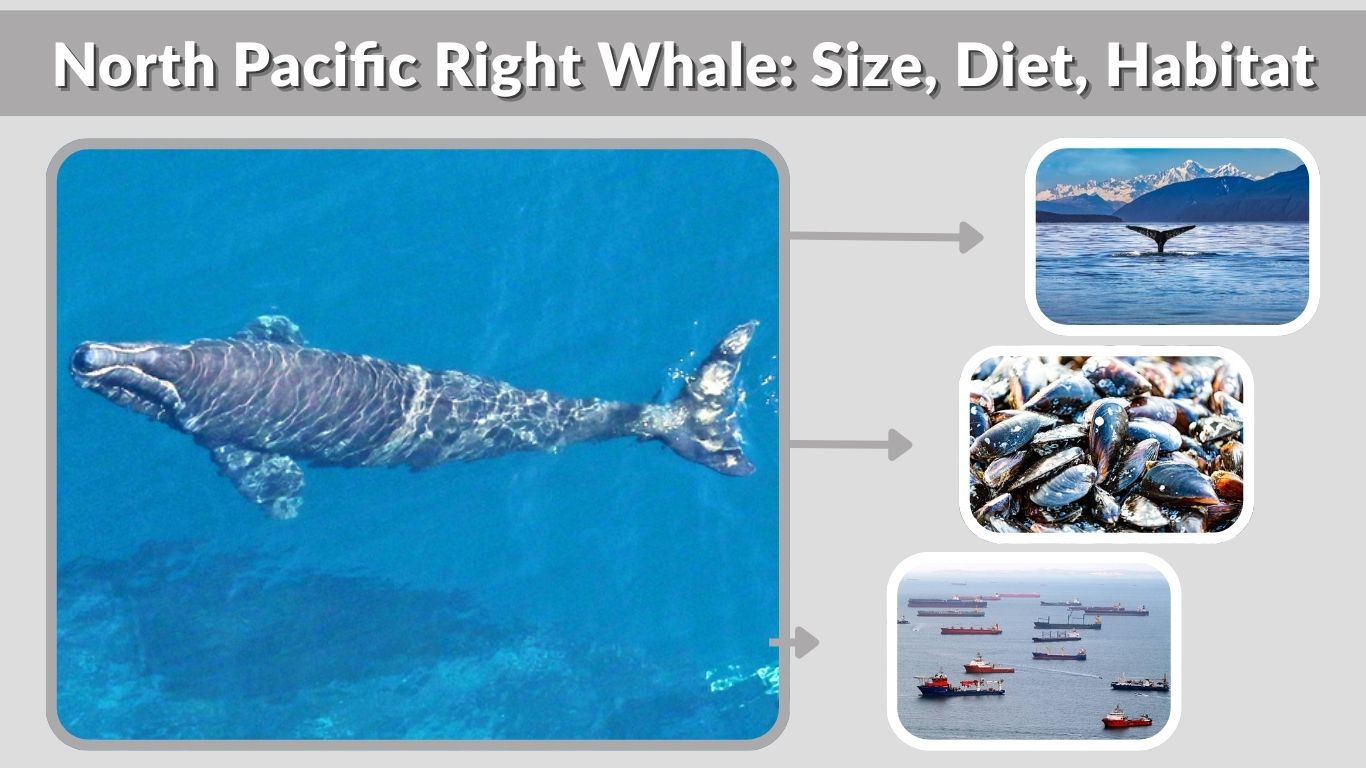
13. North Pacific Right Whale (Eubalaena japonica)

Closely related to the North Atlantic species, the North Pacific Right Whale is extremely rare and elusive. Its population is estimated to be fewer than 500 individuals.
Identification
- Length: 45–60 feet
- Weight: 40–80 tons
- Color: Mostly black with occasional white patches; callosities on the head
- Dorsal Fin: None
- Blow: V-shaped and tall
Habitat and Distribution
They are found in the North Pacific, particularly around the Bering Sea, the Sea of Okhotsk, and off the coasts of Japan and Alaska. Preferring cold, productive waters, their movements are poorly understood due to their rarity.
Diet and Feeding Behavior
North Pacific Right Whales feed on small planktonic organisms such as copepods and krill. They use a slow, surface-skimming technique similar to other right whales.
Behavior and Social Life
Very little is known about their behavior due to their small numbers and remote habitat. Sightings are rare, and the species remains critically endangered, primarily due to past commercial whaling and ongoing threats like entanglement and ship traffic.
14. Southern Right Whale (Eubalaena australis)
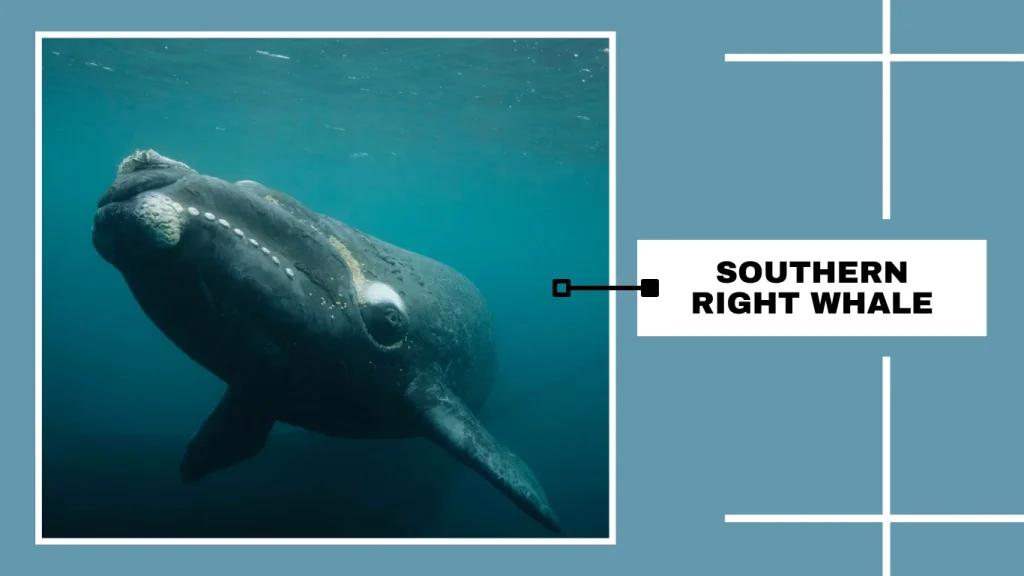
The Southern Right Whale is the southern counterpart of the North Atlantic and North Pacific species. It was heavily hunted in the past but has made a modest recovery in some regions.
Identification
- Length: 45–55 feet
- Weight: 40–60 tons
- Color: Mostly black with occasional white patches on the belly
- Callosities: Present on the head, used for individual identification
- Dorsal Fin: Absent
- Blow: Tall and V-shaped
Habitat and Distribution
Southern Right Whales are found in the Southern Hemisphere, particularly around Argentina, South Africa, Australia, and New Zealand. They migrate between high-latitude feeding grounds and low-latitude calving areas.
Diet and Feeding Behavior
They feed on zooplankton, especially copepods and krill, by skimming through the water with their mouths open. Feeding occurs mostly in colder waters.
Behavior and Social Life
These whales are known for breaching, tail lifting, and close-to-shore behavior, making them popular among whale watchers. Mothers and calves are often seen resting near the coast during breeding season.
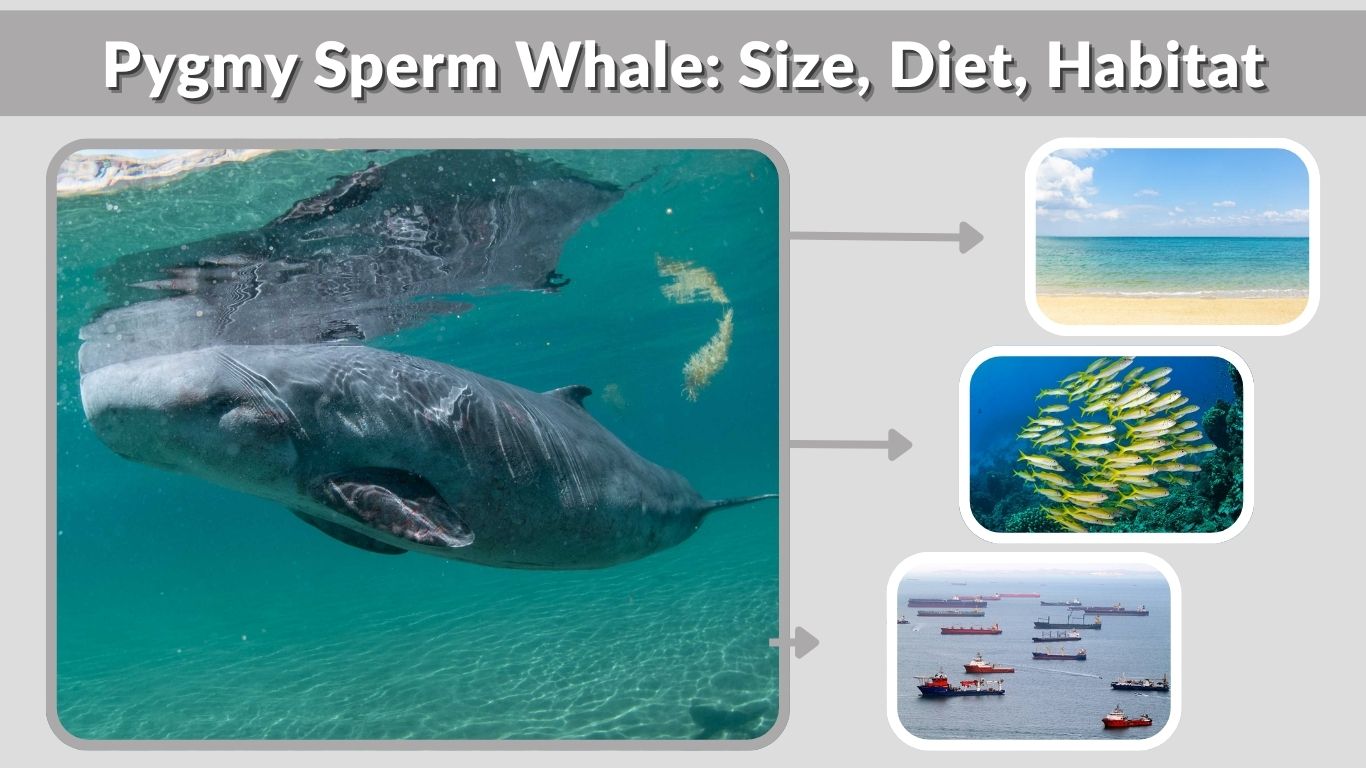
15. Pygmy Sperm Whale (Kogia breviceps)

The Pygmy Sperm Whale is a small, elusive, and deep-diving whale species that resembles a dolphin in size and appearance. It is rarely seen at the surface.
Identification
- Length: 8–11.5 feet
- Weight: 700–900 pounds
- Color: Dark gray to blue-gray on the back, lighter underneath
- Head: Blunt with a false gill mark behind each eye
- Dorsal Fin: Small and set far back
Habitat and Distribution
Pygmy Sperm Whales are found in deep offshore waters of tropical and temperate oceans worldwide. They are rarely observed in the wild due to their elusive nature.
Diet and Feeding Behavior
Their diet includes deep-sea squid, crustaceans, and fish. They hunt at depths using echolocation, surfacing only briefly to breathe.
Behavior and Social Life
Generally solitary or seen in small groups of two to three. When startled, they may release a cloud of reddish-brown fluid from an intestinal sac, similar to squid ink, to confuse predators. Much of what is known about them comes from stranded individuals rather than live observations.