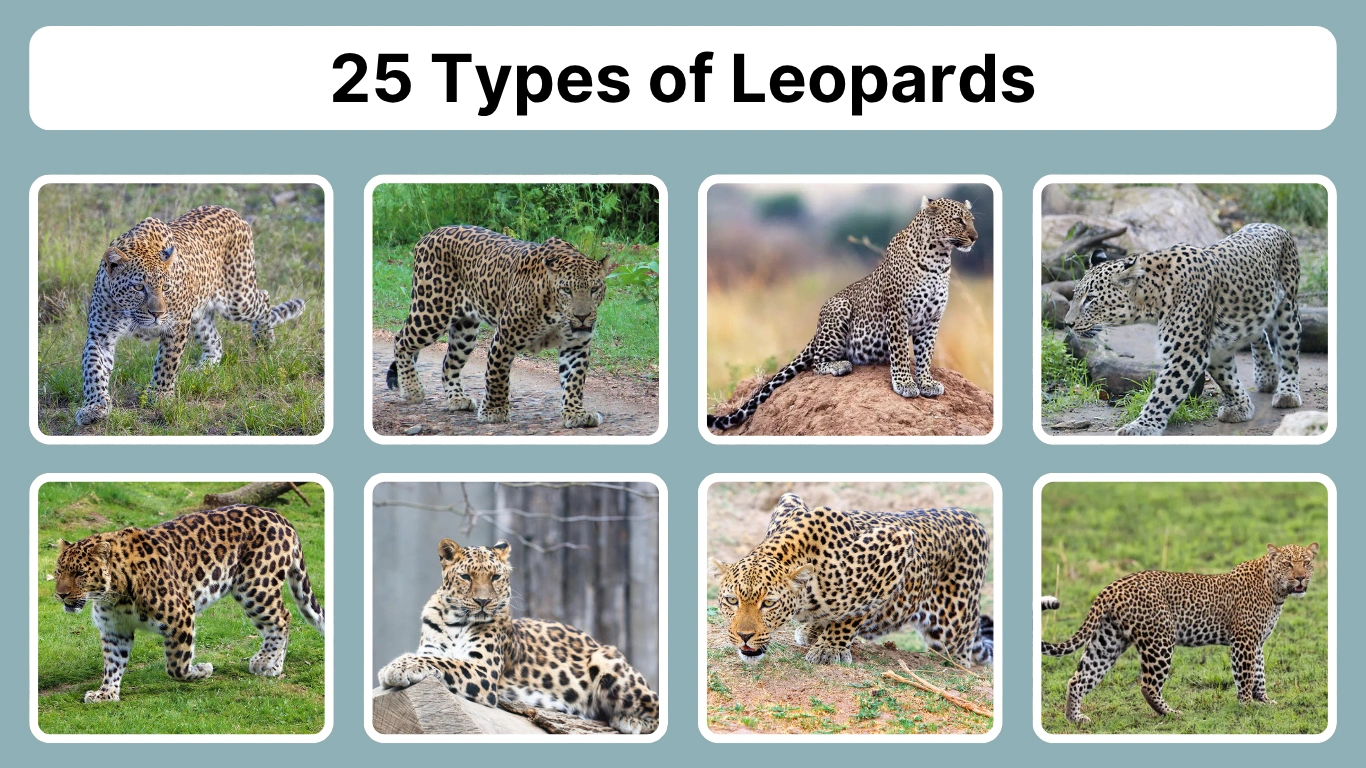
Leopards are among the most adaptable and widespread big cats, known for their elusive nature, striking spotted coats, and remarkable ability to thrive in diverse habitats. From the dense rainforests of Southeast Asia to the arid mountains of Central Asia and the savannas of Africa, leopards exhibit incredible diversity across their many subspecies and regional populations.
This guide explores 25 types of leopards, detailing their unique physical characteristics, habitats, diets, and behaviors. Whether endangered or abundant, each leopard subspecies plays a vital role in its ecosystem. Understanding these distinctions helps highlight conservation challenges and successes around the globe, offering a comprehensive look at one of nature’s most fascinating predators.
1. African Leopard (Panthera pardus pardus)
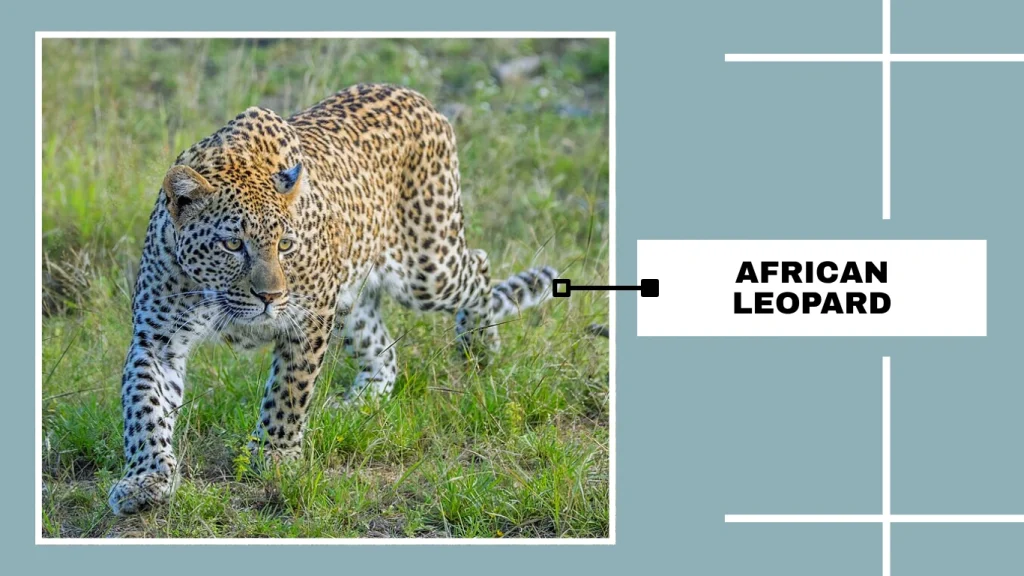
The African Leopard is the most widespread and numerous subspecies of leopard, known for its adaptability and powerful presence across diverse environments.
Identification
- Size: Males 5–6.2 ft (head-body), females slightly smaller
- Weight: Males 130–200 lbs, females 70–130 lbs
- Color: Golden-yellow coat with black rosettes; belly is paler
- Features: Muscular build, broad skull, long tail used for balance
Habitat and Range
Found throughout sub-Saharan Africa in a wide variety of habitats: savannas, rainforests, woodlands, mountains, and even semi-arid regions.
Diet and Hunting Behavior
Feeds on antelope, monkeys, birds, warthogs, rodents, and even fish. Known for dragging prey up trees to avoid scavengers. Primarily nocturnal and ambushes prey with stealth and power.
Social Structure and Behavior
Solitary and highly territorial. Uses scent markings and vocalizations to communicate. Known for intelligence, adaptability, and the ability to thrive near human settlements. Population is stable in many areas but threatened by habitat loss and conflict in others.
2. Indian Leopard (Panthera pardus fusca)
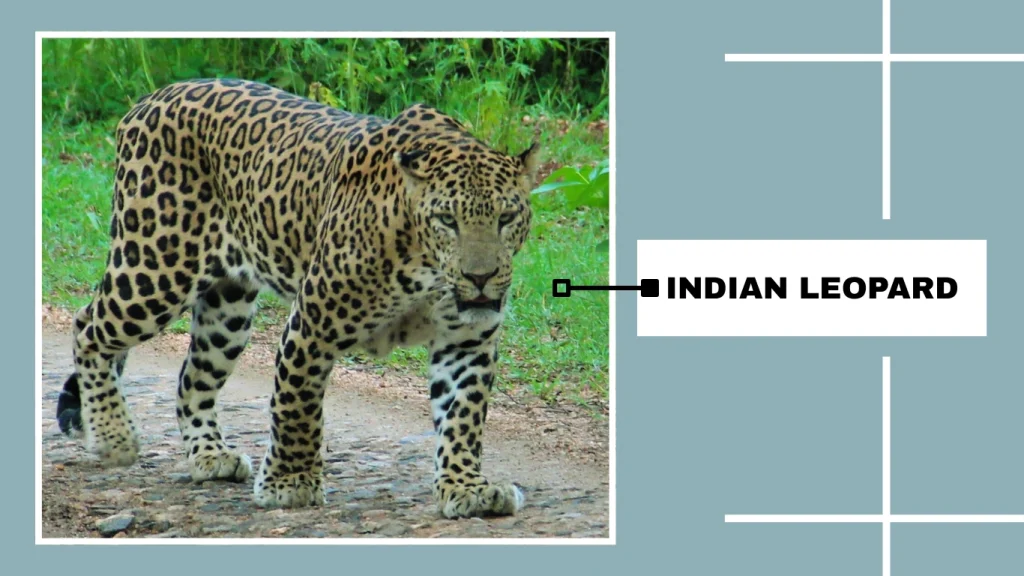
The Indian Leopard is native to the Indian subcontinent and is one of the most frequently seen leopards due to its wide distribution and occasional appearance near human settlements.
Identification
- Size: Males 4.5–6 ft (head-body), females smaller
- Weight: Males 100–150 lbs, females 65–90 lbs
- Color: Golden to dark ochre coat with well-defined black rosettes
- Features: Lean frame, long tail, and keen eyesight
Habitat and Range
Found across India, Nepal, Bhutan, and parts of Pakistan and Bangladesh. Inhabits forests, grasslands, rocky hills, and near urban edges.
Diet and Hunting Behavior
Feeds on deer, wild boar, langurs, dogs, goats, and smaller animals. Opportunistic hunter—active at night and sometimes day. Known for adapting to prey availability near villages.
Social Structure and Behavior
Solitary and territorial. Often lives in close proximity to humans, which increases conflict. Protected under Indian law, but still vulnerable to poaching and habitat encroachment.
3. Arabian Leopard (Panthera pardus nimr)

The Arabian Leopard is the smallest and one of the rarest leopard subspecies, critically endangered and native to the Arabian Peninsula.
Identification
- Size: 3.5–5 ft (head-body)
- Weight: Males 60–70 lbs, females 45–55 lbs
- Color: Pale yellow coat with widely spaced rosettes and faint markings
- Features: Slender build, adapted to hot, dry conditions
Habitat and Range
Found in fragmented populations in Oman, Yemen, and Saudi Arabia. Prefers mountainous terrain, rocky cliffs, and dry wadis.
Diet and Hunting Behavior
Feeds on hyraxes, hares, birds, ibex, and domestic livestock. Hunts by ambush and is highly elusive.
Social Structure and Behavior
Solitary and extremely elusive. Numbers have dropped below 200 in the wild. Active conservation programs are ongoing in Oman and Saudi Arabia, including captive breeding and habitat protection.
4. Persian Leopard (Panthera pardus saxicolor)

Also known as the Caucasian Leopard, the Persian Leopard is one of the largest leopard subspecies and is native to the mountainous regions of the Middle East and Central Asia.
Identification
- Size: Males 5.5–6.5 ft (head-body), females slightly smaller
- Weight: Males 130–200 lbs
- Color: Pale yellow to grayish coat with large rosettes
- Features: Long legs, thick winter coat, and powerful build
Habitat and Range
Found in Iran, Turkmenistan, Armenia, Azerbaijan, Georgia, and parts of eastern Turkey. Prefers mountainous forests, rocky outcrops, and steep ravines.
Diet and Hunting Behavior
Feeds on wild goats, sheep, deer, hares, and sometimes livestock. Hunts mainly at night, using rugged terrain for stealth.
Social Structure and Behavior
Solitary and highly elusive. Threatened by habitat fragmentation, poaching, and decline in prey. Conservation efforts are underway in the Caucasus and Iran to protect core habitats.
5. Indochinese Leopard (Panthera pardus delacouri)

The Indochinese Leopard is a rarely seen subspecies that lives in the forests of Southeast Asia.
Identification
- Size: 4.5–6 ft (head-body)
- Weight: Males 90–140 lbs, females smaller
- Color: Typically dark with small, close-set rosettes; melanistic (black) individuals are common
- Features: Sleek body adapted to dense forest
Habitat and Range
Found in Cambodia, Laos, Vietnam, Thailand, and parts of Myanmar and southern China. Inhabits tropical and subtropical forests.
Diet and Hunting Behavior
Feeds on monkeys, deer, rodents, birds, and reptiles. Prefers dense foliage for ambush hunting.
Social Structure and Behavior
Solitary and mostly nocturnal. Populations have declined sharply due to deforestation, hunting, and illegal wildlife trade. Conservation efforts are limited but urgently needed.
6. Sri Lankan Leopard (Panthera pardus kotiya)

Endemic to the island of Sri Lanka, the Sri Lankan Leopard is the top predator on the island and a flagship species for conservation.
Identification
- Size: Males 5.5–6.5 ft (head-body), females slightly smaller
- Weight: Males 120–170 lbs, females 65–95 lbs
- Color: Rich golden to rusty orange coat with black rosettes
- Features: Stocky build, relatively large skull, and long tail
Habitat and Range
Found throughout Sri Lanka in dry forests, rainforests, grasslands, and central highlands.
Diet and Hunting Behavior
Feeds on sambar deer, monkeys, wild boar, hares, and reptiles. Apex predator—hunts during day and night depending on prey availability.
Social Structure and Behavior
Solitary and territorial. Less aggressive than some other leopards. Threatened by habitat fragmentation and human conflict. Protected under Sri Lankan law with dedicated reserves.
7. Javan Leopard (Panthera pardus melas)

The Javan Leopard is critically endangered and found only on the Indonesian island of Java.
Identification
- Size: Males 4.5–6 ft (head-body)
- Weight: Males 80–120 lbs
- Color: Ranges from golden-yellow with rosettes to completely melanistic (black)
- Features: Slim body, long limbs, adapted to dense forests
Habitat and Range
Lives in the mountainous and lowland tropical forests of Java. Now restricted mainly to protected areas.
Diet and Hunting Behavior
Preys on deer, monkeys, birds, and small mammals. Stealthy ambush hunter that navigates thick vegetation.
Social Structure and Behavior
Solitary and secretive. Population is under 250 individuals. Major threats include deforestation, poaching, and conflict with humans. Conservation efforts include habitat restoration and anti-poaching patrols.
8. Amur Leopard (Panthera pardus orientalis)
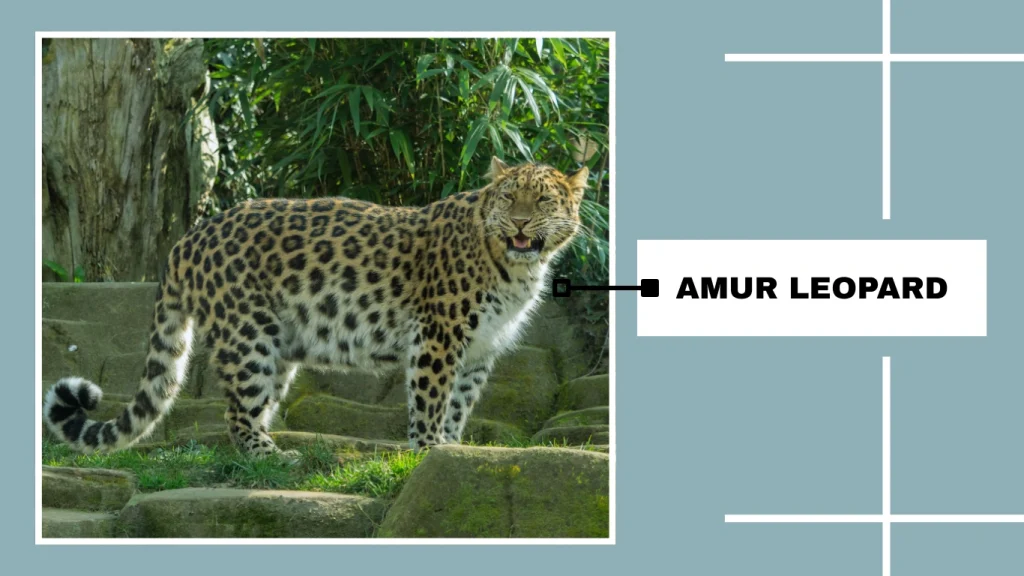
The Amur Leopard is one of the rarest big cats in the world, adapted to cold, snowy climates in the Russian Far East.
Identification
- Size: Males 6–7 ft (head-body), females slightly smaller
- Weight: Males 80–120 lbs, females 65–95 lbs
- Color: Pale cream to yellowish coat with widely spaced rosettes and thick fur
- Features: Long limbs, deep chest, and dense winter coat
Habitat and Range
Native to the temperate forests of Primorye in southeastern Russia and northeastern China.
Diet and Hunting Behavior
Feeds on roe deer, sika deer, hares, and wild boar. Hunts primarily at night, stalking through snow and dense forest.
Social Structure and Behavior
Solitary and territorial. Estimated fewer than 120 individuals remain in the wild. Conservation programs include captive breeding, habitat protection, and cross-border cooperation between Russia and China.
9. North Chinese Leopard (Panthera pardus japonensis)

This subspecies is native to northern China and is rarely seen in the wild.
Identification
- Size: Males up to 6 ft (head-body)
- Weight: 100–150 lbs
- Color: Tawny yellow coat with dense black rosettes
- Features: Stocky build and thick winter coat
Habitat and Range
Inhabits mountainous and forested regions of northern and central China. Also found in areas with rocky outcrops and steep terrain.
Diet and Hunting Behavior
Feeds on deer, wild boar, rodents, and birds. Hunts through ambush and stalk strategies in thick underbrush or rocky areas.
Social Structure and Behavior
Solitary and elusive. Little is known due to limited research. Faces threats from deforestation, prey depletion, and human expansion. Conservation status is uncertain but likely vulnerable.
10. South Chinese Leopard (Panthera pardus chinensis)

Often considered a regional population rather than a distinct subspecies, the South Chinese Leopard inhabits subtropical areas in southern China.
Identification
- Size: Males around 5.5–6 ft (head-body)
- Weight: 90–130 lbs
- Color: Rich yellow-orange coat with round rosettes
- Features: Sleek body, well-adapted to warm, forested regions
Habitat and Range
Once widespread across southern China, now likely restricted to remote forested pockets in Yunnan, Guangxi, and Guangdong provinces.
Diet and Hunting Behavior
Feeds on muntjac, wild boar, monkeys, and birds. Uses stealth and dense vegetation for stalking and ambush.
Social Structure and Behavior
Solitary. Very little population data exists, and the status may overlap with Indochinese or North Chinese leopards. Threatened by habitat loss and fragmentation.
11. Tibetan Leopard (Panthera pardus sinensis)
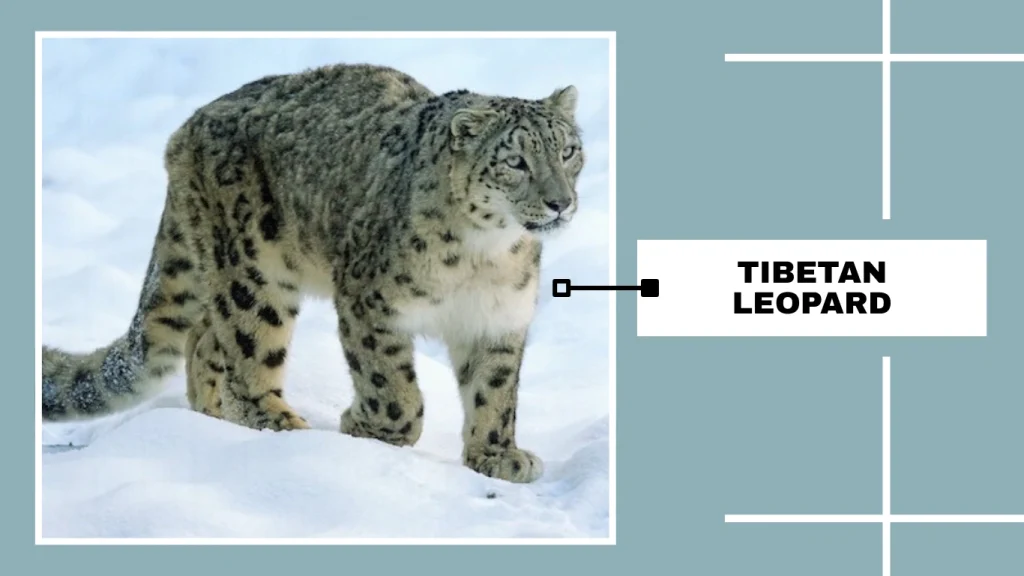
Sometimes considered a highland variant of the North Chinese or Indochinese leopard, the Tibetan Leopard is adapted to rugged terrain and cold temperatures.
Identification
- Size: Similar to North Chinese Leopard
- Weight: Typically 90–130 lbs
- Color: Thick, pale coat with prominent black rosettes
- Features: Long tail and dense fur for cold environments
Habitat and Range
Found in the eastern edges of the Tibetan Plateau, especially in high-altitude forests and scrubland.
Diet and Hunting Behavior
Feeds on blue sheep, marmots, pika, and small deer. Adapts hunting strategy for mountainous terrain, often ambushing from elevation.
Social Structure and Behavior
Solitary and reclusive. Survival is threatened by declining prey and increasing human activity in highlands. Often overlaps with snow leopard range.
12. Sinai Leopard (Panthera pardus jarvisi)

Believed to be a local variant of the Arabian or African leopard, the Sinai Leopard once roamed parts of the Sinai Peninsula but is now likely extinct in the wild.
Identification
- Size: Small and lightly built
- Weight: Estimated 60–90 lbs
- Color: Pale sandy coat with faint rosettes suited to desert camouflage
- Features: Slim limbs, small head, and adapted for arid, rocky terrain
Habitat and Range
Historically found in Egypt’s Sinai Peninsula and nearby arid regions. Preferred mountainous deserts and dry gorges.
Diet and Hunting Behavior
Likely fed on hares, hyraxes, reptiles, and ground birds. Hunted during cooler periods, mostly at dusk and dawn.
Social Structure and Behavior
Solitary and elusive. Possibly extinct due to habitat loss, persecution, and lack of prey. No verified sightings in recent decades.
13. Caucasian Leopard (Panthera pardus ciscaucasica)

This leopard is often grouped under the Persian subspecies but may represent a distinct regional form found in the Greater Caucasus.
Identification
- Size: Males 6–6.5 ft (head-body)
- Weight: Up to 200 lbs
- Color: Grayish-yellow coat with large black rosettes
- Features: Strong build, thick coat for cold winters
Habitat and Range
Inhabits the North Caucasus Mountains, primarily in Russia, Georgia, and Azerbaijan.
Diet and Hunting Behavior
Feeds on wild goats, deer, boars, and smaller mammals. Hunts at night, using rocky terrain for cover and elevation advantage.
Social Structure and Behavior
Solitary and secretive. Populations critically low but supported by Russian reintroduction programs. Habitat overlap and genetic links to the Persian Leopard are under study.
14. Central Asian Leopard (Panthera pardus tulliana)

Sometimes grouped under the Persian Leopard, the Central Asian Leopard is a regional form found in the mountainous zones of Central Asia.
Identification
- Size: 5.5–6.5 ft (head-body)
- Weight: Around 120–180 lbs
- Color: Light golden to pale coat with large rosettes
- Features: Thick coat and sturdy limbs adapted for rough terrain
Habitat and Range
Ranges across Uzbekistan, Tajikistan, Kazakhstan, and Kyrgyzstan—mainly in rocky hills, alpine meadows, and semi-arid mountains.
Diet and Hunting Behavior
Feeds on ibex, markhor, hares, and ground birds. Hunts using cover and elevation in craggy landscapes.
Social Structure and Behavior
Elusive and solitary. Threatened by habitat fragmentation and decline in prey species. Some populations overlap with Persian Leopards.
15. Somali Leopard (Panthera pardus somalica)

The Somali Leopard is an East African form found primarily in Somalia, and occasionally considered a population of the African Leopard.
Identification
- Size: Medium-sized, lean build
- Weight: Estimated 80–120 lbs
- Color: Pale sandy-yellow coat with wide, open rosettes
- Features: Slender body, long limbs, and large ears
Habitat and Range
Inhabits arid savannas, dry forests, and scrublands of Somalia and possibly eastern Ethiopia.
Diet and Hunting Behavior
Preys on small to medium-sized animals like dik-dik, hares, guinea fowl, and goats. Hunts mainly at night or twilight.
Social Structure and Behavior
Solitary and rarely seen. Faces pressure from conflict with livestock herders and habitat degradation due to political instability. Conservation data is minimal.
16. Zambian Leopard (Panthera pardus shortridgei)

This leopard is recognized as a regional variant within the African Leopard population, found primarily in Zambia and neighboring parts of southern Africa.
Identification
- Size: Similar to other African leopards
- Weight: 100–150 lbs
- Color: Golden-yellow coat with well-defined rosettes
- Features: Muscular frame, broad head, and long tail
Habitat and Range
Found in Zambia’s national parks, especially Luangwa Valley and Kafue, as well as in northern Zimbabwe and eastern Angola. Prefers woodlands, riverine forests, and savannas.
Diet and Hunting Behavior
Feeds on antelope, monkeys, bushpigs, rodents, and birds. Uses ambush tactics and is capable of climbing trees with prey.
Social Structure and Behavior
Solitary, territorial, and mostly nocturnal. Often studied in conservation efforts due to visibility in protected reserves.
17. Cape Leopard (Panthera pardus pardus, Cape variant)

The Cape Leopard is a smaller, isolated population of the African Leopard, adapted to the mountainous terrain of South Africa’s Western Cape.
Identification
- Size: Smaller than typical African leopards
- Weight: Males 65–90 lbs, females 45–65 lbs
- Color: Yellow-brown to tawny with relatively small rosettes
- Features: Compact body and short limbs for navigating rocky cliffs
Habitat and Range
Lives in the Cape Fold Mountains, fynbos vegetation zones, and remote valleys in South Africa.
Diet and Hunting Behavior
Feeds on small antelope, dassies, porcupines, and birds. Extremely shy and secretive, active mainly at night.
Social Structure and Behavior
Solitary and wide-ranging due to low prey density. Actively monitored through camera traps and community-based conservation programs. Faces threats from habitat encroachment and human-wildlife conflict.
18. Kruger Leopard (Panthera pardus pardus, Kruger variant)

The Kruger Leopard refers to the leopard population residing in South Africa’s Kruger National Park, one of the most studied and observed groups of African leopards.
Identification
- Size: Large-bodied; males up to 200 lbs
- Color: Rich golden coat with prominent rosettes
- Features: Muscular limbs, broad chest, thick neck
Habitat and Range
Found throughout Kruger National Park, including riverine woodlands, savannas, and rocky outcrops. Also ranges into adjacent reserves like Sabi Sands.
Diet and Hunting Behavior
Feeds on impalas, warthogs, baboons, reptiles, and birds. Known for tree-stashing prey to avoid scavengers like hyenas.
Social Structure and Behavior
Solitary and highly territorial. Frequently observed due to research and tourism; well-known individuals have been documented for years.
19. Congo Leopard (Panthera pardus iturensis)
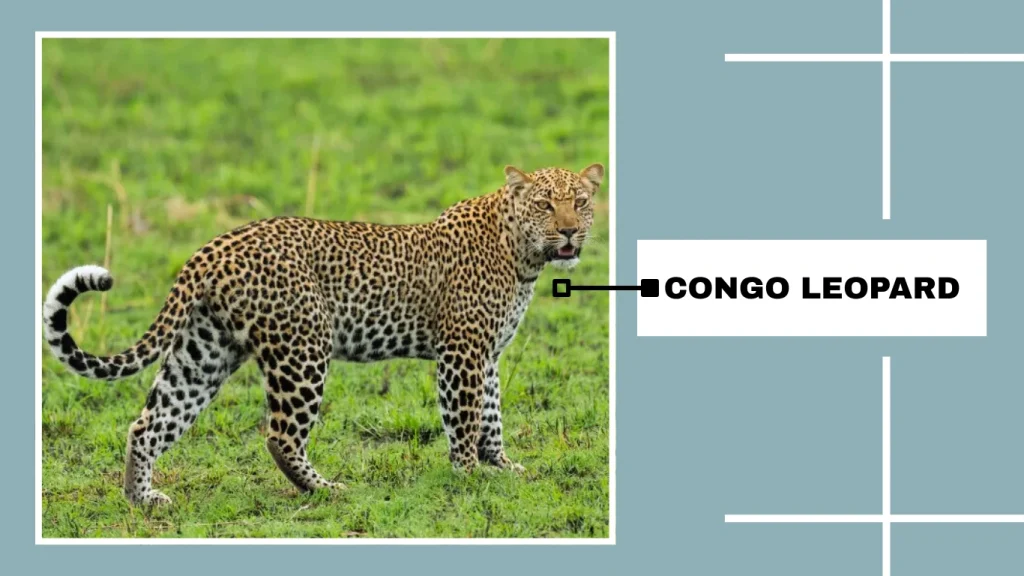
A lesser-known population of African Leopard from central Africa’s dense rainforests.
Identification
- Size: Medium build with longer limbs
- Weight: Estimated 90–130 lbs
- Color: Dark golden coat with black rosettes often obscured by long fur
- Features: Adapted to humid rainforest with slender frame and strong limbs
Habitat and Range
Native to the Democratic Republic of the Congo, especially in the Ituri Forest and surrounding areas.
Diet and Hunting Behavior
Feeds on monkeys, small antelope, rodents, and birds. Hunts silently in thick vegetation using stealth and patience.
Social Structure and Behavior
Highly secretive. Rarely seen and poorly studied due to habitat difficulty and regional instability. Faces threats from deforestation and bushmeat trade.
20. Ethiopian Leopard (Panthera pardus subsp.)

The Ethiopian Leopard is a distinct population of leopard found in the Ethiopian Highlands, adapted to mountainous terrain and cooler climates.
Identification
- Size: Medium-sized, similar to African Leopard
- Weight: Approximately 80–120 lbs
- Color: Pale golden coat with dense rosettes, sometimes darker due to environment
- Features: Agile build suitable for rugged, high-altitude landscapes
Habitat and Range
Found in the Bale Mountains and Simien Mountains of Ethiopia. Prefers afro-alpine moorlands, forest edges, and rocky outcrops.
Diet and Hunting Behavior
Preys on mountain nyala, warthogs, rodents, and birds. Skilled climbers and hunters, stalking prey in rugged terrain.
Social Structure and Behavior
Solitary and elusive. Population numbers are low, threatened by habitat loss and human-wildlife conflict. Conservation efforts include habitat protection and community awareness.
21. Rwandan Leopard (Panthera pardus population)

The Rwandan Leopard is a population of African Leopard native to Rwanda, particularly in forested and mountainous regions.
Identification
- Size: Similar to typical African Leopards
- Weight: 90–130 lbs
- Color: Golden coat with distinct black rosettes
- Features: Adapted to dense forest and mountainous terrain
Habitat and Range
Found mainly in Volcanoes National Park and Nyungwe Forest. Prefers dense rainforest and bamboo zones at high elevations.
Diet and Hunting Behavior
Feeds on duikers, monkeys, bush pigs, and small mammals. Hunts primarily by stalking and ambush in dense vegetation.
Social Structure and Behavior
Solitary and highly secretive. Faces threats from habitat fragmentation and poaching. Conservation programs are active in protected areas.
22. Anatolian Leopard (Panthera pardus tulliana or Panthera pardus ciscaucasica)

The Anatolian Leopard is a rare and possibly extirpated subspecies native to Turkey and neighboring regions.
Identification
- Size: Similar to Persian Leopard
- Weight: Estimated 120–180 lbs
- Color: Pale golden coat with large rosettes
- Features: Thick fur and strong build suited for rugged terrain
Habitat and Range
Historically found in mountainous and forested areas of Anatolia (Turkey) and the Caucasus region. Recent sightings are rare and unconfirmed.
Diet and Hunting Behavior
Likely preyed on wild goats, deer, and small mammals. Ambush predator well-adapted to rocky landscapes.
Social Structure and Behavior
Solitary and elusive. Conservation status is critical due to habitat loss, hunting, and low population numbers. Some conservation groups aim to confirm presence and protect habitats.
23. Nepalese Leopard (Panthera pardus fusca population)

The Nepalese Leopard is part of the Indian Leopard subspecies, adapted to the diverse ecosystems of Nepal.
Identification
- Size: Medium-sized, similar to Indian Leopard
- Weight: 100–140 lbs
- Color: Golden-yellow coat with black rosettes
- Features: Agile and muscular, adapted to forested and mountainous terrain
Habitat and Range
Found throughout Nepal in subtropical forests, temperate woodlands, and alpine regions. Common in protected areas like Chitwan National Park.
Diet and Hunting Behavior
Feeds on deer, wild boar, monkeys, and small mammals. Uses stealth and ambush tactics in dense forests.
Social Structure and Behavior
Solitary and territorial. Populations are stable within protected areas but face threats from human conflict outside reserves. Conservation efforts focus on anti-poaching and habitat preservation.
24. Balochistan Leopard (Panthera pardus saxicolor population)
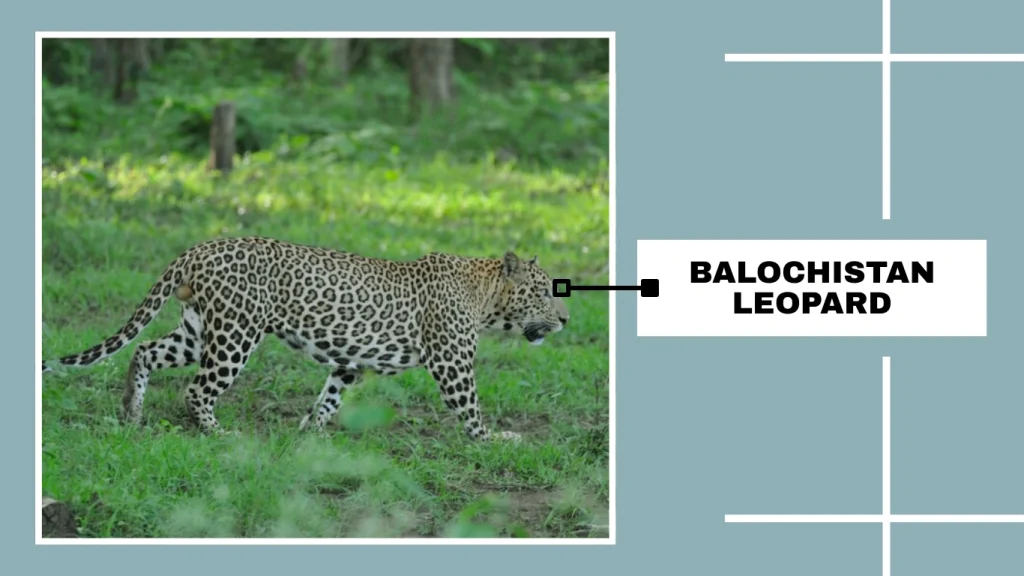
The Balochistan Leopard is a regional population of the Persian Leopard found in the arid and mountainous regions of southwestern Pakistan and southeastern Iran.
Identification
- Size: Large, similar to Persian Leopard
- Weight: 130–180 lbs
- Color: Pale golden coat with large, widely spaced rosettes
- Features: Thick fur adapted for cooler mountainous climates
Habitat and Range
Inhabits rugged mountainous and desert regions of Balochistan province and adjacent areas in Iran. Prefers rocky terrain and sparse vegetation.
Diet and Hunting Behavior
Feeds on ibex, urial sheep, small mammals, and birds. Hunts mostly at dawn and dusk, using ambush techniques.
Social Structure and Behavior
Solitary and elusive. Faces threats from habitat fragmentation, poaching, and human encroachment. Conservation efforts are limited but ongoing in some areas.
25. Thai Leopard (Panthera pardus delacouri population)

The Thai Leopard is part of the Indochinese Leopard population, native to Thailand and surrounding Southeast Asian countries.
Identification
- Size: Medium-sized, similar to Indochinese Leopard
- Weight: 90–140 lbs
- Color: Orange-yellow coat with dense black rosettes, sometimes melanistic
- Features: Adapted to tropical forest environments
Habitat and Range
Found in Thailand’s forests, including national parks like Khao Yai. Prefers dense tropical and subtropical forests.
Diet and Hunting Behavior
Feeds on deer, wild boar, monkeys, and smaller prey. Ambush predator relying on dense cover.
Social Structure and Behavior
Solitary and nocturnal. Populations have declined due to deforestation and poaching but benefit from protected areas and anti-poaching measures.