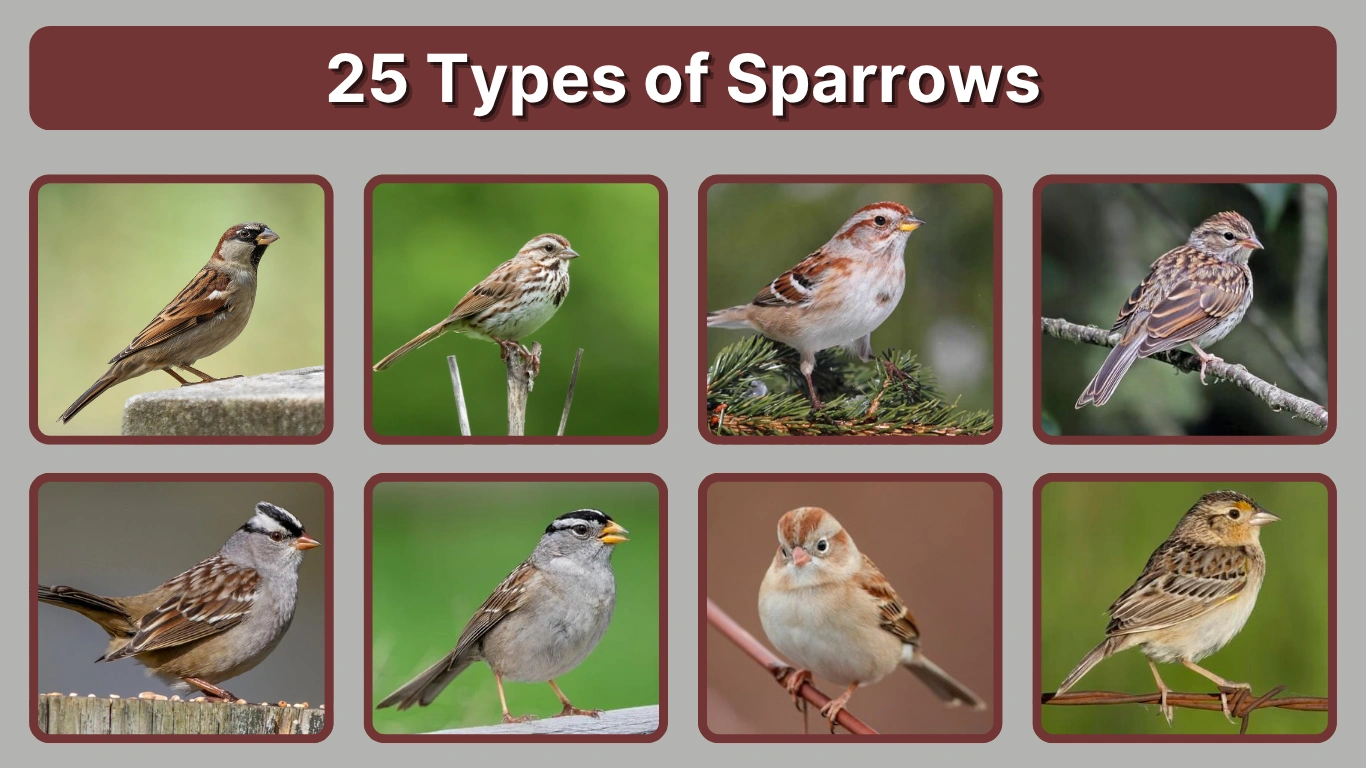
Sparrows are small, adaptable songbirds known for their cheerful chirps, earthy plumage, and wide distribution across the globe. From urban parks to remote tundras, these birds thrive in a vast range of habitats. While many sparrows appear similar at first glance, each species has its own distinct markings, behaviors, and nesting habits.
In this article, you’ll explore 25 unique types of sparrows—both common and lesser-known species—highlighted with detailed identification features, habitat preferences, behaviors, diets, and nesting habits. Whether you’re a backyard birdwatcher or a dedicated birder, this guide will help you recognize and appreciate the sparrow diversity around you.
1. House Sparrow

The House Sparrow (Passer domesticus) is a small, chunky bird that has adapted remarkably well to living alongside humans. Originally native to Europe and Asia, it has spread worldwide and is now commonly found in cities, towns, and farms across many continents. Its familiar presence and noisy chatter make it one of the most recognized sparrows.
Identification
- Length: 6–6.7 inches (15–17 cm)
- Male: Gray head, black throat bib, chestnut brown nape, white cheeks
- Female: Plain brown body with a streaked back, duller overall, no black bib
- Bill: Thick and conical; black in breeding males, yellowish in non-breeding
- Wings: Brown with black streaks and a pale wing bar
- Legs: Pinkish or pale brown
Habitat
House Sparrows live in close association with people, found around houses, buildings, farms, and urban parks. They rarely venture into forests or wildlands.
Behavior
Highly social and noisy, they often gather in flocks. They exhibit aggressive behavior around food sources and nesting spots, often displacing native birds.
Diet
Their diet mainly consists of seeds, grains, and crumbs. In spring and summer, they also consume insects and caterpillars to feed their young.
Nesting
They build messy nests in cavities—often in building crevices, vents, or under roof tiles. They reuse the same nesting sites for multiple broods throughout the breeding season.
2. Song Sparrow

The Song Sparrow (Melospiza melodia) is a widespread and highly variable species known for its rich, melodious song. Found across North America, it thrives in a variety of open and shrubby habitats and adapts well to both rural and suburban environments.
Identification
- Length: 5.5–7 inches (14–18 cm)
- Body: Brown upperparts with heavy streaking on white underparts
- Markings: Central dark spot on the chest, gray face with a brown eye stripe
- Bill: Short and stout, slightly rounded
- Tail: Long and rounded, often pumped while foraging
- Legs: Pinkish
Habitat
Song Sparrows inhabit marshes, forest edges, brushy fields, gardens, and roadside thickets. They prefer areas with dense, low vegetation for cover and nesting.
Behavior
They are solitary or in pairs, frequently seen hopping low through brush. Males perch prominently to sing territorial songs throughout spring and summer.
Diet
Their diet includes seeds, insects, and small fruits. During the breeding season, they shift to protein-rich insects for feeding their young.
Nesting
Nests are cup-shaped and built close to the ground in dense vegetation. Females typically build the nest and incubate the eggs.
3. American Tree Sparrow

The American Tree Sparrow (Spizelloides arborea) is a winter visitor across much of the United States, breeding in the far northern tundra. Despite the name, it often forages on the ground in open fields and weedy edges.
Identification
- Length: 5.5–6.3 inches (14–16 cm)
- Head: Rusty cap with a gray face
- Eye stripe: Rust-colored through the eye
- Breast: Pale with a distinct central dark spot
- Bill: Bicolored—black upper mandible and yellow lower
- Wings: Brown with two white wing bars
- Tail: Long and notched
Habitat
Found in open fields, grasslands, hedgerows, and marsh edges during winter. In summer, they nest in shrubby tundra habitats.
Behavior
They often forage in small flocks, scratching the ground for food. They’re tame around feeders and may mix with juncos and other sparrows.
Diet
Feeds on seeds, grasses, and insects. They visit feeders in winter and may eat millet and cracked corn.
Nesting
In their breeding range, they nest in low shrubs or on the ground. Nests are well hidden and insulated for cold climates.
4. Chipping Sparrow
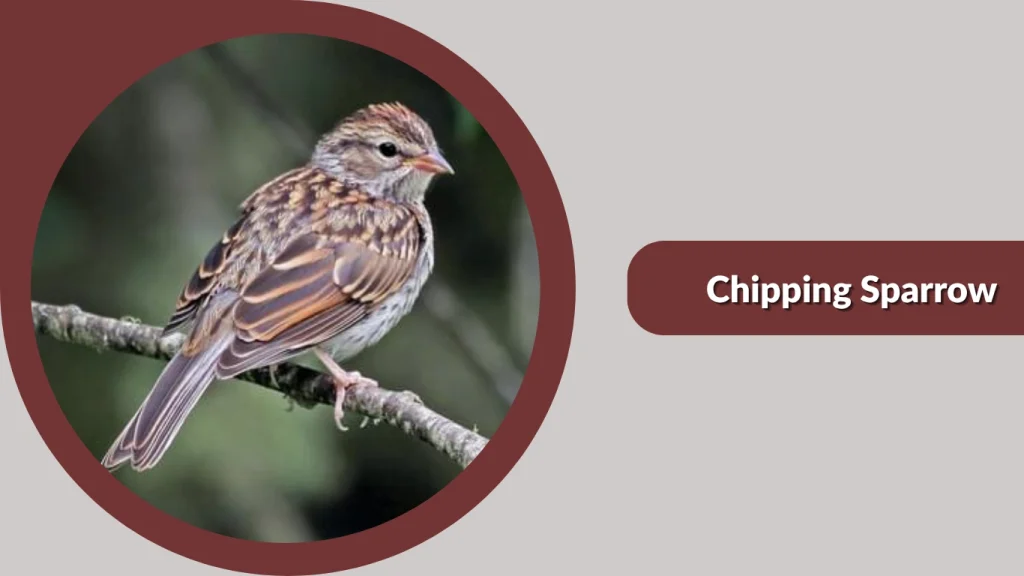
The Chipping Sparrow (Spizella passerina) is a slim, graceful sparrow known for its clean markings and distinctive trill-like song. It is a common sight in open woodlands, parks, and backyards across much of North America.
Identification
- Length: 4.7–6 inches (12–15 cm)
- Head: Rusty crown in breeding adults
- Face: Black eye line with a white eyebrow
- Underparts: Pale gray and unmarked
- Bill: Thin and pointed
- Wings: Light brown with faint streaking
- Tail: Moderately long and notched
Habitat
Chipping Sparrows prefer open woodland edges, grassy clearings, suburban lawns, and gardens with scattered trees.
Behavior
They are active and tame, often feeding on the ground or perched low in shrubs. Males sing persistently from treetops in spring.
Diet
Primarily eat seeds, especially grasses and weeds, along with insects like caterpillars and beetles during the nesting season.
Nesting
Nests are built in shrubs or low trees, made of grass and rootlets, often lined with animal hair. They may raise multiple broods per year.
5. White-throated Sparrow

The White-throated Sparrow (Zonotrichia albicollis) is a striking bird, easily recognized by its bold facial patterns and sweet, whistled song. It breeds in Canada and winters across the eastern and southern U.S.
Identification
- Length: 6.3–7.1 inches (16–18 cm)
- Throat: Bright white patch bordered with dark stripes
- Crown: Two color morphs—white-striped or tan-striped
- Bill: Short, conical, and grayish
- Face: Yellow lores between eye and bill
- Underparts: Grayish with streaked flanks
- Back: Brown and streaked
Habitat
Favors forest edges, shrubby clearings, and wooded suburban areas, especially in winter months.
Behavior
Often forages in leaf litter using a two-footed scratching technique. Social in winter, forming mixed-species flocks.
Diet
Eats seeds, berries, and insects. Will visit ground feeders for millet and sunflower seeds.
Nesting
Nests are built on or near the ground, hidden under brush or low vegetation. Both morphs can breed together.
6. White-crowned Sparrow

The White-crowned Sparrow (Zonotrichia leucophrys) is a large, elegant sparrow known for its bold black-and-white striped head. It breeds in northern and western North America and migrates widely during spring and fall.
Identification
- Length: 6.3–7.1 inches (16–18 cm)
- Head: Bold black and white stripes (no yellow)
- Bill: Pink or orange-yellow, depending on subspecies
- Back: Brown with darker streaks
- Underparts: Grayish overall with a slightly paler belly
- Tail: Long and notched
Habitat
Found in open scrublands, tundra, forest edges, and weedy fields. During migration and winter, it visits gardens and parks.
Behavior
Often forages in loose flocks, scratching at the ground for seeds. It is shy around humans but responds well to pishing.
Diet
Eats seeds, buds, berries, and insects. During breeding season, insects are more prominent in their diet.
Nesting
They nest on or near the ground in shrubs or grass clumps. Nests are built by the female and well-camouflaged in tundra or brush.
7. Fox Sparrow

The Fox Sparrow (Passerella iliaca) is one of the largest and most heavily marked sparrows in North America. Its reddish tones and strong markings make it easily identifiable during migration and winter.
Identification
- Length: 6.5–7.5 inches (16.5–19 cm)
- Color: Rusty-red plumage with heavy streaking on chest and flanks
- Face: Gray cheeks with a rufous crown and eye stripe
- Bill: Yellowish or horn-colored with a darker top
- Tail: Long and rounded, matching the reddish hue
- Legs: Pink
Habitat
Inhabits dense thickets, forest undergrowth, and brushy areas during migration and winter. Breeds in boreal forests and mountain regions.
Behavior
Solitary or in small groups, they forage by vigorously kicking leaf litter backward with both feet to uncover seeds and insects.
Diet
Primarily feeds on seeds and berries, with insects added in spring and summer. Enjoys foraging under feeders and along forest floors.
Nesting
Nests are built on or near the ground, usually hidden in dense vegetation. Made of twigs, moss, and leaves, lined with finer material.
8. Savannah Sparrow
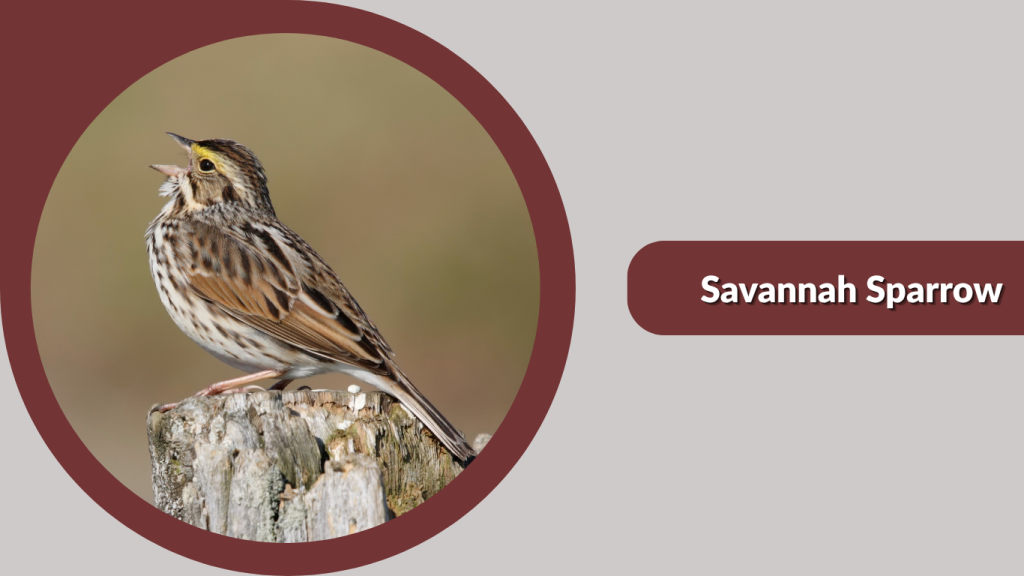
The Savannah Sparrow (Passerculus sandwichensis) is a small, streaky sparrow with subtle but distinctive markings. It inhabits a wide range of grassy and open habitats across North America, often overlooked due to its camouflaged plumage.
Identification
- Length: 4.5–6.7 inches (11.5–17 cm)
- Head: Brown with a pale eyebrow and a yellowish spot near the eye (lores)
- Body: Streaked brown and white throughout
- Breast: Central dark spot often present
- Tail: Short and notched
- Bill: Thin and slightly pointed
- Legs: Pinkish
Habitat
Found in grassy fields, meadows, coastal saltmarshes, and agricultural lands. It prefers wide-open spaces with low vegetation.
Behavior
Typically solitary or in small groups. Moves with short hops or low flights, often singing from low perches like fence posts or grass stalks.
Diet
Feeds on grass and weed seeds, as well as insects and small invertebrates during the breeding season. Will forage low in vegetation or on the ground.
Nesting
Nests are built on the ground, well-hidden in grass or under a clump. The female builds a grass cup nest and lays 3–5 eggs per clutch.
9. Lincoln’s Sparrow

The Lincoln’s Sparrow (Melospiza lincolnii) is a secretive and beautifully patterned sparrow, often found in dense cover during migration. Its shy behavior and delicate song make it a rewarding find for birders.
Identification
- Length: 5.1–5.9 inches (13–15 cm)
- Head: Gray with a fine brown crown stripe and buffy eye ring
- Breast: Buff-colored with fine black streaks
- Belly: Whitish
- Back: Streaked brown with rufous highlights
- Bill: Slender and grayish
- Legs: Pinkish
Habitat
Breeds in wet meadows and shrubby bogs; during migration, it prefers thickets, woodland edges, and brush piles.
Behavior
Very shy and elusive, often remaining hidden in dense vegetation. Flushes only at the last moment and rarely perches in the open.
Diet
Eats a mix of seeds and insects, especially during spring and summer. Forages low to the ground, flicking leaves and debris with its bill.
Nesting
Nests are placed on or near the ground in concealed grassy spots. The female weaves a tight cup of grass and moss, usually hidden beneath overhanging vegetation.
10. Vesper Sparrow
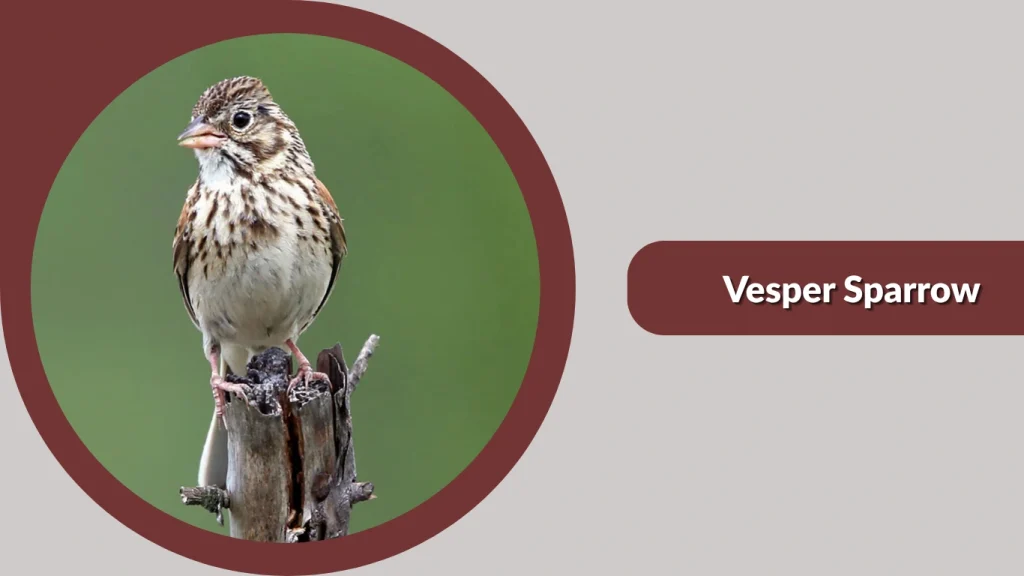
The Vesper Sparrow (Pooecetes gramineus) is a larger, streaky sparrow found in open grassy habitats across much of North America. It gets its name from its habit of singing in the evening hours—“vespers.”
Identification
- Length: 5.9–6.3 inches (15–16 cm)
- Head: Gray-brown with a white eye ring
- Body: Heavily streaked underparts and back
- Lesser coverts: Chestnut patch on the shoulders (often hidden)
- Tail: White outer tail feathers visible in flight
- Bill: Pale and sturdy
- Legs: Pink
Habitat
Prefers open country with scattered shrubs, such as prairies, pastures, hayfields, and sagebrush flats. Avoids densely wooded areas.
Behavior
Ground-dwelling and inconspicuous, it runs rather than flies when disturbed. Males sing from fence posts or low shrubs during spring and summer.
Diet
Feeds on seeds, grains, and insects. In breeding season, it consumes beetles, caterpillars, grasshoppers, and spiders.
Nesting
Builds nests in small depressions on the ground, often near a grass clump or stone. The female conceals the nest with grasses and lays 3–5 eggs per brood.
11. Field Sparrow

The Field Sparrow (Spizella pusilla) is a sweet-voiced sparrow of brushy fields and overgrown meadows. Known for its clear, accelerating trill, it is widespread in the eastern and central United States.
Identification
- Length: 4.7–5.9 inches (12–15 cm)
- Head: Plain gray face with a rufous crown
- Bill: Pink and small
- Eye ring: Thin and white
- Underparts: Clean and pale
- Back: Light brown with faint streaks
- Tail: Long and notched
Habitat
Found in abandoned fields, grassy pastures, shrubby clearings, and woodland edges with scattered saplings and bushes.
Behavior
Shy and quiet, often foraging low in vegetation or on the ground. Males perch on small trees or shrubs to deliver their musical song.
Diet
Eats grass and weed seeds, along with insects such as ants and beetles. In summer, it increases its intake of invertebrates to feed its chicks.
Nesting
Nests are built close to the ground in grasses or low shrubs. The cup-shaped nest is lined with fine materials and may hold multiple broods each year.
12. LeConte’s Sparrow

The LeConte’s Sparrow (Ammospiza leconteii) is a tiny, secretive grassland bird known for its colorful face and skulking behavior. It is rarely seen in the open, often hiding deep within dense grasses.
Identification
- Length: 4.7–5.1 inches (12–13 cm)
- Head: Orange-buff face with gray cheeks and fine black crown stripes
- Breast: Buff with fine streaking
- Back: Strong black and rufous streaks
- Nape: Gray with a purplish tinge
- Bill: Small and conical
- Tail: Short and pointed
Habitat
Breeds in wet meadows, sedge fields, and prairie potholes. During migration and winter, it hides in damp grassy areas and overgrown ditches.
Behavior
Very elusive, often running or freezing instead of flying. Rarely sings except during breeding season, when its insect-like buzzy song can be heard.
Diet
Eats small grass seeds and insects. During breeding, relies more on protein-rich arthropods like spiders and beetles.
Nesting
Nests are built near the ground or on grass tussocks, usually hidden in thick vegetation. The female constructs the nest and incubates alone.
13. Henslow’s Sparrow
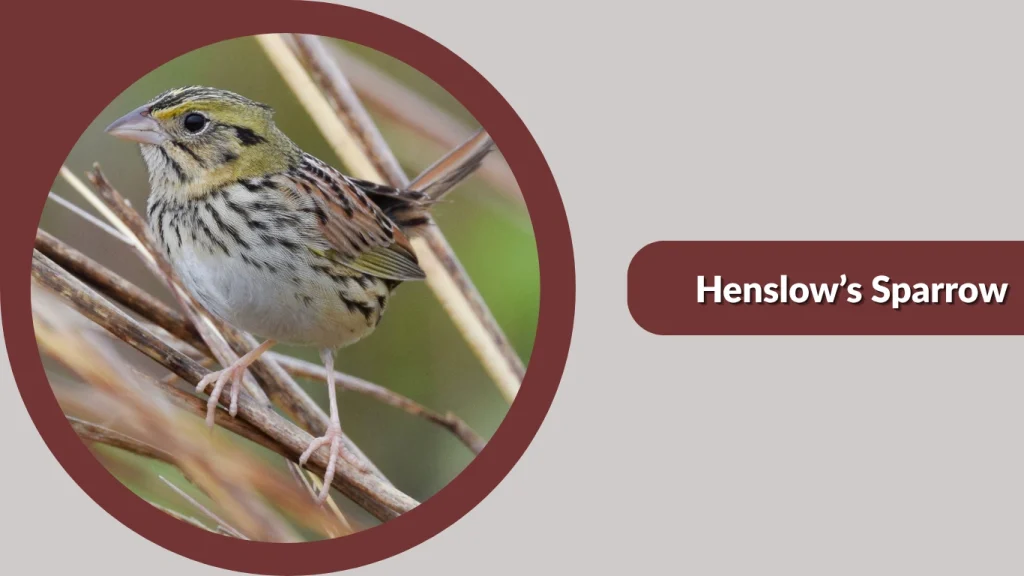
The Henslow’s Sparrow (Centronyx henslowii) is a grassland specialist with a distinctive flat-headed look and insect-like song. It has suffered habitat loss in many parts of its range due to agricultural expansion.
Identification
- Length: 4.3–5.1 inches (11–13 cm)
- Head: Olive-green with black crown stripes and a flat, wide profile
- Breast: Light with faint streaks
- Back: Richly streaked with black, chestnut, and olive tones
- Tail: Short and slightly rounded
- Bill: Pale and thick
- Legs: Pink
Habitat
Prefers undisturbed tallgrass prairies, meadows, and grassy wetlands. Avoids short or grazed fields.
Behavior
Extremely shy and often remains hidden in dense grass. Males sing a quiet “tsi-lick” from perches during the breeding season.
Diet
Feeds mostly on insects and spiders during summer; consumes seeds and grass grains in other seasons.
Nesting
Ground nests are well concealed at the base of dense grass clumps. The female builds the nest and incubates 3–5 eggs per clutch.
14. Grasshopper Sparrow

The Grasshopper Sparrow (Ammodramus savannarum) is named for its insect-like song that resembles a grasshopper’s buzz. This small, short-tailed sparrow is difficult to spot, as it spends much of its time hidden in grasslands.
Identification
- Length: 4.3–4.5 inches (11–11.5 cm)
- Head: Flat-crowned with an orange-buff face and a pale central crown stripe
- Nape: Grayish with fine streaking
- Breast: Pale with little to no streaking
- Back: Rich brown with black streaks
- Tail: Short and notched
- Bill: Pale and conical
- Legs: Pink
Habitat
Occupies dry prairies, hayfields, and overgrown pastures with sparse, short grass and scattered forbs or shrubs.
Behavior
Typically walks or runs rather than flies, staying low to avoid detection. Males perch on grass stems or fences to sing a faint, insect-like buzz during breeding season.
Diet
Eats mostly grass and weed seeds, supplemented with grasshoppers, crickets, caterpillars, and beetles during summer months.
Nesting
Builds well-hidden, domed nests on the ground with an overhead grass canopy. Nest placement and concealment are critical to avoiding predation.
15. Nelson’s Sparrow

The Nelson’s Sparrow (Ammospiza nelsoni) is a secretive bird of coastal marshes and wet prairies, known for its soft, hissing song and bright, orange face. It is especially elusive outside the breeding season.
Identification
- Length: 4.7–5.1 inches (12–13 cm)
- Head: Rich orange face with a gray crown and fine dark streaks
- Breast: Orange with blurry dark streaking
- Back: Heavily streaked brown and black
- Nape: Grayish with olive tones
- Tail: Short and rounded
- Bill: Slender and pale
- Legs: Pinkish
Habitat
Breeds in tidal saltmarshes and freshwater sedge meadows. Winters in coastal marshes along the southeastern United States.
Behavior
Stays low in dense marsh vegetation, moving stealthily rather than flying. Males sing a soft, whispery “hiss-click” from exposed perches in breeding areas.
Diet
Feeds on small seeds and aquatic insects, including midges, flies, and tiny crustaceans. Forages close to the waterline or mud.
Nesting
Builds cup-shaped nests close to the ground, often in thick marsh grass. Nests are built above the high tide line to avoid flooding and are anchored to vertical grass stems.
16. Seaside Sparrow
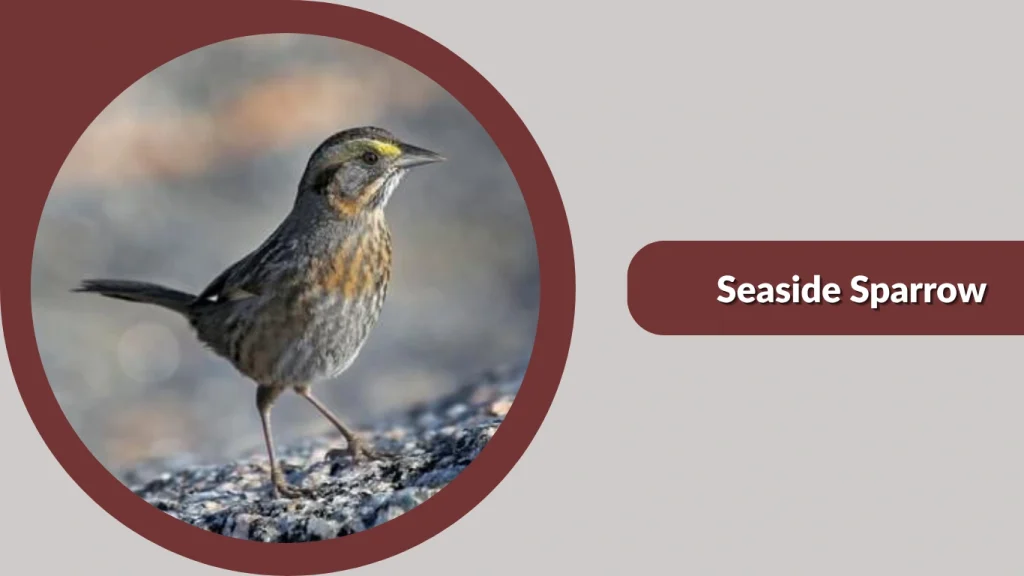
The Seaside Sparrow (Ammospiza maritima) is a saltmarsh specialist with a subdued grayish appearance and a sharp call. It lives exclusively in coastal habitats and is vulnerable to habitat loss and sea level rise.
Identification
- Length: 5.0–5.9 inches (13–15 cm)
- Head: Gray with a faint white eyebrow and dark mustache stripe
- Body: Uniform grayish-olive with fine streaks on the chest
- Back: Olive-gray with faint streaking
- Bill: Stout and dark
- Tail: Short and rounded, edged in gray
- Legs: Dark pink or brownish
Habitat
Lives year-round in tidal saltmarshes along the Atlantic and Gulf Coasts. Prefers dense cordgrass, needlerush, and black mangrove areas near brackish water.
Behavior
Stays low in thick marsh grass, sometimes singing from elevated stalks or flying in short bursts. Avoids open spaces and is mostly active near dawn and dusk.
Diet
Feeds on insects, spiders, snails, small crustaceans, and seeds. Forages in mud and vegetation near water, often at low tide.
Nesting
Builds nests low in grass, just above the high tide line. The cup-shaped nests are supported by vegetation and hidden from predators and flooding.
17. Baird’s Sparrow

The Baird’s Sparrow (Centronyx bairdii) is a delicate and uncommon sparrow that breeds in native tallgrass prairies of the northern Great Plains. Its soft, tinkling song is heard mostly in summer breeding areas.
Identification
- Length: 5.0–5.5 inches (13–14 cm)
- Head: Pale yellow face with bold crown stripes
- Breast: Buff with fine, dark streaking
- Back: Richly streaked with brown, black, and pale tones
- Nape: Grayish with buffy wash
- Tail: Medium length and notched
- Bill: Short and pale
- Legs: Flesh-colored
Habitat
Breeds in unbroken prairie, especially tall or mixed-grass grasslands with moderate cover. Winters in desert grasslands of northern Mexico and the southwestern U.S.
Behavior
Very shy and difficult to flush. Walks or runs through grasses and rarely perches visibly except to sing. Males sing from tall grass or low perches.
Diet
Consumes a mix of grass and forb seeds, along with insects such as grasshoppers, caterpillars, and beetles during the breeding season.
Nesting
Ground nests are well-concealed under thick vegetation. The female constructs the cup-shaped nest of dry grasses and incubates the eggs alone. Nests are typically located in undisturbed prairie away from human activity.
18. Clay-colored Sparrow
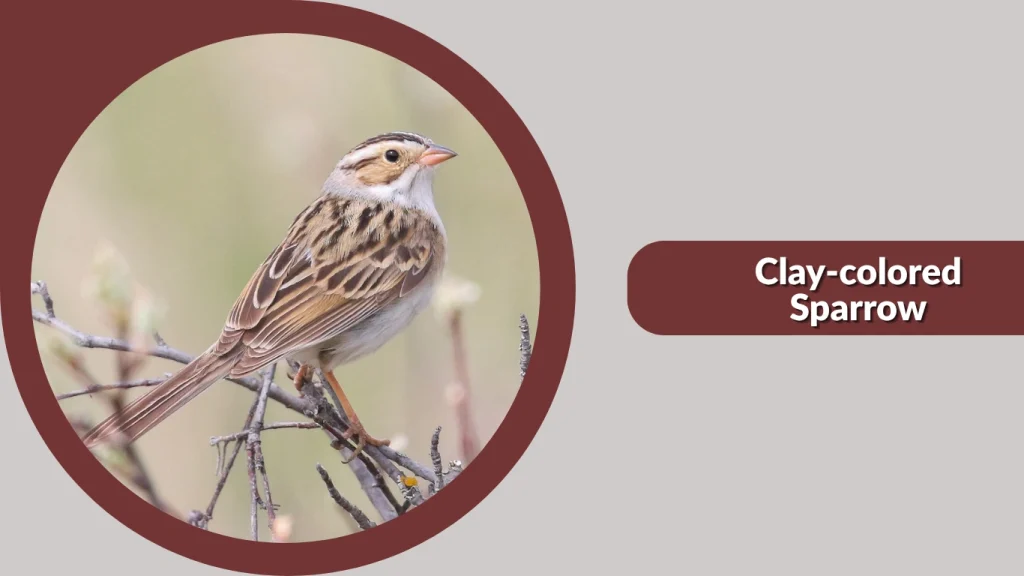
The Clay-colored Sparrow (Spizella pallida) is a small, pale sparrow that breeds in shrubby prairies and young regenerating woodlands of central North America. It is best identified by its crisp facial markings and dry, buzzy song.
Identification
- Length: 5.1–6 inches (13–15 cm)
- Head: Pale gray face with a black eye line and brown crown stripes
- Nape: Gray and slightly streaked
- Breast: Pale and unmarked
- Back: Light brown with fine streaking
- Bill: Small, sharp, and pinkish
- Tail: Long and notched
- Legs: Pink
Habitat
Found in shrubby grasslands, pastures with scattered bushes, and recently logged forest areas. Prefers open environments with nearby low cover.
Behavior
Often perches on bushes or wire fences to sing its harsh, insect-like “tssst-tssst-tssst.” Moves with short hops or quick flights between shrubs.
Diet
Feeds primarily on seeds and grains outside of breeding season. In summer, adds insects like beetles, caterpillars, and ants to its diet.
Nesting
Builds cup-shaped nests low in shrubs or occasionally in grass. The female constructs the nest using dry grasses and lines it with fine material. She lays 3–5 eggs per clutch.
19. Lark Sparrow

The Lark Sparrow (Chondestes grammacus) is a strikingly patterned sparrow, larger than most of its relatives, with bold facial markings and a melodic, varied song. It favors open country with scattered trees or fence lines.
Identification
- Length: 5.9–6.7 inches (15–17 cm)
- Head: Distinct chestnut crown and cheek patches, white central stripe, and black whisker marks
- Tail: Long with white corners, often fanned during displays
- Breast: White with a dark central spot
- Back: Brown and streaked
- Bill: Short and conical
- Legs: Pink
Habitat
Prefers dry grasslands, open savannas, agricultural fields, and areas with scattered trees or hedgerows.
Behavior
Often seen foraging on the ground or perched on fences and wires. Males sing from high perches and perform a hopping courtship display with spread tail and fluttering wings.
Diet
Eats seeds, grains, and insects. During breeding season, focuses on grasshoppers, caterpillars, and beetles.
Nesting
Nests are built on the ground, often beneath a clump of grass or low shrub. The nest cup is made of grasses, weed stems, and animal hair. Lark Sparrows sometimes reuse old nests.
20. Brewer’s Sparrow
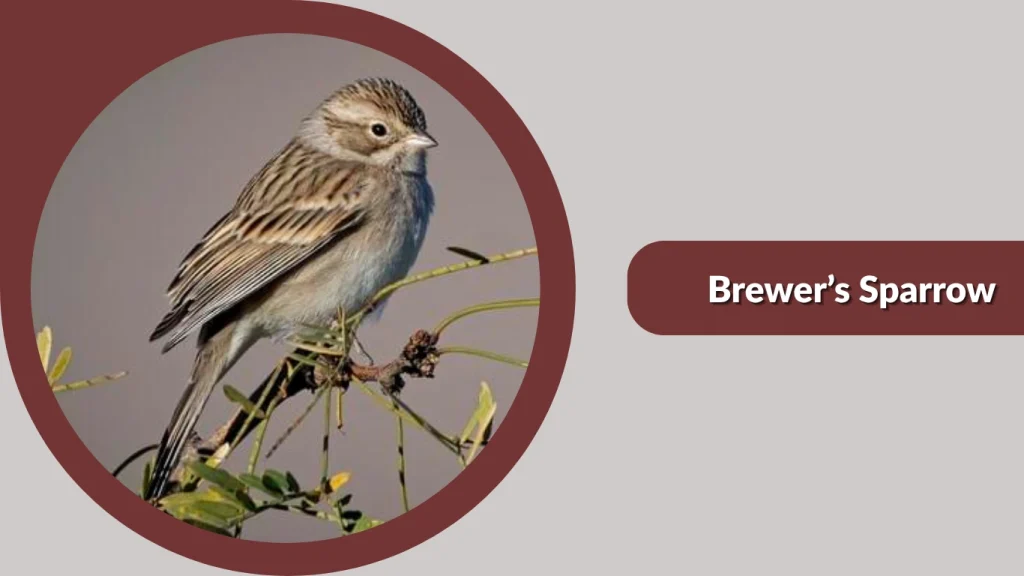
The Brewer’s Sparrow (Spizella breweri) is a small, plain-looking sparrow found in arid western North America. Though visually subtle, it is known for its long, musical trill and preference for sagebrush habitat.
Identification
- Length: 5.1–5.9 inches (13–15 cm)
- Head: Gray with fine streaking and a pale eye ring
- Back: Light brown with fine black streaks
- Breast: Pale gray with no streaking
- Bill: Slim, grayish-pink
- Tail: Medium length, slightly notched
- Legs: Pink
Habitat
Breeds in dry sagebrush flats, shrubsteppe, and open desert scrublands. In winter, found in similar habitats in southwestern U.S. and Mexico.
Behavior
Skulks low in vegetation; males sing from exposed sagebrush tops. Very discreet when not singing. May join small mixed flocks in winter.
Diet
Feeds on seeds and insects. Insects dominate during the breeding season, including ants, beetles, and grasshoppers.
Nesting
Builds small cup-shaped nests in sagebrush or low shrubs. Nests are constructed of grasses and fine twigs, lined with softer materials. Female incubates 3–4 eggs per clutch.
21. Golden-crowned Sparrow

The Golden-crowned Sparrow (Zonotrichia atricapilla) is a large, striking sparrow seen mostly in the western U.S. during migration and winter. It is easily identified by its bold yellow crown and plaintive song.
Identification
- Length: 7.1 inches (18 cm)
- Head: Bright yellow central crown with black borders (in adults)
- Face: Grayish with a faint brown eye stripe
- Back: Streaked brown
- Breast: Plain gray with no streaking
- Bill: Dark and stout
- Legs: Pinkish
Habitat
Breeds in alpine scrub and tundra in Alaska and western Canada. Winters in chaparral, coastal thickets, parks, and gardens along the Pacific coast.
Behavior
Moves in loose flocks, often with White-crowned Sparrows. Ground forager, scratching with both feet. Shy but vocal—mournful three-note whistles are common in winter.
Diet
Eats seeds, berries, and insects. Commonly visits bird feeders offering millet and cracked corn during winter.
Nesting
Nests are on or near the ground, often under shrubs. The female builds a grass cup lined with moss and feathers. She lays 3–5 eggs and cares for the young alone.
22. Black-throated Sparrow

The Black-throated Sparrow (Amphispiza bilineata) is a small, desert-dwelling sparrow known for its crisp black-and-white facial pattern and melodic song. It is one of the most striking sparrows in North America.
Identification
- Length: 4.7–5.5 inches (12–14 cm)
- Head: Gray with white supercilium and black throat patch
- Underparts: White with black on the upper chest
- Back: Plain grayish-brown
- Tail: Long with white edges
- Bill: Short, thick, and dark
- Legs: Pinkish or gray
Habitat
Inhabits arid scrublands, desert washes, and rocky hillsides in the southwestern U.S. and northern Mexico.
Behavior
Often perches atop low shrubs or cacti to sing. Hops on the ground while foraging. Usually solitary or in small loose groups.
Diet
Feeds on seeds, especially of desert grasses and shrubs. Insects become a major food source during the breeding season.
Nesting
Nests are built low in desert shrubs or cacti, often in shaded areas. The female weaves a neat cup from grasses and plant fibers.
23. Olive Sparrow

The Olive Sparrow (Arremonops rufivirgatus) is a shy, tropical sparrow found along the southernmost edges of Texas and northeastern Mexico. It is the only sparrow in the U.S. with overall olive coloration.
Identification
- Length: 5.5–6.3 inches (14–16 cm)
- Head: Olive-gray with a rusty crown stripe and subtle facial markings
- Underparts: Grayish and unmarked
- Back: Olive-brown
- Wings and tail: Olive
- Bill: Thick and dark
- Legs: Pink
Habitat
Favors dense thickets, forest undergrowth, and brushy edges, especially near water sources in subtropical regions.
Behavior
Secretive and quiet. Forages low in the brush or on the ground. Rarely seen out in the open and sings a clear, descending trill from hidden perches.
Diet
Eats seeds, berries, and insects. Forages in leaf litter and among ground vegetation.
Nesting
Builds large, domed nests hidden in thick vegetation. Nest is made from grass and lined with soft materials like feathers and plant down.
24. Canyon Towhee

The Canyon Towhee (Melozone fusca) is a large, earthy-colored sparrow-like bird native to the arid canyons and deserts of the southwestern United States and Mexico. Though not a true sparrow, it is often grouped with them due to similar habits.
Identification
- Length: 7.9–9.1 inches (20–23 cm)
- Head: Plain brown with a rusty cap
- Body: Uniform brown with a slightly paler belly
- Underparts: Dusky buff with a rusty patch under the tail
- Tail: Long and rounded
- Bill: Thick and dark
- Legs: Pinkish
Habitat
Found in deserts, canyon slopes, scrublands, and arid foothills with scattered trees or shrubs.
Behavior
Often seen foraging on the ground, kicking up leaf litter. They move with deliberate hops and show little fear of humans in some areas.
Diet
Feeds on seeds, berries, and insects. Gleans food from the ground and under bushes, especially near human settlements.
Nesting
Nests are built in low trees, shrubs, or cacti. The female constructs a bulky cup of twigs, grasses, and rootlets and lays 2–4 eggs.
25. Harris’s Sparrow

The Harris’s Sparrow (Zonotrichia querula) is the largest North American sparrow, notable for its black bib and pink bill. It breeds in the Canadian tundra and winters across the central U.S.
Identification
- Length: 7.5–7.9 inches (19–20 cm)
- Head: Gray with black crown and face
- Throat: Bold black bib that extends down the chest
- Bill: Pink and conical
- Back: Brown with black streaks
- Underparts: Pale gray with faint flank streaking
- Tail: Medium length and notched
- Legs: Pink
Habitat
Breeds in open spruce-tamarack forest and scrubby tundra. Winters in brushy fields, woodland edges, and shelterbelts in the central U.S.
Behavior
Forages on the ground, scratching for seeds and insects. Moves in loose flocks, often seen with White-throated or White-crowned Sparrows in winter.
Diet
Eats weed seeds, grass grains, and invertebrates. In winter, visits feeders offering millet and cracked corn.
Nesting
Nests are built on the ground, often under low shrubs or tundra vegetation. The female lines the cup with fine grasses and feathers, laying 3–5 eggs.