


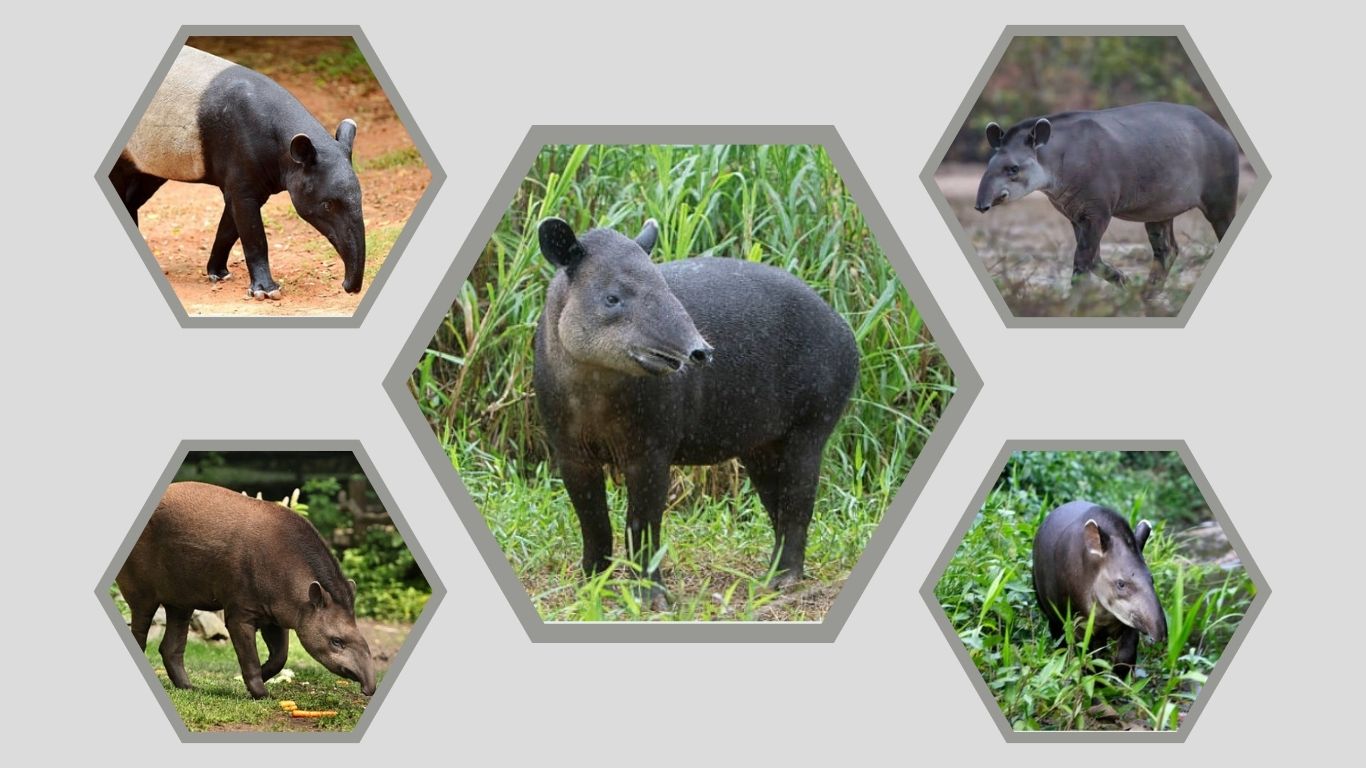
Tapirs are large, herbivorous mammals known for their thick bodies, short legs, and flexible, trunk-like snouts. Often described as living relics, they have existed in similar forms for millions of years. Found in the rainforests, swamps, and mountain regions of Central America, South America, and Southeast Asia, tapirs play an important ecological role as seed dispersers. In this guide, you’ll explore five main types of tapir animals, highlighting their unique features, habitats, and behaviors.
1. Baird’s Tapir (Tapirus bairdii)
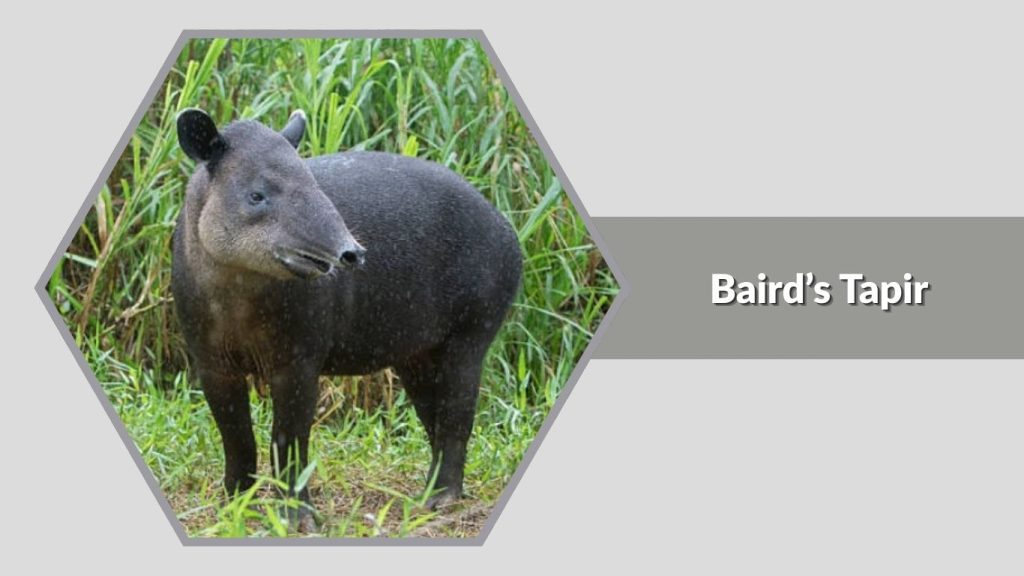
Baird’s tapir is the largest native land mammal of Central America and one of the most distinctive rainforest animals in the region. Recognized by its dark brown body and pale, flexible snout, this shy herbivore plays a crucial ecological role as a “forest gardener,” spreading seeds across wide areas. It is mainly active at night and spends much of its life near rivers, swamps, and dense tropical forests.
Identification
- Large, heavy-bodied mammal with a rounded back and barrel-shaped torso
- Short, thick legs ending in splayed toes adapted for muddy ground
- Flexible, trunk-like snout used for grasping leaves and fruit
- Dark brown to black coat with pale cream markings on the face and throat
- Small, rounded ears with light-colored edges
Habitat & Distribution
Baird’s tapir is found from southern Mexico through Central America into northwestern Colombia. It prefers humid tropical rainforests, cloud forests, mangroves, and seasonally flooded lowlands. These animals stay close to water sources such as rivers, streams, and swamps, which they use for drinking, cooling off, and escaping predators. Dense vegetation is essential for cover, as tapirs rely on camouflage and quiet movement rather than speed. Deforestation and agricultural expansion have greatly reduced their natural range, forcing many populations into isolated forest patches.
Diet & Feeding Behavior
This species is strictly herbivorous, feeding on a wide variety of leaves, young shoots, fruits, bark, and aquatic plants. Using its muscular snout, the tapir grasps vegetation and pulls it into its mouth with surprising precision. Baird’s tapirs often browse at night, quietly moving along well-worn forest paths. They are particularly important seed dispersers; many large rainforest trees depend on tapirs to carry and deposit seeds far from the parent plant. Their feeding habits help maintain forest diversity and support long-term ecosystem regeneration.
Behavior & Reproduction
Baird’s tapirs are mostly solitary, except for mothers with calves. They communicate through whistles and high-pitched calls, especially in dense forest where visibility is low. These animals are excellent swimmers and will often rest in water during hot daylight hours. After a gestation period of about 13 months, the female gives birth to a single calf. The newborn has a striking pattern of white spots and stripes that provide camouflage. Calves remain with their mother for up to a year, learning feeding routes and safe water sources before becoming independent.
2. Malayan Tapir (Tapirus indicus)
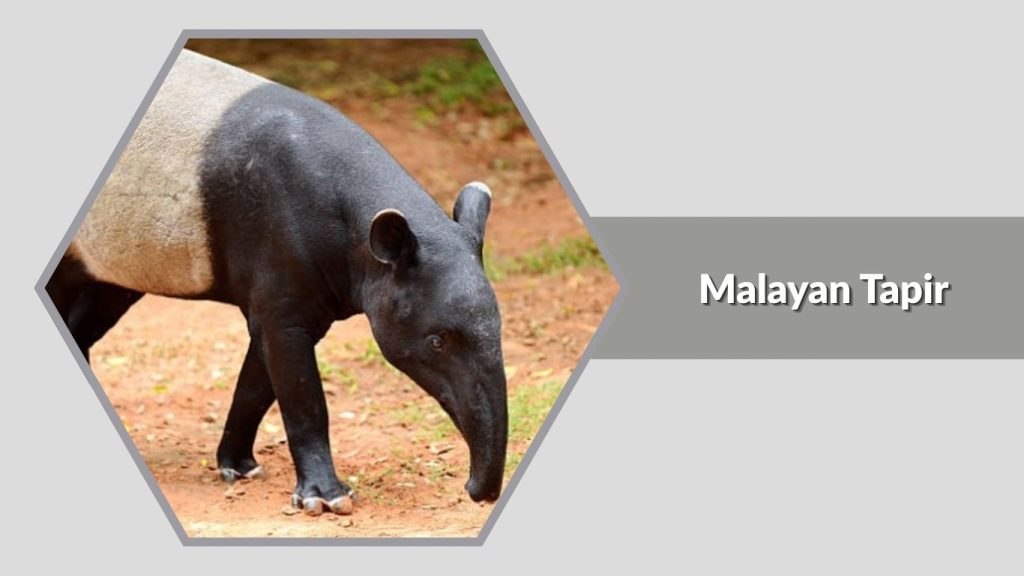
The Malayan tapir is the most visually distinctive of all tapir species, instantly recognized by its bold black-and-white body pattern. Often called the “black-and-white tapir,” this large, secretive mammal inhabits the dense rainforests of Southeast Asia. Despite its bulky appearance, it is a quiet, agile forest dweller that relies heavily on water and thick vegetation for protection and survival.
Identification
- Large, stocky body with a unique black front and rear and a white midsection
- Short, powerful legs with splayed toes for walking on soft forest ground
- Long, flexible snout used to pull leaves, shoots, and fruit
- Rounded ears with pale edges and small, dark eyes
- Smooth, hair-short coat adapted to humid tropical climates
Habitat & Distribution
The Malayan tapir is native to southern Thailand, Malaysia, and the island of Sumatra in Indonesia. It lives primarily in lowland rainforests, peat swamps, and hill forests, usually near rivers or marshy areas. Dense plant cover is essential, providing both food and protection from predators. During the daytime, Malayan tapirs often rest in thick undergrowth or muddy wallows, becoming more active after dusk. Habitat loss from logging, oil-palm plantations, and road development has severely fragmented their populations, making conservation protection increasingly important.
Diet & Feeding Behavior
Malayan tapirs are browsing herbivores that feed on leaves, tender shoots, fallen fruits, buds, and aquatic plants. Their prehensile snout acts like a short trunk, allowing them to reach vegetation and strip leaves efficiently. They follow regular feeding trails through the forest and may travel several kilometers in a single night. By consuming fruit and later passing intact seeds, Malayan tapirs help disperse many rainforest plant species, supporting forest regeneration and long-term biodiversity.
Behavior & Reproduction
These tapirs are solitary and mainly nocturnal, using their keen sense of smell and hearing to navigate in the dark. When threatened, they often flee into water, where they can swim and even walk along river bottoms. Females usually give birth to one calf after a gestation of about 13 months. The calf is born with white spots and stripes that break up its outline in forest light. Young tapirs stay with their mother for several months, gradually transitioning from milk to solid plant foods.
3. Mountain Tapir (Tapirus pinchaque)
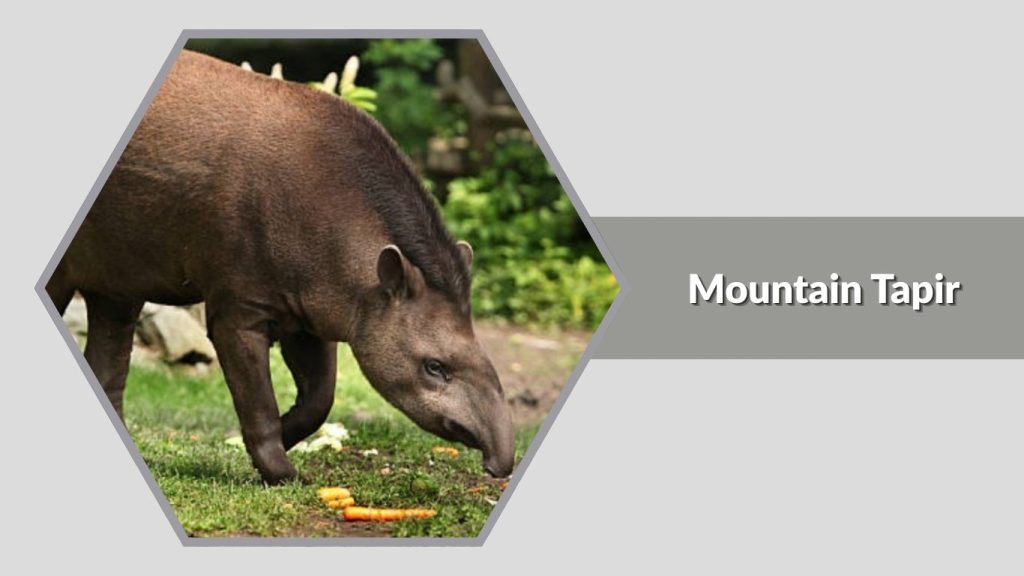
The mountain tapir is the smallest and most cold-adapted of all tapir species, specially evolved for life in the misty highlands of the Andes. Covered in thick, woolly fur, it is sometimes called the “woolly tapir.” This rare animal is a vital seed disperser in cloud forests and páramo ecosystems, where few other large mammals can survive.
Identification
- Medium-sized, compact body with thick, woolly dark-brown to black fur
- Short, sturdy legs suited for steep, muddy mountain terrain
- Flexible, short snout used to grasp leaves and shoots
- Rounded ears with light-colored edges
- Often shows pale markings around the lips and lower face
Habitat & Distribution
Mountain tapirs are found in the Andes of Colombia, Ecuador, and northern Peru, usually at elevations between 2,000 and 4,300 meters. They inhabit cloud forests, montane forests, and high-altitude páramo grasslands. These environments are cool, wet, and often covered in mist. The species depends heavily on thick vegetation and nearby water sources for feeding and shelter. Agricultural expansion, road building, and livestock grazing have significantly reduced and fragmented their habitat, placing the mountain tapir among the most endangered large mammals in South America.
Diet & Feeding Behavior
This tapir feeds on a wide range of highland plants, including leaves, buds, twigs, bark, and fallen fruit. It also consumes ferns and páramo shrubs that few other large herbivores can digest. Using its muscular snout, the mountain tapir pulls vegetation into its mouth and selectively browses along forest edges and open clearings. Through its feeding and long-distance movements, it spreads seeds across mountain slopes, helping maintain plant diversity and supporting regeneration in fragile high-altitude ecosystems.
Behavior & Reproduction
Mountain tapirs are solitary and mainly active at dusk and during the night. They follow established trails through dense vegetation and are strong swimmers, frequently entering cold mountain streams. Females give birth to a single calf after a gestation of about 13 months. The calf is born with white stripes and spots that provide camouflage among dappled light and vegetation. The young remain with their mother for up to a year, gradually learning feeding routes and safe resting sites.
4. Lowland Tapir (Tapirus terrestris)
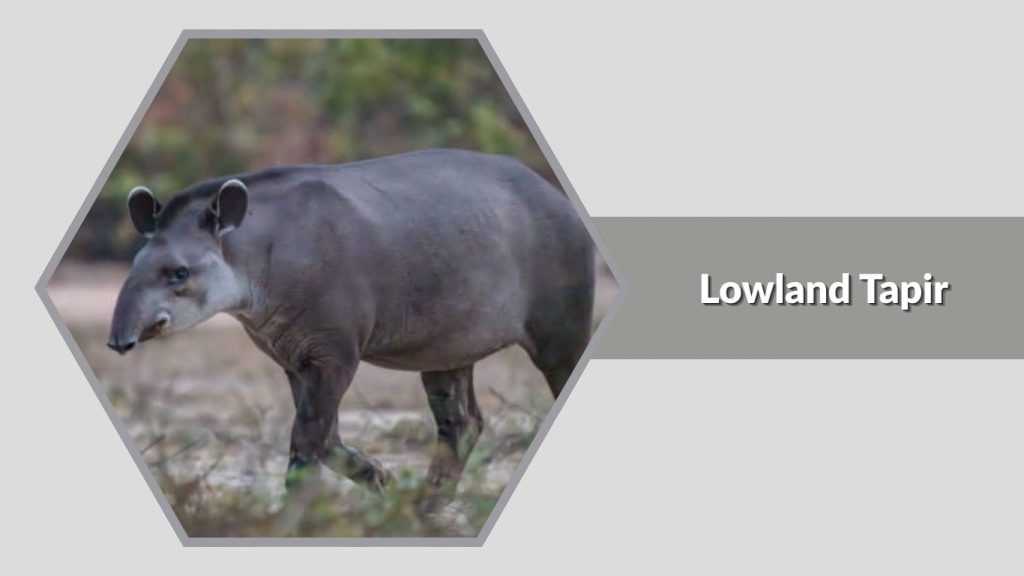
The lowland tapir, also known as the Brazilian tapir or South American tapir, is the largest native land mammal in South America. It is widely distributed and plays a major ecological role in rainforest and wetland ecosystems. With its powerful body and gentle nature, this species is often described as a “landscape gardener” because of its importance in shaping plant communities.
Identification
- Very large, heavy-bodied mammal with a rounded back and thick neck
- Short, strong legs with broad, splayed toes for soft ground
- Long, flexible snout used to grasp leaves, fruit, and branches
- Dark brown to grayish coat with lighter markings on the face
- Small eyes and rounded ears with pale edges
Habitat & Distribution
Lowland tapirs range across much of northern and central South America, including Brazil, Peru, Bolivia, Colombia, Venezuela, and the Guianas. They inhabit Amazon rainforests, seasonally flooded forests, swamps, grasslands, and river edges. Access to water is essential, as they frequently bathe, swim, and rest in muddy pools to regulate body temperature and avoid insects. Although they still have a wide range, deforestation, hunting, and road development are causing serious population declines.
Diet & Feeding Behavior
This species feeds on hundreds of plant types, including leaves, shoots, fruits, bark, and aquatic vegetation. The lowland tapir’s prehensile snout allows it to pull down branches and select nutritious plant parts. It often travels long distances each night along forest trails in search of food. By consuming large fruits and dispersing seeds over wide territories, the lowland tapir supports forest regeneration and helps maintain the structure of tropical ecosystems.
Behavior & Reproduction
Lowland tapirs are solitary, shy, and mostly nocturnal, becoming active in the evening and early morning. They are excellent swimmers and may escape predators by diving into rivers. Females usually give birth to a single calf after about 13 months of pregnancy. The calf is born with white stripes and spots that provide camouflage. Young tapirs stay with their mother for up to a year before becoming independent.
5. Kabomani Tapir (Tapirus kabomani)
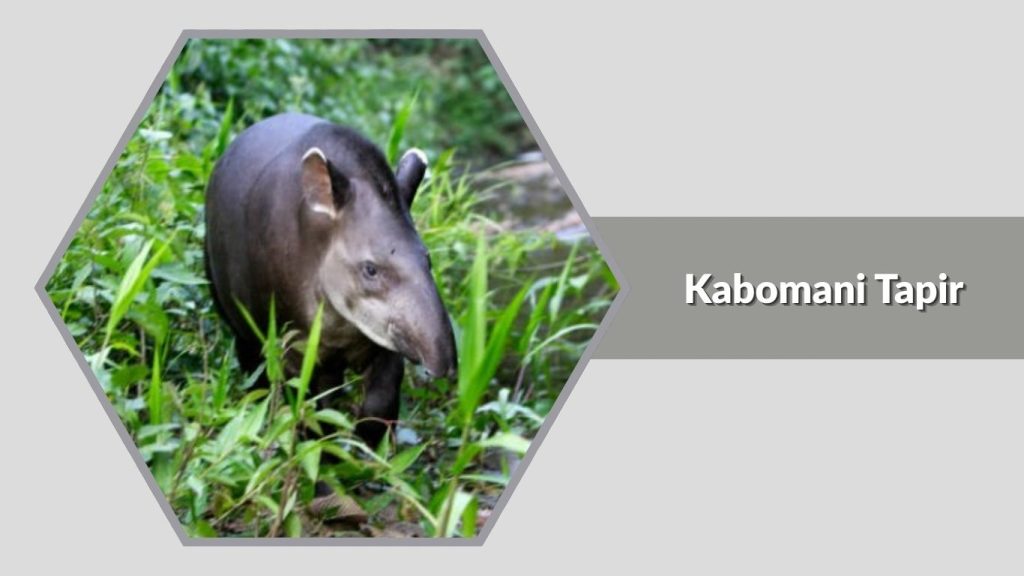
The Kabomani tapir is the smallest and most recently described tapir species, formally recognized by scientists in 2013. Native to the southern Amazon Basin, this little-known animal differs from other tapirs in its size, skull shape, and darker coloration. Because it lives in remote regions and is rarely seen, much of its behavior and ecology is still being studied.
Identification
- Smaller and more compact than other tapir species
- Dark gray to nearly black coat, often smoother and shorter
- Slender legs and a lighter overall build
- Short, flexible snout adapted for selective browsing
- Distinct skull and dental features separating it from lowland tapirs
Habitat & Distribution
Kabomani tapirs are found in parts of southern Amazonia, particularly in regions of Brazil, Colombia, and possibly neighboring areas. They are associated with forest–savanna mosaics, seasonally flooded forests, and transitional habitats between dense rainforest and open landscapes. These environments provide a mix of shrubs, fruiting plants, and water sources. Because their known range is limited and fragmented, habitat destruction from deforestation, cattle ranching, and road construction may pose serious long-term threats to their survival.
Diet & Feeding Behavior
Like all tapirs, the Kabomani tapir is herbivorous. It feeds on leaves, young shoots, fruits, and soft stems, selecting a wide variety of plant species. Its flexible snout allows it to grasp vegetation with precision, even in dense undergrowth. By moving through different habitat zones while feeding, it likely contributes to seed dispersal across forest edges and open areas. This behavior may be especially important in transitional ecosystems, where plant regeneration depends heavily on large roaming herbivores.
Behavior & Reproduction
Very little is known about the daily behavior of the Kabomani tapir. It is believed to be mostly solitary and crepuscular or nocturnal, avoiding human activity and extreme daytime heat. Like other tapirs, it probably uses forest trails and stays close to water, where it can swim and hide from threats. Females are thought to give birth to a single calf after a long gestation of around 13 months. The calf likely has the typical spotted-and-striped pattern seen in other young tapirs, providing camouflage during its early months of life.
FAQs
What is a tapir?
A tapir is a large, plant-eating mammal with a thick body, short legs, and a flexible, trunk-like snout. Tapirs belong to the order Perissodactyla, making them relatives of horses and rhinoceroses. They live in forests and wetlands and are known for their shy, solitary nature.
How many types of tapirs are there in the world?
There are five recognized types of tapirs in the world: Baird’s tapir, Malayan tapir, mountain tapir, lowland tapir, and Kabomani tapir. Four species live in Central and South America, while only one species is found in Southeast Asia.
Where do tapirs usually live?
Tapirs mainly live in tropical and subtropical forests, swamps, and grasslands near rivers and lakes. Depending on the species, they can be found in Central America, South America, and Southeast Asia. Mountain tapirs are unique because they live in cool, high-altitude cloud forests.
What do tapirs eat in the wild?
Tapirs are herbivores that feed on leaves, shoots, fruits, buds, bark, and aquatic plants. Using their flexible snouts, they pull vegetation into their mouths. By eating fruit and spreading seeds through their droppings, tapirs help maintain healthy forest ecosystems.
Are tapirs endangered?
Most tapir species are threatened or endangered due to habitat loss, deforestation, and hunting. As forests are cleared for agriculture and roads, tapirs lose food sources and safe shelter. Conservation programs focus on habitat protection, wildlife corridors, and reducing human-tapir conflicts.