

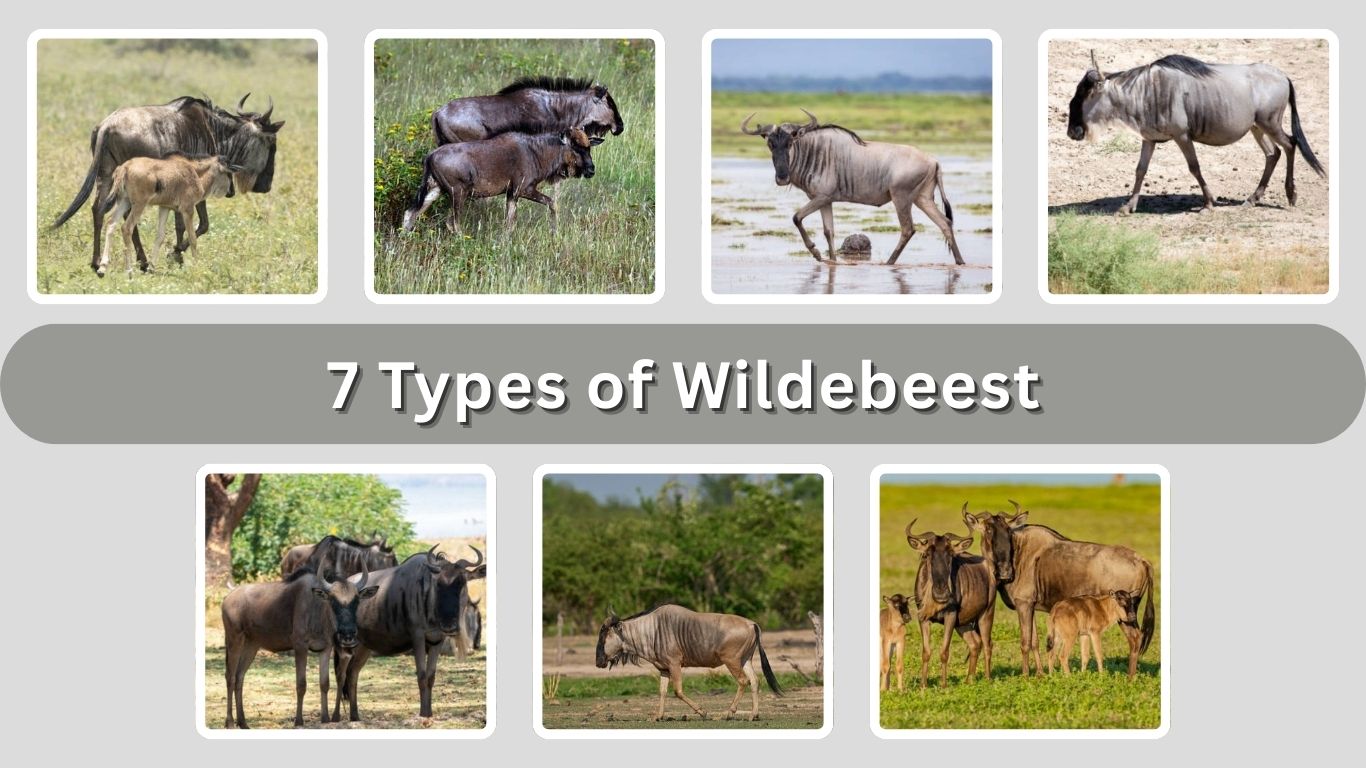
Wildebeests, also known as gnus, are large African antelopes best known for their massive herds and dramatic seasonal migrations. They roam open plains and savannas, shaping grassland ecosystems while serving as a vital food source for many predators. Although often spoken of as a single animal, wildebeests include several distinct species and regional forms with differences in color, beard patterns, and range. Exploring the different types of wildebeest reveals how these powerful grazers adapt to Africa’s diverse landscapes.
1. Blue Wildebeest (Connochaetes taurinus)
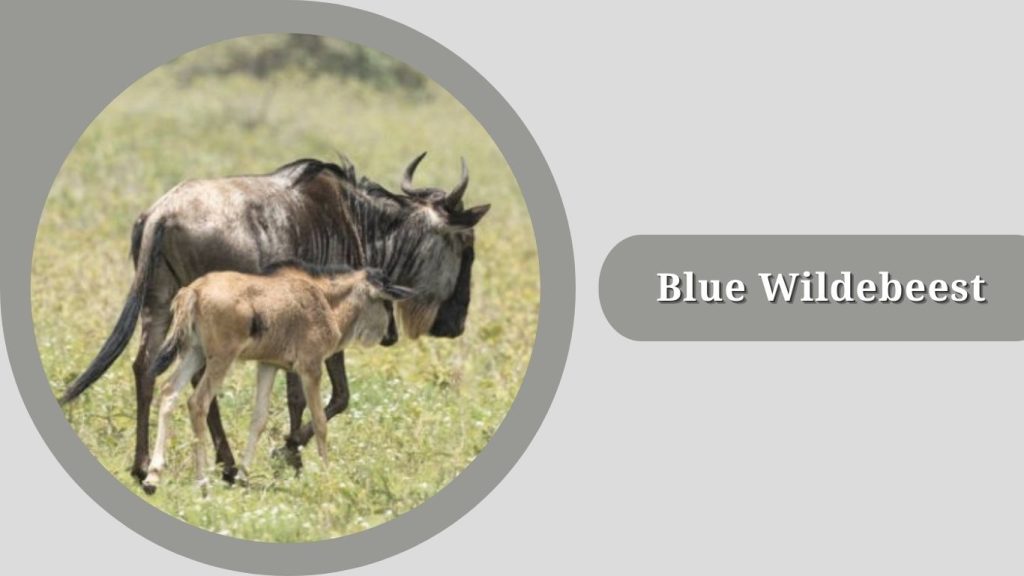
The blue wildebeest, also known as the brindled gnu, is the most widespread and well-known wildebeest species in Africa. It dominates the great savanna herds and plays a major role in famous wildlife migrations, especially across the Serengeti and Maasai Mara ecosystems. Its powerful build, curved horns, and social nature make it one of the most iconic grazing mammals on the continent.
Identification
- Large antelope with a robust, ox-like body
- Slate-gray to bluish coat with dark vertical stripes on the shoulders
- Broad head with a black mane and beard
- Both males and females have curved, outward-sweeping horns
- Long black tail with a horse-like tuft
Habitat
Blue wildebeests are primarily found in open grasslands, savannas, and lightly wooded plains of eastern and southern Africa. They prefer wide, open spaces where grass is abundant and visibility is high, allowing them to detect predators such as lions, hyenas, and crocodiles during river crossings.
Diet
They are strict grazers that feed mainly on short, fresh grasses. Blue wildebeests rely heavily on seasonal rains, following the growth of new grass across large distances. Their dependence on water and pasture drives their massive annual migrations, often covering hundreds of kilometers.
Behavior
Blue wildebeests are highly social and live in large herds that may number in the thousands. They communicate using grunts, snorts, and visual signals. During the breeding season, males establish territories, while females and calves move in fluid groups, forming the backbone of the great migratory herds.
2. Black Wildebeest (Connochaetes gnou)

The black wildebeest, also called the white-tailed gnu, is a distinctive and more compact wildebeest species native to southern Africa. Unlike its blue relative, it has a darker coat, a striking white tail, and a more upright, horse-like posture. Once nearly extinct, it is now successfully conserved in protected areas and private reserves.
Identification
- Dark brown to black coat with a glossy appearance
- Long, flowing white tail that contrasts sharply with the body
- Forward-curving horns that hook downward and then upward
- Shaggy mane and beard on the chest and throat
- More slender body and higher shoulder stance than the blue wildebeest
Habitat
Black wildebeests mainly inhabit open grasslands and lightly wooded plains of South Africa, Namibia, and Lesotho. They prefer flat or gently rolling terrain with short grasses, which supports both grazing and their alert, upright stance used to watch for predators.
Diet
Their diet consists almost entirely of grasses, especially short, green shoots. Black wildebeests graze during the cooler parts of the day and stay close to water sources. Seasonal changes in rainfall strongly influence their movement and grazing patterns.
Behavior
They form small herds, often made up of females and young, while mature males defend territories. Black wildebeests are known for their energetic galloping, tail-switching displays, and sudden, playful bursts of running that strengthen herd bonds and deter predators.
3. Eastern White-bearded Wildebeest (Connochaetes taurinus albojubatus)

The eastern white-bearded wildebeest is a regional form of the blue wildebeest, famous for taking part in the massive Serengeti–Mara migration. It is named for the pale, shaggy beard that hangs from its throat, giving the animal a heavier-faced appearance. These wildebeests are among the most numerous large mammals on the African plains.
Identification
- Gray to bluish-gray body with faint dark shoulder stripes
- Thick, pale or white beard on the throat and chin
- Curved horns sweeping outward and slightly upward
- Dark mane running along the neck and shoulders
- Strong, muscular shoulders built for long-distance travel
Habitat
This wildebeest is mainly found in northern Tanzania and southern Kenya, especially in the Serengeti, Ngorongoro, and Maasai Mara ecosystems. It favors open plains and lightly wooded savannas where vast grasslands allow for large herd formation and long seasonal movements.
Diet
Eastern white-bearded wildebeests feed almost entirely on grasses, selecting tender, newly grown shoots whenever possible. They track rainfall patterns closely, moving across the plains to take advantage of fresh grazing and reliable water sources.
Behavior
They are highly migratory and extremely social, forming herds that can reach hundreds of thousands of individuals. Their synchronized calving season overwhelms predators, while constant movement helps maintain grassland ecosystems and supports many other grazing species.
4. Western White-bearded Wildebeest (Connochaetes taurinus mearnsi)

The western white-bearded wildebeest is another regional form of the blue wildebeest and is best known for its role in the Maasai Mara portion of the great migration. It is slightly stockier than eastern populations and has a darker beard and heavier horn structure. Each year, vast herds cross crocodile-filled rivers, making this subspecies one of Africa’s most photographed large mammals.
Identification
- Gray-brown to bluish coat with darker shoulder striping
- Thick, dark beard and mane on the throat and chest
- Broad, heavy horns curving outward and upward
- Muscular neck and shoulders
- Long black tail with a flowing tuft
Habitat
Western white-bearded wildebeests mainly inhabit southwestern Kenya and parts of northern Tanzania. They prefer open savannas, floodplains, and rolling grasslands that provide both grazing and clear sightlines for detecting predators.
Diet
Their diet consists primarily of grasses, especially short, nutrient-rich species that grow after seasonal rains. They graze in tightly packed herds and move frequently to prevent overgrazing, closely following the availability of fresh pasture and surface water.
Behavior
These wildebeests are famous for dramatic river crossings and constant herd movement. They live in huge migratory groups, communicate with loud grunts, and rely on collective vigilance to reduce the risk of predation from lions, crocodiles, and hyenas.
5. Nyassa Wildebeest (Connochaetes taurinus johnstoni)
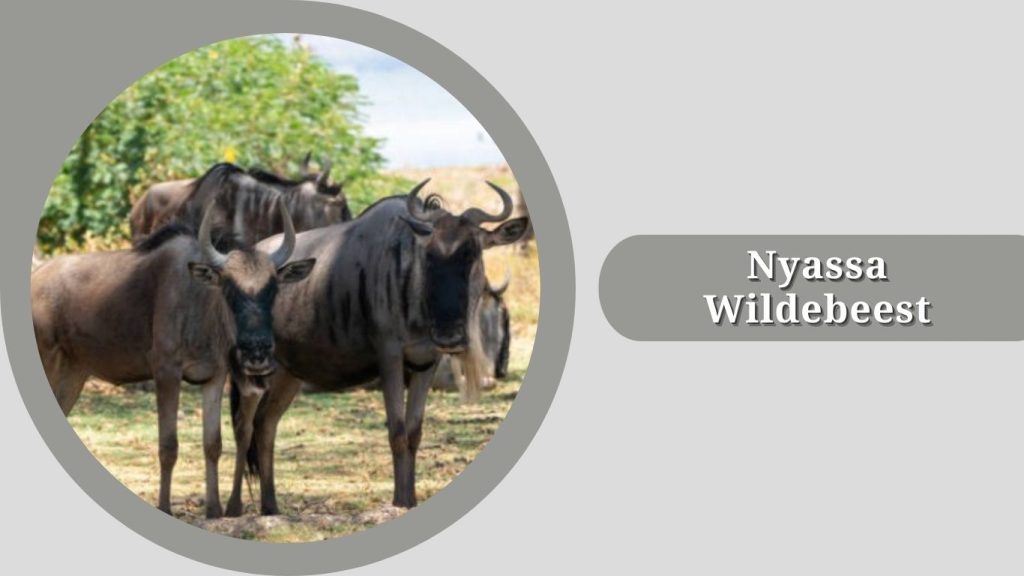
The Nyassa wildebeest, also called Johnston’s wildebeest, is a southeastern African form of the blue wildebeest. It is less famous than Serengeti populations but plays an important ecological role in the grasslands and floodplains around Lake Malawi. Its build and behavior closely resemble the common blue wildebeest, with subtle regional differences in coat tone and body proportions.
Identification
- Gray to gray-brown coat with faint vertical striping
- Dark mane and modest throat beard
- Curved horns sweeping outward from the head
- Stocky, muscular body with sloping back
- Long black tail with a coarse tuft
Habitat
Nyassa wildebeests are mainly found in Malawi, northern Mozambique, and parts of eastern Zambia. They inhabit open grasslands, seasonal floodplains, and lightly wooded savannas, often staying close to water and areas of reliable grass growth.
Diet
They are grazing specialists, feeding mostly on short grasses. Seasonal rainfall strongly influences their movement, and local migrations occur as herds track newly sprouted pasture around lakeshores and river basins.
Behavior
These wildebeests form moderate to large herds and show strong seasonal movement patterns. Males establish temporary territories during the breeding season, while females and calves remain in mobile groups that shift continuously in search of fresh grazing.
6. Cookson’s Wildebeest (Connochaetes taurinus cooksoni)
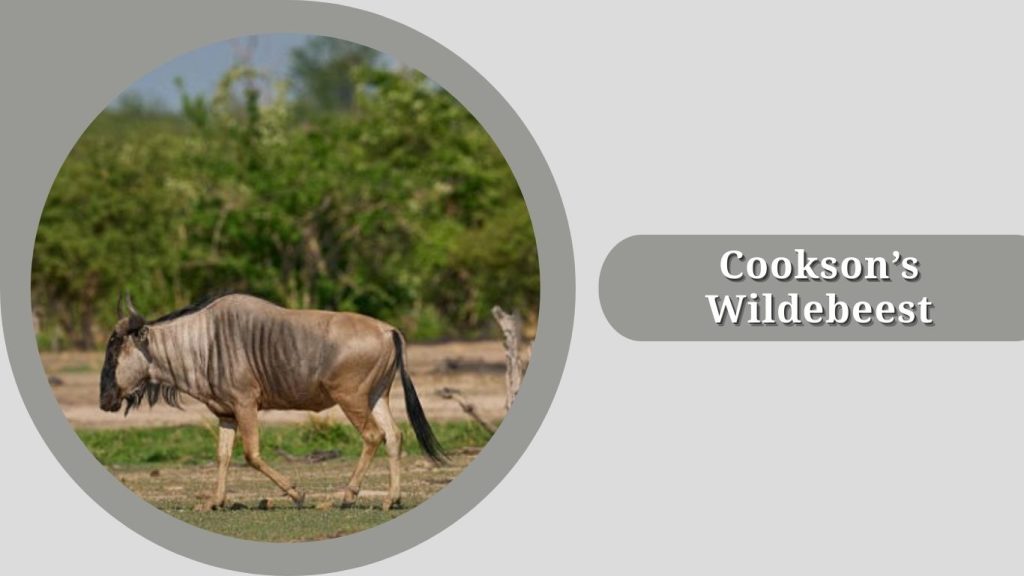
Cookson’s wildebeest is a localized southern form of the blue wildebeest, mainly associated with the Luangwa Valley ecosystem. It closely resembles other blue wildebeests but is often noted for its slightly lighter build and regional coat variations. Although not as widely discussed as Serengeti herds, it is an important grazer in its native range.
Identification
- Grayish to bluish coat with subtle shoulder striping
- Dark mane and short, bristly throat beard
- Curved horns spreading outward from the skull
- Strong shoulders with a gently sloping back
- Long, black tail ending in a coarse tuft
Habitat
Cookson’s wildebeests are primarily found in eastern Zambia, especially in and around the Luangwa Valley. They inhabit open plains, grassy floodplains, and lightly wooded savannas where seasonal grass growth supports year-round grazing.
Diet
Their diet is dominated by grasses, particularly short, fresh shoots that appear after rains. They often graze early in the morning and late in the afternoon, resting during the hottest part of the day.
Behavior
They live in herds that range from small family groups to larger seasonal aggregations. Movement patterns are strongly influenced by rainfall, and herds shift between higher ground and floodplains as water levels and grass availability change.
7. Serengeti Wildebeest (Connochaetes taurinus)
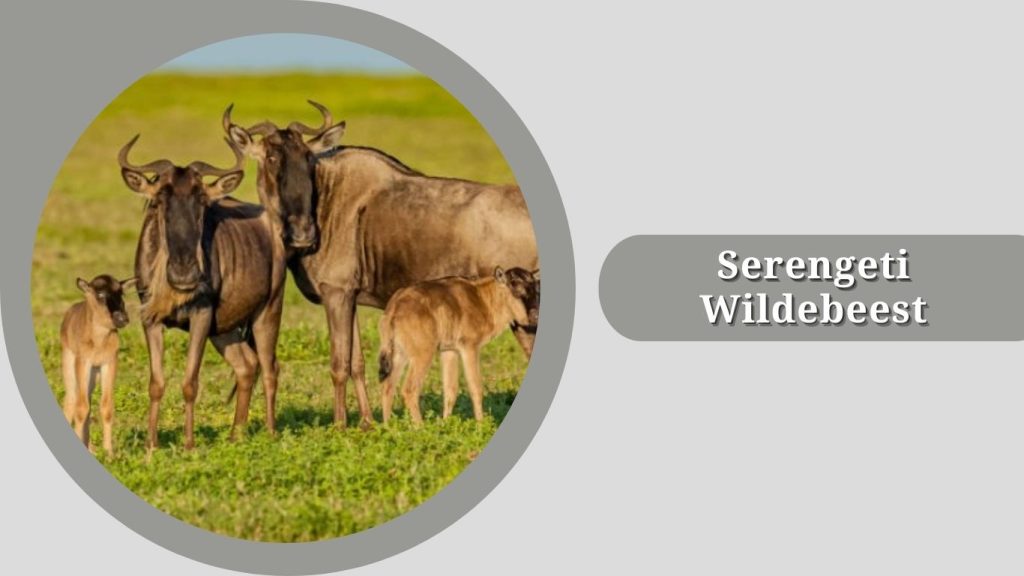
The Serengeti wildebeest refers to the massive migratory population of blue wildebeest that dominates the Serengeti ecosystem of Tanzania and Kenya. These animals form the largest remaining land mammal migration on Earth. Their constant movement shapes grassland ecosystems and supports a wide range of predators and scavengers.
Identification
- Gray to bluish-gray coat with dark vertical shoulder stripes
- Broad head with a black mane and noticeable beard
- Both sexes have thick, curved horns spreading outward
- Heavy, muscular shoulders with a sloping back
- Long black tail with a flowing tuft
Habitat
Serengeti wildebeests inhabit open plains, short-grass savannas, and seasonal floodplains of northern Tanzania and southwestern Kenya. Their range shifts throughout the year as they follow rainfall patterns and the growth of new grasses.
Diet
They are specialized grazers that feed almost entirely on grasses. Tender, newly grown grass is preferred, and their migration closely follows areas of recent rainfall that produce nutrient-rich forage.
Behavior
These wildebeests are intensely social and migratory, traveling in enormous herds that can number over a million individuals. Their synchronized calving season, constant movement, and dramatic river crossings define one of the most remarkable wildlife phenomena on the planet.
FAQs
What is the main difference between blue and black wildebeest?
The main difference lies in body color, horn shape, and range. Blue wildebeests are grayish with dark stripes and are widespread across eastern and southern Africa, while black wildebeests are darker, have a distinctive white tail, and are mostly limited to southern Africa.
How fast can a wildebeest run?
Wildebeests can run at speeds of up to about 50 miles per hour (80 km/h) over short distances. This impressive speed helps them escape predators such as lions, cheetahs, and hyenas, especially during open-plain chases and river crossing events.
Why do wildebeests migrate in huge herds?
They migrate to follow seasonal rains that trigger new grass growth. Moving in massive herds ensures access to fresh grazing, reduces individual predation risk, and synchronizes calving, which overwhelms predators with more young than they can capture.
What do wildebeests eat besides grass?
Wildebeests are almost entirely grazers and depend mainly on grasses. However, they may occasionally nibble on herbs or very low shrubs when grass is scarce, but these make up only a tiny part of their natural diet.
How long do wildebeests live in the wild?
In the wild, wildebeests typically live around 15 to 20 years. Lifespan depends on predation pressure, food availability, and environmental conditions, with calves facing the highest risk during their first year of life.