

Lacewings are delicate, net-winged insects belonging to the order Neuroptera, known for their important role in natural pest control. While the term “lacewing” often brings to mind the familiar green lacewing, the group includes a wide variety of species and relatives, many of which exhibit unique adaptations, behaviors, and habitats.
From garden-friendly predators like green and brown lacewings to strange-looking hunters like mantid lacewings and thread-winged species, these insects are diverse and fascinating. In this article, we’ll explore 10 common types of lacewings and their close relatives, describing how to identify them, where they live, and how they behave—starting with the well-known green lacewing.
1. Green Lacewings

Green lacewings are delicate, beneficial insects known for their bright green bodies and transparent, veined wings. They are among the most effective natural predators in the garden, especially valued for their voracious appetite for aphids during their larval stage.
Identification
- Color: Light green body
- Wings: Large, transparent, with fine network of veins
- Eyes: Golden or copper-colored
- Size: Adults typically 1–1.5 cm long
- Larvae: Brownish, elongated, with curved mandibles
Habitat and Distribution
Green lacewings are commonly found in gardens, meadows, agricultural fields, and forest edges. They are widespread across North America, Europe, and many temperate regions worldwide. They prefer habitats with flowering plants that provide nectar and pollen.
Behavior and Diet
Adult green lacewings primarily feed on nectar, pollen, and honeydew. However, their larvae—often called “aphid lions”—are aggressive predators. The larvae feed on a variety of soft-bodied insects like aphids, thrips, whiteflies, and small caterpillars, making them a gardener’s ally for biological pest control.
2. Brown Lacewings

Brown lacewings are closely related to green lacewings but are usually smaller and less vibrant. These insects also play a vital role in controlling pest populations, especially in cooler climates and forested areas.
Identification
- Color: Light to dark brown body
- Wings: Narrow, brownish, finely veined
- Eyes: Dark-colored
- Size: About 6–10 mm long
- Larvae: Similar in shape to green lacewing larvae but often smaller
Habitat and Distribution
Brown lacewings are frequently found in wooded areas, shrubs, and undergrowth. They are more tolerant of cold temperatures and can be found in both temperate and subtropical regions.
Behavior and Diet
Larvae are highly predatory, feeding on aphids, scale insects, mites, and other small arthropods. Adult brown lacewings may also consume small insects but often rely on nectar and pollen.
3. Mantid Lacewings

Mantid lacewings are unique insects that resemble a cross between a praying mantis and a lacewing. Their raptorial front legs and hunting behavior make them fascinating predators in the insect world.
Identification
- Color: Greenish or brown body with mottled markings
- Wings: Transparent, often patterned with brown or green spots
- Legs: Front legs adapted for grasping prey (like a mantis)
- Size: 1–2.5 cm long
- Head: Triangular, with large compound eyes
Habitat and Distribution
They are typically found in warm, dry environments such as grasslands, scrub areas, and forests. Some species are native to the Americas, Africa, and parts of Asia.
Behavior and Diet
Both larvae and adults are predators. Adults use their raptorial legs to catch small insects like flies, moths, or aphids. Larvae may act as parasites, especially targeting spider egg sacs or bee nests, depending on the species.
4. Dustywings

Dustywings are tiny lacewing relatives that resemble miniature moths. Despite their small size, they are part of the same Neuropteran order and are often seen near vegetation, especially in shady or damp environments.
Identification
- Color: Pale brown or grayish with dusty appearance
- Wings: Small, opaque, covered in fine powdery scales
- Size: Usually 1.5–3 mm long
- Antennae: Long and thread-like
- Body Shape: Slender and fragile-looking
Habitat and Distribution
Dustywings are commonly found in humid forests, under leaves, and near mossy or shaded areas. They are widespread in both temperate and tropical regions, often going unnoticed due to their size.
Behavior and Diet
The larvae are predators, feeding on tiny soft-bodied insects such as scale insects and mites. Adults are short-lived and mostly active at night. Their delicate form and nocturnal habits make them less studied compared to other lacewings.
5. Spongeflies

Spongeflies, also known as spongillaflies, are specialized lacewing relatives whose larvae live in freshwater habitats and feed on freshwater sponges.
Identification
- Color: Brownish or grayish
- Wings: Transparent, held roof-like over body when at rest
- Size: Adults typically 6–9 mm long
- Larvae: Aquatic, soft-bodied, with long sucking mouthparts
- Legs: Long and slender
Habitat and Distribution
Adults are usually found near water bodies such as ponds, streams, and lakes. Their larvae dwell in freshwater habitats, especially in sponges and sometimes aquatic bryozoans. They are distributed across North America, Europe, and Asia.
Behavior and Diet
Larvae are aquatic and feed by piercing and sucking the cells of freshwater sponges. Adults are short-lived and mostly feed on nectar or may not feed at all. Their unique life cycle makes them one of the few aquatic Neuropterans.
6. Antlions

Antlions are best known for their larval stage, during which they dig cone-shaped pits in sandy soil to trap ants and other small insects. As adults, they resemble dragonflies but are weak fliers.
Identification
- Color: Brown to gray body with mottled wings
- Wings: Long, narrow, transparent with dark spots
- Size: Adults 2–4 cm in length
- Larvae: Robust, with large sickle-shaped jaws
- Antennae: Short and clubbed
Habitat and Distribution
Antlions are common in dry, sandy areas where larvae can dig pits. Adults may rest on tree trunks or walls during the day and are active at night. They are found worldwide in arid and semi-arid regions.
Behavior and Diet
Larvae are ambush predators, hiding at the bottom of their pits and seizing insects that fall in. Adults usually feed on nectar or may not eat at all. Their larval hunting method is one of the most unique in the insect world.
7. Owlflies
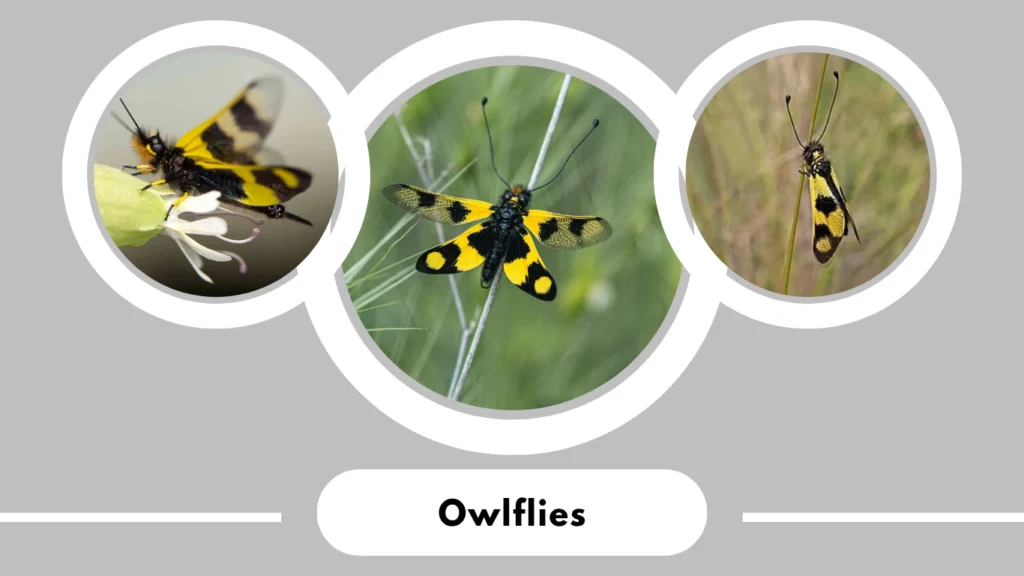
Owlflies are striking Neuropterans with large eyes and clubbed antennae. They resemble a mix between dragonflies and butterflies and are active flyers, usually during dusk and night.
Identification
- Color: Brown or yellow with various patterns
- Wings: Long, transparent, and net-veined
- Eyes: Very large, bulging like those of an owl
- Antennae: Long with noticeable clubs at the ends
- Size: Adults 3–5 cm long
Habitat and Distribution
Owlflies prefer warm, open habitats such as grasslands, scrublands, and forest edges. They are found across Africa, Asia, Europe, and the Americas, particularly in warmer climates.
Behavior and Diet
Both larvae and adults are predators. Larvae hide in leaf litter and pounce on insects, while adults actively hunt flying insects. Their large eyes and excellent vision help them locate prey in low light.
8. Thread-winged Lacewings (Nemopteridae)
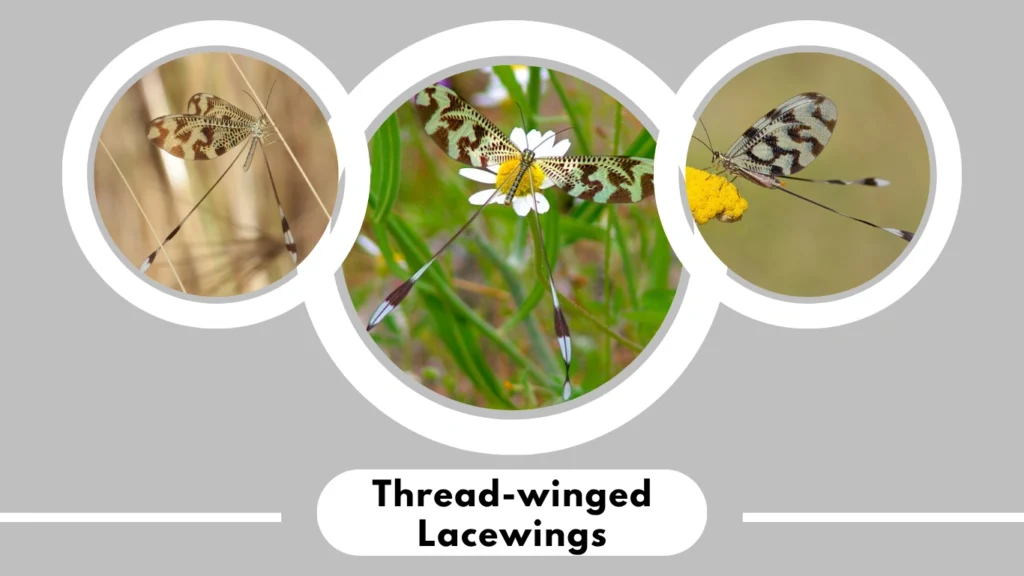
Thread-winged lacewings are known for their unusual hindwings, which are long and ribbon-like. Their graceful appearance and slow flight make them distinct among Neuropterans.
Identification
- Color: Pale yellow, brown, or white with fine markings
- Wings: Forewings narrow; hindwings extremely elongated and thread-like
- Size: Body about 2–3 cm; hindwings much longer
- Body Shape: Slender, with delicate features
- Antennae: Long and fine
Habitat and Distribution
They are typically found in warm, arid regions such as deserts, rocky areas, and Mediterranean climates. Their distribution includes parts of Africa, southern Europe, Asia, and Australia.
Behavior and Diet
Adults are mostly nectar feeders and are active during the day. The larvae, on the other hand, are predators that feed on small insects or insect eggs in the soil or under debris. Their elegant flying pattern is often slow and fluttery.
9. Split-footed Lacewings (Nymphidae)

Split-footed lacewings are a family related to antlions and are native primarily to Australia and nearby regions. They are recognized by their distinct wing patterns and relatively strong flying ability.
Identification
- Color: Brownish to black with pale spots
- Wings: Broad, strongly veined, and often patterned
- Size: Adults range from 2–4 cm
- Larvae: Flattened, with curved jaws similar to antlions
- Legs: Strong and slightly spined
Habitat and Distribution
These insects are found in dry woodlands, bushlands, and sometimes near sandy soils. They are primarily an Australian group but are also found in parts of Papua New Guinea and Indonesia.
Behavior and Diet
Larvae of split-footed lacewings are ambush predators, hiding under bark or in leaf litter to capture passing prey. Adults are nocturnal and may be drawn to lights. They are considered beneficial for their role in controlling pest insects.
10. Dipteromantispi
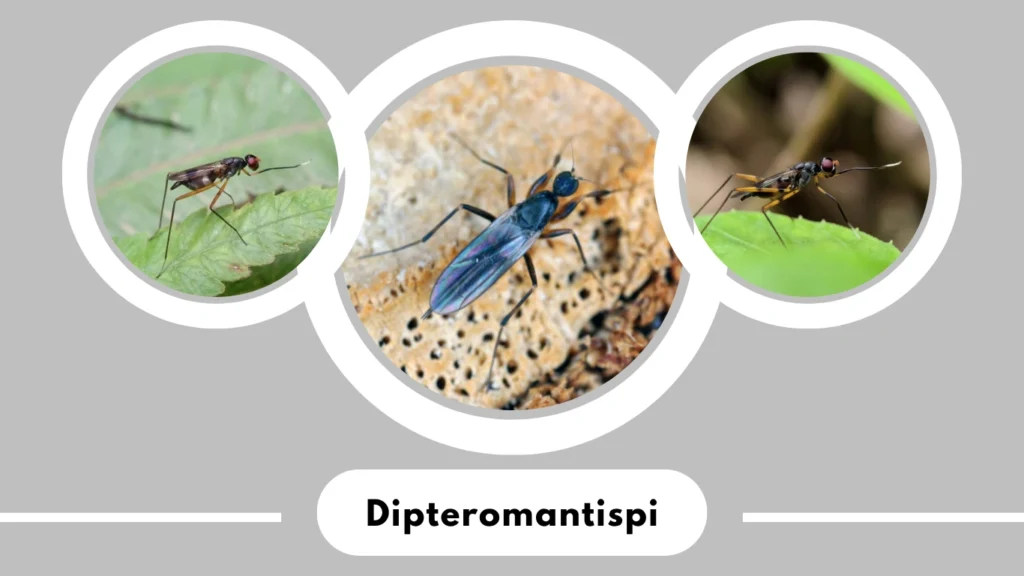
Dipteromantispi is a rare and unusual genus within the mantid lacewing group. These insects mimic flies in appearance but possess the raptorial front legs typical of mantid lacewings, making them fascinating examples of mimicry and predation.
Identification
- Color: Often dark with fly-like markings
- Wings: Transparent with subtle venation; fly-like in shape
- Size: Small to medium-sized, around 1–2 cm
- Legs: Enlarged forelegs for grasping prey
- Body Shape: Compact, resembling that of a true fly
Habitat and Distribution
Dipteromantispi species are rare and have been recorded mainly in parts of Asia. Their preferred habitats are not well documented, but they are generally associated with warm, forested, or subtropical environments.
Behavior and Diet
These insects use their front legs to ambush and capture small prey, similar to other mantid lacewings. Their fly mimicry may serve both as a defense mechanism and as a strategy to approach unsuspecting prey. Little is known about their larval behavior due to their rarity.
FAQs
1. What do lacewings eat?
Lacewing larvae are voracious predators, feeding on aphids, mealybugs, mites, thrips, and other soft-bodied insects. Adult green lacewings may also consume nectar, pollen, or honeydew, while other lacewing relatives like mantid lacewings and antlions prey on insects throughout their life stages.
2. Are lacewings harmful to humans or pets?
No, lacewings are harmless to humans and pets. They do not bite, sting, or carry diseases. In fact, they are beneficial insects in gardens and farms because they naturally control pest populations.
3. What’s the difference between green and brown lacewings?
Green lacewings are typically larger and more common, with bright green bodies and golden eyes. Brown lacewings are smaller, more tolerant of cold, and have a light to dark brown body. Both are effective predators in their larval stages.
4. Do lacewings fly at night or during the day?
Many lacewings, such as green and brown lacewings, are active during twilight or nighttime and are attracted to lights. However, some relatives like thread-winged lacewings are active during the day.
5. Where can I find lacewings in nature?
Lacewings are found in gardens, forests, grasslands, and near water bodies, depending on the species. They are often spotted on flowering plants or under leaves, especially where there are pests for their larvae to feed on.
