

Fleas are small, fast-moving parasites that often remain unnoticed until bites or itching become impossible to ignore. Because these insects hide deep in pet fur, carpets, and bedding, correctly identifying them is essential for treatment. This guide explains exactly what fleas, flea eggs, flea dirt, larvae, and their bites look like on pets, humans, and home surfaces. With clear descriptions and comparison sections, you’ll be able to confidently identify fleas in any environment.
What Adult Fleas Look Like
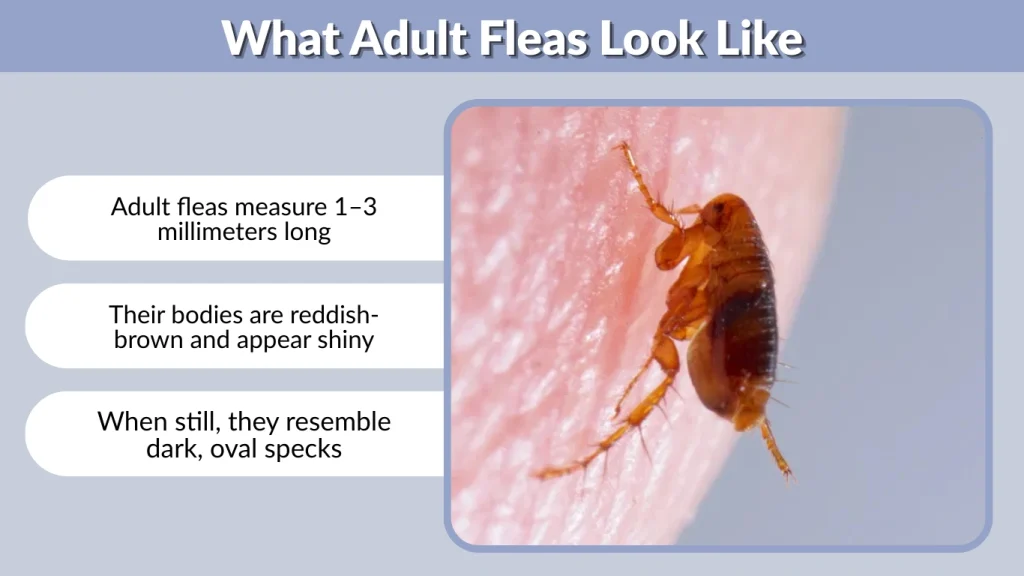
Fleas are tiny but distinctive insects. Their physical features, movement patterns, and behavior make them recognizable once you know what to look for.
Size, Shape & Coloring
Adult fleas measure 1–3 millimeters long, making them about the size of a sesame seed. Their bodies are reddish-brown and appear shiny because of their tough exoskeleton. What sets fleas apart visually is their laterally flattened shape—they are narrow from side to side, which helps them navigate through hair and fur. Despite their small size, adult fleas are visible to the naked eye. When still, they resemble dark, oval specks; when moving, they dart or jump quickly.
Movement & Behavior
Fleas are known for their exceptional jumping ability, powered by their large hind legs. They can leap vertically up to 7 inches, easily moving between pets, bedding, or flooring. When not jumping, fleas crawl rapidly, making them difficult to catch or crush. They tend to hide in warm, protected areas such as the base of a pet’s tail, neck, or armpits. On humans, they may appear briefly on clothing or skin but rarely stay long enough to be easily noticed.
What Fleas Look Like on Pets (Dogs & Cats)

Fleas on Dogs (Visual Signs)
Fleas are easier to spot on dogs with lighter or shorter coats, but they can be found on any breed. On a dog, fleas appear as tiny dark brown or black specks that dart between hairs. They are most commonly seen around the lower back, belly, groin, tail base, and neck. A visible sign is often flea dirt, which resembles black pepper sprinkled on the dog’s skin. Brushing or parting the hair in these areas can expose adult fleas trying to hide close to the skin.
Fleas on Cats (Visual Signs)
Cats are expert groomers, which makes flea detection more challenging. They may remove fleas before you ever see them. However, signs include small, fast-moving brown insects near the neck, shoulders, or hindquarters. Cats often display indirect evidence, such as tiny dark specks left on bedding or grooming surfaces. Heavy infestations make fleas more visible as they move rapidly through the thick fur. Because many cats develop allergies, you may also spot scabs or irritated skin instead of actual fleas.
Fleas on Kittens & Puppies
Young animals are highly vulnerable to fleas. On kittens or puppies, fleas may appear in clusters, especially around thinly furred areas like the belly. Because the skin is more delicate, fleas stand out clearly as dark dots moving across pale fur. Severe infestations can cause anemia, so it’s important to recognize the signs quickly. You may see numerous fleas concentrated in warm regions such as the neck or tail base, along with excessive scratching.
What Fleas Look Like on Humans, Bedding & Home

Fleas on Humans
Although humans are not ideal hosts, fleas can temporarily land on skin or clothing. When visible, they appear as tiny dark insects that jump away quickly. They are rarely seen for more than a moment. If you notice small dark specks that leap when touched, fleas are likely present in your environment.
Fleas in Bedding, Carpets & Furniture
In bedding, fleas may be noticed as dark jumping specks near the seams or edges of sheets and blankets. Infestations often leave behind flea dirt or white eggs. In carpets, fleas may hide deep between the fibers. You may observe small movements when you run your hand across the surface or shine a light at an angle. Furniture, especially upholstered pieces, can harbor fleas in cracks or along the lining. Because these areas trap heat and moisture, they offer ideal hiding spaces.
Fleas in the House (General Signs)
Fleas in a home environment typically reveal themselves through evidence rather than direct sightings. Signs include black specks (flea dirt) on floors, small white grains (eggs) near pet bedding, and tiny movements along carpet edges. Fleas may jump when a person or pet walks by because vibrations stimulate them. Baseboards, rugs, and soft furnishings are the most common hiding zones.
What Flea Eggs Look Like
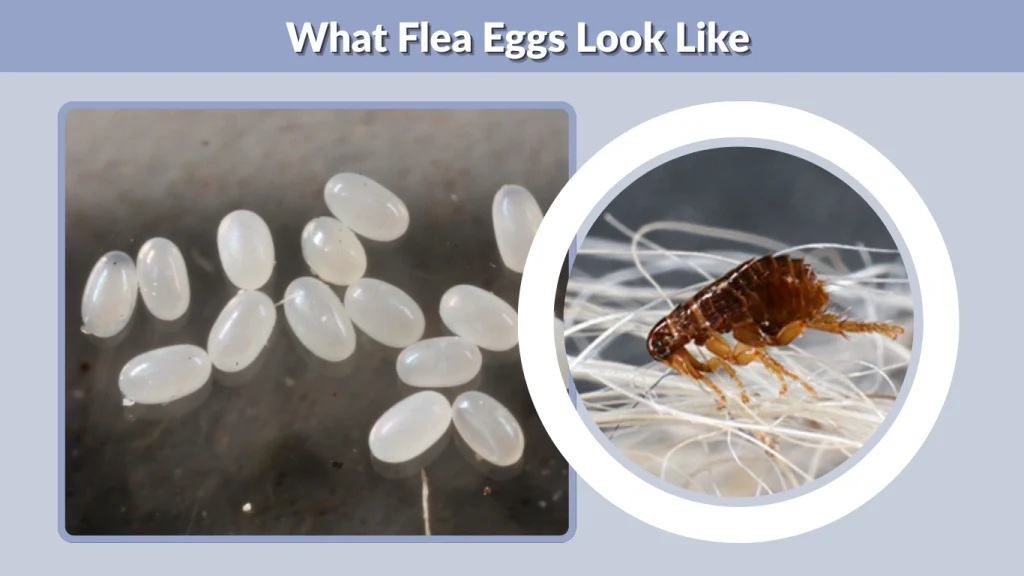
Appearance of Flea Eggs
Flea eggs are tiny, white, oval-shaped and measure about 0.5 millimeters—similar to a grain of salt. They have a smooth surface and are slightly shiny when new. Unlike dandruff, which is irregular and flaky, flea eggs are round, uniform, and do not cling firmly to hair. Their clean, polished look distinguishes them from dust particles.
Flea Eggs on Dogs & Cats
Pets often carry flea eggs without the owner realizing it. On dogs, the eggs may appear scattered across the skin like tiny salt grains, especially in dense areas such as the tail base, groin, or inner thighs. Because flea eggs are smooth and not sticky, they fall off easily, meaning only a small percentage remain on the animal. On cats, eggs may become caught closer to the roots of the fur due to grooming oils, but they are still loosely attached and drop into bedding or carpets quickly. Eggs on dark fur can be spotted by using a flea comb and shaking the collected particles onto a white towel.
Flea Eggs on Carpet, Bedding & Furniture
Carpets hold the majority of flea eggs in a home. They often look like tiny white specks nestled deep between fibers. In soft bedding, flea eggs rest near seams, edges, or the folds of blankets. On furniture—especially upholstered pieces—eggs may drop into crevices, under cushions, or along stitching lines. Because eggs blend into light-colored fabrics, a bright flashlight angled sideways helps reveal them.
Table: Flea Eggs by Location
| Location | Appearance | Visibility | Notes |
| Dogs | White oval grains | Moderate | Fall off quickly, may mix with dandruff |
| Cats | White glossy specks | Low–Moderate | Harder to spot due to grooming |
| Carpet | Salt-like dots | Medium | Found deep in fibers |
| Bedding | Smooth white ovals | High | Often near seams |
| Furniture | Scattered white specks | Medium | Hidden in cracks |
What Flea Larvae, Pupae & Dead Fleas Look Like

Flea Larvae Identification
Flea larvae look nothing like adult fleas. They resemble tiny white worms, measuring 2–5 millimeters. Without legs, larvae slither slowly and avoid light, staying hidden in dust, carpets, and dark corners. They are semi-transparent, allowing you to sometimes see dark material inside—mostly digested blood (flea dirt) consumed as food. Many people mistake them for lint or tiny maggots.
Flea Pupae (Cocoons)
In the pupal stage, larvae spin a silk-like cocoon that traps debris around it, creating a camouflaged casing. These cocoons blend into carpet fibers, fabric lint, and household dust. They are extremely hard to detect and can survive for months. When warm vibrations occur—such as footsteps—they hatch into adult fleas.
What Dead Fleas Look Like
Dead fleas appear as dark brown or black flattened specks. They no longer jump or move, and their bodies may curl slightly. It’s easy to confuse dead fleas with flea dirt, but fleas have a more defined oval shape and may still have visible legs.
What Flea Dirt Looks Like
Visual Characteristics
Flea dirt is actually flea feces—digested blood. It looks like tiny black or dark reddish-brown flakes, similar to coarse ground pepper. On pets, flea dirt often appears in clusters, especially near the tail base. When placed on a damp paper towel, flea dirt dissolves into dark red streaks, confirming it contains dried blood.
Flea Dirt vs Regular Dirt
Regular dust or soil stays black or gray when wet. Flea dirt always turns reddish because of the blood content. This test is one of the easiest ways to confirm an infestation even when live fleas are not visible.
What Flea Bites Look Like on Humans

General Appearance
Flea bites appear as small red bumps often arranged in clusters of two or three. This pattern is known as “breakfast, lunch, and dinner.” The bites are extremely itchy and may swell. They are most common on the legs, ankles, feet, and waistline—areas where fleas can easily jump.
Bites on Dark Skin
On darker skin, flea bites may look dark red, purple, or hyperpigmented, especially during healing. Post-inflammatory marks can last weeks. Swelling may be more noticeable even when the bite center remains small.
Bites on Human Legs
Leg bites often form linear or triangular clusters. Scratching can result in scabs or open sores. People with sensitivities may develop hives or large welts around the bite sites.
What Flea Bites Look Like on Dogs & Cats
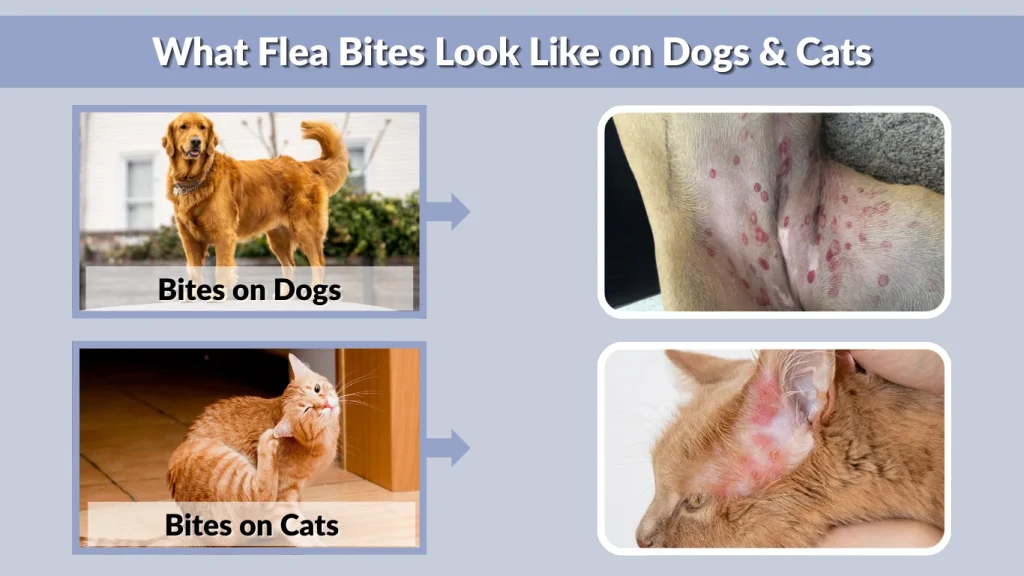
Bites on Dogs
On dogs, flea bites cause small red bumps surrounded by pink, irritated skin. Dogs may scratch, chew, or lick the area excessively, creating bald patches, especially around the tail base. Severe itching may lead to inflamed “hot spots.”
Bites on Cats
Cats often develop miliary dermatitis, a condition where dozens of tiny scabs form along the back and neck. The scabs feel like grains of sand and indicate chronic flea bite irritation. Hair loss and redness are common.
Flea Allergy Dermatitis
Some pets are allergic to flea saliva. A single bite can trigger intense itching, scabbing, and widespread redness. Dogs typically lose fur around the rear, while cats may develop thickened skin and sores.
What Sand Fleas Look Like & Their Bites
Sand Fleas Appearance
Despite the similar name, sand fleas are crustaceans, not insects. They are small, grayish-brown, and found along beaches. They jump, but their bodies look more like tiny shrimplike specks rather than insects.
Sand Flea Bites
Sand flea bites cause painful raised welts that often swell significantly. Unlike flea bites, which are tiny, sand flea bites are large, irritated, and usually appear on the feet, ankles, or lower legs.
Fleas vs Ticks: Visual Comparison

Size & Shape Differences
Fleas are very small, fast, and narrow. Ticks are larger, rounded, and crawl slowly. Fleas jump; ticks do not. Fleas have six legs, while ticks have eight.
Behavior Differences
Fleas feed quickly and move away. Ticks attach and stay in place for days. This alone makes them visually easy to distinguish.
Comparison Table
| Feature | Fleas | Ticks |
| Size | 1–3 mm | 3–12 mm |
| Movement | Jumping | Crawling |
| Color | Dark brown | Gray, brown, black |
| Body Shape | Narrow/flat | Rounded/flat |
| Bites | Clusters | Single attached bite |
FAQs
What do fleas look like to the human eye?
Fleas appear as tiny dark brown or black insects about the size of a sesame seed. They move extremely fast and often jump when disturbed. When still, they look like small oval specks, but when crawling or hopping they become much easier to identify on pets, humans, bedding, or carpets.
What do flea eggs look like compared to dandruff?
Flea eggs are smooth, white, oval-shaped and resemble tiny grains of salt. They roll easily off fur because they’re not sticky. Dandruff, however, is flaky, irregular in shape, and clings to hair. A bright light or white paper test helps you tell the difference.
What do flea bites look like on humans?
Flea bites appear as small red bumps arranged in clusters or lines, commonly around the legs, ankles, and waist. They are very itchy and may swell or scab if scratched. On darker skin, bites may appear purple or hyperpigmented, especially during healing.
How can I tell flea dirt from regular dirt?
Flea dirt looks like black pepper flakes. When placed on a damp tissue, it dissolves into reddish stains because it’s made of digested blood. Regular dirt stays black or gray when wet. This quick test is one of the easiest ways to confirm flea activity.
What do flea larvae and pupae look like?
Flea larvae look like tiny white worms, 2–5 mm long, with no legs and slight transparency. They hide in dark areas such as carpets and cracks. Pupae, on the other hand, are cocooned in a debris-covered casing that blends into fibers, dust, and fabric, making them difficult to see.
