
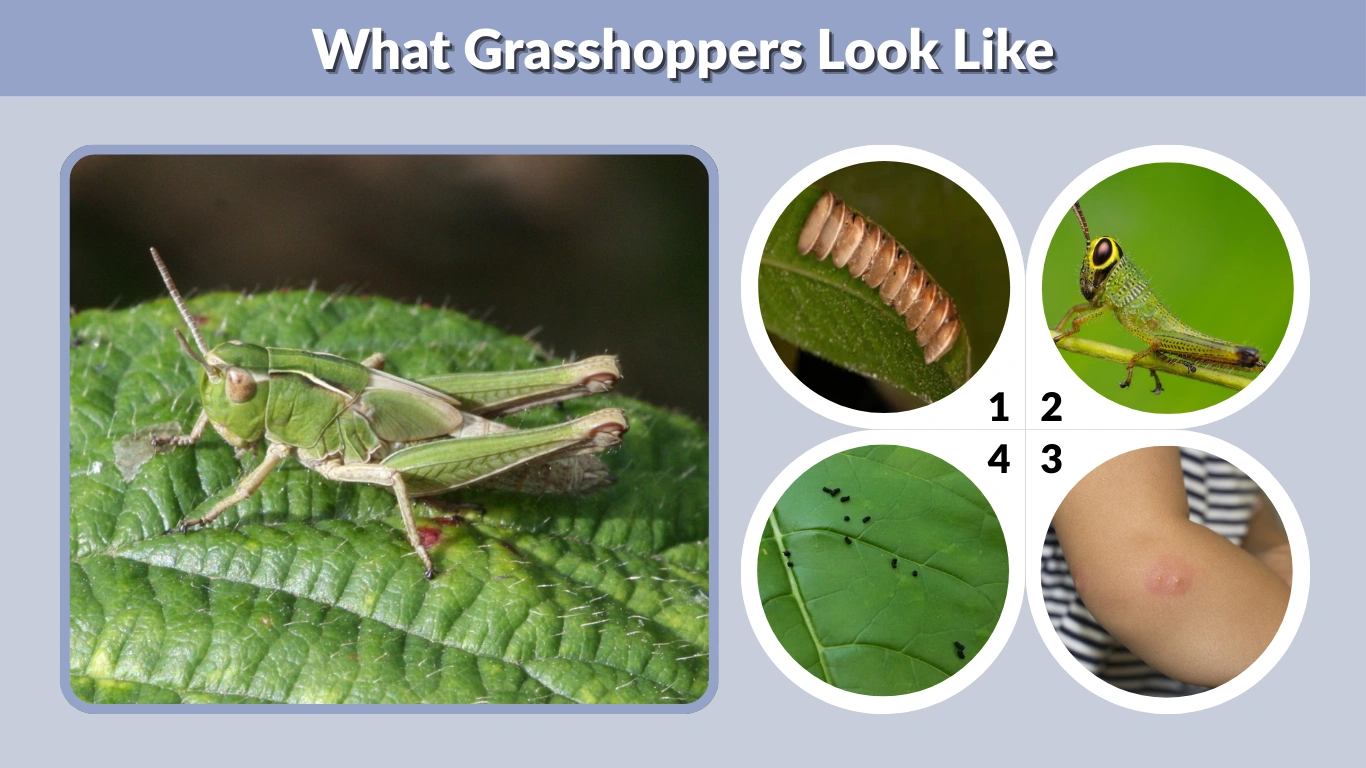
Grasshoppers are among the most recognizable insects in the world, yet their appearance varies dramatically depending on species, life stage, and environment. People often encounter eggs in soil, tiny wingless nymphs on plants, unusual droppings, or green leaf-mimicking insects and wonder whether they’re looking at a grasshopper or something else entirely. This guide explains what grasshoppers look like from egg to adulthood, how males and females differ, what their droppings and bites look like, and which insects are commonly mistaken for them. By understanding these visual clues, identification becomes easier and far more accurate.
What Adult Grasshoppers Look Like

General Physical Description
Adult grasshoppers typically have elongated, cylindrical bodies divided into three main segments: the head, thorax, and abdomen. Their coloration ranges widely—green, brown, tan, gray, yellow, and even black combinations occur, depending on species and habitat. Grasshoppers living in grassy or leafy environments are more likely to be green, while those in dry, dusty habitats often develop brown or tan camouflage.
A distinguishing feature of adults is their short antennae, which are usually shorter than the body. This trait separates them from crickets and katydids, which have long, thread-like antennae. Adult grasshoppers also have large compound eyes that provide excellent motion detection and panoramic vision.
Wings and Flight Abilities
Most adult grasshoppers have two pairs of wings. The front pair, called tegmina, is narrow and leathery, serving primarily as protection. The hind wings are broader, membranous, and often colorful in band-winged species. Depending on the species, some grasshoppers are strong fliers capable of long-distance movement, while others can only glide short distances and rely more on jumping to escape predators.
Legs and Jumping Anatomy
Grasshoppers are known for their powerful hind legs, which contain thick bundles of muscle that allow them to jump many times their body length. These legs are studded with spines that offer traction and protection. The enlarged femur is one of the easiest ways to identify a grasshopper, especially when viewed from the side. Compared to crickets and katydids, grasshoppers have a more upright posture and visibly stronger jumping limbs.
What Grasshopper Eggs Look Like

Individual Egg Appearance
Grasshopper eggs are small, elongated, and resemble tiny grains of rice. They typically measure between 3 and 6 millimeters long and are usually yellow, cream, or pale tan. Freshly laid eggs are moist and soft, but they harden slightly as they begin developing. While individual eggs are rarely seen on their own in nature, they become more noticeable when removed from their protective casing.
Egg Pods in Soil
Rather than laying single eggs, grasshoppers deposit them in clusters called egg pods. These pods are created when the female releases a foam-like substance that surrounds the eggs and hardens into a protective casing. A typical pod can contain anywhere from 20 to 60 eggs, depending on the species. The pod itself is usually tan or light brown, cylindrical, and buried a few centimeters beneath the soil surface. Lubber grasshoppers produce particularly large and noticeable egg pods.
Common Places to Find Egg Pods
Egg pods are usually located in dry, loose soil where digging is easy. Areas such as garden beds, field edges, meadows, and sandy patches are common nesting spots. Females prefer undisturbed soil, which is why homeowners often discover egg pods while tilling gardens or turning soil in the spring.
What Baby Grasshoppers Look Like (Nymphs)

Appearance of Newly Hatched Nymphs
Baby grasshoppers, known as nymphs, look like miniature adults but without wings. Newly hatched nymphs are very small—often just a few millimeters long—and are usually bright green or pale in color. When they first emerge from the egg pod, some may appear almost white or translucent because their exoskeleton has not yet hardened.
Growth Stages & Molts
Grasshoppers develop through a process called incomplete metamorphosis. Instead of passing through a larval and pupal stage, they molt several times, gradually growing larger and developing wing buds. Most species undergo 5–7 molts, known as instars. With each molt, the wing pads become more pronounced, and the coloration becomes more defined. By the final instar, nymphs closely resemble adults but still lack fully formed wings.
White or Pale Baby Grasshoppers
It is common to find a pale or almost white baby grasshopper on a plant. This occurs because the insect has just shed its exoskeleton. The new cuticle underneath is soft and light in color, slowly darkening as it hardens. This stage lasts only a short time, but it often confuses observers who think they’ve found an albino grasshopper.
What Male, Female & Pregnant Grasshoppers Look Like

Male Grasshoppers
Male grasshoppers are generally smaller and slimmer than females. They often have more pronounced sound-producing structures, such as ridges on their wings or legs. Males tend to be more active and may display more vibrant cues during mating periods, though this varies among species.
Female Grasshoppers
Females are larger and have a noticeably wider abdomen. One of their most distinguishing features is the ovipositor, a pointed, shovel-like structure at the tip of the abdomen used for depositing eggs into the soil. Females often appear sturdier due to the space needed to carry dozens of developing eggs.
Pregnant Grasshoppers
A pregnant grasshopper has a visibly swollen abdomen with expanded segmentation. The body may appear more rounded, and the insect often moves more slowly. As she prepares to lay eggs, she may probe the soil repeatedly with her ovipositor, searching for a suitable site.
What Grasshopper Poop Looks Like

Pellet Shape & Color
Grasshopper droppings, often called frass, appear as tiny, dry pellets. They are typically cylindrical and may taper slightly at one or both ends. The color ranges from dark green to brown or nearly black, depending on what the insect has eaten. Because grasshoppers feed primarily on plant material, their droppings tend to have a fibrous, crumbly texture. The pellets are lightweight and usually scattered below plants where the insects feed.
How to Tell It From Mouse Poop
At first glance, grasshopper frass can be confused with mouse droppings, but there are notable differences. Mouse feces are larger, shinier, and more uniform in shape, while grasshopper pellets are smaller, drier, and often variable in size. Mouse droppings also have a more pointed shape and a moist sheen when fresh. Grasshopper pellets, by contrast, are matte and easily crushed between fingers. They are most commonly found directly beneath damaged plants rather than along walls or food-storage areas.
What Grasshopper Bites & Damage Look Like

Grasshopper Bite Appearance
Grasshoppers rarely bite humans, but when they do, the bite is usually harmless. It may appear as a small red bump or a slightly raised welt. The area can be mildly itchy or irritated, but serious reactions are uncommon. Because grasshoppers have strong chewing mandibles designed for cutting plant material, a defensive bite may feel like a sharp pinch. However, unless the insect is a large species such as the Eastern lubber, it typically cannot break the skin deeply.
Plant Damage From Grasshoppers
Grasshopper feeding damage is easier to spot than their bite marks on humans. They create ragged, uneven edges along leaves, and in heavy infestations, entire sections may be stripped down to the midrib. Some species leave “windowpane” patterns—areas where the leaf surface is scraped thin but not entirely removed. Grasshopper damage often occurs in clusters, with multiple plants showing missing foliage. In agricultural settings, severe outbreaks can devastate crops such as alfalfa, grains, and vegetables. Unlike caterpillars, which often leave frass piles around feeding areas, grasshoppers leave smaller scattered pellets that blend with soil.
Insects That Look Like Grasshoppers

Many insects resemble grasshoppers in shape or color, which leads to frequent misidentification. Understanding the differences helps distinguish harmless species from potential pests.
Katydids
Katydids are the insects most commonly mistaken for grasshoppers. They are typically bright green and have wings that mimic leaves with remarkable accuracy. Unlike grasshoppers, katydids have very long antennae that often exceed the length of their body. They inhabit shrubs and trees, making them more arboreal than grasshoppers. Their wings display pronounced veining that resembles leaf structure, providing excellent camouflage.
Locusts
Locusts are actually a type of grasshopper that can transform under crowded conditions. Physically, solitary locusts look identical to ordinary grasshoppers. However, when food is scarce and their population density rises, they enter a swarming phase—changing color, becoming more robust, and forming enormous migratory groups. This behavioral shift is the main difference between locusts and typical grasshoppers.
Crickets
Crickets share the general body shape of grasshoppers but differ in several key ways: they have long antennae, flattened bodies, and darker coloration. They are primarily nocturnal and produce chirping sounds by rubbing their wings together. Grasshoppers, on the other hand, often create sound using their hind legs. While crickets and grasshoppers may appear similar at a glance, antenna length is the easiest way to tell them apart.
Other Look-Alike Insects
Several lesser-known insects also resemble grasshoppers:
- Leafhoppers: Small, wedge-shaped insects that hop but have thinner bodies.
- Treehoppers: Often mimic thorns or plant structures.
- Juvenile praying mantises: Slender but can resemble long-legged hoppers.
- Camel crickets: Spider-like insects with humpbacked bodies and long hind legs.
- Giant wetas: Massive, wingless relatives of grasshoppers found in New Zealand.
Each of these insects shares some features with grasshoppers but differs in behavior, antenna length, posture, or habitat.
Special Color Forms & Species Variations

Green Grasshoppers
Green coloration helps grasshoppers blend into leafy vegetation. Many common meadow and garden species use this bright green camouflage to avoid predators. Young nymphs also tend to be greener than adults, which helps them blend into the soft green growth of early plants.
Brown Grasshoppers
Brown species usually live in dry fields, dirt patches, or areas with sparse vegetation. Their coloring helps them blend into soil and dried grass. Some species shift from green to brown depending on temperature, humidity, or their developmental stage.
Leaf-Mimicking Grasshoppers
True leaf-like insects are usually katydids rather than grasshoppers. Their wings are impressively leaf-shaped, complete with veins and sometimes even mimicry of leaf damage or fungal spots. In low light, many people mistake them for actual leaves until they hop away.
What Grasshoppers Look Like Up Close & Under a Microscope
Close-Up Features
Viewed closely, grasshoppers reveal many details not visible from afar. Their compound eyes consist of hundreds of tiny hexagonal facets that create a wide field of vision. The mouthparts include sharp mandibles for cutting plants and sensory palps for testing food. Fine hairs cover their legs and body, helping them sense vibrations and air currents. Small openings called spiracles line the sides of the body, allowing the insect to breathe.
Microscopic Anatomy
Under magnification, a grasshopper’s exoskeleton displays intricate patterns and textures. Their wing membranes reveal a network of veins that offer flexibility and strength. Leg joints resemble ball-and-hinge structures reinforced with tough plates. Internally, pale tracheal tubes branch throughout the body, delivering oxygen directly to tissues. These microscopic details highlight the complexity of a seemingly simple insect.
What the Inside of a Grasshopper Looks Like
Internal Organs & Systems
Inside a grasshopper, the body is largely filled by the digestive tract, which includes the foregut, midgut, and hindgut. The insect’s blood, known as hemolymph, is greenish or clear and flows freely through an open circulatory system. Female grasshoppers contain rows of developing eggs inside elongated ovaries. Fat bodies, which store energy, appear as creamy or pale yellow masses.
Musculature & Leg Structure
The legs—especially the hind legs—contain huge bundles of muscle that enable powerful jumps. These muscles attach to hardened internal plates called apodemes. In the thorax, flight muscles anchor to the interior of the exoskeleton and control wing movement. Together, these structures form a compact but efficient system for jumping and flying.
FAQs
What does a normal adult grasshopper look like?
Adult grasshoppers have a long, narrow body, short antennae, and powerful hind legs for jumping. Their colors vary from green to brown or yellow, depending on habitat. They also have two pairs of wings, large compound eyes, and a tough exoskeleton with clearly segmented body parts.
What do grasshopper eggs look like in soil?
Grasshopper eggs are tiny, elongated, and pale yellow or tan. They’re stored in clusters inside hardened foam-like pods buried a few centimeters underground. These pods can contain 20–60 eggs. When dug up, eggs resemble small grains of rice packed closely together.
What do baby grasshoppers look like right after hatching?
Baby grasshoppers, called nymphs, look like miniature wingless adults. They’re usually bright green, pale, or even white if they just molted. Over several molts, they gain darker colors and wing buds. Their small size and quick hopping make them easy to overlook on plants.
How can you tell a grasshopper from a cricket or katydid?
Grasshoppers have short antennae, thicker bodies, and stronger jumping legs. Crickets and katydids have very long antennae—often longer than their bodies—and katydids have wings shaped like leaves. Crickets are typically darker and more flattened, while grasshoppers are more upright and active during the day.
What does grasshopper damage look like on plants?
Grasshopper feeding leaves ragged, uneven edges on leaves, small window-like patches, and sometimes entire sections stripped down to the midrib. Heavy infestations cause quick defoliation across multiple plants. Droppings—small dry pellets—often collect beneath the damaged foliage.
