
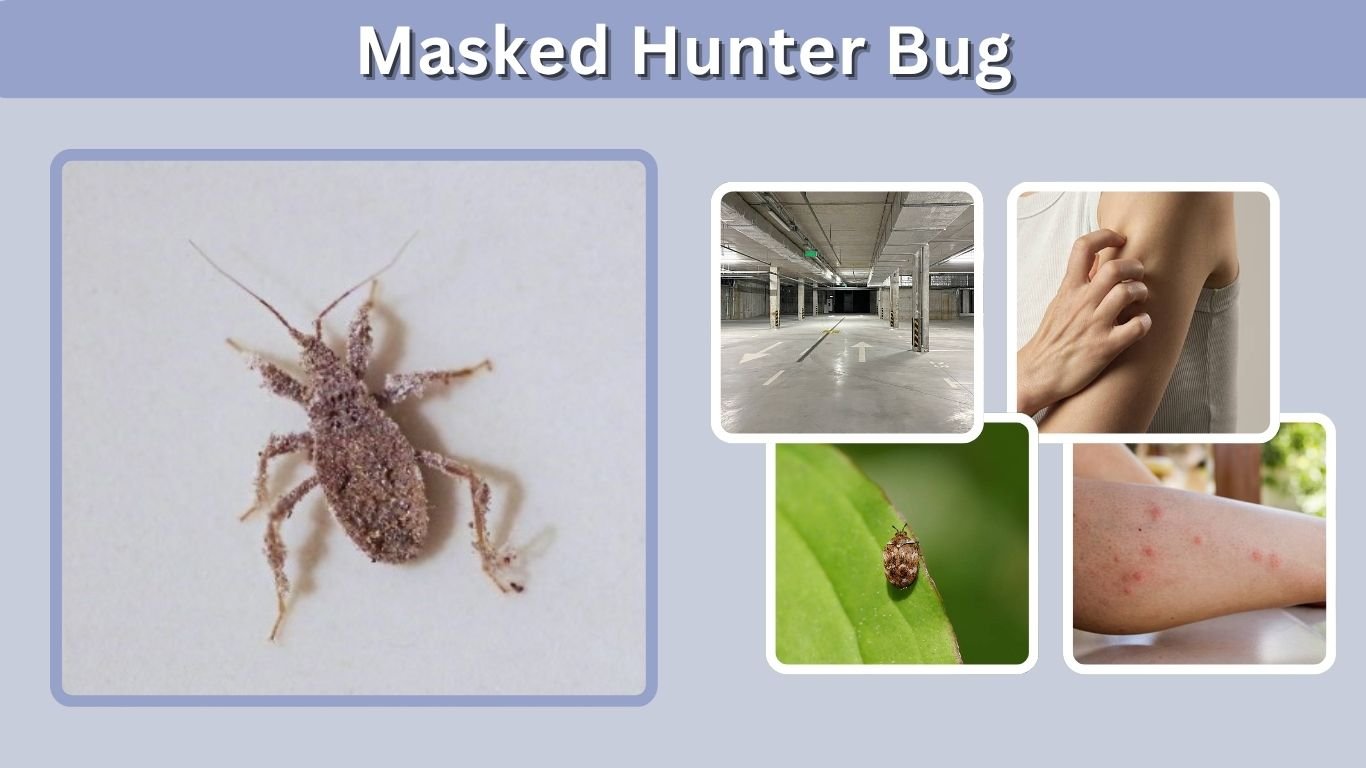
The masked hunter bug is a dark-colored predatory insect commonly found inside homes. Adults resemble kissing bugs, while immature masked hunters camouflage themselves with dust, lint and debris, making them look like moving dust bunnies. Although this assassin bug can deliver a painful defensive bite, it does not normally feed on humans or transmit Chagas disease. Correct identification is important because kissing bugs are blood-feeding relatives with different behavior and potential health significance.
Masked Hunter Bug Quick Facts
| Feature | Information |
| Scientific name | Reduvius personatus |
| Family | Reduviidae |
| Insect type | Assassin bug |
| Adult size | Approximately 17–22 mm |
| Adult color | Dark brown to black |
| Nymph appearance | Covered with dust and lint |
| Main diet | Other insects and spiders |
| Bite risk | Painful when handled |
| Disease transmission | Not known to transmit Chagas disease |
What Is a Masked Hunter Bug?
The masked hunter is a species of assassin bug originally associated with Europe but now established across parts of North America. It is especially notable for living indoors, where it hunts insects in dark, undisturbed areas.
Adults measure roughly 17–22 millimetres, or around three-quarters of an inch. They have elongated, dark brown or black bodies, a small head, a visible neck and fully developed wings. A short, thick, curved beak is folded beneath the head when it is not being used.
Despite sometimes being called a masked hunter beetle, it is not a beetle. It is a true bug in the order Hemiptera and uses piercing mouthparts rather than chewing jaws.
How to Identify an Adult Masked Hunter
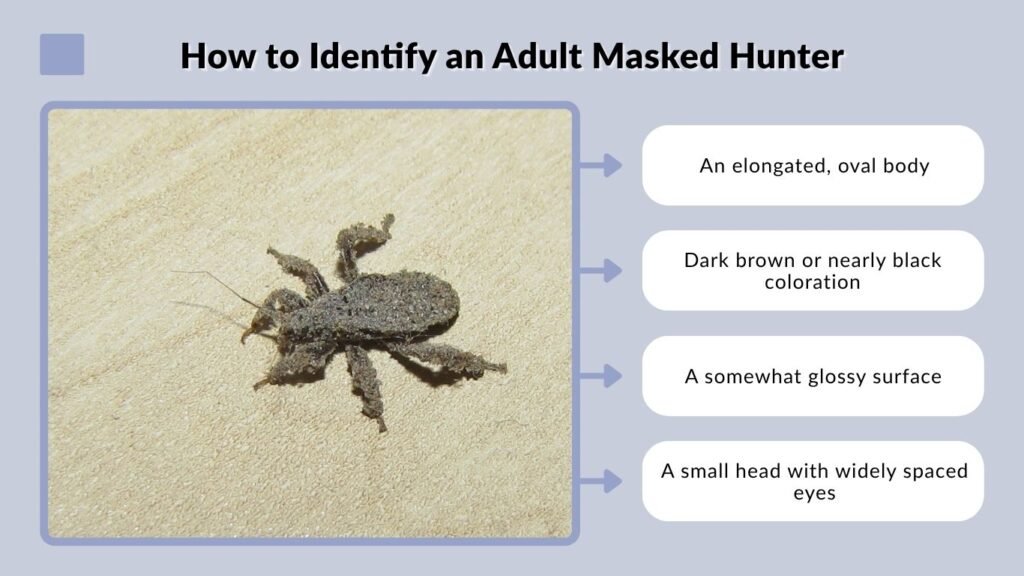
Adult masked hunters can appear intimidating because they are nearly black and have the long body shape associated with many assassin bugs.
Identification Features
Look for:
- An elongated, oval body
- Dark brown or nearly black coloration
- A somewhat glossy surface
- A small head with widely spaced eyes
- A narrow neck behind the head
- Moderate-length antennae
- A short, curved beak beneath the body
- Wings lying flat over the abdomen
- Two small raised knobs on the upper thorax
- Six long but relatively sturdy legs
Adults do not normally carry dust on their bodies. Their dark color and shape may cause them to be mistaken for kissing bugs, especially when discovered indoors at night.
What Does a Masked Hunter Nymph Look Like?
The immature masked hunter is one of the strangest-looking household insects. Its body produces a sticky coating that collects dust, lint, sand, hair and pieces of insect remains.
This camouflage makes the nymph resemble:
- A moving dust bunny
- A tiny ball of lint
- A white or gray fuzzy insect
- A piece of debris with legs
- A small bug covered in household dust
Underneath the debris, the nymph has a body similar to the adult but lacks fully developed wings. As it walks, small legs and antennae may become visible beneath the dusty covering.
The camouflage may help conceal the young assassin bug from predators and allow it to approach prey without being noticed.
Masked Hunter vs Kissing Bug
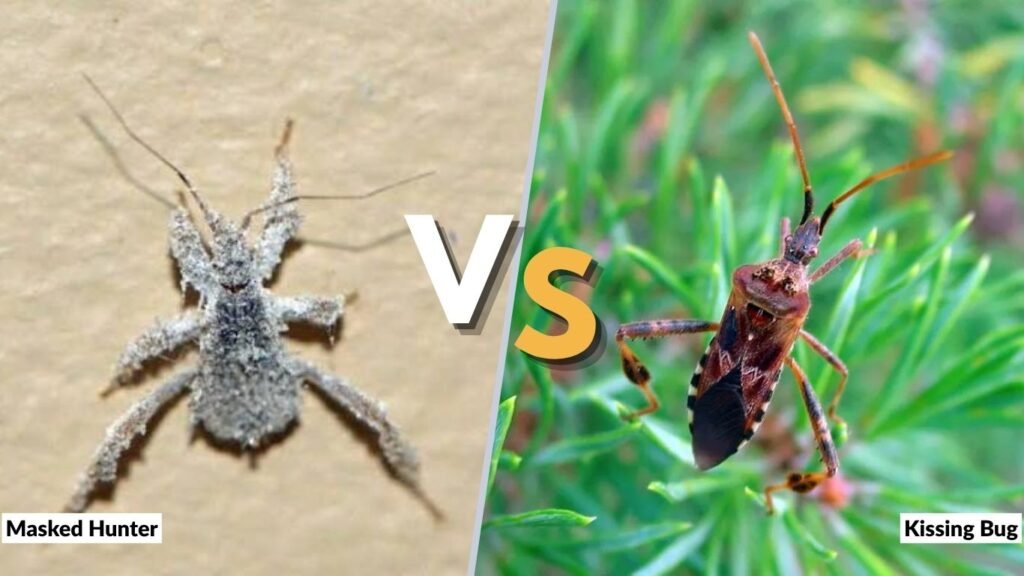
Masked hunters and kissing bugs belong to the same insect family, Reduviidae. However, their feeding habits and medical significance are very different.
| Feature | Masked hunter | Kissing bug |
| Scientific group | Reduvius personatus | Triatominae |
| Main food | Insects and spiders | Blood from vertebrates |
| Adult color | Mostly dark brown or black | Usually dark with colored abdominal edges |
| Nymph appearance | Often covered in dust | Not normally dust-covered |
| Head | Small with visible neck | Long and cone-shaped |
| Indoor behavior | Hunts household insects | May seek sleeping hosts |
| Chagas disease risk | Not a known vector | Some species can carry T. cruzi |
The Most Important Difference
Masked hunters are predators of other insects. They do not purposely seek humans or pets for blood meals. Kissing bugs are specialized blood feeders that may feed on mammals, birds and people.
Many kissing bugs also show orange, yellow or red markings along the exposed edges of the abdomen. Masked hunters are generally more uniformly dark and lack the boldly patterned abdominal border typical of many triatomine species.
Can Masked Hunters Spread Chagas Disease?
Masked hunters are not considered vectors of Chagas disease. The disease is associated with infected triatomine bugs, commonly called kissing bugs, rather than ordinary predatory assassin bugs.
Chagas disease is caused by the parasite Trypanosoma cruzi. Transmission usually occurs when infected kissing bug feces enter a bite wound, the eyes or the mouth—not simply from the insect inserting its mouthpart.
Not every kissing bug carries the parasite, and finding a dark assassin bug does not by itself indicate exposure to Chagas disease. A suspected kissing bug should be captured without crushing it and submitted to a qualified local insect or public-health identification service.
Do Masked Hunter Bugs Bite?
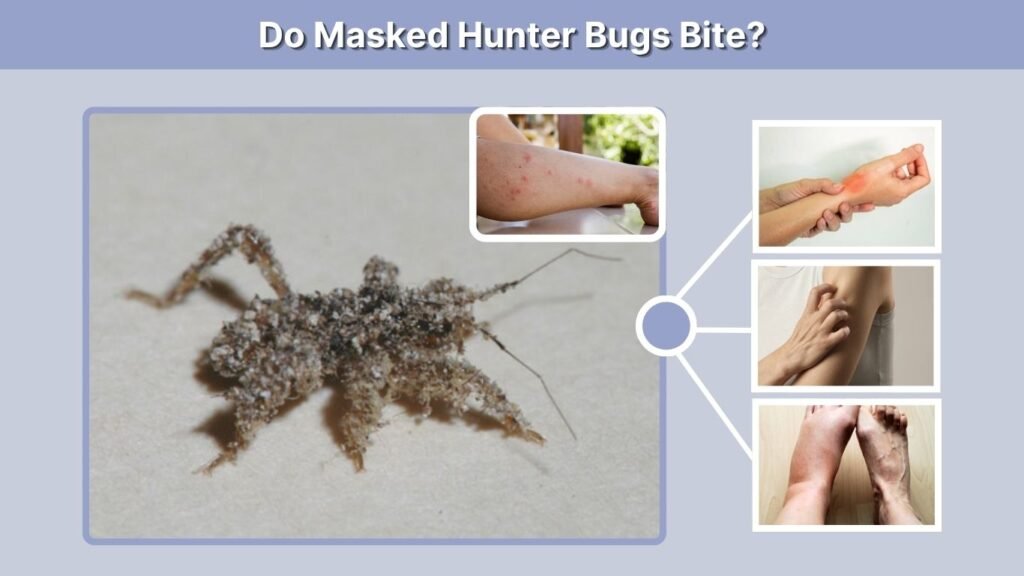
Yes. Both adults and nymphs can bite when handled, trapped against the skin or accidentally pressed inside clothing or footwear.
They do not normally approach people to bite. Their mouthpart is primarily used to pierce prey, but the same structure can penetrate human skin during a defensive reaction. Masked hunter bites are often described as sharply painful.
Possible Bite Symptoms
A bite may cause:
- Immediate sharp or burning pain
- Local redness
- Swelling
- Tenderness
- Itching
- A small puncture mark
- Warmth around the affected area
The appearance of the mark is not unique. It may resemble bites or stings from several other insects, so a photo of the skin alone usually cannot identify the cause.
What to Do After a Masked Hunter Bite
Wash the affected skin with soap and water. Place a cold pack wrapped in cloth over the swollen area for about 10–20 minutes at a time.
Avoid scratching, since broken skin may become infected. Seek urgent medical help if breathing becomes difficult or swelling develops around the lips, mouth, tongue or throat. Medical advice is also appropriate when pain is severe, redness continues spreading or the wound develops pus.
Do not cut the skin, squeeze the wound or apply harsh chemicals.
What Do Masked Hunters Eat?
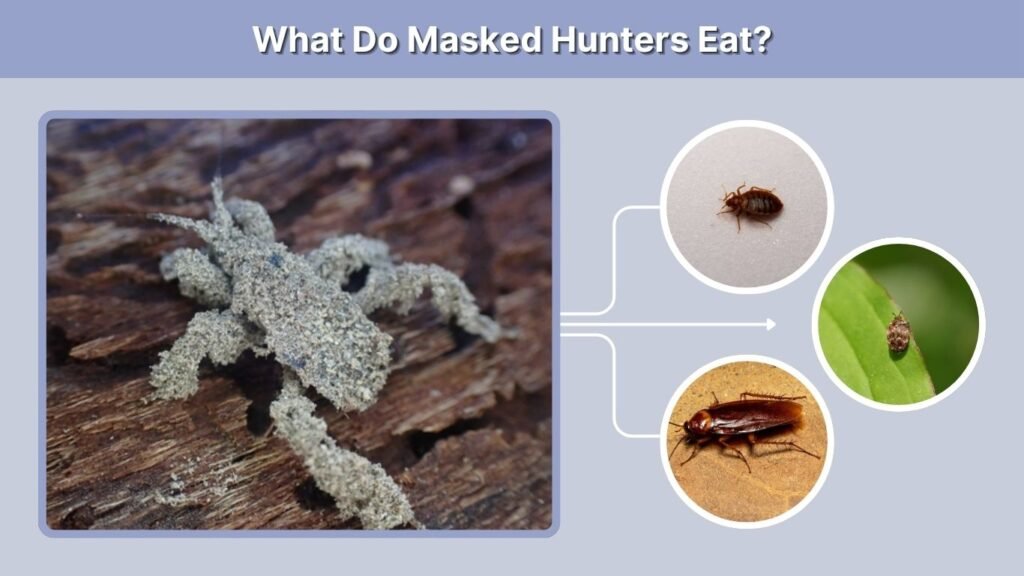
Masked hunters prey on small household arthropods. Reported prey includes:
- Bed bugs
- Carpet beetles
- Cockroaches
- Silverfish
- Sowbugs
- Spiders
- Flies
- Other insects entering from outdoors
They hunt mainly at night and often hide during the day in dry, protected spaces. Finding one may indicate that other insects are available as food, although a single masked hunter does not prove that a home has a bed bug infestation.
Does a Masked Hunter Mean You Have Bed Bugs?
Masked hunters sometimes feed on bed bugs and are occasionally called masked bed bug hunters. However, they also eat many other insects.
If one is found near a bed, inspect for actual signs of bed bugs, including live bugs, shed skins, dark fecal spots and unexplained repeated bites. Do not diagnose an infestation based solely on the presence of a masked hunter.
Where Do Masked Hunter Bugs Live?
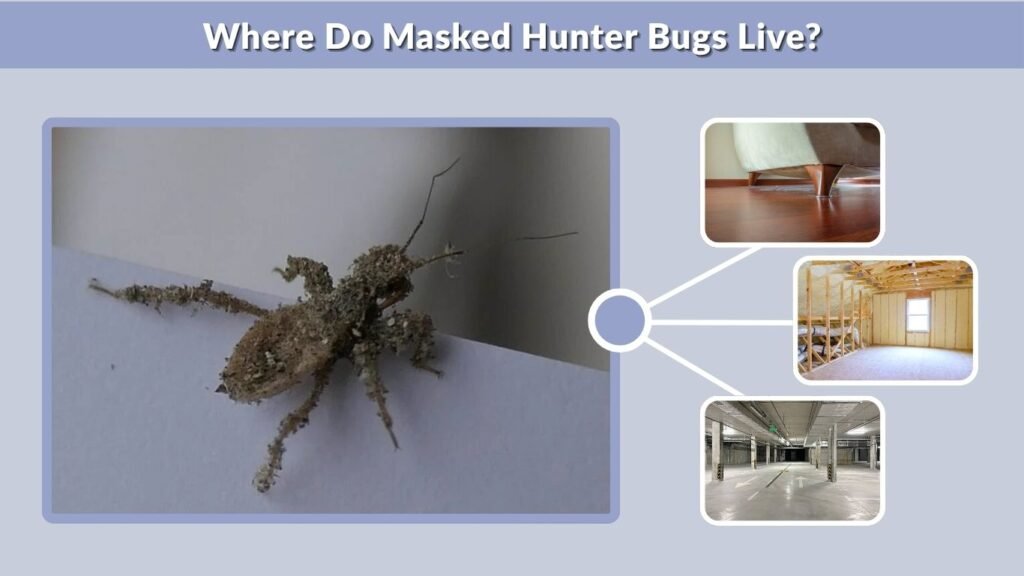
Indoors, masked hunters favor quiet, dry and dark locations such as:
- Beneath furniture
- Behind baseboards
- Inside wall gaps
- Attics
- Basements
- Storage areas
- Under beds
- Near insect activity
Adults may also enter through windows, doors and small exterior gaps during warm weather. Wisconsin Extension describes masked hunters as commonly encountered indoors in the state and notes that no verified kissing bug sightings had been recorded there as of its September 2025 update.
Location is still not a substitute for identification, especially as insect ranges can change.
How to Get Rid of Masked Hunter Bugs
An occasional masked hunter can be captured with a container and stiff paper. Do not pick it up with bare fingers.
For repeated sightings:
- Vacuum thoroughly. Clean cracks, baseboards, furniture edges and storage spaces.
- Reduce clutter. Remove lint, dust and hiding areas used by nymphs and their prey.
- Control other insects. Masked hunters remain where food is available.
- Seal entry points. Repair screens and close gaps around doors, windows and utility lines.
- Use monitoring traps. Sticky traps may help reveal where crawling insects are active.
- Investigate possible infestations. Look for bed bugs, cockroaches, carpet beetles and other prey.
Long-term control depends more on removing prey and sealing entry points than on spraying individual masked hunters.
FAQs
Is a masked hunter bug dangerous?
It is not aggressive and does not feed on human blood, but it can deliver a painful bite when handled or crushed against the skin. Avoid touching both adults and nymphs.
Why does the nymph cover itself with dust?
The nymph has a sticky body surface that collects lint, dust and debris. This material disguises its shape and gives it the appearance of a moving dust ball.
Is a masked hunter the same as a kissing bug?
No. Both are assassin bugs, but the masked hunter eats insects while kissing bugs feed on blood. Some kissing bugs can carry the parasite associated with Chagas disease.
Can masked hunters fly?
Adult masked hunters have developed wings and may fly, although they are commonly seen walking. Nymphs cannot fly because their wings have not developed.
Should I kill a masked hunter?
A single insect can usually be captured and released or removed with a vacuum. Repeated sightings suggest that the home may contain prey insects or accessible entry points that should be investigated.
