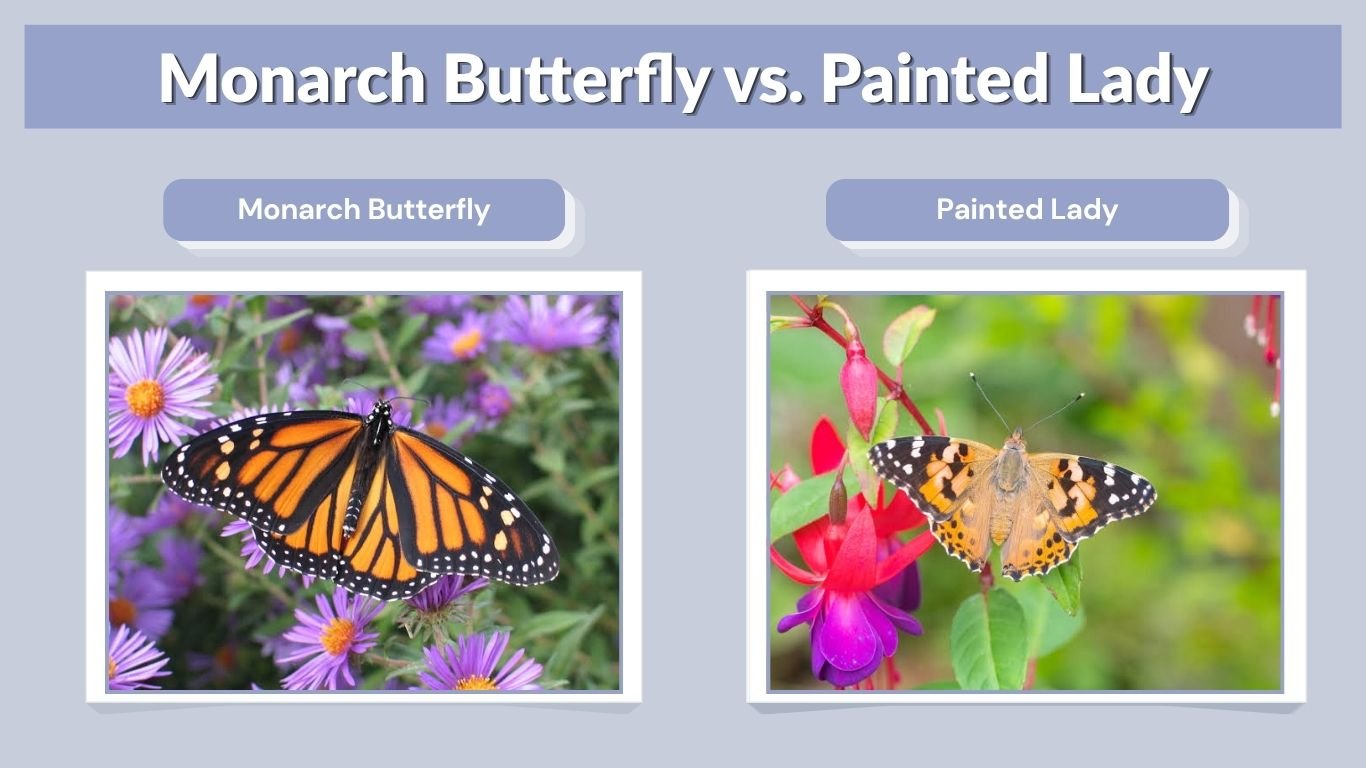
Monarch and painted lady butterflies are two beautiful species commonly seen in gardens, meadows, and open fields. Both have orange, black, and white wing patterns, making them easy to confuse at first glance. However, their size, wing markings, caterpillars, host plants, and migration habits reveal several important differences. Monarch butterflies are famous for their long-distance migration and dependence on milkweed, while painted ladies are widespread travelers with a much broader range of host plants. This monarch butterfly vs. painted lady comparison explains how to identify both species.
Monarch Butterfly vs. Painted Lady: Quick Comparison
The monarch butterfly (Danaus plexippus) and painted lady (Vanessa cardui) belong to the Nymphalidae family, but they are different species with distinctive characteristics. Monarchs generally have larger wings and a more organized black-veined pattern. Painted ladies display smaller, more complicated wing markings. Comparing their appearance and behavior makes identification much easier.
Key Differences at a Glance
| Feature | Monarch Butterfly | Painted Lady Butterfly |
| Wingspan | 3.5–4 inches | 2–2.9 inches |
| Wing pattern | Orange with bold black veins | Orange-brown with irregular black markings |
| Wing underside | Pale orange with black veins | Mottled brown with small eyespots |
| Caterpillar | Black, white, and yellow stripes | Dark body with branching spines |
| Host plants | Milkweed species | Thistles, mallows, and other plants |
| Chrysalis | Green with gold markings | Brownish or gray with metallic markings |
| Migration | Established seasonal migration routes | Long-distance, multi-generational movements |
| Predator defense | Stores milkweed toxins | Does not rely on milkweed-derived toxins |
Monarch vs. Painted Lady Butterfly Identification
Wing size, color distribution, and markings are the easiest ways to distinguish these butterflies. Although both species display orange and black coloration, their patterns are noticeably different when viewed closely. Monarchs have broad wings with strong black veins, while painted ladies have smaller wings decorated with irregular spots and patches.
Monarch Butterfly Wing Identification
Monarch butterflies have several distinctive physical features:
- Bright orange wings: Large orange sections separated by prominent black veins.
- Black wing borders: Wide dark edges containing small white spots.
- Large wingspan: Typically 3.5–4 inches across.
- Rounded wing shape: Broad forewings and rounded hindwings.
- Male marking: Males have a dark scent-gland spot on each hindwing.
Their striking wing pattern makes monarchs relatively easy to identify when resting with their wings open.
Painted Lady Butterfly Wing Identification
Painted lady butterflies have orange-brown wings with black patches and small white spots near the forewing tips.
Their hindwings feature rows of black spots rather than the bold black veins seen in monarchs.
The underside is particularly distinctive, displaying intricate gray and brown patterns with four small eyespots on each hindwing.
Painted ladies also have a smaller wingspan, generally measuring between 2 and 2.9 inches.
Monarch vs. Painted Lady Caterpillar Differences

The caterpillars of these butterflies are considerably easier to distinguish than the adults. Monarch caterpillars have smooth-looking, striped bodies with black filaments, while painted lady caterpillars are spiny and darker. Their feeding behavior and preferred host plants also provide useful identification clues during the larval stage.
Monarch Butterfly Caterpillar
Monarch caterpillars have black, yellow, and white stripes running around their bodies.
They possess two pairs of flexible black filaments, one near the head and another near the rear.
These caterpillars feed exclusively on milkweed plants. As they grow, they pass through five developmental stages called instars before forming a chrysalis.
Painted Lady Butterfly Caterpillar
Painted lady caterpillars have several distinctive characteristics:
- Dark brown, gray, or nearly black body coloration.
- Rows of branching spines covering the body.
- Yellowish stripes running along the sides.
- Feeding shelters constructed using silk and leaves.
- A diet that includes thistles, mallows, and other host plants.
Their spiny appearance is very different from the smoother body of a monarch caterpillar.
Monarch vs. Painted Lady Life Cycle
Both butterflies undergo complete metamorphosis through four stages: egg, caterpillar, chrysalis, and adult. However, their egg-laying behavior and pupal appearance differ considerably. Environmental temperatures influence how quickly each species develops, and both may produce several generations during favorable growing seasons.
Monarch Butterfly Life Cycle
Female monarchs lay individual cream-colored eggs on milkweed plants.
The eggs generally hatch within a few days. Caterpillars then feed and grow for approximately two weeks before transforming into a chrysalis.
Monarch chrysalides are usually bright green with distinctive gold markings.
After approximately one to two weeks, an adult butterfly emerges.
Painted Lady Butterfly Life Cycle
Female painted ladies lay individual pale green eggs on suitable host plant leaves.
Their caterpillars hatch within several days and feed inside loose silk shelters.
When fully grown, they form angular, grayish-brown chrysalides that sometimes display metallic markings.
The adult butterfly usually emerges after approximately one to two weeks, depending on temperature.
Monarch vs. Painted Lady Host Plants and Diet

One of the most important differences between these species involves their caterpillar food requirements. Monarch caterpillars depend on milkweed, making them highly specialized feeders. Painted lady caterpillars have a broader diet and can develop on many different plant species. Adults of both butterflies visit flowers for nectar.
Caterpillar Host Plant Differences
Common host plants include:
- Monarch: Common milkweed, swamp milkweed, butterfly weed, and other milkweed species.
- Painted lady: Thistles, hollyhocks, mallows, sunflowers, and several other plants.
Female monarchs must locate suitable milkweed plants for their eggs.
Painted ladies have greater flexibility when choosing host plants, allowing them to reproduce in a wider variety of environments.
What Do Adult Butterflies Eat?
Adult monarchs feed on nectar from milkweed flowers, asters, goldenrod, and many other flowering plants.
Painted ladies also consume flower nectar, frequently visiting thistles, asters, zinnias, and similar flowers.
Both species contribute to pollination while moving between flowering plants.
Monarch vs. Painted Lady Habitat and Migration
Both species migrate, but their seasonal movements differ considerably. Monarch butterflies are famous for predictable migrations between breeding and overwintering regions. Painted ladies also travel extraordinary distances, often through successive generations. Their migrations can vary substantially according to weather conditions, seasonal rainfall, and the availability of host plants.
Monarch Butterfly Migration
Eastern North American monarchs migrate south toward forested overwintering areas in central Mexico.
Western migratory populations generally spend winter along the California coast.
Some monarchs travel more than 2,000 miles during migration. The generation that completes the long autumn journey can survive for several months.
Painted Lady Butterfly Migration
Painted ladies are among the world’s most widespread butterflies and occur across numerous continents.
In North America, they move northward from warmer southern regions during favorable seasons.
Unlike monarchs, painted ladies do not gather at the same famous, concentrated overwintering sites.
Their populations can increase dramatically during large migration years, sometimes producing impressive numbers of butterflies.
Are Monarch and Painted Lady Butterflies Poisonous?

Both butterflies are harmless to humans, but their chemical defenses against predators differ. Monarchs obtain protective compounds from milkweed during their caterpillar stage. Painted ladies lack this particular milkweed-based defense system. These differences influence how predators respond to each butterfly in its natural environment.
Monarch Butterfly Toxicity
Monarch caterpillars absorb chemicals called cardenolides from milkweed plants.
These compounds can make monarchs distasteful or toxic to certain predators, particularly birds.
Their bright orange and black coloration acts as a warning signal.
Are Painted Lady Butterflies Toxic?
Painted lady butterflies are not known to possess the same milkweed-derived chemical defenses as monarchs.
Their orange coloration does not necessarily indicate toxicity.
Neither species stings or poses a significant danger to humans during ordinary observation.
How to Attract Monarchs and Painted Ladies
Creating a butterfly-friendly garden can support both species. Providing suitable caterpillar host plants is just as important as growing nectar-producing flowers. Since monarchs and painted ladies have different larval food preferences, planting several appropriate species can encourage both butterflies to visit and reproduce in suitable locations.
Best Plants and Garden Tips
- Grow milkweed species native to your region for monarch caterpillars.
- Include suitable thistles, mallows, or hollyhocks for painted ladies.
- Plant nectar flowers such as asters, zinnias, and goldenrod.
- Choose sunny, sheltered garden locations.
- Avoid unnecessary insecticide applications.
A diverse garden with flowers blooming throughout the growing season can provide valuable food for adult butterflies.
FAQs
1. Is a Painted Lady Butterfly Smaller Than a Monarch?
Yes. Painted ladies generally have wingspans of 2–2.9 inches, while monarchs typically measure around 3.5–4 inches. Size is one of the easiest identification differences.
2. Can Painted Lady Caterpillars Eat Milkweed?
Milkweed is not a normal painted lady caterpillar host plant. They typically feed on thistles, mallows, and various other plants, while monarch caterpillars require milkweed.
3. Do Painted Lady Butterflies Migrate Like Monarchs?
Yes, painted ladies migrate over long distances, but their movements are less concentrated around fixed overwintering locations than those of North American migratory monarchs.
4. Are Painted Lady Butterflies Poisonous Like Monarchs?
No. Painted ladies do not normally acquire the same protective milkweed toxins that monarchs store during their caterpillar stage.
5. Which Butterfly Is Easier to Identify?
Monarchs are often easier to recognize because of their large size and bold black wing veins. Painted ladies have smaller wings with more complicated orange, black, and white patterns.