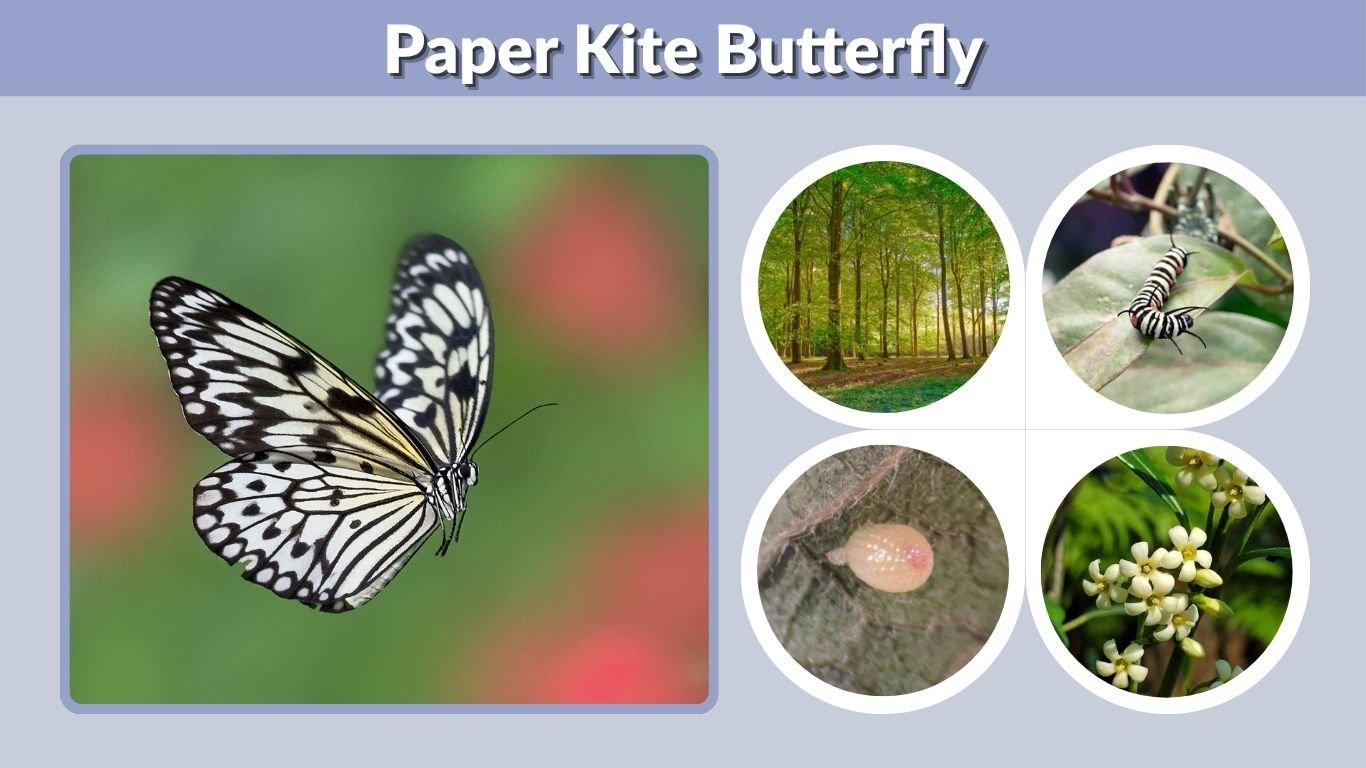
The Paper Kite butterfly (Idea leuconoe) is a beautiful tropical butterfly recognized for its large black-and-white wings and graceful, floating flight. Also called the Rice Paper butterfly or Large Tree Nymph, this fascinating species inhabits tropical forests across Southeast Asia and nearby regions. Its delicate appearance, unusual caterpillar, and shiny golden chrysalis make it especially popular in butterfly gardens and exhibitions. Despite its fragile appearance, the Paper Kite possesses chemical defenses that discourage predators. This guide explains its identification, habitat, diet, life cycle, behavior, and interesting facts.
What Is a Paper Kite Butterfly?
The Paper Kite butterfly is a large tropical butterfly belonging to the Nymphalidae family. Its scientific name is Idea leuconoe, and it is closely related to other tree nymph butterflies.
Its common name comes from its slow, floating flight and delicate, paper-like wings. The species is particularly popular in tropical butterfly houses because of its striking appearance and gentle flying behavior.
Paper Kite Butterfly Facts
- Scientific name: Idea leuconoe
- Common names: Paper Kite, Rice Paper Butterfly, Large Tree Nymph
- Family: Nymphalidae
- Wingspan: Approximately 10–14 cm
- Wing color: Creamy white with black markings
- Native region: Southeast Asia
- Habitat: Tropical forests and coastal vegetation
- Adult food: Flower nectar
- Caterpillar food: Selected plants in the dogbane family
- Defense: Chemical compounds that discourage predators
Paper Kite Butterfly Identification
Identifying a Paper Kite butterfly is relatively easy because of its distinctive black-and-white wing pattern and unusual flying style. Unlike many butterflies that move rapidly between flowers, Paper Kites often glide slowly through the air, resembling lightweight paper decorations floating in the breeze.
Paper Kite Butterfly Appearance
The Paper Kite has broad, elongated wings with creamy-white or pale yellowish backgrounds. Black veins form an intricate network across its wings, while dark spots decorate the outer edges.
Its wings may appear slightly translucent when sunlight passes through them. The butterfly also has a slender body and relatively long antennae.
Its large wingspan makes it noticeably bigger than many common garden butterflies.
Male vs. Female Paper Kite Butterfly
Male and female Paper Kite butterflies look remarkably similar. Both possess black-and-white wing patterns and elongated wings.
Their differences can be difficult to recognize without close examination. Females may have fuller abdomens, particularly when carrying eggs, but this feature alone does not reliably determine sex.
Where Do Paper Kite Butterflies Live?
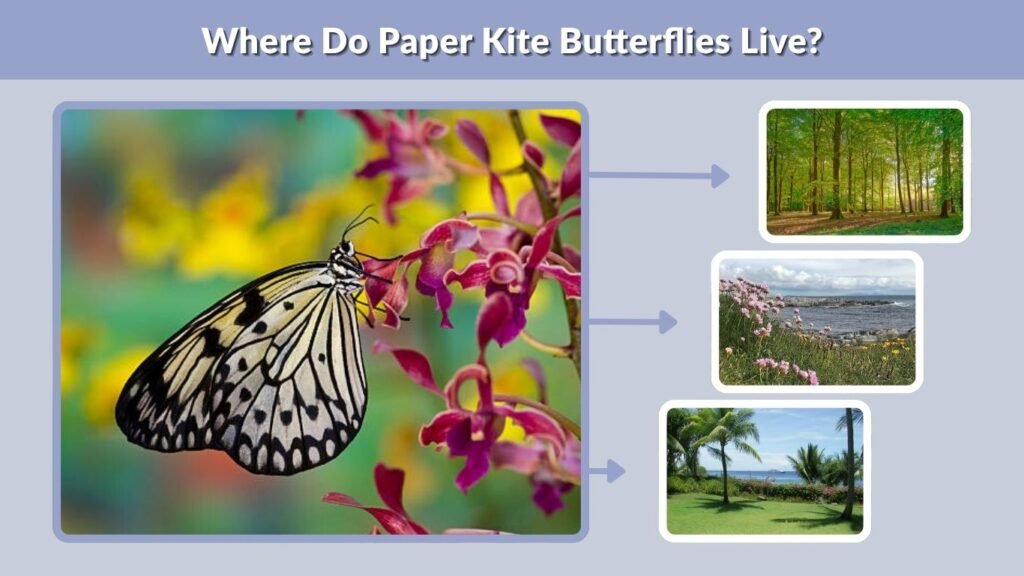
Paper Kite butterflies naturally inhabit warm tropical and subtropical environments. They are associated with forests, coastal vegetation, and places containing suitable caterpillar host plants. Their distribution extends across several Asian countries, and they are also commonly displayed in butterfly conservatories worldwide.
Paper Kite Butterfly Habitat
Paper Kites prefer sheltered environments with abundant vegetation, flowering plants, and suitable breeding conditions.
They often fly among trees and forest edges, where they can feed and search for mates. Some populations also inhabit coastal forests and mangrove-associated habitats.
Warm temperatures and suitable plant availability are important for their survival.
Paper Kite Butterfly Distribution
The species occurs in parts of Southeast Asia, including the Philippines, Malaysia, Indonesia, and Thailand. It also occurs in Taiwan and the southern Japanese islands.
Although visitors may see Paper Kites in butterfly houses in Europe or North America, these captive populations do not indicate that the species is naturally established in those regions.
Paper Kite Butterfly Caterpillar and Chrysalis
The Paper Kite butterfly undergoes remarkable physical changes before becoming an adult. Its caterpillar has striking warning colors, while its chrysalis displays an unusual metallic golden appearance. These developmental stages make the species particularly interesting for butterfly enthusiasts and wildlife photographers.
Paper Kite Butterfly Caterpillar
Paper Kite caterpillars have contrasting black-and-white markings with reddish or orange-red spots and fleshy projections.
These bright patterns help warn predators about their chemical defenses.
The larvae feed on particular host plants containing naturally occurring defensive substances. As they develop, they accumulate compounds that can make them unpleasant or harmful to predators.
Paper Kite Butterfly Chrysalis
The chrysalis is one of the butterfly’s most remarkable features. It often has a shiny golden appearance with dark markings, resembling a small metallic ornament.
The developing butterfly remains protected inside this structure until metamorphosis is complete.
Unlike many moths, Paper Kite butterflies do not normally spin silk cocoons around their pupae.
Paper Kite Butterfly Life Cycle
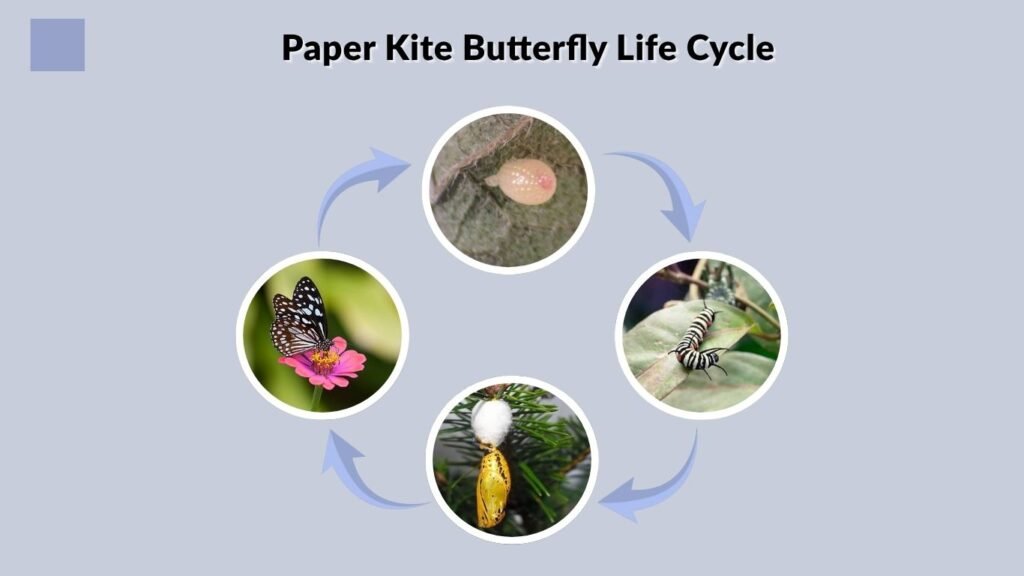
The Paper Kite butterfly undergoes complete metamorphosis, developing through four distinct stages. Its development depends on temperature, food availability, and environmental conditions. Each stage serves a different purpose, allowing the insect to grow, transform, and reproduce.
Four Stages of the Paper Kite Butterfly Life Cycle
- Egg: Female butterflies deposit eggs on suitable host plants, providing newly hatched caterpillars with immediate access to food.
- Caterpillar: The larvae feed on host plant leaves and grow through several molts. Their distinctive markings become more noticeable as they mature.
- Chrysalis: Mature caterpillars transform into golden pupae. Inside, their bodies undergo major structural changes.
- Adult butterfly: The butterfly emerges, expands its wings, and begins feeding on nectar. Adults eventually mate and reproduce.
Development time varies depending on environmental conditions.
What Do Paper Kite Butterflies Eat?
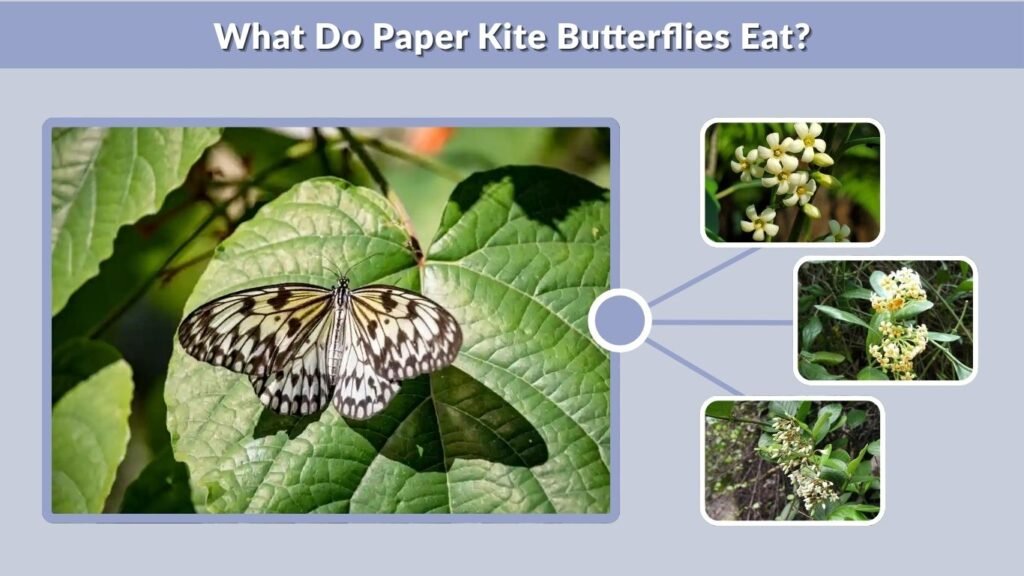
Adult Paper Kite butterflies and their caterpillars have different diets. Adults primarily feed on nectar, while caterpillars depend on particular host plants. These feeding relationships influence where the butterflies live and reproduce.
Paper Kite Butterfly Host Plants
Paper Kite caterpillars feed on selected plants belonging to the Apocynaceae family.
Recorded host plants include:
- Parsonsia species
- Parsonsia helicandra
- Parsonsia spiralis
- Tylophora hispida
- Cynanchum formosanum
These plants can contain defensive chemicals that caterpillars retain during development.
Adult Paper Kite Butterfly Diet
Adult Paper Kites primarily consume nectar from flowering plants.
They use their long, flexible proboscis to reach nectar inside flowers. This provides energy for flying, reproduction, and other activities.
Their slow movement makes them relatively easy to observe while feeding in tropical butterfly gardens.
Are Paper Kite Butterflies Poisonous?
Paper Kite butterflies possess chemical defenses that make them unpleasant or potentially harmful to predators that eat them. Their caterpillars obtain defensive compounds from particular host plants.
The contrasting black-and-white wing pattern may act as a warning signal to birds and other predators.
However, Paper Kites are not venomous and do not sting people. They are not generally dangerous through ordinary contact.
Their defensive chemistry explains why they can fly slowly without relying entirely on speed to escape predators.
Paper Kite Butterfly in Animal Crossing: New Horizons
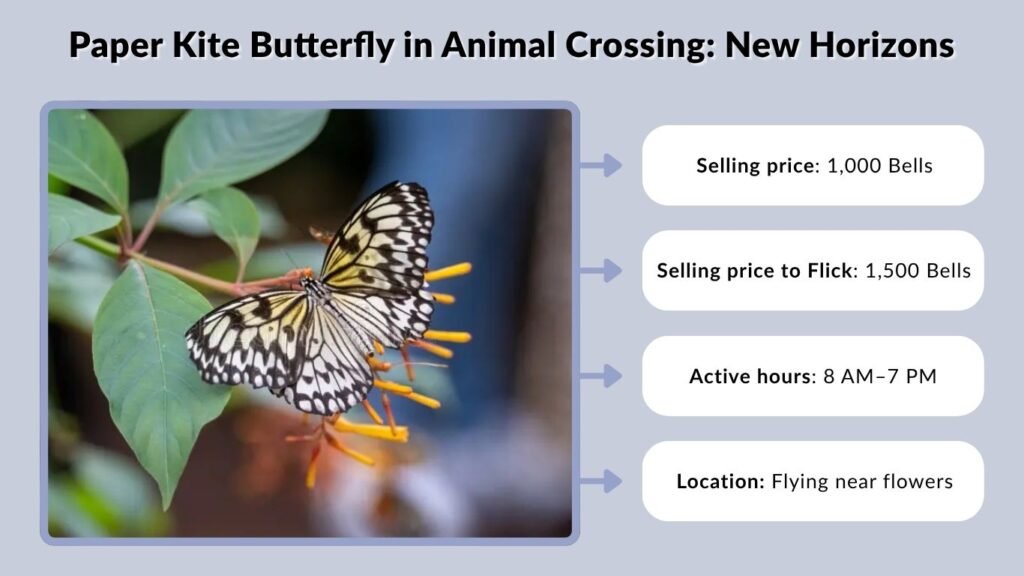
The Paper Kite butterfly also appears in Animal Crossing: New Horizons (ACNH). Players can capture this large black-and-white butterfly while exploring their islands.
It is available throughout the year in both hemispheres, making it a collectible insect for players building their museum collections.
Paper Kite Butterfly Price and Catching Guide
- Selling price: 1,000 Bells
- Selling price to Flick: 1,500 Bells
- Available months: January through December
- Active hours: 8 AM–7 PM
- Location: Flying near flowers
- Weather: Does not appear during rain
- Catching method: Approach carefully and use a bug net
Players can donate their first captured Paper Kite butterfly to the museum or sell additional specimens.
Paper Kite Butterfly Meaning and Symbolism
Paper Kite butterflies are sometimes associated with transformation, freedom, beauty, and peacefulness. Their graceful movement and delicate wing patterns have inspired artwork, butterfly tattoos, and decorative designs.
In symbolic interpretations, their transformation from caterpillar to butterfly may represent personal growth or new beginnings.
These meanings are cultural or personal rather than scientifically established characteristics of the species.
FAQs
1. Where Are Paper Kite Butterflies From?
Paper Kite butterflies are native to Southeast Asia and nearby regions, including parts of Japan and Taiwan. They inhabit tropical forests and other suitable vegetation-rich environments. They are also displayed in butterfly houses around the world.
2. Are Paper Kite Butterflies Poisonous to Humans?
Paper Kite butterflies contain chemical defenses that discourage predators from eating them. However, they are not venomous and generally pose no danger to humans through ordinary contact. Their defensive compounds are mainly important for protection against predators.
3. How Long Do Paper Kite Butterflies Live?
Paper Kite butterfly lifespan depends on environmental conditions and protection from predators. Adults may survive several weeks or longer. Under favorable captive conditions, some individuals have been reported to live for approximately six months.
4. Why Is It Called a Paper Kite Butterfly?
The Paper Kite butterfly receives its name from its large, delicate wings and slow, floating flight. Its movement resembles a lightweight paper kite drifting through the air. It is also commonly known as the Rice Paper butterfly.
5. How Much Is a Paper Kite Butterfly Worth in Animal Crossing?
In Animal Crossing: New Horizons, a Paper Kite butterfly sells for 1,000 Bells at Nook’s Cranny or 1,500 Bells when sold to Flick. Players can catch it near flowers between 8 AM and 7 PM throughout the year.