
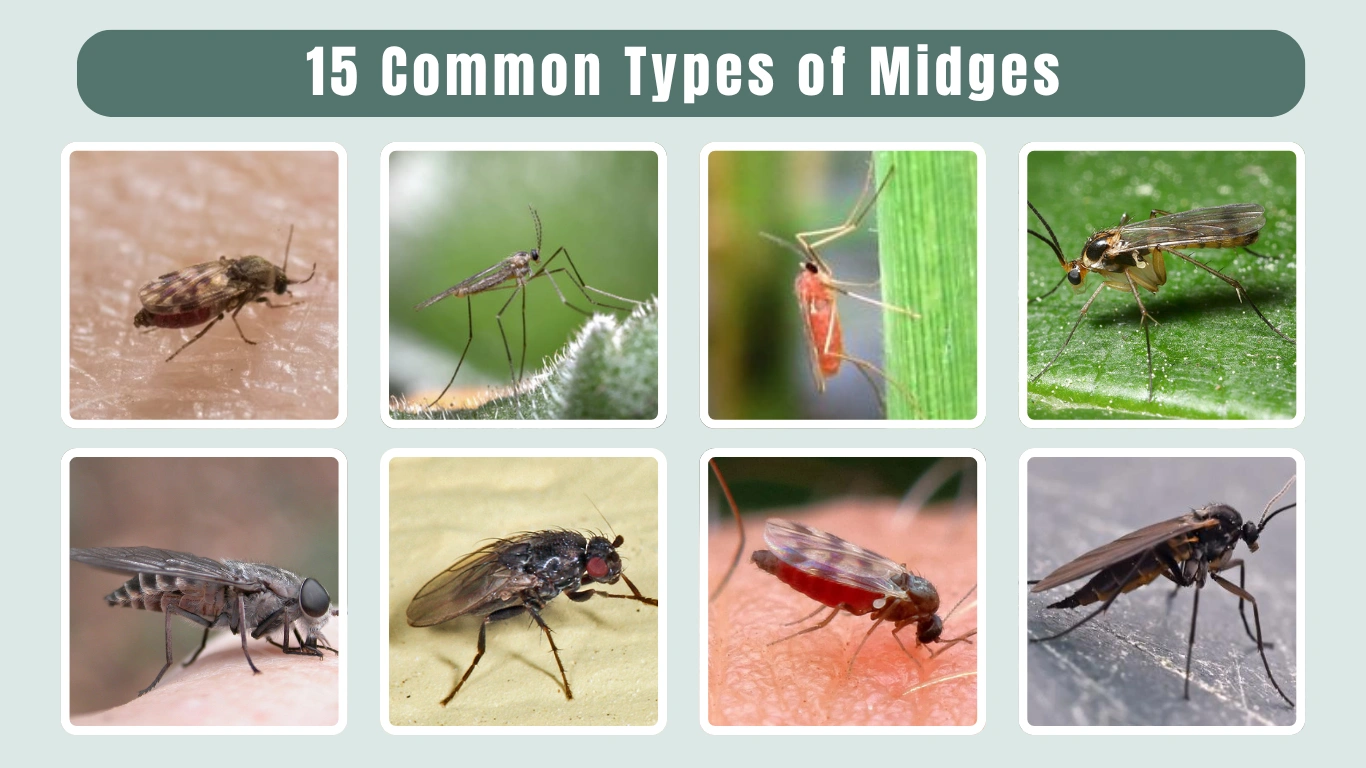
Midges are small, fly-like insects that belong to several families within the order Diptera. While some midges bite and cause irritation, others are harmless or even beneficial. They play crucial roles in ecosystems—from pollination and decomposition to serving as food for fish and birds. This guide covers 15 common types of midges, including biting midges, non-biting midges, gall midges, phantom midges, and more, along with their key traits and habitats.
1. Biting Midges (Ceratopogonidae)

Biting midges are tiny blood-feeding flies, commonly known as no-see-ums, punkies, or sandflies (not to be confused with true sandflies of the family Psychodidae). Despite their small size, their bites can be painful and irritating.
Identification
- Color: Gray to dark brown
- Size: 1–3 mm
- Wings: Clear or patterned with dark spots
- Body: Compact, with short legs and long antennae
- Mouthparts: Piercing-sucking type for feeding on blood
Habitat and Distribution
Biting midges are found worldwide, especially in tropical and coastal regions, wetlands, and marshes. They breed in moist soil, mud, damp sand, and vegetation-rich aquatic edges.
Behavior
Females feed on blood from mammals, birds, or reptiles to produce eggs. Males feed on nectar. These midges are most active during dawn and dusk, and their bites can cause itching, allergic reactions, or even transmit diseases like bluetongue virus in livestock.
2. Non-Biting Midges (Chironomidae)
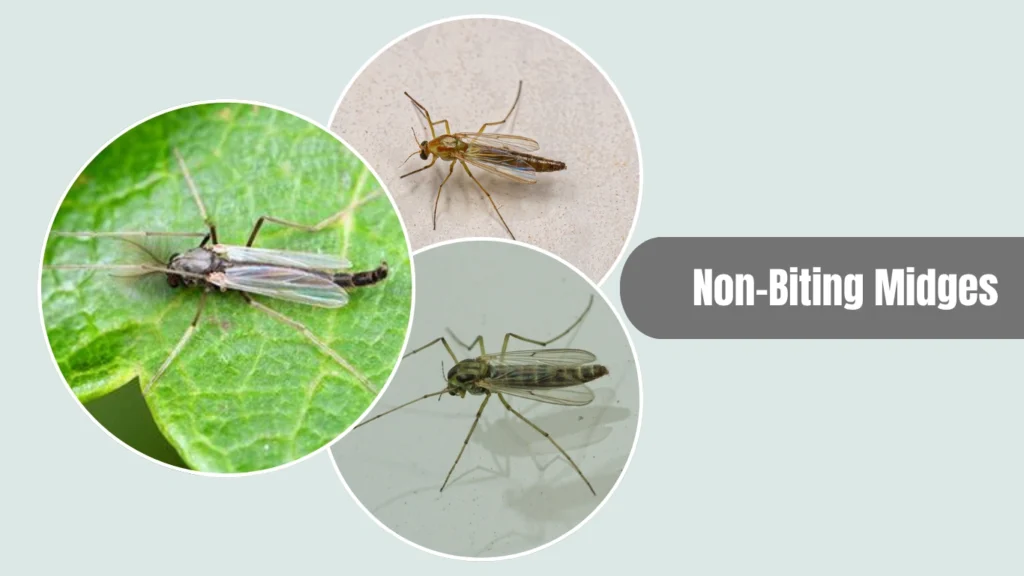
Non-biting midges are often mistaken for mosquitoes due to their similar appearance, but they do not bite or feed on blood. They are vital for freshwater ecosystems, serving as a major food source for fish and other aquatic animals.
Identification
- Color: Green, brown, black, or red
- Size: 2–10 mm
- Wings: Clear, without scales (unlike mosquitoes)
- Body: Slender with long legs and antennae
- Mouthparts: Reduced; adults do not feed
Habitat and Distribution
Found worldwide, especially near lakes, rivers, ponds, and wetlands. Larvae (often called “bloodworms” due to their red color) live in sediment and are common in both clean and polluted waters.
Behavior
Adults form large mating swarms, often in the evening. Though harmless, swarms can be a nuisance near homes and water bodies. Larvae play a crucial role in the aquatic food chain and help break down organic matter.
3. Gall Midges (Cecidomyiidae)

Gall midges are tiny flies whose larvae cause unusual plant growths called galls. These galls can form on leaves, stems, flowers, or roots, depending on the midge species.
Identification
- Color: Yellow, orange, or dark brown
- Size: 1–3 mm
- Wings: Hairy and delicate, often held roof-like
- Body: Small and slender with long legs
- Antennae: Beaded or segmented
Habitat and Distribution
Found globally, especially in gardens, forests, and agricultural fields. Each species tends to target specific host plants, from grasses and vegetables to trees and shrubs.
Behavior
Larvae feed inside plant tissue, triggering the plant to form a gall that shelters and feeds them. Some species are pests, while others are beneficial, such as predatory gall midges used in biological control against aphids.
4. Phantom Midges (Chaoboridae)
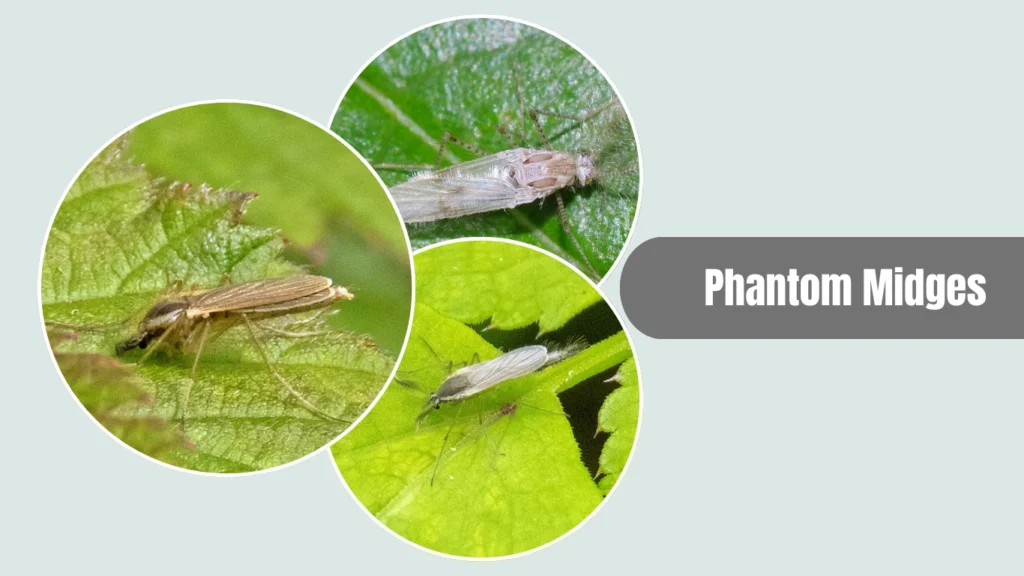
Phantom midges are transparent, aquatic insects known for their ghost-like larvae that float mid-water in lakes and ponds. Though they resemble mosquitoes, they do not bite and are ecologically important predators.
Identification
- Color: Adults are gray to dark; larvae are nearly transparent
- Size: Adults 4–8 mm; larvae 5–15 mm
- Wings: Clear, narrow with light venation
- Body: Slender with long legs
- Larvae: Transparent with visible air sacs for buoyancy
Habitat and Distribution
Found in freshwater lakes, ponds, and deep still waters across North America, Europe, Africa, and Asia. Larvae float in midwater zones, often in deeper, darker areas.
Behavior
Larvae are predators of tiny aquatic organisms like zooplankton. Adults are nocturnal and often attracted to lights. They play a role in food webs by linking small plankton to larger predators like fish.
5. Fungus Gnats (Sciaridae, sometimes grouped with midges)

Fungus gnats are small, dark insects often mistaken for midges. They are commonly found indoors and in greenhouses where larvae feed on fungi and decaying plant material.
Identification
- Color: Black or dark gray
- Size: 2–4 mm
- Wings: Long and slender with Y-shaped vein pattern
- Body: Thin with long legs and antennae
- Larvae: White, legless with black heads
Habitat and Distribution
Widespread in moist soil, greenhouses, houseplants, and decaying vegetation. Common in temperate and subtropical climates.
Behavior
Adults are weak fliers and often seen near potted plants. Larvae live in soil and can damage seedlings by feeding on roots and fungi. While they don’t bite, infestations can be a nuisance indoors.
6. Wood Midges (Lestremiinae, subfamily of Cecidomyiidae)

Wood midges are tiny, delicate insects associated with decaying wood and fungi. Their larvae feed on fungal spores and organic material found in rotting tree trunks, logs, and forest litter.
Identification
- Color: Light brown to yellowish
- Size: 1–3 mm
- Wings: Narrow, hairy, and weakly veined
- Body: Slender with long antennae and legs
- Larvae: Soft-bodied, legless, often found in moist wood
Habitat and Distribution
Common in woodlands and forests across North America, Europe, and Asia, especially where fallen logs and moist decomposing wood are abundant.
Behavior
Larvae develop in fungus-infested wood and contribute to decomposition. Adults are short-lived, non-biting, and usually fly close to the forest floor.
7. March Flies (Bibionidae)

March flies, sometimes considered large non-biting midges, are stout, hairy flies that emerge in spring in large swarms. They are also known as lovebugs in some regions.
Identification
- Color: Black or reddish-black
- Size: 6–12 mm
- Wings: Clear or smoky, often held flat over the body
- Body: Robust with short antennae
- Legs: Long with swollen femora
Habitat and Distribution
Found in grassy fields, meadows, gardens, and along forest edges throughout temperate and subtropical zones worldwide.
Behavior
Adults often swarm in spring (hence the name “March” flies). They feed on nectar or not at all. Larvae live in soil, feeding on decaying organic matter and plant roots. In large numbers, they can damage crops or lawns.
8. Black Midges (Simuliidae) – Often Referred to as Black Flies

Black midges, more commonly known as black flies, are small, dark, biting insects that breed in fast-moving water. Some species are notorious for their painful bites and role in spreading disease.
Identification
- Color: Black or dark gray
- Size: 1.5–5 mm
- Wings: Short, broad, and clear with few veins
- Body: Humpbacked appearance with short antennae
- Mouthparts: Cutting-lapping type for blood feeding
Habitat and Distribution
Found worldwide, especially in cool, fast-flowing rivers and streams. Common in North America, Africa, and northern Europe.
Behavior
Females require blood meals for egg development and often bite humans and animals. Some species transmit Onchocerciasis (river blindness) in parts of Africa. Swarms can be a major outdoor nuisance.
9. Sphaerocerid Midges (Sphaeroceridae) – Lesser Dung Flies

Sphaerocerid midges, or lesser dung flies, are tiny flies often found in decaying organic matter, including dung, compost, and rotting vegetation. Though not true midges, their size and habitat often cause confusion.
Identification
- Color: Dark brown to black
- Size: 0.5–4 mm
- Wings: Short, rounded with few veins
- Body: Stocky and shiny
- Antennae: Short, with bristle-like arista
Habitat and Distribution
Found globally, especially in farms, stables, compost heaps, and sewage systems. Thrive in decomposing organic waste.
Behavior
Larvae feed on bacteria and decaying materials. While harmless to humans, large numbers can indicate sanitation issues. Adults may become a nuisance when disturbed indoors or around food-handling areas.
10. Coastal Midges (Various Ceratopogonidae species)

Coastal midges are biting midges commonly found near beaches, salt marshes, and mangroves. They are notorious for their painful bites and are often referred to as “sandflies” in tropical and coastal regions.
Identification
- Color: Light gray to dark brown
- Size: 1–2 mm
- Wings: Spotted or clear, held flat when at rest
- Body: Tiny and compact with long antennae
- Mouthparts: Piercing-sucking for blood feeding
Habitat and Distribution
Widely distributed in tropical and subtropical coastal areas including Florida, the Caribbean, Southeast Asia, and Australia. Larvae develop in wet sand, mudflats, or mangrove roots.
Behavior
Females bite humans, especially during dawn and dusk when humidity is high. Bites cause intense itching and swelling. Adults are weak fliers and can be repelled with fine mesh screens or insect repellents.
11. Snow Midges (Boreochlus spp.)

Snow midges are unique among midges in that they are active during winter and often found walking on snow. They are among the few insects adapted to cold, snowy environments.
Identification
- Color: Black or dark brown
- Size: 2–3 mm
- Wings: Reduced or absent in some species
- Body: Short and compact with long legs
- Antennae: Long and thread-like
Habitat and Distribution
Found in alpine and subalpine regions of North America, Scandinavia, and Asia, particularly on snow-covered forest floors and near frozen streams.
Behavior
Adults are wingless or weak fliers and crawl across snow to mate and lay eggs. Larvae live in moist soil beneath snow or in icy stream banks. Despite harsh conditions, they are important in nutrient cycling in cold ecosystems.
12. Glacier Midges (Diamesa spp.)

Glacier midges are cold-adapted non-biting midges that thrive in glacial and alpine stream environments. They are among the few insects capable of surviving near-freezing water temperatures year-round.
Identification
- Color: Dark gray to black
- Size: 3–5 mm
- Wings: Clear, narrow with fine veins
- Body: Slender with long legs and antennae
- Larvae: Dark or reddish, often found clinging to rocks in icy streams
Habitat and Distribution
Common in high-elevation or polar regions across Europe, North America, and Asia, particularly in glacier-fed streams, alpine seeps, and cold springs.
Behavior
Larvae cling to submerged stones and graze on algae and detritus. Adults are short-lived and typically emerge in summer, despite the frigid conditions of their habitat.
13. Predatory Midges (Clinocerinae, subfamily of Empididae)

Predatory midges are agile, carnivorous insects that feed on smaller aquatic invertebrates. Though not true midges, their small size and aquatic behavior cause them to be grouped with other midge-like flies.
Identification
- Color: Brown to black
- Size: 3–6 mm
- Wings: Clear, held flat or roof-like over the body
- Body: Slender and muscular
- Mouthparts: Piercing or grasping for catching prey
Habitat and Distribution
Found in clean, fast-flowing streams, cold creeks, and woodland springs across North America, Europe, and Asia.
Behavior
Larvae and adults are predators that actively hunt mosquito larvae, midges, and other small aquatic insects. They play an important role in maintaining ecological balance in freshwater systems.
14. Soil Midges (Bradysia spp.)

Soil midges, often grouped with fungus gnats, are tiny insects that thrive in moist soils, especially in potted plants and greenhouses. Their larvae feed on decaying organic matter and sometimes plant roots.
Identification
- Color: Dark gray to black
- Size: 2–4 mm
- Wings: Clear with a Y-shaped vein pattern
- Body: Slender with long legs and antennae
- Larvae: White, legless with shiny black heads
Habitat and Distribution
Common in greenhouses, nurseries, gardens, and indoor potted plants worldwide. Thrive in rich, damp soil and decaying vegetation.
Behavior
Adults are weak fliers and often seen hovering around soil surfaces. Larvae can damage young plants by feeding on root hairs. While harmless to humans, large infestations can be harmful to seedlings and ornamental plants.
15. Swarming Midges (Chironomidae – various species)

Swarming midges are non-biting midges that form large clouds during mating. These swarms are often seen over water bodies, lawns, or urban lights and can be mistaken for mosquitoes.
Identification
- Color: Green, brown, or black
- Size: 3–10 mm
- Wings: Transparent and narrow, lacking scales
- Body: Slender with long antennae (feathery in males)
- Mouthparts: Reduced, non-functional in adults
Habitat and Distribution
Found globally near lakes, rivers, ponds, and marshes. Particularly common in temperate and subtropical climates.
Behavior
Adults do not feed and live only a few days to mate. Males gather in large swarms during dusk, often above reflective surfaces or vegetation. Though harmless, they can become a nuisance in residential and urban areas when numbers are high.
