
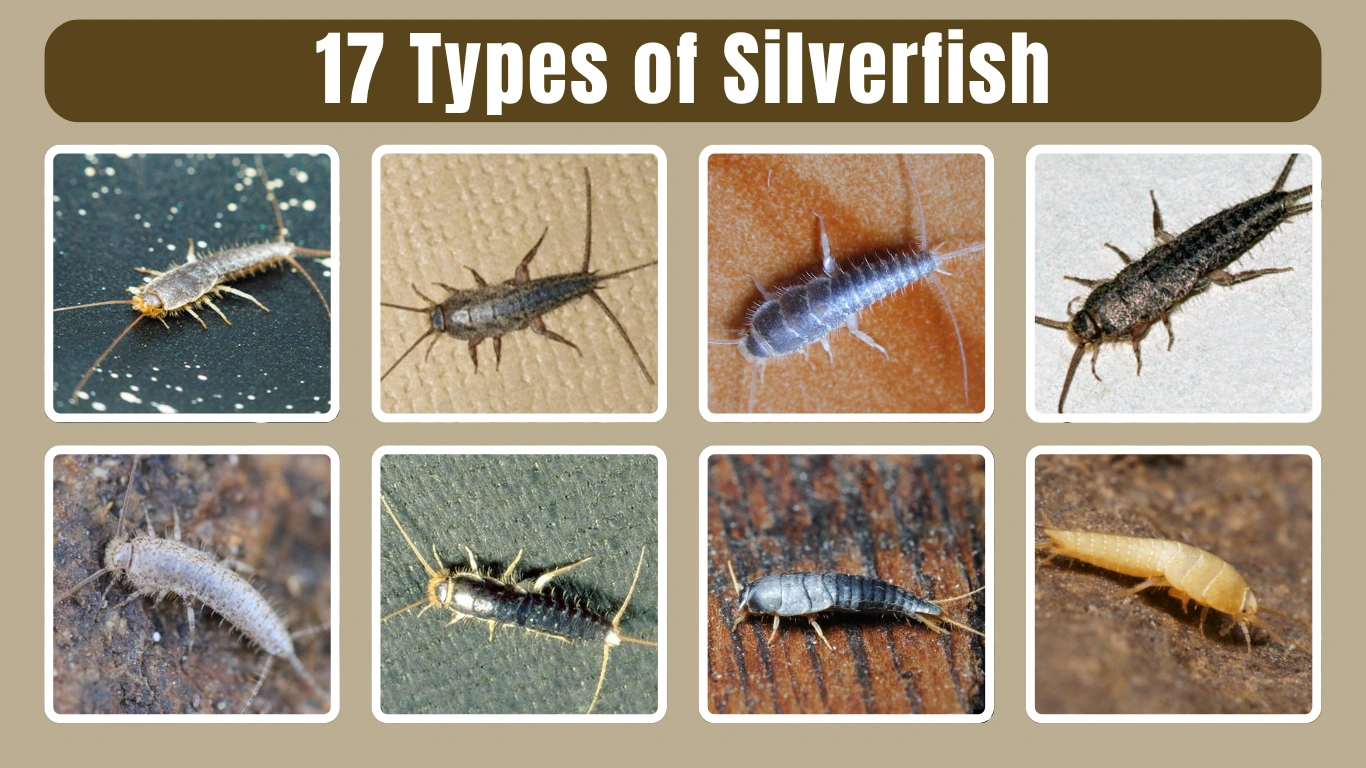
Silverfish are primitive, wingless insects known for their silvery scales, quick movements, and ability to thrive in dark, hidden spaces. While the Common Silverfish is well known as a household pest, there are many other species with unique traits and habitats. This guide covers 17 different types of silverfish, including common invaders like the Firebrat and Gray Silverfish, as well as rare, regional species found in natural and urban environments across the world.
1. Common Silverfish (Lepisma saccharinum)

The Common Silverfish is the most well-known species in the silverfish family. Recognized for its fish-like shape and silvery sheen, it’s a nocturnal household pest that thrives in humid indoor environments such as bathrooms, kitchens, and basements.
Identification
- Color: Silvery-gray with a metallic sheen
- Size: 12–15 mm long (excluding antennae and tail filaments)
- Body Shape: Flattened, tapered, and fish-like
- Antennae: Long and thread-like
- Tail: Three long bristle-like appendages at the rear
Habitat and Distribution
Found worldwide, particularly in damp, dark areas of homes and buildings. Common in North America, Europe, Asia, and Australia. They hide in cracks, behind baseboards, or under sinks and bathtubs.
Behavior
Silverfish are nocturnal and avoid light. They feed on starches, paper, glue, fabric, and dead insects. Though harmless to humans and pets, they can damage books, wallpaper, and stored fabrics over time. Infestations are often persistent due to their ability to survive for months without food.
2. Firebrat (Thermobia domestica)

The Firebrat is a close relative of the common silverfish but prefers warmer environments. It is often found near furnaces, water heaters, and boilers, thriving in places with both high heat and humidity.
Identification
- Color: Mottled gray and brown with a speckled appearance
- Size: 10–12 mm long
- Body Shape: Flat, teardrop-shaped with three tail filaments
- Antennae: Long and slender
- Tail: Three long bristles at the rear, similar to silverfish
Habitat and Distribution
Firebrats are distributed globally, commonly found in industrial settings, laundry rooms, and hot water closets. They prefer temperatures above 32°C (90°F).
Behavior
Nocturnal and fast-moving, firebrats feed on carbohydrate-rich materials like glue, paper, fabrics, and even crumbs. Though not harmful to health, they can damage stored goods, insulation, and wallpaper if left unchecked.
3. Gray Silverfish (Ctenolepisma longicaudatum)
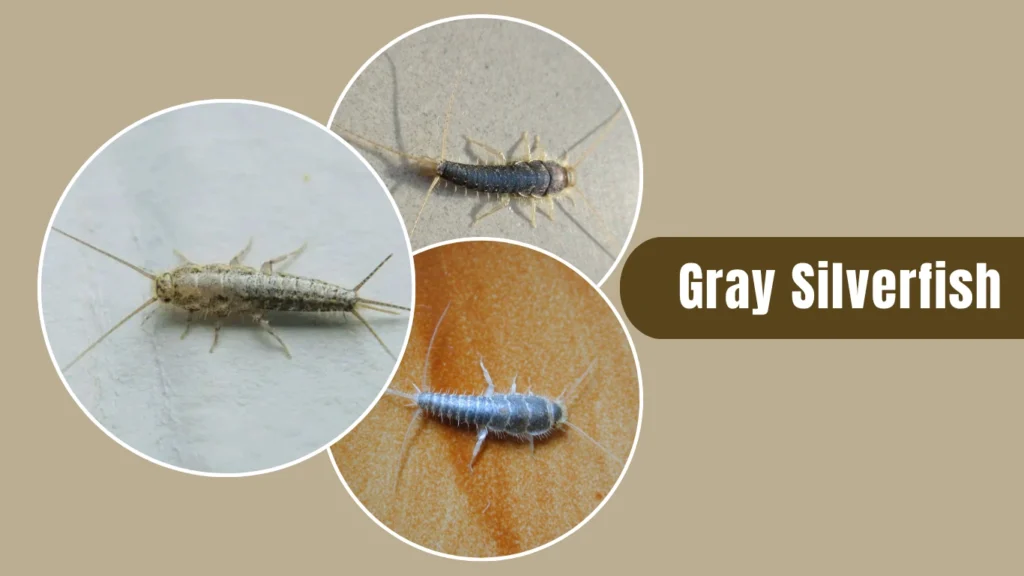
The Gray Silverfish is one of the most widespread and increasingly common household pests in Europe and North America. It is larger than the common silverfish and can survive in drier environments.
Identification
- Color: Uniform gray or silvery-gray
- Size: 13–19 mm long
- Body Shape: Elongated, flattened with fine scales
- Antennae: Very long and slender
- Tail: Three long bristles with equal length
Habitat and Distribution
Originally native to Africa, this species is now found across Europe, North America, and parts of Asia. It lives in both damp and dry indoor spaces, including attics, bookshelves, and storage rooms.
Behavior
More resilient than other silverfish, the gray silverfish is active year-round and hides during the day. It feeds on cellulose, starches, glue, and textiles, posing a risk to books, documents, and clothing.
4. Four-lined Silverfish (Ctenolepisma lineata)
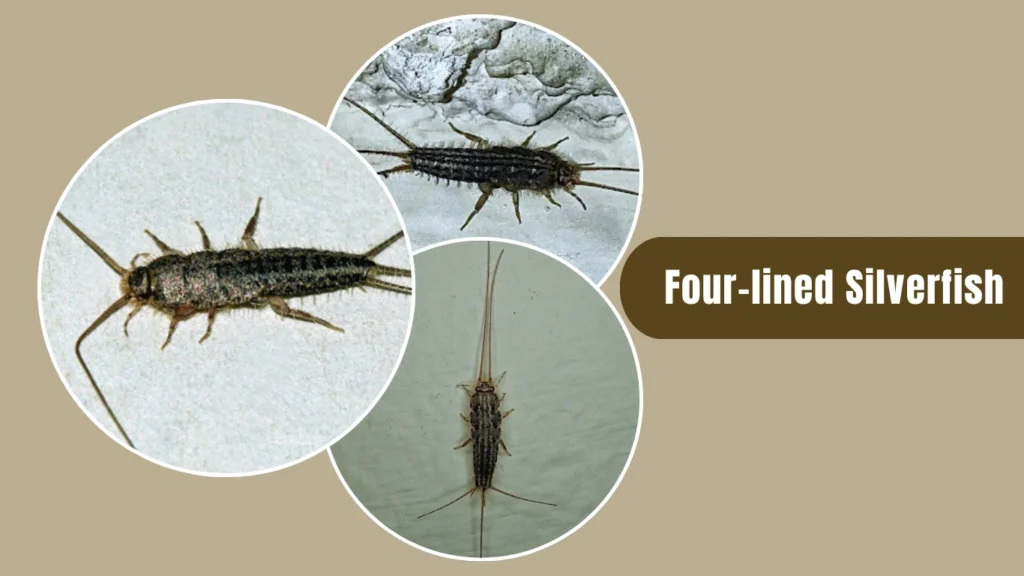
The Four-lined Silverfish gets its name from the four distinct dark lines that run lengthwise along its body. It is commonly found indoors and outdoors in warm regions, especially in undisturbed, dusty areas.
Identification
- Color: Brownish-gray with four dark dorsal stripes
- Size: 10–14 mm long
- Body Shape: Elongated and flattened with tapering ends
- Antennae: Long and flexible
- Tail: Three long tail filaments
Habitat and Distribution
Widespread in southern United States, Mexico, and Mediterranean climates. It thrives in attics, closets, baseboards, and even beneath bark and rocks outdoors.
Behavior
Four-lined silverfish are nocturnal and feed on paper, cardboard, dried foods, and even hair. Though not aggressive, they can be persistent invaders in storage spaces and older buildings.
5. Giant Silverfish (Ctenolepisma ciliatum)

The Giant Silverfish is one of the largest members of the silverfish family. It is known for its size and dense body scales, which give it a velvety appearance. It is mostly found in warmer, drier indoor environments.
Identification
- Color: Silvery-brown to gray
- Size: 15–20 mm long
- Body Shape: Broad and robust with a slightly thicker abdomen
- Antennae: Very long and curved
- Tail: Three strong, long tail filaments
Habitat and Distribution
Native to Mediterranean and subtropical regions, including parts of Europe, North Africa, and Southwest Asia. Often found in dry storage areas, libraries, and old buildings.
Behavior
Less dependent on humidity than other silverfish, it feeds on paper, starches, and organic debris. Due to its larger size, infestations can be more noticeable, especially when disturbed.
6. Seaside Silverfish (Ctenolepisma guadianicum)
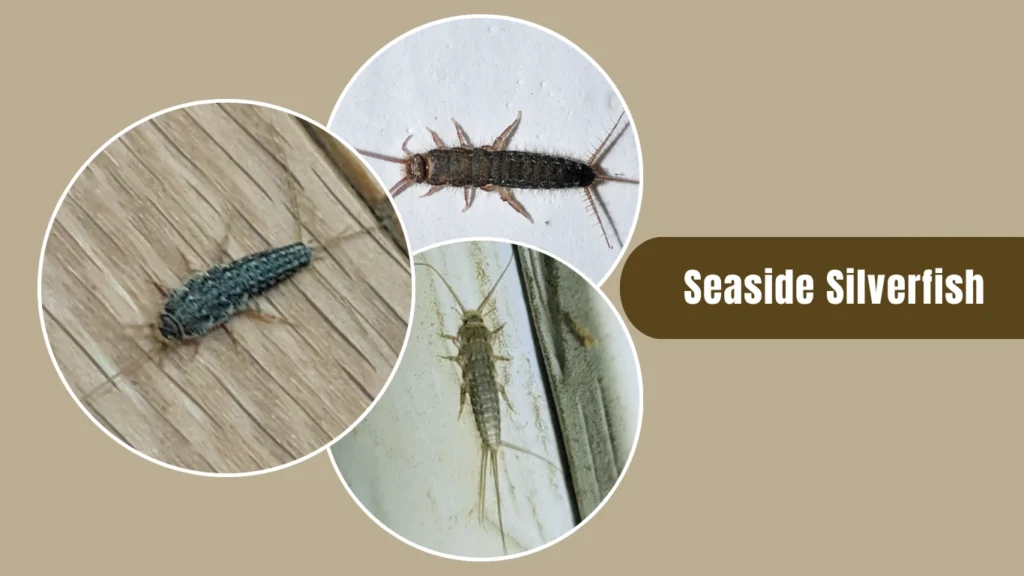
The Seaside Silverfish is a coastal species adapted to humid, salty environments near beaches and shorelines. While not commonly found indoors, it may occasionally enter seaside buildings or cottages.
Identification
- Color: Silvery-gray to pale brown
- Size: 9–13 mm long
- Body Shape: Slim, elongated, and covered in fine scales
- Antennae: Long and segmented
- Tail: Three tail filaments with matching length
Habitat and Distribution
Found in southern Europe, particularly Spain and Portugal, and along coastal areas. It prefers rocks, sandy crevices, and beach vegetation near the shoreline.
Behavior
Primarily active at night, this species feeds on organic beach debris, algae, and plant matter. It is rarely a pest but may wander indoors in coastal homes or facilities.
7. Urban Silverfish (Ctenolepisma urbanum)
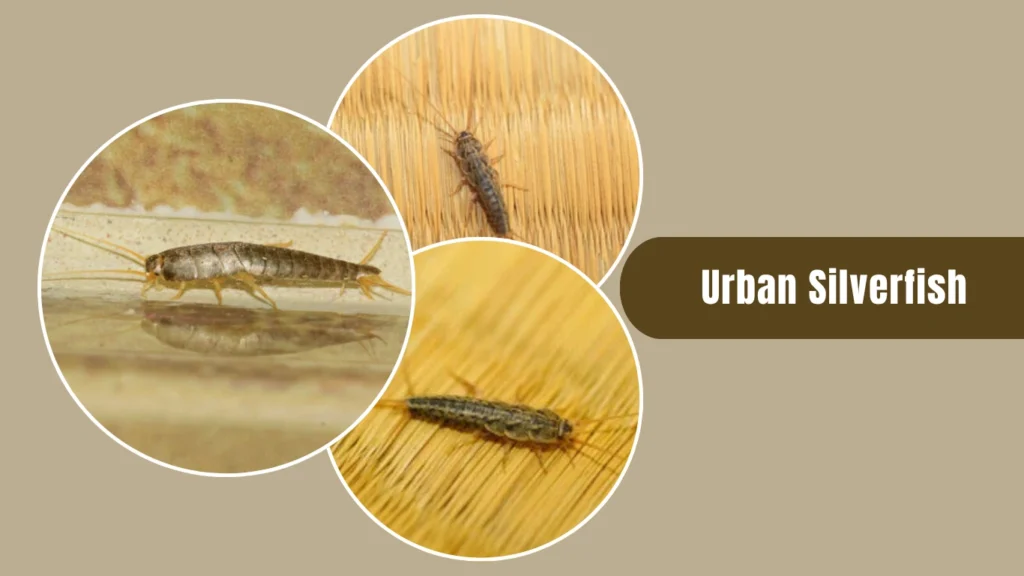
The Urban Silverfish is a house-adapted species that thrives in modern environments. It’s well-suited to dry indoor climates and is commonly found in apartment buildings and office spaces.
Identification
- Color: Pale gray to light brown
- Size: 10–14 mm long
- Body Shape: Flattened and oval with smooth, shiny scales
- Antennae: Long, thin, and widely spread
- Tail: Three tail-like bristles
Habitat and Distribution
Widespread in urban centers across Europe, Asia, and parts of North America. Typically inhabits ceilings, wall cavities, baseboards, and behind appliances.
Behavior
Unlike some silverfish that prefer moisture, this species tolerates dry conditions well. It feeds on paper, glue, synthetic fibers, and even dust. It’s discreet but persistent once established indoors.
8. Ctenolepisma rothschildi

Ctenolepisma rothschildi is a hardy silverfish species found in both tropical and temperate regions. It is often discovered in museums, libraries, and historical buildings, where it can damage valuable materials.
Identification
- Color: Pale gray or silver with fine scales
- Size: 10–13 mm long
- Body Shape: Narrow, elongated with a slight taper
- Antennae: Long and thin, almost body-length
- Tail: Three filaments, equal in length
Habitat and Distribution
Reported across Europe, North Africa, Australia, and Asia, especially in indoor environments like storage facilities, archives, and older structures.
Behavior
This species is known for feeding on paper, wallpaper glue, fabrics, and even old book bindings. It prefers warm, undisturbed indoor spaces, and its slow development helps it go unnoticed until significant damage occurs.
9. Ctenolepisma almeriense

Ctenolepisma almeriense is a lesser-known species, native to Spain, particularly the Almería region, where it inhabits arid environments and dry stone structures.
Identification
- Color: Gray to dark gray with subtle striping
- Size: About 9–12 mm
- Body Shape: Slender and tapering with body scales
- Antennae: Long and flexible
- Tail: Three long, fine tail filaments
Habitat and Distribution
Endemic to southeastern Spain, often found in dry outdoor areas, abandoned structures, and stone walls.
Behavior
This species is more adapted to arid conditions than most silverfish and is typically seen in dry, rocky microhabitats. It is rarely a household pest but of interest to researchers due to its regional specificity.
10. Ctenolepisma targionii

Ctenolepisma targionii is a silverfish species more commonly found in southern Europe and the Mediterranean region. It prefers dry, warm habitats and can be found both indoors and outdoors.
Identification
- Color: Light gray to silver, sometimes with subtle striping
- Size: 10–13 mm long
- Body Shape: Slender and slightly arched with shiny scales
- Antennae: Very long and slender
- Tail: Three evenly spaced bristle-like filaments
Habitat and Distribution
Native to Italy, Spain, and nearby Mediterranean areas, it inhabits dry homes, attics, and cracks in stone walls. Often found in older buildings with minimal humidity.
Behavior
This species is more tolerant of dry and warm conditions than many other silverfish. It feeds on starches, paper, glue, and dead insects, but generally remains hidden and inactive during the day.
11. Ctenolepisma vieirai

Ctenolepisma vieirai is a rare and localized silverfish species found mainly in Portugal. It was first described in the 20th century and is considered a species of interest for biodiversity studies in the Iberian Peninsula.
Identification
- Color: Light brown or silvery-gray
- Size: 9–11 mm
- Body Shape: Streamlined with fine scales
- Antennae: Long and thin
- Tail: Three prominent tail bristles
Habitat and Distribution
Primarily found in Portugal, especially in rural or natural rocky environments. Rarely seen in modern homes.
Behavior
Its lifestyle is not well documented, but like other silverfish, it likely feeds on organic debris, plant matter, and possibly fungal growth. It is usually found in cool, shaded, and undisturbed areas.
12. Ctenolepisma bicolor

Ctenolepisma bicolor is a striking silverfish species known for its two-tone coloration. It is less common in homes but occasionally found in warmer indoor environments and outdoor shelters in subtropical regions.
Identification
- Color: Front half silvery-gray, rear half darker or brownish
- Size: 10–12 mm
- Body Shape: Slender with distinct contrast between head and abdomen
- Antennae: Long and delicate
- Tail: Three filaments of equal length
Habitat and Distribution
Recorded in parts of Southern Europe, North Africa, and South Asia. Found in dry buildings, under stones, and leaf litter in warm regions.
Behavior
Feeds on cellulose, paper, starch, and dried plant material. Its distinct coloring helps in visual identification but it behaves similarly to other household silverfish—nocturnal, fast-moving, and light-avoiding.
13. Lepisma baeticum

Lepisma baeticum is a rare silverfish species native to southern Spain, particularly within the Baetic mountain region, from which it gets its name. It is mainly studied for its ecological significance rather than as a pest.
Identification
- Color: Pale gray to translucent
- Size: 8–10 mm
- Body Shape: Small, soft-bodied, and elongated
- Antennae: Medium-length, slightly curved
- Tail: Three fine, equal-length filaments
Habitat and Distribution
Endemic to southern Spain, especially in dry rocky crevices, caves, and natural stone shelters.
Behavior
This species lives in natural, undisturbed habitats, where it feeds on organic debris. It is rarely seen indoors and poses no known risk to property or stored materials. Its presence is of interest mostly to entomologists and biodiversity researchers.
14. Neoasterolepisma pallidum

Neoasterolepisma pallidum is a lesser-known silverfish species that thrives in dry indoor environments. It is part of a genus often found in residences, warehouses, and old buildings, where it feeds on starchy substances.
Identification
- Color: Pale silvery-white to light gray
- Size: Around 10–12 mm
- Body Shape: Slender, elongated with fine body scales
- Antennae: Very long, often body-length
- Tail: Three evenly spaced long bristles
Habitat and Distribution
Found in Europe and parts of the Middle East, especially in dry storage rooms, attics, and under floorboards.
Behavior
Nocturnal and shy, this species feeds on paper, fabric glue, dead insects, and synthetic materials. It prefers drier conditions than many silverfish and is often found in older wooden structures.
15. Neoasterolepisma crassipes

Neoasterolepisma crassipes is a silverfish species characterized by its thicker, more robust legs, which give it a slightly heavier appearance. It is typically found in arid environments or dry indoor spaces.
Identification
- Color: Grayish with subtle brown markings
- Size: 9–11 mm
- Body Shape: Oval and broad, covered in fine scales
- Antennae: Long and feathery
- Tail: Three tail filaments of similar length
Habitat and Distribution
Reported in Mediterranean and North African regions, where it occupies dry, low-humidity shelters, including buildings, walls, and cracked masonry.
Behavior
This species avoids moisture and is adapted to arid conditions. It feeds on starch-based materials, including wallpaper paste, bookbinding glue, and certain fabrics. Its strong legs allow for quick movement when disturbed.
16. Sceletolepisma michaelseni

Sceletolepisma michaelseni is a rugged silverfish species often found in outdoor environments such as under rocks, leaf litter, and bark. It is more adapted to natural habitats than household spaces.
Identification
- Color: Dark gray to brown with a slight metallic sheen
- Size: 10–13 mm
- Body Shape: Robust and thickly scaled
- Antennae: Medium to long
- Tail: Three bristle-like filaments, evenly spaced
Habitat and Distribution
Native to Africa and southern Europe, particularly in dry forests, rocky hillsides, and semi-arid zones. Rarely enters homes unless disturbed.
Behavior
Feeds on decomposing plant material, fungi, and organic debris. This species plays a small ecological role in nutrient cycling and is seldom a pest unless it enters storage areas or sheds.
17. Tricholepisma aureum – Golden Silverfish

Tricholepisma aureum, also known as the Golden Silverfish, is a visually distinct species with a slightly golden or bronzed appearance. It is less common than other silverfish and primarily lives in natural and semi-urban habitats.
Identification
- Color: Golden-gray or bronze with fine shimmering scales
- Size: 11–14 mm
- Body Shape: Streamlined and narrow
- Antennae: Long and curved
- Tail: Three filaments, often slightly fringed
Habitat and Distribution
Found in southern Europe, Middle Eastern regions, and North Africa, often inhabiting stone walls, wood piles, and cracked masonry.
Behavior
While not a typical household pest, it can occasionally be found indoors in warm, quiet spaces. It feeds on organic detritus, fibers, and starch-rich materials, similar to other silverfish.
