
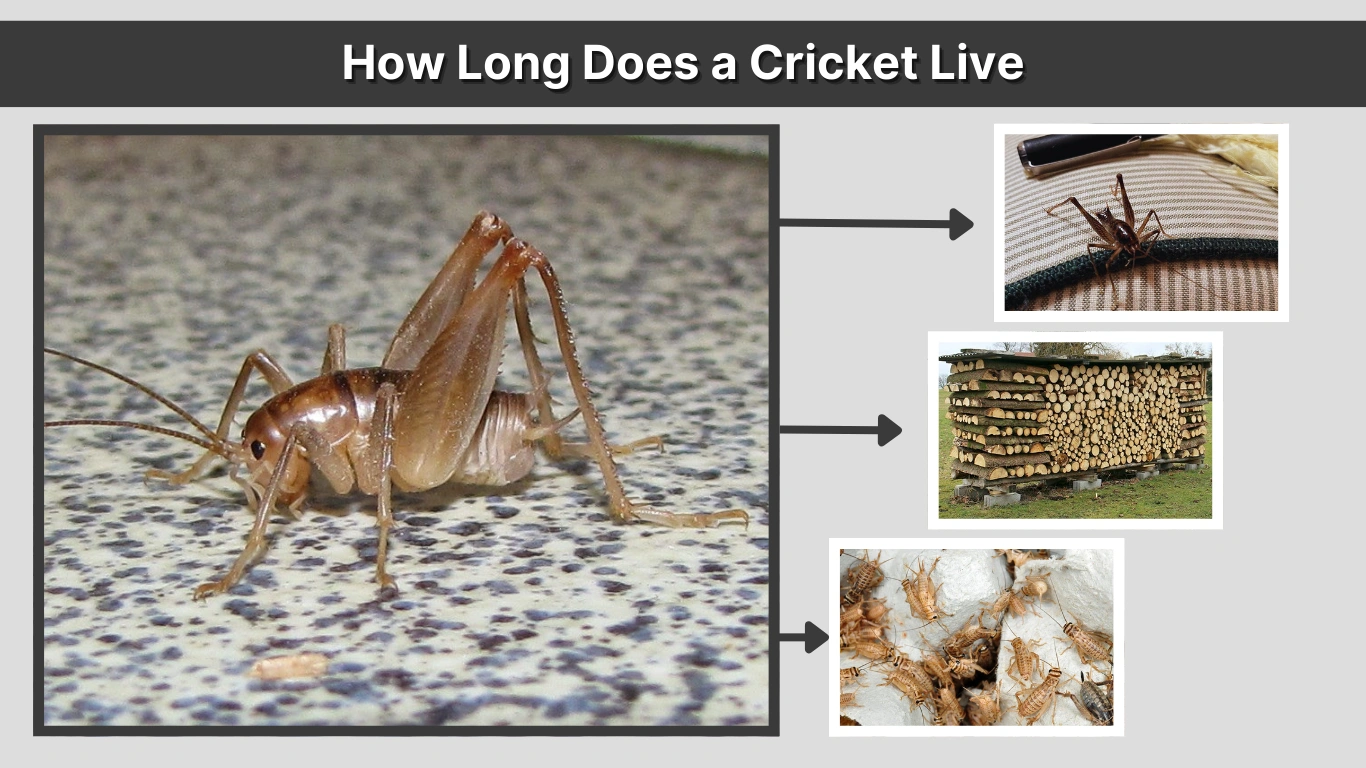
Crickets are small insects that most people recognize by their distinctive chirping sound. They are found in fields, gardens, and even inside homes, especially during warmer months. Despite their small size, they play an important role in ecosystems as both decomposers and a food source for many animals. One of the most common questions people ask is: How long does a cricket live? To answer that, we need to look at both their lifecycle stages and average lifespan across different species.
Understanding Cricket Lifespan
On average, most cricket species live for 2 to 3 months in the wild. However, this can vary widely depending on the type of cricket, environmental conditions, and whether they live indoors, outdoors, or in captivity. Some species, like camel crickets and mole crickets, survive much longer than common house or field crickets.
Crickets in captivity usually live longer because they are protected from predators and given a steady supply of food and warmth. In contrast, wild crickets often die earlier due to harsh conditions, predators, and lack of resources.
Cricket Life Cycle: Egg to Adult

Like many insects, crickets go through three main stages of development: egg, nymph, and adult. Understanding each stage helps explain why their overall lifespan is relatively short.
Egg Stage
The cricket life begins when a female lays eggs in soil, damp cracks, or plant matter. Depending on the species, a single female can lay anywhere between 100 to 500 eggs during her lifetime.
The eggs are tiny, white to yellowish, and cylindrical in shape. They usually hatch within two to three weeks, though cooler temperatures can slow down the process. Egg survival depends heavily on environmental conditions—warmth and moisture speed up development.
Nymph Stage
When the eggs hatch, small crickets known as nymphs emerge. Nymphs look like miniature versions of adults but are wingless. They immediately start feeding on organic material such as plants, fungi, or insects.
Over time, nymphs undergo several molts—shedding their exoskeletons to grow larger. Depending on the species, they may molt 8 to 10 times before reaching adulthood. The nymph stage lasts 4 to 6 weeks, and during this time, their wings and reproductive organs gradually develop.
Adult Stage
Once a cricket reaches adulthood, it has fully developed wings and reproductive ability. This stage is relatively short compared to the entire life cycle, lasting only 6 to 8 weeks in most species.
Adult crickets spend much of their remaining life focused on reproduction. Males produce their famous chirping sound by rubbing their wings together to attract females, while females focus on egg-laying. After reproduction, adults gradually weaken, becoming slower and less active until their natural death.
Average Lifespan of Crickets by Type
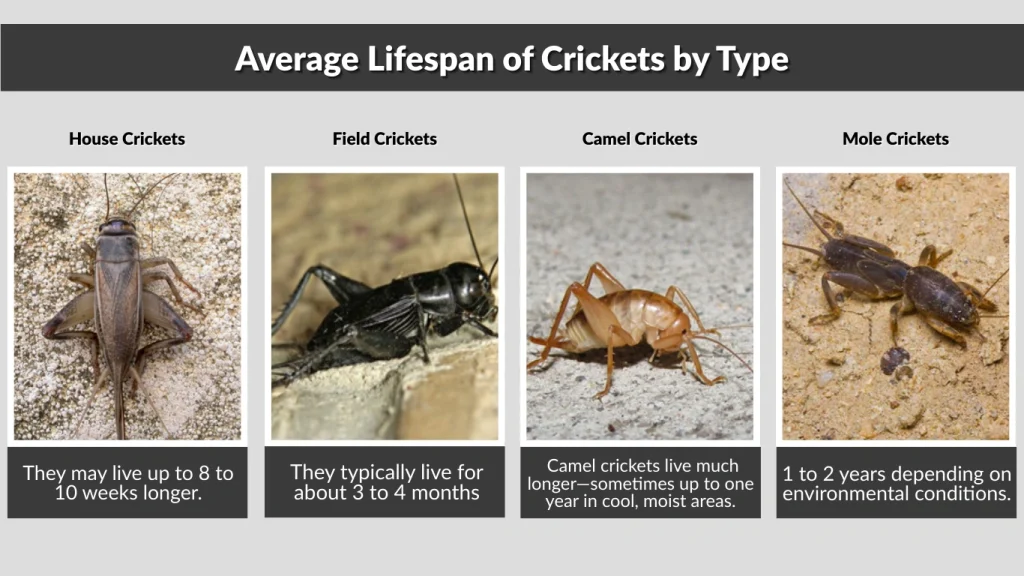
Different cricket species live for varying lengths of time. Here are the most common examples:
House Crickets (Acheta domesticus)
House crickets are the species most often found indoors. Their lifespan is usually 2 to 3 months in the wild. However, when kept in captivity or in warm indoor environments with steady food supply, they may live up to 8 to 10 weeks longer.
Field Crickets (Gryllus spp.)
Field crickets are larger and darker than house crickets. They typically live for about 3 to 4 months, with their life cycle strongly influenced by seasonal changes. They are most abundant in late summer and early fall, after which their populations decline.
Camel Crickets (Rhaphidophoridae)
Camel crickets, also called spider crickets, are unusual because they do not chirp. They prefer damp, dark environments like basements, caves, and crawl spaces. Compared to other crickets, camel crickets live much longer—sometimes up to one year in cool, moist areas.
Mole Crickets (Gryllotalpidae)
Mole crickets are burrowing insects with specialized front legs adapted for digging. They are among the longest-living crickets, with some species surviving 1 to 2 years depending on environmental conditions. Their ability to burrow underground protects them from predators, contributing to their longer lifespan.
Factors That Affect Cricket Lifespan

Not all crickets live the same length of time. Several factors influence how long an individual cricket survives.
Environmental Conditions
Crickets thrive in warm, humid environments. In colder regions, their lifespan is often cut short because they cannot survive freezing temperatures. Indoors, where conditions are more stable, they often live longer.
Predators and Threats
Crickets are a food source for many animals, including birds, frogs, lizards, spiders, and small mammals. This high level of predation is one of the main reasons their average lifespan in the wild is short.
Captivity vs Wild
Crickets kept as feeder insects for reptiles or in laboratory environments usually live longer than wild crickets. This is because they are protected from predators and given a controlled supply of food, warmth, and moisture. In contrast, wild crickets face daily threats that reduce their overall lifespan.
Do Male and Female Crickets Live the Same Length?
Male and female crickets live similar lifespans, but there are slight differences influenced by behavior and energy use.
- Males: Often live shorter lives because they spend large amounts of energy chirping. Their constant stridulation not only consumes energy but also exposes them to predators. In many species, males die soon after the breeding season.
- Females: Generally live slightly longer since they do not chirp. Their main role is egg-laying, which requires less risky behavior than calling for mates.
In captivity, these differences are less obvious because both sexes are given protection and care, but in the wild, females usually outlive males by a few weeks.
Signs of Aging in Crickets
Just like other living creatures, crickets show signs of aging as they approach the end of their short lives.
- Reduced Chirping: Male crickets chirp less frequently and with weaker sounds as they grow older.
- Decreased Activity: Older crickets move more slowly and are less likely to jump.
- Feeding Decline: Their appetite decreases, and they feed less actively on available food.
- Worn Appearance: Adult crickets may develop ragged wings, thinner bodies, or duller coloring near the end of their lives.
These aging signs help distinguish young, active adults from crickets nearing the end of their natural lifespan.
Importance of Understanding Cricket Lifespan
Learning about cricket lifespans is useful for several reasons:
- Pest Control: Knowing how quickly crickets reproduce helps in planning effective management indoors.
- Feeder Insects: Crickets are commonly bred as feeder insects for reptiles, amphibians, and birds. Farmers and pet owners need to understand their growth and survival patterns.
- Ecosystem Balance: As decomposers, crickets recycle organic matter, while also serving as food for many predators. Understanding their lifecycle shows how essential they are in food chains.
- Research and Education: Crickets are widely used in science labs and classrooms because of their clear developmental stages and chirping behavior.
Despite their short lifespans, crickets have a surprisingly large impact on both natural ecosystems and human activities.
FAQs
How long do crickets live indoors?
Crickets that live indoors usually survive 2–3 months. With steady food and warmth, their lifespan may be extended compared to outdoor crickets exposed to predators and seasonal changes.
Do crickets live longer in captivity?
Yes, crickets often live longer in captivity because they are protected from predators and given a constant food source. Under controlled care, some species can survive up to 3–4 months.
What is the longest-living cricket species?
Camel crickets and mole crickets are the longest-living types. Camel crickets can live nearly a year in damp, dark conditions, while mole crickets sometimes survive 1–2 years underground.
How many eggs does a female cricket lay?
A female cricket may lay anywhere from 100 to 500 eggs during her lifetime, depending on species and conditions. This high reproductive rate ensures stable populations.
Do male or female crickets live longer?
Female crickets typically live slightly longer than males because they conserve energy for egg-laying. Males often die earlier due to the stress of constant chirping and higher exposure to predators.
