

House crickets are among the most familiar insects that often make their way into homes, especially during warm seasons. Known for their distinctive chirping sound, they can be both fascinating and frustrating for homeowners. While their presence may raise questions about bites, risks, and household damage, these crickets play a bigger role in nature than many realize. Understanding their identification, behavior, and impact will help you manage them effectively and appreciate their ecological importance.
What is a House Cricket?
The house cricket (Acheta domesticus) is a small insect belonging to the family Gryllidae. Unlike field crickets that thrive outdoors, house crickets easily adapt to indoor environments. They are commonly found in basements, kitchens, and places with warmth and moisture.
Physically, they have a light brown to yellowish-tan body with three dark bands running across their heads. Their body length typically ranges from 16–21 mm, and they possess long antennae that are longer than their bodies. Equipped with wings, house crickets are also agile jumpers, making them quick movers when disturbed.
Scientific Classification of House Crickets

Family
House crickets belong to the family Gryllidae, a large group of insects recognized for their chirping sounds.
Order
They are classified under Orthoptera, which includes grasshoppers, katydids, and locusts.
Scientific Name
The scientific name of the house cricket is Acheta domesticus.
Common Name
They are commonly called “house crickets” because of their tendency to live indoors near human dwellings.
Identification of House Crickets

Appearance
House crickets are light brown with darker patterns across their body. They are slender, with a rounded head and powerful hind legs for jumping. Adults have fully developed wings that cover their abdomen, while the long antennae are one of their most distinguishing features.
Nymph Stage
Young house crickets, known as nymphs, look like miniature versions of adults but lack wings. As they grow, they molt several times, gradually developing adult features. During this stage, they are very active and feed on a variety of materials, making them noticeable even before they reach maturity.
House Cricket Sound (Chirping)

One of the most recognizable features of house crickets is their chirping sound. This sound is produced by males rubbing their wings together, a process known as stridulation. The chirping has several purposes:
- Mating call: Attracting females for reproduction.
- Rivalry call: Warning other males to stay away.
- Distress call: Indicating danger or a threat.
Interestingly, the frequency of chirping can be linked to temperature. According to Dolbear’s Law, you can estimate the temperature by counting cricket chirps per minute. This unique trait has made house crickets a natural “thermometer” in folklore.
House Cricket Behavior

House crickets are nocturnal insects, meaning they are most active at night. They are attracted to light, warmth, and food sources, which explains why they often enter homes. In groups, they tend to hide in cracks, cluttered areas, and dark corners during the day, emerging at night to feed and chirp.
Their behavior is largely driven by survival—seeking food, moisture, and safe places to reproduce. Though harmless in most cases, their tendency to reproduce rapidly can make them an indoor nuisance.
House Cricket Bite

Do They Bite Humans?
A common concern is whether house crickets bite humans. The truth is that while they can nibble if handled, they are not aggressive biters. Their mouthparts are designed for chewing organic matter, not piercing skin. If a bite occurs, it is usually accidental and causes no real harm.
Signs of a Bite
If a cricket does nibble, it may leave behind a slight pinch, a tiny scratch, or mild redness. Most people won’t even notice. These signs are minor compared to insect bites like mosquitoes or fleas.
Risks
House cricket bites pose no serious risk. They do not carry venom, nor do they transmit diseases to humans. At worst, a bite may feel uncomfortable or cause minor skin irritation, which resolves on its own.
House Cricket Diet

House crickets are opportunistic omnivores. They eat a wide range of organic materials, which is why they can survive both indoors and outdoors. Their diet typically includes:
- Plants and fruits.
- Small insects or dead insect matter.
- Food crumbs, pet food, and leftover scraps.
- Household items such as paper, fabrics, and wool.
This feeding behavior explains why crickets sometimes damage clothes, upholstery, or books in storage. In the wild, they play a useful role as decomposers, helping recycle organic material back into the ecosystem.
House Cricket Habitat & Distribution
Natural Habitat
In the wild, house crickets thrive in warm, moist environments such as fields, under stones, or around garbage dumps. They prefer areas with plenty of organic matter to feed on.
Indoors
Inside homes, they are often found in basements, kitchens, near heaters, or behind appliances where warmth and food sources are available. They are especially active during nighttime when they search for food.
Geographic Range
House crickets are widely distributed across the world. Originally native to Asia, they are now found in Europe, North America, and many other regions, including the UK. Their adaptability has made them one of the most common crickets associated with human environments.
House Cricket Lifespan

Like most insects, house crickets pass through a simple life cycle of egg → nymph → adult.
- Egg stage: Females lay eggs in soil, cracks, or damp crevices. Each female can produce hundreds of eggs in her lifetime.
- Nymph stage: Eggs hatch into nymphs within 2–3 weeks. Nymphs resemble small, wingless adults and go through 8–10 molts before becoming fully mature.
- Adult stage: Once mature, house crickets live for 2–3 months in the wild. In captivity or controlled environments, their lifespan may extend up to 8–10 weeks longer if conditions remain favorable.
Overall, a house cricket’s entire life cycle lasts about 2–3 months, though populations can grow quickly when indoor conditions are warm and moist.
House Crickets in the UK
In the United Kingdom, house crickets are often found in greenhouses, basements, and older homes. They survive best in artificial heated environments, as winters can be too cold outdoors. Crickets in the UK are more active from late summer through early autumn, when temperatures are higher.
Because they adapt well to indoor heating systems, house crickets have become fairly common pests in urban areas across the UK. Their chirping is often the first sign of their presence inside homes.
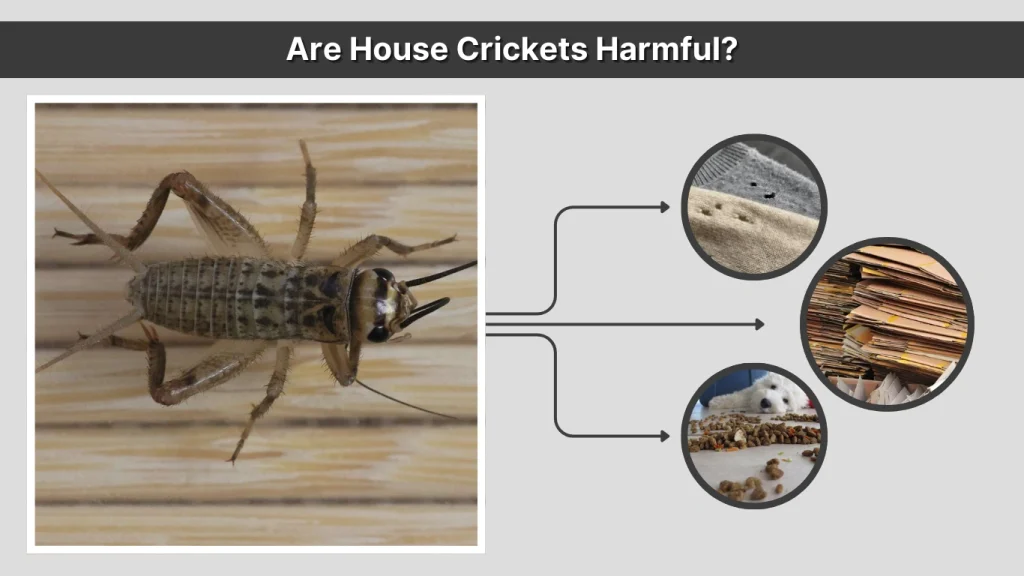
Are House Crickets Harmful?
Health Risks
House crickets are generally harmless to humans. They do not bite aggressively, spread diseases, or carry venom. Their biggest health-related issue comes from psychological stress—people may feel disturbed by their presence or by the sound of constant chirping at night.
Household Risks
The real concern lies in the damage they cause indoors:
- They chew on fabrics, clothing, and upholstered furniture.
- Paper, books, and stored cardboard boxes are vulnerable.
- Pet food and crumbs attract them, leading to contamination risks.
Although not as destructive as termites or cockroaches, they can still be a nuisance if infestations are left unmanaged.
Controlling House Crickets
Prevention
Preventing house crickets from entering your home is the most effective solution:
- Seal cracks around doors, windows, and foundations.
- Install fine mesh screens to block entry.
- Use dehumidifiers to reduce moisture in basements and crawl spaces.
- Keep cluttered areas tidy to remove hiding spots.
Natural Control
Several natural predators help control cricket populations outdoors, including spiders, birds, frogs, and lizards. Encouraging these predators in gardens helps maintain balance.
Chemical Control
For heavy infestations, chemical measures may be necessary:
- Insecticidal sprays and baits can be applied to cracks and entry points.
- Boric acid powder, when placed near cricket hiding spots, works effectively.
- Sticky traps are safe alternatives for indoor use.
A combination of sanitation, sealing, and trapping usually eliminates most household cricket problems.
House Crickets vs Other Crickets

House Crickets vs Field Crickets
- Appearance: House crickets are smaller and lighter in color (yellowish-brown), while field crickets are larger and darker (black or dark brown).
- Habitat: House crickets prefer indoor environments; field crickets live mostly outdoors.
- Chirping: Both chirp, but house crickets are more commonly heard indoors.
House Crickets vs Camel Crickets
- Body shape: House crickets have straight backs, while camel crickets have a hump-like shape.
- Sound: House crickets chirp; camel crickets are silent.
- Habitat: Camel crickets favor damp, dark crawl spaces, while house crickets adapt to both indoors and outdoors.
Importance of House Crickets in Ecosystem
Despite being considered pests, house crickets play an important role in the environment:
- Decomposers: They help recycle organic matter by feeding on decaying plants and insects.
- Food source: Birds, reptiles, amphibians, and mammals rely on them as a food supply.
- Scientific and educational use: House crickets are commonly used in classrooms, laboratories, and research due to their availability and interesting behavior.
- Feeder insects: Pet owners often breed them to feed reptiles, amphibians, and spiders.
Their role in the food chain and scientific study highlights their ecological value beyond their nuisance factor indoors.
FAQs
Do house crickets bite humans?
House crickets can nibble if handled, but their bites are harmless. They do not carry venom or spread disease. At most, a bite feels like a small pinch and may leave a faint mark. Most cases cause no discomfort, and simple cleaning of the skin is enough.
What do house crickets eat?
House crickets are omnivores that eat plants, fruits, fabrics, paper, and even other insects. Indoors, they feed on crumbs, pet food, and stored items. This wide diet explains why they sometimes damage clothing, books, or furniture when infestations are not controlled.
How long do house crickets live?
House crickets live for about 2–3 months in the wild, completing a life cycle from egg to adult. In captivity or indoor environments with warmth and food, their lifespan may extend slightly longer. Rapid reproduction helps them survive in large numbers around homes.
Why do house crickets chirp at night?
Male house crickets chirp by rubbing their wings together, a process called stridulation. This chirping is mainly a mating call to attract females, but it also warns rival males and signals distress. They are nocturnal, which is why the sound is often heard at night.
How can I get rid of house crickets?
To control house crickets, seal cracks and gaps around the home, reduce indoor moisture, and remove clutter. Sticky traps and natural predators like spiders also help. In heavy infestations, insecticidal sprays or baits may be required. Prevention is the most effective long-term solution.
