

Insects are often seen as short-lived creatures, but many species defy this expectation with lifespans stretching over months, years, and even decades. From hidden queens deep inside termite colonies to giant beetles of the tropics, these insects showcase survival strategies that ensure their endurance. This list highlights 13 long-lived insects, exploring their identification, unique lifecycles, habitats, and diets that help them thrive in diverse environments.
1. Termite Queen
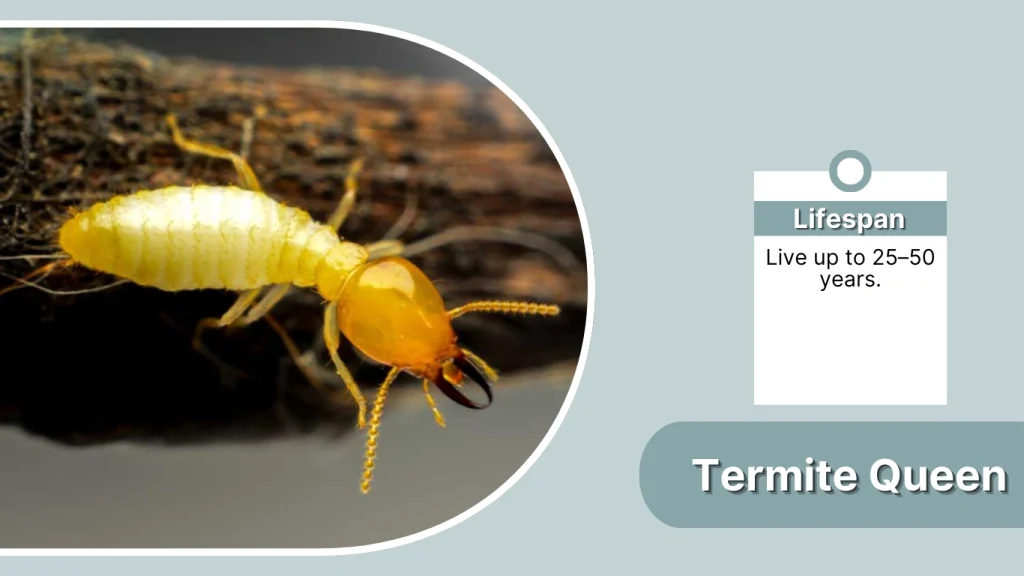
The Termite Queen is one of the longest-lived insects, often surviving for decades. Known as the heart of the colony, she is responsible for reproduction and can lay thousands of eggs daily. Her enormous size and unique role make her one of the most fascinating insect figures in nature.
Identification
- Enlarged abdomen, much larger than worker termites.
- Soft, pale body with a smooth texture.
- Rarely moves, tended by worker termites.
Lifecycle & Lifespan
The Termite Queen begins as a reproductive termite (alate) after the nuptial flight. Once established in a colony, she grows significantly and starts producing eggs. Remarkably, she can live up to 25–50 years, making her one of the longest-living insects.
Habitat and Diet
Termite Queens live deep within termite mounds or colonies, protected by worker termites. While she does not eat in the usual sense, she is sustained by nutrients provided by workers who feed her through trophallaxis. The colony itself survives on cellulose from wood, leaf litter, and plant material.
2. Cicada

Cicadas are famous for their loud, buzzing calls and unique life cycles. Some species, like periodical cicadas, spend years underground before emerging in massive numbers, creating one of nature’s most remarkable insect phenomena.
Identification
- Large eyes set wide apart.
- Transparent wings with distinct veins.
- Produces loud calls using tymbals.
Lifecycle & Lifespan
Cicadas begin as eggs laid in tree branches, hatch into nymphs, and burrow underground to feed on sap. Depending on the species, they can live underground for 2–17 years before emerging as adults, where they survive only a few weeks.
Habitat and Diet
Cicadas are found worldwide, especially in temperate and tropical regions. Nymphs feed on root sap underground, while adults feed on tree fluids.
3. Goliath Beetle
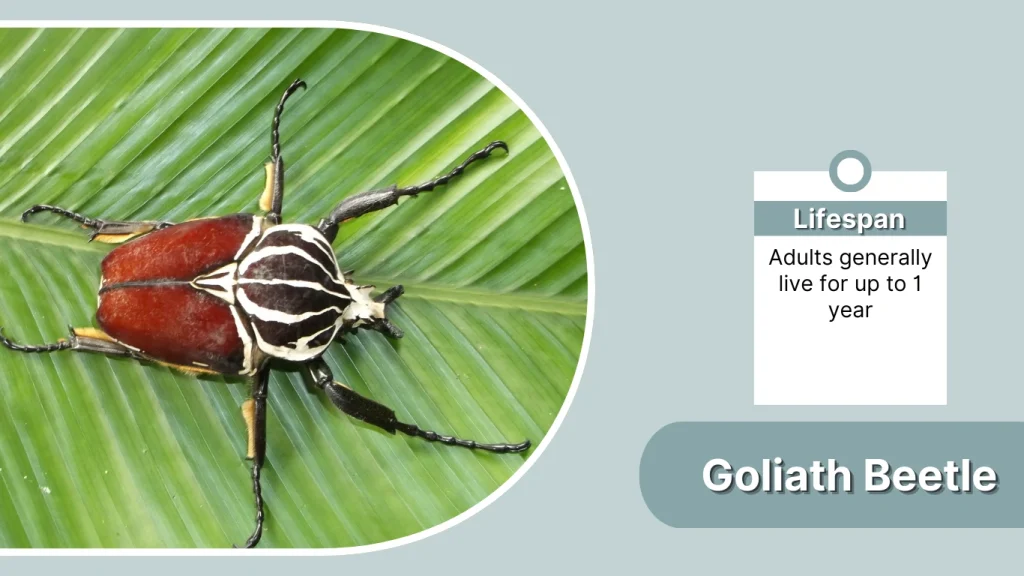
Among the largest insects on Earth, Goliath Beetles are known for their immense strength and striking appearance. They are often found in tropical forests and are a favorite subject of insect collectors.
Identification
- Can grow up to 4 inches in length.
- Strong, bulky body with patterned exoskeleton.
- Males have a Y-shaped horn on their heads.
Lifecycle & Lifespan
The beetle undergoes complete metamorphosis—egg, larva, pupa, and adult. Larvae are massive and feed heavily before pupating. Adults generally live for up to 1 year, though larval stages can last several years.
Habitat and Diet
Goliath Beetles inhabit African tropical forests. The larvae feed on decaying wood and organic matter, while adults consume tree sap and fruits.
4. Hercules Beetle

The Hercules Beetle is one of the strongest insects in the world, capable of lifting objects over 100 times its body weight. Its long horns and massive size make it a remarkable species among rhinoceros beetles.
Identification
- Males possess a long horn on the head and thorax.
- Shiny, hard exoskeleton with colors ranging from olive to black.
- Can reach lengths of up to 7 inches including the horn.
Lifecycle & Lifespan
The Hercules Beetle undergoes complete metamorphosis. The larval stage is the longest, feeding heavily on decaying wood for years before pupating. Adults generally live 3–6 months, but the entire life cycle from egg to adult may span up to 2–3 years.
Habitat and Diet
These beetles are native to the rainforests of Central and South America. Larvae feed on rotting wood, while adults feed mainly on fruit, tree sap, and nectar.
5. Giant Weta

The Giant Weta, native to New Zealand, is one of the heaviest insects in the world. Its intimidating size and spiny legs make it a unique survivor in its isolated island habitat.
Identification
- Large, cricket-like body with spiny legs.
- Can weigh more than a sparrow.
- Brown or mottled coloration for camouflage.
Lifecycle & Lifespan
Giant Wetas follow an incomplete metamorphosis, molting multiple times before reaching adulthood. They typically live for 2–3 years, which is long compared to most insects. Their slow growth and size contribute to their extended lifespan.
Habitat and Diet
They are found in New Zealand’s forests, shrublands, and offshore islands. Giant Wetas are primarily nocturnal and feed on leaves, fruit, flowers, and occasionally smaller insects.
6. Tsetse Fly
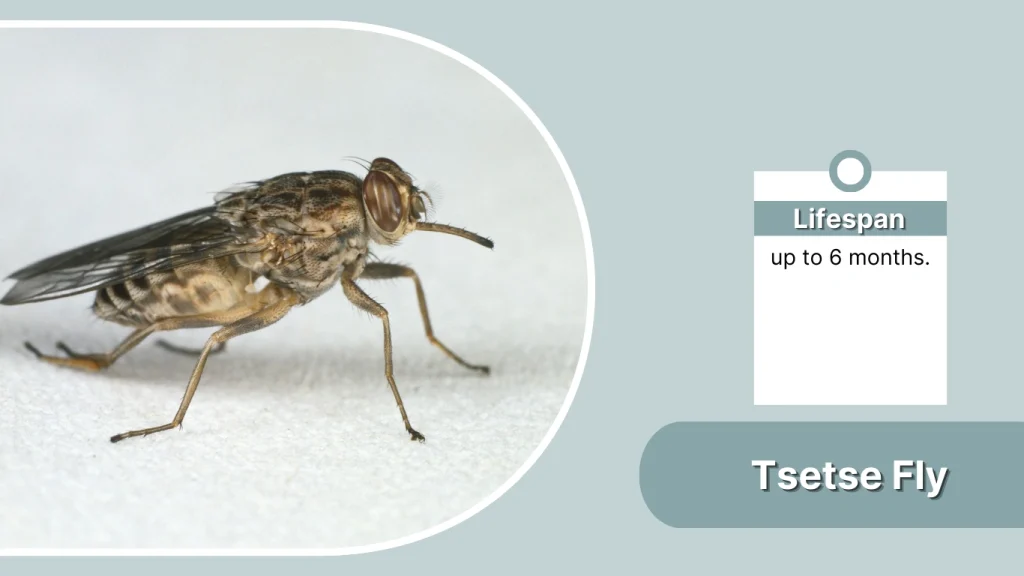
The Tsetse Fly is notorious as a vector of African trypanosomiasis, or sleeping sickness. Unlike many other flies, it gives birth to live larvae instead of laying eggs.
Identification
- Medium-sized fly with a distinctive proboscis.
- Wings fold directly over each other when at rest.
- Brown to gray body coloration.
Lifecycle & Lifespan
Female tsetse flies nourish a single larva internally until it is ready to pupate. This reproductive process is unique among flies. Adults typically live 1–3 months, though under favorable conditions some can survive up to 6 months.
Habitat and Diet
Tsetse flies are found in sub-Saharan Africa, particularly in riverine and savannah regions. Both males and females feed exclusively on blood from humans and animals.
7. Dragonfly
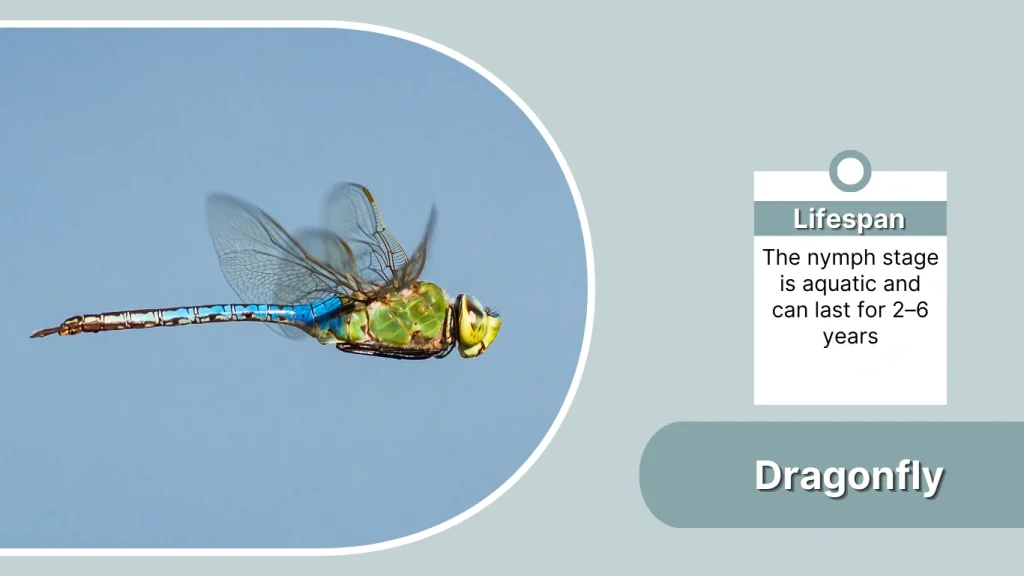
Dragonflies are ancient insects that have existed for over 300 million years. They are admired for their speed, agility, and striking colors.
Identification
- Large multifaceted eyes covering most of the head.
- Two pairs of strong, transparent wings.
- Long, slender abdomen with bright coloration.
Lifecycle & Lifespan
Dragonflies undergo incomplete metamorphosis. The nymph stage is aquatic and can last for 2–6 years, depending on the species. Adult dragonflies, however, live only a few weeks to several months.
Habitat and Diet
Dragonflies are found near freshwater habitats worldwide. Nymphs are aquatic predators feeding on small fish and insect larvae, while adults consume mosquitoes, flies, and other flying insects.
8. Periodical Cicada (Magicicada)
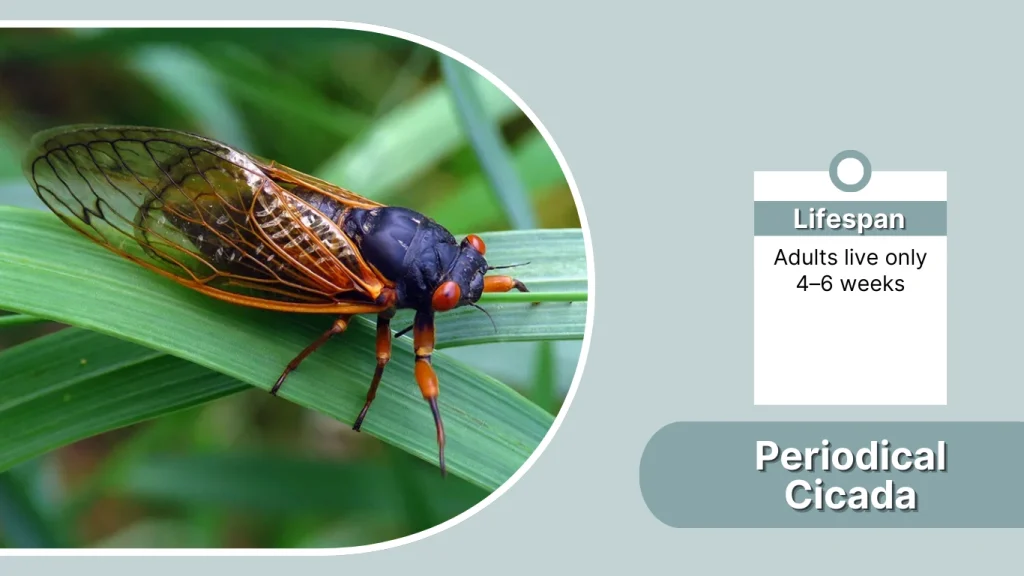
The Periodical Cicada is famous for its synchronized mass emergence after many years underground. These events are spectacular and often occur in 13- or 17-year cycles.
Identification
- Black body with striking red eyes.
- Transparent wings with orange veins.
- Loud, buzzing mating calls produced by males.
Lifecycle & Lifespan
Nymphs live underground feeding on root sap for 13 or 17 years depending on the brood. After emerging, adults live only 4–6 weeks, completing one of the longest insect lifecycles known.
Habitat and Diet
They are native to the eastern United States. Nymphs feed on tree roots underground, while adults consume fluids from tree branches.
9. Longhorn Beetle

Longhorn Beetles are a diverse family with thousands of species, recognized for their elongated antennae. Some species are notorious wood borers, damaging forests and wooden structures.
Identification
- Extremely long antennae, often longer than the body.
- Cylindrical or elongated bodies.
- Varying colors and patterns, often camouflaged with bark.
Lifecycle & Lifespan
Longhorn Beetles undergo complete metamorphosis. Larvae bore into wood and may remain in this stage for years. Depending on the species, the lifecycle can last 1–3 years, with some extending to up to 10 years in the larval stage.
Habitat and Diet
They are found worldwide, particularly in forests. Larvae feed on dead or decaying wood, while adults typically consume nectar, leaves, or bark.
10. Darkling Beetle
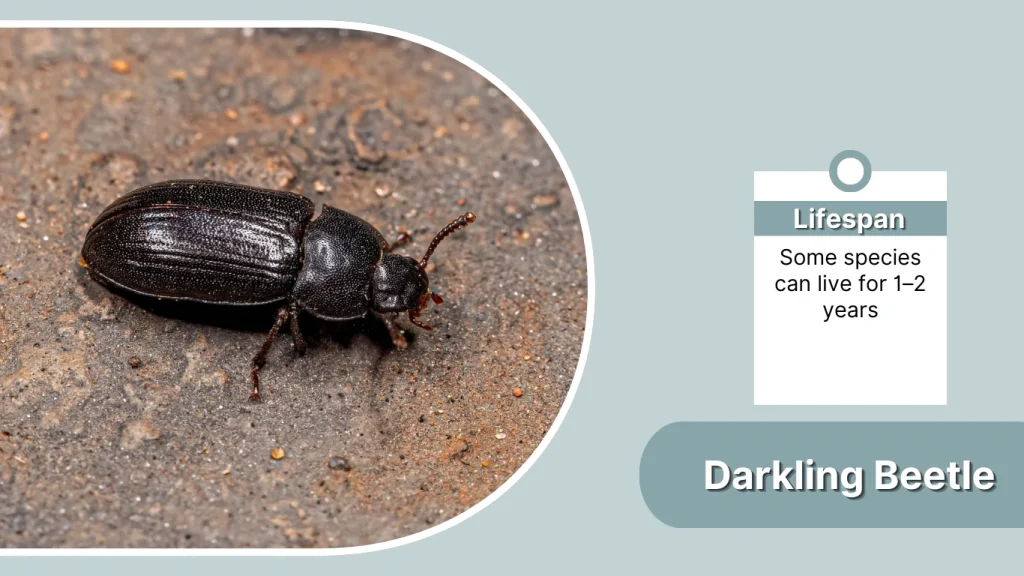
Darkling Beetles are a diverse group, including the well-known mealworms. They are highly adaptable and thrive in deserts, forests, and even human environments.
Identification
- Hard, dark-colored exoskeleton.
- Elongated body with well-developed legs.
- Antennae often bead-like in structure.
Lifecycle & Lifespan
They undergo complete metamorphosis: egg, larva (mealworm), pupa, and adult. Some species can live for 1–2 years, with the larval stage sometimes lasting several months before pupation.
Habitat and Diet
Darkling Beetles are found worldwide in dry and arid regions, as well as forests. They are scavengers, feeding on decaying organic matter, fungi, and stored grains.
11. Mayfly (Larval Stage)

Mayflies are ancient insects, often indicators of clean water quality. While adults are short-lived, their larval stages are surprisingly long.
Identification
- Adults have delicate, transparent wings and long tail filaments.
- Nymphs (naiads) are aquatic with flattened bodies and gills.
- Adults usually lack functional mouthparts.
Lifecycle & Lifespan
The nymph stage can last 1–2 years, depending on the species and environment. Once they emerge as adults, they live for only a few hours to a few days, focusing solely on reproduction.
Habitat and Diet
Mayfly nymphs live in freshwater rivers, streams, and lakes. They feed on algae, detritus, and microorganisms, while adults do not eat at all.
12. Atlas Moth (Larval Stage)
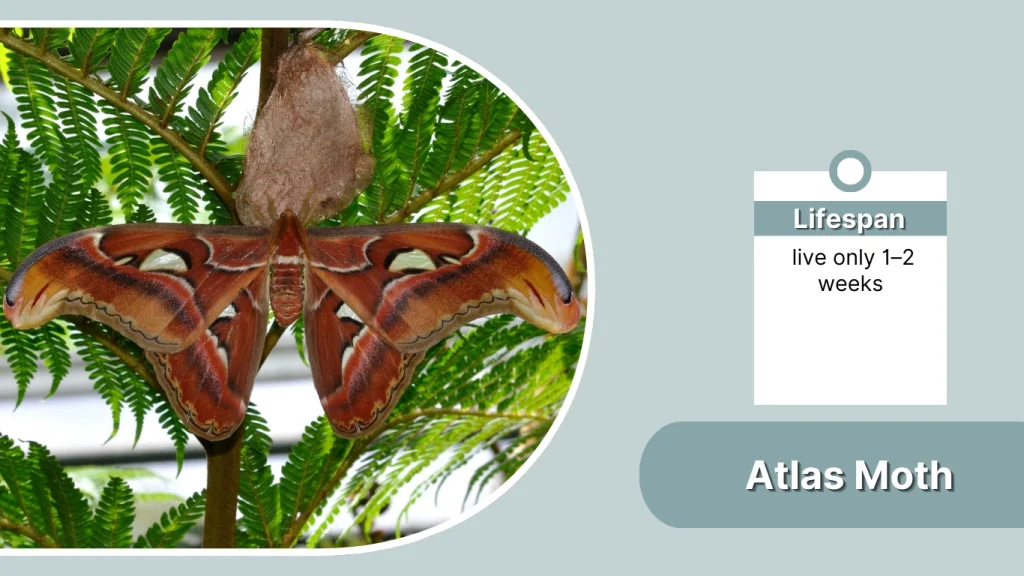
The Atlas Moth is one of the largest moths in the world, with wingspans reaching up to 10–12 inches. While adults live briefly, the larval stage is long and crucial for survival.
Identification
- Massive wings with reddish-brown patterns.
- Wingtips resemble snake heads for defense.
- Caterpillars are green with spiny protrusions.
Lifecycle & Lifespan
Atlas Moths undergo complete metamorphosis. The caterpillar stage can last several months, during which it consumes vast amounts of foliage. Adult moths, however, live only 1–2 weeks, as they lack functional mouthparts.
Habitat and Diet
They are found in Southeast Asia’s tropical forests. Caterpillars feed on leaves of trees such as citrus, guava, and cinnamon, while adults survive on stored energy reserves.
13. Dobsonfly (Larval Stage)

Dobsonflies are large insects known for their intimidating mandibles and aquatic larvae called hellgrammites. The larval stage is much longer than the short-lived adult phase.
Identification
- Adults have large wings and long, slender bodies.
- Males possess elongated mandibles; females have shorter, stronger jaws.
- Larvae are tough, elongated, and aquatic with gill structures.
Lifecycle & Lifespan
The larval stage (hellgrammites) lasts 2–5 years in freshwater habitats. After pupation, adults live only a few days to a week, focusing solely on reproduction.
Habitat and Diet
Hellgrammites inhabit streams and rivers with clean, fast-flowing water. Larvae are predatory, feeding on aquatic insects and small invertebrates, while adults feed little or not at all.
FAQs
What is the longest-living insect in the world?
The Termite Queen holds the record, living up to 50 years. Her longevity is tied to her role as the colony’s primary reproductive, laying thousands of eggs over her lifetime.
Do all insects have short lifespans?
No. While many live only weeks, species like cicadas, beetles, and termite queens can live for years or even decades, depending on their role and environment.
Why do some insects live longer than others?
Longevity depends on their lifecycle strategy. Insects like cicadas and mayflies spend most of their lives in larval or nymph stages, while others, like queens, are protected within colonies.
Which insect has the longest larval stage?
The Dobsonfly and Periodical Cicada are notable. Dobsonfly larvae can last 2–5 years, while cicada nymphs can remain underground for 13–17 years.
Do long-lived insects pose any danger to humans?
Most long-lived insects are harmless. However, some, like the Tsetse Fly, are dangerous because they spread diseases such as sleeping sickness in sub-Saharan Africa.
