

Crane fly larvae, belonging to the family Tipulidae, are commonly known as leatherjackets because of their tough, leathery skin. While adult crane flies are often mistaken for giant mosquitoes, their larvae are equally misunderstood. These worm-like creatures play an important role in ecosystems but can also cause problems in lawns, turf, and agricultural fields. Knowing how to identify them, where they live, and what they eat is essential for both gardeners and anyone interested in insect ecology.
What Are Tipulidae Larvae?
Tipulidae larvae are the immature stage of crane flies, insects under the order Diptera. Unlike mosquito larvae, which live in water, many crane fly larvae are found in soil. They are soft-bodied, legless, and cylindrical in shape, growing up to 1–4 cm in length depending on the species.
- Common names: leatherjackets, crane fly larvae.
- Texture: smooth, tough, and gray to brown in color.
- Habitat: either soil (terrestrial species) or aquatic environments (streams, ponds, wetlands).
Because they resemble grubs or caterpillars, they are often confused with other larvae, but their leathery body and distinct breathing spiracles at the rear set them apart.
Tipulidae Larvae Identification Key

Correct identification is important, especially since leatherjackets can become turf pests. Here are the main features:
- Body shape: elongated, worm-like, cylindrical.
- Skin: tough, grayish-brown, giving them the “leatherjacket” name.
- Legs: absent.
- Head capsule: small and retractable, with chewing mouthparts.
- Posterior spiracles: visible at the rear end, used for breathing.
When disturbed, they may curl up or retreat deeper into soil. Gardeners often discover them while digging in turf or noticing thinning patches in grass.
What Do Tipulidae Larvae Look Like?
At first glance, crane fly larvae look like small, dirty-colored worms. Their outer skin lacks any shiny surface and feels rough compared to caterpillars or beetle grubs.
- Size: ranges from 1 cm in young larvae to about 4 cm in mature ones.
- Color: gray, brown, or blackish, often blending with soil.
- Head: barely visible, unlike mosquito larvae with prominent heads.
- Movement: slow, wriggling, often buried in soil or submerged in mud.
Because of their appearance, many people confuse them with pests like cutworms or chafer grubs, but leatherjackets are unique to crane flies.
Tipulidae Larvae Habitat

The habitat of Tipulidae larvae varies by species. They are adaptable and occupy both terrestrial and aquatic ecosystems.
Terrestrial Larvae (Leatherjackets)
- Found in lawns, turfgrass, golf courses, pastures, and agricultural fields.
- Prefer moist, rich soils where organic matter and grass roots are abundant.
- Thrive in temperate climates, especially during wet seasons.
- Often considered pests because they damage turf by feeding on grass roots.
Aquatic Tipulidae Larvae
- Live in streams, ponds, rivers, and marshes.
- Feed on algae, organic detritus, and decaying plant matter.
- Help in nutrient recycling and decomposition.
- Serve as an important food source for fish, amphibians, and aquatic birds.
This dual habitat—soil for terrestrial species and water for aquatic species—makes crane fly larvae ecologically versatile.
Tipulidae Larvae Diet
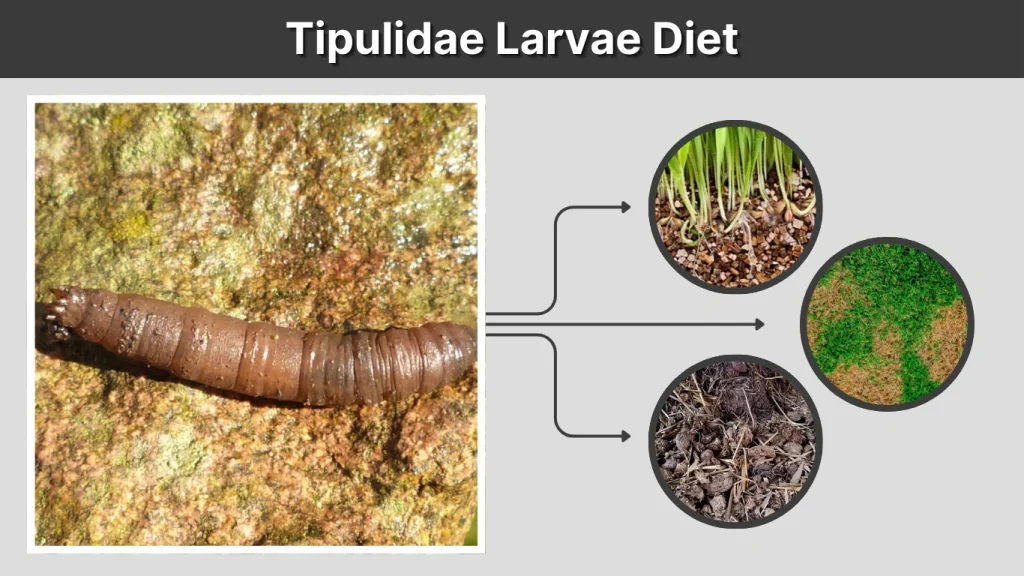
The feeding habits of crane fly larvae depend on whether they are terrestrial or aquatic.
- Terrestrial species (leatherjackets):
- Feed on tender grass roots, seedlings, and stems.
- Can damage lawns, leaving irregular yellow or brown patches.
- Also eat decaying plant material, contributing to decomposition.
- Feed on tender grass roots, seedlings, and stems.
- Aquatic species:
- Consume algae, rotting leaves, and organic detritus.
- Help keep aquatic ecosystems balanced by recycling nutrients.
- Consume algae, rotting leaves, and organic detritus.
Because of their root-feeding behavior, leatherjackets can become serious turf pests if populations grow large, especially in cool, damp conditions.
Do Crane Fly Larvae Eat Mosquito Larvae?
A common myth is that crane fly larvae feed on mosquito larvae. This is false.
- Crane fly larvae are not predators.
- Their diet is plant-based (roots, stems, decaying matter) or detritus-based (in aquatic species).
- Mosquito larvae, on the other hand, are aquatic and feed on algae and microorganisms.
The confusion comes from the nickname “mosquito eater,” which people wrongly assume applies to larvae as well. In reality, crane fly larvae do not help control mosquito populations.
Crane Fly Larvae Life Cycle

Crane flies undergo complete metamorphosis with four distinct stages: egg, larva, pupa, and adult.
Egg Stage
- Females lay eggs in moist soil or shallow water.
- Eggs hatch within days to weeks, depending on conditions.
Larval Stage
- Longest and most active phase of the life cycle.
- Can last several months, particularly in temperate climates.
- Larvae feed heavily on roots and organic matter.
Crane Fly Larvae Life Cycle (Continued)
Pupal Stage
After months of feeding and growth, crane fly larvae enter the pupal stage.
- Pupation takes place in soil (terrestrial species) or mud near aquatic environments.
- Pupae are cylindrical and darker than larvae, with visible breathing structures.
- This stage lasts from several days to weeks depending on temperature and moisture.
- Pupae remain inactive until they emerge as adult crane flies.
Adult Stage
Adult crane flies are fragile, mosquito-like insects with very long legs and slender bodies.
- Their primary role is reproduction.
- Most adults do not feed; some may sip nectar or water.
- Lifespan: only 10–15 days.
- Females lay eggs in soil or water to continue the cycle.
This short adult life contrasts with the long larval stage, which can last several months and is the most ecologically significant phase.
When to Treat Crane Fly Larvae (Control in Lawns)
In gardens and lawns, leatherjackets can become pests. They feed on grass roots, leading to thin, patchy turf. If populations are large, intervention may be needed.
Signs of Infestation
- Yellow or brown patches in lawns that do not recover with watering.
- Grass pulls up easily due to root damage.
- Birds (like crows or starlings) pecking at the soil to feed on larvae.
Best Time to Treat
- Late summer to early fall is ideal, as larvae are small and more vulnerable.
- Treatment during spring is less effective because larvae are larger and harder to control.
Treatment Methods
- Biological Control
- Beneficial nematodes (e.g., Steinernema feltiae) are highly effective.
- These microscopic worms infect and kill larvae naturally.
- Beneficial nematodes (e.g., Steinernema feltiae) are highly effective.
- Cultural Practices
- Keep lawns healthy with regular mowing, aeration, and proper watering.
- Encourage birds and natural predators to visit the area.
- Keep lawns healthy with regular mowing, aeration, and proper watering.
- Chemical Treatments
- In severe cases, insecticides may be used, but these should be a last resort.
- Many gardeners prefer eco-friendly biological methods.
- In severe cases, insecticides may be used, but these should be a last resort.
Ecological Role of Tipulidae Larvae

Despite their reputation as pests, crane fly larvae have important ecological functions:
- Decomposers: break down organic matter, returning nutrients to the soil.
- Soil Aeration: burrowing improves water movement and root growth.
- Food Source: serve as prey for fish, amphibians, birds, and mammals.
Aquatic species, in particular, play a critical role in cleaning waterways by feeding on detritus and algae.
Where Do Crane Fly Larvae Live?
Crane fly larvae are found worldwide, but they are especially common in temperate regions.
- Terrestrial larvae: lawns, golf courses, pastures, fields, and gardens.
- Aquatic larvae: streams, ponds, lakes, and wetlands.
- Seasonal presence: most active in moist conditions; populations increase after heavy rains.
- Survival in winter: many larvae overwinter in soil and emerge in spring to pupate.
Their adaptability to both aquatic and terrestrial environments makes them widespread across Europe, North America, and Asia.
Tipula Larvae and Related Species
The genus Tipula is one of the largest within the family Tipulidae.
- Includes numerous crane fly species with similar larval stages.
- Some species are more associated with agricultural damage, while others remain harmless decomposers.
- Scientific references often describe them as Tipula sp. larvae when species-level identification is difficult.
Researchers frequently study Tipula larvae because of their ecological impact and pest potential.
Diptera Tipulidae Larvae in Research
Crane fly larvae are of interest to scientists for several reasons:
- Indicators of environmental health: aquatic larvae reflect water quality in streams and wetlands.
- Soil studies: terrestrial larvae show the effects of soil conditions on insect populations.
- Agricultural impact: research focuses on controlling leatherjackets to protect turfgrass and crops.
Their role as both pests and ecological contributors makes them a key subject in entomology.
FAQs
How do I identify crane fly larvae in my lawn?
Look for gray-brown, legless larvae about 1–4 cm long. They are usually found just under the soil in thinning patches of grass.
Are crane fly larvae harmful to crops?
Yes. Large populations can damage turf, seedlings, and pasture grasses by feeding on roots.
Do crane fly larvae bite humans?
No. They do not bite, sting, or harm people or pets.
What eats crane fly larvae?
Birds, amphibians, fish, and small mammals feed on them, helping to keep populations balanced.
How long do crane fly larvae live?
They can live several months in the soil as larvae, making this the longest and most active stage of their life cycle.
