

Spiders with blue coloration are among the most fascinating and visually stunning creatures in the arachnid world. Their vibrant hues range from metallic cobalt to shimmering sapphire, often making them stand out in their natural habitats. These spiders are found across tropical forests, arid scrublands, and even rocky savannas. Beyond their beauty, they display unique behaviors, lifecycles, and adaptations that ensure survival in diverse environments. This list explores 15 remarkable blue spider species in detail.
1. Blue Tarantula

The Blue Tarantula is a striking spider species known for its vibrant blue coloration, making it one of the most visually captivating tarantulas in the world. Though the name “Blue Tarantula” is sometimes used broadly for several blue-colored tarantulas, it generally refers to species with intense blue hairs and shimmering bodies.
Identification
- Distinct metallic blue coloration on legs and body
- Covered with fine, iridescent hairs
- Medium to large body size, depending on species
- Robust body structure with prominent chelicerae
- Sexual dimorphism: males are slimmer, females are bulkier
Habitat
Blue Tarantulas are typically found in tropical forests and subtropical regions. They prefer moist, warm environments and often dwell in burrows, leaf litter, or under logs for protection.
Behaviors
These tarantulas are mostly nocturnal and reclusive. They rely on ambush tactics for hunting, remaining hidden in burrows or retreats. They are generally shy but can show defensive behaviors when threatened.
Lifecycle & Lifespan
The lifecycle begins as eggs laid in silk sacs, hatching into spiderlings. Juveniles undergo multiple molts before reaching maturity. Females can live 10–15 years, while males usually survive only 3–5 years after maturity.
Diet
Blue Tarantulas are carnivorous, feeding primarily on insects such as crickets, roaches, and beetles. Larger specimens may occasionally capture small vertebrates like lizards or frogs.
2. Cobalt Blue Tarantula

The Cobalt Blue Tarantula (Haplopelma lividum) is one of the most famous blue spiders, recognized for its deep metallic blue legs and aggressive temperament. It is a fossorial species, spending most of its life underground.
Identification
- Shiny cobalt-blue legs
- Dark brown to black carapace
- Medium-sized body (4–5 inches leg span)
- Females are bulkier than males
- Known for its defensive posture and speed
Habitat
Native to Myanmar and Thailand, this tarantula thrives in tropical rainforests. It prefers moist soil where it constructs deep burrows for shelter.
Behaviors
Highly defensive and fast, it is not suitable for handling. It spends most time hidden in burrows, emerging primarily at night to hunt.
Lifecycle & Lifespan
Eggs are laid in a silk sac, hatching into spiderlings that stay near the mother initially. Females can live up to 15–20 years, while males usually survive only 3–4 years.
Diet
Feeds on insects like crickets, roaches, and beetles. In captivity, they readily accept mealworms and other feeder insects.
3. Greenbottle Blue Tarantula

The Greenbottle Blue Tarantula (Chromatopelma cyaneopubescens) is known for its vivid coloration—metallic blue legs, orange abdomen, and greenish carapace. It is one of the most colorful tarantulas.
Identification
- Blue legs with iridescent shine
- Bright orange abdomen with distinct hairs
- Metallic green-blue carapace
- Medium size (4–6 inches leg span)
- Long, slender legs with dense hair coverage
Habitat
Native to desert and scrubland regions of northern Venezuela, it prefers arid environments with sandy soil and sparse vegetation.
Behaviors
This species is semi-arboreal and a prolific webber, often creating extensive silk retreats. It is more docile compared to other blue tarantulas but can be skittish.
Lifecycle & Lifespan
Egg sacs contain dozens of spiderlings, which grow quickly. Females can live up to 12–14 years, while males live around 4–5 years.
Diet
Feeds on insects such as crickets, roaches, and moths. Juveniles eat smaller prey like fruit flies and pinhead crickets.
4. Singapore Blue Tarantula

The Singapore Blue Tarantula (Lampropelma violaceopes) is one of the largest arboreal tarantulas, admired for its iridescent blue legs and sheer size. It is fast, defensive, and thrives in humid environments, making it both stunning and challenging to keep.
Identification
- Metallic blue legs with purple hues under light
- Long and slender leg span up to 10–11 inches
- Females: robust with darker shades; Males: slimmer, lighter in tone
- Prominent spinnerets
- Arboreal body structure with long legs for climbing
Habitat
Native to Singapore and Malaysia, it inhabits dense rainforests. Prefers tall trees, rotting logs, and hollow trunks where it constructs silken retreats. High humidity and stable warmth are essential to its survival.
Behaviors
Highly defensive and lightning-fast, this tarantula should not be handled. It is primarily arboreal, spending much time climbing and webbing. It ambushes prey at night and often uses vibrations to detect movement.
Lifecycle & Lifespan
Females can live 12–15 years, while males generally live only 3–4 years post-maturity. Spiderlings grow quickly and require frequent feeding. The egg sac can contain 50–150 spiderlings.
Diet
Feeds on insects like crickets, roaches, moths, and grasshoppers. Large females may also capture small vertebrates such as geckos.
5. Electric Blue Earth Tiger (Chilobrachys dyscolus)

The Electric Blue Earth Tiger is a stunning tarantula species with iridescent blue legs and tiger-like striping on its carapace and abdomen. Native to Southeast Asia, it is admired for its beauty but known for its defensiveness.
Identification
- Electric blue coloration, especially on front legs
- Carapace and abdomen show tiger-like striping
- Medium to large size (5–6 inches leg span)
- Strongly built with thick setae
- Distinct sexual dimorphism: females larger and more vividly colored
Habitat
Found in Vietnam and nearby regions, this species lives in tropical forests and humid lowlands. It constructs burrows in soil or hides beneath logs and rocks.
Behaviors
Very defensive and fast-moving, it is not suitable for handling. It builds silken retreats around burrows and often remains hidden until prey approaches. Despite being fossorial, it sometimes exhibits semi-arboreal tendencies in captivity.
Lifecycle & Lifespan
Egg sacs can hold over 100 spiderlings. Females may live 10–12 years, while males typically survive 3–4 years. Juveniles molt frequently to develop their striking coloration.
Diet
Primarily insectivorous, feeding on roaches, crickets, beetles, and moths. Larger adults may occasionally eat small vertebrates such as frogs.
6. Chromatopelma cyaneopubescens
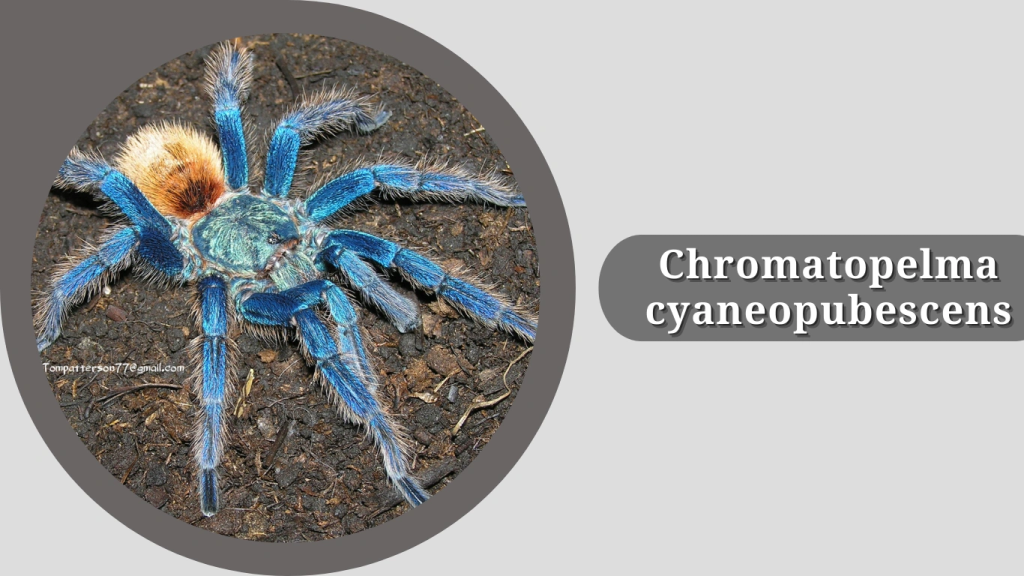
The Chromatopelma cyaneopubescens, often called the Greenbottle Blue Tarantula, is prized for its dazzling colors—blue legs, green carapace, and fiery orange abdomen. It is hardy, fast-growing, and a popular choice among tarantula keepers.
Identification
- Shimmering blue legs with fine hairs
- Metallic green-blue carapace
- Bright orange, hairy abdomen
- Medium size (4–6 inches leg span)
- Dense spinnerets, prolific webbing species
Habitat
Native to the Paraguaná Peninsula in northern Venezuela, this species thrives in arid scrublands and desert edges. It prefers sandy soil with sparse vegetation and builds extensive silk retreats above ground.
Behaviors
Known for heavy webbing, it creates intricate tunnels and silken mats. It is active, often visible, and less reclusive than many tarantulas. While skittish, it is less defensive compared to burrow-dwelling species.
Lifecycle & Lifespan
Females live 10–14 years, males around 4–5 years. Eggs sacs contain 100–150 spiderlings. Spiderlings grow rapidly, gaining vibrant colors with successive molts.
Diet
Feeds on crickets, roaches, grasshoppers, moths, and mealworms. In captivity, juveniles eat fruit flies and pinhead crickets.
7. Poecilotheria metallica (Gooty Sapphire Tarantula)

The Gooty Sapphire Tarantula (Poecilotheria metallica) is one of the rarest and most striking tarantulas, famous for its vibrant sapphire-blue coloration. Discovered in India, it is highly sought after due to its rarity and beauty.
Identification
- Striking cobalt-blue legs with yellow band markings
- Metallic blue carapace with light central marking
- Distinct patterns resembling lightning bolts
- Arboreal structure with long slender legs
- Females bulkier, males slimmer and lighter in tone
Habitat
Endemic to a small forest reserve near Gooty, Andhra Pradesh, India. It inhabits tall trees in moist deciduous forests, preferring high humidity and moderate temperatures.
Behaviors
Fast, defensive, and highly territorial. It is arboreal, spending much time in tree hollows or bark crevices. It ambushes prey using speed and precision. Communal tendencies have been observed in captivity under certain conditions.
Lifecycle & Lifespan
Females may live 12–15 years, while males live 3–4 years. Egg sacs contain 60–100 spiderlings, which grow quickly under proper care.
Diet
Feeds on flying insects, crickets, roaches, and moths. Larger specimens may also capture small birds or reptiles in the wild.
8. Haplopelma lividum (Cobalt Blue Tarantula)

The Haplopelma lividum, commonly known as the Cobalt Blue Tarantula, is admired for its intense metallic blue coloration but feared for its extreme defensiveness. It is a fossorial species that spends most of its life underground.
Identification
- Deep cobalt-blue legs with a velvety sheen
- Dark brown to black carapace
- Medium size (4–5 inches leg span)
- Stocky, muscular body
- Females larger and heavier than males
Habitat
Native to Myanmar and Thailand, this species thrives in tropical rainforests. It prefers damp soil and constructs deep burrows lined with silk for protection.
Behaviors
Highly defensive and extremely fast, making it one of the more aggressive tarantulas. It rarely leaves its burrow during the day and ambushes prey at night. Handling is not recommended.
Lifecycle & Lifespan
Females can live 15–20 years, while males usually survive 3–4 years post-maturity. Eggs sacs may contain 100–150 spiderlings, which disperse soon after hatching.
Diet
Feeds primarily on crickets, roaches, and beetles. Large adults may consume small amphibians or reptiles when available.
9. Lampropelma violaceopes (Singapore Blue Tarantula)

The Lampropelma violaceopes, known as the Singapore Blue Tarantula, is famous for its sheer size and brilliant violet-blue legs. It is one of the largest arboreal tarantulas in the world.
Identification
- Iridescent violet-blue legs with a purplish sheen
- Carapace darker, sometimes showing metallic tones
- Very large, with leg spans up to 10–11 inches
- Long, slender body with distinct spinnerets
- Females bulkier, males slimmer with longer legs
Habitat
Found in Singapore and Malaysia, inhabiting dense rainforests. Prefers hollow logs, tree trunks, and high arboreal retreats in humid, tropical conditions.
Behaviors
Fast and defensive, with a strong tendency to climb. It builds silken retreats high in trees and hunts by ambush. It reacts aggressively when threatened, making it unsuitable for handling.
Lifecycle & Lifespan
Females can live 12–15 years, while males live 3–4 years. Egg sacs contain 80–150 spiderlings, which grow quickly under proper humidity and warmth.
Diet
Feeds on large insects like crickets, roaches, moths, and grasshoppers. Large females may also prey on small lizards or amphibians.
10. Monocentropus balfouri (Socotra Blue Baboon Tarantula)

The Monocentropus balfouri, also known as the Socotra Blue Baboon, is a unique tarantula species highly valued for both its striking coloration and unusual social behavior. Unlike most tarantulas, this species can thrive in communal setups.
Identification
- Blue legs with creamy-white carapace and abdomen
- Distinct contrast between pale body and vivid blue limbs
- Medium size (4–6 inches leg span)
- Dense hair coverage giving a silky appearance
- No significant sexual dimorphism in coloration
Habitat
Endemic to Socotra Island (Yemen), it inhabits dry, rocky scrublands. Prefers arid environments with minimal vegetation, making use of burrows, crevices, and rocky shelters.
Behaviors
Semi-communal species—adults and juveniles may share burrows and even hunt cooperatively. Defensive but less aggressive compared to other old-world tarantulas. Builds silken retreats in rocky shelters.
Lifecycle & Lifespan
Females live 10–12 years, while males live 3–4 years. Egg sacs contain 50–100 spiderlings. Juveniles often remain together longer than most tarantula species.
Diet
Feeds on crickets, roaches, grasshoppers, and beetles. In communal setups, groups may share prey.
11. Phlogius sp. (Australian Blue Leg Tarantula)

The Australian Blue Leg Tarantula (Phlogius species) is a striking old-world tarantula native to northern Australia. It is known for its blue-tinged legs and robust body, making it a favorite among collectors.
Identification
- Blue shimmer on legs, especially under light
- Brown to dark carapace and abdomen
- Stocky body with thick setae
- Large size, up to 8 inches leg span
- Females bulkier, males slender with longer legs
Habitat
Native to tropical and subtropical northern Australia. Found in savannas, woodlands, and scrublands, where it builds deep burrows in sandy or clay soil.
Behaviors
Fossorial species that spends most time underground. Defensive when disturbed, capable of delivering medically significant bites. Hunts at night by ambushing prey near burrow entrances.
Lifecycle & Lifespan
Females can live 15–20 years, while males survive around 5 years. Spiderlings grow steadily and undergo multiple molts before reaching maturity.
Diet
Feeds on insects, beetles, and roaches. Larger individuals may capture frogs, small reptiles, or even mice.
12. Pterinopelma sazimai (Brazilian Blue Tarantula)

The Pterinopelma sazimai, also called the Brazilian Blue Tarantula, is one of the most vividly colored tarantulas, displaying a deep metallic blue across its body. Native to Brazil, it is both rare and highly prized in the hobby.
Identification
- Striking metallic blue coloration over legs and carapace
- Abdomen darker with fine hair coverage
- Medium size, around 5–6 inches leg span
- Compact body with slightly stocky legs
- Females more vibrant than males
Habitat
Endemic to Brazil’s Chapada Diamantina National Park, living in savannas and rocky grasslands. Prefers dry to semi-humid conditions and shelters under rocks or shallow burrows.
Behaviors
Generally skittish but not overly aggressive. It often flees to its hide rather than defending itself. Produces moderate amounts of silk around its retreat.
Lifecycle & Lifespan
Females can live 12–15 years, while males live about 4–5 years. Spiderlings grow steadily, with coloration becoming brighter after successive molts.
Diet
Feeds primarily on insects like roaches, crickets, and grasshoppers. Larger specimens may eat small lizards or amphibians.
13. Idiothele mira (Blue Foot Baboon Tarantula)

The Idiothele mira, commonly known as the Blue Foot Baboon, is an African tarantula noted for the metallic blue coloration on its feet. It is one of the few tarantulas that creates a trapdoor-style burrow.
Identification
- Dark brown to black body with velvety sheen
- Distinct metallic blue tips on feet (tarsi)
- Medium size (4–5 inches leg span)
- Dense setae covering legs and body
- Robust, stocky build typical of baboon spiders
Habitat
Native to South Africa and Mozambique. Prefers dry scrublands and savannas, constructing burrows with silk-lined trapdoors for ambushing prey.
Behaviors
A trapdoor-building species, it spends most of its time hidden beneath the surface. Ambush predator that relies on vibrations to detect prey. Defensive but not excessively aggressive.
Lifecycle & Lifespan
Females live 10–12 years, while males survive 3–4 years. Spiderlings grow slowly and develop blue coloration on feet after early molts.
Diet
Feeds on insects like beetles, roaches, and crickets. Occasionally captures small reptiles or amphibians that wander near the burrow entrance.
14. Heteroscodra maculata (Togo Starburst Tarantula)

The Heteroscodra maculata, known as the Togo Starburst or Ornamental Baboon Spider, is admired for its cryptic patterns and subtle bluish sheen. Though not as vividly blue as others, it often displays a silver-blue tint under light.
Identification
- Greyish-white body with intricate starburst patterns
- Subtle bluish or silvery hue on legs
- Arboreal build with long, slender legs
- Medium to large size (5–6 inches leg span)
- Females bulkier, males thinner with longer limbs
Habitat
Native to Togo and Ghana in West Africa. Found in forests, savannas, and rocky outcrops, often sheltering in tree crevices and rocky burrows.
Behaviors
Fast, defensive, and highly reclusive. Arboreal tendencies with strong climbing ability. Produces dense silk retreats and ambushes prey with speed. Handling is not advised due to potent venom.
Lifecycle & Lifespan
Females live 12–15 years, males 3–4 years. Egg sacs contain around 50–100 spiderlings. Growth rate is moderate, with juveniles showing cryptic coloration early.
Diet
Feeds on insects such as crickets, roaches, moths, and beetles. Larger specimens may occasionally capture geckos or small amphibians.
15. Harpactira pulchripes (Golden Blue Leg Baboon Tarantula)

The Harpactira pulchripes, commonly called the Golden Blue Leg Baboon, is a stunning African tarantula recognized for its golden carapace and metallic blue legs. It is one of the most visually striking baboon spiders.
Identification
- Golden carapace with metallic sheen
- Legs vividly blue with golden highlights
- Medium size (4–5 inches leg span)
- Dense hair coverage with iridescent shine
- Females more vibrant than males
Habitat
Native to South Africa’s semi-arid scrublands and grasslands. Constructs silk-lined burrows in sandy soil or shelters beneath rocks.
Behaviors
Primarily fossorial but ventures out at night to hunt. Defensive when provoked, quick to retreat into burrows. Builds strong silk retreats around its burrow entrance.
Lifecycle & Lifespan
Females live 12–15 years, males around 3–4 years. Spiderlings hatch in clutches of 50–100 and grow steadily with successive molts.
Diet
Feeds mainly on crickets, roaches, grasshoppers, and beetles. Larger adults may consume frogs or small reptiles when available.