

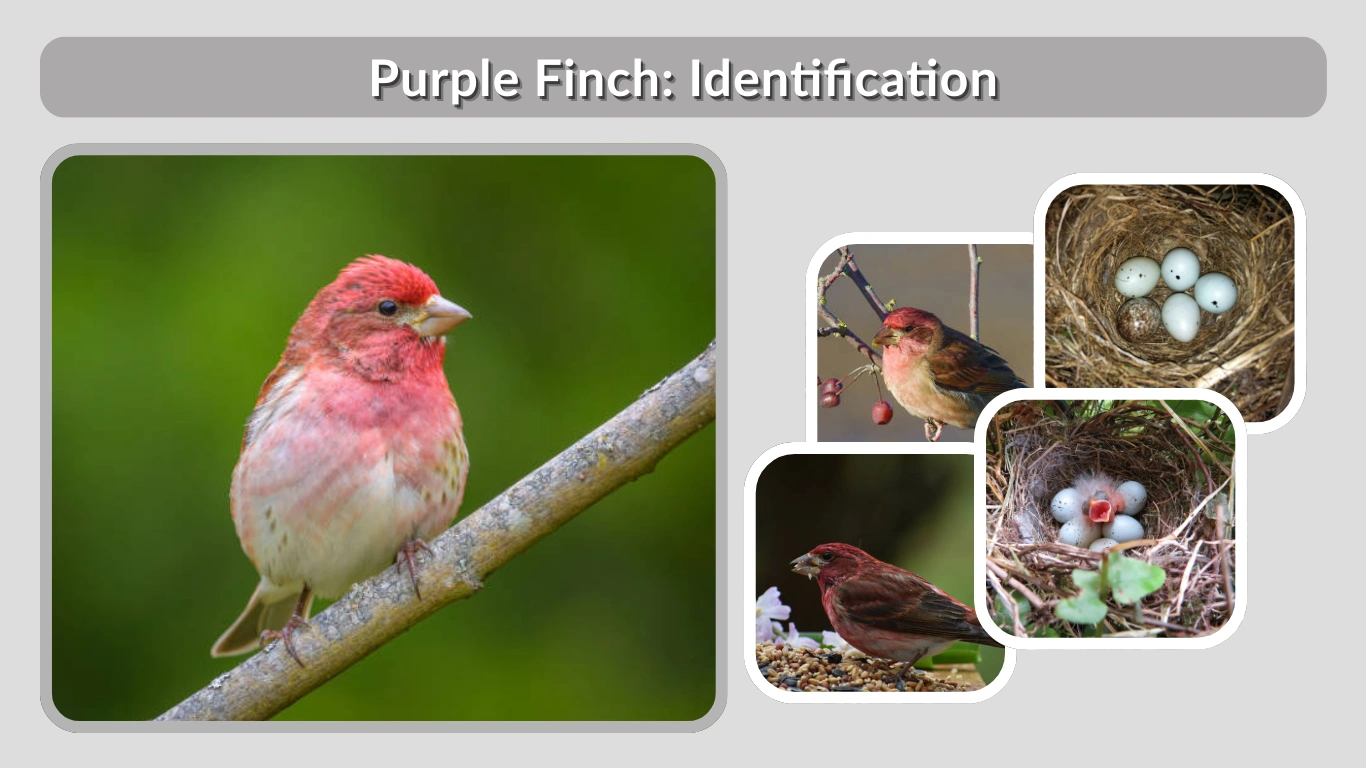
The Purple finch (Haemorhous purpureus) is a small North American songbird admired for the rich raspberry-red coloring of the male and its pleasant, warbling song. Often found in forests, woodland edges, and backyard gardens, this finch is both attractive and musically gifted. Although frequently confused with the house finch, the purple finch has distinct features and behaviors that set it apart. This guide explores its identification, habitat, diet, and early life, helping bird lovers better understand this beautiful species.
Purple Finch Overview
The purple finch belongs to the finch family Fringillidae and is native to North America. Its scientific name, Haemorhous purpureus, reflects the reddish coloration that gives the bird its common name, though the shade is closer to raspberry than true purple. Purple finches are mainly associated with cool, forested regions, especially areas dominated by coniferous and mixed woodland.
They play an important ecological role by feeding on seeds, buds, and fruits, helping control plant growth and contributing to seed dispersal. Purple finches are known for their gentle temperament and rich vocal abilities. They are more common in northern regions during the breeding season and may move southward in winter, often appearing at backyard feeders. Their adaptability to both natural forests and suburban settings has made them familiar yet fascinating birds to observe.
Identification and Physical Features
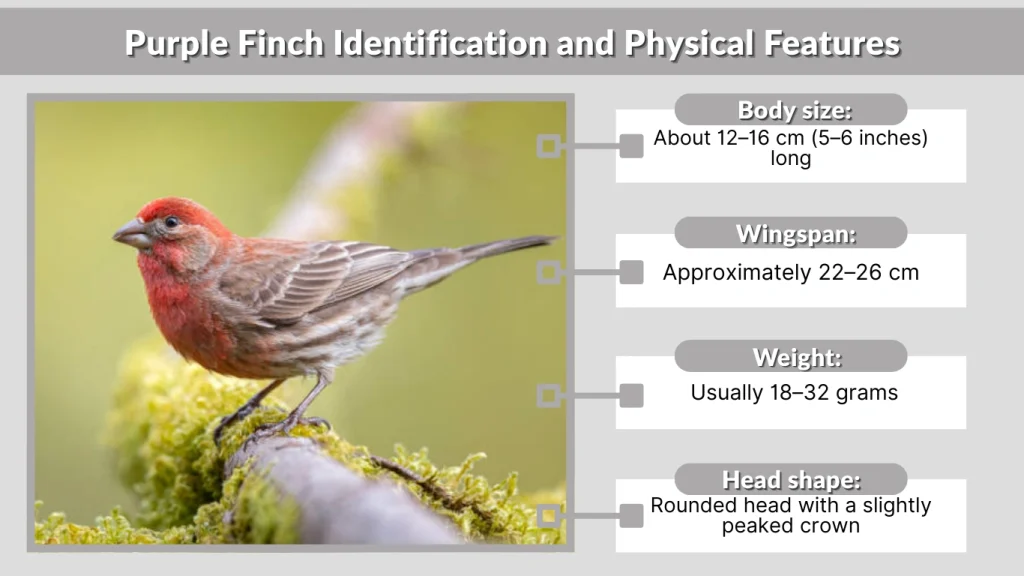
The purple finch is a medium-sized finch with a sturdy body and a slightly notched tail. Its thick, conical beak is well suited for cracking seeds and buds.
- Scientific name: Haemorhous purpureus, family Fringillidae
- Body size: About 12–16 cm (5–6 inches) long
- Wingspan: Approximately 22–26 cm
- Weight: Usually 18–32 grams
- Head shape: Rounded head with a slightly peaked crown
- Beak: Short, thick, and slightly curved
- Wing pattern: Subtle wing bars and a gently notched tail
- Flight style: Light, bouncing flight with quick wingbeats
These physical traits give the purple finch a compact, robust appearance compared to some slimmer finch species.
Male vs Female Purple Finch

Male Purple Finch Appearance
Male purple finches are best known for their rich raspberry-red coloration. This color appears most strongly on the head, throat, and chest, spreading unevenly across the back and flanks. Unlike the house finch, whose red is often limited to the head and chest, the purple finch looks as if it has been “dipped in berry juice,” with red tones washing over much of the body. The wings and tail remain brown, creating a soft contrast that highlights the brighter areas.
Female Purple Finch Appearance
Female purple finches are completely different in appearance. They lack red coloring and are patterned in brown and white streaks. A bold facial pattern is a key feature, with a strong white eyebrow stripe and dark cheek markings. The underparts are heavily streaked, giving the female a sharper, more contrasting look than the plainer female house finch. This streaking provides camouflage while nesting.
Juvenile Differences
Juvenile purple finches closely resemble adult females. They are brown and streaked, with no red coloring. Their markings are slightly softer and less defined, becoming clearer as they mature. Young males begin developing red feathers during their first major molt.
Natural Habitat and Distribution
Purple finches are primarily birds of cool, moist forests. They favor coniferous woodlands dominated by spruce, fir, hemlock, and pine, but they are also found in mixed forests that include deciduous trees. During the breeding season, they are most common across Canada, the northeastern United States, and parts of the northern Midwest and Pacific coast.
In winter, many purple finches move southward into the central and eastern United States. Their winter range shifts depending on food availability, especially cone crops and seed abundance. In suburban areas, they readily visit gardens with mature trees, shrubs, and bird feeders, allowing people to observe them at close range.
Diet and Feeding Behavior
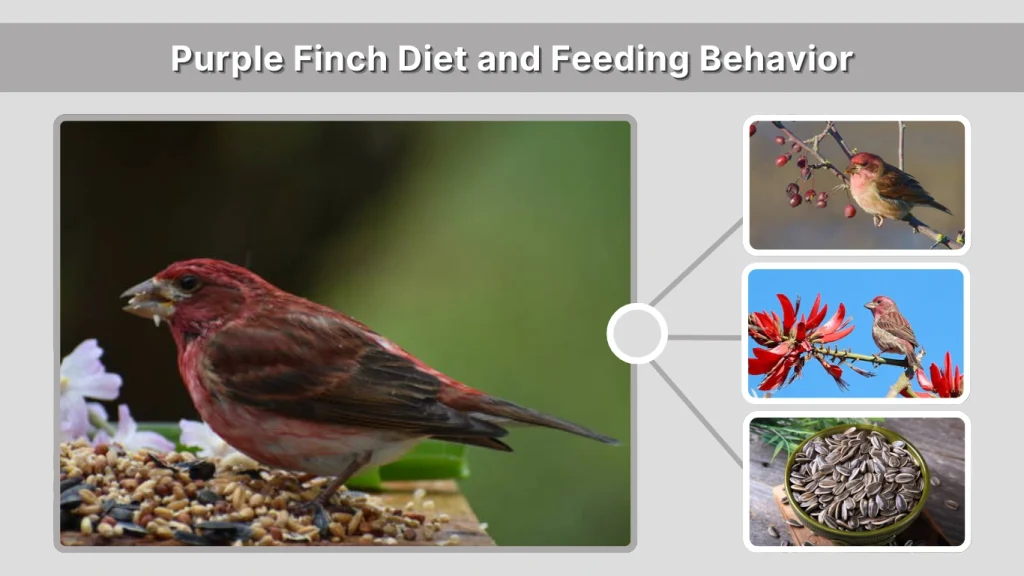
Purple finches are mainly plant eaters, but they take advantage of a wide variety of foods throughout the year.
- Seeds: From conifers, grasses, and weeds
- Tree buds: Especially in early spring
- Berries and fruits: Including wild berries and soft fruits
- Flowers and nectar: Occasionally taken in warm seasons
- Insects and larvae: Important during the breeding period
- Feeder foods: Sunflower seeds, millet, and safflower
They often feed in trees rather than on the ground, clinging to cones or branches while extracting seeds. Their strong beaks allow them to crush tough seed coats with ease. Purple finches are usually seen alone, in pairs, or in small flocks, especially during winter.
Nesting and Breeding Cycle
Breeding Season and Courtship
The breeding season of the purple finch usually begins in late April and can extend into July. As spring arrives, males become more vocal, singing rich, warbling songs from treetops to attract mates and establish small territories. Courtship is gentle rather than aggressive, often involving soft singing, chasing flights, and the male offering food to the female. Once a pair bond is formed, the two remain closely associated throughout the nesting period.
Nest Construction
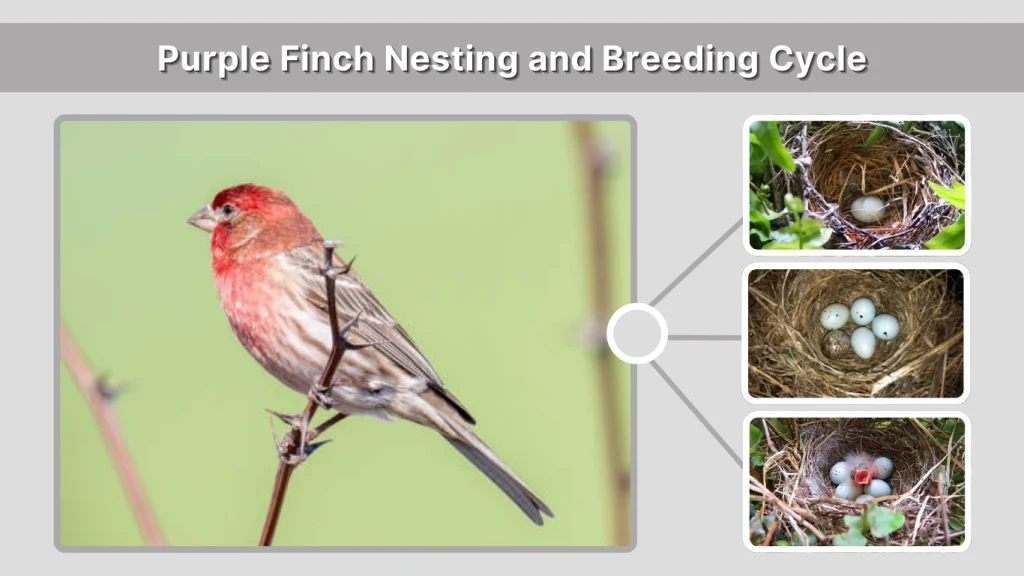
Nests are typically built high in trees, especially conifers such as spruce, pine, and fir. The female does most of the building, weaving together twigs, roots, bark strips, and grasses to form a compact cup. The inner lining is soft, made from fine grass, feathers, hair, or plant fibers. The elevated and concealed location of the nest provides protection from ground predators and harsh weather.
Eggs and Incubation
A typical clutch contains three to five pale blue or greenish eggs, often marked with dark speckles. The female incubates the eggs for about twelve to fourteen days. During this period, the male brings food to the nest and stays nearby, defending the area from intruders and potential threats.
Purple Finch Eggs and Chicks
After hatching, the chicks are blind and nearly featherless. Both parents share feeding duties, bringing insects, larvae, and regurgitated plant material. This protein-rich diet allows the chicks to grow rapidly. Their feathers begin to emerge within a week, and their eyes open soon after. Fledging usually occurs around twelve to sixteen days after hatching. Even after leaving the nest, young purple finches remain dependent on their parents for several weeks while they learn to forage and recognize safe feeding areas.
Song, Call, and Communication
Purple Finch Song
The purple finch is widely admired for its musical voice. Its song is a rich, rolling warble made up of varied notes, trills, and soft buzzes. Often compared to a refined version of the house finch’s song, it has a smoother, more fluid quality. Males sing most frequently during the breeding season, using song to attract females and communicate territorial presence.
Calls and Alarm Sounds
In addition to song, purple finches use short contact calls to stay in touch with mates or flock members. These calls are sharp but not harsh. Alarm calls are quicker and more urgent, alerting nearby birds to predators such as hawks or cats. These vocal signals help maintain group coordination and safety.
Behavior and Seasonal Movement
Purple finches are active, agile birds that spend much of their time in trees and shrubs.
- Daily activity: Most active in the morning and late afternoon
- Social behavior: Seen alone, in pairs, or small flocks
- Territorial habits: Mildly territorial during breeding season
- Winter behavior: Often joins mixed-species flocks
- Movement patterns: Partial migrant, shifting south in winter
- Human interaction: Regular visitor to backyard feeders
Their movements depend strongly on food supply. In years with poor seed crops, large numbers may move farther south than usual.
Lifespan, Predators, and Survival
In the wild, purple finches usually live between two and seven years, though some individuals may survive longer. Predators include hawks, owls, snakes, and domestic cats. Eggs and chicks are especially vulnerable to squirrels, jays, and climbing mammals. Purple finches rely on dense forest cover, alert behavior, and their ability to remain high in trees to reduce predation risk.
Purple Finch in Gardens and Birdwatching
Purple finches are popular backyard visitors, particularly in winter. They are attracted to feeders offering black oil sunflower seeds, safflower seeds, and nyjer. Platform feeders and tube feeders both work well. Planting native shrubs and maintaining mature trees increases the chances of regular visits. Birdwatchers often locate purple finches by listening for their rolling song or by watching treetops where they frequently feed and rest.
Conservation Status and Population Trends
The purple finch is currently listed as “Least Concern” by the IUCN, but long-term surveys indicate population declines in parts of its range. Habitat loss, changes in forest composition, and competition with house finches are considered major factors. Protecting coniferous forests, maintaining mixed woodlands, and supporting bird-friendly gardens are important steps in helping stabilize purple finch populations.
FAQs
What does a purple finch eat throughout the year?
Purple finches feed mainly on seeds, buds, and fruits. In spring, they eat many tree buds and flowers. During summer, insects and larvae become important, especially for feeding chicks. In autumn and winter, seeds, berries, and feeder foods make up most of their diet.
How can you tell a purple finch from a house finch?
Male purple finches have a deep raspberry-red color spread over the head, back, and chest, while house finches usually show red only on the head and chest. Female purple finches have bold facial markings and heavy streaking, unlike the plainer female house finch.
Where do purple finches build their nests?
Purple finches usually nest high in coniferous trees. The female builds a compact cup nest from twigs, bark, and grasses, lined with soft material. The elevated position offers protection and helps keep the eggs and chicks hidden from many predators.
Is the purple finch migratory?
Purple finches are partial migrants. Many northern birds move south in winter, while others remain year-round where food is available. Their movements depend largely on cone crops and seed supplies rather than strict seasonal routes.
Are purple finches endangered?
Purple finches are not endangered and are listed as Least Concern. However, population declines have been recorded in some regions. Habitat protection and the preservation of mixed and coniferous forests are important for their long-term stability.