

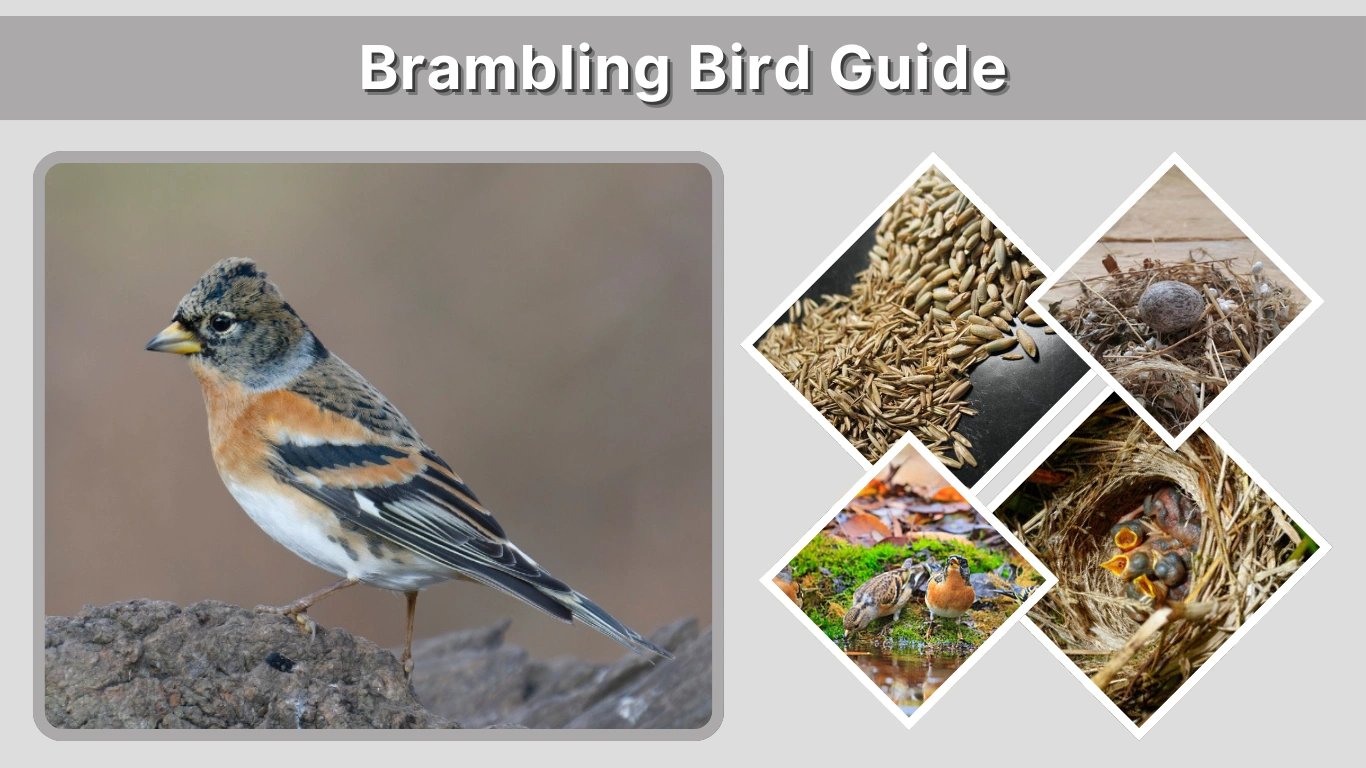
The brambling bird (Fringilla montifringilla) is a colorful migratory finch best known for its striking seasonal plumage and massive winter flocks. Breeding across northern Europe and Asia, this woodland bird travels thousands of kilometers each year to escape harsh winters. Birdwatchers admire the brambling for its black-headed breeding look, orange breast, and lively feeding behavior. Understanding brambling identification, habitat, and diet helps nature lovers easily recognize this fascinating finch in forests, farmlands, and winter feeding grounds.
Brambling Bird Overview
The brambling is a small passerine bird belonging to the finch family, Fringillidae. At first glance, it closely resembles the common chaffinch, but careful observation reveals distinct colors and seasonal changes that set it apart. During the breeding season, adult males develop a bold black head, bright orange breast, and crisp white wing bars, making them especially eye-catching.
Outside the breeding season, bramblings undergo a noticeable transformation. Their black feathers become tipped with pale edges, giving the head a brownish appearance. This seasonal plumage change often causes confusion among beginner birdwatchers, especially when bramblings mix with chaffinches in large winter flocks.
Bramblings are highly social in winter and can gather in enormous numbers where food is abundant. Some roosts across Europe have been recorded with hundreds of thousands of individuals, creating one of the most spectacular finch gatherings in the bird world.
Scientific Classification
- Kingdom: Animalia
- Phylum: Chordata
- Class: Aves
- Order: Passeriformes
- Family: Fringillidae
- Genus: Fringilla
- Species: Fringilla montifringilla
The brambling is the only member of its species and is closely related to the common chaffinch. Despite their similarities, bramblings maintain distinct migration patterns, plumage traits, and vocalizations that justify their separate classification.
Brambling Identification
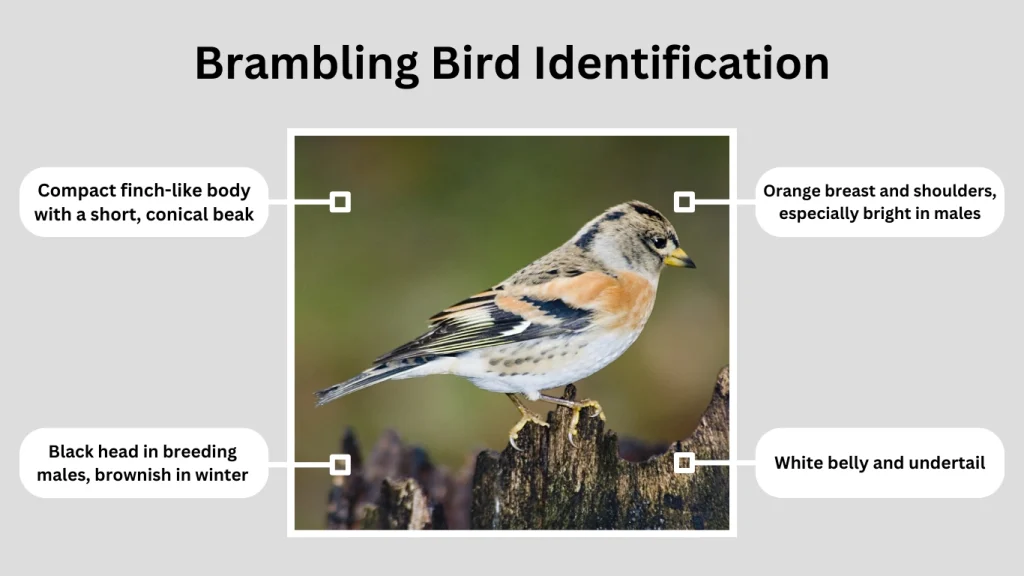
The brambling can be recognized by a combination of shape, markings, and color patterns that shift with the seasons.
- Compact finch-like body with a short, conical beak
- Orange breast and shoulders, especially bright in males
- Black head in breeding males, brownish in winter
- White belly and undertail
- Bold white wing bars visible in flight
- Distinct white rump patch
- Slightly forked tail with dark edges
These features together help distinguish the brambling from similar finches, particularly when seen in mixed feeding flocks.
Male vs Female Brambling
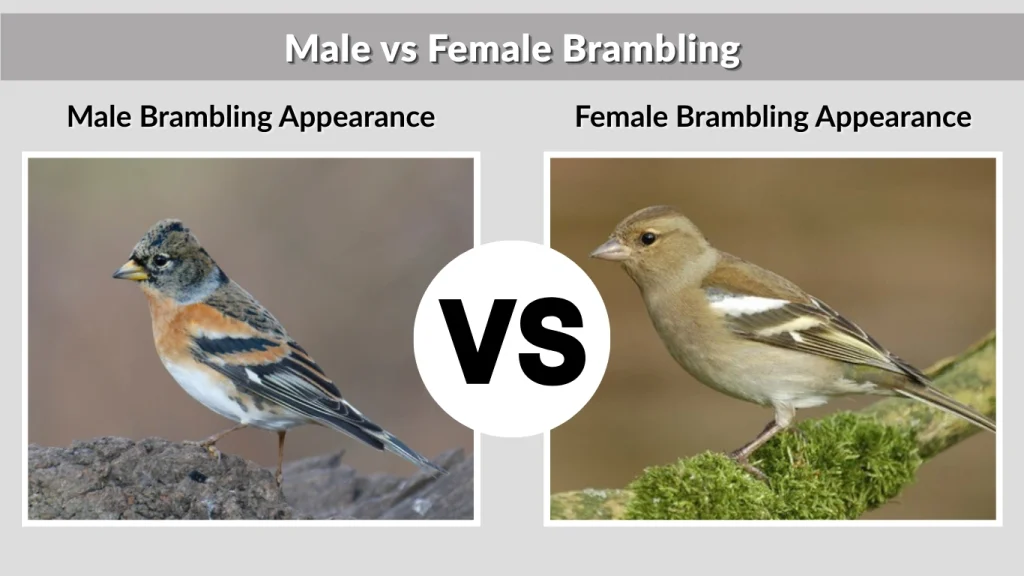
Male Brambling Appearance
Male bramblings are most striking during the breeding season. Their heads become deep black, contrasting sharply with the orange breast, white belly, and patterned wings. The back shows dark tones mixed with pale spotting, while the white rump becomes very visible in flight. In winter, males appear softer brown on the head as pale feather tips partially cover the black.
Female Brambling Appearance
Female bramblings are more subtly colored. Their heads are gray-brown rather than black, and their orange areas are duller and less sharply defined. The overall look is softer, providing better camouflage during nesting. Despite this, females still retain the white rump and wing bars that help confirm identification.
Size, Wingspan, and Physical Features
Bramblings are small birds, measuring about 14 to 16 centimeters in length, placing them close in size to sparrows and chaffinches. Their wingspan usually ranges between 22 and 26 centimeters, allowing for quick, agile flight over long migratory distances.
They have a sturdy, seed-cracking beak that shifts in color through the year—pale and horn-colored in summer, darker in winter. Their legs are slim yet strong, adapted for both ground feeding and perching on thin branches.
In flight, bramblings show a distinctive flashing pattern created by their white rump and wing bars. This makes moving flocks easy to identify even from a distance, especially when birds rise suddenly from feeding fields or woodland floors.
Habitat and Distribution
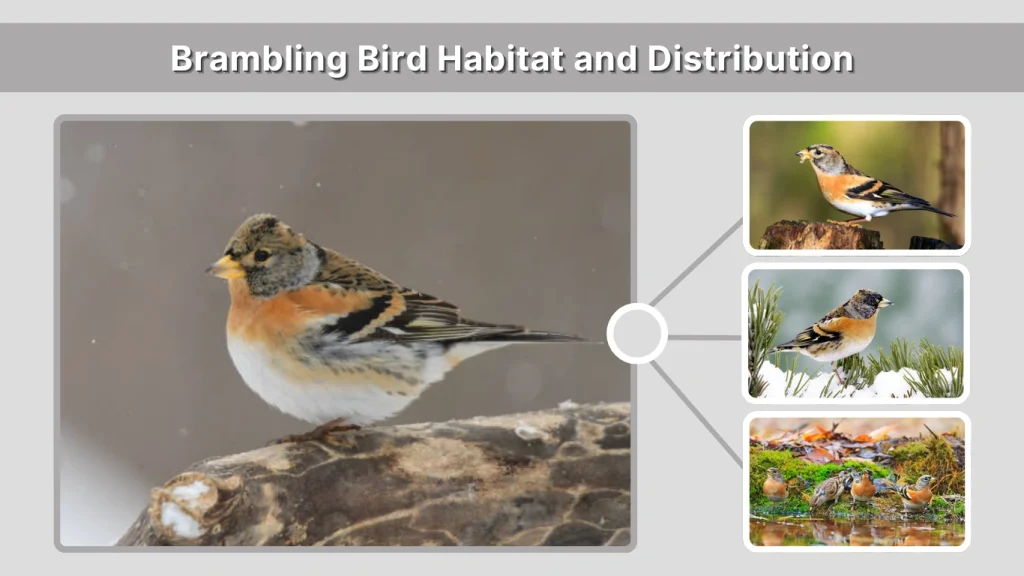
Bramblings occupy a wide geographic range that changes dramatically with the seasons.
- Breeding in northern Europe and across Siberia
- Nesting mainly in birch, spruce, and mixed forests
- Wintering in southern and central Europe, East Asia, and parts of the Middle East
- Common in woodland edges, farmland, and forest clearings
- Frequently seen in beech forests during mast years
- Visiting parks, gardens, and feeding stations in winter
Their dependence on forest seeds strongly influences where large winter flocks settle each year.
Migration and Seasonal Movement
Brambling is a true long-distance migrant. As autumn arrives, millions leave northern breeding grounds and move southward in waves. The exact wintering areas vary yearly depending on seed crops, especially beech mast. In years of heavy seed production, vast numbers may concentrate in a single region.
Spring migration begins early, with birds returning north to claim breeding territories. During this period, males gradually regain their black head feathers, signaling the start of courtship and nesting behavior.
Diet and Feeding Behavior
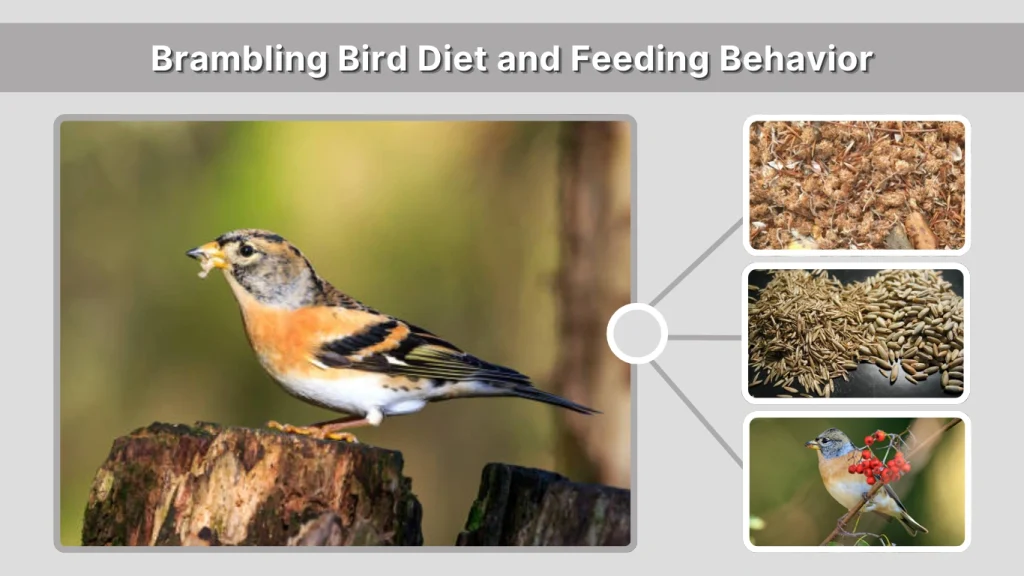
Bramblings are primarily seed eaters, but their diet changes with the seasons and food availability. During the breeding period, they rely more heavily on insects to meet the high protein demands of raising chicks. In winter, their survival depends largely on tree seeds and agricultural grains.
- Beech mast, birch seeds, and alder seeds
- Grass seeds and cereal grains
- Berries and small fruits
- Beetles, caterpillars, and spiders
- Ground foraging under trees and hedgerows
- Dense winter feeding flocks
- Regular visits to bird feeders
When feeding, bramblings often hop along the ground, flicking leaves aside to reach fallen seeds. At feeding stations, they may mix with chaffinches, greenfinches, and sparrows, sometimes forming very large, noisy groups.
Breeding Season and Nesting Habits
The breeding season begins soon after bramblings return to their northern forest habitats in spring. Males establish small territories and attract females through song and display flights. Courtship involves wing fluttering and the presentation of food.
Nests are usually built in trees, often several meters above the ground, hidden among branches. The female constructs the nest using twigs, grass, moss, and lichen, lining it with feathers and softer plant fibers to insulate the eggs.
Once the nest is complete, the female lays a small clutch and takes the primary role in incubation, while the male guards the territory and brings food. Both parents later participate in feeding the chicks, making frequent trips with insects.
Eggs, Chicks, and Development
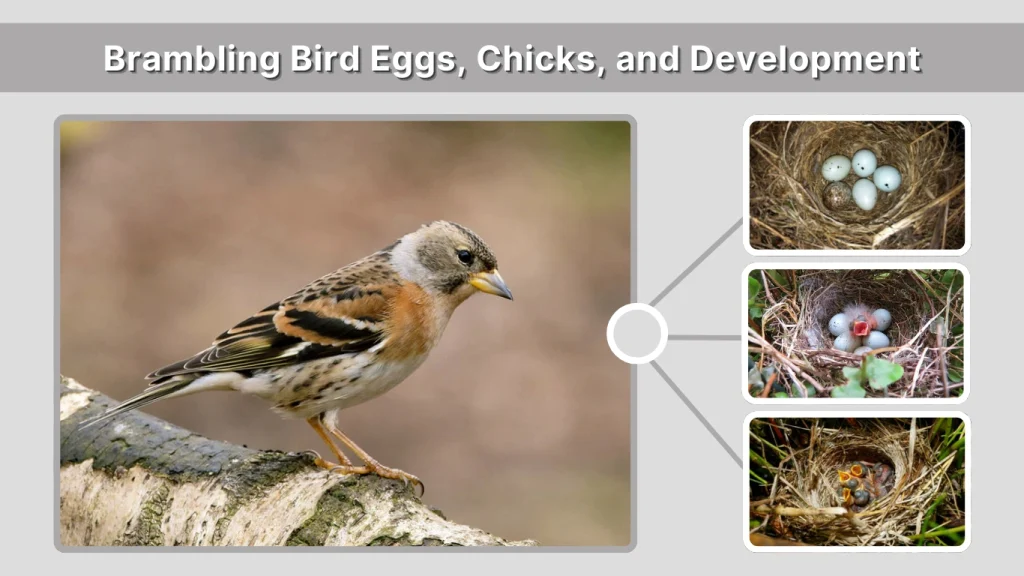
Brambling eggs are typically pale bluish or greenish with fine reddish-brown speckles. A normal clutch contains four to six eggs. Incubation lasts about two weeks, after which the chicks hatch blind and helpless.
For the first days, the nestlings depend entirely on their parents for warmth and food. The adults provide a steady supply of insects, which are essential for rapid growth. As the chicks mature, seeds are gradually introduced.
After around two weeks, the young birds leave the nest, though they continue to be fed by their parents for a short time. By late summer, juvenile bramblings begin to form small flocks and prepare for their first migration.
Behavior and Social Life
Bramblings are relatively quiet and territorial during the breeding season, but their behavior changes dramatically in winter. They become highly social and often gather in massive flocks, sometimes numbering in the hundreds of thousands.
These flocks feed together during the day and gather at communal roosts in the evening. Such roosts can stretch for kilometers and create an impressive spectacle as birds arrive from all directions at dusk.
Bramblings frequently associate with other finches, especially chaffinches. This mixed flocking behavior improves predator detection and increases feeding efficiency in open winter landscapes.
Brambling Bird Song and Calls
Song Description
The brambling’s song is a short, sharp series of trills and rattles, often delivered from a tree branch during the breeding season. It is less musical than some finches but is distinctive once learned.
Common Calls
In flight and feeding flocks, bramblings use dry, nasal calls to maintain contact. Alarm calls are sharper and louder, warning others of approaching predators.
Lifespan, Predators, and Threats
In the wild, most bramblings live between two and five years, though some individuals survive much longer. Their main predators include birds of prey such as sparrowhawks and falcons, as well as mammals like foxes and martens.
Eggs and chicks are vulnerable to crows, jays, and squirrels. Harsh winters, food shortages, and habitat loss can also affect survival. Despite these challenges, bramblings remain resilient due to their wide range and adaptability.
Conservation Status and Population Trends
The brambling is currently listed as a species of Least Concern by the IUCN. It has an extremely large range and a stable global population. While local declines may occur due to forest changes or climate effects, the species as a whole is not considered threatened.
Continued protection of woodland habitats and sustainable forestry practices are important for maintaining healthy brambling populations across Europe and Asia.
Interesting Brambling Bird Facts
Bramblings are famous for forming some of the largest known bird roosts in Europe. In certain winters, single roosts have been estimated to contain more than ten million birds, making them among the biggest bird gatherings on the continent.
Their dramatic seasonal color change is another fascinating feature. What looks like a brown-headed bird in winter can transform into a striking black-headed finch by spring, simply through feather wear rather than molting.
Bramblings have also played a role in historical records, where sudden winter invasions were used by early naturalists to track forest seed cycles long before modern ecological studies existed.
FAQs
What is a brambling bird?
A brambling bird is a small migratory finch native to northern Europe and Asia. It is closely related to the chaffinch and is known for its orange breast, white rump, and dramatic seasonal plumage change, especially the black head of breeding males.
Where do brambling birds live?
Bramblings breed in northern forests across Scandinavia and Siberia. During winter, they migrate south to central and southern Europe, East Asia, and nearby regions, often forming huge flocks in woodlands, farmlands, and parks.
What do brambling birds eat?
Bramblings mainly eat seeds, including beech mast, birch seeds, and grains. In spring and summer, they also consume insects and larvae, which provide essential protein for breeding adults and growing chicks.
How can you identify a brambling?
You can identify a bramble by its orange breast, white belly, bold white wing bars, and white rump. Breeding males have a black head, while females and winter birds show brownish heads with softer contrasts.
Is the brambling bird rare?
No, the brambling is not rare on a global scale. It has a large population and wide range, though its numbers in any specific location may change greatly from year to year depending on food availability.