



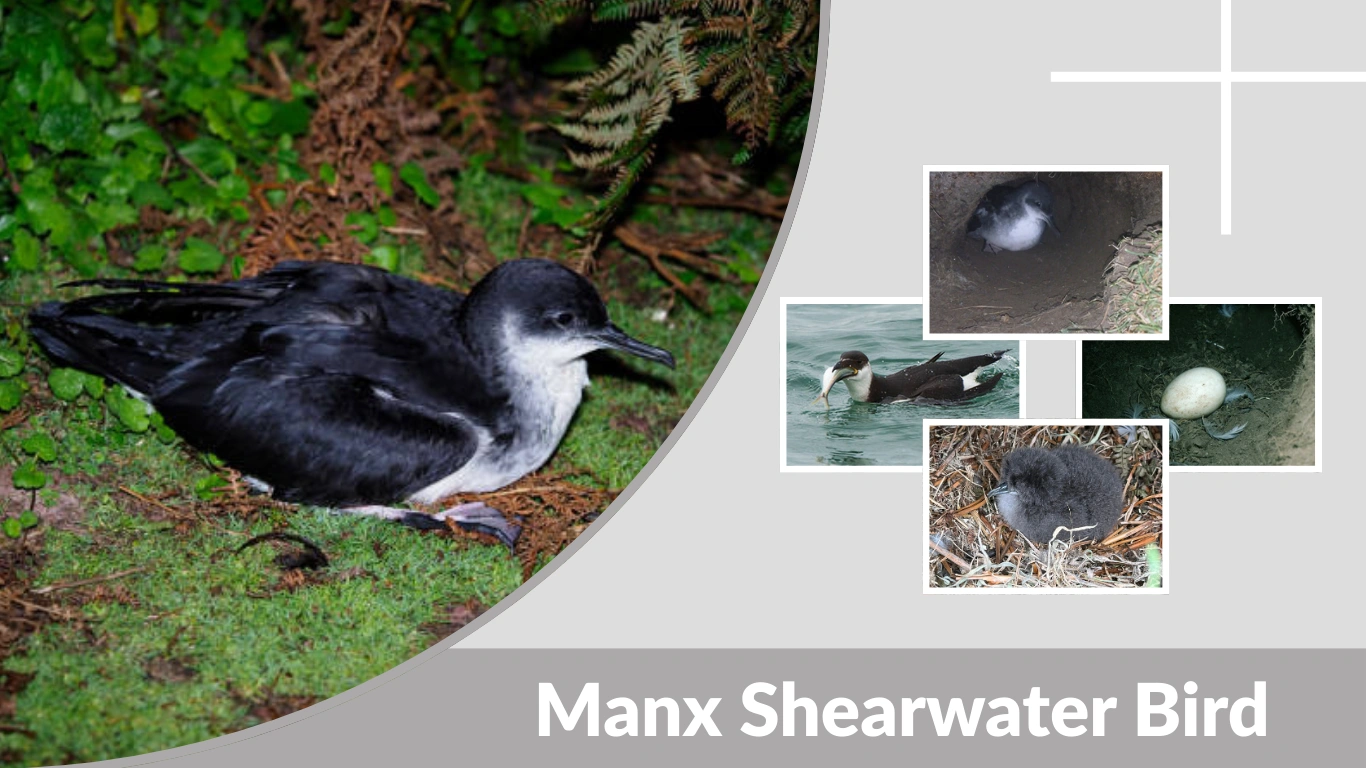
The Manx shearwater (Puffinus puffinus) is a remarkable ocean-going bird famous for its long-distance migrations, elegant gliding flight, and mysterious nighttime calls at breeding colonies. Spending most of its life far from land, this seabird travels across entire oceans each year, connecting northern breeding islands with southern feeding grounds. With a black-and-white body, narrow wings, and powerful endurance, the Manx shearwater is considered one of the most impressive navigators in the avian world.
What Is a Manx Shearwater?
The Manx shearwater is a medium-sized seabird belonging to the Procellariidae family, which also includes petrels and fulmars. This group is specially adapted for life over open oceans, with long wings for dynamic soaring and tubular nostrils that help manage salt intake.
Manx shearwaters spend the vast majority of their lives at sea, only returning to land to breed. They are strongly associated with the North Atlantic during the nesting season but travel far into the Southern Hemisphere outside of breeding months. Their scientific name, Puffinus puffinus, reflects their traditional classification among the “true shearwaters,” birds known for skimming low over waves in a distinctive shearing flight.
Unlike many coastal birds, Manx shearwaters rarely come ashore during daylight. On land, they are mostly nocturnal, an adaptation that reduces predation risk. At sea, however, they are highly active, traveling long distances daily in search of food and favorable ocean conditions.
Manx Shearwater Identification
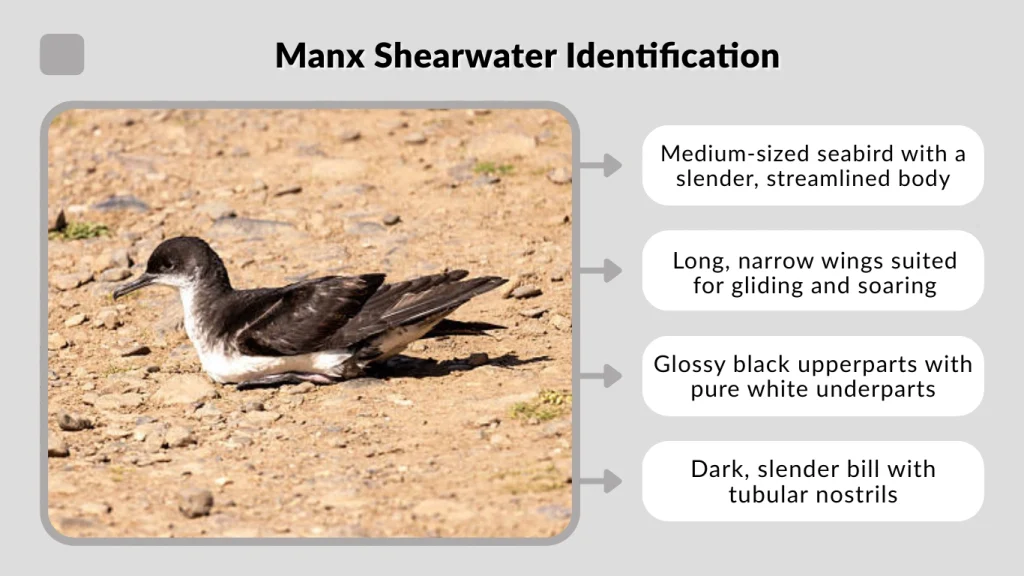
Short overview: The Manx shearwater is easily recognized by its clean black-and-white contrast, slim wings, and buoyant flight just above the water’s surface.
- Medium-sized seabird with a slender, streamlined body
- Long, narrow wings suited for gliding and soaring
- Glossy black upperparts with pure white underparts
- Dark, slender bill with tubular nostrils
- Pale pinkish legs and webbed feet
- Juveniles closely resemble adults, with slightly duller plumage
Size, Wingspan, and Physical Features
Manx shearwaters are built for efficiency rather than power. Adults typically measure around 30–38 cm (12–15 inches) in length, with a wingspan of approximately 76–89 cm (30–35 inches). Their weight varies seasonally, becoming heavier before migration and lighter after long ocean crossings.
Their wings are long and stiff, ideal for dynamic soaring, a flight technique that allows them to harvest energy from wind gradients above the waves. This style of movement lets them travel enormous distances while using surprisingly little energy. When feeding, they can switch from gliding to rapid wingbeats, then drop suddenly to seize prey from the surface.
The plumage is smooth and tightly packed, providing waterproofing and insulation against cold ocean waters. Their webbed feet are set far back on the body, making them awkward on land but powerful swimmers. These adaptations together make the Manx shearwater a near-perfect ocean traveler.
Habitat and Global Distribution
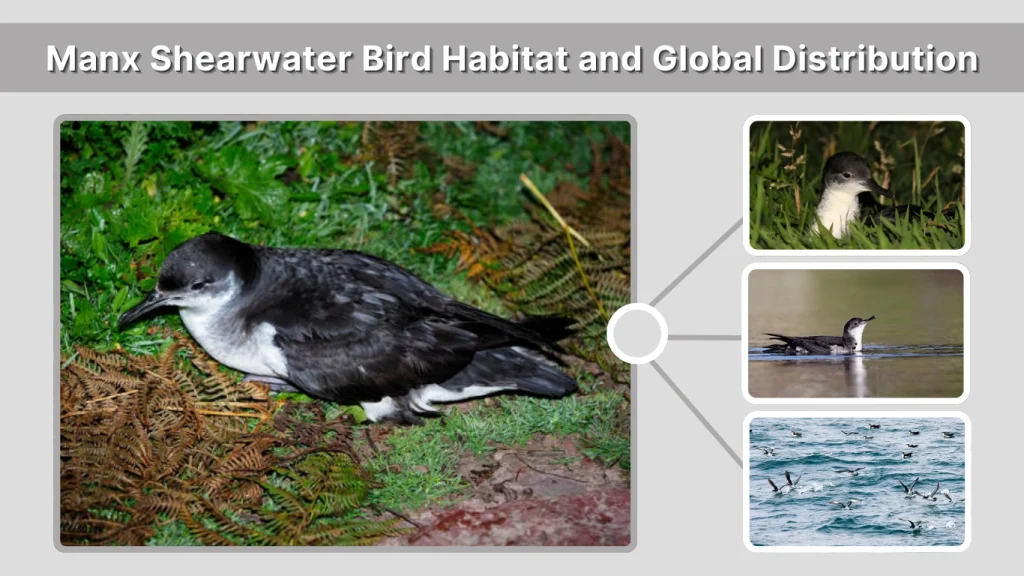
Ocean Habitat
For most of the year, Manx shearwaters live far out at sea, often beyond the sight of land. They favor productive ocean zones where currents bring nutrients to the surface, attracting fish and squid. They are commonly seen skimming low over waves, especially in windy conditions that support their gliding flight.
These birds rest directly on the water’s surface between feeding bouts, forming loose flocks. They may associate with dolphins, whales, or other seabirds, which help drive prey closer to the surface.
Breeding Colonies
When breeding season arrives, Manx shearwaters return faithfully to island colonies, often the same burrow they used in previous years. They prefer remote islands with grassy slopes, cliffs, or soft soil suitable for digging tunnels.
Nests are placed deep inside burrows, protecting eggs and chicks from weather and predators. Colonies are typically silent during the day but become loud and active at night as adults return from the sea, calling loudly to locate their mates and burrows in the darkness.
Diet and Feeding Behavior
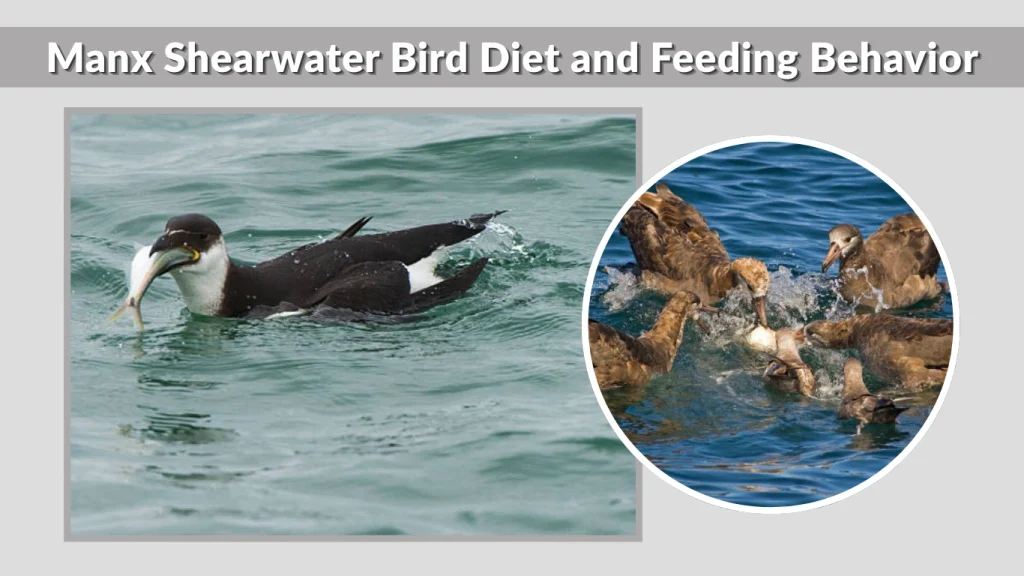
Short overview: The Manx shearwater is a skilled surface-feeder and shallow diver, relying on marine life found in upper ocean layers.
- Small schooling fish such as sand eels and anchovies
- Squid and other soft-bodied cephalopods
- Crustaceans and plankton-feeding organisms
- Surface seizing while flying low over waves
- Short plunges and shallow dives below the surface
- Cooperative feeding with other seabirds and marine mammals
Manx shearwaters often feed in groups, especially when prey is abundant. They can travel great distances between feeding areas, using wind patterns and memory of productive waters to locate food efficiently.
Migration Patterns and Navigation
The Manx shearwater is famous for its extraordinary migration. After breeding in the North Atlantic, many individuals travel southward across the equator, reaching rich feeding grounds in the South Atlantic and off the coasts of South America and southern Africa.
This journey can exceed tens of thousands of kilometers in a single year, making the Manx shearwater one of the longest-migrating birds on Earth. They rely on a combination of environmental cues, ocean winds, the sun, stars, and possibly Earth’s magnetic field to navigate across featureless seas.
Researchers tracking Manx shearwaters with modern devices have discovered looping migration routes that follow productive ocean currents rather than straight lines. This strategy allows them to feed continuously while traveling, turning migration into an extended foraging expedition.
Breeding Cycle and Reproduction
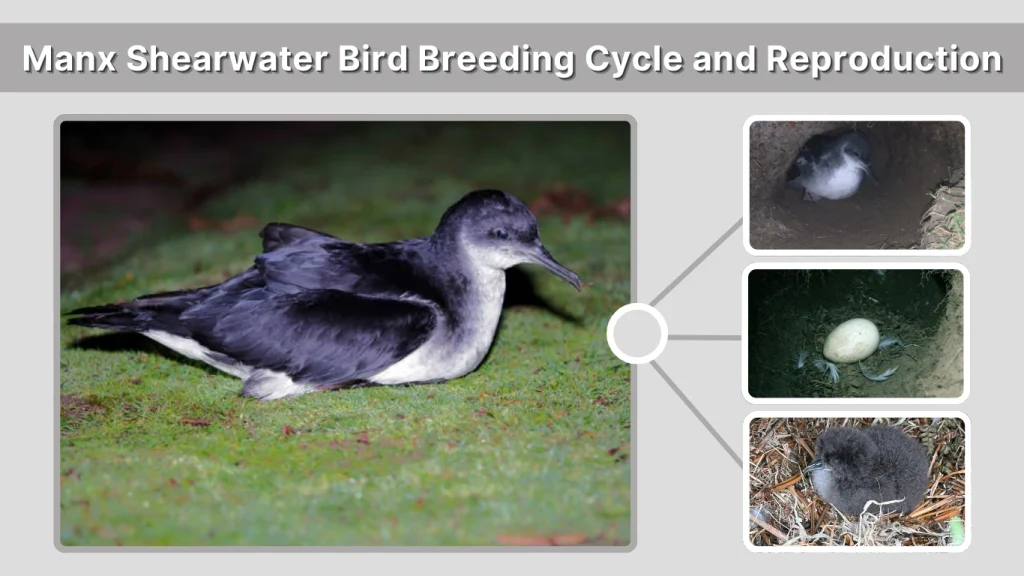
Courtship and Nesting
Manx shearwaters are highly faithful to both their mates and nesting sites. Many pairs reunite year after year, returning to the same underground burrow on isolated islands. Courtship involves mutual calling, bill-touching, and synchronized movements, usually performed at night to avoid predators.
Burrows may be naturally occurring cavities or tunnels dug into soft soil and grassy slopes. These nesting chambers can extend more than a meter underground, ending in a widened chamber lined with dry vegetation. Nocturnal behavior at colonies helps protect adults from gulls, skuas, and other daytime predators.
Eggs and Chick Development
Each breeding season, the female lays a single white egg. Both parents share incubation duties, taking long shifts that may last several days while the other partner feeds at sea. This strategy allows them to forage far from the colony without abandoning the egg.
Once hatched, the chick is fed regurgitated fish and squid oils rich in energy. The chick grows rapidly, often becoming heavier than the adults before fledging. After several weeks, the young bird leaves the burrow under cover of darkness and heads directly to the open ocean, where it will remain for years before returning to breed.
Behavior and Vocalizations
At sea, Manx shearwaters are graceful and efficient flyers, spending long periods gliding just above wave crests. They rest on the water between feeding bouts and may travel hundreds of kilometers in a single day. On land, however, they are awkward walkers, relying on wings and feet to shuffle inside burrows.
Their colonies are famous for their eerie nighttime sounds. Adults produce a wide range of wailing, cackling, and crooning calls used to locate burrows and communicate with partners. These ghostly choruses echo across breeding islands after dark, giving rise to centuries of folklore surrounding seabird colonies.
Lifespan, Survival, and Predators
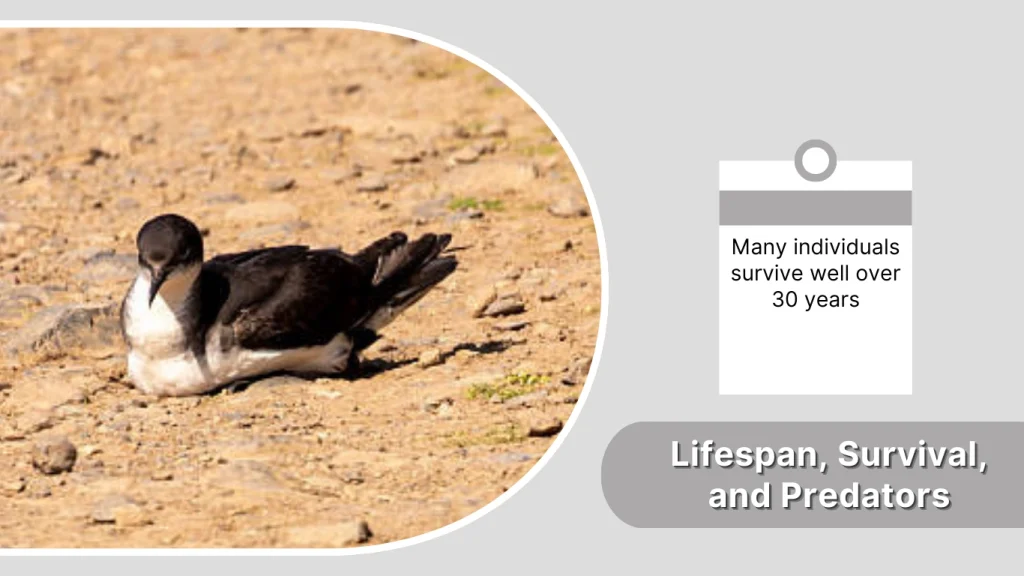
Manx shearwaters are exceptionally long-lived birds. Many individuals survive well over 30 years, and some banded birds have been recorded living more than half a century. Such longevity allows them to reproduce over many seasons, offsetting their low annual breeding output.
On land, eggs and chicks are vulnerable to predatory birds and introduced mammals such as rats and cats. At sea, larger fish and marine predators pose risks, especially to inexperienced juveniles. Their main survival strategies include nocturnal nesting, deep burrows, and spending most of their lives far from land-based threats.
Ecological Importance
Manx shearwaters play an important role in marine ecosystems. By feeding on fish and squid and returning nutrients to land in the form of guano, they link ocean and island environments. This nutrient transfer supports plant growth and influences entire island food webs.
Because they depend on healthy fish populations and ocean productivity, Manx shearwaters are considered valuable indicator species. Changes in their breeding success, distribution, or migration timing often reflect broader shifts in ocean health, climate patterns, and food availability.
Conservation Status and Threats
Short overview: Although the Manx shearwater is not currently considered globally endangered, it faces increasing environmental pressures.
- Climate change altering ocean temperatures and prey distribution
- Overfishing reducing availability of small fish
- Plastic pollution and accidental ingestion
- Bycatch in fishing gear
- Introduced predators on nesting islands
- Ongoing island restoration and monitoring programs
Many conservation projects now focus on removing invasive predators from breeding islands, protecting marine feeding areas, and tracking migration routes to identify critical habitats.
Manx Shearwater vs Other Shearwaters
Compared to other shearwater species, the Manx shearwater is moderate in size but exceptional in migration distance. Larger species, such as great shearwaters, may dominate southern oceans, while smaller species often remain closer to regional waters.
The Manx shearwater stands out for its strong black-and-white contrast, narrow wings, and close association with North Atlantic islands. Its long lifespan, extreme migratory behavior, and strong site loyalty make it one of the most intensively studied shearwaters in the world.
FAQs
What is special about the Manx shearwater?
The Manx shearwater is famous for its extraordinary long-distance migration, traveling from the North Atlantic to the Southern Hemisphere and back each year. It is also known for its longevity, strong pair bonds, and haunting nighttime calls heard at breeding colonies on remote islands.
How far can a Manx shearwater migrate?
A Manx shearwater can travel tens of thousands of kilometers annually. Many individuals fly from breeding islands in the North Atlantic to feeding areas off South America or southern Africa. This makes it one of the longest-migrating birds in the world.
Where do Manx shearwaters nest?
Manx shearwaters nest in underground burrows on remote coastal islands. They choose grassy slopes, cliffs, and predator-free environments where they can dig tunnels to protect their eggs and chicks from weather and predators.
What does a Manx shearwater eat?
Their diet mainly consists of small fish, squid, and crustaceans found near the ocean surface. They capture prey by skimming low over the water, seizing food from the surface, and making short, shallow dives.
Is the Manx shearwater endangered?
The Manx shearwater is currently listed as a species of least concern, but local populations can be vulnerable. Threats include climate change, overfishing, plastic pollution, and introduced predators, making continued conservation efforts essential.