

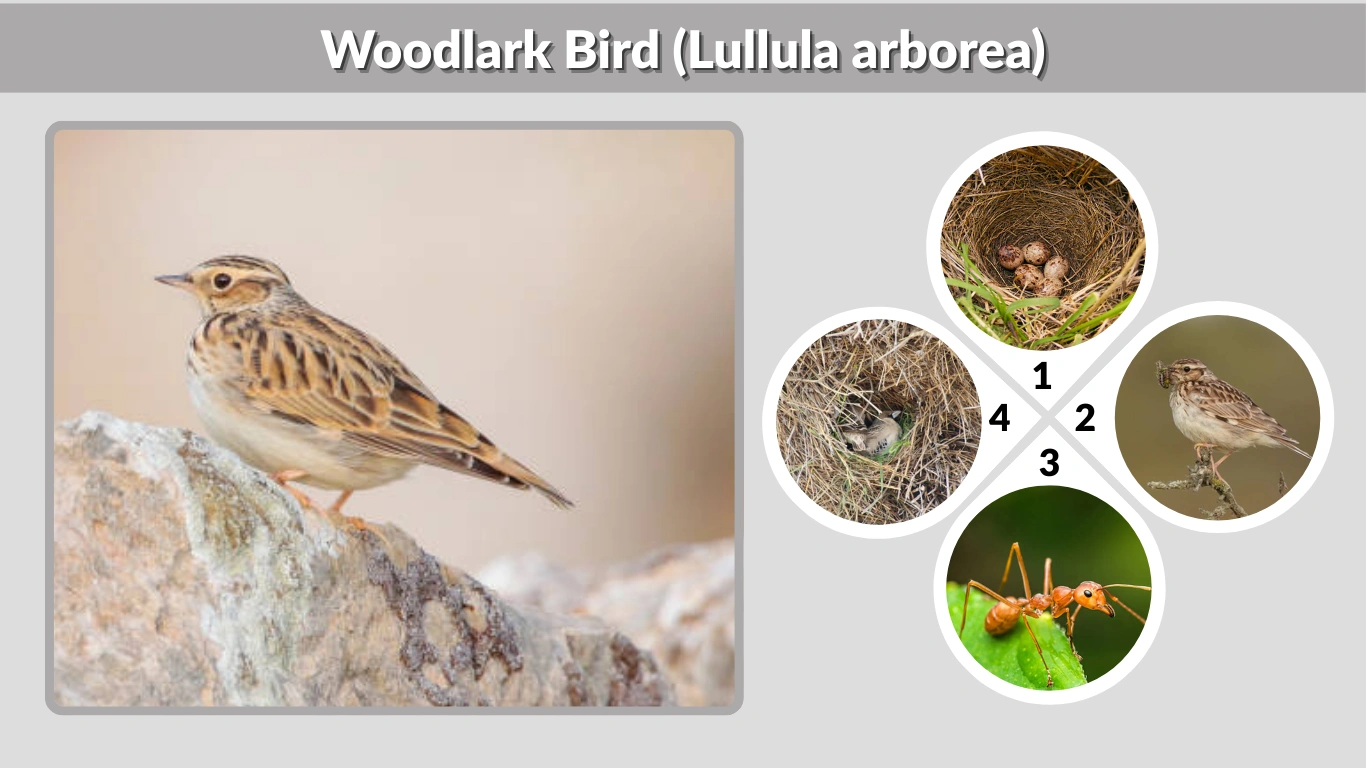
The woodlark is a small, melodious songbird best known for its soft, flute-like voice and gentle flight displays. Found mainly across Europe, with parts of its range stretching into western Asia and North Africa, this bird prefers open woodland, heathland, and sandy grasslands. Unlike many other larks, the woodlark often sings while perched, creating a calm, musical atmosphere in its surroundings. Because of habitat loss and population decline in some regions, the woodlark has become an important species for conservation and bird-watching interest.
Taxonomy and Scientific Classification
The woodlark belongs to the lark family, Alaudidae, a group of birds adapted to open landscapes and ground-based lifestyles. Its scientific name, Lullula arborea, reflects both its soft call and its frequent association with woodland edges and open forests.
Within the Alaudidae family, the woodlark is unique because it is the only species placed in the genus Lullula. This sets it apart from skylarks, crested larks, and horned larks, which belong to different genera and often show different flight styles, songs, and habitat preferences.
Compared with other larks, the woodlark is more compact and more closely linked to mixed habitats that combine trees with open ground. This combination of woodland and grassland makes it ecologically distinct and explains why its population is closely tied to the availability of lightly managed landscapes.
Physical Appearance and Identification
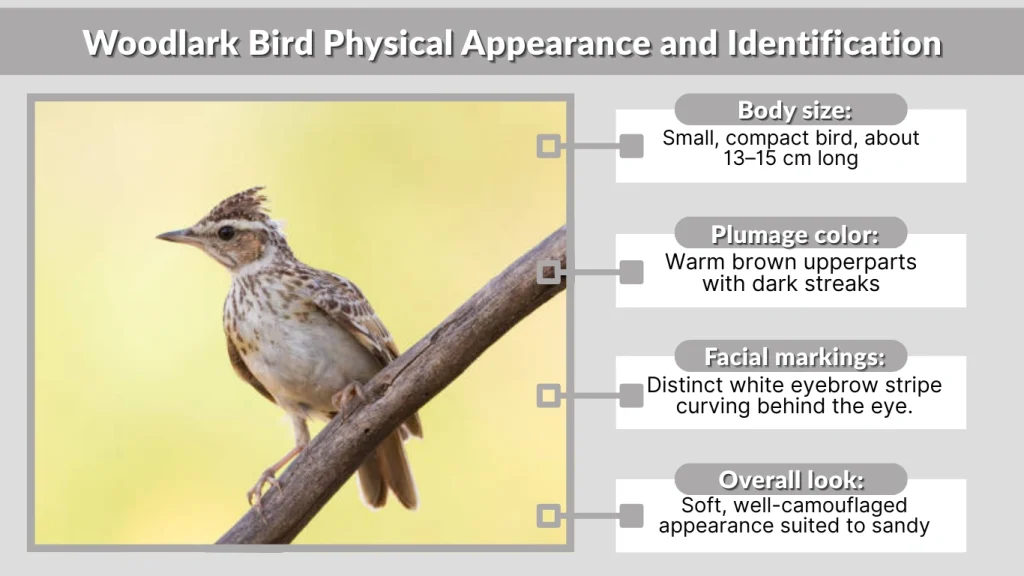
The woodlark has several clear features that make it easier to recognize in the field.
- Body size: Small, compact bird, about 13–15 cm long, with a short tail and rounded wings.
- Plumage color: Warm brown upperparts with dark streaks, pale cream to buff underparts.
- Facial markings: Distinct white eyebrow stripe curving behind the eye.
- Wing and tail shape: Broad, rounded wings and noticeably shorter tail than a skylark.
- Overall look: Soft, well-camouflaged appearance suited to sandy and grassy h
Habitat and Natural Range
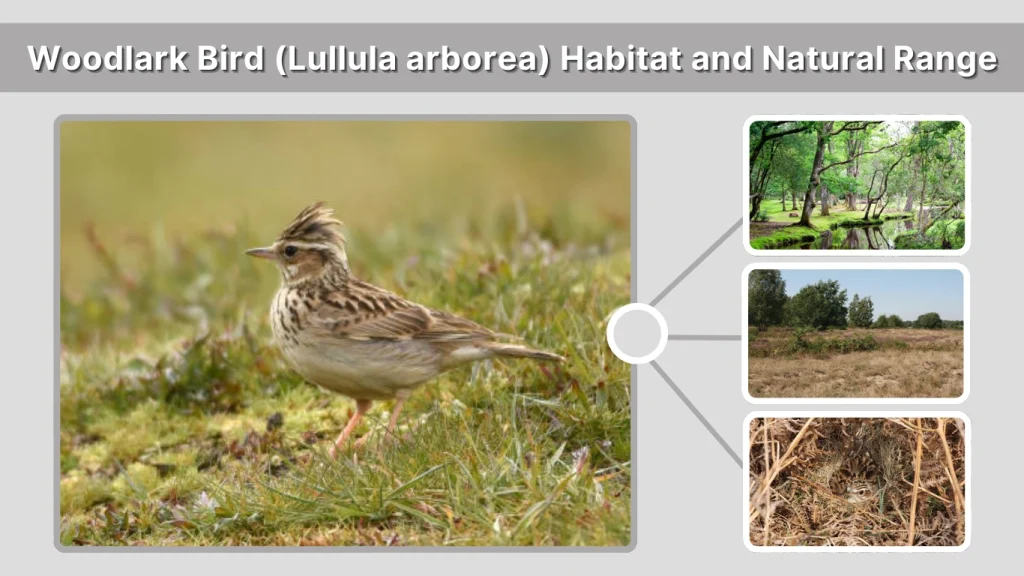
Preferred Habitats
Woodlarks favor open landscapes with scattered trees and patches of bare ground. Typical habitats include heathlands, open pine forests, forest clearings, sandy grasslands, and lightly grazed pasture. They often avoid dense forests and heavily cultivated farmland.
These environments provide two essential needs: open ground for feeding and low vegetation or shrubs for nesting and shelter. Areas managed by low-intensity agriculture or traditional forestry are especially suitable.
Geographic Distribution
The core range of the woodlark lies across much of Europe, from the Iberian Peninsula and the British Isles eastward into central and eastern Europe. Its range continues into parts of western Asia and extends south into North Africa.
Some populations are resident and remain in the same areas year-round, while others migrate short distances to escape harsh winter conditions. Southern populations tend to be more sedentary, while northern birds often move south in winter.
Seasonal Movement Patterns
During the breeding season, woodlarks occupy open breeding territories with suitable nesting cover. In winter, they may gather in small flocks and shift to lower altitudes or more sheltered areas where food is more accessible.
Behavior and Lifestyle
Daily Activity Patterns
Woodlarks are primarily ground-dwelling birds. They spend much of the day walking across open ground in search of food, rather than hopping like many small songbirds. They are alert and cautious, often freezing or crouching when disturbed.
Outside the breeding season, they may form loose flocks, especially in feeding areas. During spring, males become more territorial and vocal.
Flight Style and Displays
The flight of the woodlark is gently undulating, with a series of quick wingbeats followed by short glides. Males perform characteristic song flights, rising in slow circles while singing continuously before descending back to the ground or a perch.
Unlike skylarks, which often sing at great heights, woodlarks usually remain lower and frequently sing from trees, shrubs, or fence posts.
Social and Territorial Behavior
During the breeding season, pairs defend small territories where nesting and feeding occur. Males use song to attract mates and warn rivals, while females focus more on nest building and chick care. Outside this period, territorial behavior weakens, and birds become more tolerant of one another.
Diet and Feeding Habits
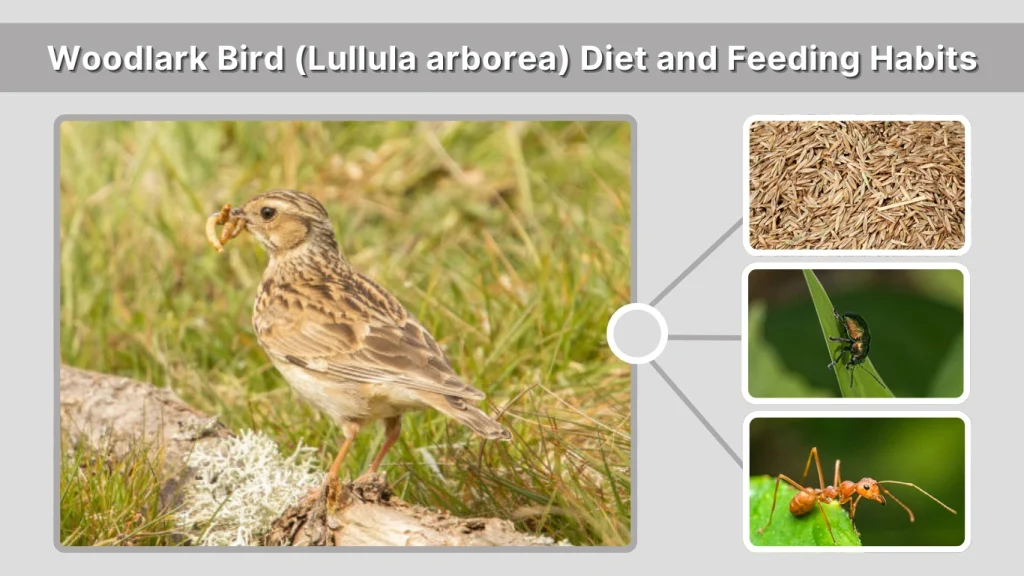
The woodlark has a flexible diet that changes with the seasons and local food availability.
- Grass and wild plant seeds
- Small beetles and insects
- Ants, spiders, and larvae
- Seasonal shift from insects in summer to seeds in winter
During spring and summer, insects form a major part of the diet, especially when chicks are being fed. In colder months, seeds become increasingly important, allowing woodlarks to survive when insect numbers decline.
Woodlark Song and Vocalization
Description of the Song
The woodlark is especially admired for its soft, musical song. The voice is often described as flute-like, flowing, and slightly melancholic, made up of rolling whistles and repeated “lu-lu-lu” notes. The song is less loud than that of the skylark but is richer in tone and more rhythmic.
Purpose of Vocal Sounds
Singing plays a vital role in attracting mates and defending territory. Males use their song to announce ownership of a breeding area and to communicate their presence to both rivals and potential partners. Softer calls are also used between pairs and between adults and chicks.
Singing Behavior
Unlike many larks, woodlarks frequently sing while perched on trees, shrubs, or fence posts. They also perform slow, circling song flights at low to medium height, continuing their melody almost without pause.
Breeding and Reproductive Cycle
The breeding season usually begins in early spring and may continue into mid-summer, depending on climate and food availability.
- Breeding period typically runs from March to July
- Nests are built on the ground under grass or low shrubs
- Clutches usually contain three to five eggs
- Incubation lasts around thirteen to fifteen days
- Both parents take part in feeding the young
Pairs may raise more than one brood in a successful season. Breeding success is strongly influenced by habitat quality, disturbance levels, and food supply.
Nest Structure and Egg Characteristics
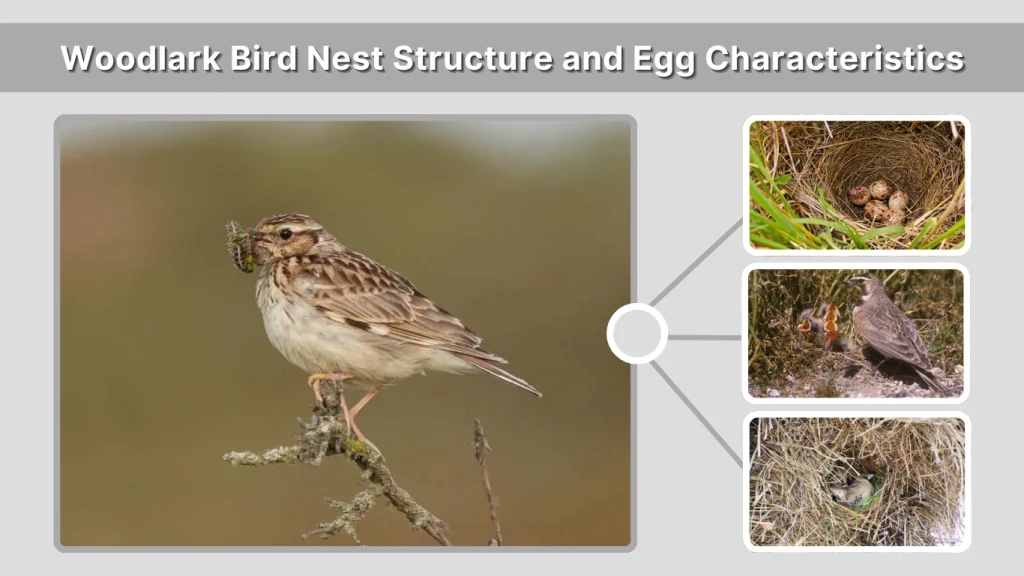
Nest Placement
Woodlarks place their nests directly on the ground, often at the base of a grass tuft, small bush, or low shrub. This hidden positioning helps shield the nest from wind and reduces visibility to predators.
Nest Materials
The nest is a shallow cup made from dry grasses, fine roots, and plant fibers. The interior is often lined with softer material to provide insulation and comfort for the eggs and chicks.
Egg Appearance
Eggs are usually pale cream or whitish with fine brown or gray speckles. Their subtle coloring blends well with surrounding soil and vegetation, offering effective natural camouflage.
Chick Development and Growth
Hatching Stage
When chicks hatch, they are blind, lightly covered in down, and completely dependent on their parents. Both adults remain active around the nest, guarding and feeding the young frequently.
Feeding and Growth Phase
Chicks are mainly fed insects, which provide the protein needed for rapid growth. Within a short time, feathers begin to develop, and the chicks become more alert and mobile.
Fledging Period
After roughly ten to twelve days, the young leave the nest, although they cannot yet fly well. Parents continue to care for them, guiding them to feeding areas and offering protection.
Predators and Natural Threats
Common Predators
Natural predators include birds of prey, foxes, snakes, and small mammals. Ground nesting makes eggs and chicks particularly vulnerable.
Human-Related Threats
Modern farming, heavy grazing, urban development, and forest densification reduce suitable habitat. Early mowing and land disturbance can destroy nests before chicks are fully grown.
Defense and Survival Strategies
Camouflage is the woodlark’s primary defense. Adults may perform distraction displays to lure predators away, while chicks remain motionless when danger approaches.
Conservation Status and Population Trends
Current Conservation Status
Globally, the woodlark is not considered endangered, but many local populations have declined significantly.
Reasons for Population Decline
Loss of heathland, changes in forestry practices, agricultural intensification, and habitat fragmentation are the main causes of decline.
Protection and Conservation Efforts
Habitat restoration, controlled grazing, conservation reserves, and monitoring programs have helped stabilize some populations. Protecting open woodland landscapes is essential for the species’ future.
Woodlark vs Skylark
(Insert comparison table in full article)
Include differences in size, tail length, habitat preference, singing behavior, flight height, and nesting style.
Ecological Importance of Woodlarks
Woodlarks play a valuable role in maintaining balanced ecosystems. By feeding on insects, they help regulate invertebrate populations, while seed consumption contributes to plant dynamics. Their presence often indicates healthy, low-intensity managed landscapes.
Because woodlarks require a mix of open ground and scattered vegetation, they are considered indicator species for high-quality heathland and open woodland habitats. Their decline often signals broader environmental problems.
Interesting Facts About the Woodlark
The woodlark has long attracted attention because of its behavior and voice.
- The genus name Lullula imitates its soft call
- It often sings earlier in the morning than many other birds
- Unlike skylarks, it frequently sings from perches
- It appears in European poetry and folklore
FAQs
What is a woodlark bird?
The woodlark is a small songbird from the lark family known for its gentle, flute-like song and preference for open woodland and heathland habitats. It is smaller than the skylark and is easily recognized by its short tail and pale eyebrow stripe.
Where do woodlarks live?
Woodlarks are mainly found across Europe, with parts of their range extending into western Asia and North Africa. They favor open pine woods, heathlands, sandy grasslands, and forest clearings where both feeding and nesting conditions are suitable.
What does a woodlark eat?
Woodlarks feed on a mix of seeds and insects. During the breeding season, they rely heavily on insects such as beetles and larvae to feed their chicks, while in autumn and winter they switch mainly to seeds.
Why is the woodlark’s song special?
The woodlark’s song is softer and more musical than that of many other larks. It consists of flowing, flute-like notes and is often delivered from a perch, giving it a calm and melodic quality that birdwatchers find distinctive.
Is the woodlark endangered?
The woodlark is not globally endangered, but it has declined in many regions. Habitat loss, agricultural intensification, and land development have reduced suitable environments, making conservation efforts increasingly important.