




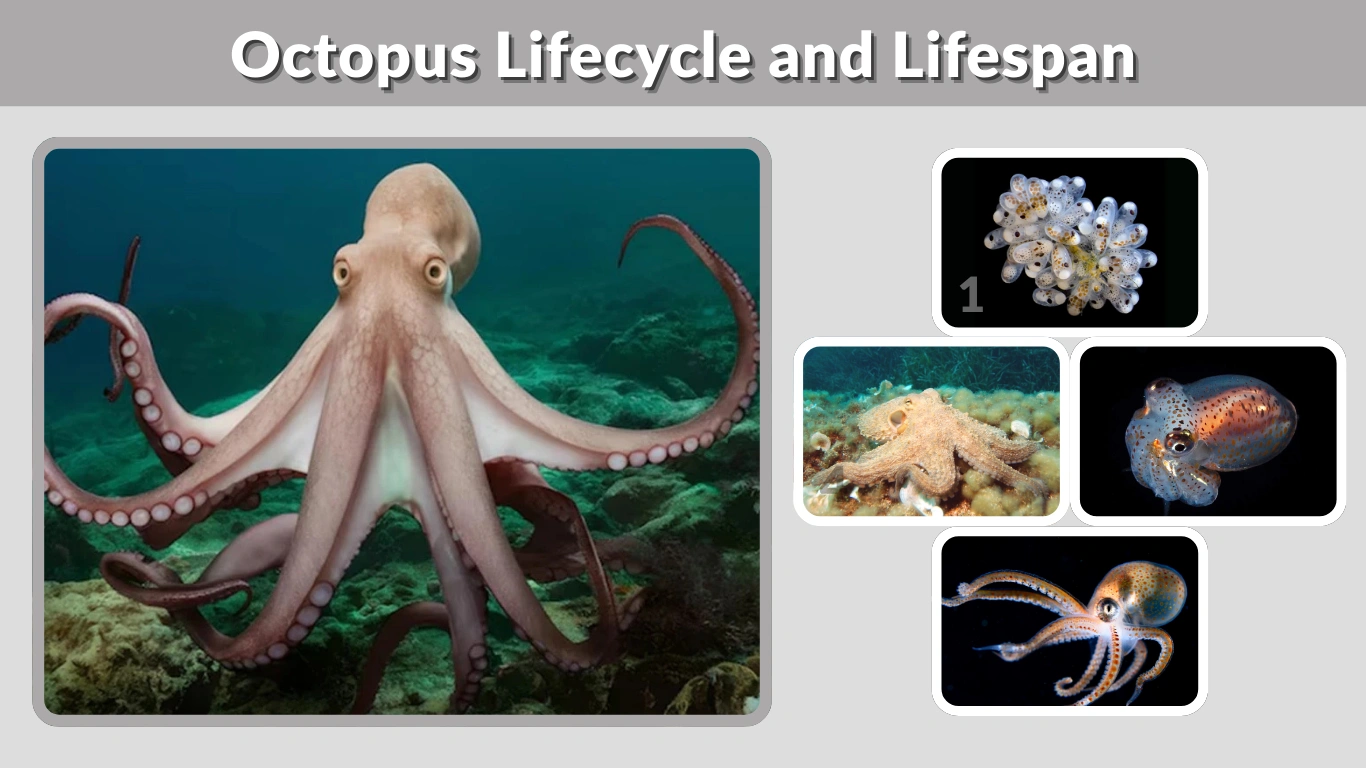
Octopuses are among the most intelligent and fascinating creatures in the ocean, yet they live surprisingly short lives. Unlike many marine animals that survive for decades, most octopus species complete their entire existence within just a few years. Their lifecycle is fast, intense, and biologically programmed to end soon after reproduction. Understanding the octopus lifecycle and lifespan reveals how these soft-bodied predators grow, survive, reproduce, and ultimately die, while playing a vital role in maintaining healthy marine ecosystems.
What Makes the Octopus Lifecycle Unique
The octopus lifecycle is unlike that of most ocean animals. Octopuses grow extremely fast, reaching maturity in a matter of months rather than years. They are also semelparous, meaning they reproduce only once in their lifetime. After mating and egg care, their bodies enter a rapid decline that leads to death.
Another unique feature is the absence of any parental care beyond egg guarding. Hatchlings are born fully independent and must survive alone from the first moment of life. Despite their short lifespan, octopuses develop complex nervous systems, advanced hunting skills, camouflage abilities, and problem-solving intelligence that rival many vertebrates.
The Complete Octopus Lifecycle Stages
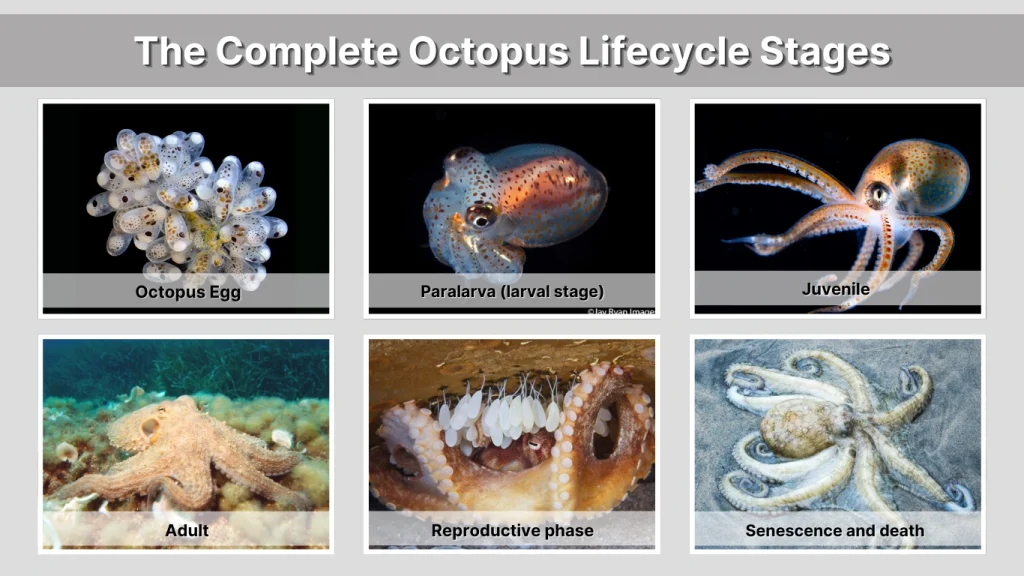
The octopus lifecycle follows a clear biological progression:
- Egg
- Paralarva (larval stage)
- Juvenile
- Adult
- Reproductive phase
- Senescence and death
Each stage is brief but intense, with survival heavily dependent on environment, food availability, and avoiding predators.
Stage 1 – Octopus Egg Stage
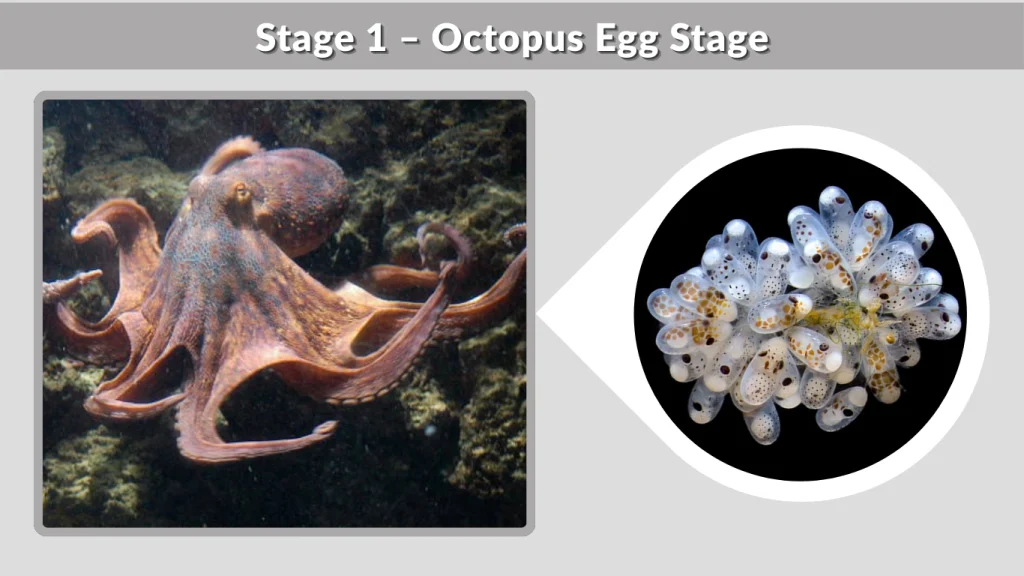
After mating, the female octopus enters the most critical phase of her life: egg production and protection.
Mating and Fertilization
Male octopuses transfer sperm to females using a specialized arm called the hectocotylus. Fertilization occurs internally, and females may store sperm for weeks before laying eggs. In many species, mating marks the beginning of the end for both sexes, as their biological focus shifts entirely toward reproduction.
Egg Laying Behavior
A female octopus can lay anywhere from a few hundred to several hundred thousand eggs, depending on the species. The eggs are usually strung together in long clusters and attached to hard surfaces inside a protected den, such as rock crevices or coral cavities. Once laid, the eggs become the sole priority of the female.
Maternal Care
The mother guards her eggs constantly. She cleans them with her suckers, blows water over them to provide oxygen, and protects them from predators. During this time, she typically stops hunting and rarely eats. This egg-care period can last from a few weeks to several months. By the time the eggs are close to hatching, the female is usually weak, emaciated, and near death.
Stage 2 – Paralarva (Larval) Stage
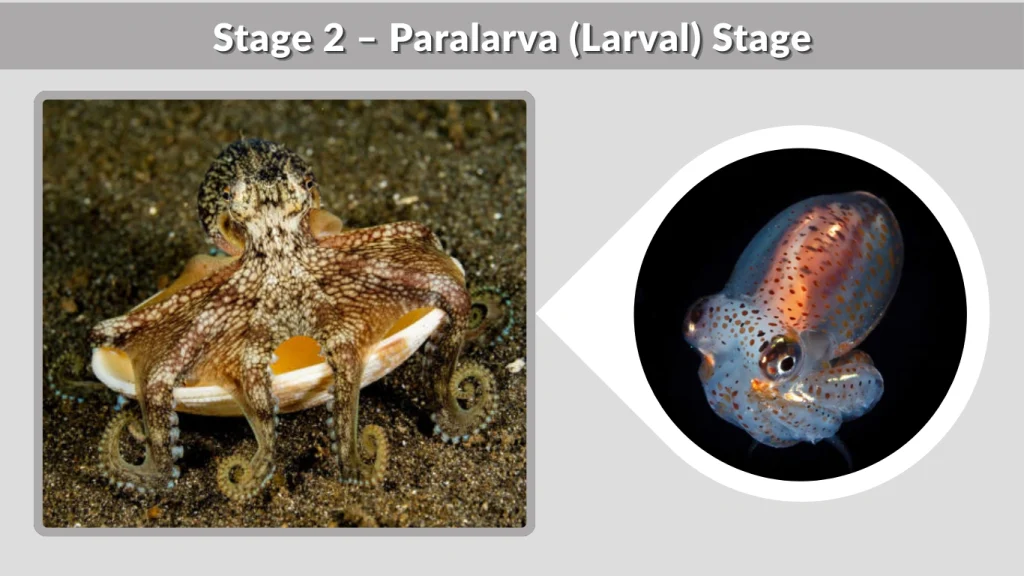
When the eggs hatch, the next stage of the octopus lifecycle begins—one of the most dangerous phases of all.
Hatching Process
Newly hatched octopuses are extremely small, often no larger than a grain of rice. They emerge as transparent, fully formed miniature octopuses. Unlike many animals, there is no parental care after hatching. In most species, the mother dies shortly before or soon after the young emerge.
Life in the Open Ocean
These tiny octopuses enter a planktonic phase known as the paralarval stage. Instead of living on the seafloor, they drift in the open ocean, carried by currents. During this time, they feed on microscopic crustaceans, copepods, and larval organisms. Their survival depends on finding enough food while avoiding the countless predators that feed on plankton.
Survival Challenges
This stage has the highest mortality rate in the octopus lifecycle. Currents may sweep larvae far from suitable habitats, food may be scarce, and predators such as fish and jellyfish consume vast numbers of hatchlings. Scientists estimate that only a tiny fraction of octopus larvae survive long enough to reach the seafloor and continue development.
Stage 3 – Juvenile Octopus
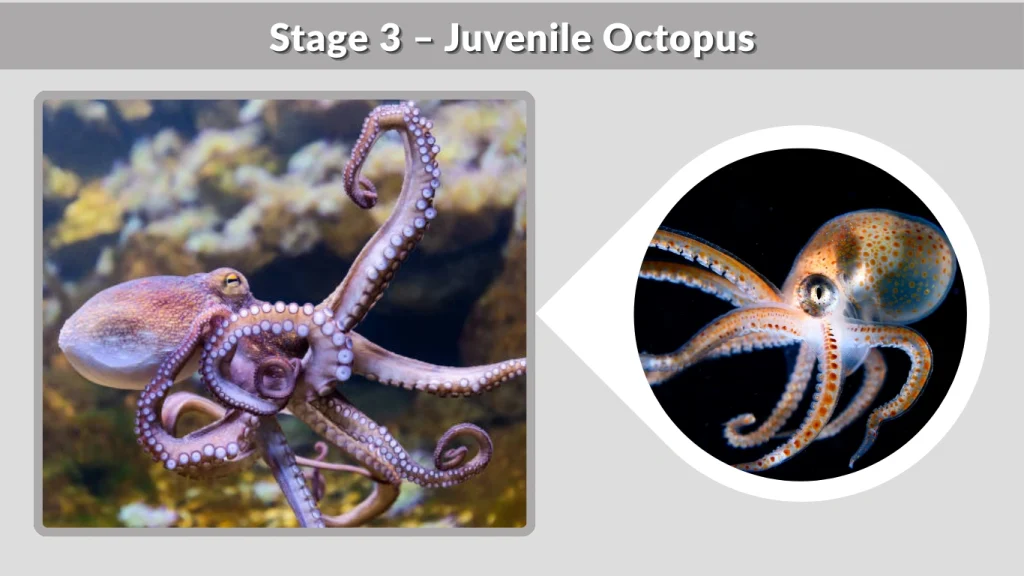
Those that survive the open-ocean phase eventually transition into juvenile octopuses.
Transition to Seafloor Living
After weeks or months drifting in the water column, juvenile octopuses settle onto the ocean floor. This shift marks a major turning point. They begin living a benthic lifestyle, hiding among rocks, reefs, and seagrass beds where shelter and prey are more abundant.
Growth and Hunting Skills
Juvenile octopuses grow rapidly. They start hunting small crabs, shrimp, and mollusks, using their developing arms and beaks. Camouflage becomes essential at this stage. Juveniles quickly learn to change color, texture, and posture to blend into their surroundings, helping them both ambush prey and avoid predators.
Physical Development
During the juvenile phase, muscle strength increases, neural connections expand, and sensory abilities sharpen. The octopus refines its ability to squeeze through tiny spaces, manipulate objects, and build dens. This period is critical, as successful juveniles soon transition into fully independent adult predators.
Stage 4 – Adult Octopus
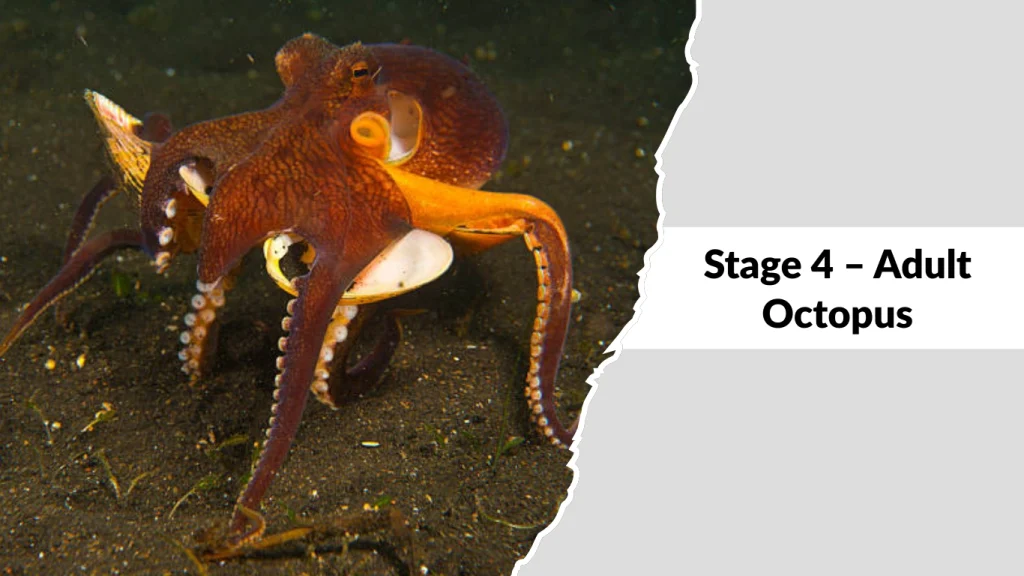
Once an octopus reaches adulthood, it becomes a fully developed and highly efficient predator. Adult octopuses are solitary and territorial, usually living alone in a chosen den made from rocks, shells, or coral fragments. They actively maintain these shelters, clearing debris and sometimes arranging objects as protective barriers.
At this stage, octopuses display their full range of intelligence and adaptability. They hunt primarily at night, feeding on crabs, fish, clams, and other marine animals. Using powerful arms lined with sensitive suckers, they explore their surroundings, capture prey, and manipulate food with remarkable precision. Their ability to rapidly change color and skin texture allows them to ambush prey, communicate, and avoid predators.
Adult octopuses continue to grow throughout most of their lives, although growth slows as they approach reproductive maturity. Depending on the species, adulthood may last only a few months or up to several years in larger octopus species.
Stage 5 – Reproductive Phase
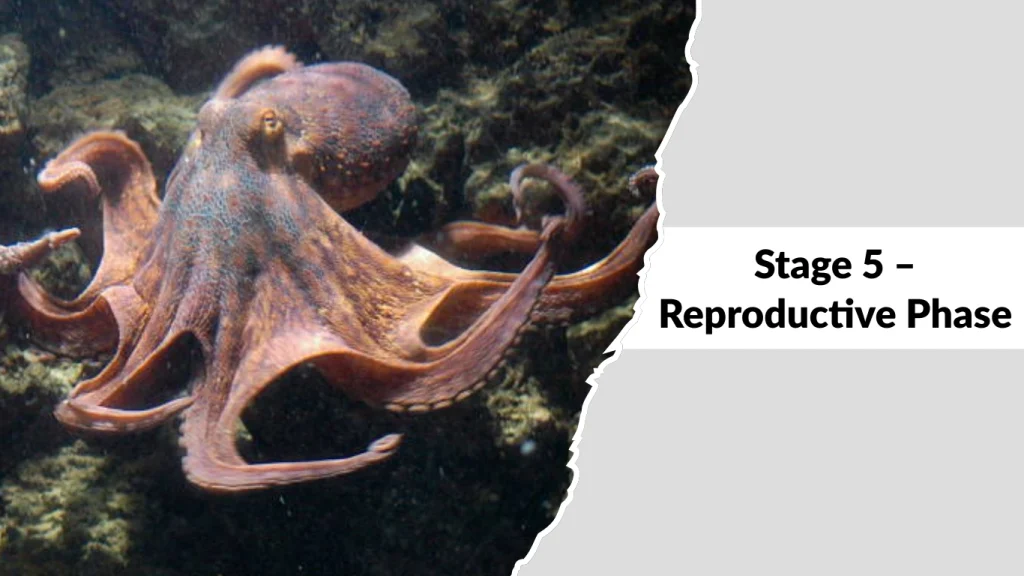
Reproduction marks the final active chapter in the octopus lifecycle.
Male Reproductive Role
Male octopuses locate females through chemical signals in the water. During mating, the male inserts his hectocotylus arm into the female’s mantle cavity to deliver sperm packets. After mating, many males experience rapid physical decline. Some stop feeding, wander aimlessly, and die within weeks.
Female Reproductive Role
After fertilization, the female seeks a protected den and begins laying eggs. Once egg laying is complete, her entire focus shifts to guarding and caring for them. She cleans the eggs constantly and ensures proper water circulation. During this time, she rarely eats, relying on stored energy.
Biologically Programmed Death
Octopus death after reproduction is controlled by hormones from a gland near the eyes called the optic gland. These hormones shut down feeding behavior and trigger tissue breakdown. This process ensures that all remaining energy is devoted to the next generation.
Final Stage – Senescence and Death
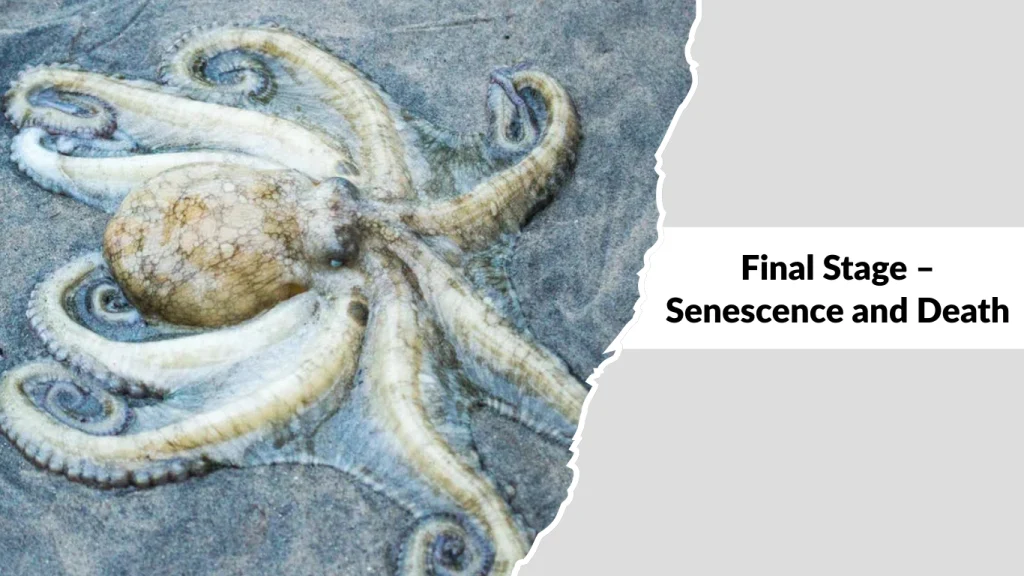
Senescence is the final stage of the octopus lifecycle. During this phase, the octopus undergoes visible physical and behavioral decline. Skin becomes pale and damaged, wounds fail to heal, and coordination weakens. Octopuses may lose the ability to camouflage effectively and often become disoriented.
Eventually, the octopus stops eating entirely. Death usually occurs shortly after the eggs hatch in females, or weeks after mating in males. Although their lives are short, the nutrients released by their bodies return to the ecosystem, supporting microorganisms and other marine life.
Average Octopus Lifespan by Species
Octopus lifespan varies significantly between species:
- Common octopus (Octopus vulgaris): 1–2 years
- Giant Pacific octopus (Enteroctopus dofleini): 3–5 years
- Blue-ringed octopus (Hapalochlaena species): 6 months to 2 years
- Mimic octopus (Thaumoctopus mimicus): about 1 year
- Dumbo octopus (Grimpoteuthis species): up to 5 years
Most small tropical octopuses live less than one year, while cold-water and deep-sea species tend to live longer.
Factors That Affect Octopus Lifespan
Several factors influence how long an octopus lives:
- Species genetics and body size
- Water temperature and oxygen levels
- Availability of food
- Predator density
- Habitat stability
- Human impacts such as pollution and fishing
- Stress levels in captivity
Warmer water generally shortens lifespan by increasing metabolic rate, while colder environments often support longer-lived species.
Octopus Lifespan in the Wild vs Captivity
In the wild, octopuses face predators such as sharks, dolphins, moray eels, and large fish. Disease, injuries, and food shortages also reduce survival. Even without predators, most octopuses still die soon after reproduction due to their biological programming.
In captivity, octopuses are protected from predators and have consistent access to food. While this may slightly increase their chances of reaching full lifespan, it does not prevent post-reproductive death. However, controlled environments allow scientists to observe every stage of the octopus lifecycle in detail.
Why Octopuses Have Such Short Lives
Octopuses evolved to grow quickly, reproduce once, and invest all remaining energy into offspring. This strategy allows populations to recover rapidly and adapt to changing environments. High intelligence helps them survive during their brief lives, but evolution favors fast reproduction over longevity.
Ecological Importance of the Octopus Lifecycle
Octopuses are both predators and prey, making them essential to marine food webs. They help control populations of crabs and mollusks, while also feeding fish, seals, and sharks. After death, their bodies return nutrients to the ecosystem, supporting plankton and benthic organisms.
FAQs
How long does an octopus live on average?
Most octopus species live between one and three years. Smaller tropical species often survive less than a year, while large cold-water species like the giant Pacific octopus may live up to five years. Regardless of species, most octopuses die shortly after reproducing.
Do octopuses die after giving birth?
Yes. Female octopuses usually die shortly after their eggs hatch. During egg care, they stop feeding and their bodies deteriorate due to hormonal changes controlled by the optic gland. This biological process ensures all remaining energy supports the next generation.
What is the longest-living octopus species?
The giant Pacific octopus and some deep-sea octopuses are among the longest-living, reaching up to five years. These species live in cold environments, which slow metabolism and allow longer growth periods compared to warm-water octopuses.
Can an octopus live longer in captivity?
Captivity may help octopuses avoid predators and starvation, but it does not stop biological aging after reproduction. Most octopuses still die soon after mating or egg care, even in aquariums, because their lifecycle is genetically programmed.
Why don’t baby octopuses stay with their parents?
Octopus hatchlings are fully independent from birth. In most species, the mother dies before or shortly after hatching. Evolution favors producing many offspring rather than long-term parental care, increasing the chances that at least some young will survive.