

If you’ve seen a giant yellow spider spinning a silky golden web, you might be wondering whether it’s a banana spider or a Joro spider. These two arachnids are often confused—especially in the southeastern U.S.—because of their large size, long legs, and golden webs. But despite their similar looks, they are not the same spider.
Let’s explore the differences between banana spiders and Joro spiders, including where they live, what they look like, and how they behave.
Banana Spider vs Joro Spider
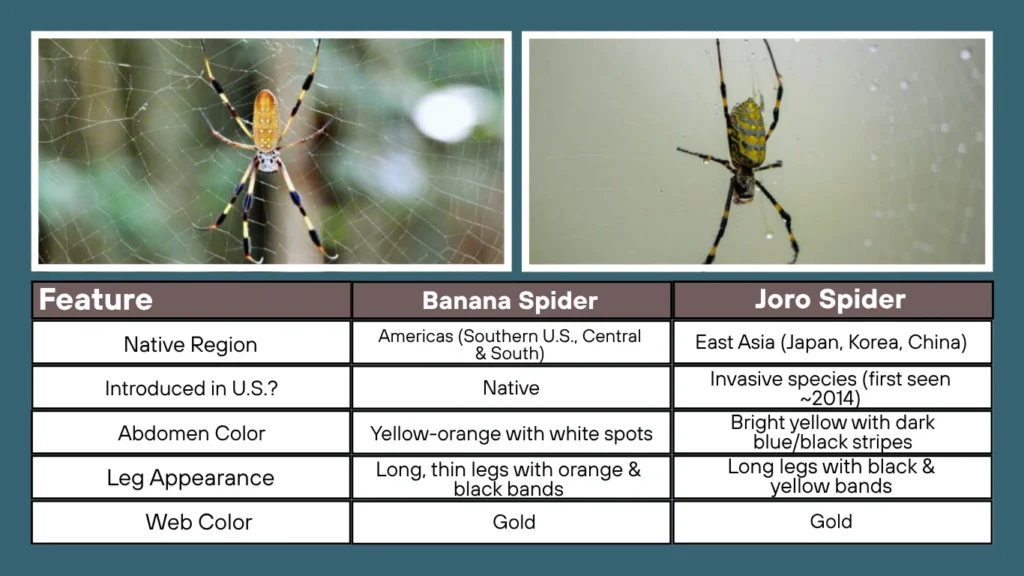
| Feature | Banana Spider (Trichonephila clavipes) | Joro Spider (Trichonephila clavata) |
| Native Region | Americas (Southern U.S., Central & South) | East Asia (Japan, Korea, China) |
| Introduced in U.S.? | Native | Invasive species (first seen ~2014) |
| Abdomen Color | Yellow-orange with white spots | Bright yellow with dark blue/black stripes |
| Leg Appearance | Long, thin legs with orange & black bands | Long legs with black & yellow bands |
| Web Color | Gold | Gold |
| Web Placement | Forest edges, gardens, trails | High in trees, power lines, eaves |
| Body Size (Female) | Up to 1.5 inches | About 1 inch |
| Male Appearance | Small, dark, not showy | Small, brown, inconspicuous |
| Bite Risk to Humans | Harmless | Harmless |
| Behavior | Day-active, shy | Calm, stays on web |
Scientific Relationship
Interestingly, both spiders belong to the same genus: Trichonephila, which makes them close relatives. That’s why they share many characteristics, such as body shape, golden web color, and habitat preference. But the species are different—the Joro spider is Trichonephila clavata, and the banana spider is Trichonephila clavipes.
Despite both being orb-weavers with golden webs, they evolved in different parts of the world and have distinct physical and behavioral traits.
Geographic Range and Spread
The banana spider is native to the Americas, including the southern United States, Central America, and tropical parts of South America. It’s especially common in Florida, Texas, Louisiana, and Georgia, and prefers warm, humid environments.
The Joro spider, in contrast, is native to East Asia—Japan, Korea, and parts of China. It was accidentally introduced into Georgia around 2014 and has been spreading across the Southeastern U.S., with sightings now in Tennessee, Alabama, and beyond.
Because of its rapid expansion and cold tolerance, the Joro spider has received much more attention recently.
Color and Appearance

Both spiders are large and impressive, but you can visually distinguish them if you know what to look for.
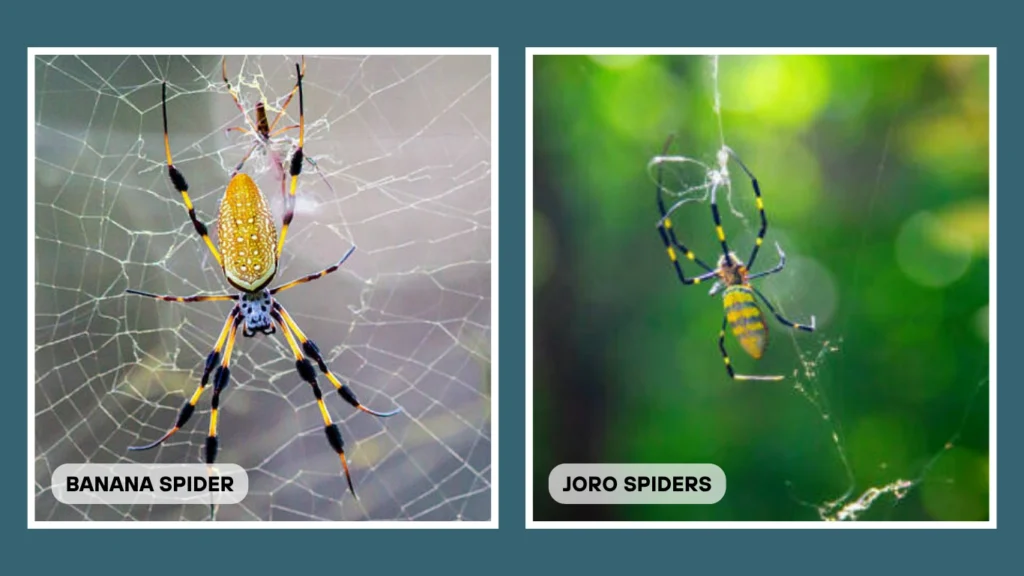
Banana Spider (Trichonephila clavipes):
- Abdomen is elongated, with a yellow-orange background and white markings.
- Legs are banded orange and black, sometimes appearing reddish.
- The entire body is slightly more slender than the Joro spider.
- Females are much larger than males.
Joro Spider (Trichonephila clavata):
- Abdomen is more rounded, with bright yellow and dark blue or black vertical bands.
- Underside of the abdomen may have reddish spots or trim.
- Legs are banded with black and yellow, often longer and positioned more outward.
- Also shows strong sexual dimorphism (males are tiny and brown).
While both spiders have similar postures and leg orientation, the banana spider tends to look more orange, while the Joro spider is more yellow and striped.
Web Structure and Placement
Both spiders spin large, round golden orb webs, which reflect sunlight and are extremely strong. Their silk has a golden hue that’s particularly noticeable in the sun.
However, there are subtle differences in placement and structure:
- Banana spiders build webs lower to the ground, especially along forest edges, hiking trails, and gardens. They’re often found in open vertical spaces, with multiple webs close together in summer and fall.
- Joro spiders build their webs high above the ground, in trees, on power lines, porches, and eaves. They often seem to “hang in the air” because their webs are attached to overhead points.
Both webs can measure several feet wide and are effective for catching large flying insects.
Behavior and Temperament
Neither spider is aggressive, and both are non-venomous to humans. Their bites are rare and only happen if they’re trapped or pressed against skin.
- Banana spiders are typically shy. They may drop out of their web if disturbed or retreat to the edge.
- Joro spiders tend to sit calmly in the center of their web, even when people approach. Their tolerance of human activity is one reason they’re becoming more noticeable in populated areas.
Both species are day-active and visible during daylight, which makes them more noticeable than nocturnal spiders.
Egg Sacs and Reproduction
Like most orb-weavers, both spiders lay one or more egg sacs in the fall. These sacs are attached to sheltered areas near the web or in foliage.
- Banana spiders produce a light-colored, papery egg sac attached nearby.
- Joro spiders often hide their papery-brown egg sacs under leaves, bark, or hidden tree cavities.
In both species, the females die after laying eggs, and the spiderlings hatch in spring, dispersing through ballooning (floating on silk strands).
Are They Dangerous?
No. Despite their size and appearance, both spiders are harmless to humans.
- Bites are rare.
- If a bite does occur, symptoms are typically mild: redness, slight pain, or itching.
- Neither spider is considered medically significant.
They are both beneficial predators, feeding on:
- Mosquitoes
- Flies
- Moths
- Beetles
- Other small insects
FAQs
1. Is the Joro spider the same as a banana spider?
No. While both belong to the Trichonephila genus, the Joro spider is a separate species from the banana spider. They differ in origin, color pattern, and geographic range.
2. Are Joro spiders taking over banana spider habitats?
Not currently. Joro spiders tend to build their webs higher than banana spiders and may occupy different vertical zones in the environment. There’s no strong evidence of direct competition yet.
3. Which one is more likely to be seen in the U.S. right now?
In the southeastern U.S., both can be seen. However, Joro spiders are expanding more rapidly, while banana spiders are native and already well established.
4. Do both spiders spin golden webs?
Yes. Both produce gold-colored silk, although the Joro’s web may be more golden in appearance under bright light. The structure is also slightly denser and higher placed.
5. Should I remove either spider from my yard?
Not unless absolutely necessary. Both spiders are harmless, non-aggressive, and eat pest insects. If the web is in a problem spot, gently relocate the spider without killing it.