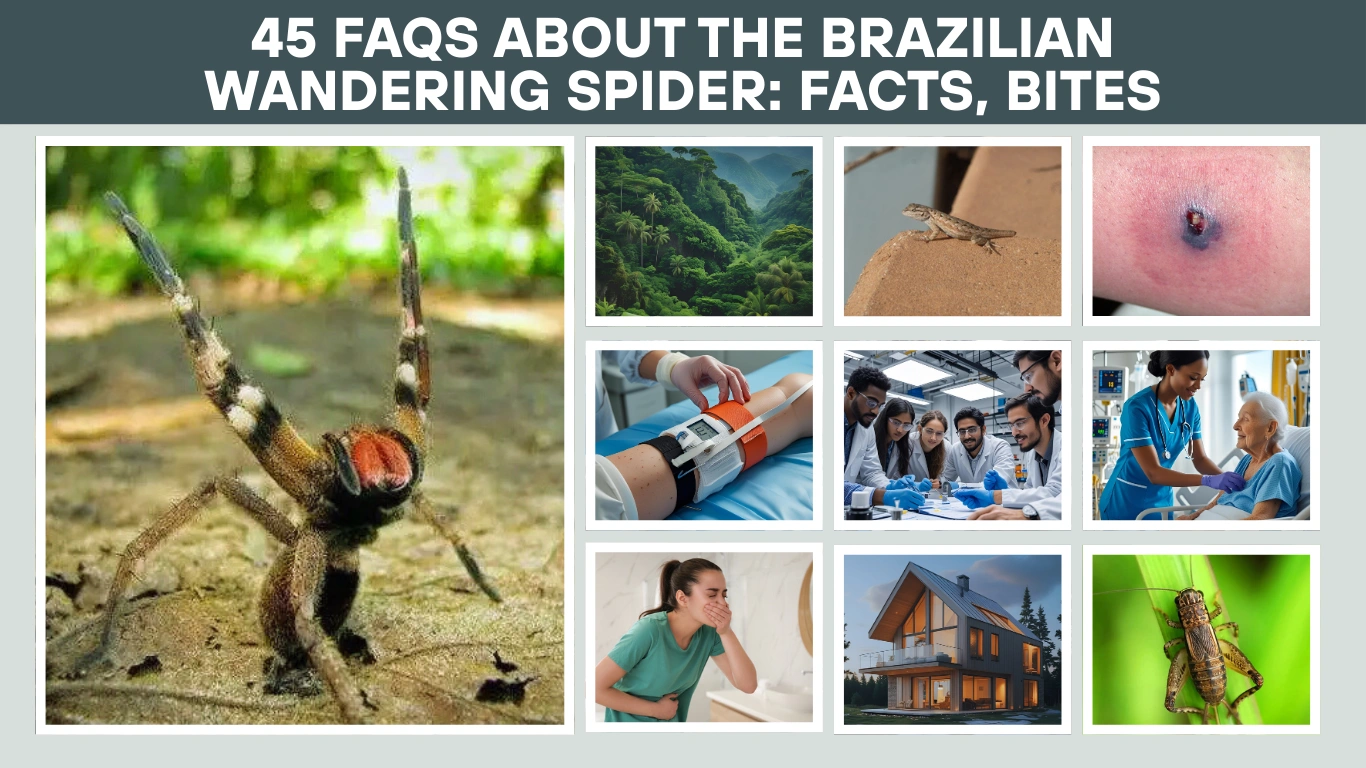
The Brazilian wandering spider is one of the most feared spiders on Earth—fast, aggressive, and highly venomous. But how deadly is it really? Where is it found, and what happens if it bites you? In this guide, we answer 45 frequently asked questions about this infamous arachnid, covering its appearance, habitat, bite effects, venom research, and more to separate fact from fear.
1. What is a Brazilian wandering spider?

The Brazilian wandering spider belongs to the genus Phoneutria, known for its aggressive behavior and potent venom. Unlike web-building spiders, it roams the forest floor at night in search of prey, which is why it’s called a “wandering” spider. It’s considered one of the most dangerous spiders due to its highly neurotoxic venom.
2. What does a Brazilian wandering spider look like?
Brazilian wandering spiders are large and hairy, with long legs and a body color that ranges from brown to reddish-brown. They often have black spots or bands on their legs. Their size and defensive posture—rearing up with front legs raised—make them easy to identify when threatened.
3. How big is a Brazilian wandering spider?
An adult Brazilian wandering spider can grow up to 5 inches (13 cm) across, including the legs. Their body length alone is about 1.5 to 2 inches (4–5 cm). This impressive size, combined with their bold nature, makes them one of the most intimidating spiders encountered in South and Central America.
4. How much does a Brazilian wandering spider weigh?
On average, a Brazilian wandering spider weighs between 10 and 20 grams. Their weight can vary depending on their size, sex, and feeding habits. Despite their lightweight build, their powerful legs and fast reflexes make them efficient hunters and highly mobile predators.
5. How fast can a Brazilian wandering spider run?

The Brazilian wandering spider is incredibly fast and agile. It can run at speeds of up to 1 meter per second (about 3.3 feet per second). This speed allows it to chase down prey and escape predators, as well as surprise humans who accidentally disturb it.
6. How long does a Brazilian wandering spider live?
In the wild, a Brazilian wandering spider typically lives for 1 to 2 years. Females often live longer than males. Their life cycle includes egg, spiderling, juvenile, and adult stages. Captive specimens may live slightly longer with proper care, though they are not commonly kept as pets due to their venom.
7. Where does the Brazilian wandering spider live?
Brazilian wandering spiders are native to tropical South and Central America, especially Brazil. They thrive in rainforests, banana plantations, and rural areas. At night, they actively roam the forest floor and plants; during the day, they hide under logs, rocks, or inside shoes and boxes.
8. Where is the Brazilian wandering spider found?
They are mainly found in Brazil, Colombia, Peru, Venezuela, and nearby tropical regions. Occasionally, they’ve been accidentally exported to other countries in shipments of bananas—earning them the nickname “banana spider.” However, they do not establish populations outside their native tropical environment.
9. Where can you find a Brazilian wandering spider?

You can find these spiders in dense forests, fruit plantations, or rural areas with warm, humid climates. They are ground-dwellers that hide in natural debris or crevices during the day and hunt at night. Caution is advised in regions like Brazil where they naturally occur.
10. Can Brazilian wandering spiders live in the UK?
No, Brazilian wandering spiders cannot naturally survive in the UK. The cool, temperate climate is unsuitable for their survival. Rare sightings in the UK occur only when they are accidentally transported in fruit shipments. They do not reproduce or form stable populations outside of tropical environments.
11. Is the Brazilian wandering spider a tarantula?
No, the Brazilian wandering spider is not a tarantula. While both are large and hairy, they belong to different families. Tarantulas are part of the Theraphosidae family, whereas Brazilian wandering spiders belong to the Ctenidae family. Wandering spiders are more aggressive, faster, and more venomous compared to the typically docile tarantulas.
12. Is the Brazilian wandering spider a vertebrate?
No, the Brazilian wandering spider is not a vertebrate. It is an invertebrate, meaning it has no backbone. Like all arachnids, it has an exoskeleton and segmented body with eight legs. Its nervous system is much simpler than that of vertebrates, but it’s well-adapted for hunting and sensing vibrations.
13. Is the Brazilian wandering spider a carnivore?

Yes, the Brazilian wandering spider is a carnivore. It feeds on insects, small reptiles, other spiders, and occasionally small amphibians. It uses its venom to immobilize prey before feeding. As a nocturnal hunter, it actively seeks out food rather than catching it in a web like many other spider species.
14. Is the Brazilian wandering spider an arthropod?
Yes, the Brazilian wandering spider is classified as an arthropod. Arthropods are invertebrates with jointed legs, segmented bodies, and exoskeletons. This spider, like all arachnids, fits into that group. Its tough outer shell and mobile joints help it move quickly and hunt effectively in its forest habitat.
15. Is the Brazilian wandering spider aggressive?
Yes, the Brazilian wandering spider is considered one of the most aggressive spiders in the world. When threatened, it raises its front legs and displays its fangs as a warning. While it avoids confrontation when possible, it will bite defensively if disturbed—especially if it feels trapped or provoked.
16. Can a Brazilian wandering spider kill you?
Yes, a Brazilian wandering spider can kill a human, but such cases are extremely rare. Its venom is highly neurotoxic and potentially fatal, particularly to young children or individuals with compromised health. However, with prompt medical treatment and access to antivenom, survival is highly likely.
17. Can a Brazilian wandering spider kill a human?

Yes, it is capable of killing a human under certain conditions. A severe envenomation without medical intervention could lead to respiratory paralysis or cardiac complications. Thankfully, fatalities are now very rare due to increased awareness and effective antivenom availability in endemic areas.
18. Can you survive a Brazilian wandering spider bite?
Yes, most people survive a Brazilian wandering spider bite, especially with immediate medical attention. While the bite can be extremely painful and cause serious symptoms, access to antivenom and supportive care greatly reduces the risk of death. Most victims recover fully within a few days to a week.
19. How dangerous is the Brazilian wandering spider?
The Brazilian wandering spider is one of the most dangerous spiders in the world. Its venom contains powerful neurotoxins that can cause muscle paralysis, intense pain, difficulty breathing, and, in rare cases, death. Its aggressive behavior and large size increase the risk of defensive bites if provoked.
20. How venomous is the Brazilian wandering spider?
Extremely venomous. The Brazilian wandering spider’s venom contains PhTx3, a potent neurotoxin that affects the nervous system. It can cause pain, sweating, tremors, salivation, and even respiratory issues. Despite its power, fatalities are rare thanks to medical advancements, though its venom is considered among the most toxic of all spiders.
21. How deadly is the Brazilian wandering spider?

The Brazilian wandering spider is considered one of the deadliest spiders in the world due to the potency of its venom. However, fatalities are rare with modern antivenom and supportive care. Most bites result in intense pain and symptoms but not death, especially when medical help is sought quickly.
22. What happens if a Brazilian wandering spider bites you?
A bite from this spider can cause immediate pain, burning, and swelling. Within minutes, symptoms like sweating, nausea, blurred vision, or difficulty breathing may appear. In men, it may also cause a painful, prolonged erection. Severe cases require hospitalization, but with treatment, full recovery is likely within a few days.
23. What does a Brazilian wandering spider bite do?
The venom primarily targets the nervous system, causing muscle paralysis, intense pain, elevated heart rate, and sometimes respiratory distress. In rare cases, it may cause seizures or unconsciousness. It also triggers a surge of neurotransmitters, which can lead to prolonged erections in males—a symptom that has gained medical interest.
24. What does a Brazilian wandering spider bite look like?
The bite mark is typically small and may appear as two puncture wounds. The area becomes red, swollen, and tender. In some cases, bruising or a blister may develop. While the bite may not look dramatic at first, the systemic symptoms can be severe, especially without treatment.
25. How bad is a Brazilian wandering spider bite?

It can be very painful and potentially serious. The venom causes burning at the bite site and may lead to systemic symptoms like cramping, sweating, vomiting, and difficulty breathing. While rarely fatal, the bite requires prompt medical care due to the risk of severe reactions and complications.
26. How fast can a Brazilian wandering spider bite kill you?
In extreme cases without treatment, the venom could lead to death within a few hours due to respiratory paralysis. However, this is incredibly rare. Most victims survive with timely medical attention. Children and individuals with pre-existing health conditions are at greater risk of serious outcomes.
27. How many people have died from a Brazilian wandering spider?
Reported deaths from Brazilian wandering spider bites are very rare. Only a handful of confirmed cases exist, mostly from earlier decades when medical treatment was less accessible. With modern antivenom and healthcare, fatalities are now almost nonexistent in regions where the spider is native.
28. Is there an antivenom for the Brazilian wandering spider?
Yes, there is an effective antivenom specifically developed for bites from Phoneutria species. It is administered in severe cases, particularly when life-threatening symptoms like respiratory distress occur. In addition to antivenom, supportive treatments such as IV fluids and pain management are used to aid recovery.
29. How does the Brazilian wandering spider venom work?

The venom contains a potent neurotoxin that interferes with calcium channels in nerve cells, disrupting nerve signals. This causes intense pain, muscle contractions, and in severe cases, paralysis. It also overstimulates the nervous system, which is why it can cause unusual symptoms like priapism (prolonged erections in men).
30. What does the Brazilian wandering spider eat?
The spider feeds on insects, small frogs, lizards, and even mice. It’s an active nighttime hunter that uses its speed and venom to overpower prey. Instead of building webs, it ambushes or chases down food on the forest floor, using its strong fangs to inject venom and immobilize its target.
31. How does the Brazilian wandering spider kill its prey?
The spider kills its prey by quickly injecting venom through its fangs. The venom contains neurotoxins that paralyze the prey almost instantly, stopping muscle movement and nervous system signals. Once immobilized, the spider uses digestive enzymes to liquefy the prey’s tissues and consumes it. This method allows it to hunt larger or fast-moving animals.
32. How does the Brazilian wandering spider protect itself?
When threatened, it raises its front legs high, exposes its fangs, and rocks side to side in a defensive display. This posture warns predators or humans to stay away. If provocation continues, it may bite. During the day, it hides in dark, sheltered places like under logs or inside boxes to avoid danger.
33. How does the Brazilian wandering spider attack?

Unlike web-based spiders, it attacks by stalking and lunging at prey. With lightning-fast speed, it grabs the target and sinks its fangs in to deliver venom. It doesn’t use webs to catch food. When disturbed, it may also attack defensively, especially if cornered or protecting eggs.
34. How does the Brazilian wandering spider mate?
Mating begins when the male approaches the female cautiously and performs courtship behaviors, like tapping and vibrating. If accepted, he transfers sperm via specialized pedipalps. The male usually escapes afterward but may be eaten by the female. The fertilized female later lays hundreds of eggs in silken sacs.
35. How many eggs does a Brazilian wandering spider lay?
A female Brazilian wandering spider can lay around 300 to 400 eggs at a time. These are enclosed in a silk egg sac that she guards aggressively. She may produce multiple sacs during her lifetime. Once hatched, the spiderlings disperse and begin their independent lives.
36. How many eyes does a Brazilian wandering spider have?
Like most spiders, the Brazilian wandering spider has eight eyes arranged in three rows. Despite having multiple eyes, its vision is relatively poor. It relies more on vibrations and touch to detect prey and threats, using sensitive hairs on its legs and body for navigation.
37. Can a Brazilian wandering spider spread diseases?

No, Brazilian wandering spiders do not spread diseases to humans. Their danger lies in their venomous bite, not in transmitting pathogens. They are not vectors for viruses or bacteria like mosquitoes or ticks. Bites can become infected if untreated, but that’s due to secondary bacteria—not the spider itself.
38. Can you keep a Brazilian wandering spider as a pet?
Technically, it is possible, but it is strongly discouraged. Their venom makes them highly dangerous, even to experienced keepers. They are aggressive, fast, and hard to handle safely. Most countries regulate or ban their sale and ownership due to the risk they pose to public safety.
39. Where can I buy a Brazilian wandering spider?
Most regions prohibit the sale of Brazilian wandering spiders due to their deadly venom. While some exotic pet markets may illegally offer them, owning one is dangerous and often illegal. It’s not recommended to seek one, and reputable sellers avoid trading in high-risk venomous species like this.
40. Can you buy Brazilian wandering spider venom?
Yes, Brazilian wandering spider venom is sometimes available for scientific or medical research, but not for public sale. It is used to study potential treatments for erectile dysfunction and neurological conditions. However, it is extremely expensive, strictly regulated, and only accessible to certified institutions and researchers.
41. Is the Brazilian wandering spider venom used in Viagra?

Yes, components of the spider’s venom have been studied for their effects on blood flow and erectile function. One compound in the venom can cause priapism—a prolonged, painful erection—which led researchers to explore its potential for treating erectile dysfunction. However, it’s not currently an ingredient in commercial Viagra.
42. Is the Brazilian wandering spider real?
Yes, the Brazilian wandering spider is real and scientifically classified under the genus Phoneutria. It is native to South and Central America and is well-documented by researchers. Due to its venomous bite and aggressive behavior, it has gained widespread notoriety and is often cited as one of the world’s most dangerous spiders.
43. Is the Brazilian wandering spider endangered?
No, the Brazilian wandering spider is not currently listed as endangered. It is widespread in its native tropical habitat and does not face immediate threats to its population. However, habitat destruction from deforestation could impact some local populations in the future if environmental pressures continue.
44. How to identify a Brazilian wandering spider?
You can identify this spider by its large size, hairy brown to reddish body, and prominent leg span (up to 5 inches). When threatened, it displays an aggressive posture with front legs raised. It also has distinctive black bands or markings on the legs and moves quickly, often on the ground.
45. What to do if bitten by a Brazilian wandering spider?

Seek emergency medical help immediately. While waiting, stay calm, wash the bite with soap and water, and keep the bitten limb immobilized and below heart level. Avoid using a tourniquet. Prompt treatment with antivenom and supportive care can prevent severe complications and ensure full recovery.