

Red wasps are striking insects known for their bright reddish bodies, narrow waists, and long dangling legs in flight. Their bold coloration and size often make them appear threatening, and they’re frequently mistaken for other wasp-like or red-colored insects. Understanding what red wasps truly look like—and how to tell them apart from imitators—can help you recognize them safely and avoid unnecessary fear.
Appearance and Identification

General Description
The red wasp has a slender, smooth body with a deep reddish-brown or mahogany hue. Its wings are usually translucent brown or smoky gray, and its legs hang loosely during flight—a signature trait of paper wasps. Most adults range from three-quarters to one and a half inches long, with females slightly larger than males.
Its abdomen and thorax are glossy and evenly colored, though some species show faint yellow or black accents. The wasp’s narrow waist (petiole) distinctly separates the thorax and abdomen, giving it a graceful yet menacing look. The antennae are dark brown or reddish, and the eyes are large and black, allowing excellent motion detection.
Distinguishing Features
Red wasps are part of the Polistes genus, a group known for open, paper-like nests and visible body segmentation. They can be recognized by:
- Long legs that trail behind when flying
- Smooth, hairless exoskeleton
- Clearly visible stinger in females
- Slender body with a reddish or copper sheen
Unlike hornets or yellow jackets, red wasps appear less compact and more elongated, often gliding in flight rather than buzzing erratically.
Common Red Wasp Species

Red Paper Wasp (Polistes carolina)
This is the most well-known species in North America. It has a uniform reddish body with smoky wings and is common in the southern and eastern United States. They build umbrella-shaped nests under eaves, porches, and sheds.
Polistes rubiginosus
Similar to P. carolina, but slightly darker and more robust. It’s often confused with the red paper wasp due to nearly identical coloration. Found throughout the southern U.S., it prefers secluded areas like barns and tree hollows.
European Paper Wasp (Polistes dominula)
Though primarily yellow and black, some variants show reddish markings, leading to confusion with true red wasps. They are widespread across North America and Europe.
Spider Wasps (Family Pompilidae)
Spider wasps often have red or black bodies and long legs, resembling red wasps but with a different lifestyle. They’re solitary hunters that paralyze spiders for their larvae and rarely sting humans unless provoked.
Red Wasp Look-Alikes
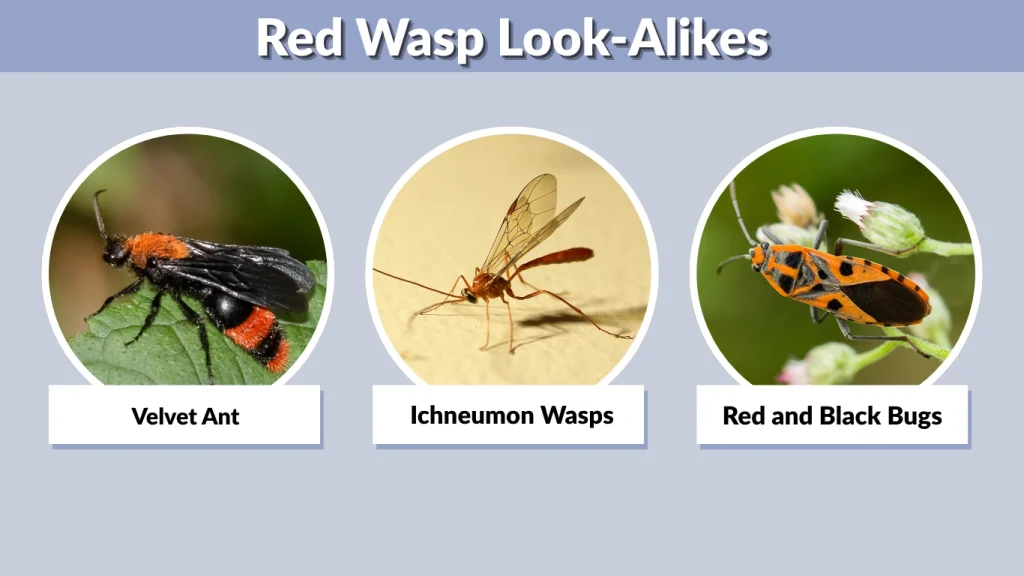
Velvet Ant (Cow Killer)
Despite its name, the velvet ant is actually a wingless wasp. Females have bright red, furry bodies and deliver a sting so painful it earned them the nickname “cow killer.” They do not form colonies and are usually solitary.
Ichneumon Wasps
These wasps are slender, often red or orange, with extremely long ovipositors. Although they look intimidating, ichneumon wasps are harmless to humans. They use their ovipositors to lay eggs inside other insects, not to sting.
Red and Black Bugs
Insects like boxelder bugs, assassin bugs, and milkweed bugs can appear red and black like wasps but lack the narrow waist and wing shape of true wasps. They also don’t sting; instead, they feed on plants or other small insects.
What a Red Wasp Nest Looks Like

Red wasps are paper wasps, meaning they create open, umbrella-shaped nests made of chewed plant fibers mixed with saliva. These fibers dry into a paper-like material, forming a structure with hexagonal cells where eggs are laid.
Their nests are typically found:
- Under roof eaves and porch ceilings
- On tree branches or wooden beams
- In sheds, attics, or mailboxes
The nests are usually gray or light brown and hang by a thin stalk. Each cell is visible, and unlike hornet nests, they lack an outer covering. During spring, a single queen begins the nest, and by late summer, colonies can contain dozens of adult wasps.
What a Red Wasp Sting Looks and Feels Like
A red wasp sting is immediately painful, often described as a sharp, burning sensation followed by redness and swelling. The sting area quickly develops into a raised welt and may itch for several hours.
Typical reactions include:
- Mild pain and redness at the sting site
- Warmth and swelling
- Local tenderness lasting a few hours to a day
Severe allergic reactions can cause difficulty breathing, dizziness, or hives across the body—symptoms that require urgent medical attention.
The Red Wasp Stinger and Sting Behavior
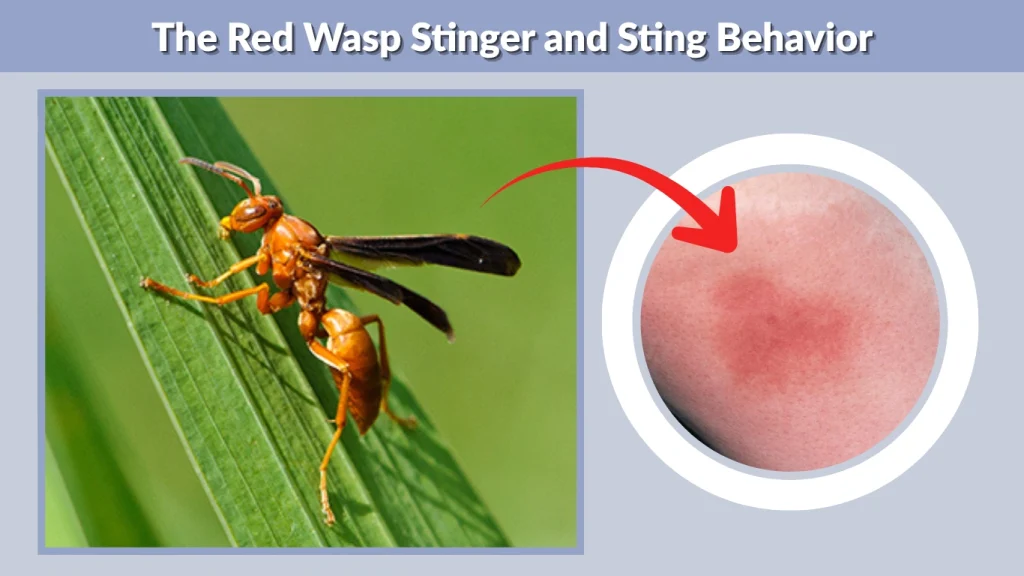
What a Red Wasp Stinger Looks Like
The red wasp’s stinger is a smooth, needle-like structure located at the end of the abdomen. Only females possess stingers, which are modified egg-laying organs. Unlike bees, red wasps do not lose their stinger after attacking, allowing them to sting multiple times. When threatened, they inject a small dose of venom that causes pain, redness, and swelling almost immediately.
What a Red Wasp Sting Feels Like
A sting from a red wasp produces a sharp, burning pain followed by localized swelling. The area may remain tender for several hours and occasionally for more than a day. People allergic to wasp venom may develop hives, nausea, or difficulty breathing, requiring prompt medical attention.
To treat a sting, clean the area with soap and water, apply cold compresses, and use antihistamines or calamine lotion for relief. Avoid scratching, as it can increase irritation or risk of infection.
Behavior and Reaction to Colors
Do Wasps Like the Color Red?
Despite their name, red wasps are not attracted to the color red. In fact, wasps are unable to perceive the red spectrum clearly. They are more sensitive to yellow, blue, and ultraviolet light, which is why they are drawn to bright floral colors.
However, movement and contrast trigger defensive instincts—so wearing dark, contrasting clothing or waving arms can make them feel threatened. Neutral shades like beige, gray, or green are less likely to provoke a reaction when outdoors.
Do Red Wasps Like Meat or Sweet Foods?
Red wasps are omnivorous feeders. They consume nectar, ripe fruits, and sugary substances, but they also hunt caterpillars, flies, and other small insects to feed their larvae. During late summer, when natural food sources decline, they may become more interested in human foods such as barbecue meats, sweet drinks, and garbage bins.
Red Wasps in Different Regions
United States
Red wasps are most common in the southern U.S., including Texas, Florida, Georgia, and Tennessee. Warm climates allow them to build large colonies that thrive from spring through late autumn. In cooler regions, colonies die off during winter, leaving only fertilized queens to start new nests the following year.
United Kingdom and Europe
In the UK, true red paper wasps are rare. Most “red wasp-like insects” observed there are ichneumon or spider wasps, which are solitary and non-aggressive. Mediterranean countries like Italy, Greece, and Turkey host reddish paper wasps that resemble Polistes carolina.
Australia and Asia
In Australia, native paper wasps such as Polistes humilis often display orange or reddish markings. Across Asia, especially in China and Southeast Asia, giant red-and-black wasps and potter wasps are common. These solitary species are beneficial predators of caterpillars and play a vital role in pest control.
Ecological Role of Red Wasps
Though feared for their sting, red wasps are highly beneficial insects. They serve two major ecological functions:
- Pollination: Adult wasps feed on nectar, inadvertently transferring pollen between flowers.
- Pest Control: They hunt caterpillars, spiders, and other pests, naturally regulating insect populations in gardens and fields.
By preying on destructive larvae, red wasps help maintain a healthy ecological balance without chemical pesticides.
FAQs
What do red wasps look like?
Red wasps have slender reddish-brown bodies, long dangling legs, and translucent brown wings. They measure about one inch long and are often seen hovering near eaves or trees. Their vivid coloration warns predators of their painful sting and defensive nature.
What insects look like red wasps?
Velvet ants, spider wasps, and ichneumon wasps resemble red wasps in color and shape. However, velvet ants are wingless, spider wasps are solitary hunters, and ichneumon wasps have longer bodies and harmless ovipositors instead of stingers.
What does a red wasp sting look like?
A red wasp sting leaves a raised, red welt with noticeable swelling and pain. Mild cases fade within a few hours, but allergic reactions can cause severe swelling, itching, or dizziness. Applying ice and antihistamine cream usually provides relief.
What does a red wasp nest look like?
The nest appears as a gray or brown paper umbrella with visible hexagonal cells. It’s built from chewed plant fibers and hangs from a single stalk. These nests are usually found under roof edges, porch ceilings, or tree branches.
Do wasps react to the color red?
Wasps do not specifically react to red because they can’t perceive it well. Instead, they respond to movement and contrast. Bright or dark clothing combined with sudden gestures can trigger defensive behavior, while calm movement and light colors reduce the chance of attracting them
