

Trap-jaw ants are among the most fascinating and efficient predators in the insect world. Famous for their lightning-fast mandibles, these ants use remarkable speed and precision to capture prey, defend their nests, and even launch themselves into the air when threatened. Found in tropical and subtropical regions, trap-jaw ants play an important role in their ecosystems as predators, scavengers, and soil aerators. This article explores their identification, habitat, behavior, and diet, providing a detailed guide for nature enthusiasts and researchers alike.
Identification of Trap-Jaw Ants

Trap-jaw ants are easily distinguished from other ant species by their unique physical adaptations and aggressive appearance. Observing them in their natural habitat reveals several key features.
Key Features (List Items)
- Ultra-Fast Mandibles: Their defining feature, capable of snapping shut in microseconds to catch prey or launch themselves backward.
- Shiny, Smooth Body: Often dark-colored, with a sleek exoskeleton that facilitates quick movement.
- Long Legs and Antennae: Adapted for fast running and precise sensory detection.
- Specialized Head Structure: Stores elastic energy to power mandible strikes with extreme speed.
- Medium to Large Size: Adults range from 6–15 mm depending on the species.
Their head and thorax structure, combined with the specialized mandibles, gives them a powerful and predatory look that is instantly recognizable.
Habitat and Distribution

Trap-jaw ants thrive in tropical and subtropical climates, where the environment supports both their nesting and hunting needs.
Geographic Range
- Found across Central and South America, Africa, and Southeast Asia.
- Prefer moist forest floors with abundant leaf litter and decomposing wood.
- Often found in areas that provide ample prey and safe nesting sites.
Nesting Habits
- Construct nests underground or beneath stones, logs, and leaf litter.
- Nests contain chambers for the queen, workers, and brood, organized efficiently for colony survival.
- Colony sizes vary but often contain hundreds of individuals depending on the species.
These nests not only provide shelter but also protect the queen and brood from predators and environmental fluctuations. They are carefully maintained by the worker ants to ensure optimal conditions for development.
Behavior and Social Structure
Trap-jaw ants exhibit a combination of aggressive predation and sophisticated social organization.
Aggression and Predation
- Known for territorial behavior; workers defend their nests vigorously.
- Hunt individually using their spring-loaded mandibles to capture prey efficiently.
- Employ a unique escape mechanism called “mandible-powered jumping,” snapping their jaws against the ground to launch themselves away from threats.
Colony Roles
- Queen: Focuses on reproduction and establishing new colonies.
- Workers: Conduct foraging, defense, nest maintenance, and brood care.
- Communication: Use a combination of tactile and chemical signals to coordinate hunting and warn colony members of danger.
Trap-jaw ants’ combination of visual acuity, reflexes, and mandible strength makes them exceptionally effective hunters, capable of taking down prey larger than themselves.
Diet and Hunting Techniques

Trap-jaw ants are primarily carnivorous, with a diet that reflects their predatory efficiency and speed.
Typical Diet (List Items)
- Insects and Arthropods: Small spiders, crickets, beetles, and other arthropods form the bulk of their diet.
- Nectar and Honeydew: Occasionally consumed for energy, especially when prey is scarce.
- Carrion: Opportunistically feed on small dead animals.
- Hunting Strategy: Mandibles act like a spring-loaded trap, allowing instantaneous strikes that immobilize prey before it can escape.
Their predation method is not only effective but also precise, enabling them to tackle prey larger than themselves and avoid injury during hunts. Each strike is calculated and powered by stored energy in their specialized head and mandible structure.
Venom and Human Interaction
Trap-jaw ants rely on venom both for hunting and defense. While generally not lethal to humans, their sting can be painful.
Potency of Venom
- Contains toxins that quickly paralyze small prey.
- In humans, stings can cause localized pain, redness, swelling, and itching.
- Severe allergic reactions are rare but possible, requiring medical attention.
Safety Tips
- Avoid disturbing nests when hiking or exploring tropical forests.
- Wear protective clothing if working in areas with high ant activity.
- Educate children about avoiding direct contact with these ants.
Despite their small size, trap-jaw ants’ combination of speed and venom makes them highly effective hunters and formidable defenders of their nests. Human encounters are uncommon but should always be treated with caution.
Lifecycle and Reproduction
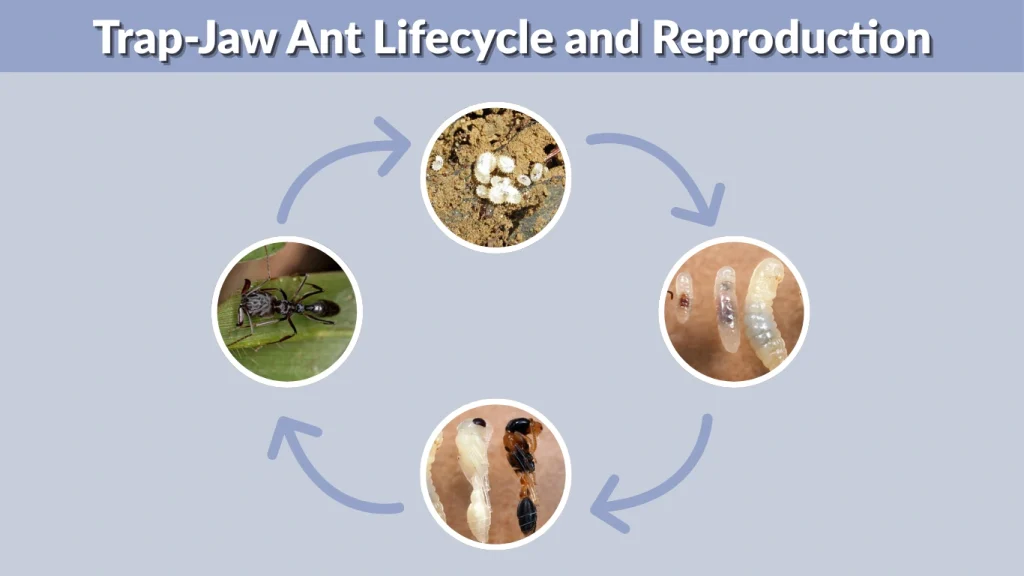
The lifecycle of trap-jaw ants is highly structured, ensuring the survival and growth of the colony.
Egg to Adult
- Eggs: Laid by the queen in secure chambers.
- Larvae: Fed and cared for by workers; growth occurs under controlled conditions.
- Pupae: Transition stage before adulthood, protected within nest chambers.
- Adults: Workers, soldiers, and queens take on specific roles for the colony’s survival.
Mating and Colony Expansion
- Nuptial flights allow males and new queens to mate in the open air.
- Fertilized queens establish new colonies and lay eggs to expand the species.
- Workers maintain the nest, hunt, and care for the brood, ensuring rapid colony development.
This lifecycle allows trap-jaw ants to adapt quickly to environmental changes and maintain strong colonies over time.
Conservation and Ecological Role
While trap-jaw ants are not currently endangered, they face several ecological threats.
Threats
- Deforestation and habitat destruction reduce nesting areas.
- Pesticides can harm entire colonies.
- Climate change affects prey availability and habitat suitability.
Ecological Importance
- Control populations of insects and arthropods, maintaining ecosystem balance.
- Serve as prey for birds, reptiles, and other predators.
- Tunnel systems aerate soil and aid nutrient cycling.
Conservation efforts focus on habitat preservation and awareness campaigns to educate the public on the ecological significance of these ants. Protecting them helps sustain healthy tropical forest ecosystems.
Fascinating Facts About Trap-Jaw Ants (List Items)
- Mandibles can close at speeds up to 140 mph, one of the fastest movements in the animal kingdom.
- Capable of “trap-jaw jumping” to escape predators or launch at prey.
- Highly efficient solitary hunters despite being social insects.
- Exceptional vision and reflexes compared to most ant species.
- Can capture prey several times their size using precision strikes.
These unique adaptations make trap-jaw ants one of the most extraordinary insect species, both in terms of behavior and physical capability.
FAQs
What makes trap-jaw ants different from other ants?
Trap-jaw ants have ultra-fast mandibles that snap shut in microseconds, allowing precise and rapid predation. Unlike most ants, they rely on speed and vision rather than chemical trails for hunting.
Are trap-jaw ants dangerous to humans?
Stings are generally not harmful but can cause localized pain, swelling, and redness. Severe allergic reactions are rare but require medical attention.
Where do trap-jaw ants live?
They inhabit tropical and subtropical forests in Central and South America, Africa, and Southeast Asia, favoring moist areas with abundant leaf litter or decomposing wood.
How do trap-jaw ants hunt?
Trap-jaw ants use spring-loaded mandibles to strike prey with incredible speed and precision, often immobilizing insects larger than themselves before they can escape.
Can trap-jaw ant colonies have multiple queens?
Most colonies have a single queen responsible for reproduction, although some species may have secondary queens in larger colonies to assist with colony growth and egg-laying.
